📌Quick Answer for People in a Hurry
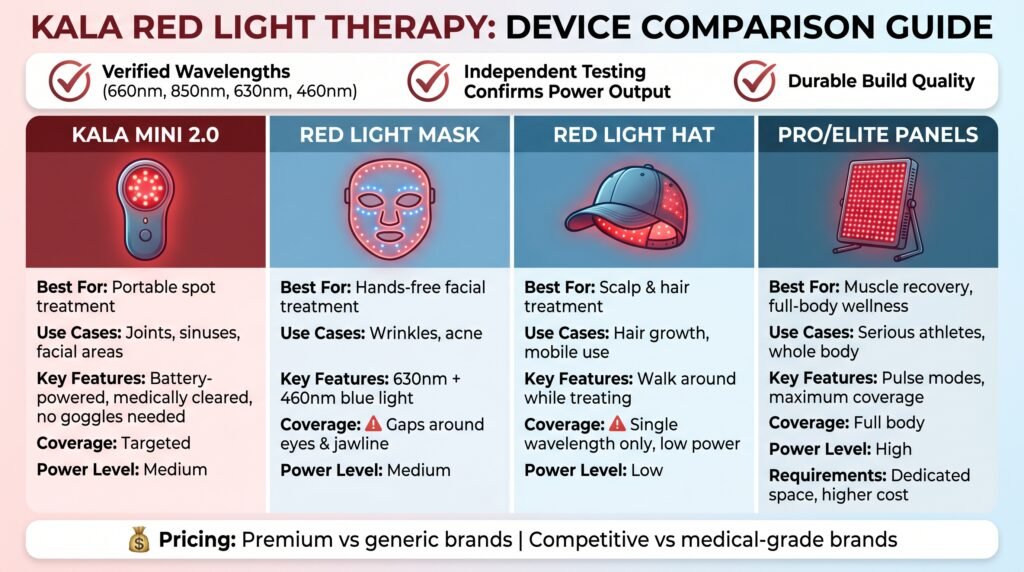
Kala is legit. The wavelengths are solid (660 nm red and 850 nm near-infrared for most devices, plus 630 nm red and 460 nm blue in the mask for acne).
Independent testers confirm the power output matches what Kala claims.
Build quality is good – these aren’t flimsy gadgets that break after three months.
Here’s how to pick:
If you want portable spot treatment for joints, sinuses, or specific facial areas, the Kala Mini 2.0 makes the most sense. It’s battery-powered, medically cleared, and you don’t need goggles.
If you want hands-free facial treatment for wrinkles and acne, the Kala Red Light Mask works, but the coverage has gaps around the eyes and jawline. That might matter to you, might not.
If you want scalp and hair treatment while walking around the house, the Kala Red Light Hat gives you that freedom, but the power is low, and it only uses one wavelength.
If you want serious muscle recovery or full-body wellness, the Kala Pro or Elite panels give you better coverage and pulse modes, but they cost more and need dedicated space.
The downsides are real, though. Some products have coverage or wavelength gaps.
The lineup feels overwhelming if you’re new to red light therapy.
And the pricing is premium compared to generic Amazon panels (even if it’s reasonable compared to other medical-grade brands).
Check current pricing and deals on Kala devices here
🧾 Table of Contents
- Quick Answer for People in a Hurry
- What Kala Actually Is
- Breaking Down the Kala Lineup
- Comparison Table
- Performance Testing and Quality
- Pricing and Value
- Red Light Therapy Cost Savings Calculator
- Pros and Cons Summary
- Final Recommendation
- FAQ
What Kala Actually Is
Kala Therapy positions itself as a pioneer of ultra-high-power red/NIR therapy lights. That’s marketing speak, but independent testers do confirm that their panels put out more power than a lot of competitors at similar price points.
Their devices use medical-grade components. The Kala Mini 2.0 has FDA Class II Medical Device clearance and Health Canada approval.
That means actual regulatory testing happened.
The science they reference is pretty standard for the industry. Red light around 630-660 nm works well for surface skin concerns like collagen production, pigmentation, fine lines, and inflammatory skin conditions.
Near-infrared around 830-850 nm penetrates deeper for muscle, joints, circulation, and even some brain-related benefits.
Blue light around 460 nm targets acne and possibly eczema.
The benefits they list match what research supports: wrinkles, fine lines, age spots, scars, stretch marks, acne, rosacea, eczema, psoriasis, muscle recovery, joint pain, bone healing, sleep support, mood, and stress management.
That all checks out with what clinics and physical therapists use red light for.
The question is whether specific Kala devices deliver enough of that light to the right areas. Because that’s where things get interesting.
Breaking Down the Kala Lineup
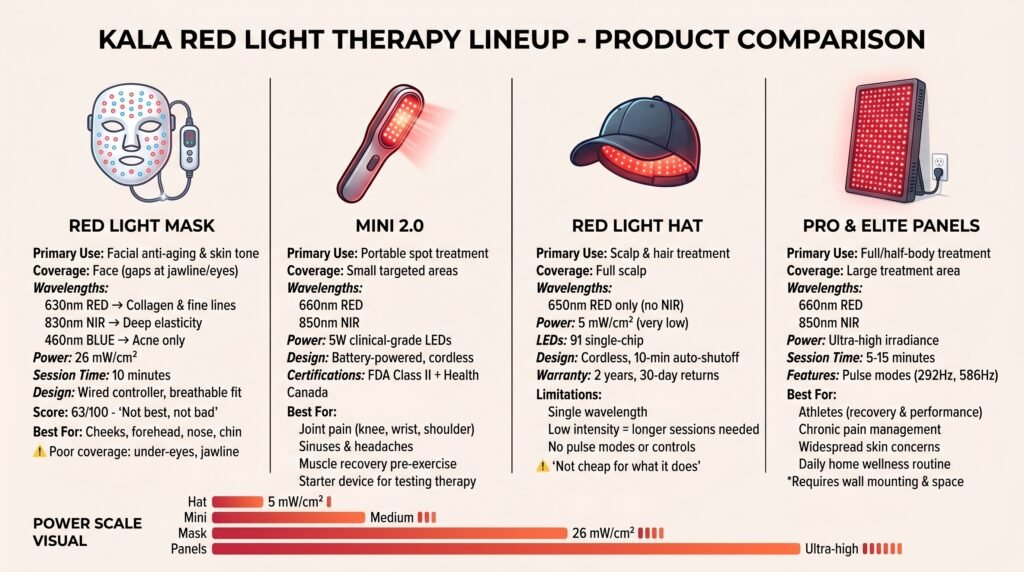
Kala sells four main types of devices, and they’re aimed at different use cases. I’m going to go through each one with the actual specs and what independent reviewers found during testing.
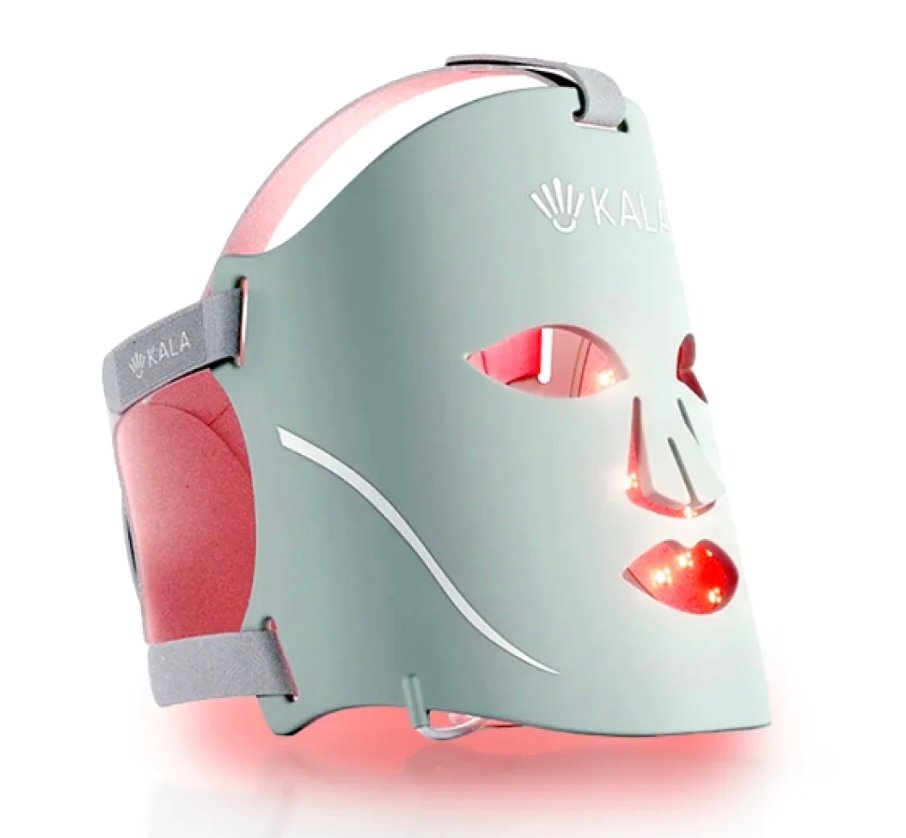
The Kala Red Light Mask
This is a face mask with LEDs inside. It uses three wavelengths:
- 630 nm red for collagen, fine lines, and general skin tone
- 830 nm near-infrared for deeper penetration and elasticity
- 460 nm blue for acne (but this doesn’t help with anti-aging)
Independent testers measured the intensity at around 26 mW/cm² over the red and NIR LEDs. That’s better than a lot of masks in this price range.
That power level means you can hit a therapeutic dose (around 10-20 J/cm²) in a 10-minute session for most skin concerns.
Comfort: The mask fits well. It’s breathable, secure, and you can talk or move around without it sliding off.
That’s a plus compared to some masks that feel like you’re suffocating.
Coverage: This is where it falls short. There are noticeable gaps around the jawline, top of the head, and especially under the eyes.
If you’re buying a face mask specifically for crow’s feet or the upper cheek area, those gaps matter.
Design: It still uses a wired controller, which limits how much you can move around. Some newer masks are fully cordless, so this feels a bit outdated.
One independent review gave it a 63/100 score and labeled it “not the best, not bad.” The price was described as reasonable when it’s on sale, but the coverage issues and limited return policy (depending on where you buy it) drag the value down.
This mask works best if you want hands-free facial treatment and are mainly focused on the cheeks, nose, forehead, and chin. If eye area and jawline coverage is critical for you, this isn’t the right pick.
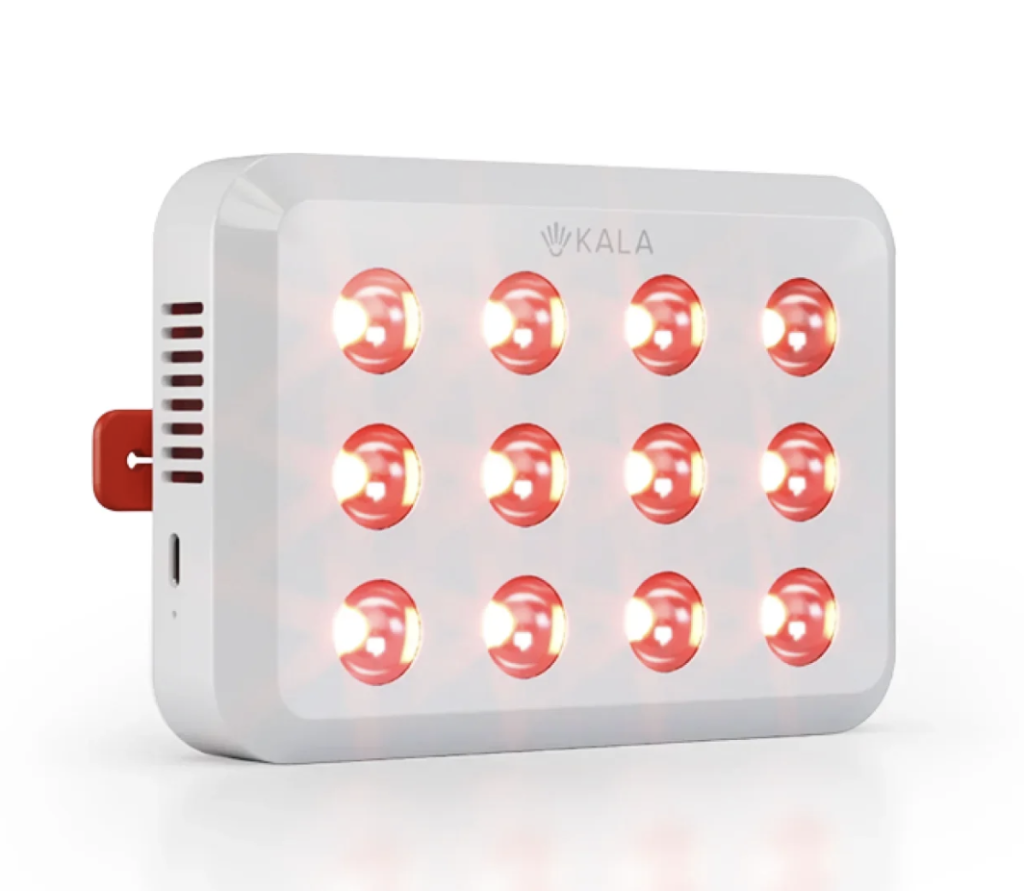
The Kala Mini 2.0
This is the portable handheld device in the Kala lineup. It’s small, runs on a rechargeable battery, and uses the same wavelengths as their big panels: 660 nm red and 850 nm near-infrared.
Key specs:
- 5W clinical-grade LEDs (same core LED quality as the Pro and Elite panels)
- Battery-powered, no cord during use
- FDA Class II Medical Device and Health Canada clearance
- No goggles required (safe for sinus and facial use)
The coverage area is small, so this is a spot treatment device. You’re not going to treat your whole back or legs efficiently.
But for joints, wrists, knees, shoulders, sinuses, headaches, or small facial areas, it works really well.
Independent testers note that the 660/850 nm combo sits right in the photobiomodulation “optical window” for effective tissue penetration. Research supports those wavelengths for muscle recovery and performance when used before exercise.
This device works best if you want something portable for targeted muscle recovery, joint support, or sinus congestion. It’s also a solid starter device if you’re not ready to commit to a big panel but want to test whether red light therapy works for you.
See current Mini 2.0 pricing and bundles here
The Kala Red Light Hat
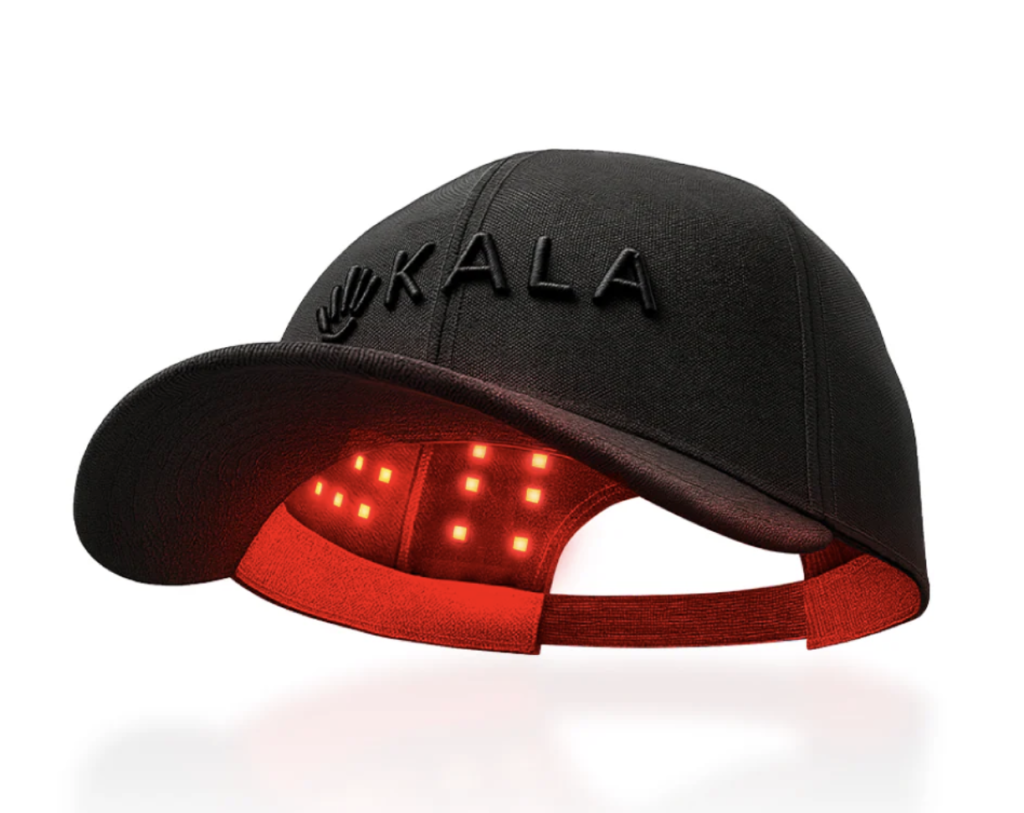
This is a baseball cap with LEDs inside. It’s designed for scalp and hair treatment, and it’s fully cordless so you can walk around while using it.
Key specs:
- 650 nm red only (no NIR)
- 91 single-chip LEDs
- Irradiance around 5 mW/cm² (very low compared to panels or the mask)
- Built-in lithium battery
- No pulse modes, no intensity control, just on/off with a 10-minute auto shutoff
- 30-day return policy and 2-year warranty
The 650 nm wavelength still fits in the red light range that supports surface skin, collagen, and circulation. But it’s missing near-infrared, which is what penetrates deeper.
The 5 mW/cm² power output is gentle. That’s good if you have sensitive skin, but it means you’ll need longer or more frequent sessions compared to higher-power devices.
One reviewer described it as “not cheap for what it does” given the single wavelength, low power, and basic feature set. The 30-day return window helps, but you’re mainly paying for the convenience of being able to wear it while doing other things.
This hat works best if you specifically want scalp and hair treatment and you value being able to walk around during sessions. If you need stronger intensity or deeper penetration, this won’t cut it.
The Kala Pro and Elite Panels
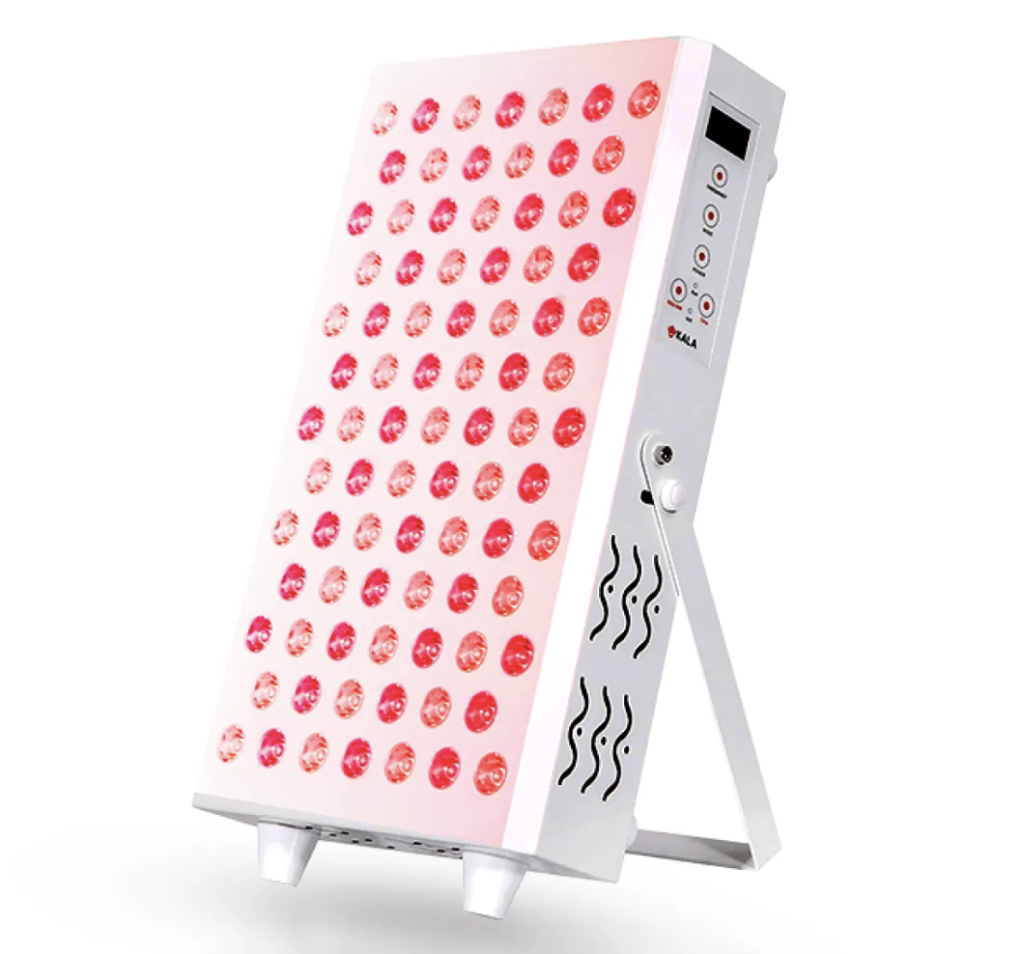
These are the high-end panels for serious users. They cover half-body or near full-body areas depending on how far you stand, and they use the same 660 nm red and 850 nm NIR wavelengths as the Mini.
Key features:
- High irradiance (ultra-high-power category)
- Pulse Recovery modes on the Pro at 292 Hz and 586 Hz, plus custom options
- Large treatment area
- Same clinical-grade LEDs as the Mini
- Require wall space and consistent setup
Independent testers classify these in the high-power category. Treatment times are usually 5-15 minutes per area, which is effective if you’re doing this daily.
The pulse modes on the Pro give you more tools to experiment with. Some people use specific frequencies for nerve pain, brain-related goals, or particular recovery protocols.
The research on pulsed light is still emerging, but clinics use it.
These panels work best if: You’re an athlete working on recovery and performance, you have chronic pain or widespread skin issues, or you want a central piece of home wellness equipment. They make financial sense if you’re consistent, because a few months of clinic sessions cost as much as one of these panels.
Comparison Table
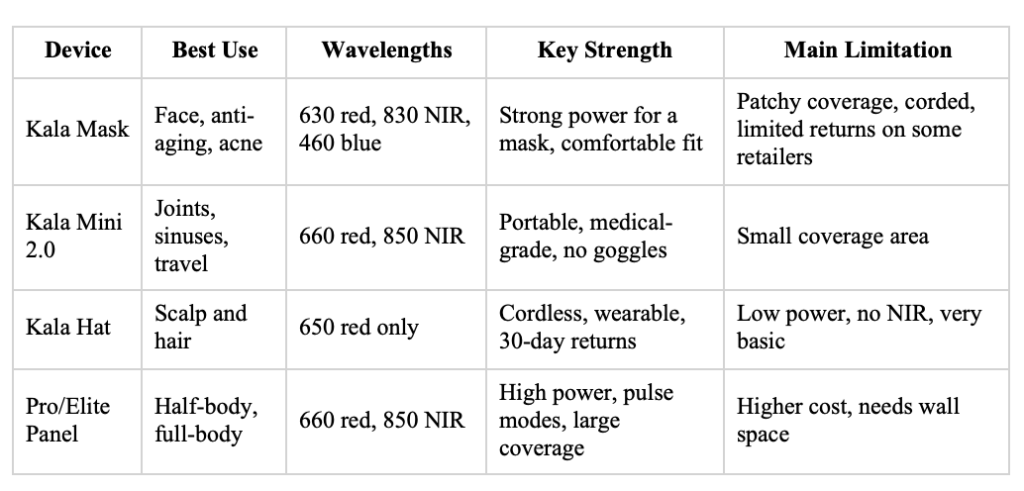
Here’s a quick breakdown of what each device does best and where it falls short:
Performance Testing and Quality
One reason to consider Kala over cheaper no-name panels is that independent reviewers have actually tested these devices with spectrometers and light meters.
Wavelength accuracy: The mask was confirmed to use 630 nm red, 830 nm NIR, and 460 nm blue. The Mini and panels consistently use 660 nm red and 850 nm NIR.
The hat uses 650 nm red. All of those wavelengths match what research identifies as effective for photobiomodulation.
Intensity: The mask measured around 26 mW/cm², which is strong for a face mask. The hat measured around 5 mW/cm², which is low.
The panels are classified as high-power by testers.
For aging skin and chronic joint issues, low-intensity devices feel like wasted money because you either need really long sessions or you just don’t hit a therapeutic dose. Kala passes that bar for most devices, except the hat trades speed for comfort.
Comfort: The mask scores well for breathability and secure fit. The Mini gets high marks for simplicity – just charge it and hold it over the area.
The hat wins on convenience since you can walk around.
Panels need more commitment, but they’re straightforward once set up.
Pricing and Value
Exact prices change with sales and promotions, but here’s the general range based on independent reviews:
Kala Mask: Around low-300s USD retail, often discounted. The price is reasonable for the power and wavelengths, but coverage gaps and limited return policies (depending on the retailer) affect the value.
Kala Mini 2.0: Mid-premium handheld range, often over $500 depending on bundles. The value comes from portable, medical-grade functionality and solid construction.
Makes sense if you’ll use it regularly for months or years.
Kala Hat: Described as “not cheap” for a single-wavelength, low-power device. The 30-day return and 2-year warranty help, but you’re paying for hands-free convenience more than cutting-edge performance.
Pro/Elite Panels: Premium panel category. For people going to clinics 2-3 times a week, a Pro or Elite panel pays for itself within a few months.
How It Compares to Professional Sessions
Clinic sessions add up fast. Many spas and physical therapy clinics charge $50-$150 per session.
A single professional red light therapy session at a dermatologist or med spa costs anywhere from $75 to $125+. Going 2-3 times a week for several months easily runs into four figures.
Kala devices cost about the same as a few months of clinic visits upfront, but then you can treat daily, share the device with family, and use it for years. For people who commit to red light as part of daily skin care, pain management, or recovery, that long-term value matters way more than the initial price.
See our cost-savings calculator below to crunch the real-time numbers of Kala at-home red light therapy products vs. the cost of clinical sessions. Bookmark this page and come back to it whenever you are researching red light therapy services in your area.
Red Light Therapy Cost Savings Calculator
Discover how much you’ll save with Kala devices vs. ongoing clinic visits. Professional sessions add up fast—see your investment pay for itself in months.
With a Kala device, you can treat daily, share with family, and use for years—all for the cost of just a few months of clinic visits. Plus, you get the convenience of treating at home on your schedule, without driving to appointments or booking ahead.
Compare home devices vs clinic pricing and start saving today!
Pros and Cons Summary
What Kala Does Well
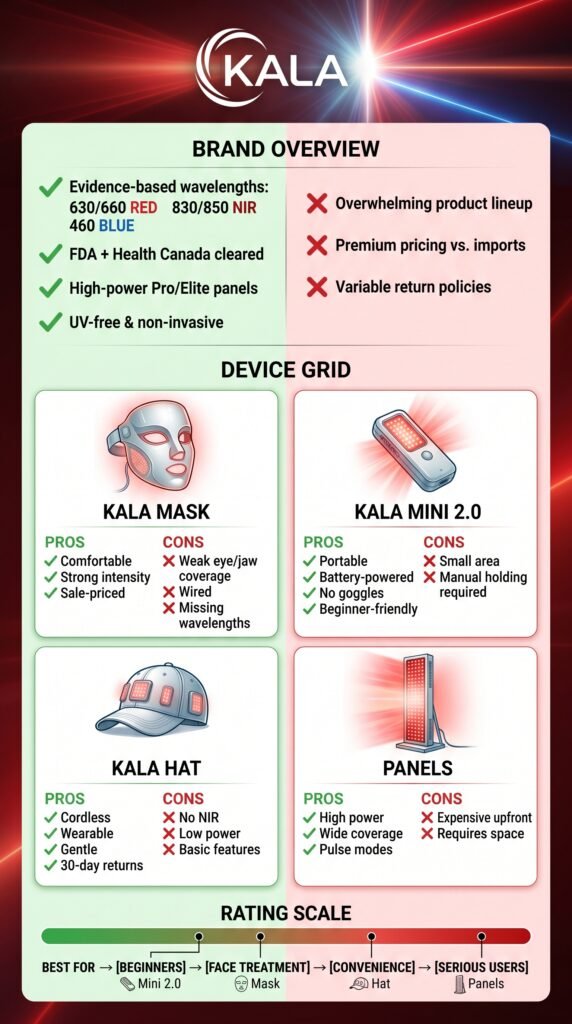
Evidence-based wavelengths (630/660 red, 830/850 NIR, 460 blue for acne). Medical-grade positioning with FDA and Health Canada clearances on core devices.
High-power options in the Pro and Elite panels.
Non-invasive and UV-free – red/NIR is considered safe across most research.
Where Kala Falls Short
The lineup feels overwhelming if you're new to this stuff. Premium pricing compared to generic imports.
Return policies and guarantees vary by product and where you buy it.
Device-Specific Pros
Kala Mask – Comfortable fit, strong intensity for a mask, reasonable sale price.
Kala Mini 2.0 – Portable, battery-powered, medically cleared, no goggles needed, great starting point.
Kala Hat – Cordless, wearable, simple, gentle intensity, 30-day returns.
Panels – High power, strong coverage, pulse modes on the Pro.
Device-Specific Cons
Kala Mask – Weak coverage around eyes and jawline, wired controller, lacks some wavelengths competitors offer.
Kala Mini 2.0 – Small treatment area, needs manual holding during sessions.
Kala Hat – No NIR, low power, very basic features.
Panels – Higher upfront cost, need dedicated space.
Final Recommendation
Kala makes strong devices, but not every product suits every person. Here's how to think about it based on what you're actually trying to fix.
For Wrinkles and Aging Skin
The Kala Mask works if you want a hands-free face solution and can accept the coverage gaps. The Pro Panel makes more sense if you want face, neck, chest, and joint benefits in one setup.
Skip the hat unless scalp and hair are your main focus.
The Mini works as a supplement but not as your sole anti-aging tool.
For Muscle Recovery and Performance
Start with the Kala Mini 2.0 for spot joint and muscle recovery. If you train hard several times a week and you're still using it months later, upgrading to a Pro or Elite Panel makes sense for systemic recovery support.
For Chronic Skin Conditions (Acne, Psoriasis, Eczema)
The Kala Mask helps with facial acne and inflammatory skin issues thanks to the red, NIR, and blue combo. Panels make more sense if you have widespread skin involvement on the torso, back, or limbs.
Red and NIR aren't cures, but consistent use supports inflammation control and healing.
For Brain, Mood, Sleep, and Overall Optimization
The Pro Panel works as a central home setup that covers brain, joints, skin, and muscles in one session. The Mini 2.0 works as a supplement for desk use or travel.
NIR penetrates through the skull and modulates mitochondrial function in brain cells, which aligns with emerging research on mood and cognition.
The key takeaway: Match the device to your actual priorities. Wrinkles and facial texture first? Mask or Panel.
Recovery and performance? Mini or Panel.
Hair and scalp focus? Hat, ideally paired with a panel for everything else.
FAQ
Is the Kala Red Light Mask Safe?
Red and near-infrared therapy is considered extremely safe when used as directed. Kala's devices are non-invasive and non-thermal. The mask uses gentle wavelengths that don't damage DNA the way UV can.
Side effects are usually limited to mild temporary redness or warmth if overused.
How Long Until You See Results?
Early changes like reduced redness or slightly calmer skin can show up within the first few weeks. More noticeable shifts in wrinkles, texture, and pigmentation often take 8-12 weeks of consistent use.
Consistency beats intensity.
A decent mask used 4-5 times per week beats a strong device used once every two weeks.
How Often Should You Use the Kala Mask?
Kala recommends 5-10 sessions per week of 10-20 minutes for 4-6 weeks. Many users settle into a 3-5 times per week routine long term.
Overuse doesn't speed results indefinitely, so once or twice per day is usually the upper sensible limit.
Can You Use the Kala Mask and a Panel Together?
Yes. Many people use a panel for overall body and mood effects, and the mask for focused facial work and blue-light acne support.
If you stack sessions on the same area, keep an eye on total time so you don't dramatically exceed typical dose ranges.
Is Kala Better Than CurrentBody?
A detailed comparison found that the Kala Red Light Face Mask "wins" for most buyers because it offers three wavelengths (red, NIR, blue) at a similar or lower price than CurrentBody, which only offers red + NIR. For someone who cares about acne management as well as anti-aging, Kala's mask has the broader range of effects.
Bottom line on this Kala red light therapy mask review: Before paying clinic rates for repeated sessions, check current Kala promotions and bundle deals and match the device (mask, Mini, hat, or panels) to your main goal. The right pick depends less on hype and more on where you actually want that red and near-infrared light to go.
This article includes affiliate links. If you click through and make a purchase, I may receive a small commission. This helps support the site and allows me to keep creating helpful content at no extra cost to you.