📌 Quick Summary
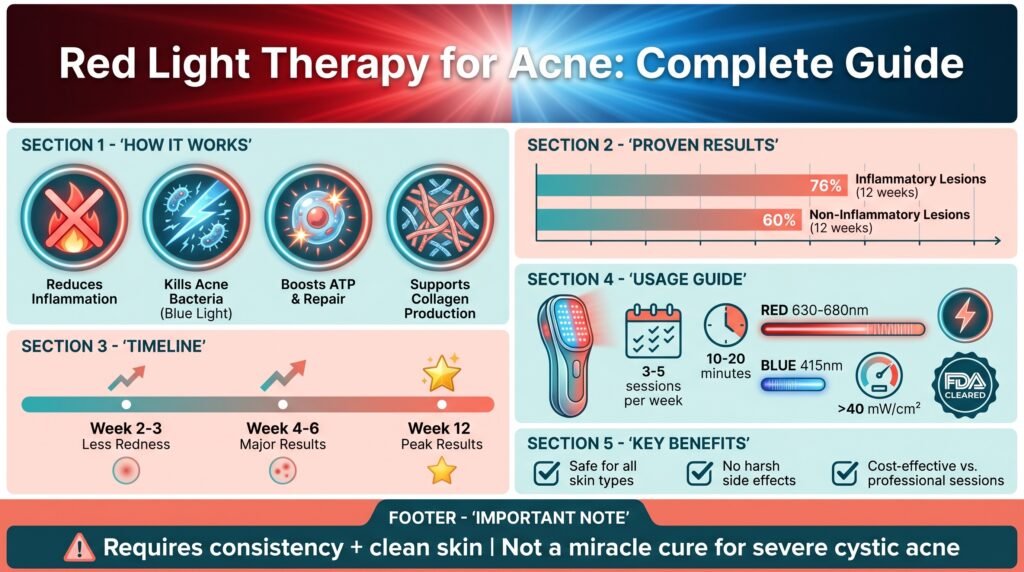
Red light therapy (often combined with blue light) can significantly help clear inflammatory acne by reducing inflammation, killing acne-causing bacteria (via blue light), boosting cellular repair through mitochondrial ATP production, and supporting collagen without the harsh side effects of traditional treatments like retinoids or benzoyl peroxide.
Clinical studies show up to 76% reduction in inflammatory lesions and 60% in non-inflammatory lesions after 12 weeks of consistent use. Visible improvements typically start in 2–3 weeks (less redness), with major results in 4–6 weeks. It works best with 3–5 sessions per week (10–20 minutes each) using FDA-cleared at-home devices offering 630–680 nm red + 415 nm blue wavelengths at sufficient power density (>40 mW/cm²). At-home devices often pay for themselves quickly compared to professional sessions and are safe for all skin types, including sensitive or darker skin. It complements other treatments but requires consistency and clean skin for best results. Not a miracle cure for severe cystic acne on its own
🧾 Table of Contents
· Introduction
· Understanding What Red Light Actually Does to Your Skin
· The Blue Light Connection You Need to Know About
· How to Actually Implement Red Light for Acne
- Getting Your Skin Ready
- Choosing Your Equipment
- Setting Up a Consistent Treatment Protocol
· Post-Treatment Care
- Timeline Expectations
- Do Not Over-Treat
- Professional Red Light Sessions vs. At-Home Treatment
· Red Light Therapy Cost Savings Calculator
· Key Takeaways
· FAQs
Introduction
When I first heard about red light therapy for acne, I thought it sounded like some kind of futuristic spa gimmick. Standing in front of a glowing red panel to clear up breakouts felt a bit too sci-fi for my taste.
But then I started digging into the actual research, and what I found completely changed my perspective. Turns out, there’s really solid science showing how specific wavelengths of light can fundamentally change what’s happening in your skin at a cellular level.
Here’s what really got my attention: unlike a lot of acne treatments that essentially wage war on your skin (hello, benzoyl peroxide burns and retinoid flaking), red light therapy works with your body’s natural repair systems. The approach centers on activating the mechanisms your skin already has for healing and regulating itself, rather than destroying or stripping anything away.
And the clinical data backs this up pretty impressively, with studies showing that around 76% of people experienced significant reductions in inflammatory acne lesions after consistent use.
So, if you’re tired of the harsh side effects from conventional treatments, or you’re just curious about a more biologically harmonious approach to managing breakouts, I think you’ll find this really fascinating. Let’s get into exactly how this works and, more importantly, how to actually use it effectively.
Understanding What Red Light Actually Does to Your Skin
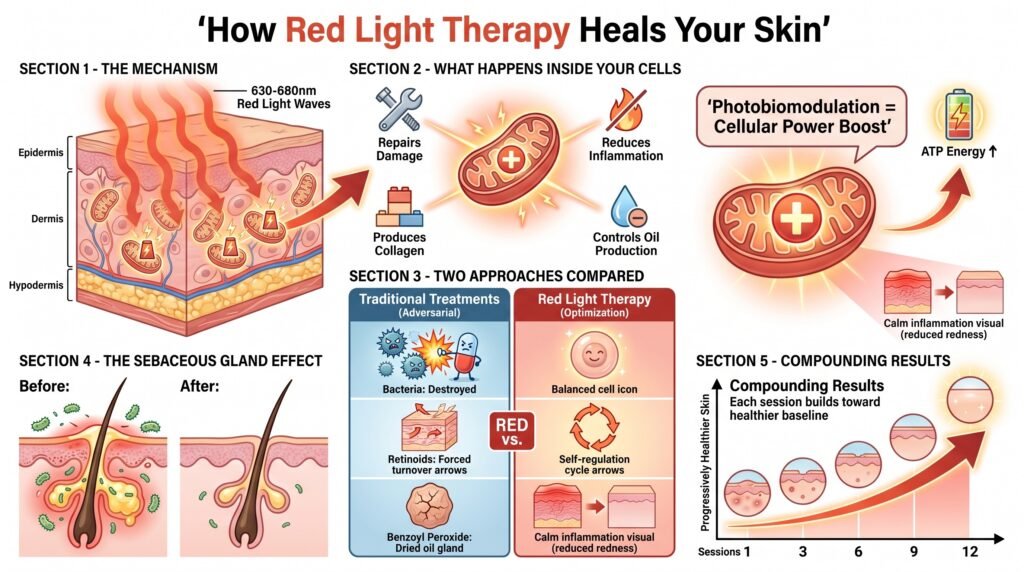
The key to understanding red light therapy is grasping this concept called photobiomodulation. Essentially, certain wavelengths of light, specifically in the red spectrum around 630 to 680 nanometers, can penetrate through your outer skin layers and interact directly with the mitochondria inside your cells.
Now, mitochondria are basically the power plants of your cells. They produce ATP, which is the energy molecule that fuels every single cellular process.
When red light hits these mitochondria, it stimulates them to produce more ATP. And when your skin cells have more energy available, they can perform their jobs way more efficiently, repairing damage, regulating inflammation, producing structural proteins like collagen, and managing oil production.
What’s particularly interesting about this mechanism is how fundamentally different it is from traditional approaches. Traditional acne treatments often work by destroying bacteria (antibiotics), forcing rapid cell turnover (retinoids), or drying out oil glands (benzoyl peroxide).
Those approaches definitely have their place, but they’re fundamentally adversarial.
Red light therapy works through optimization. You’re giving your skin cells the energetic resources they need to regulate themselves properly.
Think of it like this: instead of forcing your skin to behave differently through chemical intervention, you’re powering up the systems that allow your skin to self-regulate the way it’s supposed to.
The inflammation reduction aspect is especially relevant for acne. When you have active breakouts, your immune system is going into overdrive, releasing pro-inflammatory cytokines that cause all that redness, swelling, and discomfort.
By boosting cellular energy production, red light helps modulate this inflammatory response, calming it down without suppressing it entirely.
Your skin can still fight bacteria and heal damage, but without the excessive inflammation that makes acne look and feel so much worse.
There’s also a direct effect on your sebaceous glands, which are the oil-producing structures in your skin. Research shows that red light exposure can actually reduce sebum secretion. This is really significant because excess oil is one of the primary factors that allows acne-causing bacteria to thrive.
By creating a less oily environment, you’re essentially making your skin less hospitable to the bacteria that trigger breakouts in the first place.
The beauty of this approach is that these effects compound over time. Each session builds on the previous one, gradually shifting your skin toward a healthier baseline state where breakouts become less frequent and less severe.
The Blue Light Connection You Need to Know About
Here’s where things get a bit more nuanced. While red light works on inflammation and cellular function, blue light (around 415 nanometers) has a completely different mechanism.
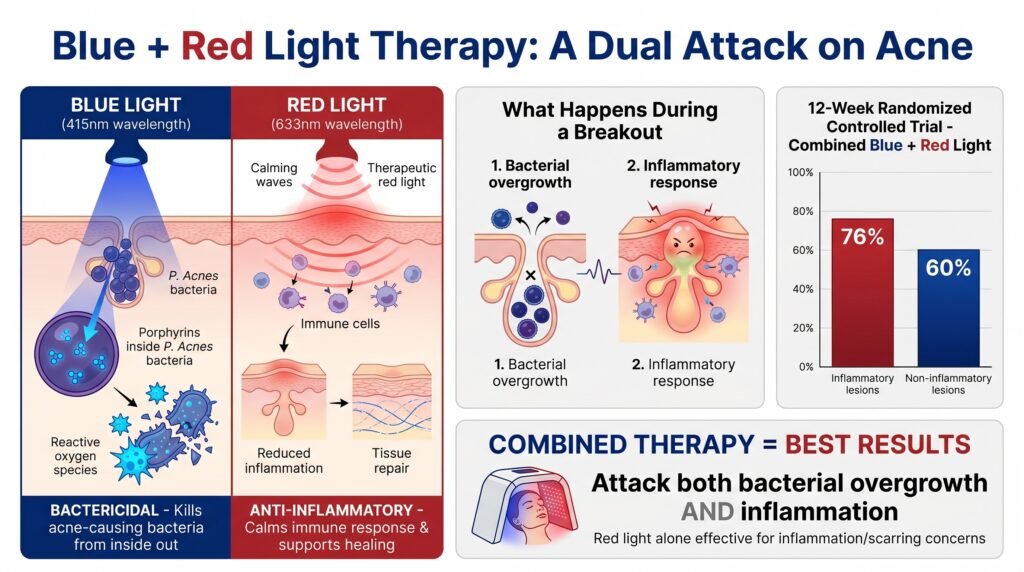
Blue light wavelengths are directly absorbed by compounds called porphyrins that exist inside P. Acnes bacteria.
When these porphyrins absorb blue light, they produce reactive oxygen species that basically destroy the bacteria from the inside out. So, blue light is bactericidal. It kills the bugs.
Red light is anti-inflammatory and reparative. It calms the immune response and supports healing.
Now, the really interesting finding from clinical research is that combining both wavelengths produces significantly better results than either one alone.
There was a randomized controlled trial that found patients using combined blue and red light therapy achieved a 76% reduction in inflammatory lesions and a 60% reduction in non-inflammatory lesions after 12 weeks.
Those are pretty substantial numbers.
What this means practically is that if you’re choosing a device, you’ll probably get better results from one that offers both wavelengths rather than red light only. That said, if inflammation and scarring are your primary concerns, red light alone can still be really effective.
It just depends on what your specific skin issues are.
The combined approach makes sense when you think about what’s actually happening during a breakout. You’ve got bacterial overgrowth creating the initial problem, then you’ve got your immune system’s inflammatory response making everything worse.
Blue light addresses the bacterial component while red light manages the inflammatory cascade.
Attack the problem from both angles, and you get better overall clearance.
How to Actually Implement Red Light for Acne
Alright, so you’ve decided to try red light therapy. Here’s exactly how to approach it for the best possible results.
Getting Your Skin Ready
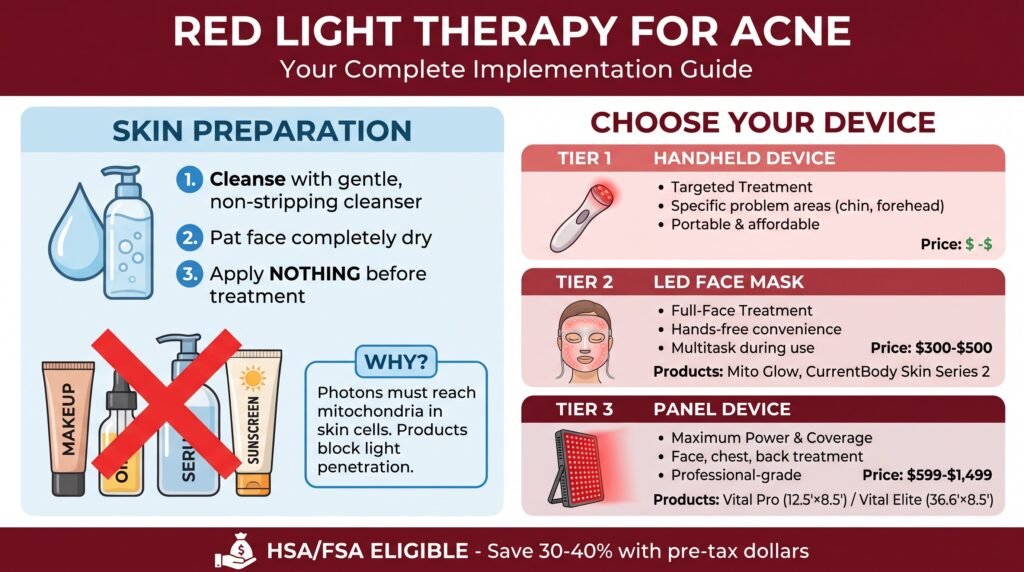
This might seem obvious, but you absolutely need to start with completely clean skin. I’m talking freshly washed, no makeup, no oils, no serums, nothing between the light source and your actual skin cells. The reason is straightforward: any barrier on your skin surface reduces light penetration.
You want those photons reaching as deep as possible to interact with your mitochondria, not getting absorbed by your moisturizer.
Use a gentle, non-stripping cleanser that’s suitable for your skin type. Pat your face completely dry.
Don’t apply anything before treatment. Save your skincare for after.
I know this seems like a small detail, but I’ve seen people wonder why they’re not getting results when they’re treating through a layer of foundation and sunscreen.
The light literally cannot penetrate effectively through product buildup.
Clean skin makes a measurable difference in outcomes.
Choosing Your Equipment
This is where it can get a bit overwhelming because there are literally hundreds of devices on the market now, ranging from $100 handheld wands to $ 1,000-plus for professional panels. Here’s how I’d think about it:
For targeted treatment, such as if you only break out on your chin or forehead, a handheld device is perfectly adequate. They’re portable, affordable, and easy to maneuver to specific areas. You can really focus the light exactly where you need it most.
For full-face treatment, a wearable mask is incredibly convenient. You just strap it on and can literally do other things while you’re treating your skin. These typically run $300-$500 for quality options.
Two such devices are the Mito Glow Red Light Mask and the CurrentBody Skin LED Light Therapy Face Mask: Series 2.
The hands-free aspect means you’re way more likely to actually use it consistently, which matters more than having the most powerful device if you never turn it on.
For most power and coverage, especially if you want to treat your chest and back as well, a larger panel device delivers higher power density and covers more surface area.
These are the pricier options, usually starting around $1,000, but they’re also closest to professional-grade equipment.
If you’re serious about this and treating larger areas, the investment can be worth it.
The Vital Pro (Dimensions: 12.5″ x 8.5″ x 2.3″), at $599, is a smaller red light panel that provides acne clearing and skin rejuvenation.
However, the Vital Elite (Dimensions: 36.6″ x 8.5″ x 2.3″), at $1499, delivers the same benefits but provides full-body treatment.
Also, all of Vital Red Light’s products are HSA/FSA eligible. This means you may be able to purchase eligible red light therapy devices using pre-tax dollars, which can save you around 30–40% overall.
Click the link below to browse Vital Red Light’s large array of red light panel options.
The critical specifications to look for are wavelength precision (you want confirmed 630-680nm for red, and ideally 415nm if it includes blue), adequate power density (at least 40 mW/cm² for at-home use), and FDA clearance for acne treatment if possible.
FDA clearance means the device has actually been tested and validated for the specific condition you’re trying to treat, which gives you confidence you’re not just buying an expensive nightlight.
Setting Up a Consistent Treatment Protocol
Here’s the protocol that aligns with clinical research findings:
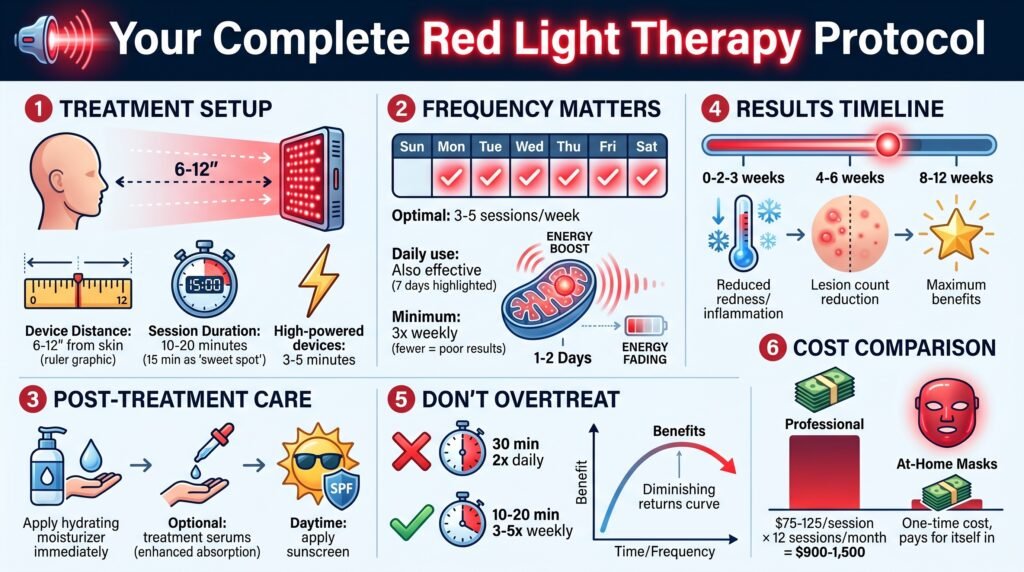
Position yourself or your device according to manufacturer guidelines, usually about 6 to 12 inches from your skin. If you’re using a mask, just secure it properly so it makes even contact.
Distance matters because it affects the intensity of light reaching your skin. Too far and you’re diluting the effect; too close and you might not get even coverage.
Treat for 10 to 20 minutes per session. Most research protocols use around 15 minutes, which seems to be the sweet spot.
Some newer high-powered devices recommend shorter durations like 3 to 5 minutes because they’re delivering more concentrated light energy, but unless you’ve got one of those specific devices, stick with the 15-minute range.
Frequency matters enormously. The data consistently shows that 3 to 5 sessions per week produce the best outcomes.
Daily use is fine, and some studies used daily protocols, but the least effective frequency seems to be three times weekly.
Less than that and you’re probably not going to see significant results.
The reason frequency matters so much is that you’re creating added cellular changes. One session gives your mitochondria a boost, but that effect fades over the next day or two.
Regular, repeated stimulation keeps those cellular processes activated and trending in the right direction.
Post-Treatment Care
Right after your session, apply a good hydrating moisturizer. Your skin has just been stimulated at a cellular level, and supporting that with proper hydration helps the repair processes along.
This is also when your skin might be slightly more receptive to active ingredients, so if you’re using any treatment serums, this could be an optimal time to apply them.
If you’re treating during the day, absolutely follow up with sunscreen. Red light therapy itself doesn’t make you photosensitive the way retinoids do, but if you’re combining treatments or have compromised skin barrier function, sun protection is non-negotiable.
Timeline Expectations
This is really important to understand upfront: you’re not going to see dramatic changes overnight. The cellular processes that red light stimulates take time to manifest as visible improvements.
Based on clinical research, the average time to see measurable results is around 2 weeks, with a range from 1 to 10 weeks depending on personal factors and acne severity. Most people start noticing reduced redness and inflammation within 2 to 3 weeks.
Significant reductions in actual lesion count typically show up around the 4 to 6 week mark with consistent use.
Maximum benefits need ongoing treatment over several weeks to months. This approach works cumulatively, with each session building on the effects of previous ones.
Do Not Over-Treat
There’s a persistent belief that more is better, so some people start doing 30-minute sessions twice daily, thinking they’ll get faster results. The research doesn’t support this.
Beyond about 20 minutes per session, you’re hitting diminishing returns.
The cellular mechanisms have been adequately stimulated, and extra exposure doesn’t amplify the effect proportionally.
Stick with the evidence-based protocols: 10 to 20 minutes, 3 to 5 times weekly. Trust the research over your impulse to do more.
Professional Red Light Sessions vs. At-home Treatment
Maximum benefits need ongoing treatment over several weeks to months. This approach works cumulatively, with each session building on the effects of previous ones.
As previously mentioned, consistent results follow consistent use. Many professional red light therapy providers charge $75 – 125 per session. When you are looking at 2-3 sessions per week, the costs can add up.
When shopping for at-home devices, look for FDA-cleared products that specify exact wavelength output, power density, and treatment area size
Two such devices are the Mito Glow Red Light Mask and the CurrentBody Skin LED Light Therapy Face Mask: Series 1.
When comparing these at-home red light masks to the cost of professional sessions multiple times a week, the CurrentBody and HSA/FSA eligible Mito Glow Mask pays for itself in less than a month, plus they can be used at any time in the comfort of your own home.
Use the cost-saving calculator below to crunch the real-time savings numbers. Bookmark this page, and come back to it whenever you need to compare at-home red light products to service providers in your area.
Red Light Therapy Cost Savings Calculator
Consistent results follow consistent use. Many professional red light therapy providers charge $75 – $125 per session. When you are looking at 2-3 sessions per week, the costs can add up. Compare the long-term savings of investing in an at-home FDA-cleared device versus ongoing professional sessions.
Key Takeaways
Red light therapy works through photobiomodulation, stimulating mitochondrial energy production that enhances your skin’s natural repair and regulatory mechanisms rather than attacking acne through destructive means.
Consistency is absolutely critical. You need 3 to 5 sessions weekly for at least 4 to 6 weeks before evaluating effectiveness, with many people seeing initial improvements around the 2 to 3 week mark.
Combination wavelengths (blue 415nm plus red 630-680nm) produce superior results compared to either wavelength alone, with clinical studies showing up to 76% reduction in inflammatory lesions.
Device selection matters significantly. Prioritize wavelength accuracy, adequate power density (minimum 40 mW/cm²), and FDA clearance when possible over price alone.
Red light therapy complements rather than conflicts with most conventional acne treatments, making it valuable as part of a comprehensive approach.
Most common failure points are inconsistent use, unrealistic timeline expectations, inadequate devices, and neglecting proper skin preparation before sessions.
This approach is particularly well-suited for inflammatory acne and acne scarring, with cellular mechanisms that reduce inflammation, modulate oil production, and stimulate collagen synthesis for improved skin texture and tone.
Get started treating acne and start rejuvenating your skin with the affordable and effective options below.
Vital Red Light has partnered with Flex so qualified customers can use their Health Savings Account (HSA) or Flexible Spending Account (FSA). This means you may be able to purchase eligible red light therapy devices using pre-tax dollars, which can save you around 30–40% overall.
People Also Asked
Does red light therapy work for cystic acne?
Red light therapy can help manage inflammation associated with cystic acne, but it typically won’t be enough as a standalone treatment for severe cystic cases. The inflammation in cystic acne is so deep and severe that you’ll likely need more aggressive medical intervention.
However, red light can be a valuable addition to your treatment plan, helping to reduce inflammation and support healing alongside prescription medications.
How long does it take to see results from red light therapy for acne?
Most people start noticing reduced redness and inflammation within 2 to 3 weeks of consistent use. Significant reductions in lesion count typically appear around the 4 to 6 week mark.
The average time to see measurable results ranges from 1 to 10 weeks depending on your acne severity and how consistently you use the therapy.
You need to commit to at least 4 to 6 weeks before evaluating whether the treatment is working for you.
Can I use red light therapy with retinol?
Yes, you can safely combine red light therapy with retinol or prescription retinoids. In fact, the anti-inflammatory effects of red light can help offset some of the irritation that retinoids commonly cause.
The key is to cleanse your skin before your light therapy session, treat with red light, then apply your retinoid product afterward.
Don’t try to treat through a layer of retinoid, as it will block light penetration.
What wavelength of red light is best for acne?
The most effective wavelengths for acne treatment are in the red spectrum around 630 to 680 nanometers. For bacterial control, blue light at about 415 nanometers is optimal.
Studies show that combining both wavelengths produces superior results, with one trial demonstrating a 76% reduction in inflammatory lesions when using combined blue and red light therapy.
Is red light therapy safe for all skin types?
Red light therapy is generally safe across all skin types, including darker skin tones. Unlike some laser treatments that target melanin and can cause hyperpigmentation in melanin-rich skin, red light doesn’t carry that risk.
If you have very sensitive or reactive skin, you might want to start with shorter sessions (8 to 10 minutes) and lower frequency (3 times weekly) to see how your skin responds before increasing to full protocols.
How often should I do red light therapy for acne?
The optimal frequency based on clinical research is 3 to 5 sessions per week. Daily use is acceptable, and some studies used daily protocols, but the least effective frequency appears to be three times weekly.
Less than that and you probably won’t see significant results.
Consistency matters more than intensity, so find a frequency you can realistically maintain long-term.
This article includes affiliate links. If you click through and make a purchase, I may receive a small commission. This helps support the site and allows me to keep creating helpful content at no extra cost to you.