📌 Quick Summary
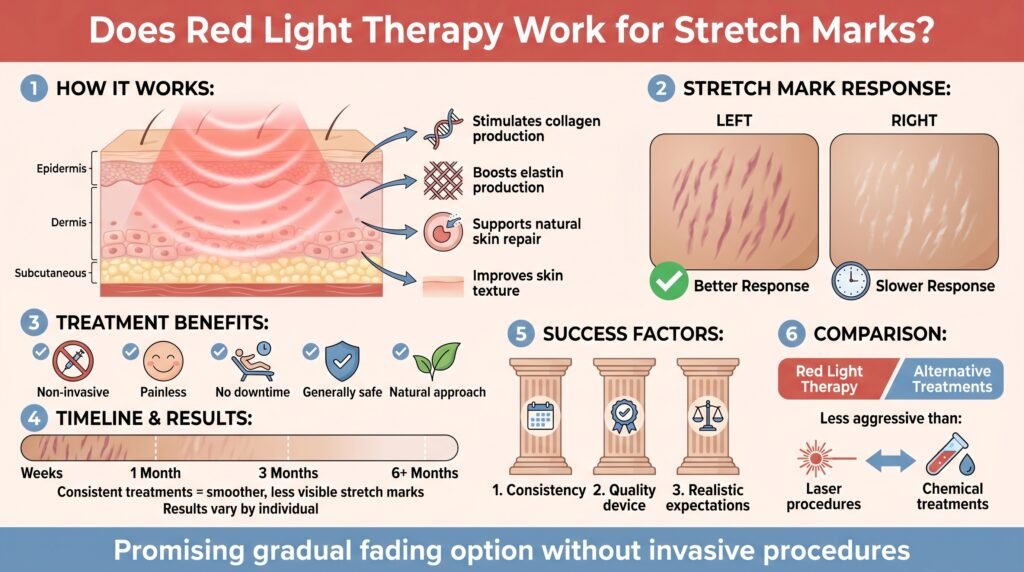
Red light therapy may help reduce the appearance of stretch marks by stimulating collagen and elastin production, improving skin texture, and supporting natural skin repair. While results vary, many users notice smoother, less visible stretch marks after consistent treatments over several weeks or months. Newer red or purple stretch marks tend to respond better than older white ones.
Red light therapy is non-invasive, generally safe, and painless compared to more aggressive treatments like lasers or chemical procedures. Consistency, device quality, and realistic expectations are key factors for seeing improvement.
Overall, red light therapy appears to be a promising option for people looking to gradually fade stretch marks naturally without downtime or invasive treatments.
🧾 Table of Contents
- Introduction
- What Red Light Therapy Actually Does to Stretch Marks
- The Wavelength Difference That Actually Matters
- What the Research Actually Shows
- The Timeline Nobody Tells You About
- The Cost Reality Check
- Cost-Savings Calculator
- The Treatment Protocol That Actually Works
- What to Actually Expect
- Key Takeaways
- People Also Asked
Introduction
You’ve probably seen the ads. Someone holding a glowing red panel, promising to erase years of skin damage, fade stubborn stretch marks, restore confidence.
Maybe you’ve scrolled past before-and-after photos that look too good to be true, or heard a friend swear by their at-home device.
But here’s what’s eating at you: is this actually science, or is it just expensive placebo wrapped in fancy marketing? Because if you’re going to invest hundreds or even thousands of dollars and commit to months of consistent treatment, you need to know whether red light therapy genuinely works for stretch marks or if it’s another wellness trend that promises everything and delivers nothing.
The truth sits somewhere more nuanced than either extreme. Red light therapy does work for stretch marks, but not in the new, overnight way some companies suggest.
What it actually does is far more interesting than simple scar erasure.
What Red Light Therapy Actually Does to Stretch Marks
Think of stretch marks as internal scars. When your skin stretched faster than your collagen production could keep up during pregnancy, rapid weight changes, or growth spurts, the dermal layer literally tore.
Your body rushed to repair those tears, but it used disorganized scar tissue instead of the beautifully arranged collagen fibers that make normal skin look smooth and uniform.
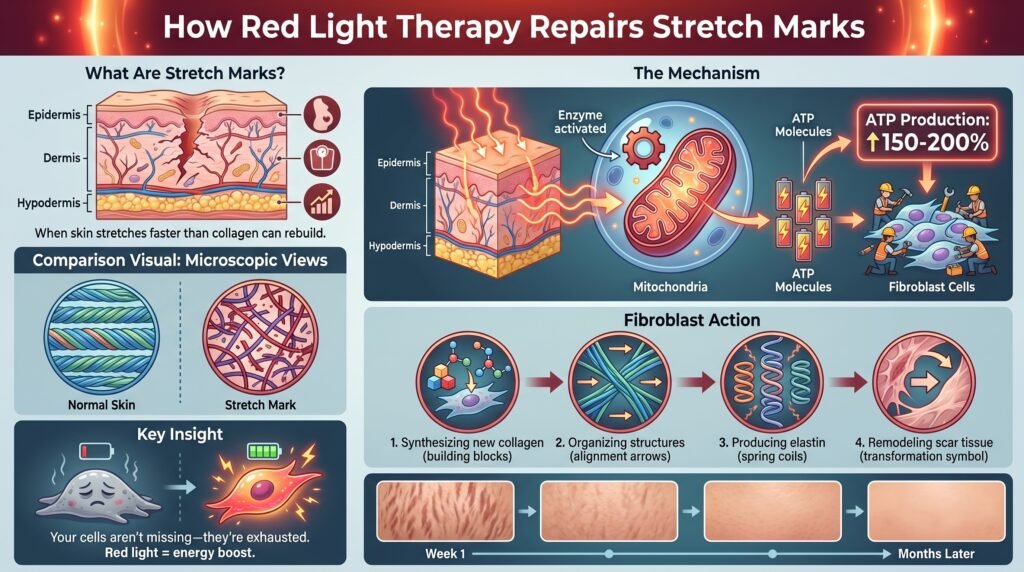
Red light therapy works by energizing the cells responsible for skin repair. When specific wavelengths of red and near-infrared light penetrate your skin, they’re absorbed by mitochondria in your cells, particularly in fibroblasts.
These fibroblasts are the construction workers of your skin, building collagen and elastin.
The light stimulates an enzyme called cytochrome c oxidase, which kicks ATP production into higher gear. ATP is cellular energy, and when your fibroblasts have more energy, they can actually do their job properly.
They start synthesizing new collagen, organizing it into functional structures, producing elastin for skin flexibility, and gradually remodeling that chaotic scar tissue into something that more closely resembles normal skin.
Here’s what makes this really interesting. Your stretch-marked skin doesn’t lack fibroblasts.
Those cells are there; they’re just exhausted and underperforming.
Red light therapy doesn’t add anything foreign to your body. It simply gives your existing repair mechanisms the energy boost they need to function at optimal capacity.
The mechanism is straightforward. Light hits your cells, mitochondria absorb that energy, ATP production increases by 150-200%, and fibroblasts suddenly have the fuel to rebuild damaged tissue.
This happens at a cellular level you can’t see or feel initially, but the effects accumulate over weeks and months until they become visible.
The Wavelength Difference That Actually Matters
Not all red light is created equal, and this is where most people get confused by conflicting information.
Red light in the 630-680 nm range, typically 660 nm, penetrates about 8-10 mm into your skin. This affects the epidermis and superficial dermis, where it’s really effective at improving color uniformity, reducing redness in newer stretch marks, and smoothing surface texture. You can think of this wavelength as the surface specialist.
Near-infrared light in the 800-880 nm range, usually 850 nm, penetrates much deeper at 15-20 mm or more. This reaches into the deeper dermis and even subcutaneous tissue where the most significant structural damage from stretch marks exists.
This wavelength handles the heavy lifting of deep collagen remodeling.
The best results come from devices that mix both wavelengths because you’re treating many layers simultaneously. The red light handles surface improvements while near-infrared works on the deeper structural repair.
This layered approach explains why combination devices consistently outperform single-wavelength options in clinical observations, even though they’re not dramatically more expensive.
Most quality devices now offer dual-wavelength capability. If you’re shopping for a device and it only offers one wavelength, you’re missing half the treatment spectrum.
A device with both 660 nm and 850 nm LEDs will always outperform a single-wavelength option, even if the single-wavelength device has higher total power output.
What the Research Actually Shows
Let’s talk real numbers, not marketing hype.
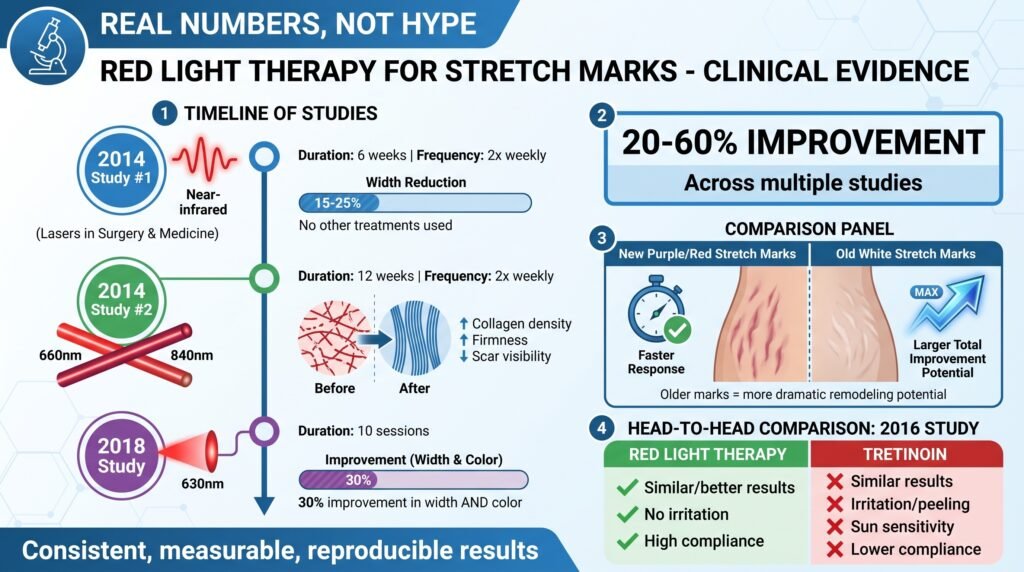
A 2014 pilot study published in Lasers in Surgery and Medicine showed that near-infrared light reduced stretch mark width by 15-25% after just six weeks of twice-weekly treatments. That’s measurable, visible improvement in a relatively short timeframe.
The participants weren’t using any other treatments, just red light therapy alone.
Another 2014 clinical trial combined 660 nm red light with 840 nm near-infrared, treating participants twice weekly for twelve weeks. The results showed increased collagen density in the stretch marks themselves, which translated to improved skin firmness and reduced scar visibility.
When researchers took skin biopsies before and after treatment, they could measure more organized collagen fibers under a microscope.
More recent research from 2018 demonstrated about 30% improvement in both stretch mark width and color after ten sessions of 630 nm red light therapy. These aren’t secret transformations, but they’re consistent, reproducible improvements that matter when you’re looking at your own skin.
The average improvement across many studies ranges from 20-60%, with newer purple or red stretch marks typically responding faster than older white ones.
That said, and this is counterintuitive, older white stretch marks often show more dramatic total improvement because they represent fully formed scar tissue that can be systematically remodeled, whereas fresh marks are still in inflammatory chaos.
One particularly interesting 2016 study compared red light therapy to topical tretinoin for stretch marks. Red light therapy produced similar or slightly better results without any of the skin irritation, peeling, or sun sensitivity that tretinoin causes. The compliance rate was also much higher because people could actually stick with the treatment when it didn’t make their skin angry.
The Timeline Nobody Tells You About
Here’s what actually happens when you start red light therapy, week by week.
During weeks zero to two, absolutely nothing visible happens. Your cells are increasing ATP production, your fibroblasts are waking up, your mitochondria are getting energized, but you won’t see any external changes.
This is when most people give up, assuming it doesn’t work.
They’ve invested in a device, used it religiously for two weeks, see nothing, and conclude it’s a scam.
Weeks two to four bring the first subtle changes. Your skin might feel softer, more hydrated. Blood flow to the treated areas increases by 10-20%, which you might notice as a slight healthy flush that fades after sessions.
Still no dramatic visual improvement, but the internal repair process is actively underway.
If you measured skin elasticity with specialized equipment, you’d see measurable changes, but to the naked eye, not much.
Around weeks four to eight, early collagen changes begin. If you’re treating newer red or purple marks, you’ll probably notice the color starting to fade slightly. Texture becomes a bit smoother.
These changes are subtle enough that you might question whether they’re real or just hopeful thinking.
Take photos at this stage because changes happen gradually enough that you don’t notice day-to-day, but week-to-week comparison photos will show real differences.
Weeks eight to twelve is when significant improvement becomes undeniable. Color fading accelerates, texture smooths noticeably, and the depth of indented marks starts reducing.
Most clinical studies measure results at this twelve-week mark because it represents the point where collagen remodeling becomes visually obvious.
This is when people typically start getting comments from others asking what they’ve been doing differently.
Beyond twelve weeks and into months four to six, you reach most effects. The collagen continues organizing itself into more functional patterns, skin firmness improves, and the overall appearance reaches its peak improvement from that particular treatment course.
Some people see continued improvement up to nine months after stopping treatment as the collagen remodeling process finishes itself.
The Cost Reality Check
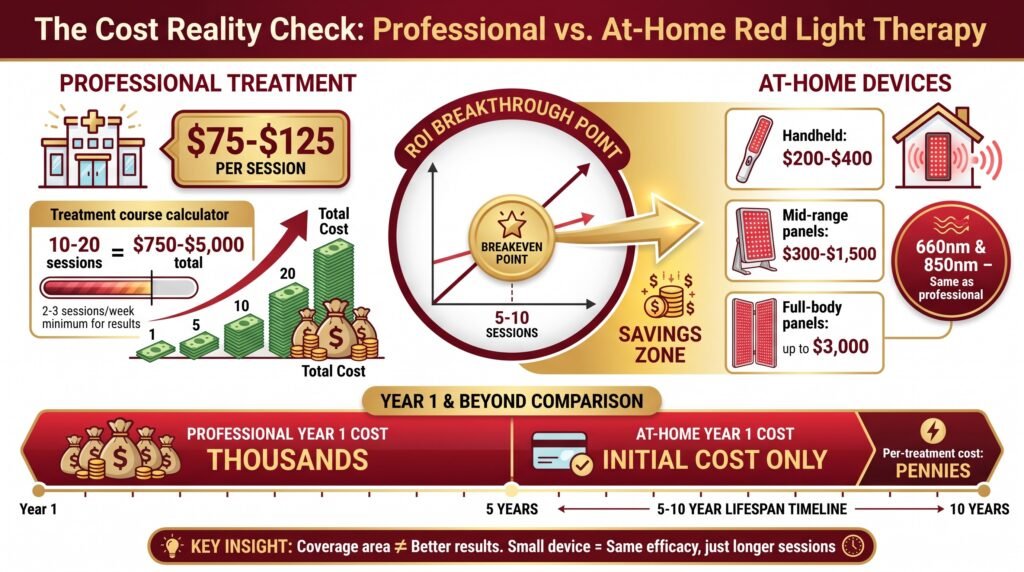
Professional red light therapy sessions run in the range $75-125 each. A full course of 10-20 treatments means you’re looking at $750 – 5,000 total. Since consistency is key to seeing any meaningful results, 2 to 3 sessions per week at a minimum can add up.
These sessions use high-powered professional equipment and sometimes mix red light with other modalities, but fundamentally, they’re delivering the same wavelengths you can get at home.
At-home devices range from $300 handheld units to $3,000 full-body panels. Here’s the thing that device manufacturers don’t want you to know: a well-engineered $200-400 device with the fix wavelengths (660 nm and/or 850 nm) produces essentially equivalent results to a $3,000 panel.
The difference is coverage area and convenience, not basic efficacy.
A small handheld device, like the Vital Red Light Charge, treating one area at a time, works just as well as a massive panel, it just takes longer per session. If you have stretch marks only on your abdomen, a focused device makes perfect sense.
If you’re treating your abdomen, thighs, breasts, and arms, a larger panel saves time but doesn’t necessarily improve results per area. Mito and Hooga Red Light make affordable red light panels that are well below $3,000.
After the initial investment, at-home devices cost essentially nothing to operate beyond minimal electricity. Most quality devices last 5-10 years with proper care, which means your per-treatment cost drops to pennies after the first few months.
The return on investment for an at-home device happens around session 5-10 compared to professional treatment costs. Everything after that is essentially free treatment.
Over a year of maintenance sessions, you’re saving thousands compared to professional treatments.
See the cost-savings calculator below to crunch the real-time numbers and see how the savings add up. Bookmark this page and come back to the calculator anytime you are comparing red light services in your area.
Red Light Therapy Savings Calculator
Professional red light therapy sessions range from $75-125 each. With a full course requiring 10-20 treatments at 2-3 sessions per week, costs quickly add up to $750-5,000 or more. Calculate how much you could save by investing in your own device.
Start Saving Today with These Top Devices
HSA/FSA eligible • Professional-grade • Money-back guarantees
The Treatment Protocol That Actually Works
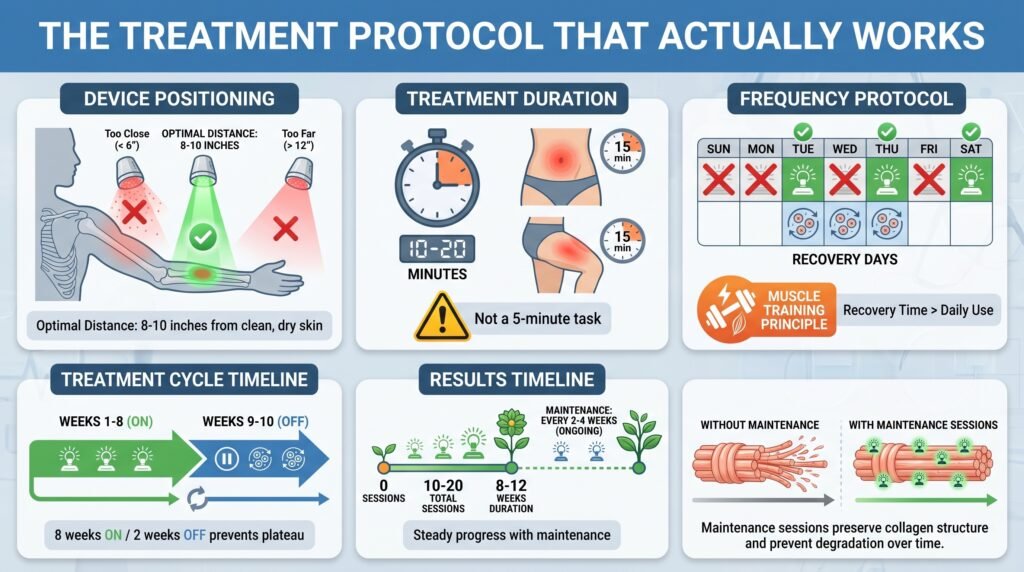
You need to position your device 6-12 inches from clean, dry skin. Closer isn’t better because light needs space to disperse evenly across the treatment area. Too close and you’re concentrating energy in a small spot; too far and the intensity drops below therapeutic levels.
The sweet spot for most devices is 8-10 inches, close enough for therapeutic intensity but far enough for even coverage.
Treatment duration is typically 10-20 minutes per area. Your abdomen might need 15 minutes, your thighs another 15 minutes.
This isn’t something you can rush through in five minutes while checking your phone.
The total light dose decides effectiveness, and that’s a function of both intensity and time. A low-power device needs longer exposure, a high-power device needs less, but you need adequate total dose either way.
Frequency matters more than intensity. Two to three sessions per week consistently outperform daily treatments in long-term results.
Your cells need recovery time between sessions to actually use that ATP boost for repair work.
Constant stimulation leads to cellular adaptation where your fibroblasts stop responding as strongly. Think of it like muscle training.
You don’t lift weights every single day because your muscles need recovery time to actually build.
The same principle applies here.
Here’s something almost nobody mentions: treatment breaks actually improve outcomes. Using an eight-week-on, two-week-off cycle prevents the plateau effect where your skin stops responding to continuous stimulus.
Professional clinics know this but rarely advertise it because they want you coming back every single week.
The rest periods allow your cellular receptors to re-sensitize, making subsequent treatment rounds more effective.
Most people need 10-20 total sessions to see meaningful results, spread across 8-12 weeks. After that initial course, maintenance sessions every 2-4 weeks help preserve improvements because collagen naturally degrades over time.
You’re fighting ongoing aging and environmental damage, so occasional tune-ups keep your results from backsliding.
What to Actually Expect
Let’s set realistic expectations based on actual clinical outcomes, not cherry-picked marketing photos.
For newer stretch marks that are still red or purple, you can realistically expect 40-60% improvement in color and 20-30% improvement in texture after 12 weeks of consistent treatment. These marks respond faster because they’re still in active healing mode, and red light speeds up that natural process.
The redness fades first, then texture gradually smooths.
For older white stretch marks, expect 20-40% improvement in visibility and 30-50% improvement in texture and depth. The changes take longer to appear, usually 12-16 weeks, but they’re often more dramatic in total effect because you’re systematically remodeling mature scar tissue.
White marks have already completed their chaotic initial healing, so red light can guide more organized reconstruction.
Complete disappearance is rare but possible for very mild, superficial marks. More commonly, you’ll achieve significant fading where marks become much less noticeable but don’t completely vanish.
Think of it as going from highly visible and emotionally distressing to barely noticeable unless you’re actively looking.
Internal improvements often precede visible changes. Your skin will feel firmer, more elastic, and healthier weeks before you see dramatic color or texture differences.
This is your collagen reorganizing itself at a structural level.
Trust this process even when you can’t see surface changes yet. See the various options that provide effectiveness and affordability.
Key Takeaways
Red light therapy produces a measurable 20-60% improvement in stretch mark appearance over 8-12 weeks for most people who finish a full protocol consistently.
The mechanism works through cellular energy enhancement, specifically increasing ATP in fibroblasts so they can produce and organize collagen more effectively.
Combination wavelengths (660 nm red plus 850 nm near-infrared) outperform single wavelengths by treating many skin layers simultaneously.
Results need patience, with internal improvements appearing around week four to six and visible changes becoming obvious by week eight to twelve.
At-home devices offer equivalent efficacy to professional treatments at a fraction of the long-term cost, provided they deliver fixed wavelengths at therapeutic intensity.
Strategic treatment breaks prevent the plateau effect where cells stop responding to constant stimulation.
Lifestyle factors, particularly hydration, stress levels, and sleep quality, significantly influence treatment outcomes in ways that match or exceed device quality.
Newer purple marks respond faster, while older white marks often show more total improvement, just over a longer timeline.
Complete disappearance is possible for mild marks but uncommon for moderate to severe cases. Realistic expectations center on significant fading and texture improvement as opposed to total erasure.
People Also Asked
Does red light therapy help with old stretch marks?
Yes, red light therapy can improve old white stretch marks, though the timeline is longer than for newer marks. Expect 20-40% improvement in visibility and 30-50% improvement in texture over 12-16 weeks of consistent treatment.
Older marks respond more slowly but often show dramatic total improvement because you’re remodeling mature scar tissue that’s already stabilized.
What wavelength is best for stretch marks?
The best approach uses both 660 nm red light for surface improvements and 850 nm near-infrared for deep dermal remodeling. Dual-wavelength devices treat many skin layers simultaneously and consistently outperform single-wavelength options in clinical observations.
How long does red light therapy take to work on stretch marks?
Most people see early subtle changes around weeks 4-6, with obvious visible improvement by weeks 8-12. Maximum results typically appear at 3-6 months.
The collagen remodeling process continues even after stopping treatment, with some people seeing continued improvement up to 9 months later.
Can you use red light therapy while pregnant?
Red light therapy using 660 nm and 850 nm wavelengths appears safe during pregnancy as it doesn’t generate heat or affect cellular DNA, but you should talk to your healthcare provider before starting treatment. Some early research suggests proactive red light therapy during pregnancy might actually help prevent stretch marks from forming.
How often should you do red light therapy for stretch marks?
Two to three sessions per week produce better long-term results than daily treatments. Your cells need recovery time between sessions to use the ATP boost for actual repair work.
An eight-week-on, two-week-off cycle prevents plateau effects where your skin stops responding to continuous stimulation.
Does red light therapy work better than retinol for stretch marks?
Recent research suggests red light therapy produces similar or slightly better results than topical retinoids without causing skin irritation, peeling, or sun sensitivity. A 2016 study found red light therapy had higher patient compliance because it doesn’t cause the uncomfortable side effects that tretinoin does.
This article includes affiliate links. If you click through and make a purchase, I may receive a small commission. This helps support the site and allows me to keep creating helpful content at no extra cost to you.