📌 Quick Summary
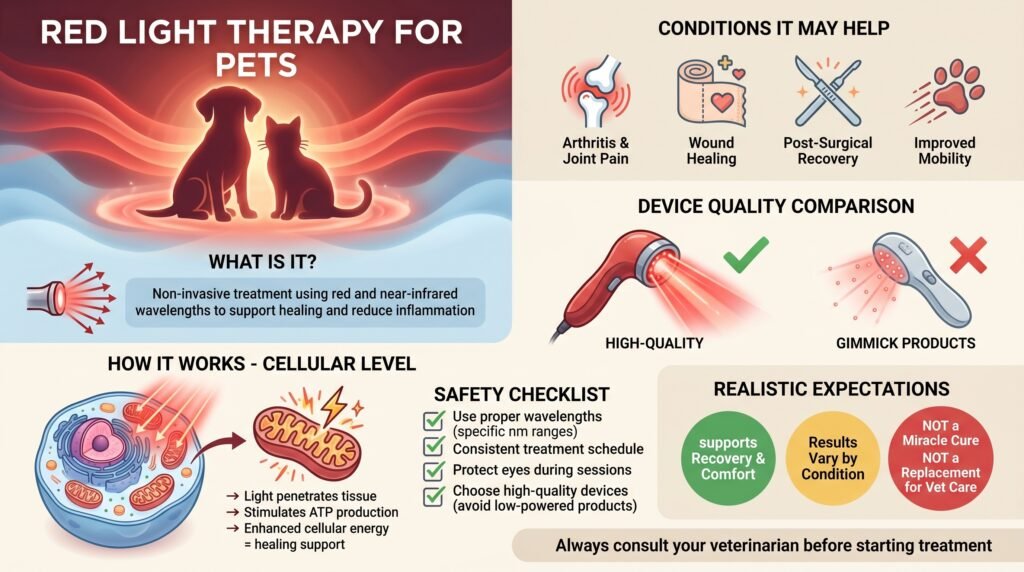
Red light therapy for pets is a non-invasive treatment that uses red and near-infrared light to support healing, reduce inflammation, and improve mobility in dogs, cats, and other animals.
Photobiomodulation works at the cellular level by stimulating ATP production, which may help with arthritis, joint pain, wound healing, and post-surgical recovery. I discuss safety considerations, including proper wavelengths, treatment consistency, eye safety, and choosing high-quality devices over low-powered “gimmick” products.
While early veterinary evidence and many pet-owner experiences are promising, results vary depending on the condition being treated and the quality of the device used. The article emphasizes realistic expectations: red light therapy can support recovery and comfort, but it is not a miracle cure or replacement for veterinary care.
🧾 Table of Contents
- Introduction
- Why Some Pets Bounce Back from Arthritis While Others Struggle
- How Light Actually Changes Tissue at the Cellular Level
- From Clinic Sessions to Kitchen Counter Treatments
- The Wavelength Question Nobody Answers Clearly
- Power Density and Dose: The Part Everyone Gets Wrong
- Choosing Between Handheld, Pad, and Panel Systems
- Building a Realistic Protocol for Chronic Arthritis
- Key Takeaways
- Frequently Asked Questions
How Light Actually Changes Tissue at the Cellular Level
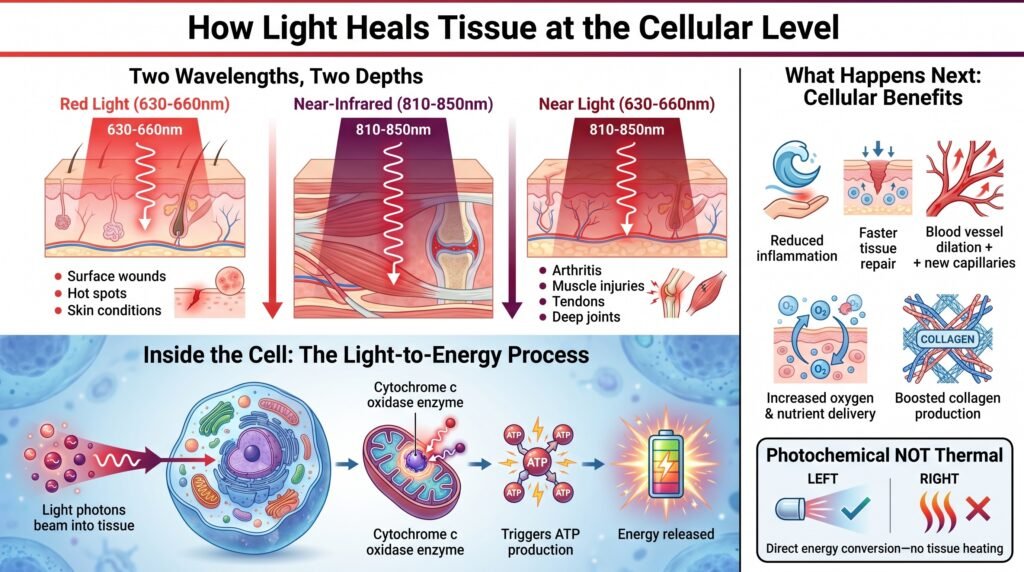
When specific wavelengths of light hit tissue, they penetrate the mitochondria and interact with an enzyme called cytochrome c oxidase.
This enzyme absorbs photons from red and near-infrared light, particularly wavelengths around 630 to 660 nanometers for red light and 810 to 850 nanometers for near-infrared. Those photons trigger biochemical reactions that boost ATP production, which is the energy currency every cell in your pet’s body runs on.
More ATP means cells function better across the board. Inflammatory cells calm down.
Damaged tissues repair faster.
Blood vessels dilate and new capillaries form, bringing fresh oxygen and nutrients while clearing out metabolic waste. Fibroblasts ramp up collagen production, which directly affects how quickly wounds heal and how well damaged ligaments and joint capsules repair themselves.
Near-infrared wavelengths penetrate deeper than visible red light, which is why protocols for arthritis and muscle injuries rely heavily on 810 to 850 nanometer light. That deeper penetration reaches joints, tendons, and muscle tissue sitting several centimeters below the skin surface.
Red light at 630 to 660 nanometers is more effective for surface wounds, hot spots, and skin conditions because it concentrates energy in the upper tissue layers.
The effects are purely photochemical rather than thermal. You’re not heating tissue or forcing blood flow through temperature changes. Light energy converts directly into cellular energy without the risks that come with heat-based treatments.
From Clinic Sessions to Kitchen Counter Treatments
When veterinary clinics started using photobiomodulation in the 1990s, the equipment cost tens of thousands of dollars and required trained technicians to operate. A typical protocol for a dog with bilateral hip arthritis involved twice-weekly sessions at seventy-five to a hundred dollars each.
Owners had to factor in travel time, parking hassles, and the stress their pet experienced in an unfamiliar clinical environment.
The technology shifted dramatically in the past decade. LED arrays now deliver the same therapeutic wavelengths and power densities that older laser systems provided, but in compact packages that sit on your coffee table.
Instead of two fifteen-minute sessions per week at the clinic, pets can receive daily treatments in their favorite sleeping spot with zero transportation stress.
Tissue healing and pain reduction from light therapy are added. A study tracking horses with soft tissue injuries found that daily treatments produced significantly better outcomes than the same total dose spread across fewer, longer sessions.
The body responds to consistent signaling as opposed to occasional large doses.
For pet owners managing a twelve-year-old cat with chronic lower back arthritis, this means you can maintain therapeutic protocols long-term without choosing between expensive weekly vet visits or nothing.
You treat at home every morning while she eats breakfast, delivering the same wavelengths and doses a rehabilitation clinic would use.
See the available red light therapy devices on Amazon below:


The Wavelength Question Nobody Answers Clearly
Shopping for a pet light therapy device gets confusing fast when manufacturers list specifications like 630nm, 660nm, 810nm, 850nm without explaining what any of it means for your specific pet’s problem.
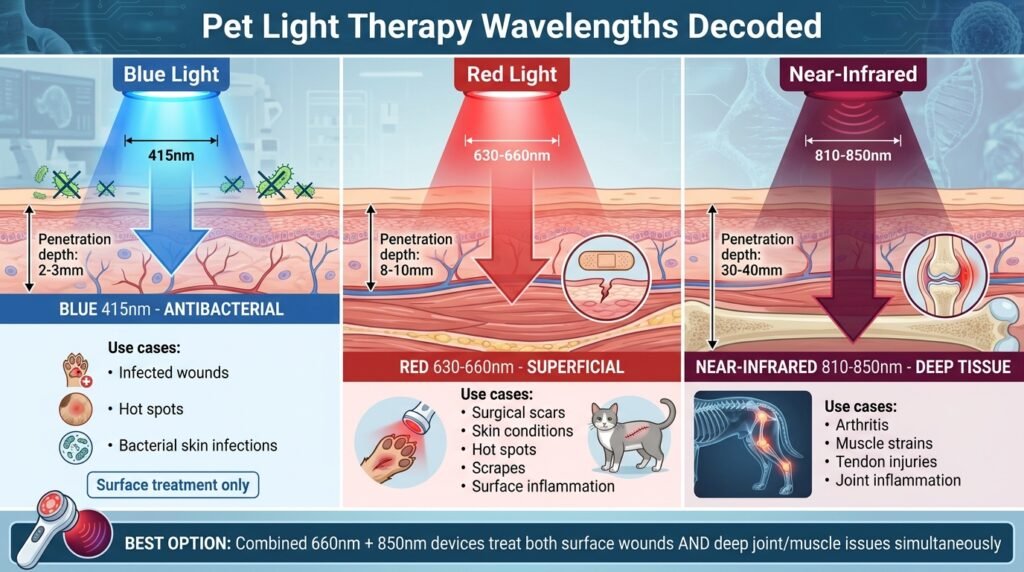
Visible red light around 630 to 660 nanometers penetrates roughly 8 to 10 millimeters into tissue. That depth works perfectly for skin conditions, superficial wounds, hot spots, incision sites, and surface inflammation.
If you’re treating a surgical scar on your cat’s belly or a scrape on your dog’s paw, red light handles most of the work.
Near-infrared light at 810 to 850 nanometers is invisible to human eyes but penetrates 30 to 40 millimeters or more, depending on tissue density and fur coverage. You need that depth for arthritis in the hip, elbow, or knee, for muscle strains in the back or shoulder, for tendon injuries like a torn cranial cruciate ligament.
The light has to reach the joint capsule, the synovial fluid, and the inflamed soft tissues wrapped around bone.
Most quality devices mix both wavelengths because real-world injuries aren’t purely superficial or purely deep. A dog recovering from TPLO surgery has an incision on the surface and inflamed joint structures underneath.
A cat with stomatitis might benefit from red light on the gums and near-infrared reaching deeper oral tissues.
Combining 660nm and 850nm in one device gives you flexibility to treat different conditions with the same equipment.
Some devices also include blue light around 415 nanometers, which has antibacterial properties. This helps with infected wounds, hot spots with secondary bacterial colonization, or skin conditions where bacteria drive inflammation.
Blue light doesn’t penetrate deeply, so it functions purely as a surface treatment addition.
Power Density and Dose: The Part Everyone Gets Wrong
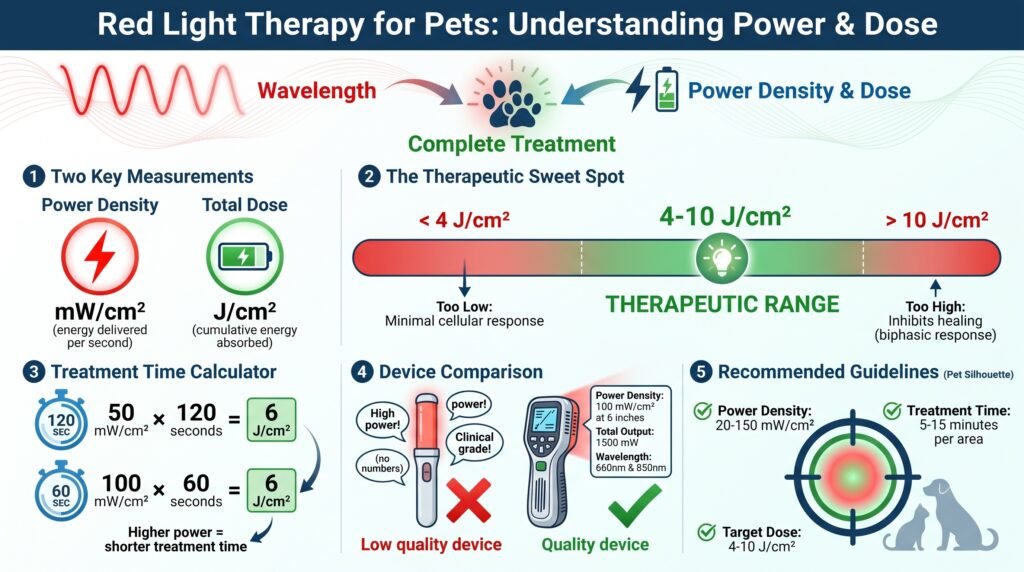
Wavelength is only half the equation. The other half is power density, measured in milliwatts per square centimeter, and total dose, measured in joules per square centimeter.
Most pet owners and even some veterinarians get lost here.
Power density tells you how much energy the device delivers to tissue per unit of time and area.
A device outputting 100 milliwatts per square centimeter delivers more energy per second than one outputting 20 milliwatts per square centimeter.
Higher power density means shorter treatment times to reach your target dose, but it also increases the risk of overdosing if you’re careless.
Total dose is the cumulative energy absorbed by tissue during a session. Research in animals suggests that somewhere between 4 and 10 joules per square centimeter is the therapeutic range for most conditions.
Below that threshold, you’re probably not triggering much cellular response.
Above it, you risk the biphasic dose-response where too much light actually inhibits healing instead of promoting it.
Here’s a practical example. If your device outputs 50 milliwatts per square centimeter and you want to deliver 6 joules per square centimeter, you need to treat for 120 seconds.
If the device outputs 100 milliwatts per square centimeter, you only need 60 seconds to hit the same dose.
The challenge with home devices is that most manufacturers don’t clearly state power density at a given distance from the LEDs. They might say “high power” or “clinical grade” without providing actual numbers.
Better devices include this information in the manual or on the product page, along with recommended treatment times based on power output.
For pets, a general guideline is to look for devices in the 20 to 150 milliwatts per square centimeter range and plan for treatment sessions between 5 and 15 minutes per area. That usually delivers a safe, effective dose without requiring you to sit there for half an hour per session.
Choosing Between Handheld, Pad, and Panel Systems
The form factor of your device decides how you actually use it in daily life. A technically perfect device that’s awkward to position will end up in the closet, while a slightly less powerful device that fits easily into your routine gets used every day.
Handheld wands and cold laser devices excel at targeting specific joints or small injuries. If your Dachshund has one bad elbow, a handheld device lets you focus all the light energy right on that joint for five minutes.
Handheld devices also work well for cats, who often tolerate a small device better than something wrapped around their body.
The downside is that treating a large dog with arthritis in many joints becomes tedious. You spend twenty minutes moving the device from hip to hip, knee to knee, and it’s easy to miss spots or give up on consistency after a few weeks.
Pads and belts handle chronic, widespread issues better. A flexible LED pad that drapes over your dog’s hips and lower back can treat both hip joints, the lumbar spine, and the sacroiliac joints simultaneously.
Most pads run for 10 to 15 minutes and automatically shut off, which makes dosing straightforward.
The LEDs are positioned close to the fabric surface, so even with fur in the way, you get good skin contact.
The learning curve with pads is getting your pet comfortable lying still or wearing a belt. Some dogs accept it immediately and fall asleep during treatment.
Others need a week of short sessions with treats and positive reinforcement before they relax.
Cats can be trickier, but a flat pad placed under their favorite blanket often works better than trying to strap anything onto them.
Panels are less common for home pet use but make sense in specific situations. If you have many large dogs or a giant breed with widespread arthritis, a panel lets you treat a large area without physical contact.
Your dog lies near the panel, and the light covers their entire side.
Panels cost more and take up space, but for serious multi-pet households or breeders managing older animals, they’re incredibly effective.
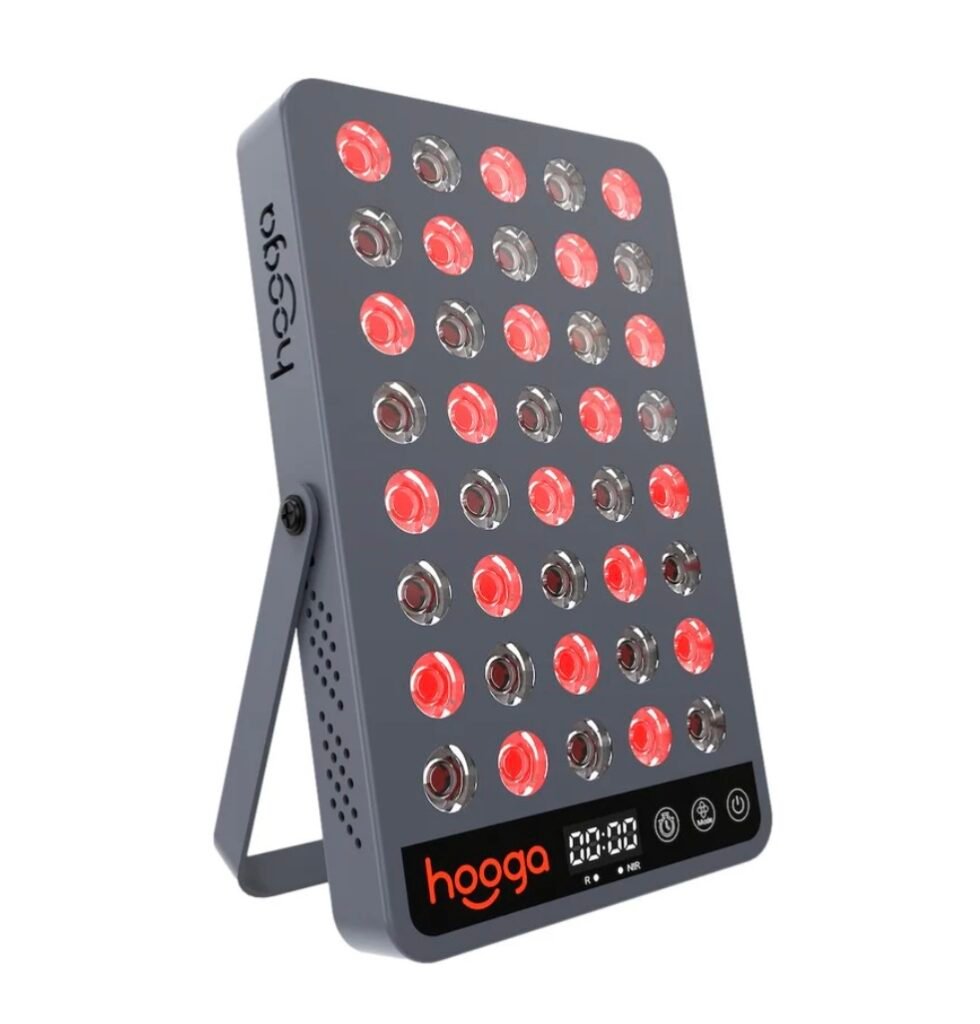
Hooga Red Light has created a line of very affordable red light panels that provide the beneficial and therapeutic wavelengths and strengths for both pets as well as their owners.
Click the button below to start with the Hooga HG200. Use the link below to get 12% off Today.
Building a Realistic Protocol for Chronic Arthritis
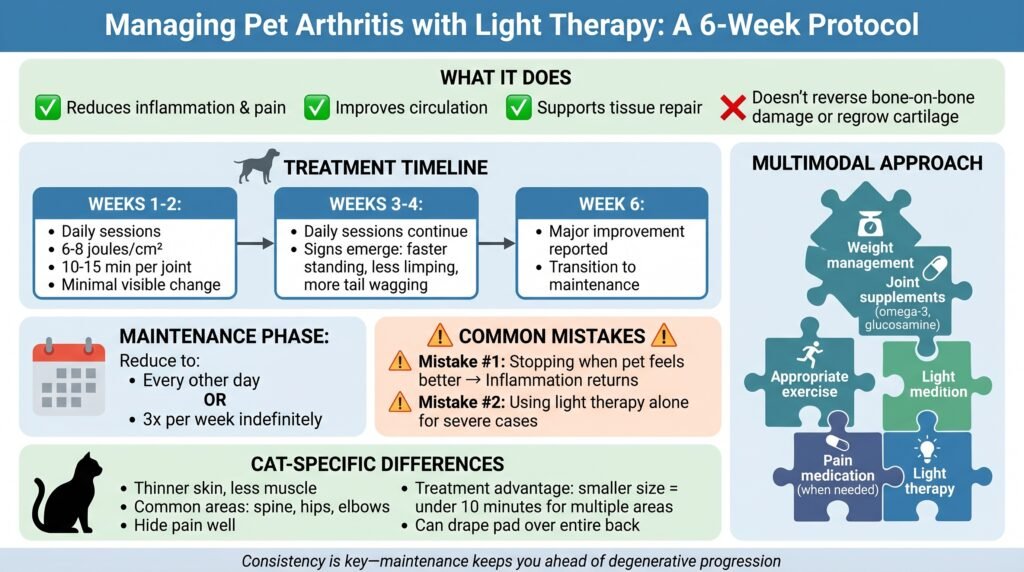
Arthritis is probably the most common reason pet owners invest in light therapy, and expectations need careful calibration here. Light therapy reduces inflammation and pain, improves circulation, and supports tissue repair.
It doesn’t reverse bone-on-bone degeneration or regrow cartilage.
What it does do, when used consistently, is often enough to keep an arthritic pet comfortable and mobile without escalating medications.
A typical home protocol for a dog with hip or elbow arthritis starts with daily sessions for the first four to six weeks. Each session delivers around 6 to 8 joules per square centimeter to the affected joints, which, with most home devices, translates to 10 to 15 minutes per area.
If your dog has arthritis in both hips, you treat both hips.
If they also have a bad knee, you add that to the session.
During the first two weeks, you might not see much change. Subtle improvements start appearing in weeks three and four.
Your dog stands up a little faster.
They walk to their food bowl without limping. They wag their tail more.
By week six, many owners report their pet is moving better than they have in months or years.
At that point, you transition to a maintenance schedule. Instead of daily treatments, you drop to every other day or three times per week.
You’re no longer knocking down acute inflammation but rather maintaining the cellular and vascular improvements you’ve built.
Some pets need maintenance indefinitely. Others improve enough that you can reduce further or pause and only restart if symptoms flare.
One mistake people make is stopping treatment as soon as their pet feels better.
Arthritis is degenerative, so the underlying joint damage stays.
If you stop treatment entirely, inflammation slowly creeps back, and you’re starting over.
Maintenance sessions keep you ahead of that curve.
The other mistake is expecting light therapy alone to solve severe arthritis. Most veterinarians recommend a multimodal approach including weight management, joint supplements like omega-3 fatty acids and glucosamine, appropriate exercise, pain medication when needed, and light therapy as one component.
Each piece contributes, and together they often mean the difference between a pet who can’t walk and one who still enjoys life.
Light therapy for cats follows the same principles but differs in practice. Cats have thinner skin, less muscle mass, and completely different temperaments than dogs.
They also develop arthritis in different areas, particularly the spine, hips, and elbows, and they hide pain exceptionally well.
Owners often don’t realize there’s a problem until it’s advanced.
The advantage with cats is that their smaller size means you can treat many areas quickly. A single handheld device session can cover both hips and the lower spine in under ten minutes.
A small pad can drape over their entire back.
Key Takeaways
Red and near-infrared light therapy reduces inflammation, speeds tissue repair, and alleviates pain in pets by boosting cellular energy production through mitochondrial photostimulation.
Wavelength selection decides treatment effectiveness, with 630 to 660 nanometers handling superficial wounds and skin issues while 810 to 850 nanometers penetrate deeply enough for arthritis and muscle injuries.
Power density and total dose decide whether treatments actually work, with most therapeutic protocols targeting 6 to 10 joules per square centimeter delivered over 10 to 15 minutes based on your specific device’s output.
Consistency over weeks produces far better results than sporadic high-intensity sessions, which is why at-home devices that enable daily treatment outperform occasional clinic visits for chronic conditions.
Realistic expectations matter because light therapy reduces pain and supports healing but doesn’t reverse structural joint damage, regrow cartilage, or replace surgery for mechanical problems.
Long-term maintenance protocols keep arthritic pets comfortable without escalating medication doses, and the therapy remains safe for years of continuous use without cumulative side effects.
Again, at-home red light options range from portable wands, wearable belts, and larger panels that can be used by the owner as well. See the various options below:
Frequently Asked Questions
Does red light therapy work for dog arthritis?
Red light therapy reduces inflammation and pain in arthritic joints by boosting cellular energy production and improving circulation. Most dogs with mild to moderate arthritis show noticeable improvement in mobility and comfort within four to six weeks of daily treatment.
It works best as part of a comprehensive approach that includes weight management, appropriate exercise, and supplements.
How long does it take for red light therapy to work on pets?
Most pets start showing subtle improvements around week three of daily treatments. By week six, owners typically report noticeable changes in mobility, activity level, and pain responses.
Acute injuries like wounds or post-surgical incisions often respond faster, showing improvement within one to two weeks.
What is the best wavelength for pet arthritis?
Near-infrared wavelengths between 810 and 850 nanometers penetrate deeply enough to reach inflamed joint tissues, making them most effective for arthritis.
Combining these with red wavelengths around 660 nanometers provides both deep and superficial tissue treatment, which helps with surface inflammation and deeper joint problems simultaneously.
Is infrared light safe for cats?
Infrared light is safe for cats when used at appropriate doses. Cats tolerate red and near-infrared light therapy well, and many actually seek out treatment sessions once they associate them with pain relief.
Start with shorter sessions of 5 to 8 minutes and watch for any signs of discomfort or agitation before increasing treatment time.
How often should I use red light therapy on my dog?
For acute conditions and the initial treatment phase of chronic conditions, daily sessions produce the best results. After four to six weeks of daily treatment, most pets transition to a maintenance schedule of three times per week.
The frequency depends on your pet’s condition severity and response to treatment.
Can red light penetrate dog fur?
Near-infrared light penetrates fur more effectively than visible red light, and modern LED devices output enough power to deliver therapeutic doses even through fur. Very thick or long coats reduce effectiveness somewhat, but parting the fur or using gentle pressure to compress it improves light transmission to the skin.
This article includes affiliate links. If you click through and make a purchase, I may receive a small commission. This helps support the site and allows me to keep creating helpful content at no extra cost to you.