📌 Quick Summary
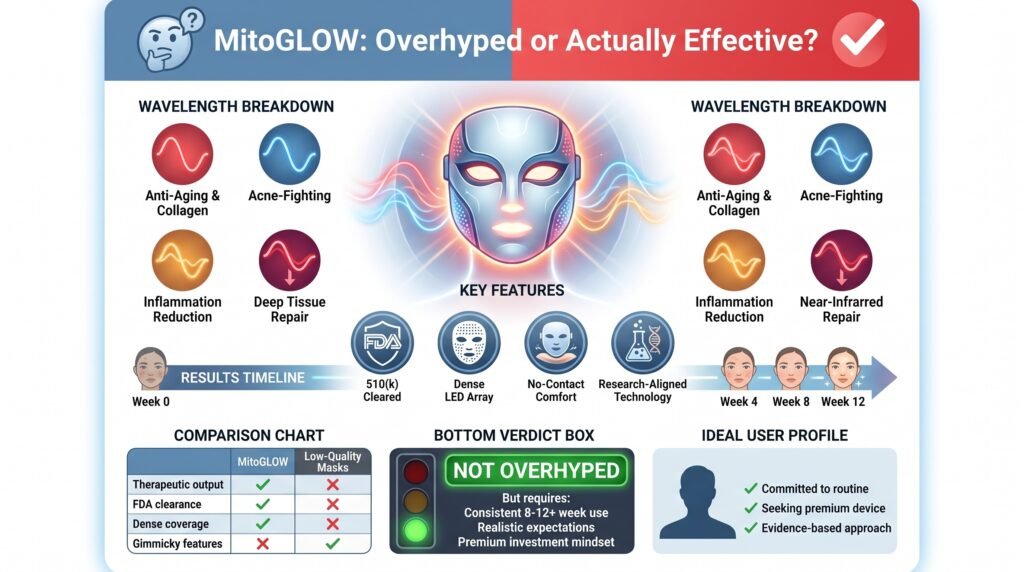
The MitoGLOW LED Mask is a high-quality, research-aligned red light therapy mask that delivers real therapeutic wavelengths, strong coverage, and FDA-cleared indications for acne and wrinkles.
- It uses multiple clinically relevant wavelengths (red, blue, amber, near-infrared) to target acne, inflammation, and aging simultaneously.
- The non-contact “hover” design improves comfort and avoids common mask issues like pressure and uneven light exposure.
- It stands out for dense LED coverage, verified output, and thoughtful engineering, rather than gimmicky features.
- FDA 510(k) clearance adds legitimacy compared to many low-quality LED masks.
Bottom line:
It’s not overhyped—but results depend heavily on consistent use (8–12+ weeks) and realistic expectations. It’s best suited for users who want a premium at-home device and will actually stick to a routine.
🧾 Table of Contents
- Introduction
- What Makes the MitoGLOW Mask Different
- The Five Modes (And When to Use Each One)
- Power Output and Why It Matters
- Real Timeline for Results
- Cost-Savings Calculator
- Who This Actually Works For
- What Actually Makes MitoGLOW Stand Out
- Final Take
- Common Questions People Actually Ask
Introduction
The MitoGLOW LED face mask delivers serious results for anti-aging and acne treatment without the hassle of clinical appointments. What stands out most is the combination of four different wavelengths (red, near-infrared, blue, and amber) that actually work on different skin concerns at the same time.
The hard-shell design keeps the LEDs at the right distance from your face, which makes those 10-minute sessions way more comfortable than the cheaper fabric masks that press against your skin. Plus, it scored 78 out of 100 in independent testing, the highest score recorded for any LED face mask tested so far.
The battery operation means you can use it anywhere without dealing with cords, and the FDA clearance gives you confidence that this thing actually does what it claims.
What Makes the MitoGLOW Mask Different
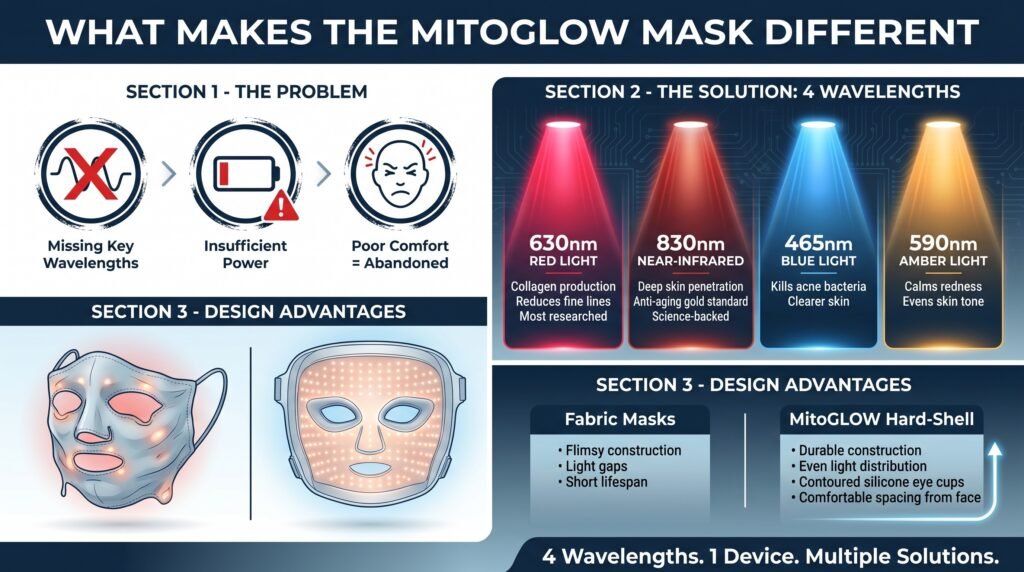
Most at-home LED masks cut corners somewhere. They either skip the wavelengths that matter, don’t deliver enough power, or they’re uncomfortable enough that you stop using them after a few weeks.
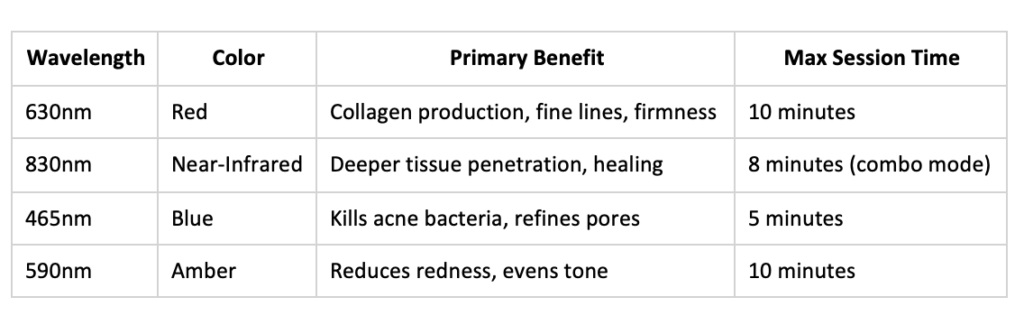
The MitoGLOW includes all four wavelengths that actually matter for skin health. The 630nm red light and 830nm near-infrared are the gold standard for collagen production and reducing fine lines.
These wavelengths have the most research backing them up.
Then you get 465nm blue light for killing acne bacteria and 590nm amber light for calming redness and evening out skin tone.
Having all four in one device saves you from buying separate tools for different problems. If you’re dealing with wrinkles and occasional breakouts (which happens more than people talk about), you can switch between modes instead of juggling many devices.
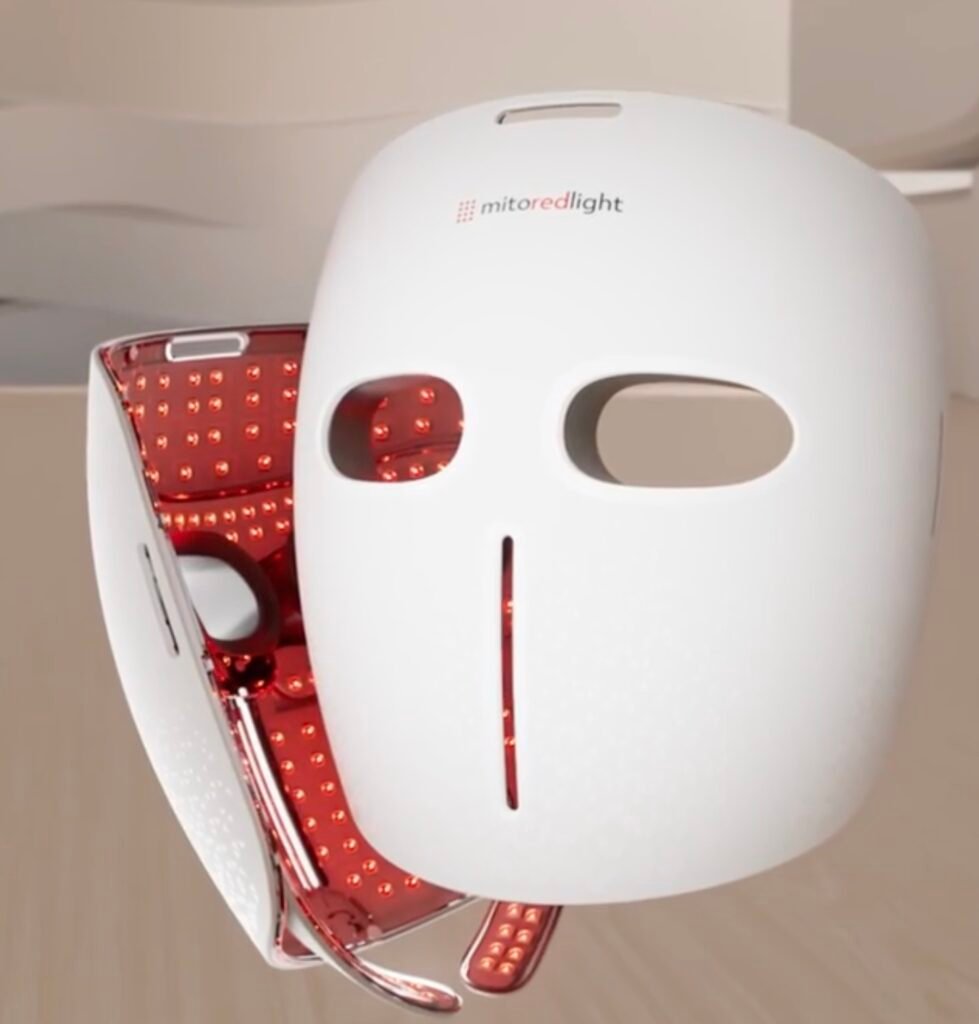
The hard-shell design is a bigger deal than it sounds. Fabric masks feel flimsy and they break down faster.
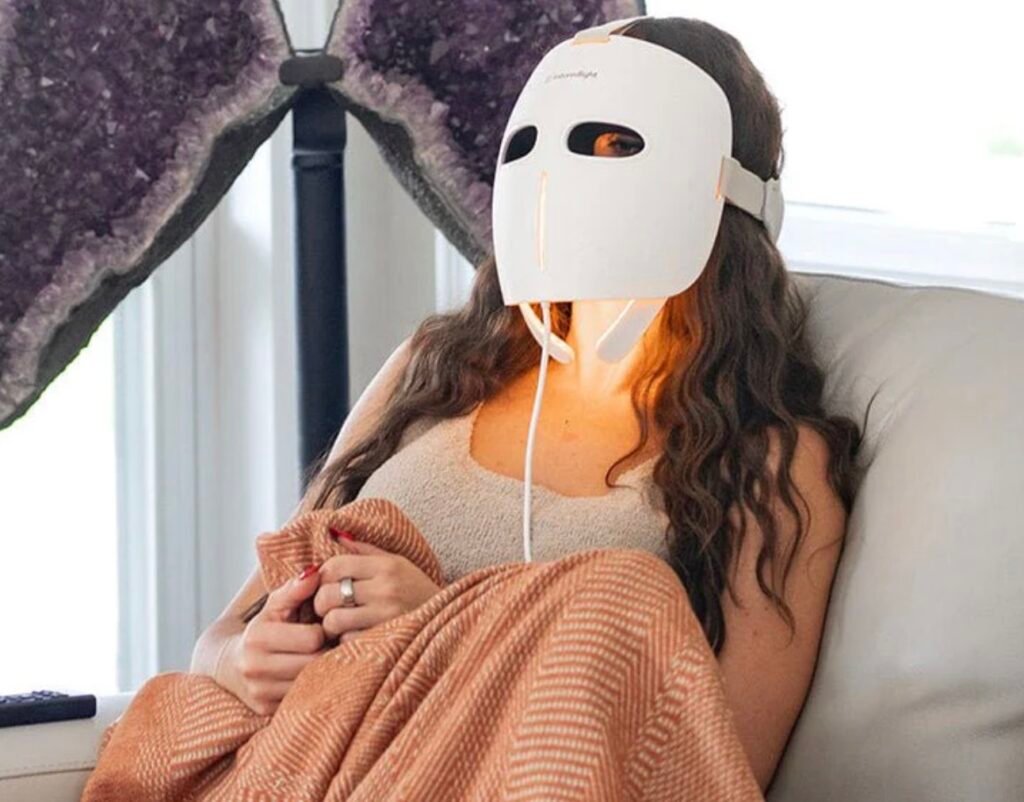
The MitoGLOW sits slightly away from your face, which distributes the light better and feels less claustrophobic during use.
The silicone cups around the eyes actually contour to your face instead of leaving gaps.
The Five Modes (And When to Use Each One)
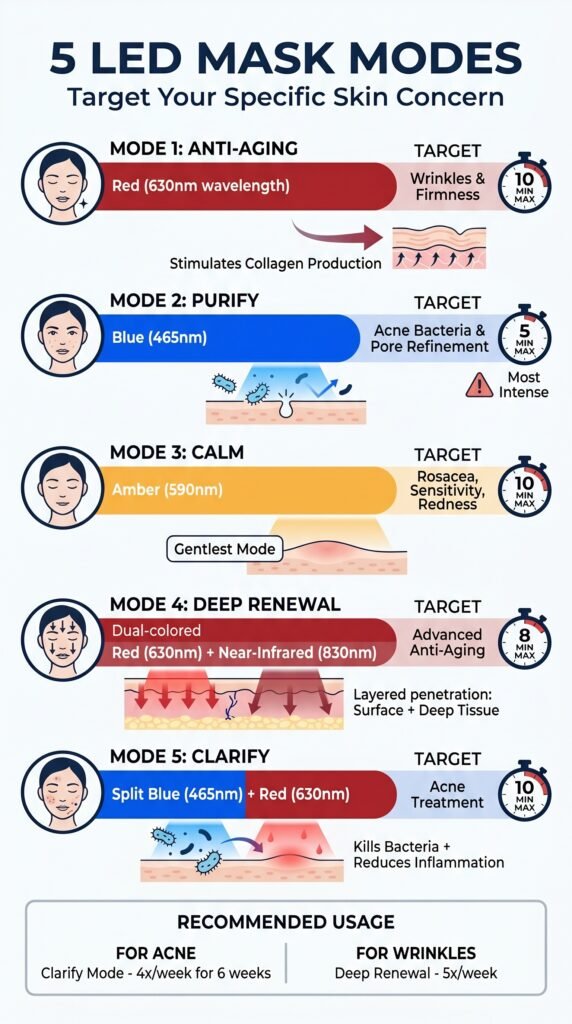
The mask has five different modes built in. Each one targets something specific.
Anti-Aging Mode uses pure red light at 630nm. This is your main mode if wrinkles and firmness are the priority.
You can use it for up to 10 minutes per session.
This wavelength penetrates deep enough to stimulate collagen production, which is what actually reduces fine lines over time (not overnight, but consistently over weeks).
Purify Mode switches to blue light at 465nm. This kills the bacteria that causes acne and helps refine pores.
The catch is you can only use it for 5 minutes max because blue light is more intense.
Shorter sessions are enough to get the job done without irritating your skin.
Calm Mode uses amber light at 590nm. This is great if you have rosacea, sensitivity, or just general redness.
It’s gentler than the other modes and you can go up to 10 minutes.
Some people alternate between Anti-Aging and Calm Mode on different days to balance results with skin comfort.
Deep Renewal Mode combines red (630nm) and near-infrared (830nm) together. This is where things get interesting… the near-infrared penetrates even deeper than red light alone, so you’re getting surface-level rejuvenation plus deeper tissue benefits at the same time.
Max session is 8 minutes for this one.
If you’re serious about anti-aging, this mode is probably going to be your go-to.
Clarify Mode mixes blue (465nm) and red (630nm) light. Blue handles the bacteria, red calms inflammation and supports healing.
It’s a two-pronged approach for acne.
You get up to 10 minutes for this combo mode.
The manufacturer recommends different frequencies depending on what you’re trying to fix. For acne, they suggest Clarify Mode four times per week for six weeks straight.
For wrinkles, Deep Renewal Mode five times weekly works better.
These aren’t random suggestions, they’re based on how long it takes for light therapy to create measurable changes at the cellular level.
Power Output and Why It Matters
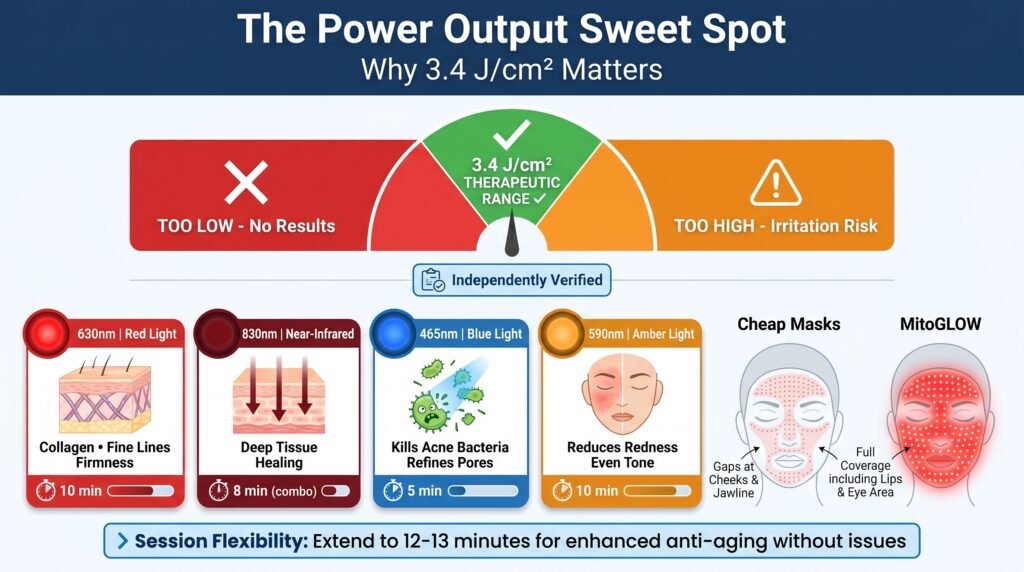
The MitoGLOW delivers 3.4 joules per square centimeter over 10 minutes. If that sounds technical, here’s why it matters: dosage is everything in red light therapy.
Too little power and you’re basically doing nothing.
Too much and you risk irritation or diminishing returns.
3.4 J/cm² sits right in the therapeutic range. It’s not the absolute highest you can get (some professional panels go higher), but it’s enough to produce real results without overdoing it.
Independent reviewers confirmed this using actual measurements, not just marketing claims.
Because the mask has a hard shell with LEDs at varying distances, some reviewers extended their sessions to 12-13 minutes without issues. That flexibility is useful if you want to push the dosage slightly higher for anti-aging goals specifically.
The LED density is high, which means the light distributes evenly across your entire face. Cheaper masks have gaps in coverage, especially around the cheeks and jawline.
The MitoGLOW covers everything, including your lips and eye area, which are the spots where aging shows up first anyway.
Real Timeline for Results
Red light therapy takes time. You’re not going to use this once and wake up with a different skin. That’s just not how cellular processes work.
For anti-aging (wrinkles, firmness, texture), most people notice subtle changes around 3-4 weeks of consistent use. The bigger improvements show up at 8-12 weeks.
That’s when collagen production has actually ramped up enough to make a visible difference.
For acne, the recommended timeline is six weeks of regular use before you judge whether it’s working. Blue light kills bacteria pretty quickly, but reducing breakouts overall takes longer because you’re dealing with cycles of inflammation and healing.
The results compound over time, which makes the upfront cost of the device way more reasonable than ongoing appointments.
The FDA cleared this mask for treating mild to moderate acne and full-face wrinkles, so the claims are actually regulated and backed by clinical evidence. That matters more than random testimonials or vague marketing language.
The advantage over clinical sessions is pretty obvious. You’re not paying $75-125 per appointment and taking time off work or rearranging your schedule. You’re spending 10 minutes at home while doing other stuff. And saving a small fortune doing it.
When comparing these at-home red light masks to the cost of professional sessions multiple times a week, the Mito Glow, at $499 (price depending on current promotions) pays for itself in less than a month. Then free sessions for life.
The MitoGLOW is also HSA/FSA eligible, which allows you to use pre-tax dollars to get additional savings.
See the cost savings calculator below, crunch the real-time savings numbers of at-home red light therapy vs clinical sessions. Bookmark this page and come back whenever you are comparing the cost of red light therapy providers in your area.
Red Light Therapy Savings Calculator
Professional red light therapy sessions cost $75-$125 each, and with 2-3 sessions per week needed for consistent results, the costs add up quickly. See how much you can save with the MitoGLOW at-home red light therapy mask.
Who This Actually Works For
The MitoGLOW works best for specific groups of people dealing with specific problems.
If you’re focused on aging, wrinkles, sagging, and loss of firmness, this device targets exactly those concerns. The red and near-infrared wavelengths have the strongest research backing for collagen production and skin health.
People in their 40s, 50s, and 60s see the most dramatic improvements because that’s when collagen decline really accelerates.
If you have mild to moderate acne, the blue light mode directly addresses the bacterial component. The Clarify Mode (blue + red combo) adds anti-inflammatory benefits on top of bacteria control, which speeds up healing and reduces the chance of scarring.
If you deal with rosacea or general redness, the Calm Mode amber light is designed specifically for that. It’s gentler than aggressive treatments and works well for reactive or sensitive skin types.
Biohackers and wellness people like this device because it combines many therapies in one tool. You’re getting cellular-level benefits from near-infrared light, surface-level improvements from red light, and targeted treatment from blue/amber, depending on what you need that day.
Fitness people sometimes use red light therapy for muscle recovery (there’s research on that too), and while this mask is focused on facial skin, the near-infrared wavelength does provide some systemic benefits. That’s more of a bonus than the primary use case, though.
The device only works if you actually use it consistently. That sounds obvious, but it’s the main reason at-home devices “fail” for people.
If you can’t commit to 3-5 sessions per week for at least 8-12 weeks, you probably won’t see results worth the money. Red light therapy is not a one-and-done treatment.
Hence, having an at-home device that you can use at any time will lower the friction of maintaining consistency.
If you’re ready to try at-home red light therapy, you can check the current price and any bundle deals on the official MitoGLOW site by clicking the button below. Sometimes they include accessories or extra session modes.
What Actually Makes MitoGLOW Stand Out
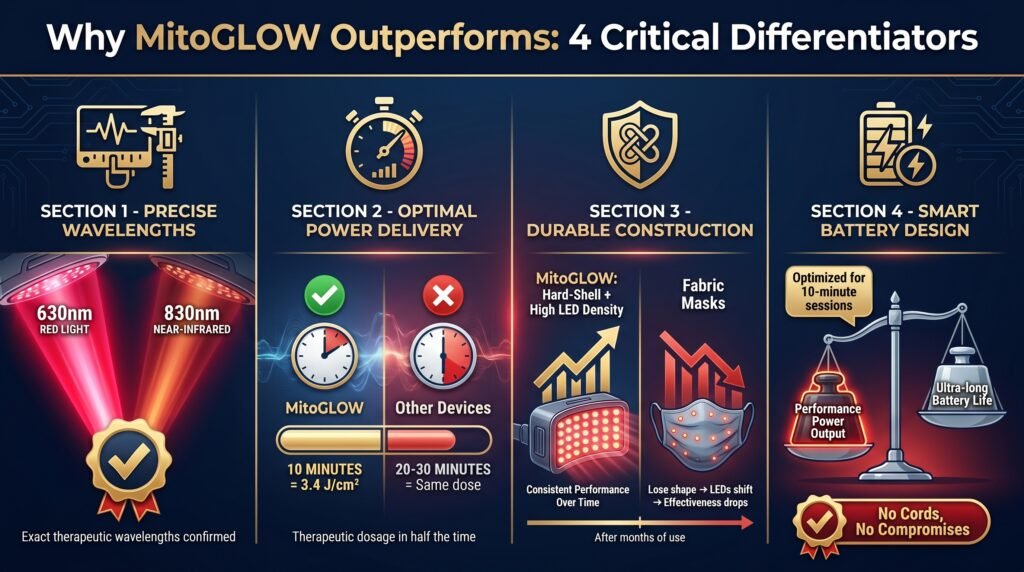
The MitoGLOW delivers actual 630nm red light and actual 830nm near-infrared, confirmed through independent measurement.
The power density hits the therapeutic range at 3.4 J/cm² over 10 minutes. Some devices deliver lower power and compensate by recommending longer sessions, which gets inconvenient.
The MitoGLOW delivers an adequate dosage in a reasonable timeframe.
The build quality holds up better than the fabric choices. Hard-shell construction with high LED density means consistent performance over time.
Fabric masks lose their shape, LEDs shift position, and effectiveness drops after a few months of regular use.
The battery operation removes the hassle of cord management without sacrificing power. Some battery-operated masks cut corners on LED output to extend battery life.
The MitoGLOW prioritizes performance over ultra-long battery life, which is the right tradeoff for a device you’re only using 10 minutes at a time.
Ready to try at-home red light therapy? Check current pricing and package options on the official MitoGLOW site to see what’s included by clicking the banner below.
Final Take
The MitoGLOW delivers on the core requirements for effective at-home red light therapy. It has the right wavelengths, adequate power output, accurate LED placement, and strong facial coverage.
The hard-shell design is more durable and hygienic than fabric masks. The battery operation adds genuine convenience without sacrificing performance.
The five modes give you flexibility to target different skin concerns without buying many devices.
The main limitation is the time commitment. This only works if you use it consistently, 3-5 times per week for 8-12 weeks, at least before judging results.
That’s not a device problem; that’s just how red light therapy works at the cellular level.
If you’ve been considering professional red light therapy but hesitated because of cost or scheduling hassles, this device removes those barriers. The per-use cost drops dramatically after the initial purchase.
You’re getting clinical-grade treatment at home on your own schedule.
If you’re skeptical about at-home devices in general, the independent testing and FDA clearance provide more confidence than most consumer wellness products.
The wavelengths are verified, the power output is measured, and the claims are regulated.
For people dealing with visible aging, chronic acne, or skin sensitivity, the MitoGLOW addresses those specific concerns with targeted wavelengths backed by research. The four-wavelength system means you’re not locked into one treatment approach.
The device works best for people who will actually commit to using it. If you can dedicate 10 minutes, 3-5 times per week, for at least two months, you’ll see measurable improvements in skin texture, firmness, and overall appearance.
If you can’t commit to that schedule, the device probably isn’t worth the investment.
Want to see how this compares to clinical treatments near you? Most dermatology clinics charge $75-125 per red light session. Grab the MitoGLOW by clicking the button below. It pays for itself pretty fast if you were considering professional treatments anyway.
Common Questions People Actually Ask
How long until you actually see changes?
Skin texture and brightness usually show up first, around 3-4 weeks of regular use. Deeper collagen effects and visible wrinkle reduction take 8-12 weeks.
That timeline is consistent across research studies, not just marketing claims.
Can you use it if you have sensitive skin?
Red and amber wavelengths are gentle enough for most sensitive skin types. Starting with shorter sessions in Calm Mode or Anti-Aging Mode works well.
Blue light is more intense, so if you have reactive skin, use Purify Mode sparingly and watch for any irritation.
What about using it with skincare products?
You can use it with skincare, and the manufacturer actually recommends pairing it with light-responsive or photoactive ingredients to boost results. Avoid heavy oils or thick occlusive products right before a session, they can block light penetration.
Lightweight serums work better.
Is the battery operation a problem?
For most people, no. Battery operation means no cord management, which makes it easier to use while multitasking.
You’ll need to recharge between uses, but if you’re doing 3-5 sessions per week, that’s manageable.
It’s more convenient than limiting unless you forget to charge it.
Who should avoid this device?
The mask is designed for adult facial use. If you have active skin cancer, photosensitive conditions, or you’re on medications that increase light sensitivity, check with a dermatologist first.
The same goes for pregnancy; the research on red light therapy during pregnancy is limited, so better to wait or get medical clearance.
Can you use it every day?
The manufacturer recommends 3-5 times per week, depending on your goals. More is not always better with light therapy.
Your cells need time to respond to the treatment between sessions.
Daily use won’t hurt you, but it probably won’t speed up results either.
This article includes affiliate links. If you click through and make a purchase, I may receive a small commission. This helps support the site and allows me to keep creating helpful content at no extra cost to you.