Key Takeaways
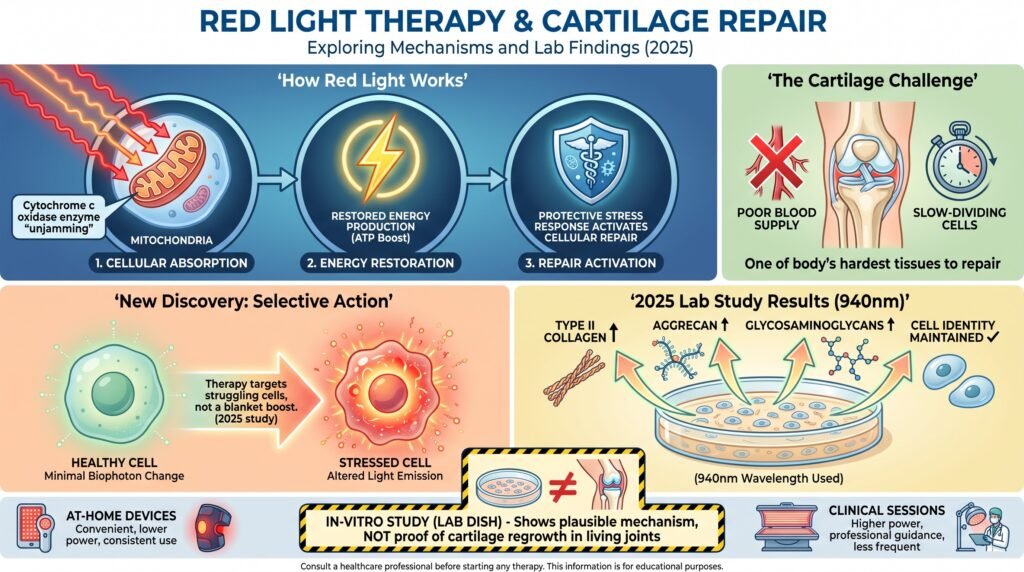
Red light therapy’s basic mechanism is well-established: red/near-infrared light frees up a jammed enzyme (cytochrome c oxidase) in mitochondria, restoring energy production, while also triggering a small protective stress response that switches on cellular repair.
Newer, more speculative research suggests cells may also emit faint light (“biophotons”) as a form of internal signaling — and a 2025 study found red light altered this light emission mainly in stressed cells, not healthy ones, suggesting the therapy works selectively where cells are struggling rather than as a blanket boost. This idea gets tested against cartilage, one of the body’s hardest tissues to repair due to poor blood supply and slow-dividing cells.
A late-2025 lab study found that 940nm near-infrared light exposure increased chondrocytes’ production of key cartilage-building molecules (type II collagen, aggrecan, glycosaminoglycans) and helped the cells maintain their proper identity. Important caveat: this was an in vitro (petri dish) study, not a clinical trial in a living joint, so it points to a plausible mechanism rather than proof that red light devices regrow cartilage in real knees. The article also covers practical/cost considerations comparing at-home devices (like the Kineon Move+ Pro) to clinical sessions.
Try Kineon’s 30-day trial as well as HSA/FSA-eligible pre-tax savings. Find out more details and receive an additional 10% off here. Use the Coupon Code: REDLIGHT.
Table of Contents
- Introduction
- The Established Science: Light, Mitochondria, and a Stuck Enzyme
- The Frontier: Do Your Cells Actually Emit Light?
- Cartilage: The Toughest Test Case
- Where This Shows Up in Practice
- At-Home Red Light vs. Professional Sessions: The Financial Calculation Changes by Situation
- The Bigger Picture
- FAQ – People Also Asked
Introduction
For years, red light therapy has been explained with a fairly simple story: shine red or near-infrared light on the body, the mitochondria absorb it, and cells make more energy. That story is real, well-documented, and worth understanding on its own.
But a wave of newer research is suggesting something stranger and more interesting underneath it — that cells may not just be receiving light; they may be emitting it, and using it to communicate. Red light therapy, in this emerging view, isn’t just an energy top-up. It may be joining a conversation your cells are already having.
It’s worth being upfront about where this article sits on the science spectrum. Some of what follows is well-established cell biology that’s been replicated for over a decade. Some of it is recent, some of it is still in preprint, and some of it comes from petri-dish studies rather than living human bodies.
None of it means you should expect a red light panel to regrow cartilage overnight. But the direction of the research is genuinely fascinating, and it helps explain why red light therapy keeps showing up in places like sports medicine, joint recovery, and skin health, where you wouldn’t necessarily expect a “light bulb” to make a difference.
The Established Science: Light, Mitochondria, and a Stuck Enzyme
Before getting into the frontier stuff, it helps to ground this in the mechanism scientists already understand well. About 10 to 15 years ago, the idea that red and near-infrared light could meaningfully affect human cells was met with skepticism. Today, the core mechanism is well documented.
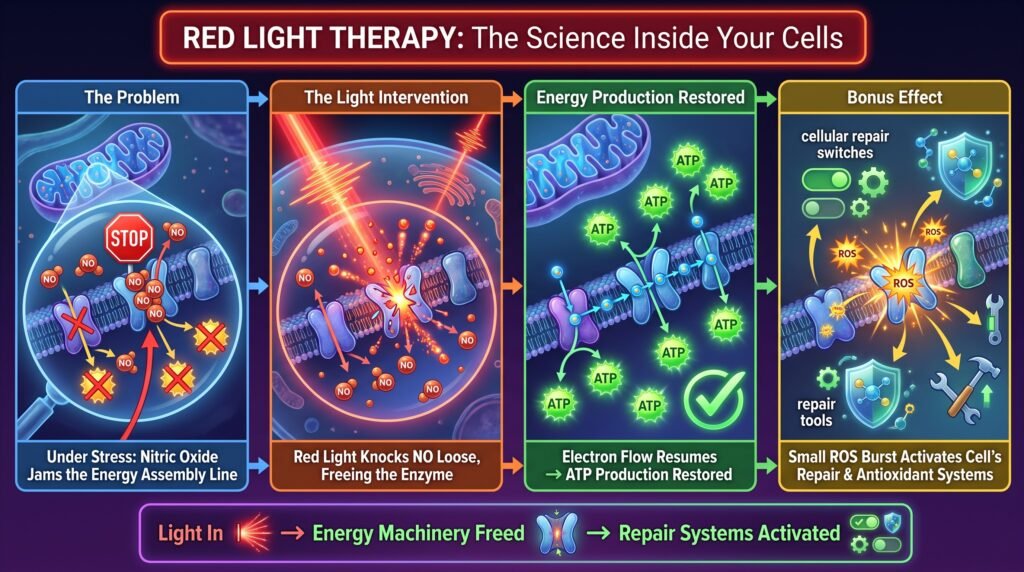
When red or near-infrared light hits your cells, it’s absorbed primarily by an enzyme called cytochrome c oxidase, a key component of the electron transport chain, the assembly line inside mitochondria that produces ATP, the molecule cells use as energy currency. Under stress, a molecule called nitric oxide can bind to this enzyme and effectively jam the assembly line, choking off energy production. Red light appears to knock that nitric oxide loose, freeing the enzyme so electron flow and ATP production can resume.
There’s a second layer to this. The light also seems to trigger a brief, small burst of reactive oxygen species. Rather than being purely damaging, this modest burst of oxidative stress acts as a signal that switches on the cell’s own antioxidant and repair pathways. In effect, a small stress nudges the cell into a repair mode.
Put simply: light goes in, the energy-making machinery runs more smoothly, and the cell’s internal repair systems get switched on. This is the accepted mechanism, and it already explains a lot of red light therapy’s real-world effects on things like inflammation and recovery.
The Frontier: Do Your Cells Actually Emit Light?
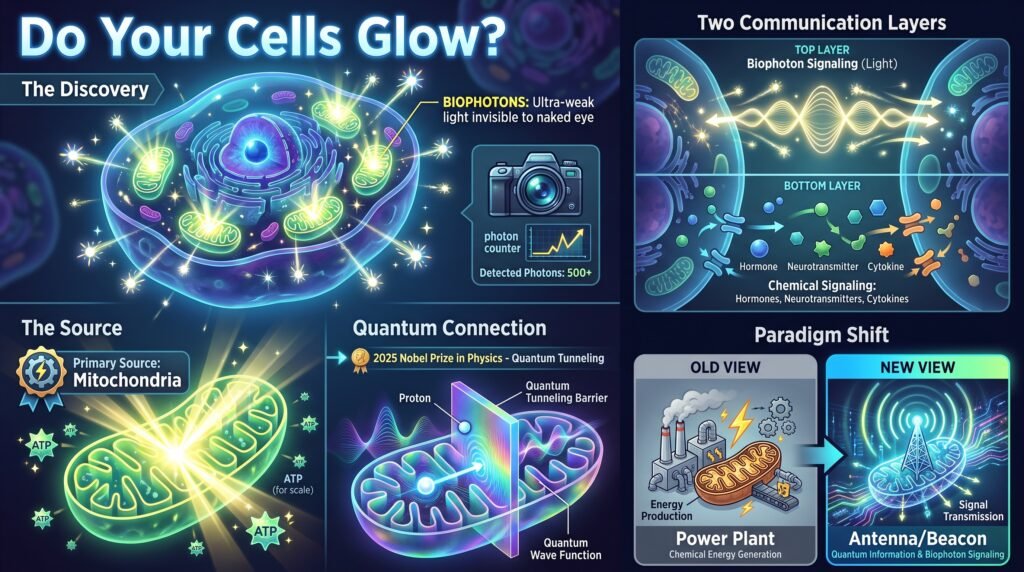
Here’s where things get stranger. For decades, researchers have known that living cells give off an extremely faint glow — so faint it’s invisible to the naked eye, but detectable with sensitive lab instruments capable of counting individual photons. These ultra-weak emissions are called biophotons, and the leading hypothesis is that mitochondria are their primary source.
Some researchers go a step further and hypothesize that this faint light isn’t just a byproduct — it might function as a signal, a way for cells to communicate something about their own internal state. If true, it would represent a layer of cellular communication running underneath the chemical signaling pathways (hormones, neurotransmitters, cytokines) that biology already recognizes.
This is where red light therapy research collides with the biophoton idea. A 2025 study looked at what happens to a cell’s biophoton emissions when it’s treated with red and near-infrared light. The finding was unexpected: in healthy, resting cells, red light barely changed their light emissions at all. But in stressed cells — ones exposed to a toxin or experiencing high oxidative stress — red light noticeably altered the biophoton output.
The implication is significant. It suggests red light isn’t a blunt instrument that revs up every cell equally, the way flipping a light switch floods a room. Instead, its effect appears to be context-dependent, doing little to cells that are already functioning well and stepping in specifically where a cell is struggling. That lines up with the established mitochondrial mechanism described above: a smoothly running electron transport chain doesn’t have much for the light to “fix,” so healthy cells show little response. Struggling ones, with jammed enzymes and disrupted output, have more room to respond — and apparently do.
That reframes red light less as a performance-enhancer for healthy tissue and more as an adaptive, responsive system — one that shows up where dysfunction already exists. It may also help explain an observation that comes up often anecdotally and in early research: people dealing with some degree of metabolic dysfunction or tissue stress often report noticing the biggest effects, since that’s precisely where there’s more for the mechanism to act on.
It’s worth noting this research sits alongside a broader, growing interest in the mitochondria as more than simple energy factories. The 2025 Nobel Prize in Physics was awarded for work on quantum tunneling, and there’s active research exploring proton tunneling within mitochondria — the idea that these organelles may behave, at some level, like quantum machines rather than purely chemical ones. That’s a separate and even more speculative thread, but it’s part of why mitochondria are increasingly being described as antennas or beacons rather than just power plants.
Cartilage: The Toughest Test Case
If red light’s meaningful effects show up specifically where cells are stressed or struggling, an obvious question follows: what’s the most stubborn, hard-to-repair tissue in the body, and does light do anything there?
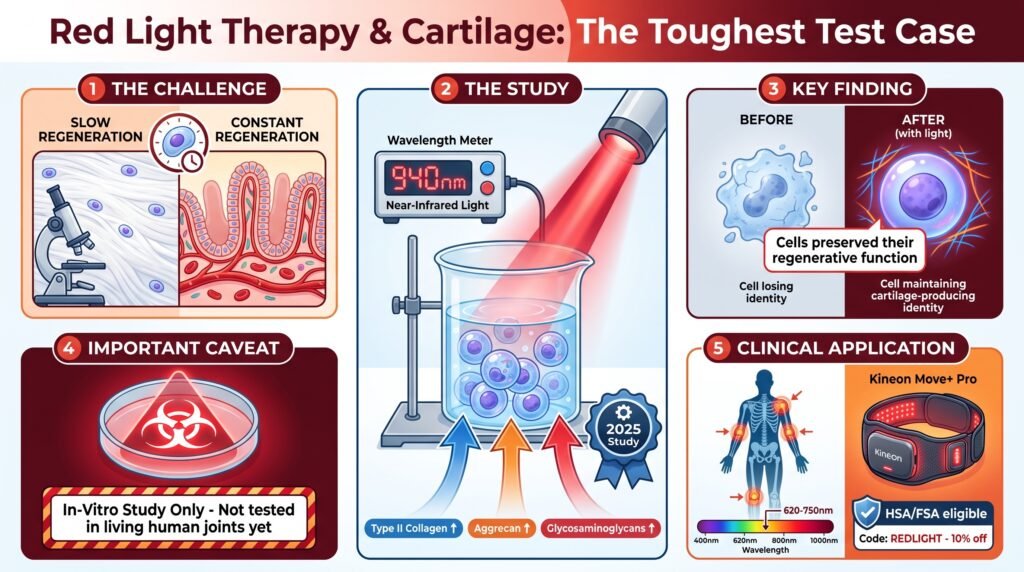
Cartilage is a strong candidate. It’s notoriously difficult to repair — it has almost no blood supply, and the cells responsible for maintaining it, chondrocytes, divide very slowly. Compare that to tissue like the gut lining, which regenerates constantly. Once cartilage wears down, the body has a limited capacity to rebuild it on its own, which is part of why joint problems are such a large area of medical spending, from injections to surgery.
A study from late 2025 examined what happens when chondrocytes are exposed to specific wavelengths of near-infrared light — in this case, 940 nanometers — in a lab setting. With the right exposure, the cells increased production of the core building blocks of healthy cartilage: type II collagen, aggrecan, and glycosaminoglycans, the components that form the cartilage matrix. In other words, cells that barely divide and rarely rebuild on their own appeared to ramp up matrix-building activity in response to light.
A second detail from the study is worth mentioning. When chondrocytes are grown outside the body, they commonly drift away from their normal cartilage-producing identity over time — a known problem in cartilage research. In this study, the light exposure appeared to help the cells hold onto that identity rather than degrade, which is notable because it’s a separate effect from simply producing more matrix protein.
The caveats here matter. This was an in-vitro study — isolated cells in a petri dish, not cartilage inside a living, weight-bearing human joint. It doesn’t mean a red light device will regrow damaged cartilage in a knee. But it does point to a plausible mechanism for something that was previously assumed almost impossible, in one of the least regenerative tissues in the body. That’s a meaningful shift in direction, even if it’s early.
A great red light device that provides targeted and concentrated dose of the specific wavelengths of light between 620 and 750 nanometers effective for cartilage treatment is the Kineon Move+ Pro.
Whether you are attempting to remedy pain and damage from knee pain, shoulder pain, or joint pain in general, Kineon is a convenient wearable red light device that can taken anywhere.
Click the button below learn more about the Kineon MOVE+ Pro and use promo code: REDLIGHT to receive 10% off. Also, Kineon products are HSA/FSA-eligible. This means you can use pre-tax dollars for additional savings on this red light device.
Important Note: This Kineon review is based on customer experiences and clinical research. Red light therapy should supplement other treatments, not replace medical advice from your doctor.
If you have severe acute injuries or chronic conditions, consult a healthcare provider before starting any new therapy.
Where This Shows Up in Practice
This research helps explain why red light and near-infrared devices have moved from a niche wellness gadget into more mainstream use, including in professional sports — red light therapy has become widespread across the NFL, reportedly starting with the San Francisco 49ers, as a low-risk, non-invasive recovery tool.
It also explains the growing interest in devices designed to deliver near-infrared light more deeply into tissue, rather than just at the skin surface, since deeper wavelengths are what allowed researchers to reach chondrocytes in cartilage. Devices using laser-based near-infrared light, worn over joints or the lower back, are built on this premise — that penetrating past the skin matters if the target is cartilage or deeper connective tissue rather than skin cells alone.
At-Home Red Light vs. Professional Sessions: The Financial Calculation Changes by Situation
The cost-benefit analysis shifts dramatically depending on your current spending and choices.
If you’re now paying $75-$100 per session for clinical red light therapy appointments twice weekly, you’re spending $600-$800 monthly. The Move+ Pro at $350-$450 (depending on promotion) pays for itself in roughly two weeks.
Even at the full retail price of $699, you break even in about three months.
This math is straightforward; the device absolutely makes financial sense compared to ongoing clinical appointments.
HSA and FSA eligibility significantly affects the real cost for Americans with these accounts. If you’re using pre-tax dollars, the effective cost drops by your marginal tax rate, potentially 20-30% depending on your bracket.
A $400 device becomes $280-$320 in real after-tax cost.
This makes the investment substantially more attractive for people with funded HSA or FSA accounts looking for eligible expenses.
The comparison to budget LED panels ($100-$200) hinges entirely on the penetration depth question. If your condition genuinely needs reaching deeper tissue structures, joint capsules, deep tendons, or muscle attachments near bone, the LED-only panels likely won’t deliver enough photon density at the necessary depth.
You’d be saving yourself a lot on a device that can’t effectively address your specific pathology.
But if you’re treating surface-level concerns where 2mm penetration suffices, the cheaper panels might work perfectly well.
Use the cost-savings calculator below to crunch the numbers and discover the real savings. Bookmark it for future use if you find another device within our reviews page worth comparing to.
💰 Red Light Therapy Savings Calculator
Discover how much you can save with Kineon’s at-home red light therapy compared to professional clinic sessions. Get professional-grade treatment from the comfort of your home.
The Bigger Picture
Step back, and the overall shape of this research tells a coherent, if still-unfolding, story. Red light does increase cellular energy production — that part is well established. But there’s growing evidence that cells are also emitting light of their own and may use it, in some form, to signal their internal state. Red light therapy’s effects appear concentrated where cells are stressed or dysfunctional rather than applied uniformly, and at the frontier, that targeted effect seems capable of nudging even historically stubborn tissue like cartilage toward rebuilding.
None of this is settled science. Biophoton signaling is still being debated, the cartilage findings are early and cell-based rather than clinical, and quantum-level explanations for mitochondrial behavior remain speculative. But the trajectory mirrors where mitochondrial research on red light stood about a decade and a half ago, before it became one of the more well-documented mechanisms in photobiomodulation. It’s a reminder that some of the more interesting stories about basic biology — how a body senses damage, communicates it, and starts repairing it — may not be fully written yet.
Click the button below to take advantage of a special promo code for 10% off.
FAQ – People Also Asked
Does red light therapy regrow cartilage?
Not proven yet. Lab studies show cartilage cells exposed to near-infrared light produce more of the building blocks used to make cartilage, but this was demonstrated in isolated cells in a dish, not in a living, weight-bearing joint.
How does red light therapy work at the cellular level?
It’s absorbed by an enzyme in mitochondria, freeing it from a molecule (nitric oxide) that can jam energy production, and triggers a small burst of oxidative stress that switches on the cell’s repair pathways.
What are biophotons?
Extremely faint light emissions given off by living cells, thought to originate mainly from mitochondria. Some researchers hypothesize they may function as a signaling system, though this remains debated.
Why is cartilage considered a difficult test case?
Cartilage has very little blood supply and its cells (chondrocytes) divide slowly, making it one of the least regenerative tissues in the body, unlike tissue such as the gut lining, which regenerates constantly.
What wavelength was used in the cartilage study?
940 nanometers, a near-infrared wavelength capable of penetrating past the skin to reach deeper tissue.
Is this settled science?
No. The article is explicit that biophoton signaling is still debated, the cartilage research is early-stage and cell-based rather than clinical, and related ideas about quantum effects in mitochondria remain speculative.
Do I need a professional-grade device to get penetration benefits, or will a budget LED panel work?
It depends on the target tissue. Budget panels may suffice for surface-level concerns (~2mm depth), but for deeper structures like joint capsules or tendons, a device designed for deeper penetration is likely needed.
Still undecided? Read our other reviews of affordable and effective red light therapy devices for at-home use here.
This article includes affiliate links. If you click through and make a purchase, I may receive a small commission. This helps support the site and allows me to keep creating helpful content at no extra cost to you.