Quick Summary
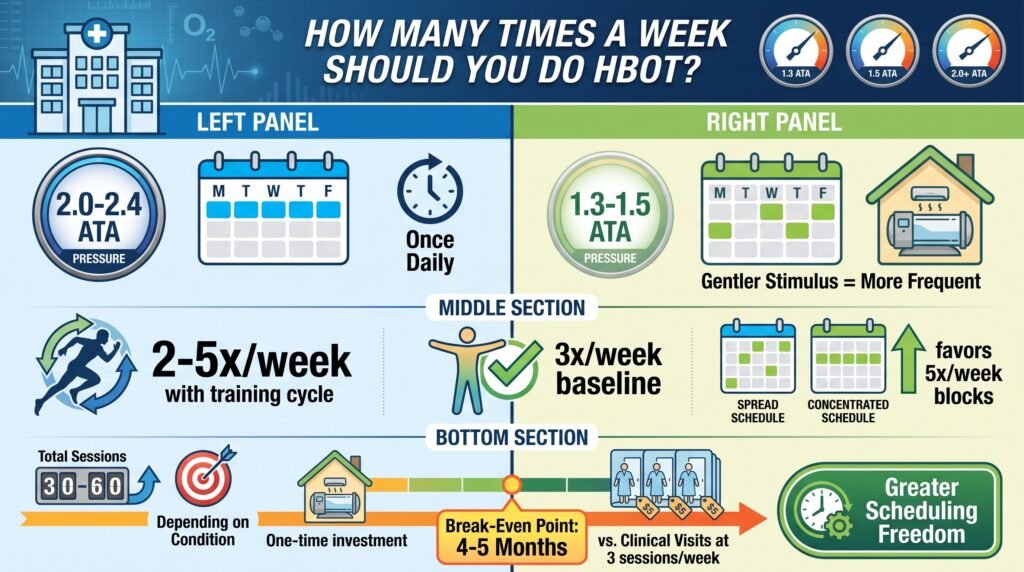
HBOT frequency depends on whether you’re using clinical or home chambers. Clinical protocols (2.0–2.4 ATA) typically run once daily, 5 days a week, for 30–60 total sessions depending on the condition. Mild home chambers (1.3–1.5 ATA) call for more frequent sessions—generally 3–5 times weekly—since lower pressure means a gentler stimulus.
Athletes often use 2–5 sessions weekly around training cycles, while wellness users tend to settle on 3 sessions weekly as a sustainable long-term baseline. Notably, frequency appears to matter more than total session count: concentrated blocks (e.g., 5x/week for 4 weeks) tend to outperform spread-out schedules with the same total sessions. Home chambers, while costlier upfront, can break even against clinical visits in about 4–5 months at 3 sessions/week and offer far greater scheduling flexibility.
Table of Contents
- Quick Summary
- Introduction
- Understanding What HBOT Frequency Really Means
- Clinical HBOT Frequency for Medical Conditions
- Wellness, Performance, and Home HBOT Frequency
- The Mild Chamber Question and How Lower Pressure Changes Frequency
- At-Home HBOT for Cost-Savings
- People Also Asked
Introduction
You’ve heard the buzz about hyperbaric oxygen therapy, maybe from a biohacking podcast, your sports medicine clinic, or a friend who swears it transformed their recovery. You’re intrigued, perhaps even ready to commit.
But then comes the question that stops everyone in their tracks: how many times a week should you actually do this?
Honestly, figuring out the right frequency is one of the most confusing aspects of HBOT. Some clinics push daily sessions for months on end, wellness centers suggest a casual twice-weekly routine, and your neighbor who bought a home chamber claims five times a week is the magic number.
Meanwhile, you’re just trying to figure out what actually works without wasting thousands of dollars or your precious time.
In this article, you’ll uncover evidence-based HBOT schedules for different goals, how home chambers change the equation, and practical strategies to design a frequency that matches your situation without burning out your calendar or your bank account.
Understanding What HBOT Frequency Really Means
When we talk about how often to do HBOT, we’re really talking about therapeutic dosing. Just like medication, HBOT has an optimal “dose” that balances effectiveness with safety, and frequency is a major component of that dose.
The dose of HBOT means more than just showing up and breathing oxygen. You’re looking at a combination of pressure level (measured in atmospheres absolute or ATA), oxygen concentration, session duration, how many times per week you go, and the total number of sessions in your treatment block.
Change any one of these variables, and you’ve changed your entire protocol.
Clinical HBOT typically happens at medical-grade pressures between 2.0 and 2.4 ATA with close to 100% oxygen delivered through a mask or hood inside a rigid chamber. This is the standard for hospital-based treatments addressing serious conditions like diabetic wounds, radiation injury, or carbon monoxide poisoning.
When you see research citing “HBOT protocols,” they’re almost always referring to this high-pressure, high-oxygen setup.
Home and wellness chambers operate quite differently. Most consumer units run at milder pressures, usually around 1.3 to 1.5 ATA, sometimes using ambient air or oxygen concentrators as opposed to pure medical-grade oxygen.
This changes the intensity of the stimulus and, so, how often you need to use them to see results.
So when someone tells you to do HBOT “five times a week,” you need to know whether we’re talking about clinical-grade chambers for wound healing, or mild chambers for general wellness. The context completely shifts the answer.
Clinical HBOT Frequency for Medical Conditions
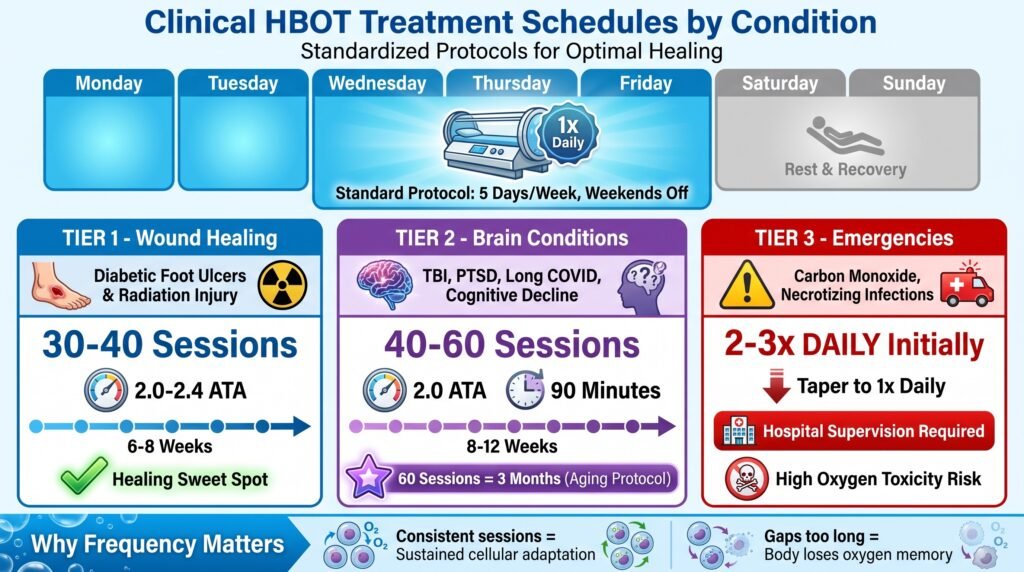
In medical settings treating approved indications, the frequency is remarkably standardized. The large majority of clinical protocols use once-daily sessions, five days per week, typically running Monday through Friday with weekends off. This pattern emerged from decades of hospital practice and has become the backbone of modern medical HBOT.
For diabetic foot ulcers, one of the most common HBOT indications, the standard protocol is 30 to 40 sessions at 2.0 to 2.4 ATA, delivered once a day on weekdays over six to eight weeks. Radiation tissue injury follows nearly identical scheduling.
These numbers represent the sweet spot where added healing effects build without pushing patients into oxygen toxicity territory.
Brain-focused protocols for traumatic brain injury, PTSD, long COVID, and cognitive decline tend to run longer. Many programs now use 40 to 60 sessions, still delivered once a day, five days per week, usually at around 2.0 ATA for 90 minutes per session.
A notable aging-focused research protocol used 60 sessions over three months.
That’s five sessions every single week for twelve weeks straight, with structured air breaks to maximize safety.
The daily weekday rhythm exists because maintaining high frequency during an intensive phase helps sustain the cellular and vascular adaptations that HBOT triggers.
Skip too many sessions or spread them out too thinly, and the body’s “memory” of the oxygen stimulus fades between exposures, blunting the added benefit.
In true medical emergencies like carbon monoxide poisoning or necrotizing soft tissue infections, frequency can spike dramatically. Some acute protocols call for two or even three sessions per day initially, then taper to once a day as the crisis stabilizes.
This aggressive dosing only happens under strict physician supervision in hospital settings, because the risk of oxygen toxicity climbs rapidly with many daily exposures.
Wellness, Performance, and Home HBOT Frequency
Outside the hospital, HBOT frequency becomes more flexible and personalized. Wellness users, athletes, and biohackers working with milder home chambers typically follow different rhythms that balance therapeutic benefit with real-world sustainability.
For athletic recovery and performance optimization, protocols commonly use two to five sessions per week during heavy training blocks. The exact frequency often depends on training intensity, competition schedule, and recovery needs.
Some athletes use HBOT preventatively at three sessions weekly year-round, while others ramp up to five sessions weekly in the weeks leading up to major events, then taper back during off-seasons.
General wellness users seeking cognitive clarity, energy optimization, or anti-aging benefits often settle into a rhythm of three sessions per week as their long-term baseline.
This frequency appears sustainable for most people, fitting into weekly schedules without dominating them, and research on mild HBOT suggests that three weekly sessions can maintain vascular and mitochondrial adaptations over time.
Intensive wellness blocks typically run higher. Many home users start with four to five sessions per week over an initial four to twelve-week period, then transition to lower-frequency maintenance.
This “block strategy” mirrors athletic periodization. You push hard during a concentrated phase to trigger adaptation, then back off to a sustainable level that preserves gains without constant high-dose exposure.
One really interesting finding from many sources is that frequency matters more than total session count. Five sessions per week for four weeks (20 total sessions) can produce greater, more lasting changes than two sessions per week for ten weeks (also 20 total sessions).
The more concentrated stimulus appears to create deeper cellular momentum, even though the total oxygen exposure time is identical.
The Mild Chamber Question and How Lower Pressure Changes Frequency
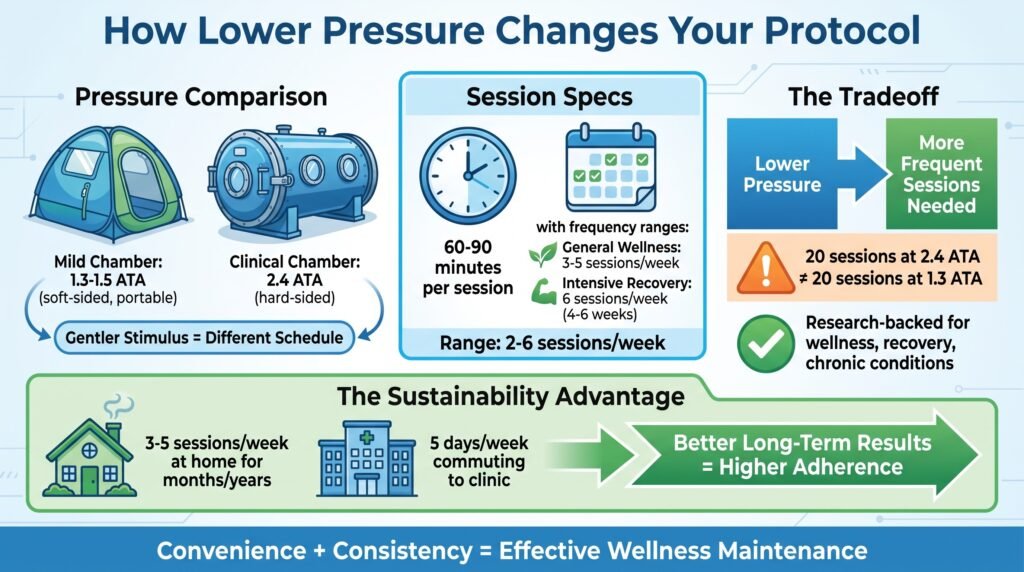
Absolutely, pressure level changes the equation. When you’re using chambers that operate below 1.5 ATA, which includes most soft-sided portable units and many consumer wellness chambers, the stimulus is gentler, and frequency recommendations shift accordingly.
Mild HBOT protocols at 1.3 to 1.5 ATA typically call for sessions lasting 60 to 90 minutes at pressure, with a frequency range of two to six times per week depending on your goals. For ongoing cognitive support and general wellness, three to five sessions weekly is the common recommendation.
For more intensive blocks targeting specific recovery goals, some protocols push up to six sessions per week over shorter timeframes like four to six weeks.
Because the pressure is lower and oxygen concentration may also be reduced compared to clinical chambers, you often need more frequent exposure or longer treatment blocks to approximate the effects of higher-pressure protocols. This doesn’t mean mild chambers are ineffective.
Plenty of research supports their use for wellness, recovery, and even some chronic conditions.
But you can’t just translate a 20-session clinical protocol at 2.4 ATA into a 20-session home protocol at 1.3 ATA and expect identical results.
That said, mild chambers offer a major advantage in terms of sustainability. Maintaining three to five sessions per week at home for months or years is far easier than commuting to a clinic five days a week.
For long-term wellness and maintenance, this convenience can actually produce better outcomes simply because adherence stays high.

At-Home HBOT for Cost-Savings
Clinical hyperbaric sessions commonly cost $150-250 per session at facilities using hard-shell chambers and 2.0 ATA protocols. Premium clinics or hospital settings can charge even more.
Some cities see broader ranges of $80-350 per session depending on the facility and chamber type.
If you are exploring at-home HBOT options, it’s even more critical to understand the frequency and dosing of these sessions since you will essentially be your own supervisor.
Hyperbaric Pro is a dynamic leader in Hyperbaric Chambers. They are a mission-driven company that is committed to delivering quality hyperbaric chambers. The Company’s Hyperbaric Chambers are tested for 5 years at three times the normal pressure for durability.
The real value of Hyperbaric Pro is time and consistency. Once the chamber is in your home, you’re not fighting for appointment slots, driving across town, or trying to line up your energy levels with clinic availability.
People with chronic illness, fatigue, pain, or kids at home regularly mention that scheduling sessions on their own timetable feels just as important as the money saved.
When you’re ready to calculate your personal break-even point, confirm current Hyperbaric Pro pricing through the link below and plug the numbers into a simple spreadsheet. Treat this like a serious investment, not an impulse buy.
Bookmark this page and come back to it whenever you are calculating the cost of professional sessions in your area vs. unlimited home use.
Hyperbaric Oxygen Chamber Cost Calculator
Compare the long-term costs of clinical hyperbaric sessions versus investing in an at-home chamber. See your break-even point and potential savings.
Clinical Sessions
Home Chamber
Break-Even Point
58 sessions (4.8 months)
Why Choose an At-Home Chamber?
Convenience: No travel time, scheduling hassles, or waiting rooms. Use your chamber whenever you want.
Cost Savings: Most users break even within 3-5 months with regular use (3 sessions/week).
Long-Term Value: After the first year, your effective cost per session drops dramatically – often to just $38-50 per session.
Privacy & Comfort: Enjoy treatments in the comfort of your own home with complete privacy.
For more information on HBOT maintenance schedules, frequency, and oxygen toxicity risks, designing your own personal HBOT schedule and more, read this article here.
People Also Asked
What does HBOT stand for?
HBOT stands for hyperbaric oxygen therapy. This treatment involves breathing oxygen in a pressurized chamber where atmospheric pressure is increased above normal levels.
The elevated pressure allows your lungs to gather more oxygen than would be possible when breathing pure oxygen at normal air pressure, and that oxygen gets dissolved into your blood plasma and tissues to promote healing.
How long does an HBOT session last?
Most HBOT sessions last between 60 and 120 minutes at therapeutic pressure. Clinical sessions for medical conditions typically run 90 minutes, while wellness sessions in mild chambers often range from 60 to 90 minutes.
The total time in the chamber is slightly longer when you factor in pressurization and depressurization periods, which can add 10 to 20 minutes to each session.
Can you do HBOT every day?
Yes, you can do HBOT daily, and many clinical protocols specifically call for once-daily sessions five or six days per week. However, doing more than one session per day increases the risk of oxygen toxicity and should only happen under strict medical supervision for emergencies.
Most people doing daily HBOT take weekends off to give their bodies recovery time.
How much does HBOT cost per session?
Clinical HBOT sessions at medical facilities typically cost between $100 and $250 per session, though prices can go higher in some areas. A full course of 30 to 40 sessions can run $4,000 to $10,000 or more.
Home chambers require a larger upfront investment, ranging from $5,000 for basic mild chambers to $30,000 or more for clinical-grade units, but they eliminate per-session costs for long-term use.
This article includes affiliate links. If you click through and make a purchase, I may receive a small commission. This helps support the site and allows me to keep creating helpful content at no extra cost to you.