Quick Summary
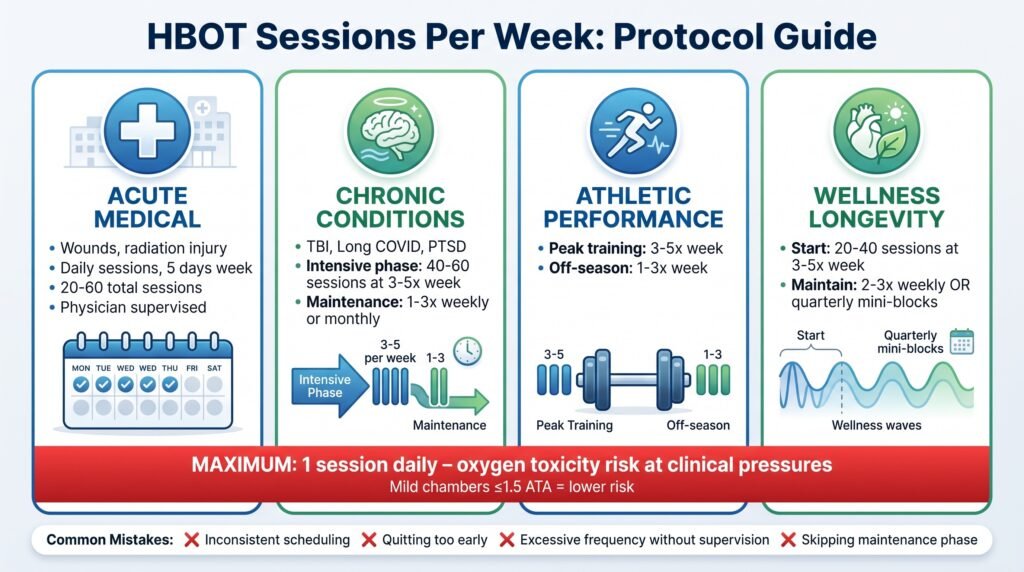
HBOT frequency depends on your goal and phase. Acute medical conditions (wounds, radiation injury) follow clinical protocols: once daily, five days a week, under physician supervision, for 20–60 sessions. Chronic conditions (TBI, long COVID, PTSD) typically need an intensive block of 40–60 sessions at 3–5x/week, followed by maintenance at 1–3 sessions weekly or monthly. Athletes match frequency to training cycles (3–5x/week during peak blocks, 1–3x/week off-season).
Wellness/longevity users often start with 20–40 sessions at 3–5x/week, then settle into 2–3 sessions weekly or quarterly “mini-blocks.” One session daily is the safe upper ceiling for most people — oxygen toxicity risk rises with frequency at clinical pressures, though mild chambers (≤1.5 ATA) carry much lower risk. The biggest mistakes: inconsistent scheduling, quitting before benefits accumulate, overdoing frequency without supervision, and abandoning maintenance after an intensive phase.
Table of Contents
- Quick Summary
- Maintenance Schedules After Your Intensive Phase
- Frequency and Oxygen Toxicity Risks
- Real-World Examples of HBOT Frequency in Action
- Designing Your Personal HBOT Frequency
- At-Home HBOT for Cost-Savings
- Key Takeaways
- People Also Asked
Maintenance Schedules After Your Intensive Phase
One of the biggest gaps in HBOT education is what to do after you finish an intensive treatment block. Most protocols focus on the initial 20, 40, or 60 sessions, but then people are left wondering whether to stop or keep going forever.
Clinical programs addressing chronic conditions often recommend ongoing maintenance at reduced frequency. One to two sessions per week is a common maintenance rhythm for people dealing with persistent issues like chronic inflammation, long-term post-concussion symptoms, or radiation injury aftereffects.
This keeps therapeutic oxygen levels elevated enough to support healing without requiring the time and cost of daily sessions indefinitely.
For wellness and performance users, quarterly or monthly “mini-blocks” have become popular. Instead of continuous weekly sessions, some people do a concentrated block of five to ten sessions (say, every day or every other day for two weeks), then take a finish break for one to three months before repeating.
This pulsed approach may align well with how the body responds to hormetic stressors: brief, intense stimuli followed by recovery and adaptation periods.
Another maintenance strategy is the steady low-dose approach of one session per week indefinitely. This works well for people who’ve achieved their initial goals but want to preserve gains or continue supporting long-term health.
One weekly session is manageable for most schedules and budgets, and it provides enough stimulus to keep mitochondrial and vascular benefits from completely decaying.
The key insight here is that maintenance frequency should match your goals and response. If you completed a 40-session block for TBI recovery and your symptoms are stable, you might need only one or two sessions per month to hold those gains.
If you’re using HBOT as part of an ongoing wellness and longevity strategy, a consistent two to three sessions weekly might make more sense.
Frequency and Oxygen Toxicity Risks
One of the most common concerns people raise about frequent HBOT is oxygen toxicity. This is actually a legitimate issue at clinical pressures with high oxygen concentrations, which is why medical protocols are so carefully controlled.
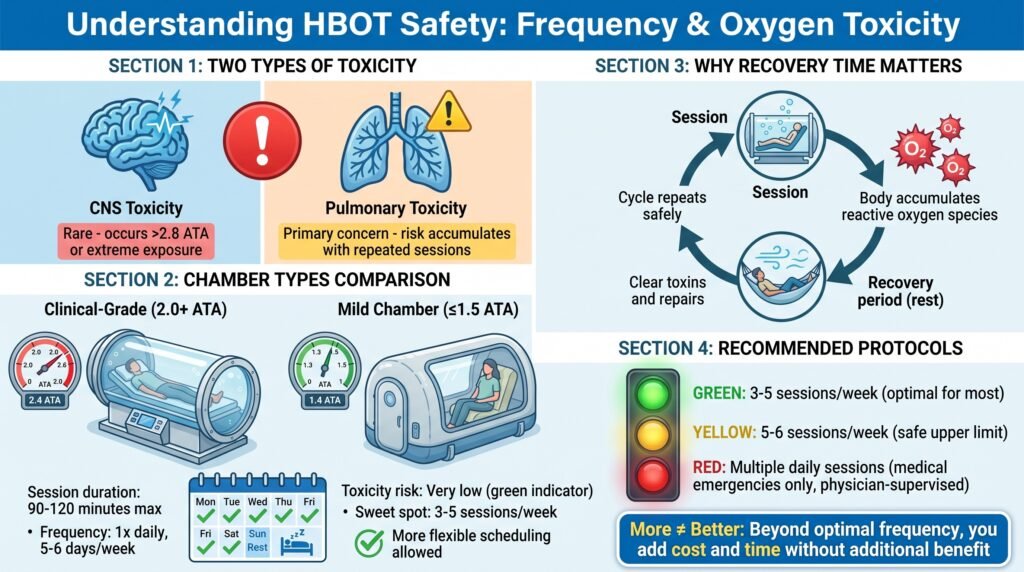
Oxygen toxicity comes in two main forms: central nervous system toxicity (which can cause seizures) and pulmonary toxicity (which can damage lung tissue). Central nervous system toxicity is rare and usually only happens at very high pressures (above 2.8 ATA) or with extremely long exposures.
Pulmonary toxicity is more relevant for typical HBOT use, and the risk is added. Your risk increases with repeated exposure over short timeframes.
Clinical guidelines manage this risk by limiting most protocols to one session per day, with session durations capped at 90 to 120 minutes at therapeutic pressure. The body needs time between sessions to clear reactive oxygen species and repair any oxidative stress.
This is why even aggressive medical protocols rarely exceed one session daily, and when they do (in true emergencies), that happens only for a few days under intensive monitoring.
For mild chambers operating at 1.5 ATA or below with ambient air or moderate oxygen supplementation, toxicity risk is extremely low. You’d need to spend many hours per day, many days in a row, to approach dangerous thresholds.
That said, more frequency doesn’t always equal better results even at mild pressures. Beyond a certain point, you’re not gaining additional benefit, just adding time and cost.
The practical takeaway is that one session per day, five or six days per week, is the upper limit for most people under most circumstances. If you’re using a clinical-grade chamber at 2.0+ ATA, stick to once a day with weekends off unless a physician specifically designs a more aggressive protocol.
If you’re using a mild chamber, you could theoretically do daily sessions for extended periods, but most people find three to five weekly sessions hit the sweet spot of benefit, safety, and lifestyle fit.
Real-World Examples of HBOT Frequency in Action
Looking at how different people structure their HBOT schedules based on real protocols and common scenarios helps clarify the practical application.
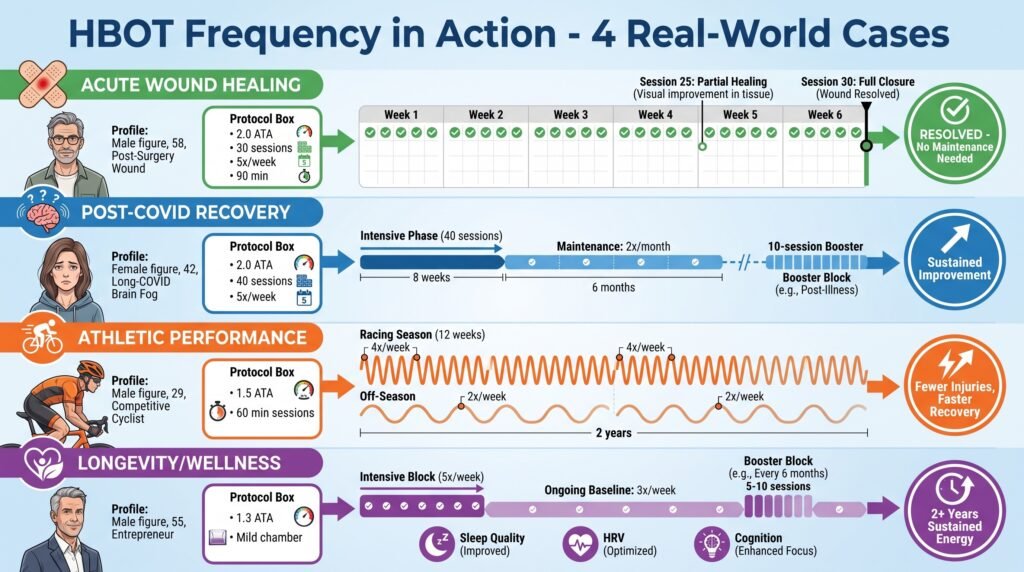
A 58-year-old man develops a non-healing surgical wound after a hip replacement. His wound care clinic prescribes 30 sessions of HBOT at 2.0 ATA, once a day, Monday through Friday.
He commits to six weeks of driving to the clinic every weekday for 90-minute sessions.
By session 25, the wound shows significant improvement, and by session 30, the wound has fully closed. No maintenance is needed because the acute problem has resolved.
A 42-year-old woman suffers from brain fog, fatigue, and concentration issues 18 months after COVID infection. She enrolls in a clinical program offering 40 sessions at 2.0 ATA, five days per week.
After eight weeks (40 sessions), her cognitive testing improves significantly.
She transitions to maintenance at two sessions per month for six months, then stops entirely while monitoring symptoms. A year later, she returns for a brief 10-session “booster block” and reports sustained improvement.
A 29-year-old competitive cyclist uses a home chamber at 1.5 ATA during his racing season. He follows a pattern of four sessions per week (Monday, Tuesday, Thursday, Friday) for 60 minutes each during his 12-week peak training block.
During his off-season, he reduces to two sessions per week for general recovery.
Over two years, this rhythm becomes his baseline training support, and he reports fewer injuries and faster recovery from hard efforts.
A 55-year-old entrepreneur interested in longevity purchases a mild home chamber (1.3 ATA). He starts with an intensive block of five sessions per week for eight weeks (40 total sessions).
He tracks sleep quality, HRV, and cognitive performance.
After the intensive phase, he shifts to three sessions per week indefinitely as part of his broader wellness routine alongside exercise, sauna, and nutrition optimization. Two years in, he reports sustained energy and mental clarity and repeats a 20-session intensive block every six months.
Designing Your Personal HBOT Frequency
So how do you actually decide how many times per week you should do HBOT? Start by clarifying your goal, your chamber type, and your constraints.
For acute medical conditions like diabetic ulcers, radiation injury, sudden hearing loss, or serious infections, follow clinical protocols. That almost always means once a day, five days per week, under physician supervision, until your condition improves or reaches a plateau.
Don’t try to freelance these protocols at home.
For chronic conditions and brain-related issues like TBI, long COVID, PTSD, or chronic inflammation, plan for a longer intensive block of 40 to 60 sessions at whatever frequency you can sustain consistently. If you have access to a clinic, five sessions per week is ideal.
If you’re using a home chamber, aim for at least three to five sessions weekly over two to three months, then transition to maintenance.
For athletic recovery and performance, match your HBOT frequency to your training cycles. Use three to five sessions per week during high-intensity training blocks or pre-competition phases, and reduce to one to three sessions weekly during lower-intensity periods or off-seasons.
Treat HBOT like any other training modality and periodize it.
For wellness, longevity, and cognitive optimization, start with an intensive block of 20 to 40 sessions at three to five sessions per week, then find your maintenance rhythm. Many people settle at two to three sessions weekly long-term, while others prefer quarterly intensive mini-blocks with breaks in between.
Track your response through energy, sleep, recovery, and mood metrics, and adjust accordingly.
For budget-conscious users, prioritize frequency over fancy equipment. Three consistent sessions per week in a mild home chamber will likely outperform sporadic visits to a high-end clinic.
Establishing a sustainable routine you can maintain for months, not just weeks, is critical.
Common Mistakes People Make with HBOT Frequency
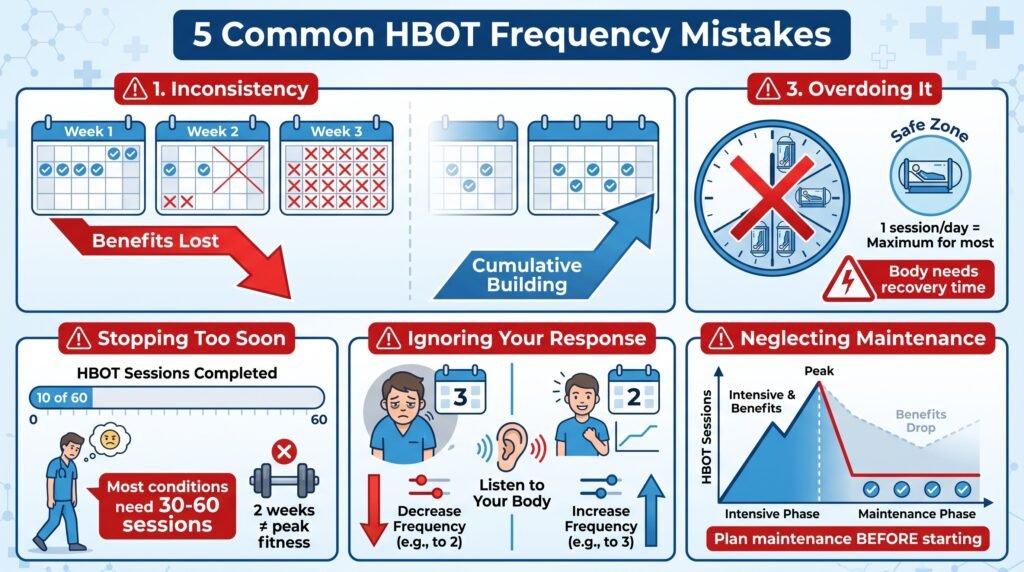
One of the biggest mistakes is inconsistency. People start strong with five sessions the first week, then drop to two the next week, then skip a week entirely.
HBOT benefits build cumulatively, and erratic schedules undermine that accumulation.
If you can only sustain two sessions per week, commit to two every single week as opposed to alternating between five and zero.
Another mistake is stopping too soon. Many conditions require 30, 40, or even 60 sessions before significant benefits appear.
Doing ten sessions, seeing minimal change, and quitting is like going to the gym for two weeks and expecting to be in peak shape.
HBOT is a gradual, added therapy for most non-emergency uses.
On the flip side, some people overdo it by thinking more frequency always equals better results. Doing two or three sessions per day without medical supervision, especially at higher pressures, is genuinely risky.
The body needs recovery time between oxygen exposures.
Respect the upper frequency limits. One session daily is the ceiling for most people.
A subtler mistake is ignoring your response. HBOT frequency shouldn’t be dogmatic.
If you’re following a three-session-per-week protocol but feeling run-down, listen to that feedback.
You might need to reduce frequency temporarily, adjust session duration, or look at other lifestyle factors like sleep, nutrition, or stress. Conversely, if you’re doing two sessions weekly and feeling great but not progressing toward your goal, you might need to increase frequency during an intensive push.
Finally, many people neglect the maintenance phase entirely. They finish an intensive block, feel better, stop completely, and then watch their gains slowly fade.
Planning your maintenance frequency before you even start intensive treatment helps you sustain results long-term.

At-Home HBOT for Cost-Savings
Clinical hyperbaric sessions commonly cost $150-250 per session at facilities using hard-shell chambers and 2.0 ATA protocols. Premium clinics or hospital settings can charge even more.
Some cities see broader ranges of $80-350 per session depending on the facility and chamber type.
If you are exploring at-home HBOT options, it’s even more critical to understand the frequency and dosing of these sessions since you will essentially be your own supervisor.
Hyperbaric Pro is a dynamic leader in Hyperbaric Chambers. They are a mission-driven company that is committed to delivering quality hyperbaric chambers. The Company’s Hyperbaric Chambers are tested for 5 years at three times the normal pressure for durability.
The real value of Hyperbaric Pro is time and consistency. Once the chamber is in your home, you’re not fighting for appointment slots, driving across town, or trying to line up your energy levels with clinic availability.
People with chronic illness, fatigue, pain, or kids at home regularly mention that scheduling sessions on their own timetable feels just as important as the money saved.
When you’re ready to calculate your personal break-even point, confirm current Hyperbaric Pro pricing through the link below and plug the numbers into a simple spreadsheet. Treat this like a serious investment, not an impulse buy.
Bookmark this page and come back to it whenever you are calculating the cost of professional sessions in your area vs. unlimited home use.
Hyperbaric Oxygen Chamber Cost Calculator
Compare the long-term costs of clinical hyperbaric sessions versus investing in an at-home chamber. See your break-even point and potential savings.
Clinical Sessions
Home Chamber
Break-Even Point
58 sessions (4.8 months)
Why Choose an At-Home Chamber?
Convenience: No travel time, scheduling hassles, or waiting rooms. Use your chamber whenever you want.
Cost Savings: Most users break even within 3-5 months with regular use (3 sessions/week).
Long-Term Value: After the first year, your effective cost per session drops dramatically – often to just $38-50 per session.
Privacy & Comfort: Enjoy treatments in the comfort of your own home with complete privacy.
For more information on clinical HBOT frequency for medical conditions, wellness, performance, and home HBOT frequency and more, read this article here.
Key Takeaways
How many times a week you should do HBOT depends on your goals, your chamber type, and your ability to stay consistent. Clinical protocols for serious medical conditions almost always use once-daily sessions, five days per week, for 20 to 60 total sessions.
Wellness and performance users typically thrive on three to five sessions weekly during intensive phases, then transition to one to three sessions weekly for maintenance.
Frequency matters more than total session count in many cases. Five concentrated sessions per week for a month often beats two sporadic sessions per week for two months, even though total exposure is similar.
Consistency is absolutely critical because erratic schedules undermine the added benefits HBOT depends on.
Mild home chambers at 1.3 to 1.5 ATA allow for sustainable long-term frequency that's really hard to maintain with clinic visits. Three sessions per week at home for a year can produce remarkable results for wellness and recovery goals, and home ownership eliminates the travel and cost barriers that tank adherence for many people.
Maintenance frequency after intensive phases is often overlooked but essential for sustaining gains. One to three sessions per week, or quarterly intensive mini-blocks, keep benefits alive without requiring indefinite daily commitment.
Plan your maintenance strategy before you finish your intensive phase.
People Also Asked
Does insurance cover hyperbaric oxygen therapy?
Insurance coverage for HBOT depends entirely on your specific condition and whether it's on the list of FDA-approved indications. Conditions like diabetic foot ulcers, radiation tissue damage, carbon monoxide poisoning, and certain infections are typically covered when medically necessary.
Wellness uses, cognitive enhancement, athletic recovery, and most off-label applications are generally not covered by insurance.
What conditions does HBOT treat?
HBOT has FDA approval for treating conditions including decompression sickness, carbon monoxide poisoning, diabetic wounds, radiation tissue damage, severe anemia, brain abscess, gas gangrene, crushing injury, sudden deafness, and certain infections.
Research also supports use for traumatic brain injury, stroke recovery, PTSD, long COVID, chronic inflammation, and various other conditions, though these may not be formally approved or covered by insurance.
Can I buy a hyperbaric chamber for home use?
Yes, you can purchase hyperbaric chambers for home use. Mild chambers operating at 1.3 to 1.5 ATA are available to consumers without a prescription in most places, while higher-pressure clinical chambers typically require medical oversight.
Prices range from around $5,000 for basic soft-sided chambers to $30,000 or more for hard-shell clinical-grade units with higher pressure capabilities.
What is mild hyperbaric oxygen therapy?
Mild hyperbaric oxygen therapy refers to treatment at lower pressures, typically 1.3 to 1.5 ATA, compared to clinical HBOT, which uses 2.0 to 2.4 ATA or higher. Mild chambers are commonly used for wellness, athletic recovery, cognitive enhancement, and general health optimization.
While the pressure is lower, consistent use over time can still produce meaningful benefits for many people.
How many HBOT sessions do you need for traumatic brain injury?
Most research protocols for traumatic brain injury use 40 to 60 HBOT sessions delivered at 1.5 to 2.0 ATA. Sessions are typically scheduled five days per week for 8 to 12 weeks.
Some people may need additional maintenance sessions after the initial intensive block, usually one to two sessions weekly or monthly depending on symptom response and progress.
This article includes affiliate links. If you click through and make a purchase, I may receive a small commission. This helps support the site and allows me to keep creating helpful content at no extra cost to you.