📌Quick Answer for People in a Hurry
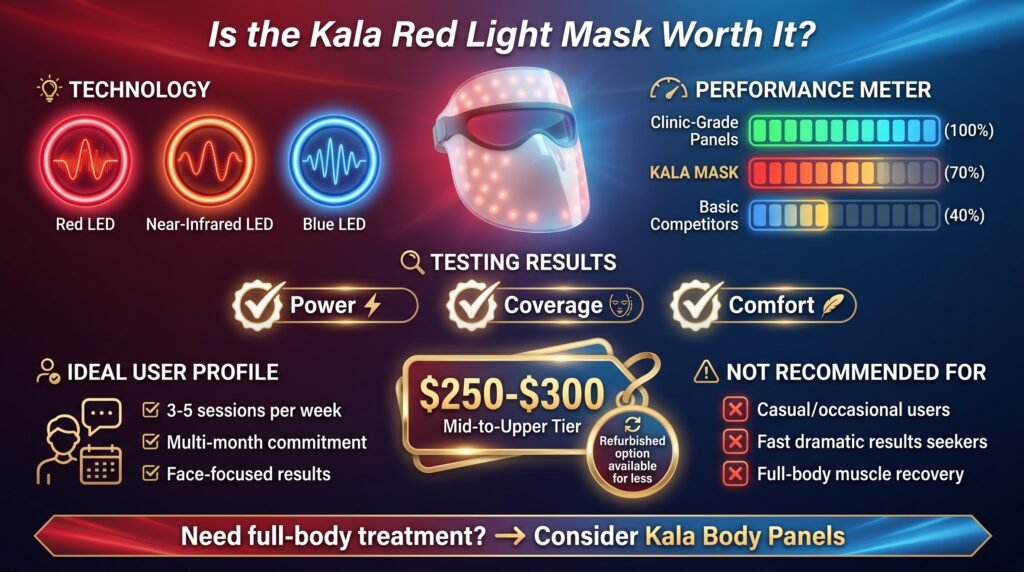
Kala’s red light face mask uses red, near-infrared, and blue LEDs and tested well against competitors for power, coverage, and comfort, though it sits below professional clinic-grade panels in intensity.
At roughly $250-300, it’s a mid-to-upper tier device that pays off mainly for people who’ll commit to 3-5 sessions a week for months; casual users or anyone wanting fast, dramatic results or full-body muscle recovery should look elsewhere (or consider Kala’s larger body panels). A refurbished “Renewed” option lowers the entry cost for the skeptical.
🧾 Table of Contents
- Brand Overview
- Kala Red Light Therapy Mask – Product Range Analysis
- Quality and Performance Testing vs Other Masks
- Pricing and Value Assessment
- Pros and Cons Summary
- Final Recommendation
- FAQ
Brand Overview
Kala built their whole company around red light therapy devices, not just random beauty gadgets. They sell the face mask, a therapy wand for sculpting and facial massage, and bigger body panels for athletes and people in recovery.
The face mask gets marketed specifically for skin rejuvenation and collagen support. They call it a medical-grade device with red, near-infrared, and blue LEDs designed to brighten and refresh skin. The body panels get pushed more toward runners and gym people for circulation and muscle fatigue.
What stands out is that Kala has an actual community. People use the #KalaFamily hashtag and post before-and-after photos pretty regularly.
That community angle matters because red light therapy only works if you keep doing it for weeks and months.
Devices that sit in closets are worthless, so having other people sharing timelines and progress shots helps with accountability.
The brand seems transparent about timelines too. They openly say some people see changes in 4-6 weeks while others need several months.
No wild promises about instant results.
Kala Red Light Therapy Mask – Product Range Analysis
Key Features and Design
For this kala red light therapy mask review, the main focus is on the face mask model (sometimes called the Kala Mask 2.0 or Red Light Face Mask, as well as renewed/refurbished versions).
Core design points:
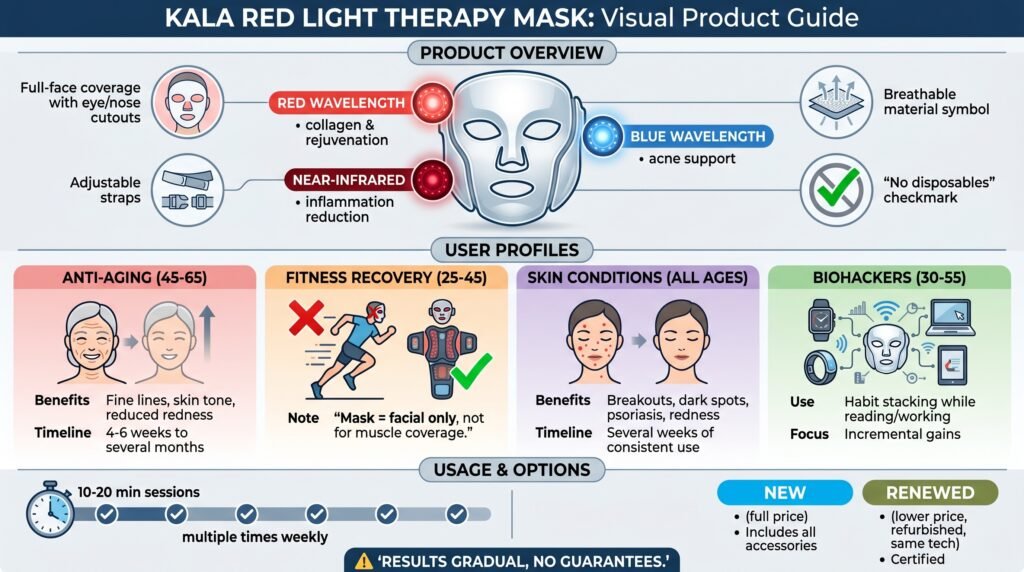
The mask uses red, near-infrared, and blue LED wavelengths. These line up with commonly researched bands for skin rejuvenation, inflammation reduction, and acne support.
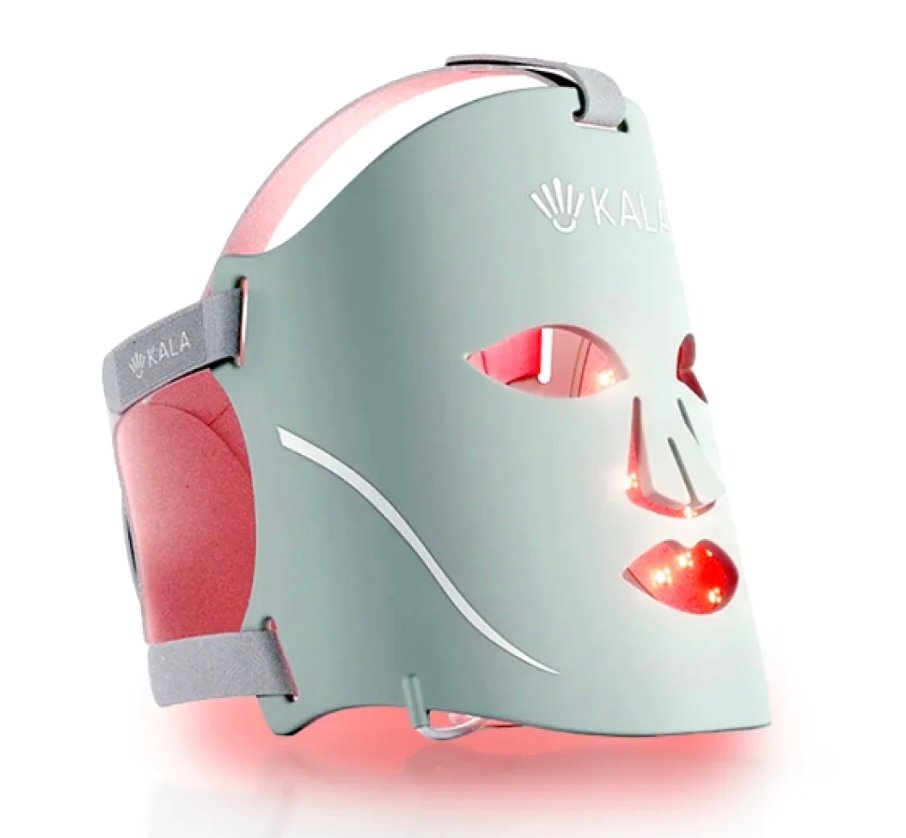
Full-face coverage with cutouts around eyes and nose. The design wraps around your face contours instead of sitting flat like a plastic shell.
Straps and structure keep the mask in place while you talk or move around lightly. Reviewers described it as breathable instead of feeling like your face is suffocating.
No disposable parts needed. You just wipe down the surface between uses.
Independent testers who actually measured the device with meters described it as comfortable, breathable, and secure enough that it won’t slip off if you’re moving around. They noted the wavelengths are suitable for cosmetic red light therapy goals.
Kala’s own guidance emphasizes regular, repeated sessions and openly states it can take several weeks before most people notice changes. Some users report seeing stuff at 4-6 weeks, while others and some doctors they quote mention timelines up to several months.
There’s no guarantee, and they’re pretty upfront about that.
How the Mask Fits Different Users
Aging adults (45-65) focused on wrinkles and texture:
The red and near-infrared LEDs target collagen support and overall skin rejuvenation. Independent reviewers testing it for anti-aging rated it as viable among at-home masks, with decent coverage and power for fine lines and tone, though still below professional panels in raw intensity.
Social media users in midlife share improvements in redness, irritation, and overall glow. Some posts mention menopausal skin looking calmer and less reactive.
Results are gradual, which fits patient people who can stick with a 10-20 minute routine many times per week.
Fitness enthusiasts (25-45) looking at recovery:
Kala promotes red light heavily for muscle fatigue reduction and better circulation, but those claims focus on full-body panels and larger devices, not the mask.
Content for runners and athletes shows panels used on legs and torso after workouts. The mask gets positioned more for facial skin and maybe the jaw or neck if you reposition it.
For someone wanting a device mainly for muscle recovery, the mask alone has limited coverage. It won’t cover hamstrings, quads, or back in any meaningful way.
People with chronic skin conditions (acne, redness, psoriasis):
The mask includes blue LEDs, which many brands market toward acne and breakout support, combined with red light for calming and healing.
User posts on TikTok and Instagram show people with dark spots and ongoing breakouts reporting reduced redness, faster settling of new blemishes, and fading of stubborn discoloration over several weeks of consistent use for conditions like psoriasis.
Reddit skincare discussions about red light masks in general show users sharing before/after sequences over 1-3 months. Some see clear softening of wrinkles and sun spots; others see smaller or more subtle changes.
Those experiences aren’t device-specific but give a sense of realistic variability.
Biohackers and wellness optimizers (30-55):
Kala’s branding and multi-device ecosystem appeal to people who already experiment with cold plunges, saunas, wearables, and supplements.
The mask works well for habit stackers who want something they can strap on while reading, meditating, or doing emails, without driving to a clinic.
For this group, incremental improvements and marginal gains often matter more than dramatic one-time changes.
Renewed / Refurbished Mask
Kala offers a “Renewed” version of the Red Light Face Mask, which is basically a refurbished unit priced lower than brand-new. The product description notes the same use cases and overall usage instructions, with emphasis on proper cleaning and comfort for 20-minute sessions.
For people who feel burned by full retail pricing, this renewed option reduces the financial hit while still using branded tech instead of a random clone.
Compare at-home Red Light Therapy devices to costly professional sessions. Click the button below to see Kala Red Light’s latest promotions.
Quality and Performance Testing vs Other Masks
Independent reviewers who actually measure LED output (not just unboxing videos) tested the Kala mask against several popular red light masks. They focused on:
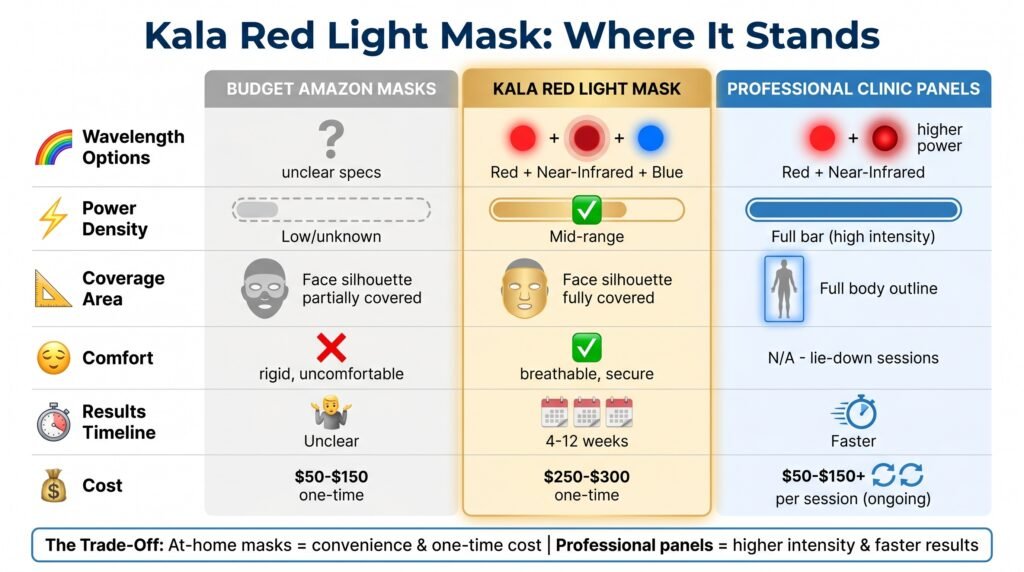
Wavelength mix: Kala uses red and near-infrared LEDs that fall into commonly studied cosmetic ranges, with blue light layered in for acne-targeted protocols.
Irradiance (power density): Testers described the mask’s light output as solid for an at-home mask. It sits in a more credible tier than cheap, untested devices, without pushing into unsafe territory.
Specific numbers vary by distance and position, but in testing it wasn’t at the bottom of the pack.
Coverage: The mask got noted for good full-face coverage, including cheeks, forehead, and jawline. That matters for consistent, even exposure.
Comfort and fit: Reviewers highlighted its breathable feel and secure fit, mentioning it stays put while talking and doesn’t pinch or dig aggressively. This sounds minor but ends up being a big deal for adherence, because uncomfortable masks end up in drawers.
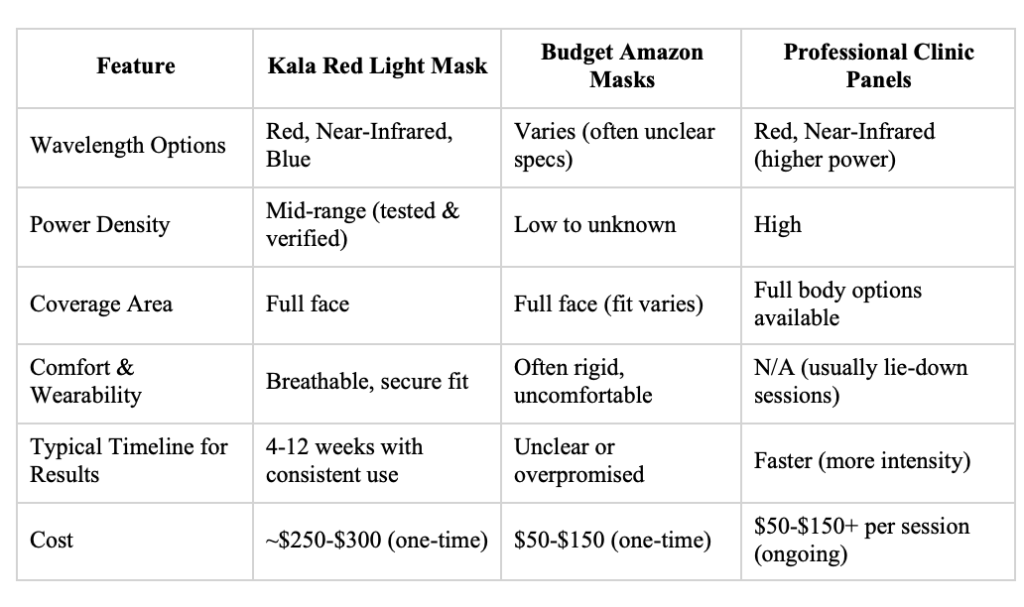
When you compare Kala to other red light masks that show up in major editor-tested lists, the pattern is pretty consistent. Most reputable masks share similar wavelength ranges, focus on 10-20 minute sessions, and target fine lines, tone, and acne.
Editorial roundups tend to spotlight mainstream beauty brands, while Kala shows up more in specialist testing and social channels.
Experts comparing masks to professional red light therapy sessions point out an important reality. Masks almost always use lower power than in-clinic panels or bed-style devices.
This leads to slower changes over time, more dependence on regular use, and shallower penetration.
That’s fine for surface skin work but less ideal for deep joint or muscle recovery.
For someone weighing Kala versus spa visits, the mask offers convenience and a one-time purchase, but not the raw intensity of a professional setup.
Pricing and Value Assessment
Kala lists the Red Light Face Mask at around $299.99, with frequent site discounts bringing it closer to roughly $254.99. The therapy wand, renewed masks, and other devices sit in a similar mid-to-upper price bracket for consumer wellness tech.
That pricing places Kala above basic budget LED masks, but below or comparable to many prestige LED brands that beauty editors regularly feature.
The real question is whether the cost makes sense relative to:
- Ongoing spa or clinic red light sessions
- Cheaper Amazon masks with vague specs
- Larger full-body panels
Clinics and wellness studios often price red light sessions as premium add-ons, which stack up fast when used weekly or many times per week. An at-home mask like Kala’s shifts that into a single purchase, then essentially “free” usage once you own it, apart from electricity and your time.
Value depends heavily on behavior:
If you’re the person who sticks to 3-5 sessions per week for months, the cost per use drops hard, and the investment looks reasonable.
If you fall off after two weeks, even a refurbished mask feels expensive.
Kala’s renewed/refurbished offers give people a way to test the waters at a lower price, which also reduces the risk of buyer’s remorse.
How It Compares to Professional Sessions
Clinic sessions add up fast. Many spas and physical therapy clinics charge $50-$150 per session.
A single professional red light therapy session at a dermatologist or med spa costs anywhere from $75 to $125+. Going 2-3 times a week for several months easily runs into four figures.
Kala devices cost about the same as a few months of clinic visits upfront, but then you can treat daily, share the device with family, and use it for years. For people who commit to red light as part of daily skin care, this at-home device can provide a great deal of savings.
Kala Mask: Around low-300s USD retail, often discounted. The price is reasonable for the power and wavelengths, but coverage gaps and limited return policies (depending on retailer) affect the value.
See our cost-savings calculator below to crunch the real-time numbers of Kala at-home red light therapy products vs. the cost of clinical sessions. Bookmark this page and come back to it whenever you are researching red light therapy services in your area.
Red Light Therapy Savings Calculator
See how much you can save with the Kala Red Light Mask compared to professional clinic sessions
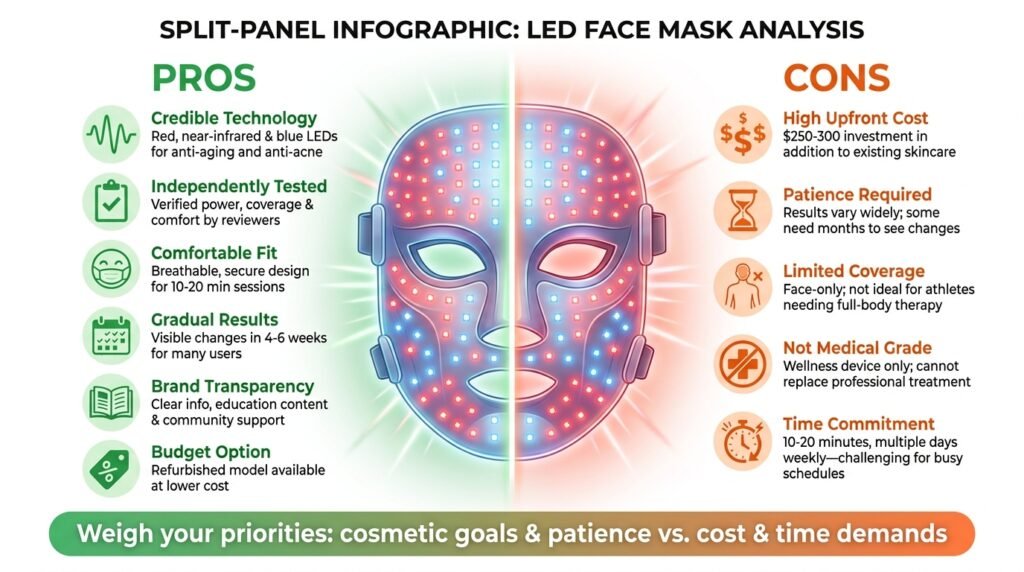
Pros and Cons Summary
Pros
Credible wavelength mix for cosmetic goals
Uses red, near-infrared, and blue LEDs aligned with typical anti-aging and anti-acne protocols in at-home masks.
Tested and measured by independent reviewers
The mask has been scientifically tested for power, coverage, and comfort, with results showing solid performance for its class.
Comfortable and wearable
Reviewers describe a breathable feel and secure fit, which matters because you’re meant to wear it regularly for 10-20 minutes.
Supports gradual improvements with consistent use
Kala’s own blog and user stories mention noticeable changes often appearing within 4-6 weeks for some users, while acknowledging that full changes can take longer.
Better transparency than generic no-name masks
The brand provides clear product pages, educational content on timelines, and a visible community, which is more than many low-cost devices offer.
Refurbished option for lower cost
The renewed mask option gives budget-conscious users access to the same general hardware at a discount.
Cons
Upfront price can sting
Around $250-300 still counts as a serious skincare or wellness purchase, especially for people already spending on serums, treatments, or gym memberships.
Results vary and need patience.
Even Kala’s own content mentions that some people need months to see meaningful change. User posts across platforms show a wide spread, from big visible shifts to more subtle or uncertain results.
Less suited for full-body recovery
While Kala markets red light strongly for athletes, the face mask itself mainly covers facial skin. Runners and lifters who want quad or back coverage need panels, not just a mask.
Not a medical treatment
Red light devices like this sit in the wellness and cosmetic space. They should not replace medical care for serious skin diseases or systemic issues.
Time and routine demands
Regular 10-20 minute sessions, several days per week, are a big ask for people already juggling work, kids, and training.
Final Recommendation
This Kala red light therapy mask review comes down to one core point. The device itself is respectable, but it only makes sense if your habits match what it needs.
Choose the Kala Red Light Mask if:
You’re 40+ and already invested in skincare, and you care about fine lines, texture, and uneven tone enough to commit to a long-term routine.
You like structured habits and can put on the mask while you read, watch TV, or answer emails, most days of the week.
You prefer paying once for a device instead of driving to a spa for regular sessions.
You’re into biohacking or wellness tracking, you watch routines and lifestyle stuff, and you’re realistic about gradual, incremental changes.
Skip or rethink the mask if:
Your main concern is serious muscle or joint recovery. Panels and larger devices make more practical sense.
You want instant, dramatic changes or something that behaves like a facelift.
You dislike wearing anything on your face, or you already know you won’t stick with 3-5 sessions per week.
You have complex or severe skin conditions and haven’t yet spoken with a dermatologist or health professional.
Among at-home LED options, Kala lands in a “serious hobbyist” tier as opposed to a casual impulse buy. For the right person, that balance of tested performance, decent comfort, and mid-range pricing feels fair.
For the wrong person, it becomes an expensive object that gathers dust.
For Chronic Skin Conditions (Acne, Psoriasis, Eczema)
The Kala Mask helps with facial acne and inflammatory skin issues thanks to the red, NIR, and blue combo. Panels make more sense if you have widespread skin involvement on the torso, back, or limbs.
Red and NIR aren’t cures, but consistent use supports inflammation control and healing.
FAQ
Is the Kala red light mask safe to use?
Kala markets the mask as a cosmetic LED device using red, near-infrared, and blue light, with materials suitable for regular facial contact. Independent reviewers tested its light output and didn’t flag safety concerns for typical use in healthy adults, though they always advise following instructions and avoiding overuse.
People with photosensitivity, epilepsy, active eye issues, or serious skin conditions should talk with a health professional before using any red light device.
How long until you see results?
Kala’s own educational content explains that while some individuals notice changes in about 4-6 weeks, others may need several months of steady use. They also reference doctors who mention timelines up to 6 months for noticeable cosmetic improvements with red light.
Social posts show users sharing one-month and multi-month updates, with some reporting reduced dark spots, calmer redness, and softer fine lines over time.
There’s no guaranteed timeline.
Can it help with acne and dark spots?
The mask includes blue light along with red light, which many brands use to target acne and post-blemish marks. Real-world posts from Kala users report that new pimples shrank faster and appeared less inflamed, and that long-standing dark spots gradually faded with consistent use.
However, not everyone sees the same change, and chronic or severe acne still calls for proper medical care.
How does the Kala mask compare to clinic red light therapy?
Experts comparing masks and professional red light systems consistently point out that mask-style devices are less powerful than full-body panels and professional rigs.
This means changes may be slower and more subtle at home, and penetration is shallower.
Independent testers found the Kala mask delivers respectable power for an at-home device, but it still sits below in-clinic hardware in intensity.
You trade raw power for convenience and long-term cost control.
Can this mask support muscle recovery or performance?
Kala strongly promotes red light for reducing muscle fatigue, boosting circulation, and speeding recovery between runs, but those claims are mainly tied to full-body panels.
The face mask covers only the face and maybe a bit of neck or jaw if repositioned, so it doesn’t provide meaningful coverage for legs, arms, or back.
Someone prioritizing muscle recovery will get more from body-sized devices or studio sessions.
How often should I use the Kala mask?
Kala recommends consistent, ongoing use, with sessions that fit easily into a daily skincare or relaxation routine. Most credible LED mask brands suggest short sessions many times per week as opposed to rare long marathons, and Kala’s guidance aligns with that pattern.
Always follow the instructions in the device manual regarding session length and weekly frequency.
Is the Kala mask worth the price?
For disciplined users who will stick with it, the price can compare favorably to months of spa or clinic sessions, especially if the device is shared by more than one person in a household. For someone who rarely follows through on routines or who expects dramatic, guaranteed results, the investment will feel disappointing.
For this Kala red light therapy mask review, the bottom line is simple. The device is solid; the real variable is how consistently you use it.
This article includes affiliate links. If you click through and make a purchase, I may receive a small commission. This helps support the site and allows me to keep creating helpful content at no extra cost to you.