📌 Quick Summary
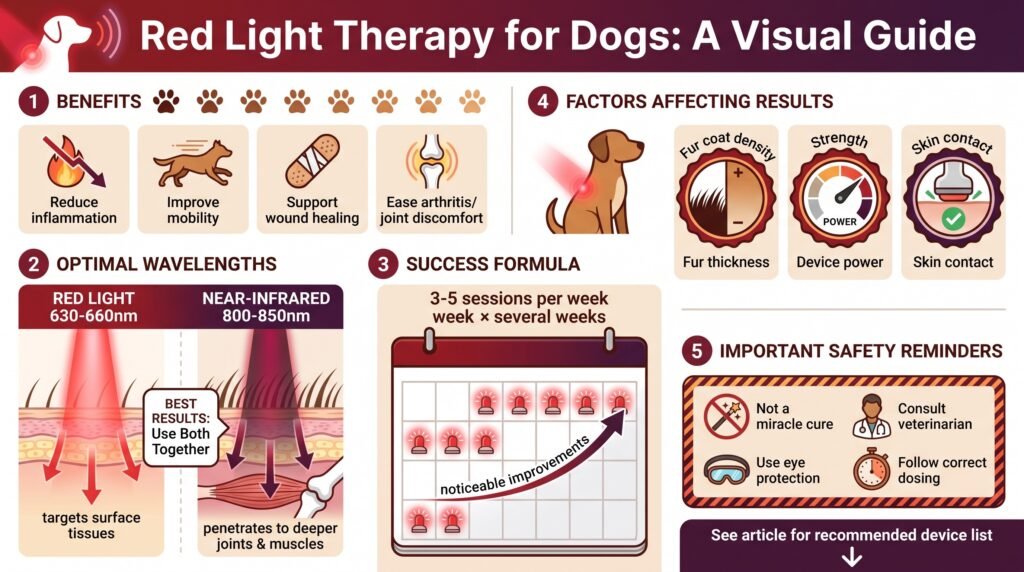
Red light therapy for dogs may help reduce inflammation, improve mobility, support wound healing, and ease arthritis or joint discomfort when used consistently with the right wavelengths and device setup. Most effective devices use a combination of red light (630–660nm) and near-infrared light (800–850nm), which work together to target both surface tissues and deeper joints or muscles.
The biggest factor in success is consistency. Most dogs need 3–5 sessions per week for several weeks before owners notice meaningful improvements. Fur thickness, device power, and direct skin contact also heavily affect results.
While research and veterinary use of photobiomodulation are promising, red light therapy is not a miracle cure and should not replace veterinary care for serious conditions. Safety risks are generally low when devices are used properly, though eye protection and correct dosing matter. See the suggested red light devices listed in the article.
🧾 Table of Contents
- Introduction
- How Red Light Therapy Actually Works at the Cellular Level
- Choosing Devices That Actually Work
- Setting Up Treatment Protocols That Get Results
- Common Mistakes That Destroy Your Results
- People Also Asked
Introduction
If you were researching ways to help your aging dog climb the stairs without wincing, you’d stumble across two paths: expensive veterinary laser treatments at $150 per session, or mysterious-sounding at-home red light devices ranging from $50 to $5,000.
The professional route tempts you with its clinical credibility, but when you calculate the cost of weekly visits over six months, you might start eyeing those DIY devices gathering dust in online reviews.
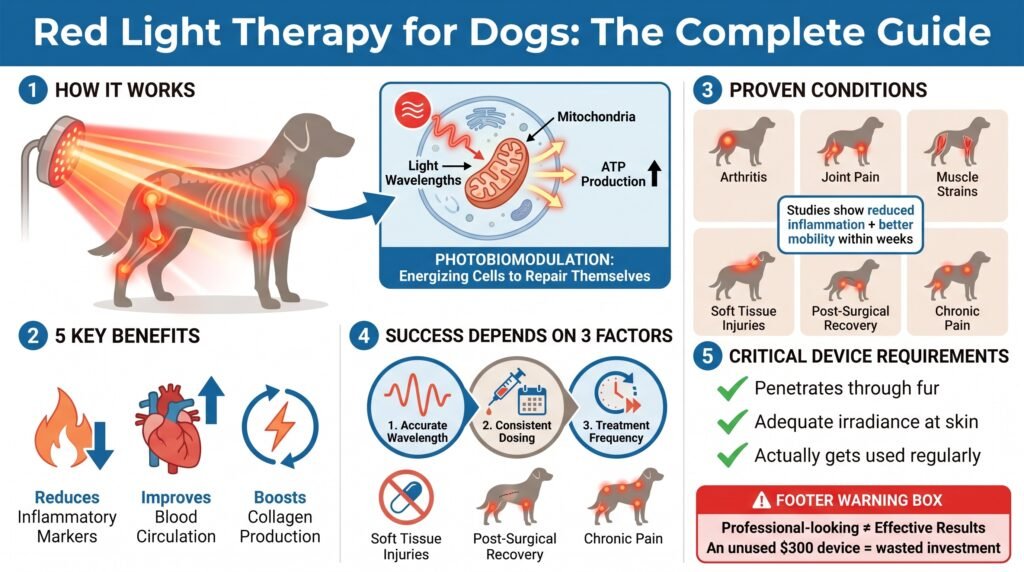
Every pet owner watching their companion struggle with arthritis, hip dysplasia, or post-surgical recovery faces the same dilemma. You want to provide real relief, but you’re drowning in contradictory information about wavelengths, irradiance, dosage protocols, and whether that $300 handheld device actually works or if you’re just burning money on placebo effects.
Red light therapy for dogs is legitimately effective when you understand three critical variables: device quality, consistent application, and realistic timelines. You can achieve meaningful results at home in 2-3 weeks with the right approach. Still, you’ll need to cut through the marketing hype, understand what sets therapeutic devices apart from decorative light shows, and commit to a protocol that actually fits your life.
How Red Light Therapy Actually Works at the Cellular Level
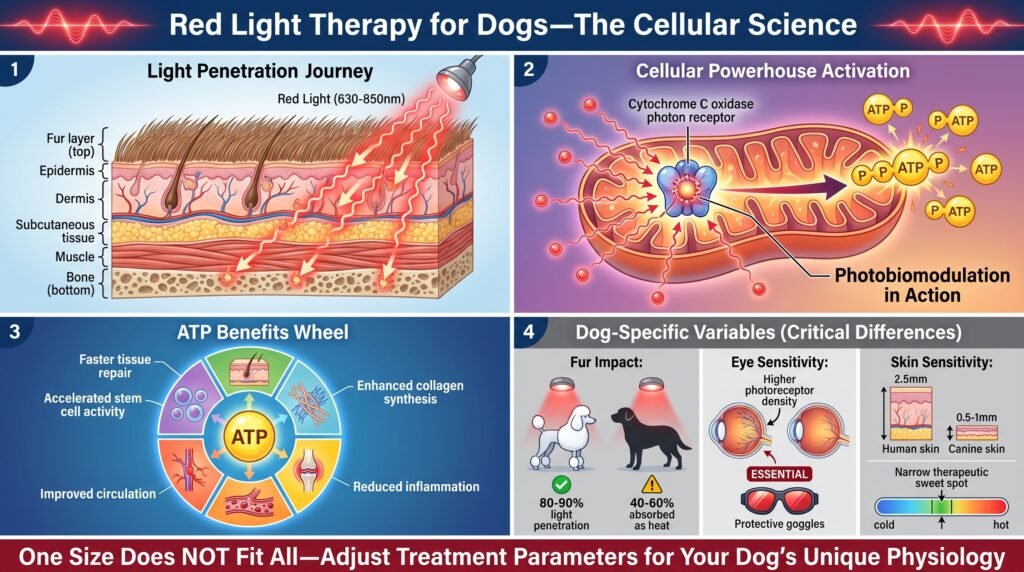
Red light therapy, technically called photobiomodulation, operates through genuine physiological mechanisms where specific wavelengths of light energy penetrate tissue and interact with cellular machinery in ways that genuinely alter function.
Light in the 630-850nm range penetrates through skin, past the epidermis, into the dermis, and, depending on wavelength and power, reaches subcutaneous tissue, muscle, and even bone. This goes way beyond surface-level warming.
Photon energy travels deep enough to reach the cellular power plants called mitochondria.
Inside those mitochondria sits an enzyme called cytochrome C oxidase. This enzyme acts like a photon receptor, absorbing red and near-infrared light energy and using it to supercharge ATP production.
ATP is adenosine triphosphate, the molecular currency your dog’s cells use for literally every biological function.
More ATP means faster repair, enhanced collagen synthesis, reduced inflammatory signaling, improved circulation, and accelerated stem cell activity. The mechanism is identical in dogs and humans, which is why human clinical studies translate reasonably well to veterinary applications.
But there’s a critical difference most device manufacturers completely ignore.
Your dog’s physiology creates variables that change everything about optimal treatment parameters. Dog fur density and color dramatically affect light penetration.
A white-coated Poodle allows light to pass through relatively efficiently, while a black Labrador Retriever absorbs 40-60% of that same light energy as heat, as opposed to therapeutic photons.
This means if you’re using identical settings on both dogs, you’re essentially overtreating the Lab and potentially undertreating the Poodle.
Your dog’s retinal structure also matters more than you’d think. Dogs have exponentially higher photoreceptor density than humans, making their eyes simultaneously more vulnerable to phototoxic injury from direct exposure and potentially more responsive to therapeutic effects.
This is why eye protection during treatment is an essential safety protocol, not optional paranoia.
Canine skin is thinner and more heat-sensitive than human skin. Those high-powered devices marketing “clinical-grade intensity” can easily create uncomfortable warmth or even thermal stress if you’re not adjusting for these physiological differences.
The sweet spot for therapeutic benefit without thermal damage is narrower in dogs than in humans, and most manufacturers ignore this completely in their dosing recommendations.
Choosing Devices That Actually Work
The red light therapy market for pets is flooded with devices making identical claims with wildly different capabilities. You’ll see $79 handhelds promising “veterinary-grade treatment” next to $2,500 panels claiming “professional results at home.” The price difference tells you nothing about therapeutic efficacy.
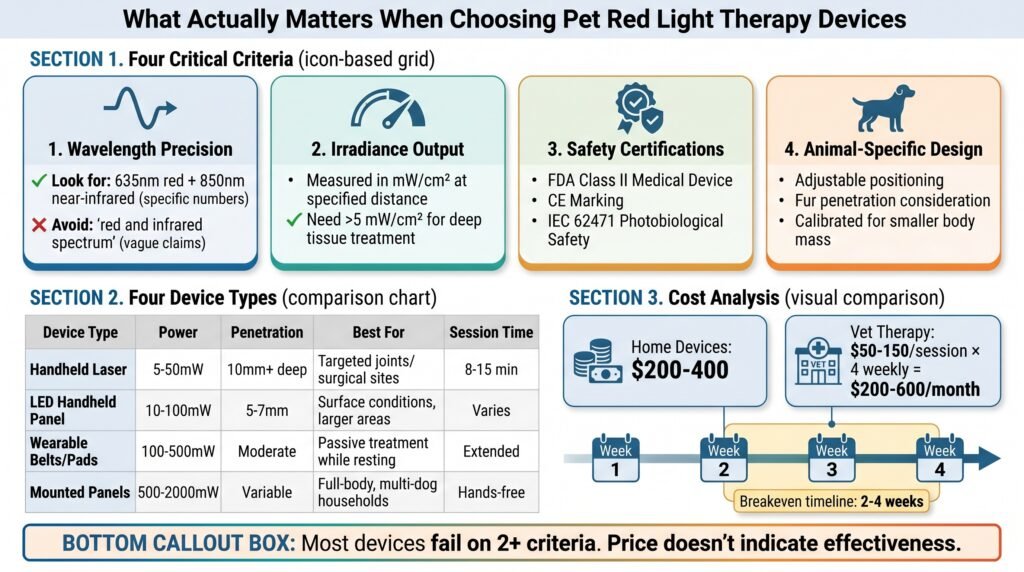
What actually matters is wavelength precision, irradiance output, safety certification, and whether the device design accounts for treating animals versus humans. Most devices fail on at least two of these criteria.
Wavelength precision means the device emits light at specific nanometer values, not broad ranges. You want devices that specify 635nm red light and 850nm near-infrared, not vague claims of “red and infrared spectrum.” The biological response happens at specific wavelengths.
If the device emits inconsistent or drifting wavelengths, you’re getting unpredictable results.
Irradiance output is measured in milliwatts per square centimeter (mW/cm²) at a specified distance. This tells you the actual power density reaching tissue.
A device might claim “500mW total power,” but if that’s distributed over a large panel at 12 inches distance, the actual irradiance hitting your dog could be under 5 mW/cm², which is therapeutically insufficient for deeper tissue conditions.
Safety certifications are your only protection against devices that overheat, emit incorrect wavelengths, or produce harmful optical radiation. Look for FDA registration as a Class II medical device, CE marking for European medical device standards, and IEC 62471 photobiological safety testing.
Devices without these certifications are untested wildcards.
Your dog can’t tell you if something feels wrong the way you can.
Device design for animals versus humans matters more than manufacturers admit. Human panels assume you’ll sit 12-24 inches away from a mounted unit.
Dog-specific devices need adjustable positioning, consideration for fur penetration, and power outputs calibrated for smaller body masses and different tissue depths.
The best options typically fall into one of four categories, each with specific advantages depending on your dog’s condition and temperament.
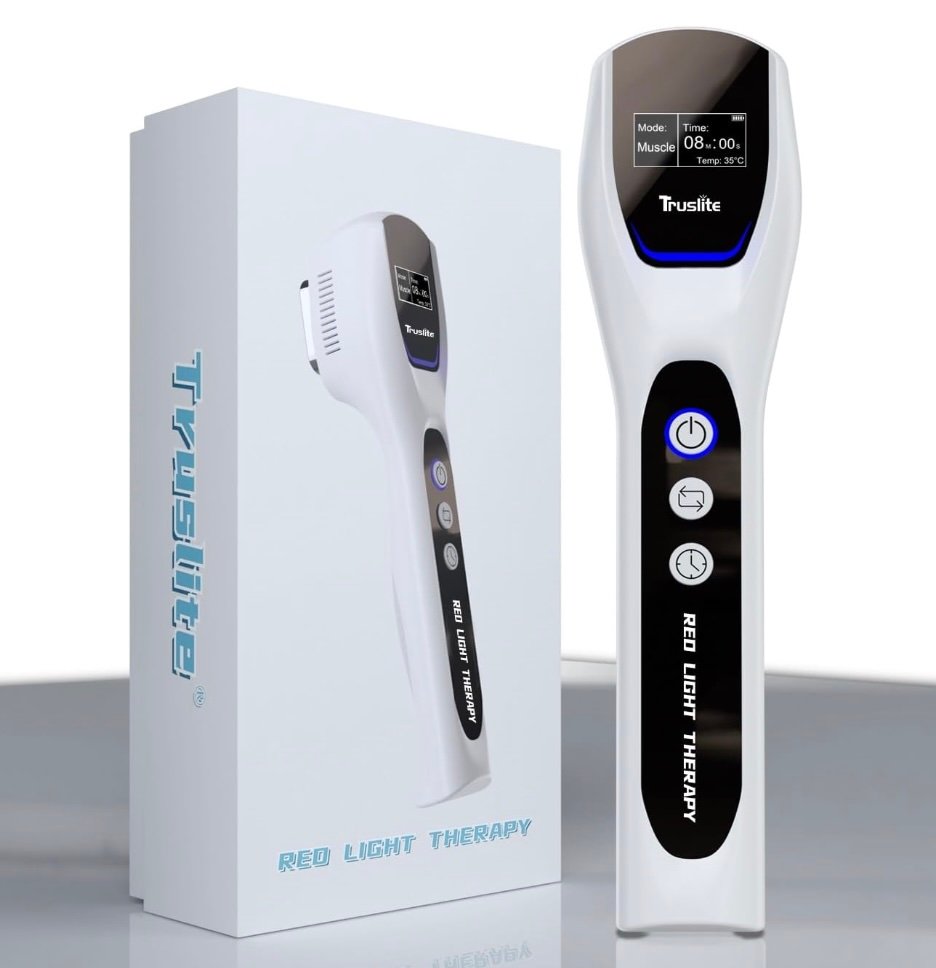
Handheld laser devices emit focused, collimated light at 5-50mW power. These excel at targeted treatment of specific joints like elbows, knees, or surgical sites.
The concentrated beam penetrates deeply, up to 10mm or more, but needs active participation.
You’re holding the device and moving it across treatment areas for 8-15 minutes per session.
LED handheld panels distribute light over broader areas at 10-100mW total power. These work well for surface conditions, larger treatment zones, and dogs that don’t tolerate focused beams well.
Penetration is moderate, around 5- 7 mm, but the larger coverage area means faster treatment of many spots.
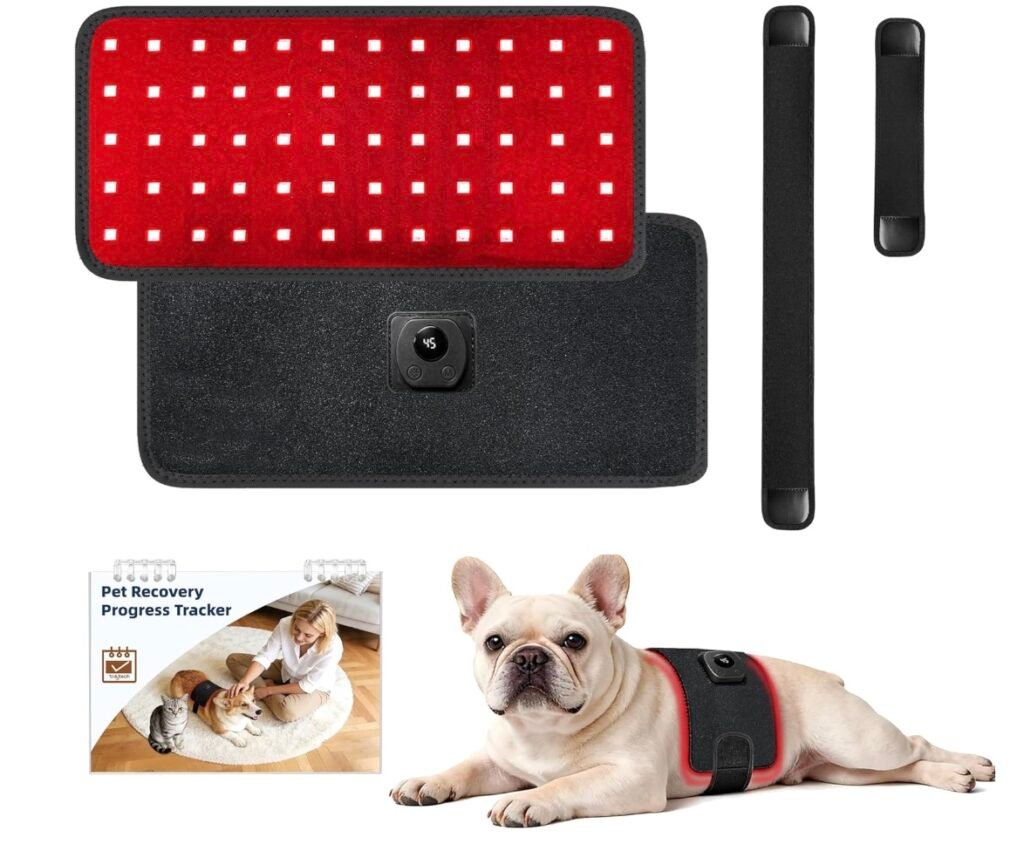
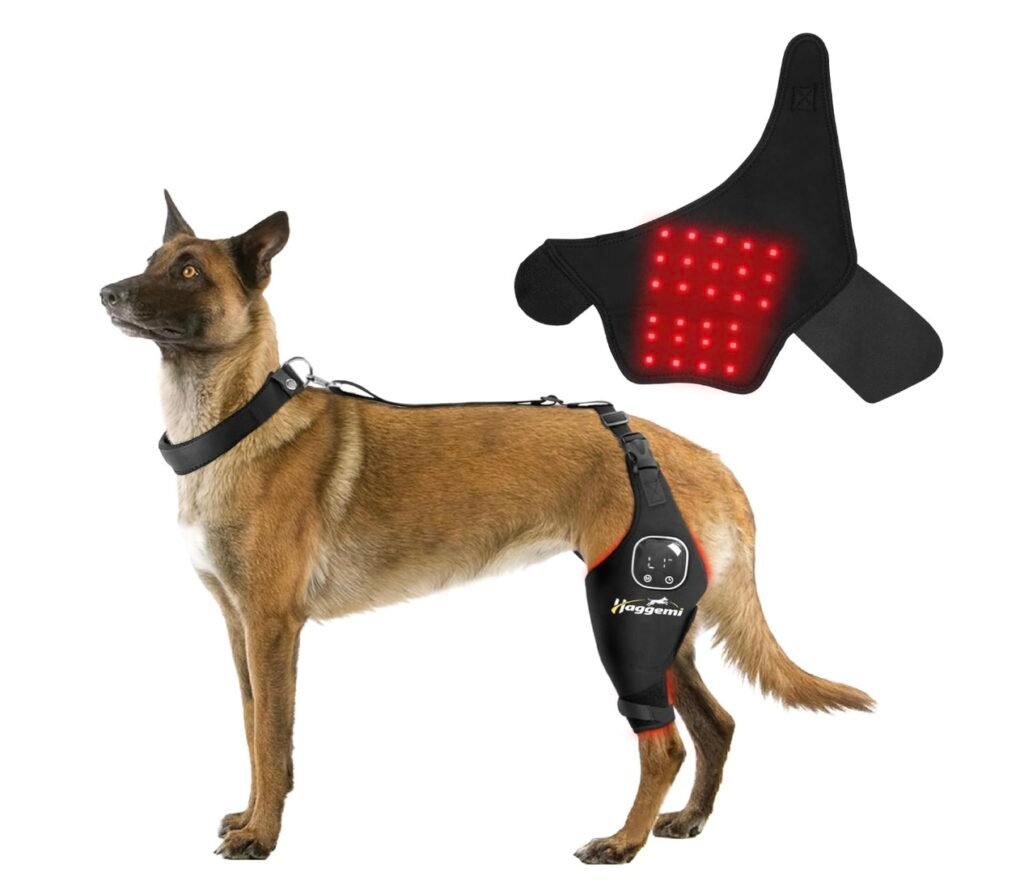
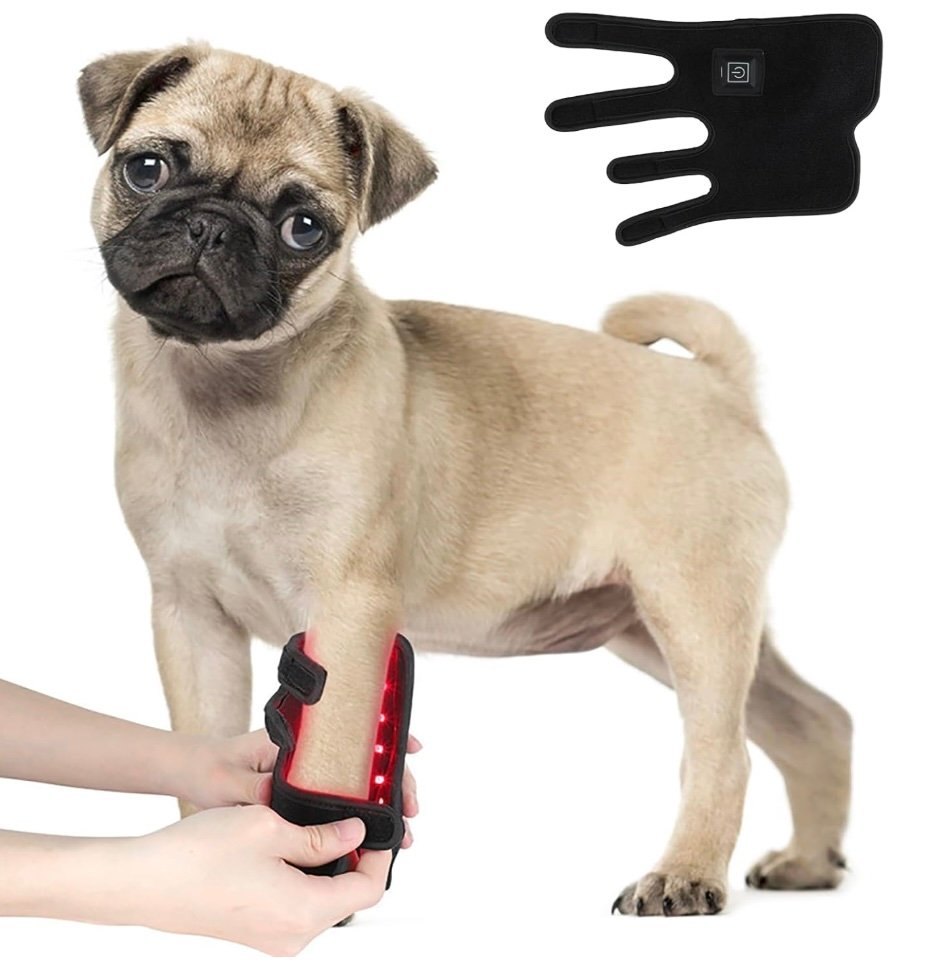
Wearable belts and pads mix 100-500mW LED arrays in fabric wraps that strap to hips, joints, or legs. These shine for passive treatment.
Your dog can rest or sleep while receiving therapy.
The tradeoff is less precise targeting and potential heat buildup in long-coated breeds during extended sessions.
Mounted panels range from 500- 2,000 mW distributed over large surface areas. These suit multi-dog households or situations where you’re treating your dog’s entire back, many joints simultaneously, or want hands-free full-body sessions.
They need dedicated space and a higher upfront cost, but offer the most versatility long-term.
For most pet owners dealing with arthritis, hip dysplasia, or post-surgical recovery, a quality LED handheld device or wearable belt delivers the best balance of effectiveness, ease of use, and cost. You’ll pay $200-400 for devices that actually work.
Professional vet laser therapy delivers higher power and typically yields better results, but it costs $50-150 per session and requires frequent travel. Most dogs need weekly sessions initially, which means $200- $ 600 per month.
The price range for the aforementioned device is between $75 and $350, and the breakeven point for even the more expensive devices is within a few weeks.
The advantage of at-home red light therapy isn’t that it replaces professional treatment. The advantage is that it lets you treat frequently at a cost that makes consistency actually realistic for most households.
See the cost-savings calculator below to crunch the real-time numbers and see how the savings add up. Bookmark this page and come back to the calculator anytime you are comparing red light services in your area.
🐾 Pet Laser Therapy Cost Savings Calculator
Discover how much you can save by investing in an at-home laser therapy device instead of paying for professional vet sessions. Calculate your breakeven point and long-term savings below.
Setting Up Treatment Protocols That Get Results
Buying the device is step one. Actually, getting results requires understanding proper protocols, which is where most pet owners unknowingly sabotage their investment.
The difference between “this didn’t work at all” and “my dog’s moving better than he has in years” often comes down to three variables: session duration, treatment frequency, and consistency over time.
Session duration needs to match your device’s irradiance output and your dog’s condition. A high-powered handheld laser might deliver a therapeutic dosage in 5-8 minutes, while a lower-power wearable belt might need 15-20 minutes to achieve the same cellular effect.
The goal is to deliver 2-6 Joules per square centimeter of tissue, which requires knowing your device’s actual output specifications.
Start conservatively, no matter what the manufacturer recommends. Your dog’s first week should involve 3-5 minute sessions once a day, just to establish tolerance and confirm no adverse reactions.
Dark-coated dogs need even shorter initial sessions because they absorb more light energy as heat.
Watch for signs of discomfort like trying to move away, excessive panting, or skin redness after treatment. These are your only feedback mechanisms since your dog can’t verbally tell you something’s wrong.
By week two, if your dog tolerates the sessions well, progress to 8-12 minutes for chronic conditions or 10-15 minutes for post-surgical recovery. The key insight most people miss is that longer isn’t better beyond a certain threshold.
Once you’ve delivered enough photon energy to saturate the tissue’s absorptive capacity, additional time adds nothing therapeutically and may actually trigger inflammatory responses.
Treatment frequency matters exponentially more than person session intensity. A 10-minute session five times weekly outperforms a 30-minute session twice weekly, even though the total time is similar.
Cellular responses to photobiomodulation are additive but decay between treatments.
Frequent modest doses maintain elevated ATP production, collagen synthesis, and anti-inflammatory signaling. Sporadic high doses create peaks and valleys that reduce overall effectiveness.
For chronic arthritis or hip dysplasia, target 4-5 sessions weekly for the first 4-6 weeks, then maintain at 2-3 sessions weekly indefinitely. Post-surgical recovery typically needs 5 sessions weekly for three weeks, then taper to 3 weekly through week six.
Acute injuries, such as muscle strains, benefit from daily sessions for 10-14 days, then reduce frequency as symptoms improve.
Distance from skin to device affects irradiance exponentially because of the inverse square law. If your device specifies “40 mW/cm² at 1 inch,” moving it to 2 inches drops that to 10 mW/cm².
Most handhelds work optimally at 1-3 inches from the skin. Wearable devices solve this by maintaining consistent contact, but you need to confirm they’re secured firmly enough to prevent gaps.
Eye protection is non-negotiable during head or neck treatments. Place a towel over your dog’s face, use goggles designed for animals, or simply avoid directing the beam anywhere near the eyes.
Dogs lack the natural aversion response humans have to bright light.
They won’t look away instinctively, making accidental retinal exposure a real risk.
See the latest red light therapy options on Amazon by clicking the buttons below →
Common Mistakes That Destroy Your Results
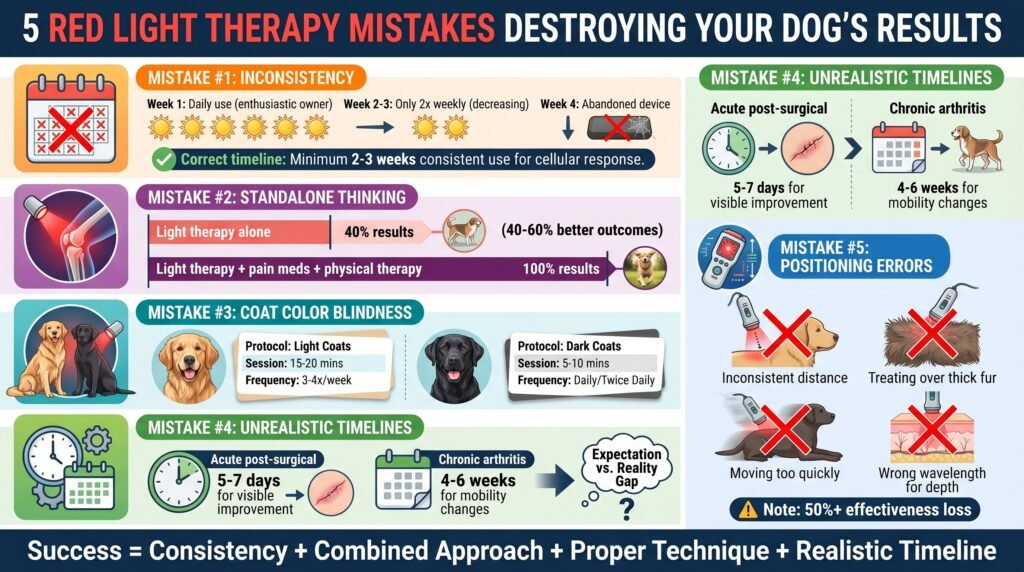
The most expensive mistake is inconsistency masked as “trying it out.” Pet owners buy a device, use it enthusiastically for a week, see no dramatic results, reduce frequency to twice weekly for another couple of weeks, then abandon it completely, claiming “it doesn’t work.” Red light therapy for tissue repair operates on added cellular responses over 2-3 weeks minimum. Expecting results in 5-7 days, then giving up, guarantees failure regardless of device quality.
Another common problem is treating red light therapy as a standalone solution when it’s actually a synergistic tool. Dogs receiving light therapy plus suitable pain medication recover faster than either intervention alone.
Dogs doing light therapy plus conservative physical therapy show 40-60% better outcomes than light therapy by itself.
The marketing narrative of “natural choice to drugs” creates an artificial either/or choice that actually limits effectiveness.
Coat color blindness sabotages countless treatment tries. A golden retriever and a black lab need different protocols even for identical conditions using the same device.
Dark coats need shorter sessions, higher frequency, and closer monitoring for heat buildup.
Light coats can tolerate longer sessions with less concern about thermal effects. Treating every dog identically ignores basic physics of light absorption.
Unrealistic expectations about recovery timelines cause premature abandonment.
Acute post-surgical inflammation might show visible improvement in 5-7 days.
Chronic arthritis that’s been developing for years needs 4-6 weeks before you’ll see meaningful mobility changes.
Expecting an overnight transformation from long-standing joint degeneration sets you up for disappointment and device returns before the protocol has time to work.
Device positioning errors reduce effectiveness by 50% or more without you realizing it.
Holding the device at inconsistent distances, treating over-thick fur without adjusting parameters, moving the beam too quickly across the area, or selecting the wrong wavelength for tissue depth all create situations where you’re “doing the treatment” but delivering an insufficient therapeutic dose to the target tissue.
People Also Asked
Does red light therapy work for dogs with arthritis?
Red light therapy delivers measurable improvements for dogs with arthritis when used consistently over 4-6 weeks. The photons stimulate mitochondrial ATP production, which reduces inflammatory signaling and promotes tissue repair in affected joints.
You’ll typically see reduced stiffness, improved mobility, and decreased pain behaviors by week three of consistent treatment.
The therapy works best when combined with weight management and suitable pain medication as opposed to as a standalone intervention.
What wavelength is best for dog red light therapy?
The most effective wavelengths for dog red light therapy are 635nm for superficial tissue penetration and 850nm for deeper tissue penetration. Devices combining both wavelengths address surface inflammation and deeper joint or muscle issues simultaneously.
Avoid devices that only specify “red and infrared spectrum” without exact nanometer values, as the biological response needs precise wavelengths to trigger cellular mechanisms effectively.
How long should I use red light therapy on my dog?
Session duration depends on your device’s power output and your dog’s coat color. Start with 3-5 minute sessions once a day for the first week to establish tolerance.
Progress to 8-12 minutes for chronic conditions or 10-15 minutes for post-surgical recovery by week two.
Treatment frequency matters more than session length. Five 10-minute sessions weekly outperform two 25-minute sessions weekly because cellular responses are added but decay between treatments.
Can red light therapy help dogs after surgery?
Red light therapy significantly speeds up post-surgical recovery by reducing inflammation, improving circulation, and promoting tissue repair at the surgical site. Start treatments 24-48 hours after surgery with veterinary approval.
Use 5 sessions weekly for three weeks, then taper to 3 sessions weekly through week six.
The therapy reduces pain and swelling faster than recovery without treatment, but it complements as opposed to replaces prescribed medications and activity restrictions.
Is red light therapy safe for dogs?
Red light therapy is safe for dogs when you use certified devices with FDA registration, CE marking, and IEC 62471 photobiological safety testing. Eye protection is essential during head or neck treatments because dogs have higher retinal photoreceptor density than humans and won’t instinctively look away from bright light.
Monitor dark-coated dogs closely for heat buildup, as they absorb 40-60% more light energy as thermal radiation compared to light-coated breeds.
What red light therapy device is best for dogs?
The best device depends on your dog’s specific condition and temperament. Wearable belts work excellently for hip and joint conditions because they allow passive treatment while your dog rests.
Handheld panels offer versatility for treating many body areas and work well for households with several pets. >>See pricing on Amazon here<<
This article includes affiliate links. If you click through and make a purchase, I may receive a small commission. This helps support the site and allows me to keep creating helpful content at no extra cost to you.