Quick Summary
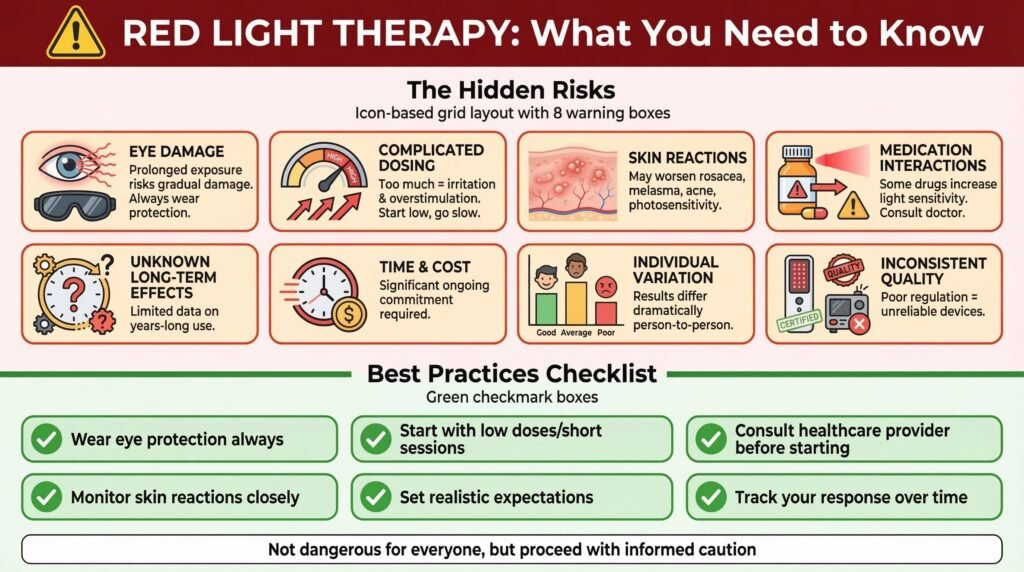
Some possible downsides to red light therapy are: potential eye damage from prolonged exposure without protection, complicated dosing that can lead to irritation or overstimulation if overdone, skin reactions (worsening rosacea, melasma, acne, or photosensitivity), medication interactions increasing sensitivity, missing long-term safety data after years of use, significant time and cost commitments, huge individual variation in results, and inconsistent device quality due to poor regulation.
It’s not portrayed as dangerous for everyone, but the hype often ignores these real limitations. Users should proceed cautiously, protect eyes, start low/slow, consult doctors if on meds or with conditions, and temper expectations.
Table of Contents
- Introduction — Overview of polarized views on RLT and the need for balanced discussion of problems
- Eye Safety Concerns That Nobody Talks About — Retinal absorption risks, gradual photochemical damage, inadequate long-term studies, conflicting manufacturer advice, and extra caution for eye conditions
- Dosing Is Way More Complicated Than Anyone Admits — Wide protocol variation, biphasic response (too much can harm), factors like device power/skin tone, and overexposure symptoms (irritation, inflammation, sleep issues)
- Timing Red Light Therapy With Other Treatments — Brief transitional note on combining with other therapies
- Skin Reactions That Surprise People — Photosensitivity, redness/rashes, heat aggravating rosacea/melasma/acne, or disrupting healing
- Medication Interactions Nobody Mentions — Photosensitizing drugs (antibiotics, retinoids, blood pressure meds, NSAIDs, etc.), potential irritation or rare theoretical risks (e.g., mania triggers)
- The Missing Long-Term Safety Data — Short-term studies dominate; unknown effects after years/decades of regular use
- The Time Commitment Challenge — 10–20 min sessions multiple times weekly; consistency required but hard to fit into busy lives
- The Cost Factor — Expensive devices ($500+) or clinic sessions ($50–200 each); ongoing commitment needed; some at-home options can save money long-term
- Individual Variation Matters — Huge differences in response due to genetics/health/lifestyle; no way to predict outcomes except by trial
- Key Takeaways — Summary of main limitations (eye risks, dosing confusion, reactions, lack of data/regulation, time/cost, variability)
- People Also Asked — Quick answers to common questions (eye damage, worsening skin, meds, device reliability, thyroid concerns, timeline for results)
Introduction
We treat health technologies in extremes. They become magic bullets that will solve everything, or we write them off completely as worthless trends.
Red light therapy exists firmly in this uncomfortable middle ground where devoted users claim life-changing results while skeptics dismiss it as another wellness fad.
What frustrates me most is how one-sided these conversations become. Nobody wants to address the legitimate problems.
There are real issues with red light therapy that deserve attention.
I’m not here to trash red light therapy entirely or claim it’s dangerous for everyone.
I’m going to walk through everything problematic, questionable, or genuinely concerning about this treatment.
If you’re planning to expose your body to specific wavelengths of light regularly, you need to understand what could actually go wrong.
But with all the following subjects we will discuss, and with nearly anything in life, there is individual variability depending on your present constitution, the issues you are treating, and much more.
Eye Safety Concerns That Nobody Talks About
While red and near-infrared wavelengths aren’t as immediately dangerous as UV light, they carry risks that stay poorly understood.
The retina absorbs these wavelengths of light. Prolonged or intense exposure could potentially cause photochemical damage over time.
We lack comprehensive long-term studies examining what happens to people’s eyes after years of regular red light therapy use.
Some manufacturers tell you to wear protective goggles. Others say keeping your eyes open is fine.
Eye damage from light exposure often doesn’t appear immediately, which makes this particularly tricky. You won’t feel sudden pain or notice vision changes right away.
The damage accumulates gradually, potentially causing problems years down the line.
By the time you notice something wrong, the damage has already occurred.
People with certain eye conditions need extra caution.
If you have macular degeneration, retinal diseases, or have had recent eye surgery, exposing your eyes to intense light therapy could potentially worsen these conditions.
Most red light therapy companies don’t provide detailed warnings about specific eye conditions that might be contraindicated.
So, the best practice is to wear some protection. But again, it is up to the individual to make their own decisions.
Dosing Is Way More Complicated Than Anyone Admits
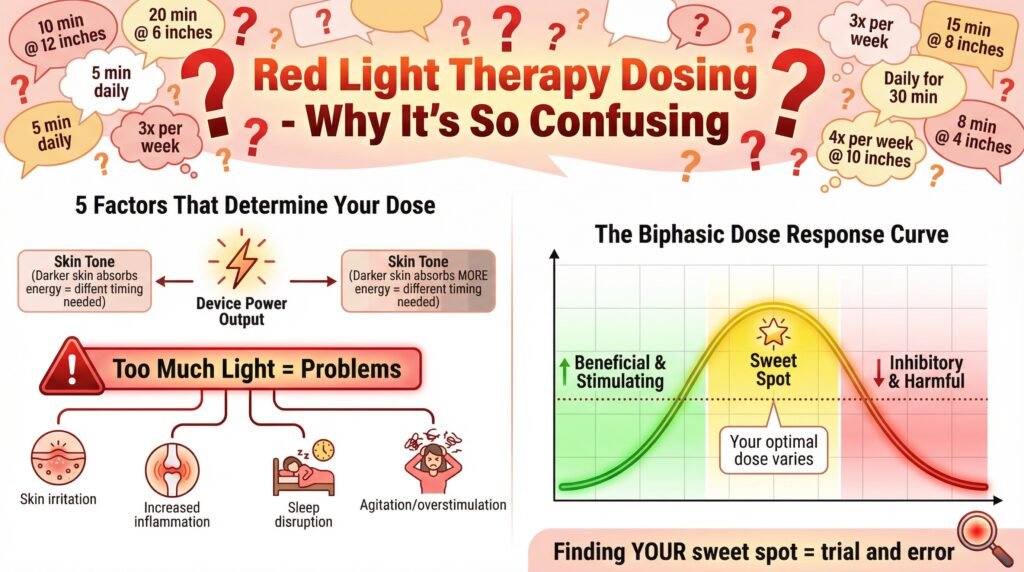
If you’ve researched red light therapy protocols, you’ve probably noticed something frustrating. Everyone recommends something different.
Ten minutes at twelve inches away.
Twenty minutes at six inches. Five minutes daily.
Three times per week.
The recommendations are scattered everywhere.
We genuinely don’t know what optimal dosing parameters are for most applications. The research that exists often uses specific protocols that might not translate to home-use devices with different power outputs and coverage areas.
Getting the right dose depends on multiple factors, including the power output of your device, the distance you sit from it, the duration of treatment, the frequency of sessions, and even your skin tone. Darker skin absorbs more light energy than lighter skin, which means people with different skin types might need different treatment times to achieve the same effect.
You can actually get too much light exposure. Excessive exposure can lead to skin irritation, increased inflammation, disrupted sleep patterns, and feelings of agitation or overstimulation.
I’ve read accounts from people who committed to daily long sessions, thinking more would be better, only to feel progressively worse.
The biphasic dose response makes this particularly tricky. This phenomenon describes how low doses of light therapy can be stimulating and useful, but high doses become inhibitory and potentially harmful.
The optimal sweet spot varies from person to person, and there’s no easy way to know where you fall on that curve without extensive trial and error.
Skin Reactions That Surprise People
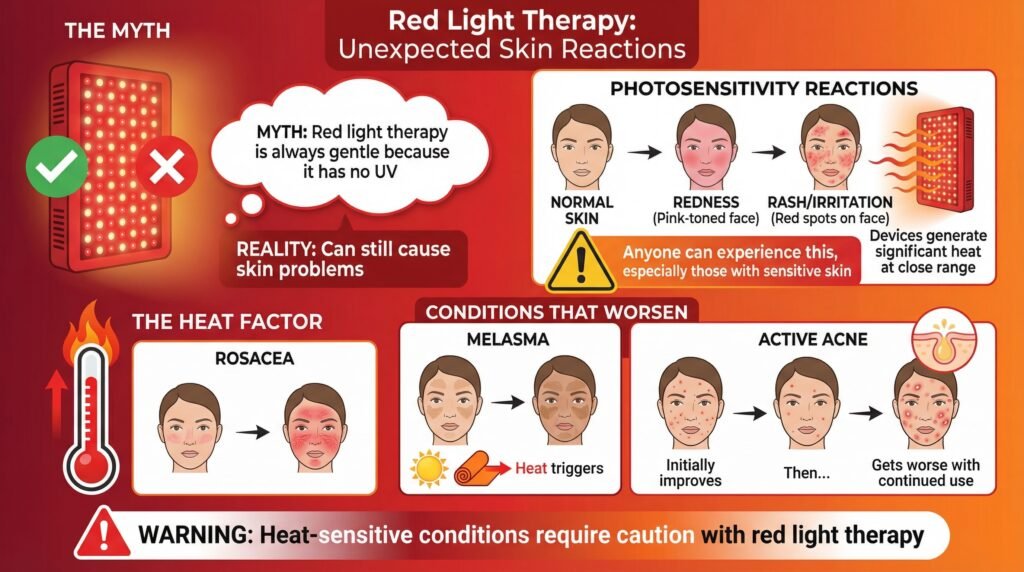
Most people assume red light therapy is universally gentle on skin because UV light isn’t involved. While red and near-infrared wavelengths don’t cause sunburn or DNA damage as UV does, they can still cause skin issues.
Some people develop photosensitivity reactions from red light therapy. Their skin becomes red, irritated, or even develops a rash after treatment.
This seems more common in people with sensitive skin or certain skin conditions, but it can happen to anyone.
Heat is another factor that doesn’t get enough attention. Red light therapy devices generate heat, especially if you’re sitting close to a high-powered panel.
This thermal effect might actually be responsible for some of the benefits people experience, but it can also cause problems.
Heat can worsen certain skin conditions like rosacea or melasma. If you already struggle with facial redness or heat-triggered flushing, adding red light therapy might make things worse.
Melasma, which is a type of hyperpigmentation that appears as brown or grayish patches on the skin, deserves special mention. While some people use red light therapy hoping to improve their melasma, the heat generated by the devices can actually trigger or worsen this condition.
Melasma is notoriously responsive to heat, which is why it often gets worse in summer or after hot yoga.
People with active acne might find that red light therapy initially seems to help, but then their skin gets worse with continued use. This could happen because of overstimulation of sebaceous glands or disruption of the skin’s natural healing process when treatments are too frequent or intense.
Medication Interactions Nobody Mentions
Certain medications can make your skin photosensitive, and that includes sensitivity to red and near-infrared light, not just UV. This topic should be discussed far more prominently.
Antibiotics like tetracyclines and fluoroquinolones can increase photosensitivity. So, can some blood pressure medications, diuretics, antihistamines, and non-steroidal anti-inflammatory drugs.
If you’re taking any of these medications and using red light therapy, you might experience unexpected skin reactions.
Retinoids, which are commonly used for acne and anti-aging, make your skin more sensitive and potentially more reactive to light therapy. While red light doesn’t have the same concerns as UV exposure, the increased cellular activity from combining retinoids with red light therapy could lead to irritation.
Certain psychiatric medications, particularly those used for bipolar disorder, can also interact with light therapy in general. While red light therapy differs from bright white light therapy, there’s a theoretical concern about triggering manic episodes in susceptible people.
The research here is limited, which is exactly the problem.
Most red light therapy resources don’t prominently talk about medication interactions. People assume that if it’s not UV light, there’s no risk of photosensitivity issues, but that assumption isn’t necessarily fix.
Trying to fit red light therapy into that routine without clear guidance about timing and medication interactions can lead to some uncomfortable skin irritation and side effects.
The Missing Long-Term Safety Data
We have very limited information about what happens to people who use red light therapy regularly for years or decades. Most studies are short-term, lasting weeks or maybe a few months.
But people have been using these devices daily for years, and we’re essentially conducting an uncontrolled experiment on long-term effects.
Could regular exposure to red and near-infrared wavelengths cause added skin changes over time? Might it affect collagen in ways that aren’t obvious initially but become problematic years later?
Do the cellular changes stimulated by light therapy have any long-term consequences we haven’t identified?
These aren’t hypothetical concerns. Many medical treatments that seemed safe in short-term studies turned out to have problems that only emerged with years of use.
We won’t know about the potential long-term effects of red light therapy until people have been using it consistently for ten, twenty, or thirty years.
This is particularly concerning given how aggressively the technology is being marketed to people for daily use. We’re encouraging millions of people to expose their bodies to a relatively new intervention without understanding what the decades-long consequences might be.
The lack of long-term data doesn’t necessarily mean red light therapy is dangerous. It might be perfectly safe for lifetime use.
But the honest answer is that we don’t know, and that uncertainty deserves to be part of the conversation.
The Time Commitment Challenge
This may be the smallest gripe on the subject. Red light therapy requires a time commitment that most marketing materials gloss over. You’re looking at ten to twenty minutes per session, multiple times per week, in order to achieve consistent benefits.
This is a small complaint because to see any real and lasting result, be it in the gym or adhering to a new diet, consistency is rule number 1. This is a ‘Captain Obvious statement,’ but many forget its vital importance.
The real issue is the practicality of making time for it in a clinical setting. You need to be in a specific location, usually undressed or minimally dressed, doing nothing essentially for fifteen minutes.
You can’t really multitask effectively. Sure, you can scroll your phone or listen to a podcast, but you’re still stuck in one spot.
For busy people juggling work, family, and other responsibilities, finding this time consistently is actually pretty challenging. Morning sessions mean getting up earlier.
Evening sessions compete with dinner, family time, and relaxation.
However, if you have control over the environment and timing, this is less of an issue. This solution will be covered in the next section. So, have no fear.
The Cost Factor
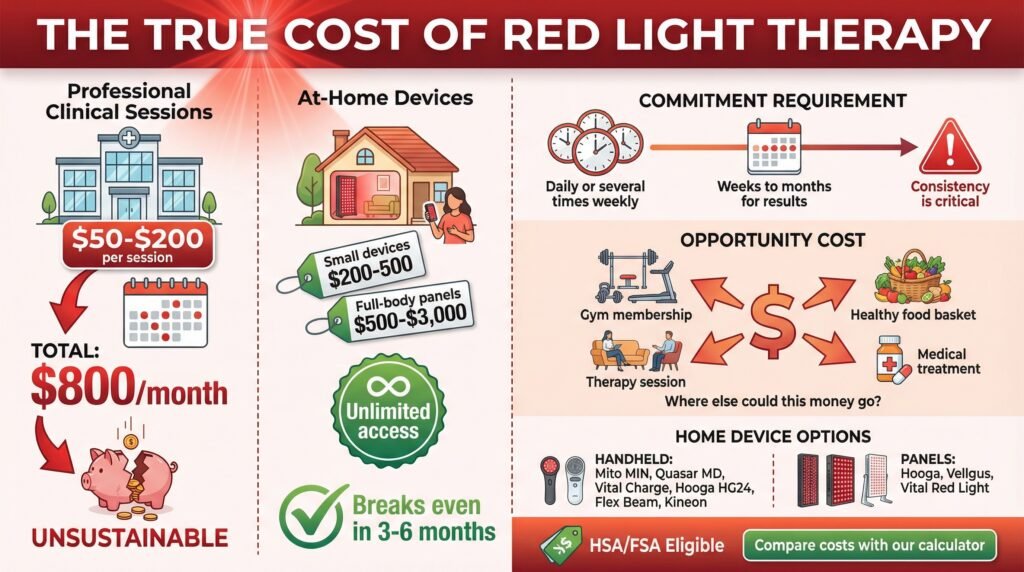
Red light therapy needs a significant financial commitment. A decent quality full-body panel will set you back anywhere from five hundred to several thousand dollars.
Smaller targeted devices might cost a few hundred. If you opt for professional treatments at a clinic, you’re looking at fifty to two hundred dollars per session.
The financial commitment becomes substantial when you consider that red light therapy needs consistency. You need regular sessions to potentially see benefits.
Most protocols recommend daily or several-times-weekly treatments for weeks or months.
If you go the professional treatment route and do two sessions per week at one hundred dollars each, that’s eight hundred dollars per month. Most people can’t sustain that kind of spending, which means they either stop treatment before giving it a fair trial or they invest in a home device.
Cheaper home devices often don’t work well, and quality ones are expensive. You’re essentially gambling that the benefits you might receive will justify the upfront cost.
For many people, that gamble doesn’t pay off.
There’s also an opportunity cost to consider. That money could be spent on other health interventions with more robust evidence, like quality food, a gym membership, therapy, or proven medical treatments.
When resources are limited, as they are for most people, you have to make choices about where your health dollars go.
The red light therapy industry doesn’t want you thinking about cost-effectiveness. They want you focused on all the potential benefits and testimonials.
But if you spend a thousand dollars on a device that ends up gathering dust in your closet after three months, that’s a thousand dollars that could have been better spent elsewhere.
However, the red-light industry has exploded with many at-home devices that are just as effective as professional red light sessions within a clinical environment.
When comparing the cost of 2-3 sessions per week at an average of $100 within a clinical setting, these options breakeven pretty quickly, and you have unlimited access to them.
These devices vary in size and light coverage. Handheld devices from the Mito MIN, Quasar MD, The Vital Charge, Hooga HG24, Flex Beam, and Kineon. And Budget-friendly panels from Hooga, Vellgus, andVital Red Light.
Also, the majority of these devices are HSA/FSA eligible, which can add to the cost savings.
See our list of reviews of some of the best red light therapy devices for at-home use here. Also, there are device-specific cost-savings calculators in every review article, so you can do real-time calculations against the expensive professional sessions.
See our cost-savings calculator for Mito Pro vs. clinical sessions below:
MitoPRO Cost Savings Calculator
Discover how much you’ll save by owning your own red light therapy device compared to professional clinical sessions
Individual Variation Matters
Red light therapy seems to work great for some people and does absolutely nothing for others, and we don’t really understand why. This is an uncomfortable truth that doesn’t get discussed enough.
Your personal response to light therapy depends on factors we’re only beginning to understand. Genetics plays a role in how your cells respond to light stimulation.
Your microbiome might influence inflammatory responses that affect outcomes.
Your baseline health status, stress levels, sleep quality, and nutritional status all interact with light therapy in ways that aren’t well studied.
You could follow the same protocol as someone who got amazing results and experience nothing. Or worse, you could have negative reactions while someone else sails through treatment without any issues.
The lack of predictability makes it really hard to make informed decisions about trying red light therapy. If we had biomarkers or screening tests that could show who’s likely to respond well, that would be incredibly valuable. But we don’t have those tools yet.
This personal variation also makes it difficult to trust anecdotal reports. Just because your friend eliminated their joint pain with red light therapy doesn’t mean you’ll get the same results for your joint pain. Your bodies, genetics, and circumstances are different.
The only way to know if red light therapy will work for you is to try it consistently for several months.
See our list of reviews of some of the best red light therapy devices for at-home use here. Use the cost-savings calculators in every review article to perform real-time calculations against the expensive professional sessions.
Key Takeaways
The negatives of red light therapy aren’t necessarily dealbreakers for everyone, but they deserve honest discussion. The scientific evidence is far less robust than marketing materials suggest, with small studies, poor standardization, and limited long-term data.
Eye safety concerns remain inadequately addressed, especially regarding the added exposure effects over the years of use.
Device quality varies enormously, with many products failing to deliver the wavelengths and power outputs necessary for therapeutic effect. The lack of regulation means consumers are largely on their own to sort through misleading claims and identify quality products.
Dosing protocols are confusing and contradictory because we genuinely don’t know what optimal treatment parameters look like for most applications. Skin reactions, medication interactions, and concerns about thyroid stimulation are underappreciated risks that get glossed over in the rush to promote benefits.
The financial investment is substantial, and the time commitment required for consistent treatment is more challenging than most people anticipate when they first purchase a device. Individual variation in response means that red light therapy works differently for different people, with no reliable way to forecast who will benefit and who will waste their time and money.
People Also Asked
Does red light therapy damage eyes?
Red and near-infrared light can be absorbed by the retina, and prolonged exposure may potentially cause photochemical damage over time. We lack long-term studies on eye safety with regular use.
Some manufacturers recommend protective goggles while others say it’s safe without them, which shows there’s no clear consensus on eye safety.
Can red light therapy make skin worse?
Yes, red light therapy can cause skin reactions in some people, including redness, irritation, rashes, and worsening of conditions like rosacea and melasma. The heat generated by devices can trigger problems, especially for people with heat-sensitive skin conditions.
Excessive use can also lead to increased inflammation.
What medications interact with red light therapy?
Antibiotics like tetracycline and fluoroquinolones, blood pressure medications, diuretics, antihistamines, NSAIDs, and retinoids can all increase photosensitivity to red light. Some psychiatric medications used for bipolar disorder may also interact.
Check with a healthcare provider if you’re on any medications before starting treatment.
How do I know if a red light therapy device actually works?
Most consumers have no reliable way to verify if devices emit the fixed wavelengths and power output they claim. Independent testing has shown that many devices, especially cheaper ones, don’t produce the therapeutic wavelengths advertised. The lack of FDA regulation means manufacturers can make claims without rigorous testing.
Can you use red light therapy on your thyroid?
Using red light therapy directly on the thyroid area is controversial and lacks adequate research. The thyroid is highly sensitive and close to the skin surface, so light will penetrate to the thyroid tissue.
For people with autoimmune thyroid conditions, this stimulation could potentially worsen autoimmune activity.
Some people report anxiety, feeling wired, or heart palpitations after neck area treatment.
How long does it take to see results from red light therapy?
Most protocols recommend consistent use for weeks or months before seeing potential benefits. Effects are often subtle and added rather than immediate, which makes it difficult to maintain motivation.
Individual variation means some people see results quickly, while others see nothing after months of use.
This article includes affiliate links. If you click through and make a purchase, I may receive a small commission. This helps support the site and allows me to keep creating helpful content at no extra cost to you.