📌 Quick Summary
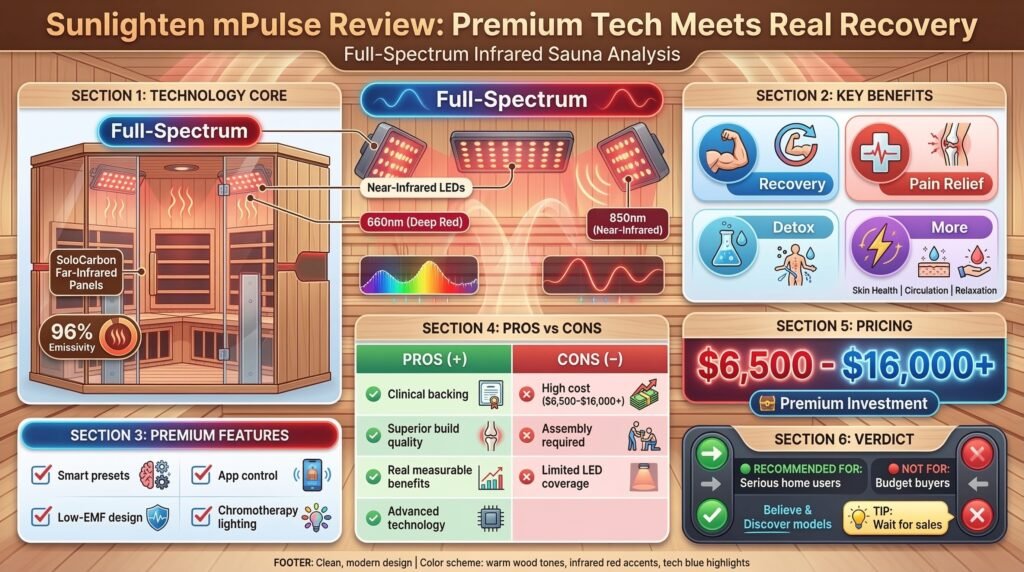
The Sunlighten mPulse is a premium full-spectrum infrared sauna line combining high-emissivity SoloCarbon far-infrared panels (96% effective) with near-infrared LEDs (660nm & 850nm) for recovery, pain relief, detox, and more. It features smart presets, low-EMF design, app control, and chromotherapy, but comes at a high price ($6,500–$16,000+). The review praises its build quality, clinical backing, and real benefits for committed users, while noting drawbacks like cost, assembly, and limited LED coverage. Recommended for serious home users (especially Believe or Discover models), but not budget buyers.
🧾 Table of Contents
1. Quick Summary
2. Brand Overview and History
3. mPulse Product Range Analysis
– mPulse Aspire (1-person)
– mPulse Believe (2-person corner)
– mPulse Discover (2-person straight)
– mPulse Conquer (3-4 person)
– Shared Features Across All mPulse Models
4. Quality and Performance Testing
5. Customer Service Experience
6. Pricing and Value Assessment
7. mPulse Pros and Cons Summary
– What Works Really Well
– What Could Be Better
8. Final Recommendation
Brand Overview and History
Sunlighten has been manufacturing infrared saunas since 1999, which means they’ve been in this space longer than most competitors. The company is based in Kansas and started when the founder was looking for choice health solutions (the classic wellness brand origin story, tbh).
What sets them apart from the dozens of other sauna brands is their SoloCarbon heating panels. They actually got these panels clinically tested by independent labs, which is pretty rare in the sauna world, where most companies just slap “infrared” on the box and call it a day.
The testing showed their panels produce around 96% emissivity in the far-infrared range, which basically means they’re really effective at producing the specific wavelengths that penetrate your skin.
The mPulse line launched as their premium option after they’d already established the Solo line (their entry-level saunas). The main upgrade with mPulse is the addition of near-infrared LEDs and the touchscreen control system that lets you run preset programs instead of just manually setting the temperature.
They’ve got patents on their heating technology and manufacture everything at their own facility, which matters if you care about quality control and not getting some random white-labeled sauna from a factory that makes 50 different brands.
mPulse Product Range Analysis
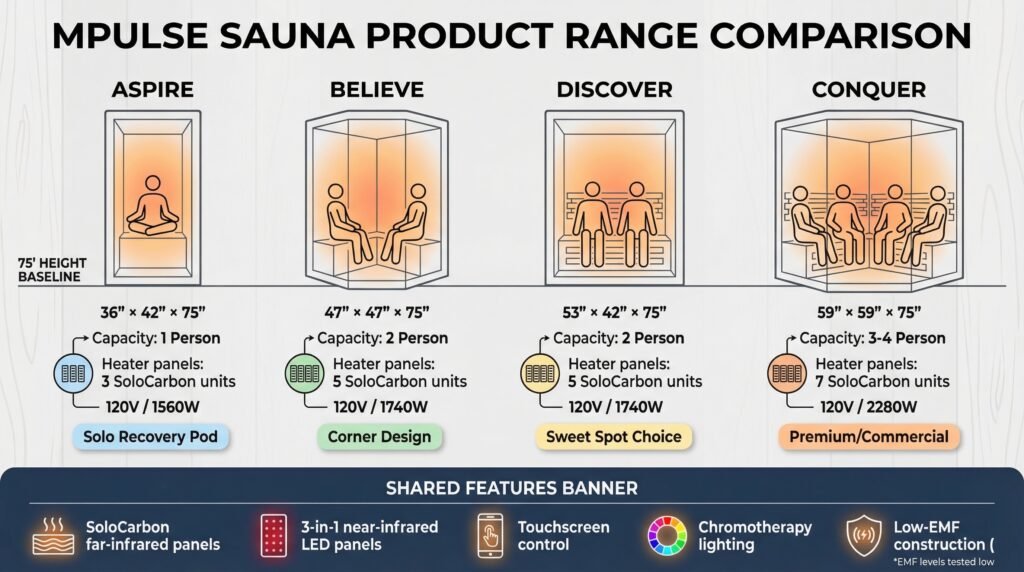
The mPulse collection breaks down into four models based on size and capacity. Here’s what you need to know about each one.
mPulse Aspire (1-person)
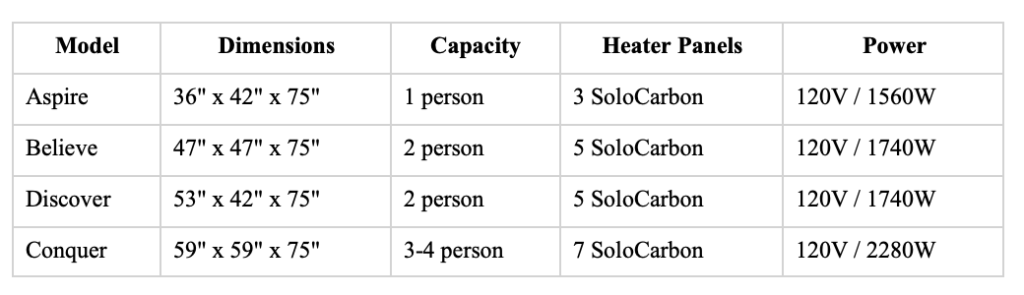
The smallest option at 36″ x 42″ x 75″. This is the solo model for people with limited space or who live alone and just want their own recovery pod. It fits one person comfortably (unless you’re like 6’5″ or something, then it might feel cramped).
Includes three SoloCarbon heaters and the full-spectrum option with near-infrared LEDs. The touchscreen comes standard, and you get all the same preset programs as the bigger models.
mPulse Believe (2-person)
Dimensions are 47″ x 47″ x 75″. This is the corner unit that fits two people if you don’t mind being close, or one person who wants to stretch out a bit.
The corner design is smart for awkward spaces in your house.
You get five SoloCarbon panels in this one, which means better heat distribution than the Aspire.
mPulse Discover (2-person)
This is 53″ x 42″ x 75″ and has a straight bench instead of the corner configuration. Honestly, I think this is the sweet spot for most people… big enough to share or move around in, but not so huge that it dominates your entire spare room.
Also has five heaters and can accommodate two adults without feeling cramped.
mPulse Conquer (3-4 person)
The big boy at 59″ x 59″ x 75″. This corner unit can technically fit 3-4 people, though realistically it’s more comfortable for 2-3 unless everyone is really good friends.
Seven SoloCarbon panels provide heat coverage from all angles. This is what you’d see at a fancy gym or wellness center, not your typical home setup unless you’ve got serious space and budget.
Shared Features Across All mPulse Models
Every mPulse sauna includes the same core technology regardless of size. You get the SoloCarbon far-infrared panels, the 3-in-1 near-infrared LED panels (for red light therapy), the touchscreen control panel, and chromotherapy lighting.
The preset programs are the same across the board: Cardio, Detox, Pain Relief, Relaxation, Weight Loss, and Anti-Aging. Each program adjusts the infrared spectrum and intensity automatically based on what research suggests works best for that goal.
The construction is all low-EMF wood (they claim less than 3 milligauss at sitting position), and every unit runs on standard 120V household power. No need for special electrical work or a 240V circuit like some commercial units require.
All models also include the Sunlighten app connectivity, which lets you control the sauna from your phone and track your sessions. Honestly, not sure how often people actually use the app, but it’s there if you want it.
Quality and Performance Testing
This is where the Sunlighten Sauna mPulse Review gets interesting, because there’s actual data instead of just marketing claims.
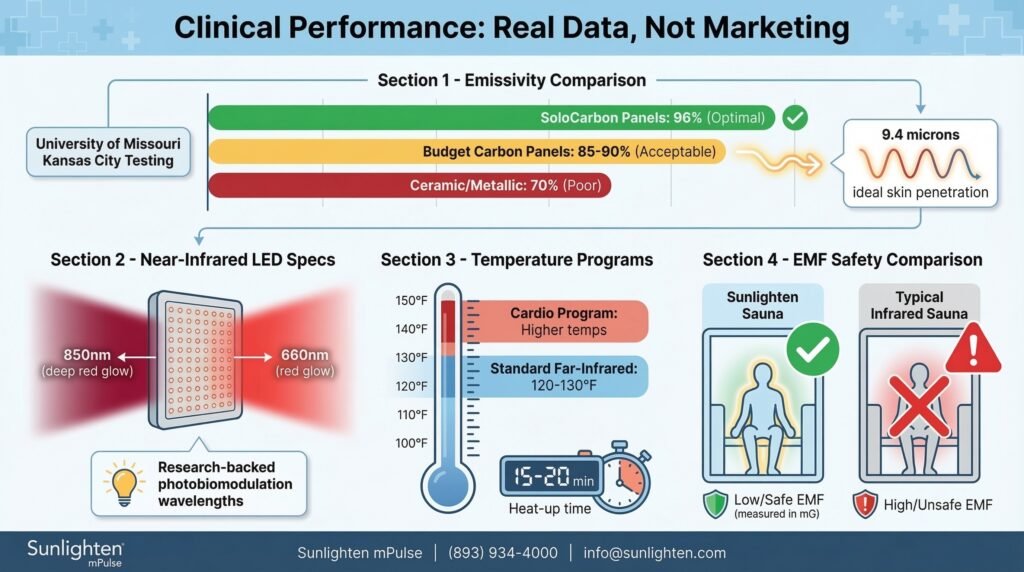
The SoloCarbon panels went through clinical testing at the University of Missouri, Kansas City. The study measured heat output, wavelength consistency, and emissivity levels.
The results showed 96% average emissivity in the far-infrared range (around 9.4 microns wavelength), which is right in the sweet spot for skin penetration.
Most cheap infrared saunas use carbon panels that are closer to 85-90% emissivity, or even worse, they use ceramic or metallic heaters that barely crack 70%. The difference matters because lower emissivity means you need higher surface temperatures to get the same infrared output, which makes the air inside the sauna uncomfortably hot instead of delivering that deep tissue heat you actually want.
The near-infrared LED panels output at 850nm and 660nm wavelengths. These are the standard red/near-infrared wavelengths that show up in most research about photobiomodulation and cellular energy production.
The LED panels are only on the front wall in most models (except the Conquer, which has them in many locations), so you’re getting that exposure on your front side during sessions.
The temperature range goes from about 100°F up to 150°F, depending on which program you’re running. The far-infrared programs typically run cooler (120-130°F) because the infrared wavelengths do the work instead of just heating the air.
The Cardio program pushes harder to get your heart rate up.
Heat-up time is around 15-20 minutes to reach operating temperature. That’s actually pretty standard for this size sauna… some cheaper ones claim faster heat-up, but that usually means they’re just cranking the air temperature without actually getting the infrared panels up to proper output.
The chromotherapy (colored light) system cycles through different colors based on whatever wellness theory associates colors with moods. Red for energy, blue for calm, green for balance, etc. Honestly, this feels like a nice-to-have bonus feature as opposed to a core function, but some people really get into it.
EMF levels tested at less than 3 milligauss when measured at the seated position. For context, your laptop probably puts out 10-20 milligauss at close range, so this is legitimately low-EMF if that’s something you care about.
Ready to get started now? Click the link below to go to Sunlighten’s official site and see their latest promotions
Customer Service Experience
Sunlighten’s customer service gets mixed reviews depending on who you ask. The company offers white-glove delivery and installation as an add-on service, which some people say is worth every penny because these saunas show up in many boxes, and you need to gather them.
The standard delivery is freight shipping to your curb. The delivery company calls ahead to schedule, but they’re not bringing it inside your house or putting it together.
You’re on your own for that part unless you pay for the installation service.
Assembly reportedly takes 1-2 hours with two people if you’re reasonably handy.
The units come with instructions and all the hardware you need. Some guys on forums mentioned that the wood panels are heavy and awkward to maneuver, so having a second person is basically required unless you want to struggle for three hours.
The warranty is lifetime on the heaters, five years on electrical components, and one year on everything else. That lifetime heater warranty is actually meaningful because the heating panels are the expensive part that you definitely don’t want to replace out of pocket.
Customer support is phone and email-based. Response times seem to vary… some people report getting help within a day, others mention waiting 3-4 days for email responses. Phone support during business hours seems to be the fastest option.
The company has an A+ BBB rating, which doesn’t mean everything is perfect, but suggests they at least respond to and decide complaints when issues come up.
Pricing and Value Assessment
Here’s where this Sunlighten Sauna mPulse Review might lose some people… these saunas can be expensive for some due to their premium quality. But you could roll the dice on a substandard quality from Amazon. It depends on your level of dedication and consistency. After less than a year of consistent use, you have free infrared sessions for life.
The mPulse Aspire (1-person) starts around $6,500-$7,000, depending on sales and promotions.
The Believe (2-person corner) runs about $6,500-$7,900
The Discover (2-person straight) runs $11,000 – $12,100
The Conquer (3-4 person) pushes up toward $9,800 – $16,199
Add another $500-$1,000 if you want the white-glove delivery and installation service. Plus, whatever you’re spending on the dedicated space in your home and the ongoing electricity costs (figure roughly $20-40/month if you’re using it daily, less if you’re more occasional).
That’s legitimately a lot of money. You can find infrared saunas on Amazon for $1,500-$2,000, so what are you actually paying for with the mPulse?
The main differences are the clinically-tested heating panels with documented emissivity levels, the addition of near-infrared LEDs for red light therapy, the low-EMF construction, the smart control system with preset programs, and the warranty coverage (especially that lifetime heater warranty).
Whether that’s worth 2-3x the price depends on how seriously you’re approaching this. If you’re experimenting with infrared therapy to see if it helps with muscle recovery or joint pain, maybe start with a cheaper unit.
If you’re committed to regular sauna use as part of your wellness routine and you want something that’s built to last and deliver consistent performance, the mPulse starts to make more sense.
The value equation also shifts if you’re now paying for regular sauna sessions somewhere. A float spa or wellness center might charge $40-$60 per infrared sauna session.
If you’re going twice a week, that’s $320-$480 per month.
The mPulse pays for itself in about a year at that usage rate, and then you’re basically getting free sessions (minus electricity) from that point forward.
Another angle… if you’re buying this for recovery after workouts or managing chronic pain, compare the cost to other interventions. Regular massage therapy, physical therapy copays, cryotherapy sessions, compression boots… if the sauna can reduce how often you need those other treatments, the ROI gets better.
For what it’s worth, the resale value on Sunlighten saunas holds up pretty well. You can find used mPulse units on Facebook Marketplace and Craigslist for 50-70% of the new price, which suggests people who buy them generally keep using them instead of letting them turn into expensive storage spaces.
Also, check if Sunlighten is running any promotions right now, because they often discount these units during certain times of the year. Getting 10-15% off can bring the price down to a more reasonable level.
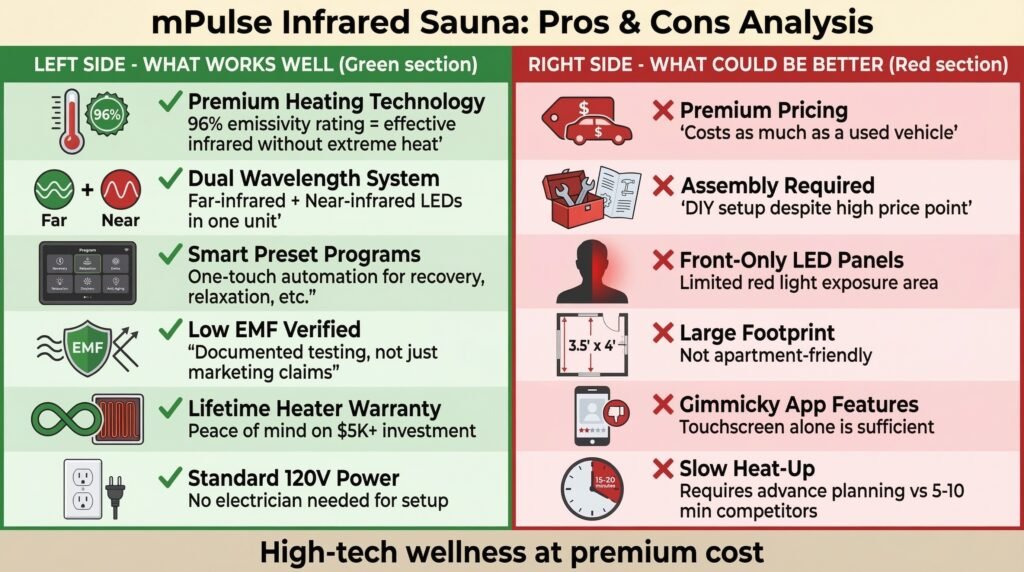
mPulse Pros and Cons Summary
What Works Really Well
The heating technology is legitimately high-quality with actual test data to back up the performance claims. The 96% emissivity rating means you’re getting effective infrared output without needing crazy high temperatures that make the sauna uncomfortable to sit in.
The combination of far-infrared plus near-infrared LEDs gives you two different wavelength ranges in one unit. Most home saunas only do far-infrared, so you’d need a separate red light therapy panel if you wanted both.
The preset programs take the guesswork out of settings. Instead of trying to figure out what temperature and infrared mix you need for recovery versus relaxation, you just pick the program and let it run.
The automation makes it easier to actually use the thing consistently instead of messing with settings every time.
Low-EMF construction is a real feature with documented testing, not just a marketing claim. If you’re spending 30-45 minutes in this thing regularly, keeping EMF exposure low makes sense.
The lifetime warranty on heaters provides peace of mind that you’re not going to be stuck with a $5,000 box with dead heating panels in five years.
Standard 120V power means you can plug it into a regular outlet without hiring an electrician to run new circuits. Setup is way easier than traditional steam saunas that need dedicated electrical and plumbing.
What Could Be Better
The price is the obvious barrier. These saunas cost as much as a used car, which puts them out of reach for a lot of people who might benefit from regular infrared therapy.
Assembly is required even after you pay several thousand dollars for the unit. Some competitors offer fully assembled delivery at this price point, so having to spend a few hours putting it together feels a bit cheap.
The near-infrared LED panels are only on the front wall in most models, which means you’re only getting red light exposure on your front side unless you turn around mid-session. Full surround LED coverage would be better for balanced exposure.
Size and space requirements are significant. Even the smallest mPulse model needs a 3.5′ x 4′ footprint plus clearance for the door, which rules out a lot of apartments and smaller homes.
The app and smart features feel a bit gimmicky. The touchscreen control panel works fine on its own, and I’m not convinced the app adds much practical value beyond remote preheating.
Heat-up time of 15-20 minutes means you need to plan instead of just hopping in whenever you feel like it. Not a huge deal, but it’s slower than the 5-10 minute heat-up some competitors claim.
Final Recommendation
This Sunlighten Sauna mPulse Review comes down to whether you’re serious enough about home infrared therapy to justify the investment.
The mPulse line delivers what it promises. The heating technology works as advertised, the build quality is solid, the warranty coverage provides backup, and the combination of far-infrared plus near-infrared gives you more functionality than most home saunas in this category.
The price is high but not outrageous compared to other premium infrared saunas with similar specs. You’re paying for documented performance, better components, and a company that’s been around long enough to actually honor their lifetime warranty.
This makes the most sense if you’re now spending money on regular sauna sessions somewhere else, dealing with recovery needs from serious training, or managing chronic pain or inflammation where consistent infrared therapy might actually move the needle on your quality of life.
It makes less sense if you’re experimenting with infrared therapy for the first time, tight on space, or not committed to using it many times per week. There are cheaper options that can give you a taste of whether infrared therapy works for you before dropping $4,000-$7,000 on a premium unit.
For most people reading this Sunlighten Sauna mPulse Review, I’d recommend starting with the Discover or Believe model. The 2-person size gives you enough room to actually relax and move around a bit, the price is in the middle of the range, and you can share it with a partner or friend. The single-person Aspire saves a bit of money but feels cramped, and the Conquer is overkill unless you’re running a small wellness center out of your house.
The preset programs that make the most practical difference are Cardio (for elevating heart rate and getting a workout-style sweat), Pain Relief (focuses on far-infrared at moderate temps), and Relaxation (lower intensity for longer sessions). The other programs are fine, but those three cover most real-world use cases.
If you’re ready to pull the trigger, wait for a sale period or at least call Sunlighten directly to see if they can offer any kind of discount. Getting even 10% off makes a real difference at this price point, and companies will often negotiate a bit if you’re a serious buyer.
The choice is going with a cheaper infrared sauna to test the waters, accepting that you’ll get lower performance and probably a shorter lifespan, and then upgrading to something like the mPulse later if you turn into a daily sauna person. That’s a totally reasonable approach and might save you money if you end up not using it as much as you thought.
For people who are already committed to regular sauna use and want something built to last with proven technology, the mPulse line is one of the better options available for home use right now. Not perfect, not cheap, but legitimately good at what it does.
The final call comes down to your space, budget, and how convinced you are that regular infrared sessions will become a consistent part of your routine. If all three of those line up, the mPulse delivers solid value despite the high upfront cost.
Frequently Asked Questions
What makes the mPulse different from cheaper infrared saunas? It uses clinically tested SoloCarbon far-infrared panels with 96% emissivity (vs. 85–90% in budget models), adds near-infrared LEDs for red light therapy benefits, offers preset wellness programs, low-EMF construction (<3 milligauss), and a lifetime warranty on heaters.
How much does a Sunlighten mPulse cost? Prices range from ~$6,500 (Aspire 1-person) to $16,199 (Conquer 3-4 person), depending on model and options. Promotions often give 10–15% off, compared to ~$1,500–$2,000 Amazon alternatives.
What health benefits does it target? Preset programs focus on cardio, detox, pain relief, relaxation, weight loss, and anti-aging via far-infrared deep heating (comfortable 120–130°F) plus near-infrared for cellular recovery, inflammation reduction, and muscle/joint benefits.
Is assembly difficult, and what about setup? Requires 1–2 hours with two people (heavy panels); ships via freight (curbside or optional white-glove install for $500–$1,000 extra). Uses standard 120V power, no special wiring needed.
Who is the mPulse best for? Committed regular users prioritize premium tech, documented performance, and recovery benefits. Not ideal for beginners, budget-conscious buyers, or casual testing, start with cheaper options if unsure. Any major downsides? High cost, slower heat-up (15–20 min), near-infrared LEDs mostly front-facing (limited in most models), required assembly, space needs, and occasionally mixed customer service experiences. App features can feel somewhat gimmicky
>>Get $200 off your purchase with this link. Click here<<
This article includes affiliate links. If you click through and make a purchase, I may receive a small commission. This helps support the site and allows me to keep creating helpful content at no extra cost to you.