Quick Summary
The article is a detailed Rogue review of their red light therapy products. It highlights the Rouge’s unique, customizable options (including rare 1060nm), independent controls via app/touchscreen, preset modes, even light distribution, and solid build quality.
With a range of products, Rouge offers long-term cost savings compared to professional sessions and is recommended for committed daily users seeking versatility for skin health, muscle recovery, or biohacking.
However, its moderate power output, NIR-heavy wavelength balance, and high price make it less ideal for casual users or those prioritizing maximum intensity or pure skin-focused therapy. Overall, it’s worth the investment for serious, long-term users who want consistent results. Ultimately, it depends on your goals and commitment level.
Table of Contents
1. Introduction – Overview of the Rouge G4 Pro’s customization features and cost savings vs. clinic sessions.
2. Brand Overview and History – Rouge’s evolution from standard panels to advanced customizable models with dual-chip technology.
3. Product Range Analysis – Comparison of G4 Pro (full-body, premium) vs. Nano (portable, entry-level), including pricing and break-even calculations.
4. Quality and Performance Testing – Details on wavelengths, penetration depths, power output (avg. 59.2 mW/cm²), and even light distribution.
5. Independent Wavelength Control and App Features – Explanation of per-wavelength adjustments, pulsing, presets, and app usability.
6. Build Quality and Daily Use Experience – Assessment of noise, mounting, interface, and practical home use.
7. Customer Service Experience – Notes on returns, warranty, and support reliability.
8. Pricing and Value Assessment – Cost breakdown, long-term savings, and comparisons to competitors.
9. What Actually Matters vs Marketing Hype – Separating valid features (e.g., 1060nm, presets) from potential overstatements.
10. Pros and Cons Summary – Balanced list of strengths and weaknesses.
11. Final Recommendation – Who it’s best for and key decision factors.
12. FAQ
Introduction
In one word, the Rouge G4 Pro is customizable: it offers customizable wavelengths, intensity, and pulsing patterns. You can basically tweak everything. And for a red light panel, that matters way more than you might think.
Not to mention, it packs eight different wavelengths into one device, whereas most competitors are still limited to two.
Not too shabby for someone tired of driving to expensive clinic sessions three times a week.
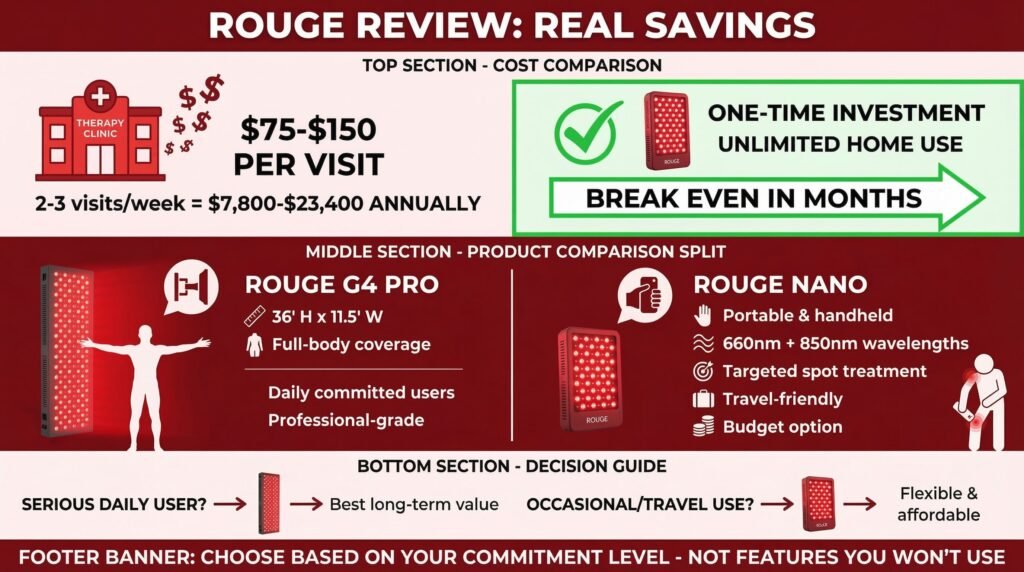
Like, really fast. $75-$ 150 per visit means you’re spending thousands annually if you’re serious about it. And honestly, the whole routine of scheduling appointments and driving across town gets old when you just want consistent recovery support.
As many red light therapy regular practitioners will attest, whether it is improvements in skin or injury recovery, consistent results require consistent use.
That being said, when embarking on your red light therapy journey, realize that the purchase of an at-home red light therapy is an investment in one’s long-term health, not just eventual cost-savings
Use the cost-saving calculator in this article to crunch the real savings of a Rouge red light device compared to 2-3 professional sessions per week at an average of $100 per session.
So, this Rouge review is going to break down whether their flagship panel actually delivers what people need, or if it’s just fancy tech that sounds impressive on paper.
Brand Overview and History
Rouge spent years making solid red light panels without getting fancy. They stuck with 660nm and 850nm wavelengths for the longest time, which are basically the industry standard.
While other companies were racing to add more and more LEDs and making wild claims, Rouge just kept building reliable devices that worked.
That approach earned them a decent reputation with people who actually use these things daily, not just guys buying them because they saw an Instagram ad.
The brand shifted gears with its latest generation, though. They finally added the customization features that power users had been asking for.
We’re talking independent wavelength control, advanced pulsing options, and a proper app interface that doesn’t feel like it was slapped together in a weekend.
What makes Rouge different from the budget panels flooding Amazon is the engineering behind the LEDs themselves. They use dual-chip technology, meaning each light source outputs multiple wavelengths at once.
The practical result is even light distribution across the entire panel surface, rather than the annoying bright spots that some cheaper devices have.
For someone using a panel every single day for muscle recovery or skin work, that consistency actually matters. You don’t want to be guessing which body part is getting proper exposure.
Product Range Analysis
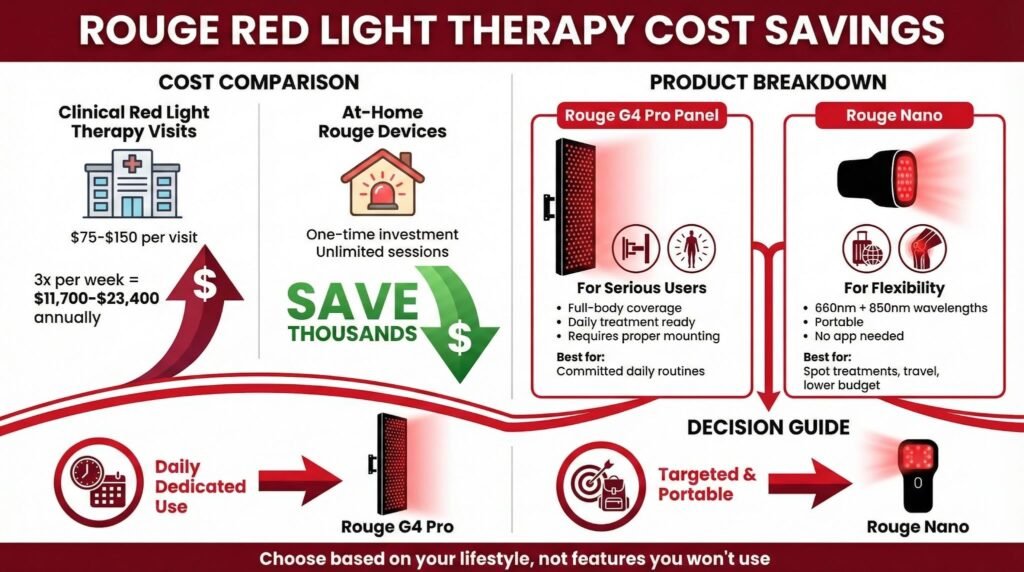
Rouge makes a few different devices depending on what you actually need. Understanding the differences prevents you from overspending on features you’ll never touch.
The Rouge G4 Pro is their main wall-mounted panel. This thing is 36 inches tall and 11.5 inches wide, built for serious use.
If you’re planning to do full-body sessions or you know you’ll stick with daily treatments, this is what most committed users end up with.
It weighs enough that you’ll want to mount it properly, not just lean it against a wall.
The Rouge Nano is completely different. It’s handheld, portable, and just gives you the basic 660nm and 850nm wavelengths without all the app controls.
This makes sense for travel or if you want something to grab quickly for targeted spot work on a sore shoulder or knee. Much cheaper too.
The product lineup actually makes sense when you think about real-world use. Some people want a dedicated setup they’ll use religiously.
Others want flexibility and portability. Rouge isn’t forcing everyone into one expensive option.
But if you’re the type who buys fitness equipment that ends up collecting dust, start with the Nano. If you know you’ll actually commit to daily use, the G4 Pro’s extra features justify the cost.
Check current Rouge pricing and variety of customizable products here
Get a real idea of the Rouge cost-savings vs. repeated weekly professional red light therapy sessions by using the calculator below:
Red Light Therapy Cost Savings Calculator
Calculate how much you’ll save by investing in your own red light therapy device versus continuing to pay for clinic visits. At $75-$150 per visit, serious users spend thousands annually. See your personalized break-even timeline and long-term savings.
Quality and Performance Testing
This is where the Rouge review gets into actual numbers instead of marketing fluff. Independent testing with spectrometers shows exactly what light you’re getting from these panels.
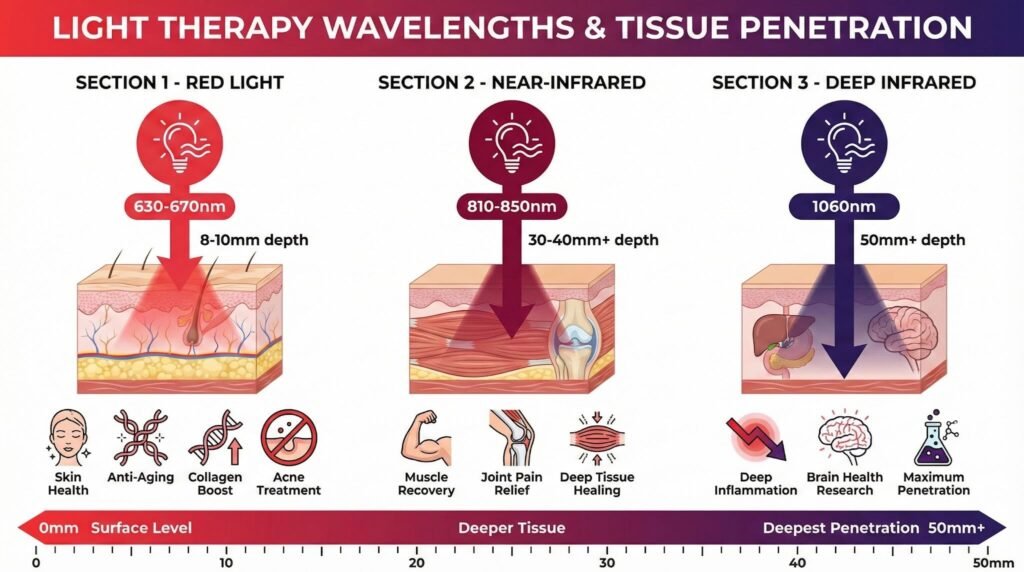
The G4 Pro outputs eight separate wavelengths: 630nm, 650nm, 660nm, 670nm, 810nm, 830nm, 850nm, and 1060nm. That’s legitimately the broadest spectrum available in a consumer panel right now.
Most competitors are still doing two wavelengths, maybe four if they’re trying to stand out.
Why does this matter beyond just having a bigger number to brag about? Different wavelengths penetrate to different depths and trigger different biological responses.
The red wavelengths (630-670nm range) penetrate about 8-10mm into the skin. This depth is ideal for surface-level work like addressing fine lines, acne flare-ups, psoriasis patches, and stimulating collagen production. If your main goal is skin health and anti-aging, you want strong output in this range.
The near-infrared wavelengths (810-850nm) go deeper, reaching muscle tissue, tendons, and even bone. This is why athletes and people managing joint issues care more about infrared output than visible red light.
You need that penetration for actual recovery work on deep tissue.
The 1060nm wavelength is where things get interesting. This wavelength rarely shows up in consumer devices because it’s typically reserved for medical equipment.
Rouge included it specifically for the maximum penetration depth, and there’s emerging research around potential applications for brain health and deep inflammation management.
Power output numbers: The G4 Pro hits a peak of 65 mW/cm² with an average of 59.2 mW/cm² measured across the treatment area. That ranks it tied for 16th place among wall-mounted panels when comparing average irradiance.
Translation: it’s solid but not the most powerful option out there.
If you’re treating really deep joint injuries or you’re an elite athlete needing the most power density, higher-output panels exist. The BioMax Pro Ultra hits 101 mW/cm², for example.
But for general muscle recovery, skin maintenance, and aging support, 59.2 mW/cm² is more than enough for most people.
At the standard 6-inch treatment distance, you get consistent light spread with no hot spots or dead zones. That dual-chip architecture delivers even coverage across the full panel surface.
About two-thirds of the total energy output comes from near-infrared wavelengths as opposed to visible red light.
This ratio appeals to people prioritizing deep tissue work and muscle recovery over purely cosmetic skin applications.
One thing worth noting: the 288 dual-chip LEDs produce 134 watts total power output. That’s efficient without running up your electric bill, and the panel stays relatively cool during operation.
Independent Wavelength Control and App Features
This feature alone separates the G4 Pro from standard panels. You’re not stuck with whatever wavelength ratio the manufacturer decided was best.
You can independently adjust the intensity for each of the eight wavelengths using either the touchscreen or the mobile app.
The really advanced option is pulsing individual wavelengths independently. You could pulse the 630nm for targeted skin work while keeping other wavelengths steady.
Or you could run a recovery-focused session with heavy 850nm and 1060nm output while minimizing red light entirely.
This level of control doesn’t exist on most home panels. They’re either on or off, maybe with a basic dimmer.
The practical application is pretty straightforward. Someone dealing with both acne breakouts and sore muscles from training can improve the wavelength ratios for their specific situation instead of choosing between preset profiles.
You can create custom programs for different times of day or different goals.
Advanced users and biohacking types absolutely love this level of customization.
Beginners can completely ignore all the features and just use the preset modes for sleep support, muscle recovery, or whatever.
The preset modes include things like sleep optimization, muscle repair, and even pet therapy settings. You just tap the mode and go. Simple.
The mobile app interface handles the complexity better than the built-in touchscreen, especially when you’re managing eight different wavelengths and multiple parameters. The screen looks nice, but feels cramped when you’re actually trying to adjust specific settings.
Most people end up defaulting to the app for anything beyond basic on/off control.
Check current Rouge pricing and availability here (Their site usually has better deals than Amazon)
Build Quality and Daily Use Experience
Red light panels end up in bedrooms, home gyms, and treatment spaces. If the thing sounds like a jet engine or breaks after six months, none of the fancy features matter.
The G4 Pro operates at 47.5 decibels, which puts it among the quieter full-size panels available. That’s roughly the same volume as a quiet refrigerator hum.
You can use it in your bedroom without it disrupting sleep or concentration, which matters if you’re doing morning or evening sessions.
The 288 LEDs are housed in a solid body designed to mount flush against a wall. The panel feels built to last, though Rouge made the weird choice to skip including a printed manual. They just provide a digital download instead.
For a premium-priced device, that feels like an annoying cost-cutting move, especially for people who prefer physical documentation or aren’t comfortable downloading PDFs.
There’s a slight humming sound when you dim certain wavelengths, though it’s not loud enough to be a real problem. Just something you might notice in a totally silent room.
The touchscreen is high-resolution but undersized for managing this many variables. The app interface works better for anyone doing advanced customization, making your phone the preferred control method.
The panel measures 2.5 inches thick, so it doesn’t stick out dramatically from the wall once mounted. It comes with wall-mounting hardware that seems solid enough, though you’ll want to hit studs if possible, given the weight.
Customer Service Experience
Rouge offers a 60-day return period, which reduces the risk factor if you buy the panel and realize you’re not going to actually use it consistently. That’s a legitimate safety net since a lot of home wellness equipment ends up gathering dust once the initial excitement fades.
The warranty coverage is pretty standard for the category. Nothing spectacular but nothing concerning either.
Customer service response times seem reasonable based on user reports, though you’re mostly dealing with email support as opposed to phone.
The company has been around long enough that they’re not some fly-by-night operation that’ll disappear in six months. That matters when you’re dropping several thousand dollars on equipment.
Pricing and Value Assessment
Investment in a Rouge G4 Pro runs in the $3,000+ range, depending on current promotions and bundle options. That’s genuinely expensive for home wellness equipment. No way around it.
The value calculation depends entirely on your choice. A single professional red light therapy session typically costs $75-150, depending on your location and the clinic.
If you’re going three times per week, you’re spending $600-1,800 monthly.
Twenty sessions get you to $1,000-3,000, which is basically the cost of owning your own panel.
Free to jump back to the cost-savings calculator to see the real savings. The numbers don’t lie.
If you’re someone who would otherwise pay for regular professional treatments, a home panel breaks even within a year while giving you unlimited future sessions. The math works.
For fitness enthusiasts managing chronic muscle soreness or tendon issues, having consistent daily access to recovery tools often produces better results than sporadic professional appointments anyway. Compliance is easier when the device is sitting in your house, ready to use.
Compared to the BioMax Pro Ultra (which puts out 101 mW/cm²), the Rouge costs more while delivering less raw power density. But the G4 Pro’s eight wavelengths, independent dimming controls, and advanced customization create different value depending on what you need.
The BioMax wins if pure power is your only concern. The Rouge wins if you value control and variety.
Compare Rouge vs other panels here
For people mainly focused on skin and anti-aging work, cheaper panels with strong red light output might make more sense.
The G4 Pro’s energy distribution leans heavily toward near-infrared, which is great for muscle and deep tissue but maybe overkill if you just want to address facial wrinkles.
What Actually Matters vs Marketing Hype
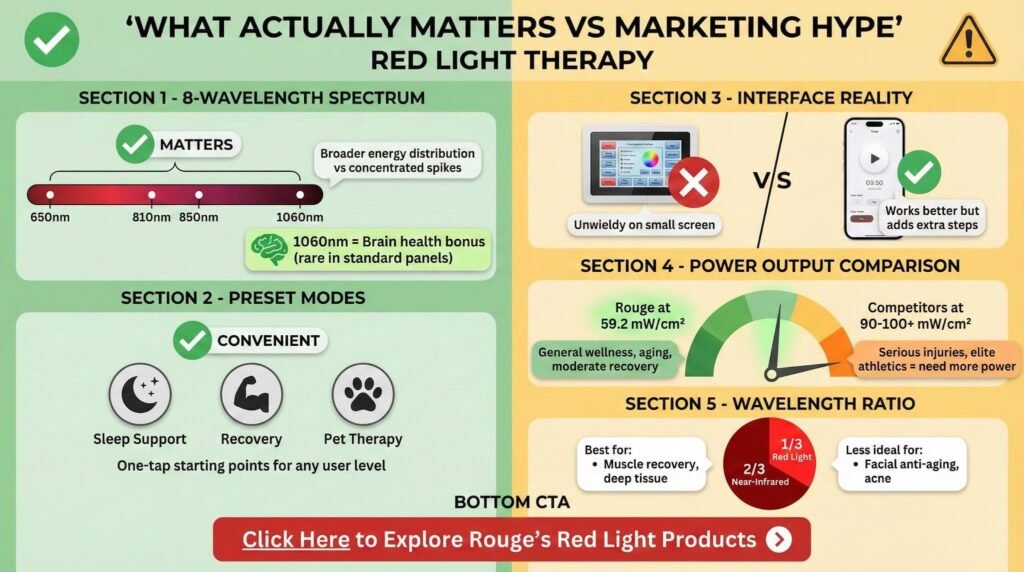
The eight-wavelength spectrum genuinely impresses people who understand light therapy.
Yeah, some wavelengths overlap functionally (650nm and 660nm are pretty similar), but the broader distribution means more balanced energy across the light spectrum instead of concentrated spikes at just two frequencies.
The 1060nm wavelength specifically gets mentioned in user discussions as a worthwhile addition. It shows up in brain health devices and represents genuine expansion beyond conventional red light panels.
Whether you personally need it depends on your goals, but having the option doesn’t hurt.
Individual preset modes offer real convenience even if you never customize beyond them. One tap for sleep support, another for muscle recovery, another for pet therapy.
These presets work as solid starting points even for advanced users who eventually create custom protocols.
What falls flat is the touchscreen interface, despite looking sleek. It becomes unwieldy when managing this many options on a small screen.
The app fixes this problem, but adds an extra step that shouldn’t be necessary for basic operation.
The wavelength ratio works great for muscle recovery and deep tissue applications. About two-thirds of energy output comes from near-infrared wavelengths.
But if your primary goal is facial anti-aging or acne treatment, you might prefer a different panel with more red light output relative to infrared.
Rouge doesn’t make the most powerful panel available. Other devices now push into the 90-100+ mW/cm² range.
If you’re treating serious bone injuries, deep inflammation, or optimizing high-level athletic recovery, you might outgrow this panel’s output eventually.
For general wellness, aging support, and moderate fitness recovery, 59.2 mW/cm² works fine.
Pros and Cons Summary
What works well: The eight-wavelength spectrum provides genuine versatility. Independent wavelength control allows serious customization.
The preset modes make it beginner-friendly despite advanced features.
Build quality feels solid and long-lasting. Quiet operation at 47.5 decibels.
The 1060nm wavelength adds unique depth.
App control interface handles complexity well. 60-day return window reduces purchase risk.
What could be better: Power output sits in the middle of the pack as opposed to leading the category. Pricing runs high compared to simpler alternatives.
The wavelength distribution heavily favors near-infrared over red light.
No printed manual included. The built-in touchscreen feels cramped for the complexity it’s managing. Slight humming during dimming operations.
The panel makes sense for fitness enthusiasts managing ongoing muscle or joint recovery who genuinely use devices daily. The control over wavelength ratios lets you adjust for specific session goals as opposed to accepting one-size-fits-all settings.
Aging adults committed to consistent anti-aging practice benefit from comprehensive wavelength coverage. The 630-670nm red light addresses facial aging directly, while 810-1060nm supports broader systemic benefits.
Biohackers and optimization-focused people interested in experimenting with light protocols get the most value from the advanced control features. The customization options justify the premium price for this audience.
Anyone managing chronic skin conditions like psoriasis, acne, or dermatitis while also wanting broader health benefits gets both skin-targeting wavelengths plus deep-penetrating near-infrared in one device.
See Rouge customer reviews and current deals
The panel doesn’t make sense for casual users wanting a no-thought device; they just flip it on occasionally. The Nano works better for travel and portability.
Higher-power panels work better for serious athletes prioritizing most output above everything else.
Final Recommendation
The Rouge review ultimately comes down to matching device capabilities with your actual commitment level and specific goals.
If you’re serious about daily red light therapy and willing to spend premium money for a well-engineered device with genuine control options, the G4 Pro delivers what it promises.
The panel doesn’t claim to be the highest-powered option available, but the eight-wavelength spectrum and independent wavelength control create capabilities absent from competitors.
The build quality supports long-term use, the noise level makes daily sessions realistic, and the preset modes work for beginners while advanced customization satisfies power users. That combination of qualities matters more than any single specification.
For muscle recovery specifically, the near-infrared-heavy output and 1060nm wavelength make this a solid choice, assuming you’re comfortable with the wavelength distribution. The panel leans toward deep tissue applications as opposed to purely surface-level work.
For aging and wrinkle reduction, the red wavelengths help with skin health, but you’re getting a panel that tilts more heavily toward systemic benefits than facial-specific therapy. People focused exclusively on cosmetic applications might prefer a different wavelength balance.
The value calculation depends on whether you’ll actually use the device daily for years. If a professional clinic visit costs you $75 monthly, this panel pays for itself in roughly four years of consistent use, then provides unlimited access afterward for just electricity costs.
Red light therapy has legitimate science supporting the investment assuming you’re committed to regular use. Rouge’s engineering and feature set justify the premium within that category.
The remaining question is whether you’re the type who follows through on daily practice or someone who buys equipment with enthusiasm only to abandon it within weeks.
That decision comes down to knowing yourself honestly, which nobody else can answer for you.
Get the Rouge G4 Pro here (60-day returns if it doesn’t work out)
The panel works well for its intended purpose. The customization features provide real value beyond basic on/off operation.
The price reflects the engineering and capabilities as opposed to just marketing hype.
FAQ
What is the Rouge G4 Pro, and what makes it unique?
It’s a wall-mounted full-body red light therapy panel from Rouge with eight wavelengths (630nm, 650nm, 660nm, 670nm, 810nm, 830nm, 850nm, 1060nm), independent control over each, pulsing options, and preset modes. It’s unique for its broad spectrum (including rare 1060nm for deep penetration) and high customization compared to most panels limited to 2-4 wavelengths.
How much does the Rouge G4 Pro cost, and is it worth it financially?
It retails in the $3,000+ range (varies with promotions). It pays for itself quickly vs. clinic sessions ($75–$150 each): daily home use can break even in ~2 months and save thousands annually (e.g., $4,000+ in the first year).
What’s the difference between the Rouge G4 Pro and the Rouge Nano?
The G4 Pro is a larger, wall-mounted panel for full-body, serious daily use with advanced controls and eight wavelengths. The Nano is a smaller, portable handheld device for targeted/spot treatment or travel, with fewer features and lower cost, better for beginners or casual users.
Is the power output strong enough for deep tissue or injury recovery?
Average irradiance is ~59 mW/cm² (solid for general use), with NIR-dominant wavelengths aiding muscle/joint recovery. It’s sufficient for most but not the highest (e.g., lower than some competitors like BioMax at 101 mW/cm²), so elite athletes needing maximum intensity may prefer alternatives.
Is it beginner-friendly despite the advanced features?
Yes, preset modes (e.g., for sleep, muscle repair, pet therapy) simplify use, while the app and touchscreen handle complexity. Advanced users/biohackers appreciate full customization.
How loud is it, and what’s the build quality like?
Quiet operation (~47.5 dB, minimal hum during dimming). Solid, thin design for wall-mounting, even light distribution via dual-chip LEDs, but it’s heavy and requires secure mounting. No printed manual (digital only).
What’s the return policy and customer service like?
60-day return period, standard warranty. Support is via email with reasonable response times; the established brand reduces risk.
How does it compare to other panels like BioMax?
Rouge offers more wavelengths and independent controls but lower power. BioMax has higher irradiance for deeper/faster treatments. Rouge is better for versatility/systemic benefits; others may suit pure power or skin-focused needs.
Is the wavelength balance better for skin anti-aging or deeper recovery?
Heavily tilted toward near-infrared (deeper muscle/joint/inflammation benefits, including 1060nm). Less optimal for pure skin/anti-aging (which favors more red light); good for chronic conditions but may be overkill for cosmetic-only users.
Do I need to use it daily, and how long until results?
Consistent daily sessions are key for cumulative benefits (e.g., skin improvements, recovery). Results vary but build over weeks/months with regular use.
This article includes affiliate links. If you click through and make a purchase, I may receive a small commission. This helps support the site and allows me to keep creating helpful content at no extra cost to you.