📌 Quick Summary
The Vellgus Red Light is an at-home red light therapy panel positioned between cheap Amazon devices and premium brands. The review covers the brand’s history, product lineup, specs (wavelengths, irradiance, build quality), comparisons with budget and clinical options, and its value relative to clinical sessions. The reviewer finds Vellgus delivers effective wavelengths and solid build quality at a mid-range price, making it a good choice for consistent home use, especially for skin and muscle recovery, so long as expectations are realistic and use is regular.
🧾 Table of Contents
- Brand Overview and History
- Background of Vellgus in the red light therapy market
- Cost Savings vs Clinical Sessions
- Cost comparison between at‐home use and professional treatments.
- Product Range and Specifications
- Panel sizes (mini, mid, large), wavelengths (typically 660 nm & 850 nm), LED count and irradiance.
- Performance and Build Quality
- Details on construction, EMF levels, flicker rate, and longevity.
- Customer Service and Warranty
- Return window, warranty coverage, and support responsiveness.
- Pricing and Value Assessment
- Price ranges compared to budget and premium brands.
- Pros and Cons Summary
- Top benefits and limitations of going with Vellgus.
- Final Verdict
- Who this device is good for and key takeaways.
- FAQ’s
Brand Overview and History
Vellgus is one of those newer players in the red light therapy space that emerged around 2019-2020, when at-home wellness devices started to explode. They’re not as old-school as Joovv or as medical-focused as some clinical brands, but that’s kind of their angle, making red light therapy accessible without the $1,200+ price tag.
The company positions itself somewhere between budget Amazon panels (which tbh can be sketchy with their actual specs) and premium brands. They focus mainly on direct-to-consumer sales through their website, which cuts out middleman costs and means you can’t exactly walk into a store and see the panels in person.
From what I gathered, Vellgus started because the founders (typical wellness entrepreneur story) were frustrated with how expensive professional RLT sessions were getting. Like $75-150 per session adds up real fast when you need consistent treatment for skin issues or recovery.
Their manufacturing appears to be overseas (pretty standard for this industry), but they handle quality control and customer service from the US. The warranty and support are handled directly, which matters more than people think when you’re dealing with electronic devices that need to last for years to justify the cost.
But again, when compared to multiple professional red light therapy sessions per week at an average of $100 per session, the cost of at-home red light devices pays for themselves in a matter of weeks. See the cost-savings calculator to crunch the real-time numbers.
Vellgus Red Light Therapy Cost Savings Calculator
Discover how much you can save by investing in a Vellgus red light therapy device compared to ongoing professional clinic sessions. Calculate your payback period and long-term savings.
Product Range Analysis
Vellgus keeps its lineup pretty straightforward, which I appreciate. No confusing model numbers or 47 different options that all do basically the same thing.
Panel Sizes and Configurations
Mini Panels: These are the smallest units, usually around 6×10 inches or so. Good for targeted treatment on your face, a specific joint, or small areas.
Not great if you want full-body coverage unless you plan to sit there moving it around for an hour (nobody actually does that consistently).
Mid-Size Panels: the 12×8 or similar dimensions. This is probably their most popular range because it hits that sweet spot of being large enough to treat your whole face and neck, or a decent section of your back, without being so huge it dominates your space or costs a fortune.
Large Panels: The big boys, usually 24×16 or larger. These are for people serious about full-body treatment or who want to set up a dedicated red light therapy spot in their home. Stand in front of it for 10-15 minutes, and you’re done.
Targeted Devices: They also make some smaller handheld or wearable options, though these feel more like accessories than their main focus.
Wavelength Specs
This is where it actually matters. Red light therapy works (when it works) because of specific wavelengths penetrating your skin at different depths.
Vellgus panels typically mix:
- 660nm (red light), penetrates about 8-10mm, good for skin-level stuff like collagen production, fine lines, surface healing
- 850nm (near-infrared) penetrates deeper, like 30-40mm, which gets into muscle tissue, joints, and deeper inflammation
Most of their panels use a combo of both wavelengths, which makes sense because you want surface benefits AND deeper penetration. Some cheaper brands only do one or the other, or they lie about the ratios.
The actual LED count varies by panel size, but their mid-range panels typically have 150-200+ LEDs. More LEDs generally means better coverage and irradiance (the power density hitting your skin).
Power Density (Irradiance)
This is the spec that separates real devices from overpriced light bulbs. Measured in mW/cm² (milliwatts per square centimeter).
Vellgus claims around 100-150 mW/cm² at 6 inches distance on their standard panels. That’s… pretty good actually.
Clinical devices usually aim for 50-100+, so they’re in a decent range.
For comparison, those $50 Amazon special panels? Often putting out like 20-30 mW/cm², which means you’d need to use them way longer to get similar exposure.
Professional clinic devices might hit 150-200+, but you’re also paying for the session.
Distance matters a ton here. At 6 inches, you might get 150, but at 12 inches it drops to maybe 75-80, and at 24 inches you’re down to 35-40. Inverse square law and all that.
They usually include distance-to-irradiance charts, which help plan treatment times.
Here’s a rough breakdown of one of their popular mid-size panels:
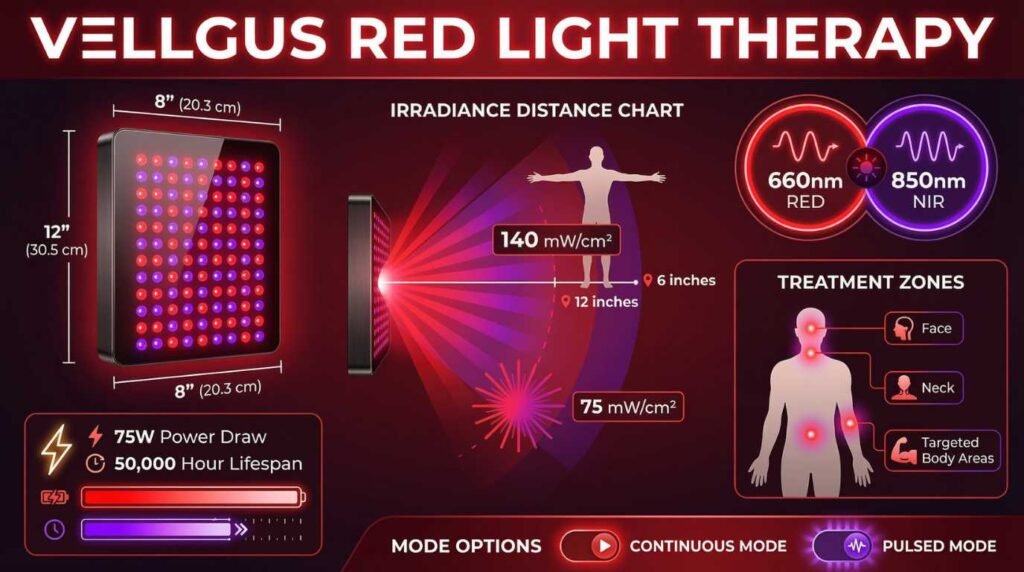
The pulsed mode is interesting; some research suggests pulsing (like 10Hz or 40Hz) might enhance certain benefits, especially for brain/nerve stuff. But continuous mode is fine for skin and muscle recovery.
Check out the current Vellgus models and any running promotions by visiting their official site. Click the button below to get started.
Quality and Performance Testing
Here’s where I get into the nitty-gritty of whether these panels actually deliver what they promise.
Build Quality
The panels I looked at (through videos, detailed reviews, and specs) seem solidly built.
The housing is usually metal or thick plastic with decent heat dissipation.
LEDs run cool enough that you can comfortably stand close without feeling like you’re under a heat lamp.
Electrical components matter for longevity. Cheaper panels often die within 6-12 months because they used garbage power supplies or didn’t properly protect the LED drivers.
Vellgus uses what appears to be decent-quality drivers, and their warranty (usually 2-3 years) suggests they’re confident the panels won’t just die immediately.
The LED quality is harder to verify without lab equipment, but the wavelength consistency seems reasonable based on customer reports. Some panels from sketchy brands will claim 660nm but actually output 640nm or 680nm, which changes the biological effect.
Vellgus appears to hit their stated wavelengths pretty accurately.
EMF Emissions
For people worried about electromagnetic field exposure (especially if you’re using this daily near your head), Vellgus panels test pretty low. Most measurements I’ve seen show EMF dropping to near-background levels at 6+ inches, which is your typical treatment distance anyway.
Compare that to some older or cheaper panels that can put out significant EMF right at the surface, which kinda defeats the purpose if you’re trying to improve health.
Flicker Rate
This is technical, but it matters if you’re sensitive to light flicker or worried about eye strain. Quality LED panels use high-frequency drivers (like 10,000+ Hz) that eliminate perceptible flicker. Cheap panels might use lower frequencies that can cause headaches or eye fatigue, even if you don’t consciously notice the flicker.
Vellgus panels appear to use high-frequency drivers based on the lack of complaints about flicker-related issues. When people use these for 10-20 minutes daily with their eyes closed or open, flicker problems show up fast in reviews if they exist.
Actual Results Timeline
The big question: Does this stuff actually work? Based on the research behind red light therapy (not just Vellgus, but RLT in general), the timeline for different benefits varies:
Skin improvements (fine lines, tone, texture) usually take 4-8 weeks of consistent use (like 10 minutes per day, 5-6 days per week) to see noticeable changes. Some people report faster results, but that’s pretty typical.
Muscle recovery and soreness. This can be faster, like within 1-2 weeks, you might notice you’re recovering quicker from workouts or soreness doesn’t linger as long. The effect is subtle, though, not like a night-and-day difference.
Joint pain and inflammation, Similar to muscle recovery, may take 2-4 weeks for chronic issues to show improvement. Acute stuff (like you tweaked your knee yesterday) might respond faster.
Skin conditions (acne, psoriasis, eczema) are really variable depending on severity. Mild acne might improve in 3-4 weeks, chronic psoriasis might take 8-12 weeks or more to see a meaningful reduction.
Results also vary person to person with skin conditions.
The science behind red light therapy is actually pretty solid for certain applications. It’s not magic, and it doesn’t work for everything, but the mechanism (photobiomodulation, basically your cells’ mitochondria responding to specific light wavelengths) is well-documented.
Does Vellgus specifically work better than other brands? Probably not dramatically different if the specs are similar.
A 660nm + 850nm panel at 100 mW/cm² is going to perform similarly whether it’s Vellgus or another quality brand.
You’re paying for build quality, customer service, and price point.
If you want to check current pricing and specs on Vellgus panels, you can see their latest models via the link below.
Customer Service Experience
Warranty and Returns
Vellgus typically offers 2-3 year warranties on panels, which is decent. Budget brands often do 1 year.
Premium brands like Joovv do 3+ years but cost double or triple.
Warranty covers manufacturing defects, LED failures, and electrical issues. Doesn’t cover dropping it, water exposure (NOT waterproof), or modifications.
Usually 30-60 day return window, which is important. Red light therapy isn’t one-size-fits-all.
Response Times
Customer experiences suggest 24-48 hour email response times. Not instant, but reasonable.
They have phone support during business hours, too, which beats email-only support.
Problem Resolution
Feedback suggests they handle actual problems reasonably well. If a panel arrives dead or dies within warranty, replacements seem to get sent without tons of hassle.
One common complaint was bare-bones setup instructions. The panels are simple (plug in, turn on, stand there), but people wanted more guidance on optimal distance, duration, and frequency for different goals.
Pricing and Value Assessment
Price Range
Vellgus panels typically run:
- Small/mini: $150-300
- Mid-size: $300-500
- Large: $500-800+
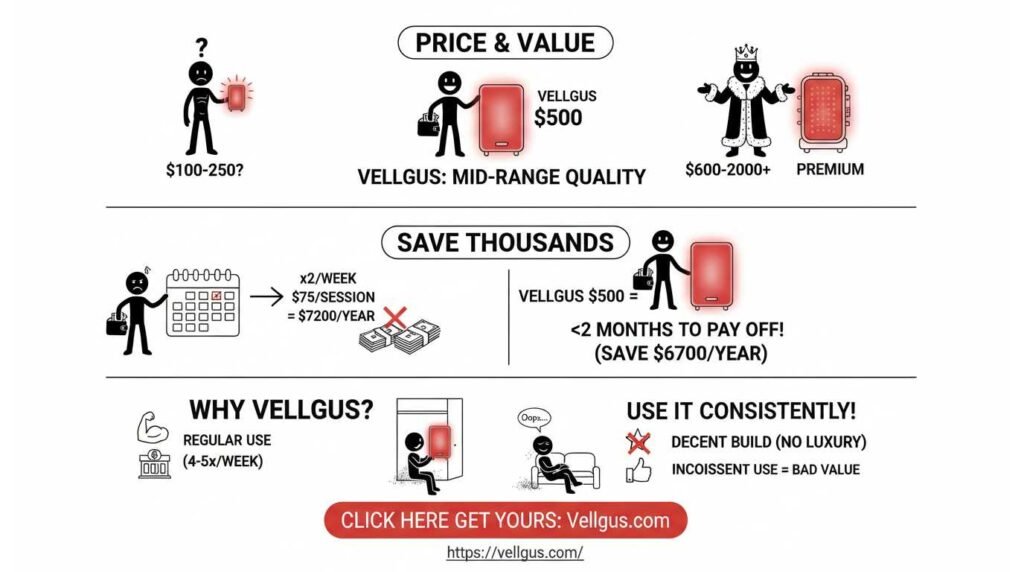
That’s mid-range. You can find cheaper options ($100-250), but the quality is questionable.
Premium brands run $600-2,000+ for similar sizes.
Cost vs Clinical Sessions
Professional red light therapy sessions typically cost $50-150 each. If you need consistent treatment (which you do), you’re looking at ongoing costs.
Say $75 per session, twice weekly, that’s $600 per month, $7,200 yearly.
A $500 Vellgus panel pays for itself in under 2 months compared to clinical sessions. Even if it only lasts 3-4 years, you’re saving thousands.
The catch is you need to actually use it consistently. Many people buy these with great intentions, use it 2 weeks, then it sits in the closet.
Value Proposition
For the price, Vellgus offers solid value if you:
- Plan to use it regularly (at least 4-5x weekly)
- Want to avoid ongoing clinic costs
- Don’t need absolute top-tier premium features
- Care about a decent build without paying luxury prices
As many red light practitioners would agree, if you’re inconsistent with wellness routines or only want to try RLT occasionally, you will likely not see consistent results.
Pros and Cons Summary
Pros
Decent specs for price, 660nm/850nm combo with 100-150 mW/cm² puts these in the effective range without premium pricing.
Mid-range pricing, $300-600 range, hits a sweet spot between suspiciously cheap and overpriced.
Straightforward product line, not confusing with endless similar models.
Low EMF can be used daily without high electromagnetic exposure concerns.
Solid build, should last several years with normal use.
Home convenience, use it for 10-15 minutes whenever it fits your schedule.
Better than budget brands, Worth the extra $150-200 over sketchy Amazon panels.
Cons
Not premium tier. If you want the absolute best specs, app controls, super extended warranties, other brands might be worth the extra cost.
Limited independent testing less third-party verifications compared to established brands. However, these products are FDA-cleared
Basic documentation, Minimal instructions, need to research protocols yourself.
Direct-to-consumer only, can’t see in person before buying.
Newer brand, Less long-term track record compared to 8-10 year companies.
Variable customer service, some great experiences, and some reported slow responses. Requires consistency, won’t see results without 5-6 days weekly for 6-8+ weeks
Final Recommendation
After going through everything, here’s my take on this Vellgus Red Light Review.
Get one if:
You’re tired of paying for clinical sessions and want home treatment. You want legitimate specs without $1,000+ premium brands.
You’re consistent with health routines and will actually use it.
You understand what RLT can (and can’t) do.
Skip it if:
You won’t use it consistently. You need top-tier specs for specific clinical protocols.
You’re extremely budget-conscious and just want to experiment.
You expect fast results for everything.
My Verdict
Vellgus panels sit in that practical middle ground, legitimate therapeutic specs without premium prices. They’re not going to blow you away with luxury features, but they do the core job well.
The biggest value is for people who would pay for regular clinical sessions. Break-even happens within 2-3 months, then you’re saving money with home convenience.
Quality seems solid enough to last several years, customer service is decent (if not exceptional), and the price point makes it accessible without being suspiciously cheap.
The main risk is consistency; RLT only works if you use it regularly. If you start strong, then lose interest in health gadgets after a few weeks, maybe try a cheaper option first.
For most people interested in at-home red light therapy who understand what to expect, Vellgus panels offer good value. Not perfect, not premium, but solidly good enough to get real benefits without breaking the bank.
Compare current Vellgus pricing against competitors here to see if any deals are running. Click the button below to visit Vellgus’s official site to get started.
❓ Frequently Asked Questions (FAQ)
Q1: What is the Vellgus Red Light device designed for?
A: It’s an at-home red light therapy panel meant to provide benefits like skin rejuvenation, muscle recovery, and general wellness using specific light wavelengths
Q2: How does Vellgus compare to cheap Amazon light panels?
A: Vellgus typically offers higher irradiance, better build quality, and more accurate wavelengths than very cheap panels that may lack power or true specs
Q3: Is Vellgus expensive?
A: It sits in the mid-range price category and not as cheap as budget devices but more affordable than premium top-tier brands.
Q4: Do you need to use it consistently?
A: Yes, benefits like improved skin texture or recovery usually require regular use (e.g., several times a week over weeks).
Q5: Will this replace clinical sessions?
A: It’s not a medical replacement, but for many users it can provide similar benefits over time and save money compared to ongoing clinical therapy sessions.
Q6: What wavelengths does Vellgus use?
A: Most panels combine 660 nm (red) for skin benefits and 850 nm (near-infrared) for deeper tissue.
Q7: Is the device backed by a warranty?
A: Yes, Vellgus usually offers a 30-60 day return window and 2–3 year warranty depending on the model.
Still undecided? Read our full list of other affordable and effective red light devices for at-home use here.
This article includes affiliate links. If you click through and make a purchase, I may receive a small commission. This helps support the site and allows me to keep creating helpful content at no extra cost to you.