Quick Summary
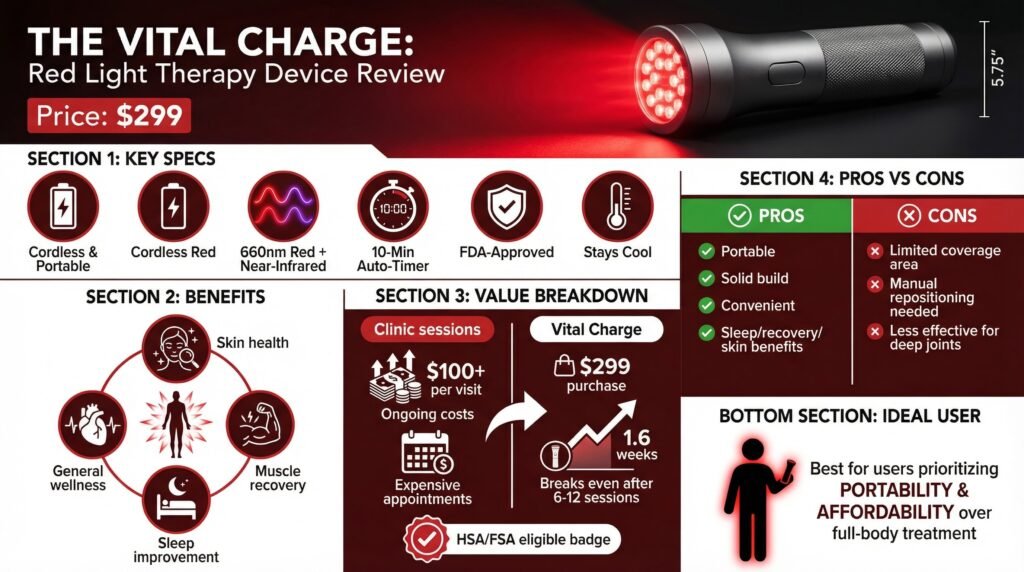
The Vital Charge is a compact, battery-powered handheld red light therapy device ($299) delivering 660nm red and near-infrared light for skin health, muscle recovery, sleep improvement, and general wellness. It’s highly portable (cordless, travel-friendly, 5.75 inches tall) with a 10-minute auto-timer, FDA-approved, and stays cool during use.
It offers strong value versus clinic sessions (breaks even after ~6-12 sessions or 1.6 weeks at typical clinic prices), with HSA/FSA eligibility potentially dropping the effective cost. Pros include convenience, solid build, and noticeable benefits for sleep/recovery/skin with consistent use.
Cons are limited coverage (targeted areas only, manual positioning required) and less effectiveness for deep joint issues. Recommended for users prioritizing portability and affordability over full-body treatment.
Check availability and current offers here if you want to test it yourself. The 30-day trial gives you enough time to assess whether it delivers for your specific needs.
Table of Contents
- Introduction — Overview of the device, its therapeutic claims, and comparison to professional clinic sessions.
- Key Features — Specifications including size, wavelengths (660nm red + NIR), LEDs, timer, battery operation, FDA approval, and cooling design.
- Portability Aspects — Battery-powered cordless use, travel suitability, and trade-offs vs. larger panels (targeted vs. full-body coverage).
- Price Details — $299 one-time cost, cost savings calculator (vs. $50-100 clinic sessions), HSA/FSA options, 30-day trial, free shipping, and money-back guarantee.
- Pros — Benefits observed: better sleep, faster muscle recovery, skin improvements, pain relief for surface areas, ease of use, and reliable support.
- Cons — Manual positioning challenges, need for exposed skin, consistency required, limited for deep pain, and a smaller treatment area.
- Comparison to Other Devices — Vs. clinic sessions, Vital Pro ($479 tabletop panel), Mito Red Light panels, Kineon MOVE Pro+ ($599 for joints).
- Testing Results and User Feedback — Timeline for benefits (sleep 1-2 weeks, recovery 2-3 weeks, skin 3-6 weeks), emphasis on daily use.
- Battery Life and Build Quality — Long-lasting battery, solid construction, quiet and cool operation.
- Usability — Simple setup, no learning curve, best routines (e.g., bedtime or travel).
- Value for Money — Long-term savings, low-risk trial, ideal for portable/specific needs.
- Overall Verdict — Positive recommendation for first-timers or those seeking flexible, affordable at-home therapy with commitment to consistent use.
Introduction
The Vital Charge has been making the rounds in wellness circles, and honestly, it’s worth looking at if you’re tired of dropping $100+ per session at red light therapy clinics. This little handheld device costs $299 and promises the same therapeutic wavelengths you’d get professionally, but at home, on your schedule, without pants (kidding… sort of).
Red light therapy isn’t some wellness fad that showed up last week. There’s actual clinical research backing it, thousands of peer-reviewed studies looking at how specific wavelengths affect cellular function, recovery, skin health, and sleep.
The question isn’t whether red light therapy works (it does), but whether this particular device delivers results without being a hassle to use.
Here’s what you need to know about the Vital Charge before spending your money on it.
What Actually Makes This Device Different
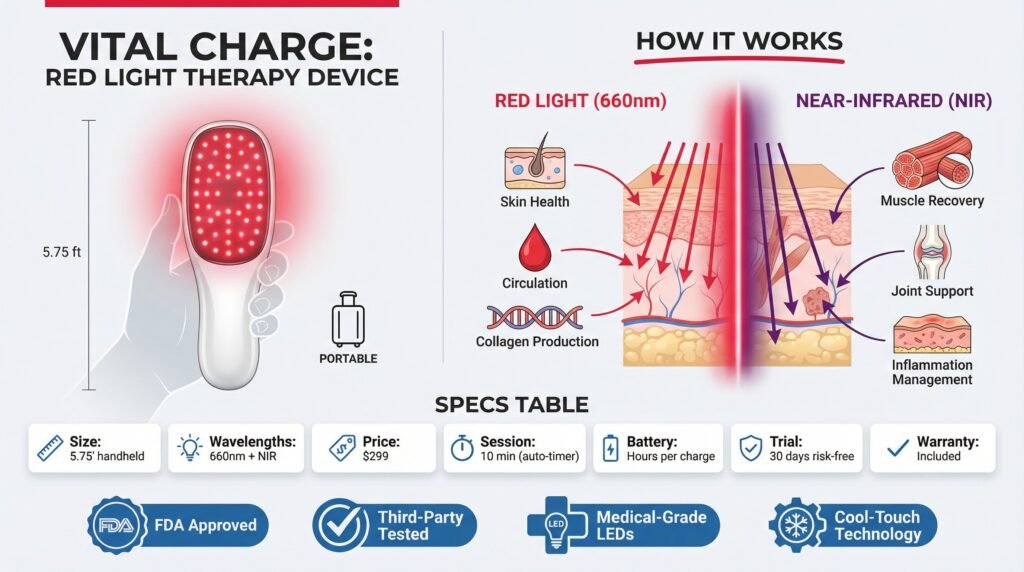
The Vital Charge sits in your hand at 5.75 inches tall. It’s small enough to throw in a suitcase but substantial enough that it doesn’t feel cheap.
Medical-grade LEDs deliver red light at 660 nm and near-infrared wavelengths, which are the two ranges that actually matter for therapeutic benefits.
Red light (660 nm) works at the surface level. Think skin health, circulation, collagen production, the stuff that shows up when you look in a mirror.
Near-infrared goes deeper into muscle tissue, joints, the knee, and connective tissue.
That’s where recovery and inflammation management happen.
The device is FDA-approved and goes through third-party testing, which matters more than it sounds. Plenty of cheap Amazon panels claim therapeutic wavelengths but don’t deliver consistent output.
You get what you pay for, and reliability and actual customer service if something goes wrong.
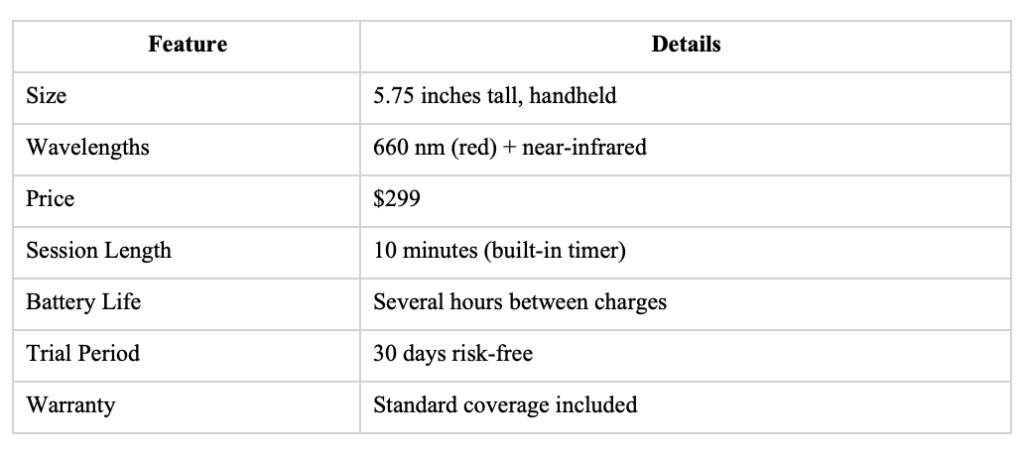
The built-in timer is clutch because you don’t have to watch the clock or set a phone alarm. Ten minutes, done.
The battery means you’re not stuck next to an outlet, and the device stays cool to the touch even after back-to-back sessions.
How People Are Actually Using the Vital Charge
Sleep Gets Better (And Faster)
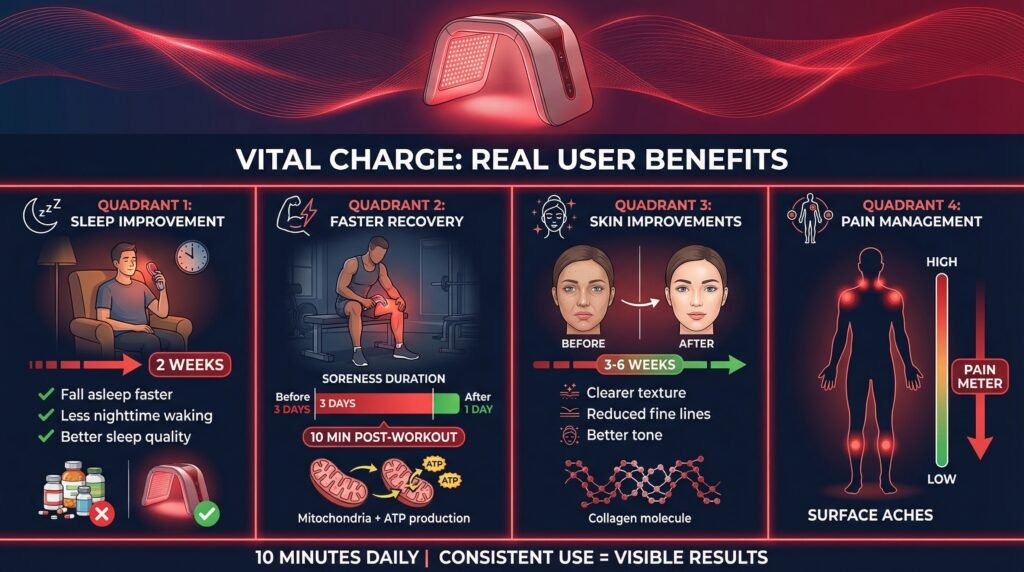
The most consistent feedback about the Vital Charge involves sleep improvement. People use it as part of their wind-down routine, usually paired with deep breathing or meditation before bed. The mechanism makes sense when you look at how certain wavelengths affect circadian rhythm and melatonin production.
One user described treating their face and neck for 10 minutes each evening, and within two weeks, noticed falling asleep faster and waking up less during the night. That’s not placebo territory; red light therapy’s effects on sleep are well-documented in clinical research.
For someone dealing with inconsistent sleep quality, this beats taking melatonin supplements or sleeping pills. No side effects, no grogginess, just better sleep architecture over time.
Recovery Happens Quicker After Training
Athletes and regular gym-goers report noticeable differences in muscle soreness recovery. After heavy squat sessions, deadlifts, or grappling practice, targeting sore muscle groups with the Charge for 10 minutes post-workout reduces the severity of DOMS (delayed onset muscle soreness).
Recovery windows get shorter. Instead of feeling wrecked for three days after a hard training session, soreness peaks lower and clears faster.
That compounds over time because you can train more often without accumulating fatigue.
Red light stimulates ATP production in your mitochondria, basically giving your cells more fuel to repair tissue damage. It’s not magic, but it’s a legitimate edge if you’re training many times per week.
Skin Improvements Take Longer but Show Up
Red light therapy affects collagen production and circulation, which translates to visible skin changes over several weeks of consistent use. People report clearer skin texture, reduced fine lines, and better overall tone.
The timeline matters here because red light therapy isn’t quick. You need three to six weeks of regular use before seeing obvious results.
One user mentioned being hopeful after three weeks but acknowledged needing another month to fully assess anti-aging effects.
If you’re expecting overnight changes, you’ll be disappointed. If you’re willing to commit to daily 10-minute sessions for two months, the results become obvious enough that other people notice.
Pain Management Works for Surface Stuff
The Charge handles general muscle soreness and surface-level aches pretty well. Stiff shoulders, tight neck muscles, sore calves after running, those respond nicely to targeted treatment.
Deep chronic joint pain is a different story. For a bad knee or elbow, something like the Kineon MOVE Pro+ (a wearable device that straps directly onto joints) performs better because the light hits exactly where you need it without dispersing.
The Charge works for general soreness, but it’s not specialized enough for serious joint issues.
If you’re checking out the Vital Charge specifically for recovery and skin health, it delivers. You can grab it here with their 30-day trial, which removes the purchase risk.
The Portable Factor Actually Matters
Battery operation means you can use this thing anywhere. Next to your bed, in a hotel room, at your desk between meetings, wherever.
Larger red light panels sit on stands and need outlets, which lock them to one location.
The trade-off is coverage area. Handheld devices treat targeted spots as opposed to your whole body at once.
A full-size panel bathes your entire torso in light during one session.
The Charge requires you to move it around or do many sessions for different areas.
For someone who travels often or wants flexibility, portability wins. For someone who wants to treat their whole body efficiently in one go, a larger panel makes more sense.
Build quality consistently gets praised in user reviews. The device feels solid, operates quietly, and doesn’t overheat.
It’s also cool to the touch even during and after use, which isn’t true for cheaper choices.
Setup takes about 30 seconds. Turn it on, aim it at whatever area you’re treating, and wait for the timer to finish.
No complicated menus, no installation, no learning curve.
If you’re serious about incorporating red light therapy into your routine without committing to clinic costs, grab the Vital Charge and test it during the trial period. Tap the banner below to visit Vital’s official site.
Comparing the Vital Charge to Other Options
Against Professional Clinic Sessions
Red light therapy clinics charge $50-100 per 20-minute session of targeted therapy. If you go twice a week, that’s $400-800 per month.
The Charge pays for itself after 6-12 sessions.
Clinics use more powerful panels with greater coverage, so results might come slightly faster. But the difference isn’t dramatic enough to justify ongoing costs if you’re planning to use red light therapy long-term.
Against the Vital Pro ($479)
The Vital Pro is a tabletop panel with a stand, covering more surface area per session. If you’re committed to daily use at home and don’t need portability, the Pro handles full-body treatment more efficiently.
The Charge costs less and travels with you. Pick based on whether you value mobility or coverage more.
Against Mito Red Light
Mito Red Light panels are affordable and hit therapeutic wavelengths effectively. The difference comes down to brand polish and warranty support.
Mito prioritizes price; Vital prioritizes customer service infrastructure.
Both work fine. Choose based on whether you care more about saving $50 or having professional support if something breaks.
Against Kineon MOVE Pro+ ($599)
Kineon is purpose-built for joint pain. It straps onto your knee, elbow, or shoulder and delivers concentrated light directly to the problem area.
If joint pain is your main concern, Kineon performs better than a handheld panel. If you want versatility across sleep, recovery, and skin health, the Charge covers more ground.
Professional Red Light Therapy Session
Targeted red light therapy sessions within a professional clinical setting environment will run you $50 – 100 per session. And if you are looking for consistent results, you will require consistent sessions of 2 to 3 per week. With this in mind, the Vital Charge’s price of $299 pays for itself within a month.
To further sweeten the deal, Vital Red Light has partnered with Flex to allow you to take advantage of pre-tax dollars by using your Health Savings Account (HSA) or Flexible Spending Account (FSA). This alone can result in net savings of 30-40%, depending on your tax bracket.
See the cost-savings calculator below to crunch the real numbers. Bookmark this page to return when you are comparing the Vital Charge to red light therapy services in your local area.
Red Light Therapy Savings Calculator
See how much you’ll save with Vital Charge vs. professional sessions
🎉 Your Total First Year Savings
Vital Red Light has partnered with Flex to allow you to use pre-tax dollars from your Health Savings Account (HSA) or Flexible Spending Account (FSA). Based on your 30% tax bracket, you could save an additional $90, bringing your effective cost down to just $209!
What Doesn’t Work as Well
You Have to Hold It
Unlike panels on stands, you need to position the Charge manually during treatment. For some areas (face, shoulders, arms), that’s fine.
For your lower back or knees, holding a device steady for 10 minutes gets awkward fast.
Some people prop it against pillows or use books to angle it, but that’s improvising. Purpose-built stands exist for handheld devices, but they’re sold separately.
Light Doesn’t Penetrate Clothing
Red light therapy requires exposed skin. You can’t treat your back through a shirt or your knees through pants. For bedtime use in private, that’s not an issue.
For using it at work or while traveling, it might feel awkward.
Shipping Takes Time
Several users mentioned shipping delays, though customer service apparently responds quickly with refunds or compensation when that happens. Don’t expect instant delivery just because shipping is free.
Results Require Consistency
Red light therapy works through accumulation. Missing a few days won’t ruin your progress, but sporadic use won’t deliver much benefit.
You need to commit to daily or near-daily sessions for several weeks before judging effectiveness.
If you’re the type who buys wellness devices and uses them twice before they collect dust, save your money. This works if you actually use it.
If it doesn’t deliver, return it. Check current pricing and trial details before deciding. Click the button below to visit Vital Red Light’s official to get started.
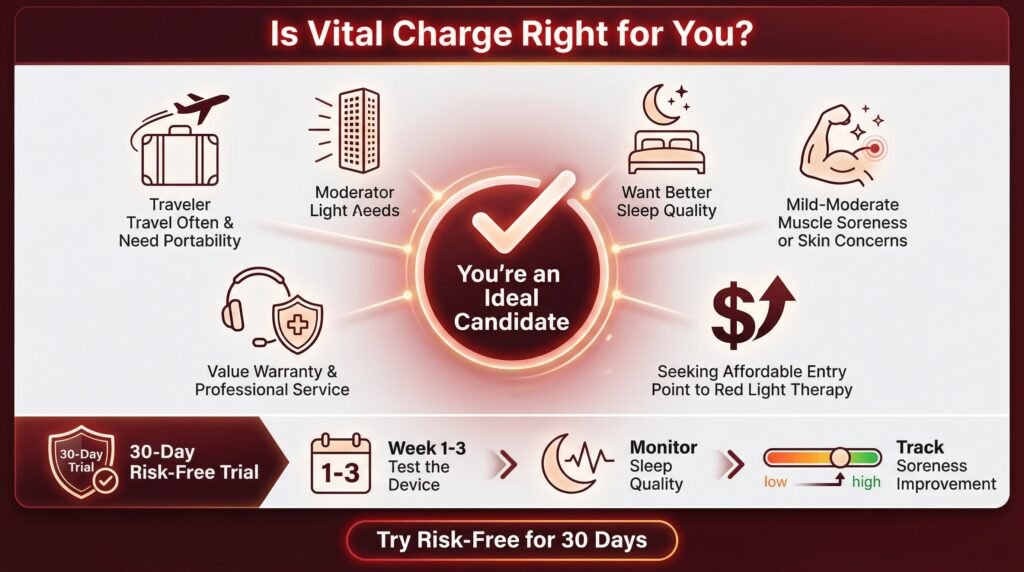
Who Should Actually Buy the Vital Charge
Get the Vital Charge if you:
- Travel often and need something portable
- Want red light therapy primarily for sleep improvement
- Have mild to moderate muscle soreness or skin concerns
- Are you looking for an affordable entry point to at-home red light therapy
- Value warranty support and professional customer service
If you’re still on the fence, the 30-day trial removes most of the risk. Test it for three weeks, track your sleep quality, and note whether soreness recovery improves.
Realistic Timeline for Results
Red light therapy isn’t instant. Here’s what to expect based on what users report:
Sleep improvement: 1-2 weeks of consistent evening use
Muscle recovery: 2-3 weeks of post-workout sessions
Skin health and anti-aging: 4-6 weeks of daily facial treatment
General inflammation and soreness: 2-4 weeks, depending on severity
Give it a full month of daily 10-minute sessions before concluding it doesn’t work. Most people who report disappointment quit after a week, which isn’t long enough for cellular-level changes to show up visibly.
Final Thoughts on The Vital Charge Review
The Vital Charge does what it claims without overpromising. It delivers therapeutic wavelengths in a portable format at a reasonable price point.
You’re getting FDA-approved equipment backed by clinical research, not some dropshipped gadget with fake Amazon reviews.
The device works best for people who value consistency and convenience. It fits on a nightstand, works in 10 minutes, and travels easily.
That removes friction from developing a routine, which matters more than most people realize.
Results show up gradually through accumulation, not overnight transformation. Better sleep arrives within weeks.
Recovery improvements become noticeable after a few training cycles.
Skin changes take longer but eventually appear if you stick with it.
The limitations are real but manageable. You need to hold or position it manually.
Treatment requires exposed skin. Deep joint pain responds better to specialized devices. And you need realistic expectations about timelines.
For $299 with a 30-day trial, the risk is minimal. Test it for a month, track your results, and decide whether it earns a permanent spot in your routine.
Most people who commit to consistent use end up keeping it.
If you’re checking out red light therapy for the first time and want something affordable and portable, the Vital Charge makes sense. If you’re already convinced about red light therapy and want to stop paying for clinic sessions, it makes even more sense.
Check availability and current offers here if you want to test it yourself. The 30-day trial gives you enough time to assess whether it delivers for your specific needs.
Just commit to actually using it daily for at least three weeks before deciding. Red light therapy compounds over time, and sporadic use won’t show you what it can do.
FAQ
What is the Vital Charge 2026? A portable, handheld red light therapy device using medical-grade LEDs at 660nm red and near-infrared wavelengths to support skin health, recovery, sleep, and cellular function.
How much does it cost? $299 one-time purchase, with potential HSA/FSA savings (e.g., ~$209 effective after tax benefits), free shipping, and a 30-day money-back trial.
How portable is it really? Extremely battery-powered (no outlet needed), compact (5.75 inches), lightweight, and travel-friendly (fits in a suitcase). Ideal for use anywhere, like a bed, a hotel, or a desk, though it treats targeted spots only.
What benefits can I expect and how long until results? Improved sleep (faster onset, fewer wakings in 1-2 weeks), quicker muscle recovery/reduced soreness (2-3 weeks), better skin texture/tone (3-6 weeks), and surface-level pain relief. Benefits are gradual and require consistent daily/near-daily 10-minute sessions.
What are the main drawbacks? A small treatment area means manual repositioning (awkward for some spots like the lower back), requires bare skin contact, is less ideal for deep joint pain (better with specialized devices), and inconsistent use yields poor results.
How does it compare to clinic red light therapy? Much cheaper long-term. Pays for itself after roughly 6-12 sessions (or ~1.6 weeks at average clinic pricing) versus ongoing $50-100 per visit, though clinic sessions may cover more area/power.
Is it worth buying over larger panels? Yes, if you value portability, travel use, or targeted treatment (face, neck, sore spots). For full-body or hands-free needs, consider panels like the Vital Pro.
Any risks or side effects? None reported; stays cool, no known issues compared to pills/supplements, backed by research and FDA approval. Consistency is key to results.
This article includes affiliate links. If you click through and make a purchase, I may receive a small commission. This helps support the site and allows me to keep creating helpful content at no extra cost to you.