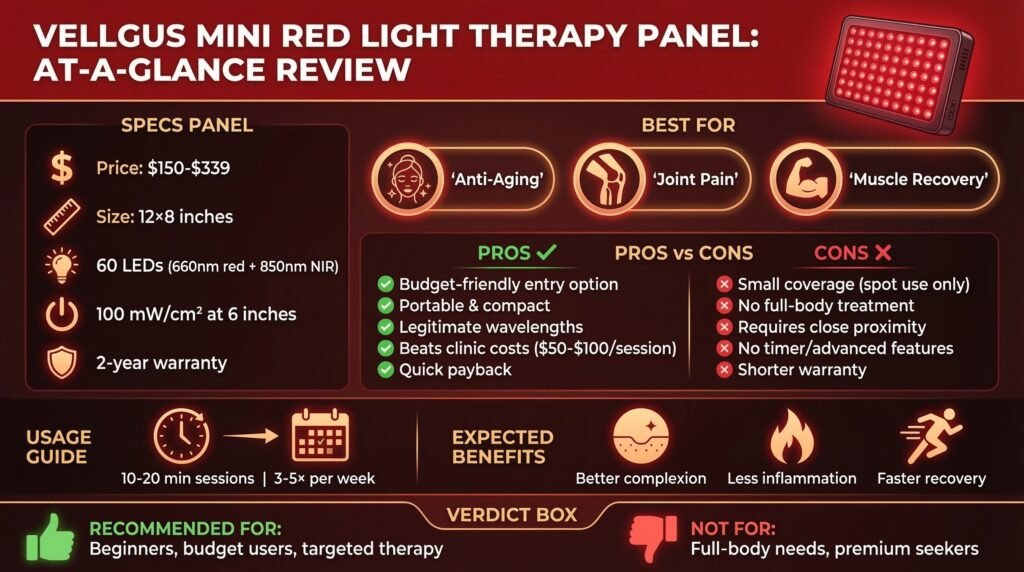
📌 Quick Summary
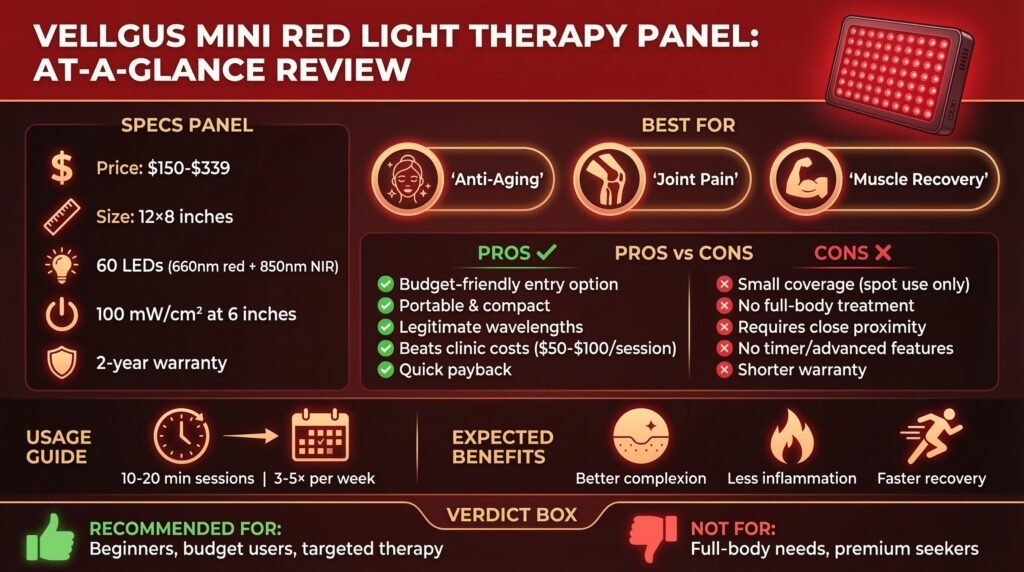
The Vellgus Mini is a compact, budget-friendly red light therapy (RLT) panel (around $150–$339) with 60 LEDs delivering legitimate 660nm red + 850nm near-infrared wavelengths and ~100 mW/cm² irradiance at close range (6 inches). It’s praised as a solid entry-level option for targeted treatments like face anti-aging, joint pain, or localized muscle recovery, offering good value, portability, and quick payback compared to clinic sessions ($50–$100 each).
However, its small 12×8-inch size limits it to spot use (not full-body), it requires proximity for best results, lacks a timer or advanced features, and has a shorter 2-year warranty. Verdict: Recommended for beginners on a budget or those needing focused therapy, but not for large-area or premium needs; consistent use (10–20 min sessions, 3–5x/week) is key for gradual benefits like better skin, reduced inflammation, and recovery.
🧾 Table of Contents
- Quick Summary
- Introduction
- What Actually Is the Vellgus Mini?
- Specs That Actually Matter
- The Good Stuff (Pros)
- Price Point Makes It Accessible
- Compact Size Has Advantages
- Decent Build Quality for the Price
- Dual Wavelength Without Modes
- The Not-So-Good Stuff (Cons)
- Limited Treatment Area
- Power Density Drops Off with Distance
- Shorter Warranty Than Premium Brands
- No Timer or Auto-Shutoff
- Fan Noise (Minor but Present)
- How It Compares to Other Options
- Vellgus Mini vs. Professional Clinic Sessions
- Vellgus Mini vs. Joovv Mini (or Similar Premium Brands)
- Vellgus Mini vs. Ultra-Cheap Amazon Panels
- Who This Panel Actually Makes Sense For
- Real Talk About Results and Expectations
- My Honest Verdict on the Vellgus Mini Review
- FAQ
Introduction
I’ve been looking into red light therapy devices for a while now, and the market is honestly overwhelming. There are like a hundred different brands all claiming their panel is the best, with specs that don’t always make sense if you’re not a physicist or something.
The Vellgus Mini kept popping up in my research as a more affordable option compared to the big names like Joovv or Platinum LED. I spent a few weeks reading through actual user feedback, comparing specs, and trying to figure out if this thing was legit or just another cheap knockoff with inflated claims.
What Actually Is the Vellgus Mini?
The Vellgus Mini is a compact red light therapy panel that measures about 12 x 8 inches. It’s designed for targeted treatment as opposed to full-body coverage, which makes sense given the size and price point.
The panel uses a combination of 660nm red light and 850nm near-infrared wavelengths. These are the two most researched wavelengths for therapeutic benefits, so at least they got that part right.
The 660nm penetrates the skin surface for things like wrinkle reduction and skin health, while the 850nm goes deeper into muscles and joints.
It puts out about 60 LEDs total, which is a decent amount for a mini panel. The power draw is around 45 watts, and it comes with a basic mounting system if you want to hang it on a wall or door.
Specs That Actually Matter
Here’s the thing about red light therapy devices… most companies throw around numbers that sound impressive but don’t tell you what you actually need to know.
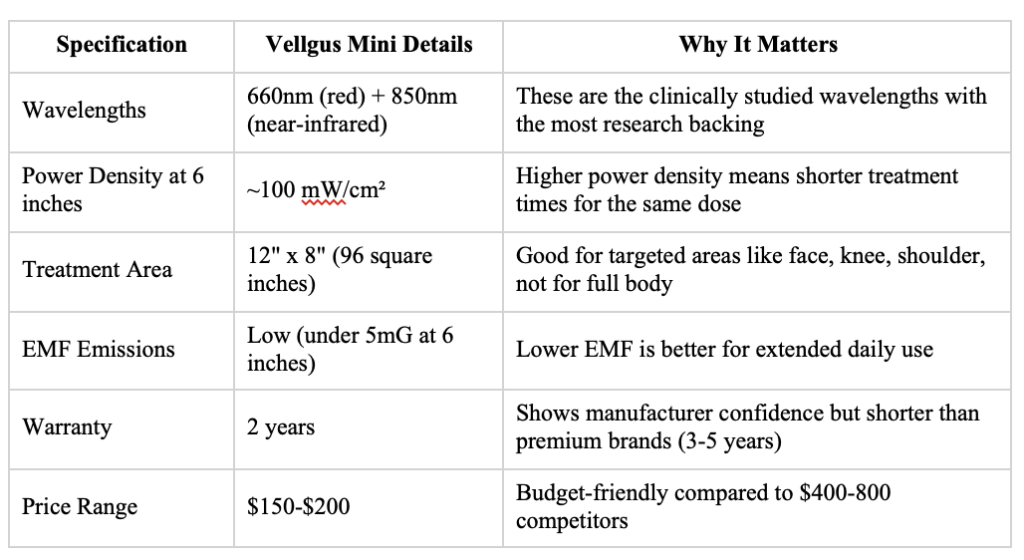
The power density is the big one people get confused about. At 6 inches away from the panel, you’re getting around 100 mW/cm² according to their specs.
That’s actually pretty decent for this price range.
For context, most studies showing benefits use power densities between 10 and 200 mW/cm². So the Vellgus Mini falls right in that therapeutic window when you stand close enough.
The Good Stuff (Pros)
Price Point Makes It Accessible
The biggest advantage of the Vellgus Mini is that it costs maybe a quarter of what you’d pay for a Joovv Mini or similar device from the premium brands. For someone just testing out red light therapy to see if it works for them, dropping $150-200 is way less painful than $600-800.
If you’ve been paying for professional RLT sessions at a clinic or spa, this thing pays for itself after like 3-5 visits. Those sessions usually run $50-100 each, which adds up fast if you’re going 2-3 times per week.
Compact Size Has Advantages
I know some people see the smaller size as a limitation, but there are actually benefits to it. It’s easy to store in a closet or under a bed. You can move it around the house without much effort.
Traveling with it is possible if you really want to (though it’s still a bit bulky for a suitcase).
For targeted treatment on specific areas like your face, a sore shoulder, or a knee that’s bothering you, the size is totally fine. You’re not trying to light up your entire body at once anyway.
Decent Build Quality for the Price
The panel feels solid enough. It’s not flimsy plastic garbage like some of the ultra-cheap Amazon panels you see for $50.
The LED array seems evenly distributed, and the cooling fan (which keeps the LEDs from overheating) is pretty quiet compared to some devices.
The mounting hardware that comes with it is basic but functional. You can hang it on a door or wall if you want a hands-free setup.
Dual Wavelength Without Modes
Some panels make you choose between red-only mode and near-infrared-only mode. The Vellgus Mini just runs both wavelengths at the same time, which is actually what most people want anyway.
You get the surface-level skin benefits from the 660nm, plus the deeper tissue penetration from the 850nm in every session.
Click the button below if you want to check current pricing and availability.
The Not-So-Good Stuff (Cons)
Limited Treatment Area
This is the obvious one. At 12 x 8 inches, you’re treating a pretty small area at a time.
To do your whole face and neck, you’ll need to position it carefully or do many sessions.
If you’re trying to treat your entire back or both legs… yeah, that’s going to take forever or just not be practical.
For most people looking at a mini panel, this is expected. But it’s worth being realistic about. You’re not getting full-body coverage here.
Power Density Drops Off with Distance
That ~100 mW/cm² number at 6 inches drops significantly if you move back to 12 or 18 inches. It follows the inverse square law, so at 12 inches, you’re getting maybe 25-30 mW/cm².
That means you need to stand pretty close to get effective treatment times. Standing 6 inches from the panel for 10-15 minutes might feel a bit awkward depending on what body part you’re treating.
Shorter Warranty Than Premium Brands
The 2-year warranty is okay, but not amazing. At this price point, though, the shorter warranty isn’t shocking. It’s a tradeoff you’re making for the lower cost.
LEDs should last for years (like 50,000+ hours theoretically), but electronics can fail.
No Timer or Auto-Shutoff
The Vellgus Mini doesn’t have a built-in timer. You just plug it in, flip the switch, and it stays on until you turn it off.
That means you need to use your phone timer or a kitchen timer to track your session length.
Not a huge deal, but it’s less convenient than panels with built-in timers that auto-shutoff after your set treatment time. You have to actually remember to turn it off.
Fan Noise (Minor but Present)
There’s a small cooling fan that runs while the panel is on. It’s not super loud, but it’s noticeable in a quiet room.
Some people find it annoying, others don’t even notice after a few uses.
If you’re sensitive to white noise or humming sounds, it might bother you during meditation or relaxation sessions.
How It Compares to Other Options
Vellgus Mini vs. Professional Clinic Sessions
Professional red light therapy sessions give you way more power and coverage. The panels at clinics are usually full-body setups with much higher power output.
You’re getting a more intense treatment.
But here’s the math… one session at a clinic costs $50-100. The Vellgus Mini costs maybe 2-4 sessions worth.
After that, every home session is essentially free (minus electricity, which is negligible).
If you need targeted treatment a few times per week, the home device pays for itself fast. If you want occasional full-body treatments or really high-powered sessions, the clinic might still be worth it.
Vellgus Mini vs. Joovv Mini (or Similar Premium Brands)
The premium brands like Joovv, Platinum LED, and Red Therapy Co. definitely have advantages. They typically offer:
- Higher power output
- Longer warranties (3-5 years)
- Better customer support
- More advanced features (Bluetooth timers, modular systems, etc.)
- Third-party testing and verification
The Joovv Mini 3 costs around $700-800. It has a larger treatment area and higher power density.
The build quality is probably better overall.
But that’s 4-5x the cost of the Vellgus Mini. For someone just starting with red light therapy or on a tighter budget, the Vellgus offers decent specs without the premium price tag.
Vellgus Mini vs. Ultra-Cheap Amazon Panels
There are tons of red light panels on Amazon for $50-100 that claim similar specs to the Vellgus. I’d be pretty skeptical of most of them.
Many of those cheap panels lie about their actual power output, use lower-quality LEDs that degrade fast, or have wavelengths that aren’t actually 660nm and 850nm despite what the listing says. Some independent testing has shown that advertised specs on budget panels are often wildly inflated.
The Vellgus sits in a middle ground. It’s not premium-priced, but it’s also not suspiciously cheap.
The specs seem to match up with what users actually measure (based on reviews from people who tested with their own meters).
Professional Red Light Therapy Session
Targeted red light therapy sessions within a professional clinical setting environment will run you $50 – 100 per session. And if you are looking for consistent results, you will require consistent sessions of 2 to 3 per week. For $339, the Vellgus Mini pays for itself within a 1 to 2 week.
See the cost-savings calculator below to crunch the real numbers. Bookmark this page to return when you are comparing the Vellgus Mini to red light therapy services in your local area.
Red Light Therapy Cost Savings Calculator
See how much you can save by investing in the Vellgus Mini compared to ongoing professional clinic sessions. Calculate your personalized savings below.
Note: Professional clinical red light therapy sessions typically cost $50-100 per session, with 2-3 sessions per week recommended for consistent results.
Who This Panel Actually Makes Sense For
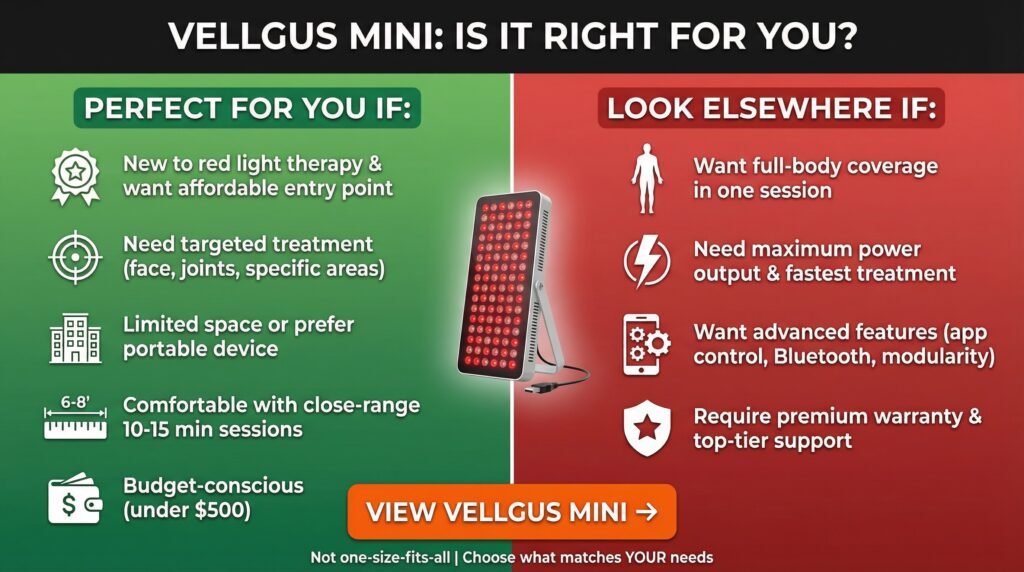
The Vellgus Mini works well for specific situations and people. It's not a one-size-fits-all solution.
You might like it if:
You're new to red light therapy and want to test it out without spending a ton of money upfront. The lower price makes it a reasonable experiment.
You need targeted treatment for specific areas. Face and neck for anti-aging stuff, a shoulder that's always sore, knee pain, a specific patch of skin that's giving you trouble... the compact size is actually perfect for these uses.
You don't have space for a big panel, or you don't want something permanently mounted. The smaller footprint is easier to store and move around.
You're willing to stand close to the panel for shorter sessions. If you're okay with positioning yourself 6-8 inches away for 10-15 minutes, you'll get decent power density.
Budget is a real consideration. Not everyone can drop $500-1000 on a red light therapy setup.
The Vellgus gives you legitimate specs at a price that's more accessible.
You probably want something else if:
You need full-body coverage. A mini panel just isn't practical for treating large areas or your entire body at once.
You'd want a larger panel or many panels for that.
You want the absolute highest power output available. Premium brands offer higher power density, which means shorter treatment times for the same therapeutic dose.
You're looking for advanced features like app control, Bluetooth timers, or modular systems you can expand. The Vellgus is pretty basic in terms of features.
You want the longest possible warranty and premium customer support. At this price point, you're getting a more basic warranty and support experience.
Click here to check out the Vellgus Mini and current deals if you think it matches what you need.
Real Talk About Results and Expectations
Here's something important that applies to any red light therapy device, not just the Vellgus...
The research on red light therapy shows real benefits for things like skin health, muscle recovery, joint pain, and wound healing. But the results are gradual, not instant.
You're looking at consistent use over weeks and months, not dramatic changes after one session.
Some people notice improvements in skin texture and tone after a few weeks of daily use. Others see better muscle recovery if they use it after workouts.
Joint pain and inflammation might decrease gradually with regular sessions.
But if you're expecting secret-level results or an overnight transformation, you'll be disappointed. Red light therapy is a tool that can help with specific issues when used consistently. It's not magic.
The Vellgus Mini has enough power output to potentially deliver these benefits based on the research, assuming you use it properly (correct distance, adequate session length, consistent schedule). The specs line up with what studies have used.
Whether it actually works for your specific situation depends on a lot of factors. What you're treating, how consistently you use it, your overall health, genetics, etc.
My Honest Verdict on the Vellgus Mini Review
After looking at the specs, comparing it to other options, and reading through what actual users report, here's my take...
The Vellgus Mini is a solid entry-level red light therapy panel for targeted treatment. It's not trying to compete with $800 premium devices, and that's fine.
It occupies a useful middle ground between suspiciously cheap junk and premium panels that most people can't afford.
The specs are legitimate enough to potentially deliver therapeutic benefits based on the research. The 660nm and 850nm wavelengths are fix, the power density at close range is in the therapeutic window, and the build quality seems adequate for the price.
The main limitations are pretty clear. Small treatment area, no fancy features, shorter warranty, and you need to stand close for effective sessions.
But none of those are dealbreakers if you understand what you're getting.
For someone wanting to try red light therapy without a huge financial commitment, it makes sense. For targeted treatment on specific areas (face, joints, localized pain), the size is actually practical.
And if you've been paying for professional sessions, it pays for itself pretty quickly.
Is it the absolute best red light panel on the market? No. But it doesn't need to be.
It's a functional device at a price point that makes red light therapy accessible to more people.
If you need full-body coverage, want the highest power output, or have the budget for premium brands with longer warranties and better features, you should probably look at larger or more expensive options. But for many people, the Vellgus Mini offers enough capability to be useful without breaking the bank.
Click here if you want to give it a shot. You can find the Vellgus Mini. Just go in with realistic expectations about the size, features, and gradual nature of red light therapy results.
The key to getting benefits from any red light device is consistent use over time. Whether you go with the Vellgus Mini or another panel, commit to a regular schedule (most people do 10-20 minute sessions 3-5 times per week) and give it at least a month before deciding if it's working for you.
That's my honest take on this panel after digging through all the details. Hope it helps you figure out if it matches what you're looking for. Get started with the Vellgus Mini today by clicking the link below.
Frequently Asked Questions (FAQs)
What are the key specifications of the Vellgus Mini? It's a 12 x 8 inch panel with 60 LEDs, dual wavelengths (660nm red and 850nm near-infrared running simultaneously), 45W power, and irradiance of ~100 mW/cm² at 6 inches (dropping to ~25–30 mW/cm² at 12 inches). It includes a basic mounting system and cooling fan but no timer or auto-shutoff.
How much does the Vellgus Mini cost, and is it worth it compared to clinic sessions? Priced around $150–$339 (commonly referenced at $339 in comparisons). It often pays for itself quickly, e.g., after just a few weeks of use versus $50–$100 professional sessions (2–3x/week), with potential savings of $1,000+ over months (as shown in the article's cost calculator).
What are the main pros of the Vellgus Mini? Affordable price, compact and portable for targeted use (face, joints, etc.), solid build quality with even LED distribution, quiet fan, and legitimate specs in the therapeutic range, making it a good middle-ground option between cheap low-quality panels and expensive premium brands.
What are the biggest drawbacks? Small treatment area (impractical for full-body or large zones), requires close proximity (6–8 inches) for effective dosing which can feel awkward, shorter 2-year warranty, no built-in timer, and minor fan noise in quiet environments.
Who is the Vellgus Mini best suited for? Beginners testing RLT on a budget, people focusing on specific/small areas (e.g., facial skin improvement, localized joint/muscle pain), those in small living spaces, or anyone wanting an affordable alternative to ongoing clinic visits. It's not ideal for full-body coverage, high-power needs, or users wanting premium features like app control or longer warranties.
Does it actually deliver results, and how long does it take? Potential benefits (backed by research) include improved skin tone/wrinkles, muscle recovery, reduced joint pain/inflammation, and wound healing, but results are gradual and require consistent use (10–20 minutes per session, 3–5 times per week) over weeks to months. Individual results vary based on distance, consistency, and personal factors.
How does it compare to premium brands like Joovv? Much cheaper ($339 vs. $700–$800 for Joovv Mini equivalents) with similar core wavelengths and decent close-range power, but smaller coverage area, lower overall power at distance, and fewer features (no Bluetooth, shorter warranty, basic build). It's positioned as a functional budget alternative rather than a direct competitor.
This article includes affiliate links. If you click through and make a purchase, I may receive a small commission. This helps support the site and allows me to keep creating helpful content at no extra cost to you.