📌 Quick Summary
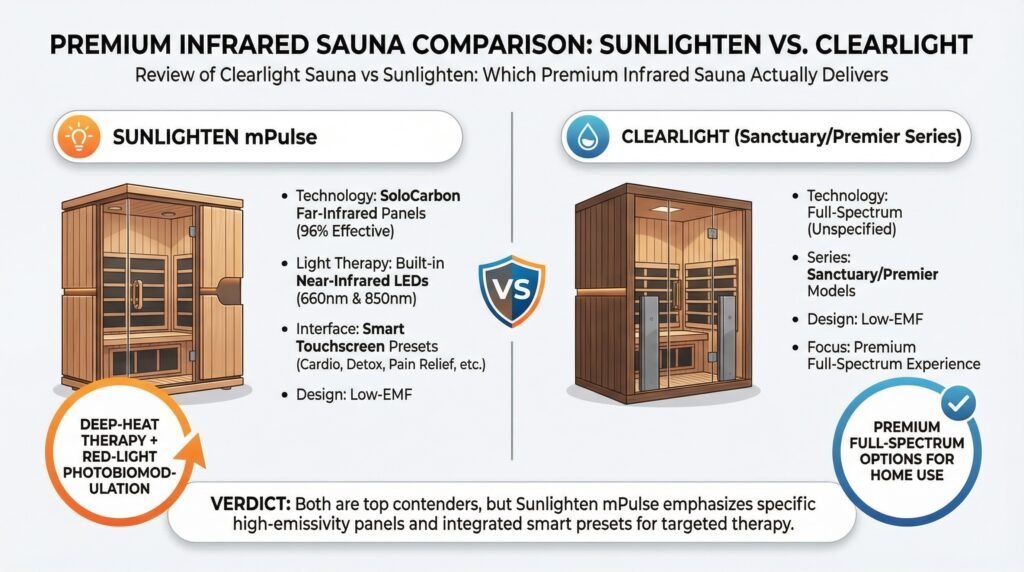
Sunlighten mPulse and Clearlight (Sanctuary/Premier series) represent two of the top premium full-spectrum infrared sauna options for serious home users.
The Sunlighten mPulse stands out with its high-emissivity SoloCarbon far-infrared panels (96% effective) paired with built-in near-infrared LEDs (660nm & 850nm) for combined deep-heat therapy and red-light-style photobiomodulation. It features smart touchscreen presets (Cardio, Detox, Pain Relief, etc.), low-EMF design (<3 milligauss), app control, chromotherapy, and runs on standard 120V power. Pricing ranges from ~$6,500 (Aspire 1-person) to $16,000+ (Conquer 3-4 person), with a lifetime warranty on heaters.
Clearlight competes strongly with its True Wave carbon-ceramic heaters, excellent EMF/ELF shielding (often near-zero), full 360° heating coverage (including under-bench and floor in many models), lifetime warranty on most components, and options for full-spectrum output. It is frequently praised for superior build quality, durability, and lower EMF compared to many competitors.
Both brands deliver clinical-grade performance for recovery, pain relief, detoxification, relaxation, and wellness—far surpassing budget saunas. Sunlighten emphasizes programmable full-spectrum presets and integrated near-infrared LEDs, while Clearlight prioritizes comprehensive low-EMF shielding and even heat distribution.
Best for: Committed users replacing frequent spa sessions (pays for itself in ~1 year at 2+ sessions/week). Drawbacks (shared/high-end category): Significant upfront cost, assembly required, and 15–20+ minute heat-up times. Sunlighten may have slightly higher seat-level EMF in some comparisons; Clearlight often wins on shielding and heater robustness.
Choose Sunlighten mPulse (especially Believe or Discover models) if you prioritize smart presets and built-in near-infrared LEDs. Choose Clearlight if ultra-low EMF/ELF and lifetime comprehensive warranty are top priorities. Both are excellent long-term investments for dedicated wellness routines.
🧾 Table of Contents
- Quick Summary
- Brand Overview and History
- mPulse Product Range Analysis
- mPulse Aspire (1-person)
- mPulse Believe (2-person corner)
- mPulse Discover (2-person straight)
- mPulse Conquer (3-4 person)
- Shared Features Across All mPulse Models
- Quality and Performance Testing
- Customer Service Experience
- Pricing and Value Assessment
- mPulse Pros and Cons Summary
- Final Recommendation
- Frequently Asked Questions
Introduction
Both Clearlight and Sunlighten have built solid reputations in the home infrared sauna market. You’ve probably seen them pop up everywhere if you’ve been looking into getting one for your place.
They’re the two brands that keep coming up in forums, wellness blogs, and those biohacking communities.
The thing is, they’re both premium options with price tags that match. So, figuring out which one actually makes sense for your situation (and your wallet) matters quite a bit.
Here’s what I found when putting Clearlight Sauna vs Sunlighten side by side.
Brand Overview and History
Sunlighten started back in 1999, which gives them about 25 years in the infrared sauna space. They were one of the earlier companies pushing hard on the whole far-infrared technology angle.
Their big thing has always been their mPulse models with the 3-in-1 heating system (near, mid, and far infrared). They’ve positioned themselves as the “medical-grade” option.
Clearlight came along a bit later, but they’ve been around long enough to build a strong following. They partnered with Dr. Raleigh Duncan (who’s pretty well-known in functional medicine circles), and that gave them credibility with the wellness crowd.
Their focus landed more on low EMF levels and what they call True Wave heaters.
Both brands are manufactured in different facilities. Sunlighten does some production domestically and some overseas.
Clearlight works with manufacturers but puts heavy emphasis on their quality control process and testing protocols.
The reputation piece is interesting because both have loyal customers who swear by their choice. Sunlighten people love the customizable programs and the chromotherapy options.
Clearlight users tend to rave about how low the EMF readings are and the lifetime warranty (we’ll get to that).
Product Range Analysis
Sunlighten’s Lineup
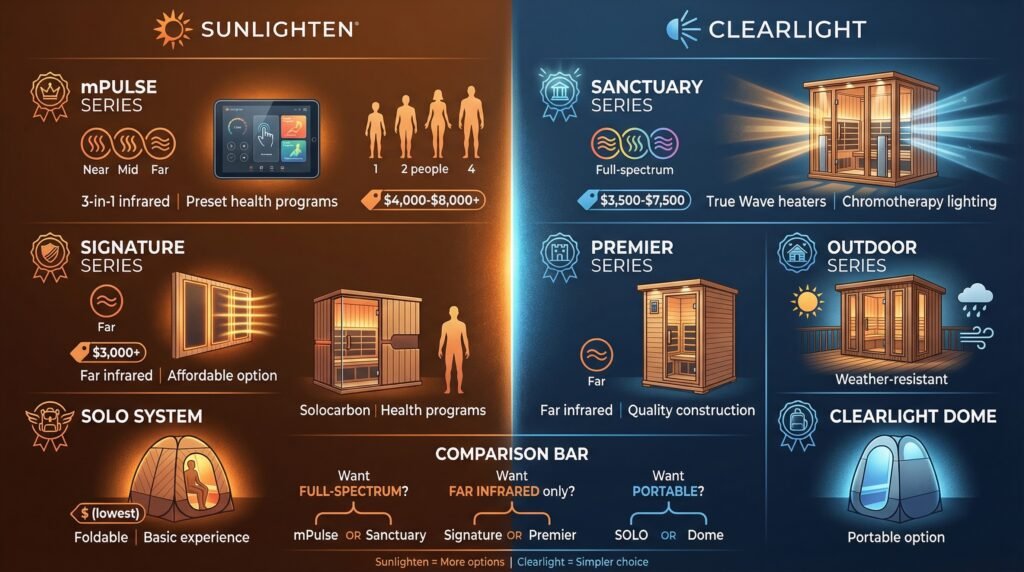
Sunlighten offers three main collections, and honestly, it can get confusing pretty fast.
The mPulse series is their flagship line. These units have the 3-in-1 infrared technology with near, mid, and far wavelengths.
You get tablet controls where you can pick preset health programs (like “detox” or “relaxation”, or “cardiovascular”).
They come in different sizes from the Solo (one person) up to the Amplify 4 (four people).
The Signature series uses far infrared only. It’s positioned as their more affordable option, but it still has decent build quality.
The heaters are their Solocarbon panels.
Then there’s the SOLO system, which is basically a portable sauna tent setup. It’s way cheaper, and you can fold it up, but it’s obviously not the same experience as a full wooden cabin.
Price-wise, the mPulse models run anywhere from around $4,000 to $8,000+, depending on size. The Signature models start lower, maybe $3,000-ish for smaller units.
Clearlight’s Lineup
Clearlight keeps things a bit more straightforward with their naming (thank god).
The Sanctuary series is their top-tier line. These are full-spectrum saunas (near, mid, and far infrared) with their True Wave Full Spectrum heaters.
The cabins look really nice, with solid wood construction, and they emphasize the medical-grade chromotherapy lighting.
The Premier series uses far infrared only with True Wave far infrared heaters. Still quality construction, but without the near and mid wavelengths.
They also offer the Outdoor series, which are weather-resistant models you can actually put on your deck or patio. That’s pretty cool if you have the space and want to use it outside.
And there’s the Clearlight Dome, their portable sauna option that competes with Sunlighten’s SOLO.
Pricing on Clearlight Sanctuary models ranges from about $3,500 to $7,500, depending on size and features. The Premier line starts a bit lower.
The Clearlight Sauna vs Sunlighten Range Comparison
Both brands cover similar ground with portable options, mid-range models, and premium full-spectrum units. Sunlighten has slightly more model variations which gives you more choices and makes the decision process longer.
Clearlight’s lineup is easier to understand at a glance.
If you want full-spectrum (all three infrared types), you’re looking at mPulse for Sunlighten or Sanctuary for Clearlight. If you’re fine with just far infrared, both brands have solid options that cost less.
Quality and Performance Testing
This is where things get technical, but it matters for your actual results.
EMF Levels
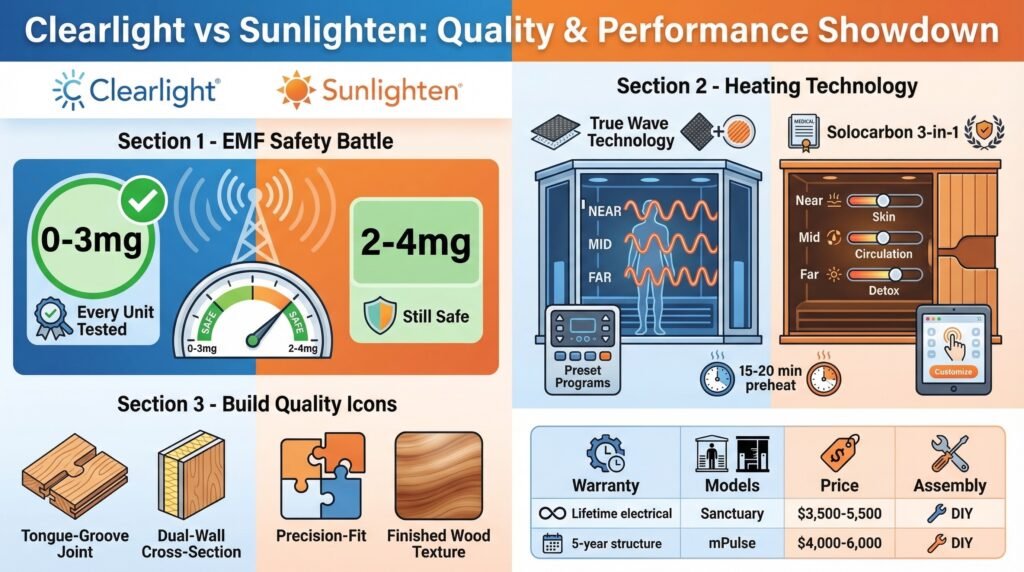
Clearlight makes a huge deal about their low EMF (electromagnetic field) levels. They publish test results showing their saunas test at 0-3 milligauss at seated position.
That’s pretty much as low as you can get.
They test every single unit before shipping.
Sunlighten also claims low EMF, but their published numbers are slightly higher, typically in the 2-4 milligauss range at the seated position. Still considered safe and way below concerning levels, but Clearlight edges them out here.
For most people, this probably doesn’t make a practical difference. But if you’re sensitive to EMF or just want the absolute lowest exposure possible, Clearlight has better documentation on this front.
Heating Technology
Sunlighten’s Solocarbon panels went through clinical testing (they mention an American Journal of Medicine study). Their 3-in-1 system in the mPulse line lets you adjust the ratio of near/mid/far infrared depending on what health benefit you’re targeting.
The idea is near infrared for skin health, mid for circulation and pain, and far for detox and relaxation.
Clearlight’s True Wave heaters use a combination of carbon and ceramic elements. Their full-spectrum models (Sanctuary series) also deliver near, mid, and far infrared, but they don’t have the same level of person wavelength control that Sunlighten’s tablet interface offers.
You get preset programs but less customization.
The heating performance seems solid from both based on user reports. People mention that both brands get up to temperature reasonably fast (15-20 minutes preheat) and maintain consistent heat.
Build Quality
Both use similar wood options: basswood, cedar, and eucalyptus. The construction quality seems comparable.
Clearlight emphasizes their tongue-and-groove assembly and dual-layer wall construction for better heat retention.
Sunlighten focuses on their precision fit and finish.
Honestly, from photos and reviews, both look well-built. You’re getting real wood cabins with glass doors, interior lighting, and decent craftsmanship.
I haven’t seen major complaints about either falling apart or having construction issues.
The benches, door hinges, and control panels, all that stuff seems to hold up fine for both brands based on long-term owner feedback.
Customer Service Experience
This is where you really see differences between companies.
Clearlight seems to have more consistent feedback on their customer service. People mention getting actual humans on the phone relatively quickly.
The pre-sale support helps you figure out which model fits your space.
Post-sale, they walk you through assembly if you get stuck (which apparently happens because some people don’t read instructions).
Their warranty claims process gets decent marks. If something goes wrong with the heaters or electrical, they ship replacement parts pretty fast.
The lifetime warranty on heaters and electrical components gives peace of mind.
Sunlighten’s customer service experiences are more hit-or-miss based on what I’ve seen. Some people have great experiences and rave about helpful reps.
Others mention longer wait times or getting bounced around between departments.
Both companies have authorized dealers, which can be good or bad. If you buy through a dealer, your experience might depend on that specific dealer’s customer service as opposed to the manufacturer directly.
For warranty work, both honor their commitments, but the speed and ease seem to vary. Clearlight appears slightly more straightforward based on user reports, but honestly, your mileage may vary.
Shipping and delivery are another thing; these are big items. Both brands use freight shipping. Expect to wait several weeks from order to delivery.
White-glove delivery (where they bring it inside and set it up) costs extra for both brands but can be worth it if you don’t want to deal with assembly.
If you’re leaning toward Clearlight, you can check current pricing and models, click the button below to get started. They often run promotions that aren’t advertised on the main site.
Pricing and Value Assessment
Let’s talk money because these saunas are expensive.
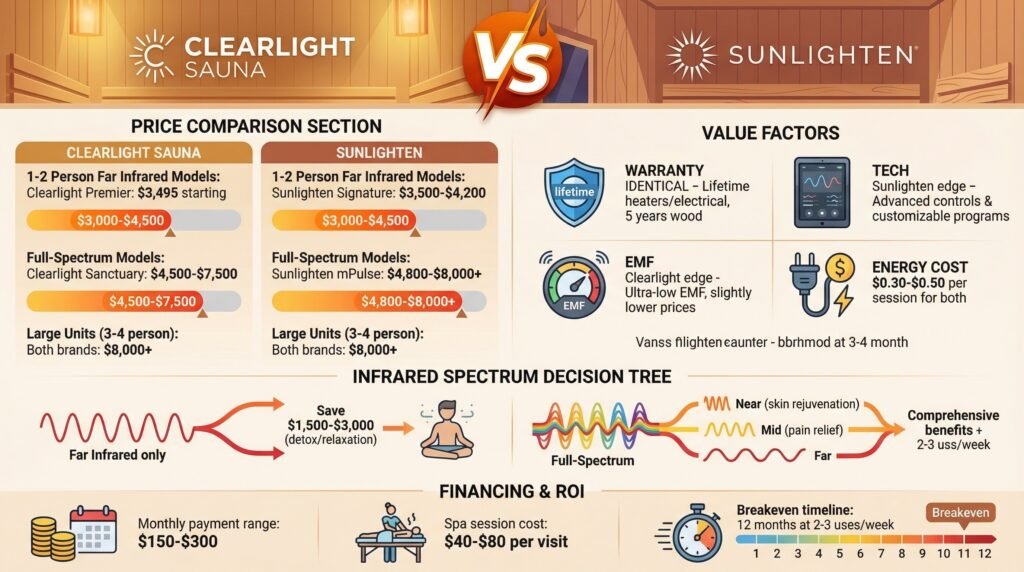
Clearlight Sauna vs Sunlighten pricing is actually pretty close when you compare similar models.
For a 1-2 person far infrared sauna, you’re looking at roughly $3,000-$4,500 from either brand. The Clearlight Premier series starts around $3,495.
Sunlighten’s Signature series is comparable, maybe $3,500-$4,200, depending on the exact model.
When you step up to full-spectrum (near, mid, and far infrared), prices jump. Clearlight Sanctuary models run $4,500-$7,500.
Sunlighten mPulse models are similar, $4,800-$8,000+.
Larger units (3-4 person capacity) from both brands can push past $8,000 easily.
What Affects Value
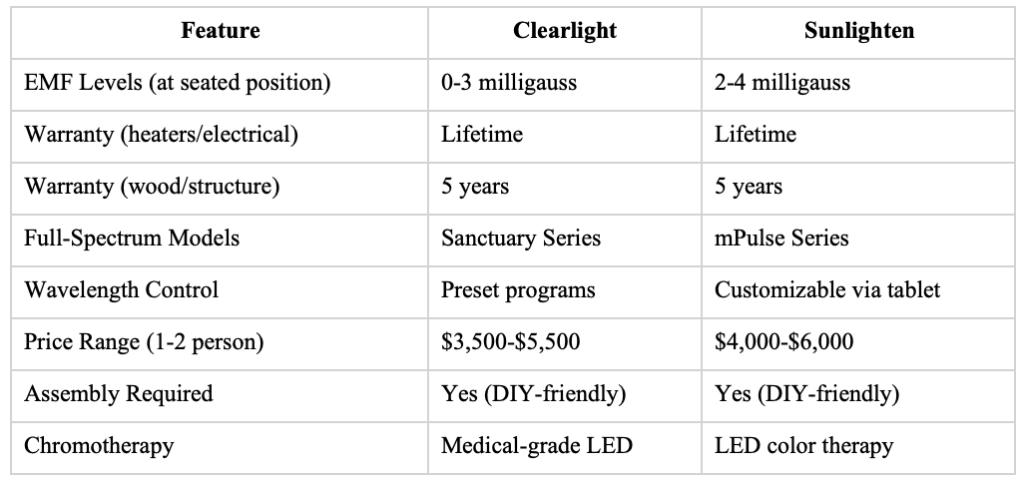
The warranties are essentially identical, lifetime on heaters and electrical, 5 years on wood and structure. So that’s a wash.
Sunlighten’s tech feels more advanced with the tablet controls and customizable wavelength programs. If you actually care about fine-tuning your infrared ratios for different health goals, that added control might be worth paying a bit more.
Clearlight’s ultra-low EMF testing and slightly lower price points on comparable models tip the value equation in their favor for people who prioritize EMF exposure minimization.
Operating costs (electricity) are low for both. You’re looking at maybe $0.30-$0.50 per session, depending on your local electricity rates.
Not a major ongoing expense either way.
The big value question is whether a full-spectrum model matters to you. If you’re mostly interested in the detox and relaxation benefits from far infrared, the cheaper far-infrared-only models from either brand work fine.
You save $1,500-$3,000 by skipping the near and mid wavelengths.
But if you want skin rejuvenation benefits (near infrared) or pain relief (mid infrared), the full-spectrum models make sense even at the higher price.
Financing Options
Both brands offer financing through third-party companies (Affirm, Bread, etc.). Monthly payments make the sticker shock more manageable.
You might pay $150-$300/month, depending on the model and terms.
Compare that to paying for regular sessions at a wellness center or spa ($40-$80 per session). If you’d use it 2-3 times per week, a home unit pays for itself in about a year compared to professional sauna sessions.
Check Sunlighten’s current deals and financing by clicking the button below to visit their official site and see what their current promotions look like.
Pros and Cons Summary
Clearlight Pros
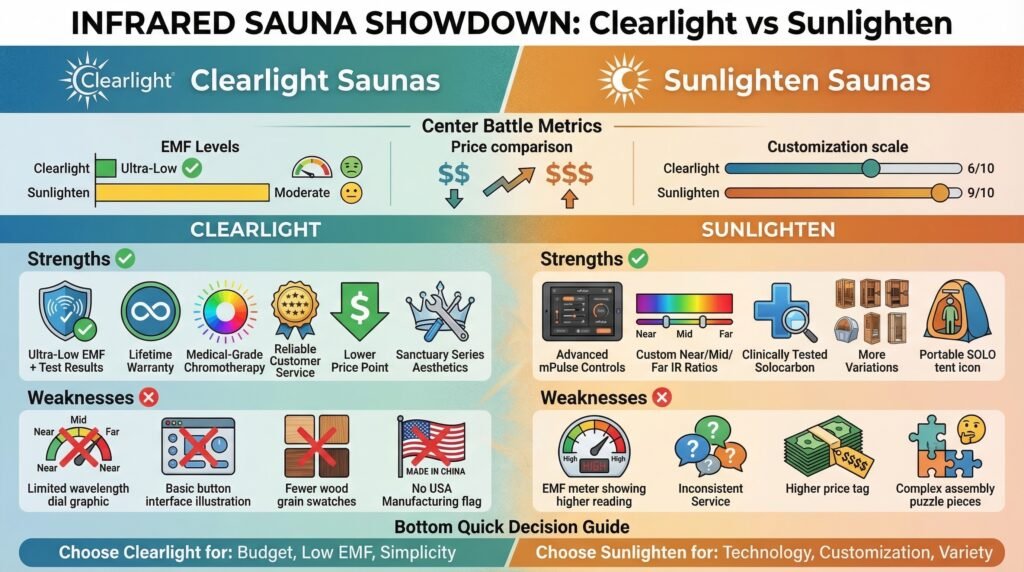
The EMF levels are about as low as you can get in an infrared sauna. That’s Clearlight’s biggest selling point, and they back it up with actual test results on every unit.
A lifetime warranty on the important stuff (heaters and electrical components) gives you long-term protection. The medical-grade chromotherapy lighting is solid if you’re into color therapy.
Customer service seems more reliable based on the feedback I’ve seen. The price is typically a few hundred dollars less than comparable Sunlighten models.
Assembly is straightforward enough for most people to DIY. The Sanctuary series looks really nice if aesthetics matter to you.
Clearlight Cons
Less wavelength customization than Sunlighten’s mPulse line. You get preset programs but can’t fine-tune the ratios yourself.
The control interface is more basic (buttons vs. touchscreen tablet). Some people find the wood choices more limited compared to Sunlighten.
No domestic manufacturing option if that matters to you.
Sunlighten Pros
The tablet interface on mPulse models is probably the most advanced control system in the home sauna market. Being able to customize near/mid/far infrared ratios is pretty cool.
Clinical testing on their Solocarbon panels gives some validation to the health claims. More model variations give you more options to find the exact fit.
The SOLO portable system is a decent entry point if you’re not ready to commit to a full cabin.
Sunlighten Cons
EMF levels are fine but slightly higher than Clearlight. Customer service experiences vary quite a bit depending on who you talk to.
Usually costs a bit more than equivalent Clearlight models. The mPulse tablet controls add cost without necessarily adding results for most users, but provides added convenience.
Assembly can be tricky on some models, based on reviews I’ve seen.
>>Click Here to visit Sunlighten’s official site to see their latest deals<<
>>Click Here to visit Clearlight’s official site to access their seasonal promotions<<
Final Recommendation
The Clearlight Sauna vs Sunlighten decision comes down to what you actually care about.
Go with Clearlight if ultra-low EMF exposure is your priority. To save a few hundred bucks on a comparable model, Clearlight usually wins.
Their customer service appears more consistent.
The Sanctuary full-spectrum models give you all three wavelength types at a slightly better price than mPulse.
The Clearlight Sanctuary 2 (two-person model) sits in a sweet spot for most people, with enough room to stretch out, full-spectrum heating, solid build quality, under $6,000 typically.
You can see the full Clearlight Sanctuary lineup and current pricing here, worth checking because they discount different models throughout the year.
Go with Sunlighten if you want the most control over your infrared wavelengths. The mPulse tablet interface lets you geek out on specific programs for different health goals.
If you like having more tech and customization options, Sunlighten delivers.
The Sunlighten mPulse Believe (their 2-person model) competes directly with the Clearlight Sanctuary 2. You’ll pay a bit more but get more wavelength control.
For most people, though, the practical differences in results between these two brands are probably minimal. Both make quality infrared saunas that work.
The far infrared does what it’s supposed to do, makes you sweat, helps with muscle recovery, and feels relaxing.
If you’re on a tighter budget, look at the far-infrared-only models from either brand. The Clearlight Premier series or Sunlighten Signature series will run you $1,500-$2,500 less than the full-spectrum versions.
You lose the near and mid wavelengths but still get the core benefits.
Final Verdict
For general wellness, muscle recovery after workouts, and that post-sauna relaxed feeling, both brands deliver. Clearlight edges ahead on value and EMF levels.
Sunlighten edges ahead on tech features and wavelength control.
If you’re recovering from chronic health issues or really want to improve specific wavelengths for skin conditions or pain management, Sunlighten’s mPulse might be worth the extra cost for that added control.
Either way, you’re getting a solid infrared sauna that should last for years. The hardest part is just picking one and ordering it.
The second hardest part is waiting for delivery. It is a large premium product, so be patient with the wait.
The bottom line is that investing in a quality home infrared sauna beats paying for endless sessions at a spa or wellness center. You use it when you want, for as long as you want, without driving anywhere or booking appointments.
Both Clearlight and Sunlighten will get you there. Pick the one that fits your budget and priorities, and you’ll probably be happy with it.
Compare current models and pricing from both brands here, prices fluctuate and both companies run sales, so it’s worth checking before you buy. See the links below to get started.
>>Click Here to visit Sunlighten’s official site to see their latest deals<<
>>Click Here to visit Clearlight’s official site to access their seasonal promotions<<
Frequently Asked Questions
What makes the Sunlighten mPulse different from cheaper infrared saunas?
The mPulse uses clinically tested SoloCarbon panels with 96% emissivity (vs. 85–90% in budget models), adds near-infrared LEDs for red light therapy, includes smart preset programs, maintains very low EMF levels (<3 milligauss), and comes with a lifetime warranty on heaters.
How much does a Sunlighten mPulse sauna cost?
Prices start at approximately $6,500 for the Aspire (1-person) and go up to $16,199 for the Conquer (3-4 person). Promotions often offer 10–15% off. White-glove delivery/installation adds $500–$1,000.
What health benefits does the mPulse target?
It supports cardio health, detoxification, pain relief, relaxation, weight loss, and anti-aging. Far-infrared provides deep tissue heat (typically 120–130°F), while near-infrared LEDs aid cellular recovery, inflammation reduction, and muscle/joint benefits.
Is assembly difficult? What about setup requirements?
Assembly takes 1–2 hours with two people due to heavy panels. Delivery is typically freight to curb; white-glove service (indoor setup) is available for extra cost. It runs on standard 120V household power—no special wiring needed.
Who is the mPulse best suited for?
It’s ideal for committed regular users focused on recovery, chronic pain/inflammation management, or replacing expensive spa sessions. It’s not recommended for beginners, casual users, or those on a tight budget—consider testing a cheaper option first.
What are the main downsides of the mPulse?
High upfront cost, 15–20 minute heat-up time (slower than some competitors), mostly front-facing near-infrared LEDs, significant space requirements, and the need for assembly. The app features can feel somewhat gimmicky.
How long does it take to pay for itself?
For users who currently do 2+ sessions per week at $40–$60 each, the sauna can pay for itself in roughly one year through avoided spa costs, plus it retains good resale value (50–70% of original price).
These sections are self-contained, concise, and optimized for reader experience while staying faithful to the original review content. You can copy and paste them directly into the article.
This article includes affiliate links. If you click through and make a purchase, I may receive a small commission. This helps support the site and allows me to keep creating helpful content at no extra cost to you.