📌 Quick Summary
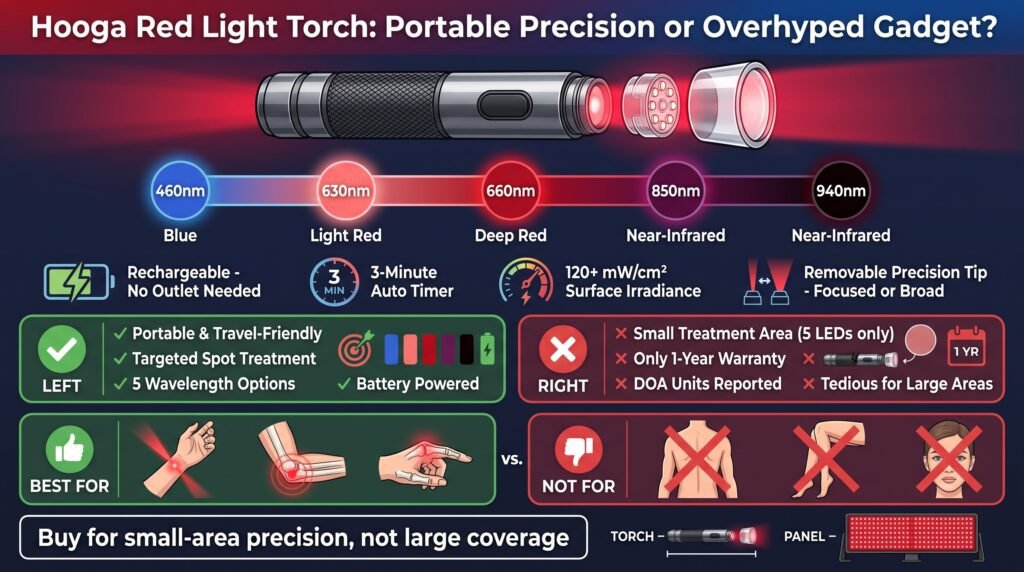
The Hooga Red Light Therapy Torch packs five different wavelengths into something you can toss in a bag. We’re talking 460nm blue, 630nm red, 660nm red, 850nm near-infrared, and 940nm near-infrared. The company claims over 120 mW/cm² surface irradiance, which sounds impressive on paper.
It’s rechargeable, runs on a built-in three-minute timer, and comes with a removable precision tip that let’s you switch between focused and broader coverage. The battery makes it portable enough for travel without needing an outlet.
But here’s the thing. The treatment area is pretty small.
Five LEDs don’t cover much ground compared to a full panel.
The one-year warranty is shorter than what Hooga offers on their bigger units, and some people have reported getting DOA units that wouldn’t power on.
The torch makes sense if you want targeted treatment on small spots and value portability over coverage. It doesn’t make sense if you’re planning to treat your entire back, legs, or even a full face regularly.
That would get tedious fast.
Bottom line: Decent option for spot treatments and travel. Not a replacement for panel-style coverage or professional sessions.
Buy it for what it actually does: small-area precision.
🧾 Table of Contents
- Quick Summary
- Features Overview
- Performance Analysis
- Pros and Cons
- User Experience Testimonials
- Value for Money
- How to Use It More Sensibly
- Final Verdict
- Frequently Asked Questions
Features Overview
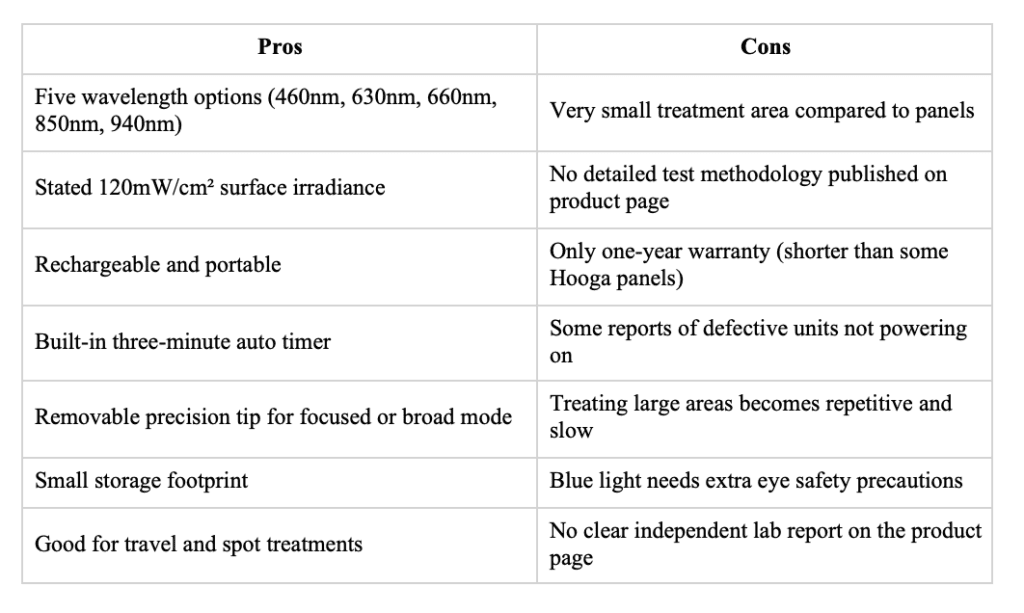
Five wavelengths in one handheld unit
Most basic red light devices stick to one or two wavelengths. The Hooga Torch includes five:
- 460nm blue light
- 630nm red light
- 660nm red light
- 850nm near-infrared
- 940nm near-infrared
Hooga calls these “clinically proven wavelengths,” but that phrase needs context. Research on light therapy typically examines specific wavelengths at specific doses for specific conditions.
Evidence for one setup doesn’t automatically transfer to every device using similar wavelengths.
The 460nm blue light option is what sets this apart from standard red/NIR devices. Blue light behaves differently than red and near-infrared, so you’ll want to follow the manufacturer’s instructions as opposed to assuming all five settings work the same way.
The irradiance claim
Hooga lists “120mW/cm² at surface” for irradiance. That’s the amount of light energy hitting a given area, and it matters because dose equals irradiance multiplied by time.
Quick math: 120mW/cm² for three minutes theoretically delivers around 21.6 J/cm² at the surface. That assumes the stated output stays consistent across the beam and doesn’t drop with battery level or angle.
Real-world dose varies based on distance, positioning, how they measured it, and whether that 120mW/cm² figure represents peak output or average across the entire treatment area. The product page doesn’t spell out the exact test conditions, meter type, or methodology.
Five LEDs total
Five LEDs give you a concentrated beam. That’s useful for precision work on small areas.
It becomes a limitation when you want broader coverage because you’ll need to move the device around repeatedly.
A panel with dozens or hundreds of LEDs covers more surface area per session. The torch trades coverage for portability and focused targeting.
Removable precision tip changes the beam
The precision tip screws on and off. With it attached, you get a tighter, more focused beam.
Remove it, and the light spreads over a broader area.
This is probably the most practical design feature. You get two treatment patterns without buying separate attachments or devices.
The downside is that the precision tip makes positioning more critical. Small movements can shift which part of the target area gets the strongest exposure.
Battery and timer
The built-in lithium-ion battery means you can use it anywhere without an outlet. The three-minute auto timer keeps sessions simple without watching a clock.
Battery devices are convenient until you forget to charge them. If you tend to leave stuff in drawers for weeks, you might grab it when you need it and find it dead.
Test the charging setup when it arrives and develop a charging routine if you plan regular use.
Warranty details
Hooga offers a one-year warranty on the Torch, which covers defects and failures but not damage from dropping it or misuse. That’s shorter than the warranty period on some of their panel models. The company also mentions a 60-day return window with no restocking fee, though you pay return shipping and should include all accessories for a full refund. Confirm the current terms before buying, especially if you’re outside the US
Performance Analysis
Output looks strong but lacks detailed testing info
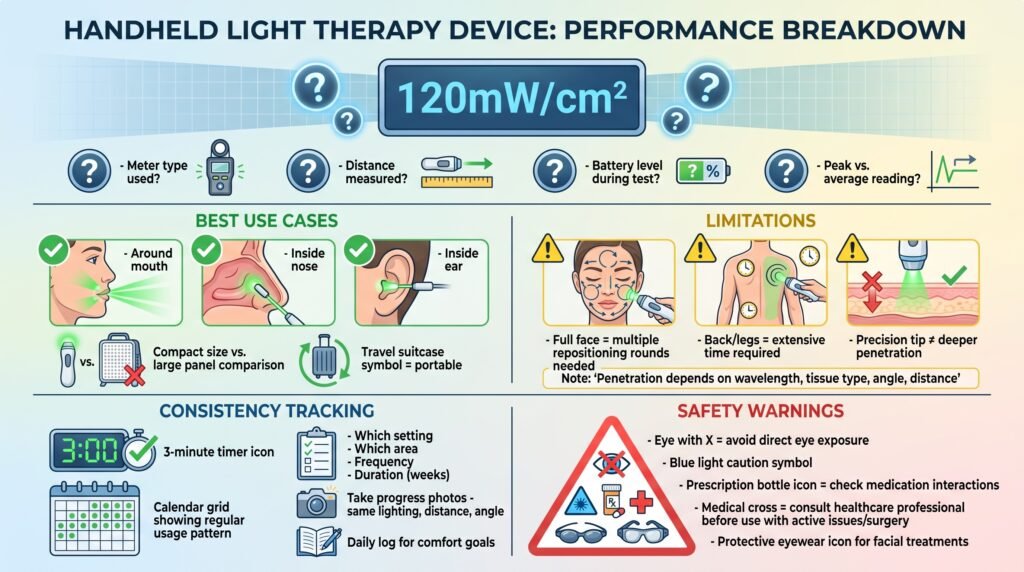
A stated 120mW/cm² surface irradiance is high for a handheld unit this size. If that measurement is accurate and representative, you shouldn’t need super long sessions to get a decent dose.
The problem is that retailers don’t always publish how they tested it. What meter did they use?
At what distance?
What battery level? Is that number an average across the beam or a peak reading at the center?
Without those details, the 120mW/cm² claim is useful for comparing Hooga products to each other but harder to verify independently.
Targeted treatment is where it shines
The product page mentions using it around the mouth, inside the nose, and inside the ear. That’s a specific use case that separates it from general full-body panels.
A targeted device makes sense when you don’t want to position a large panel for one small area. It takes less space, costs less than most panels, and travels easily.
But using it on larger body parts turns into a repositioning exercise. Treating your entire face would mean holding it in multiple positions for several rounds.
Treating your back or legs would take even longer.
The precision tip helps with accuracy but doesn’t magically make light penetrate deeper or guarantee it reaches specific structures under the skin. Penetration depends on wavelength, tissue type, angle, and distance.
Three minutes is convenient, consistency is harder
An auto timer removes the need to track time manually. The bigger challenge is actually using it regularly enough to judge results.
Occasional random use makes it tough to tell if anything changed. You’ll want to track which setting you used, which area, how often, and for how many weeks.
Otherwise, you’re just guessing based on fuzzy memory.
Take photos if appearance is part of why you bought it. Same lighting, same distance, same angle each time.
For comfort-related goals, keep a simple daily log instead of relying on how you think you remember feeling three weeks ago.
Safety stuff worth mentioning
The product page talks about use around the mouth, nose, and ear, but don’t assume every internal application is suitable for your situation. Avoid pointing bright light directly into your eyes.
Follow the included instructions and talk to a healthcare professional before using light devices around active medical issues, recent surgery, or if you take medications that increase light sensitivity.
Blue light deserves extra caution around the eyes. Protective eyewear might be necessary depending on what the manufacturer recommends, particularly for facial use.
Pros and Cons
User Experience Testimonials
The product page emphasizes portability, the precision tip, the three-minute timer, and use around small areas. Those are marketing descriptions as opposed to independent verification, so keep that in mind.
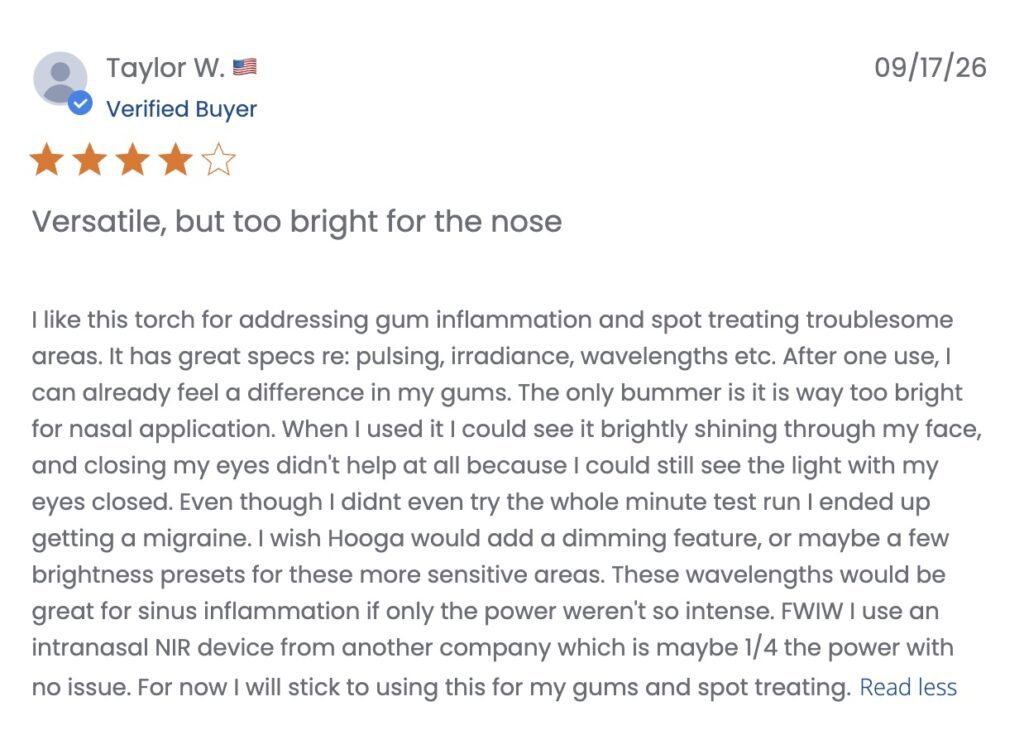
As expected, independent feedback online is mixed. In one Reddit discussion, someone mentioned their Hooga Torch worked well, while other commenters described receiving units that wouldn’t turn on and having to return them.
Another thread had people discussing the device’s output and comparing handheld treatment versus panel use, but those were personal experiences as opposed to controlled testing.
Broader customer feedback on Hooga as a brand tends to be positive overall. People often mention decent build quality, fast shipping, and helpful support.
The fair takeaway is that there’s no widespread pattern of problems, but the risk of getting a faulty unit isn’t zero. Of course, this should be obvious for any product a person may buy.
As with anything you buy, practice common sense consumer behavior and test it soon after delivery. Keep the packaging, charging cable, and receipt until the return window closes.
Value for Money
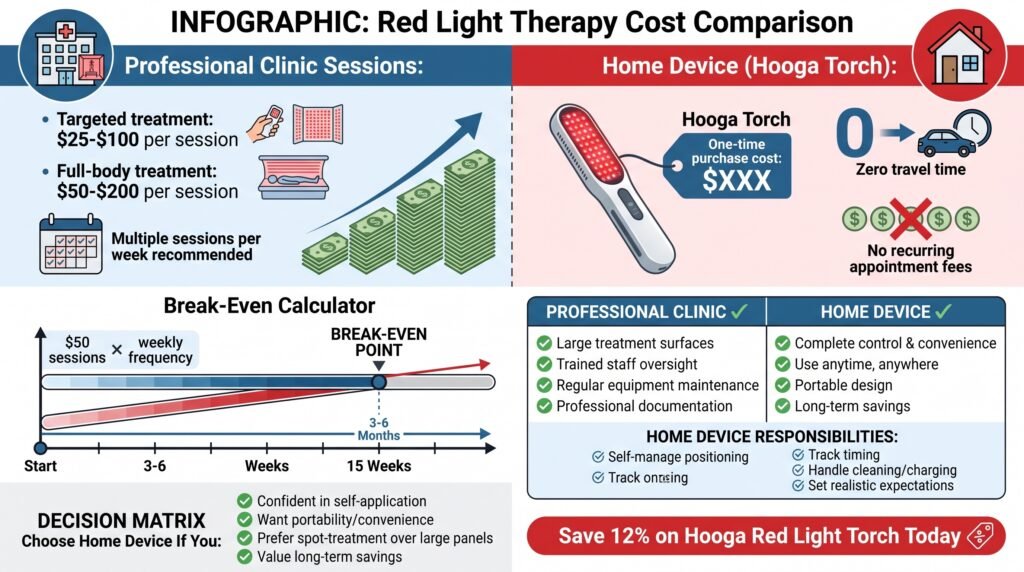
Professional red light sessions typically run around $25 to $100 for targeted treatments, while full-body sessions can cost $50 to $200 depending on location and provider. Some clinics recommend multiple sessions per week during an initial course, which adds up quickly.
A home device can cut out travel time and eliminate repeated appointment fees. The financial math depends on the purchase price and how often you actually use it.
If a torch replaced one $50 targeted session per week, the purchase could theoretically pay for itself after several weeks or a few months.
The torch doesn’t replace professional care. A clinic might offer larger treatment surfaces, better documentation, trained staff, and equipment that gets checked regularly between sessions.
Home equipment gives you control and convenience. You’re also responsible for managing positioning, timing, cleaning, charging, and expectations without professional oversight.
If you specifically want a small spot-treatment device, a large panel might feel wasteful.
So if you feel confident in your ability to apply red light therapy to your body, want the portability and convenience of red light anytime without leaving your home, and the savings this device clearly provides, click the button below to get started with the Hooga red light torch and receive an additional 12% off your purchase.
Also, crunch the real-time numbers and see the actual weekly and monthly savings by using the cost savings calculator below. Bookmark this page and come back to it anytime you want to compare the cost of red light therapy sessions in your area.
💡 Hooga Red Light Torch Savings Calculator
Discover how much you could save by investing in the Hooga Red Light Torch instead of paying for ongoing professional red light therapy sessions. Calculate your potential savings over time!
Did you know? Professional red light therapy sessions typically cost $25-$100 for targeted treatments and $50-$200 for full-body sessions. With multiple sessions recommended per week, these costs add up quickly. The Hooga Red Light Torch offers a one-time investment for unlimited home therapy.
How to Use It More Sensibly
Read the current instructions that come with the device as opposed to copying routines from random forum posts. Pick one setting and one treatment area to start.
Keep your distance and session length consistent so you can actually judge changes fairly over time.
Take baseline photos if appearance matters to you. Use the same room, lighting, camera distance, and angle every time you document.
Otherwise, you’re just guessing whether something changed.
For comfort-related goals, write down a simple daily rating instead of trusting vague memories from weeks ago.
Stop using it if your skin develops persistent irritation, unusual discomfort, or any other concerning reaction. Don’t stack multiple light devices together without understanding the combined exposure.
Keep the device clean, dry, and protected from being dropped.
Final Verdict
This red light torch review finds the Hooga Torch to be a practical, targeted device with a clear purpose. The five wavelengths, stated 120mW/cm² surface irradiance, rechargeable battery, built-in timer, and removable precision tip give it useful features for spot treatments.
The limitations are equally clear. The beam is small, the output claim lacks published testing methodology on the product page, the warranty runs only one year, and some online reports mention hardware failures on arrival.
The torch also can’t match a panel’s coverage or a professional clinic’s supervision.
Buy it if portability and precise spot treatment matter more than broad coverage. Choose a panel if you expect to treat large areas regularly.
Either way, treat any home device as a convenience tool with uncertain personal results. It’s not a guaranteed substitute for medical treatment, and results will vary based on consistency, technique, and personal factors.
Frequently Asked Questions
What wavelengths does the Hooga Red Light Torch use?
It has five: 460nm blue, 630nm red, 660nm red, 850nm near-infrared, and 940nm near-infrared. The blue light option is what separates it from most standard red/NIR devices, and it needs extra eye caution.
How strong is the Hooga Torch’s output?
Hooga lists 120mW/cm² at the surface. That figure is high for a handheld unit, but the product page doesn’t explain the meter, distance, or battery level used to measure it, and it isn’t clear whether it’s a peak or average reading. Real-world dose will vary with distance, angle, and positioning.
How long is each session?
The torch has a built-in three-minute auto timer. At the stated output, that works out to roughly 21.6 J/cm² at the surface in theory, assuming the output stays consistent.
What does the removable precision tip do?
With the tip attached, you get a tighter, more focused beam for small spots. Without it, the light spreads over a broader area. The tradeoff is that positioning matters more with the tip on.
Can the Hooga Torch treat large areas like my back or legs?
Technically, yes, but it’s a poor fit. With only five LEDs, you’d have to reposition the device repeatedly, which gets slow and tedious. A panel is the better choice for large areas, and even a full face takes multiple rounds.
Is it portable?
Yes. It’s rechargeable, runs on a built-in lithium-ion battery, and doesn’t need an outlet, so it works for travel. Just charge it ahead of time so it isn’t dead when you reach for it.
What does the warranty cover?
Hooga offers a one-year warranty covering defects and failures, but not drops or misuse. That’s shorter than the warranty on some of their panel models. There’s also a 60-day return window with no restocking fee, though you pay return shipping and should include all accessories. Confirm current terms before buying, especially outside the US.
Is it safe to use red light around the eyes, mouth, nose, or ears?
The product page mentions use around the mouth, nose, and ear, but don’t assume every application suits your situation. Avoid shining bright light directly into your eyes, and use protective eyewear if the manufacturer recommends it, especially with blue light.
Talk to a healthcare professional if you have an active medical issue, recent surgery, or take medications that increase light sensitivity.
Can it replace professional red light therapy sessions?
Not entirely. It can cut costs and travel time for small-spot treatments, but clinics offer larger treatment surfaces, trained staff, and regularly checked equipment. Think of it as a convenience tool, not a substitute for professional care or medical treatment.
How can I tell if it’s working?
Be consistent. Use the same setting, distance, and session length, and log your results. For appearance goals, take baseline photos in the same lighting, from the same distance and angle. For comfort goals, keep a simple daily rating instead of relying on memory.
Who should buy the Hooga Torch?
It suits people who want precise spot treatments and portability. If you plan to treat large areas regularly, a panel is the better choice.
This article includes affiliate links. If you click through and make a purchase, I may receive a small commission. This helps support the site and allows me to keep creating helpful content at no extra cost to you.