Quick Summary
While serious red light therapy side effects are rare, they typically stem from overexposure, poor-quality devices, or pre-existing light sensitivity. The most common red light therapy side effects include temporary skin redness, eye strain, and headaches.
Red light therapy (RLT) is widely regarded as safe and non-invasive, but “doing it wrong” can lead to complications.
The article emphasizes that RLT follows a “biphasic dose-response”, meaning too much light can actually reverse benefits or cause irritation, and provides a roadmap for avoiding these pitfalls through proper timing and eye protection.
Table of Contents
- Introduction: Is Red Light Therapy Actually Safe?
- The difference between UV light and RLT.
- Why “more” isn’t always “better.”
- Reality Behind “Mild and Temporary”
- The Biphasic Dose-Response (Arndt-Schulz Law)
- Thermal Burns and Blistering (Overheating).
- When Your Skin Tone Changes the Game.
- Hyperpigmentation in Darker Skin Tones.
- Skin Redness and Tightness.
- The Eye Situation Nobody Wants to Discuss – Common Short-Term Side Effects
- Eye Strain and Light Sensitivity.
- Headaches and the Neurological Response
- Headaches and Migraines.
- The Medication Interaction Nobody Mentions
- Interaction with Photosensitizing Medications.
- When Detox Becomes an Excuse
- The Thyroid Connection
- Power Density Miscalculations
- Incorrect distance from the panel.
- Session duration: The “Sweet Spot.”
- Quality Control in an Unregulated Market
- Low-quality/Flickering devices.
- The Circadian Disruption Factor
- Conclusion and Key Takeaways
Introduction: Is Red Light Therapy Safe?
I’ll be honest with you, when I first started researching red light therapy, I was looking for reasons to dismiss it. I’d seen too many wellness trends promising secret results with zero downsides, and my skepticism was running at an all-time high.
But what I found surprised me.
The red light therapy side effects are real, but they’re not what most people expect them to be.
The thing is, we’ve gotten really good at asking “does it work?” but we’re not always great at asking “what happens when it doesn’t?”
And with red light therapy becoming as common as a morning coffee routine for some people, understanding the actual risks, not the fear-mongering headlines, but the legitimate medical concerns, has become essential.
The Reality Behind “Mild and Temporary”
You’ll see those words everywhere in red light therapy literature: “mild and temporary.” And technically, that’s accurate for most people.
But here’s what nobody really explains: what “mild” actually feels like when it’s happening to your face, and what “temporary” means when you’ve got a work presentation in three days, and your skin looks like you fell asleep on a heating pad.
The most documented red light therapy side effect is erythema, which is just the medical term for redness. In clinical trials using pretty intense doses, essentially 480 joules per square centimeter, literally 100% of participants had visible redness afterward, regardless of their skin type or the specific light parameters used.
That kind of redness typically fades within a few hours for most people. Similar to the flush you get after a hot shower or a challenging workout, your blood vessels dilate, blood flow increases, and your skin responds visibly.
The difference is that with red light therapy, you’re deliberately triggering this response because increased circulation is part of how the treatment works. Where things start getting problematic is when people don’t understand dosage.
I’ve talked to guys who figured if 10 minutes was good, 30 minutes must be three times better. That assumption falls apart pretty quickly with photobiomodulation.
There’s this concept called the biphasic dose response, which essentially means there’s a sweet spot where red light therapy provides benefits, but too little does nothing, and too much actually becomes counterproductive or harmful.
Think of it like watering a plant. The right amount keeps it thriving. Too little and it withers. Too much and you drown the roots.
Your cells respond to light exposure in a remarkably similar way, needing that precise balance to function optimally without getting overwhelmed.
When Your Skin Tone Changes the Game
This is where things get more complicated, and honestly, it’s an area that doesn’t get talked about enough.
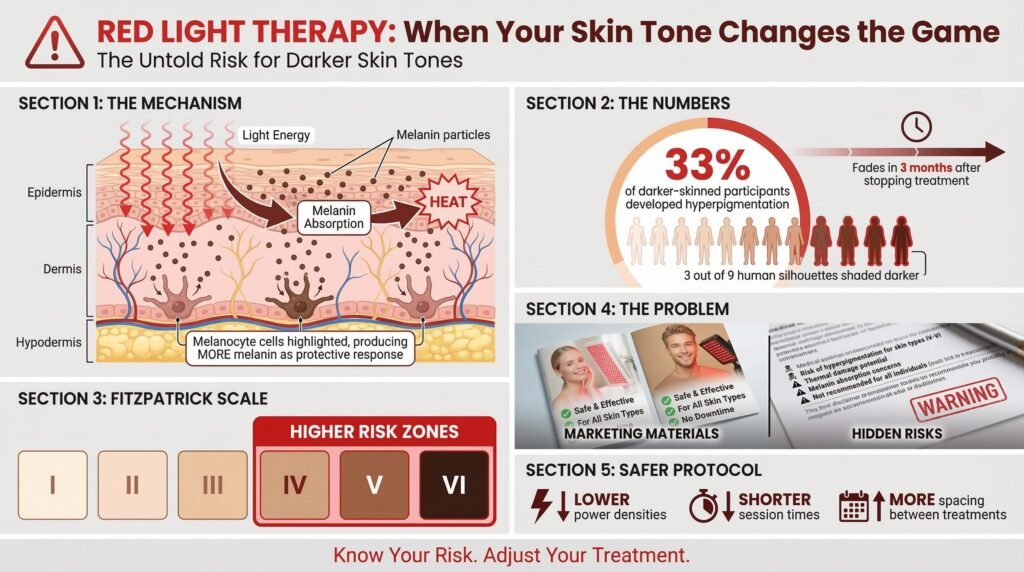
Hyperpigmentation, the development of darker patches on your skin, is significantly more common in people with darker skin tones, and the mechanism behind it is actually pretty fascinating if you understand what’s happening.
When you know the basics of what red light therapy does to your face, things appear a lot less complicated.
Melanin, the pigment that gives skin its color, absorbs light energy. When red light penetrates melanin-rich skin, it doesn’t just pass through harmlessly.
The melanin absorbs that energy and converts some of it to heat.
That localized heating can trigger melanocytes, the cells that produce melanin, to go into overdrive, producing even more pigment as a protective response.
In clinical studies, about one-third of participants with darker skin developed some level of hyperpigmentation at therapeutic doses. That percentage is not insignificant.
And while the hyperpigmentation did fade within about three months after stopping treatment, three months is a really long time to deal with uneven skin tone, especially if you were using red light therapy to improve your skin’s appearance in the first place.
What frustrates me is that most marketing materials show red light therapy working beautifully on fair-skinned models, and the specific risks for darker skin get buried in the fine print or clinical papers that most consumers never read.
If you have a deeper skin tone, particularly if you’re a Fitzpatrick Type IV, V, or VI, the risk-benefit calculation genuinely changes, and you need more careful monitoring and potentially different treatment parameters.
Lower power densities, shorter session times, and more spacing between treatments can help reduce the risk, but you need to know these adjustments are necessary in the first place.
The Eye Situation Nobody Wants to Discuss
There’s this weird tension around eye safety with red light therapy. On one hand, some practitioners specifically use red light for eye health.
On the other hand, device manufacturers include warnings about eye exposure.
So, which is it?
The reality is that intensity matters tremendously. The low-level red light used in some ophthalmologic applications is vastly different from the high-intensity panels people use for skin treatments.
When you’re standing in front of a full-body red light panel pumping out therapeutic levels of light, that’s not the same gentle exposure your eyes might benefit from.
I’ve experienced this firsthand. After using a facial red light device without closing my eyes properly, I had this weird visual artifact for about an hour afterward, not exactly pain, but this persistent bright spot in my vision, kind of like when you accidentally glance at a bright lightbulb.
It faded completely, but it was unsettling enough that I became pretty religious about keeping my eyes closed during treatments after that.
The photoreceptors in your retina are incredibly sensitive because that’s literally their job: to respond to light. Overwhelming them with intense red light, especially for extended periods, can cause temporary dysfunction.
Most home devices aren’t powerful enough to cause permanent damage, but clinical-grade equipment is a different story. To find a reliable, safe, and affordable red light therapy device, read our reviews here.
Proper protocols include either protective eyewear or positioning that keeps the light away from direct eye exposure. The problem is that most people using devices at home skip these precautions because they don’t realize the risk exists.
Headaches and the Neurological Response
This is one of the weirder side effects that doesn’t get enough attention. Some people develop headaches during or after red light therapy, and the explanations I’ve found are all over the place, everything from “detox reactions” to “increased blood flow” to “light sensitivity.”
What actually seems to be happening, based on the research I’ve dug into, is that red light affects neurological function more than we initially thought.
Your brain is incredibly metabolically active, and when you increase cellular energy production through photobiomodulation, you’re essentially revving up an already highly active system.
For some people, particularly those who already deal with migraines or have a history of light sensitivity, this can trigger a headache response.
Similar to how some people get headaches from strong smells or sudden weather changes, their neurological system has a lower threshold for what it considers overstimulation.
I know someone really excited about red light therapy for chronic pain, started using a device on their neck and shoulders, and developed persistent headaches within a week. When they cut back to shorter sessions and avoided treating the neck area directly, the headaches stopped.
Their theory was that they were getting too much light exposure near major blood vessels and nerve pathways, essentially overwhelming their nervous system’s ability to adapt.
The Medication Interaction Nobody Mentions
Here’s something that genuinely concerns me about how casually red light therapy is marketed: the lack of clear information about medication interactions.
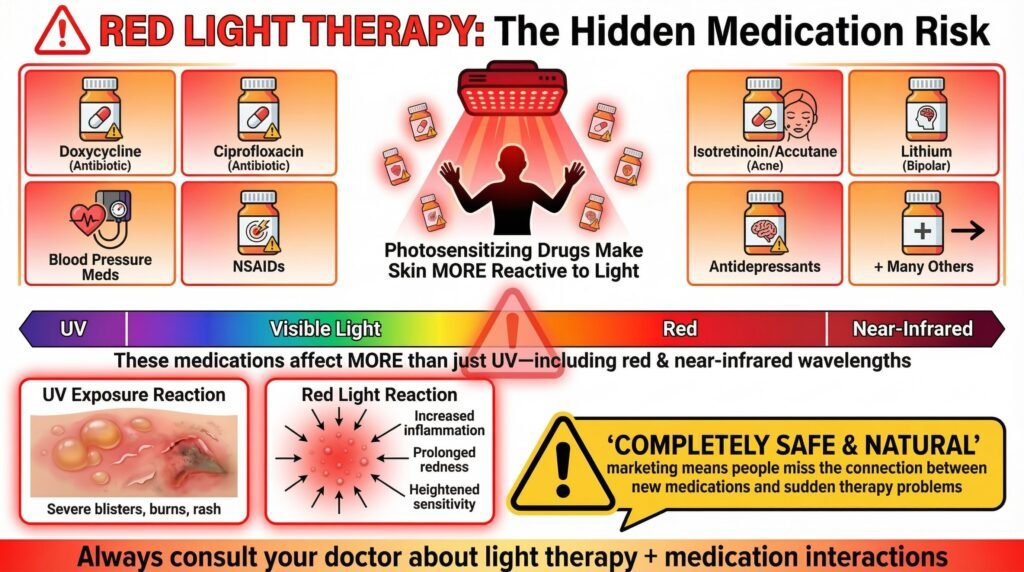
Photosensitizing drugs, medications that make your skin more reactive to light, are more common than most people realize.
Common antibiotics like doxycycline and ciprofloxacin are photosensitizing. So is isotretinoin (Accutane), which is widely prescribed for acne.
Lithium for bipolar disorder.
Even some blood pressure medications and NSAIDs can increase photosensitivity.
And while most photosensitivity warnings focus on UV light and sun exposure, some of these medications increase reactivity across the light spectrum, including red and near-infrared wavelengths.
The problem is that the interaction isn’t always obvious. You might not burn or blister like you would with UV exposure.
Instead, you might experience increased inflammation, prolonged redness, or heightened skin sensitivity that seems to come out of nowhere. And because red light therapy is often marketed as “completely safe and natural,” people don’t necessarily make the connection between starting a new medication and suddenly having problems with a treatment that previously worked fine for them.
When Detox Becomes an Excuse
I want to address something that drives me slightly crazy in the wellness space: the concept of “detox reactions” being used to explain every negative response to a treatment.
Yes, you’ll sometimes see temporary skin purging when you start red light therapy, increased breakouts, minor inflammation, that kind of thing. But calling everything a “detox reaction” can mask actual problems.
Your skin does increase turnover rate with red light therapy. Stimulating cellular renewal and clearing out damaged cells more efficiently is part of how the treatment functions.
So, experiencing some initial breakouts as your skin adjusts is plausible, particularly if you have congestion or underlying skin issues.
But legitimate purging is temporary and relatively mild. If you’re experiencing severe, persistent breakouts, ongoing inflammation, or worsening skin conditions, that’s an adverse reaction, not detox.
Maybe the device is too powerful for your skin type. Maybe you’re using it too often. Maybe your skin barrier is compromised, and the extra stimulation is overwhelming your skin’s ability to repair itself.
I’ve seen people push through genuinely harmful reactions because they were told it was “just detox,” and by the time they stopped treatment, they’d done real damage to their skin that took months to repair. Trust your body’s signals.
Some initial adjustment is normal. Prolonged problems are not.
The Thyroid Connection
This is one of the more controversial areas in red light therapy research, and I think it deserves more attention than it typically gets.
Your thyroid gland, located in the front of your neck, is metabolically active and responds to various stimuli, including light exposure.
Some practitioners actually use red light therapy specifically for thyroid support, claiming it can help improve thyroid function. And there is some research suggesting that photobiomodulation might influence thyroid hormone production.
But that also means the potential exists for unwanted effects, particularly in people who already have thyroid conditions.
If you have hypothyroidism or hyperthyroidism, or if you’re on thyroid medication, directly exposing your thyroid to therapeutic levels of red light could theoretically alter your thyroid hormone levels.
That change isn’t necessarily catastrophic, but it’s significant enough that it should be monitored, especially if you’re on carefully calibrated medication.
What concerns me is that most people using at-home devices have no idea this is even a consideration. They’re not tracking thyroid function, they’re not mentioning their red light therapy use to their endocrinologist, and they’re certainly not thinking about thyroid exposure when they’re doing neck and facial treatments.
Power Density Miscalculations
Here’s where things get technical, but it’s really important. The effectiveness and safety of red light therapy depend heavily on power density (also called irradiance), which is measured in milliwatts per square centimeter.
The problem is that power density changes with distance.
Most devices specify power density at a certain distance, typically measured at the surface of the device or at a standard treatment distance. But when you move closer to increase intensity, or further away to be more cautious, you’re dramatically changing the actual dose your skin receives.
And most people don’t understand this relationship.
There was a case in one clinical trial where a participant accidentally increased the effective dose by folding her arms during treatment, essentially pressing her skin directly against the device.
She developed an 8mm blister that took weeks to heal. That wasn’t a device malfunction or an inherent danger of red light therapy; that was a dosing error that dramatically exceeded safe parameters.
The challenge is that home users don’t have the tools to measure power density accurately. They’re going by manufacturer specifications and recommended distances, but they don’t really know what dose they’re receiving, especially as devices age and LED output potentially decreases.
This creates a situation where people are essentially guessing at their treatment parameters.
Quality Control in an Unregulated Market
I need to be blunt about this: the red light therapy device market is flooded with low-quality products that make therapeutic claims without adequate testing or quality control. Some devices don’t actually emit the wavelengths they claim.
Others have wildly inconsistent power output across the treatment surface.
Some use LEDs that degrade rapidly, meaning the device you used for the first month is significantly different from the device you’re using six months later.
This matters for side effects because if you don’t know what wavelengths you’re actually being exposed to, you can’t forecast how your body will respond.
If the device includes wavelengths outside the therapeutic range, particularly in the blue light spectrum, you might experience reactions that have nothing to do with red light therapy itself and everything to do with a poorly designed product.
I’ve compared specifications from different manufacturers claiming similar capabilities, and the variations are kind of alarming. Some use medical-grade LEDs with documented output specifications.
Others use generic components with minimal quality testing. The price isn’t always a reliable indicator, either. I’ve seen expensive devices with questionable specs and more affordable options that are actually well-engineered.
Find reliable FDA-approved and FDA-cleared red light devices for at-home use via the button below.
The Circadian Disruption Factor
This is a newer area of concern that hasn’t gotten much mainstream attention yet. Your body’s circadian rhythm, the internal clock that regulates sleep, hormone production, and countless other processes, is heavily influenced by light exposure.
That’s why we’re told to avoid blue light before bed and get morning sunlight.
Red light has generally been considered less disruptive to circadian rhythms than blue light, and that’s largely true. But exposing yourself to the bright light of any wavelength at the wrong times can still influence your circadian system.
Some people using red light therapy in the evening, particularly for extended sessions or with high-intensity devices, report sleep disruptions or feeling wired when they should be winding down.
The mechanism probably involves melanopsin, a photoreceptor in your eyes that’s particularly important for circadian regulation. While melanopsin is most sensitive to blue light, it does respond to other wavelengths at high intensities.
If you’re doing facial red light therapy late at night with your eyes open or partially open, you’re potentially giving your brain a signal that it’s daytime, which can delay melatonin production and shift your sleep timing.
Conclusion and Key Takeaways
The article concludes that Red Light Therapy is an exceptionally safe modality when compared to pharmaceutical or surgical alternatives, provided the user respects the biological limits of the body.
Key Takeaways:
- Safety is Dose-Dependent: The primary “danger” of RLT isn’t the light itself, but the misuse of it. Exceeding recommended times (usually 10–20 minutes) can lead to cellular fatigue, where the benefits vanish, or minor irritation begins.
- Quality Matters: Cheap, uncertified devices often have high “flicker” rates or unstable power outputs, which are the leading causes of the headaches and eye strain reported by users.
- The “Eyes Have It”: While NIR (Near-Infrared) light can be beneficial for eyes in tiny doses, the intensity of modern panels requires blackout goggles to prevent long-term retinal fatigue.
- Medical Screening: Users on medications like Tetracycline or Accutane must avoid RLT due to extreme photosensitivity.
Bottom Line: If you use an FDA-cleared device, wear eye protection, and stick to a consistent but moderate schedule, the risk of “things going wrong” is nearly zero.
Find a suitable, affordable, and effective red light therapy device for your needs. Click the button below to get started.
Frequently Asked Questions
Can red light therapy cause burns?
Red light therapy can cause burns if used incorrectly, particularly when the skin is pressed directly against a high-powered device or when treatment times are excessive. Most reported burns happen from misuse as opposed to from following proper protocols.
Maintaining the manufacturer’s recommended distance and treatment duration significantly reduces this risk.
Does red light therapy work for darker skin tones?
Red light therapy does work for darker skin tones, but people with higher melanin content face an increased risk of hyperpigmentation. Approximately one-third of darker-skinned participants in clinical studies experienced temporary darkening of the treated areas.
Using lower power settings and shorter treatment times can help reduce this risk while still providing benefits.
Is red light therapy safe during pregnancy?
There’s insufficient research on red light therapy safety during pregnancy to make evidence-based recommendations. Since pregnancy already involves accelerated cellular processes, adding photobiomodulation introduces an unknown variable.
The responsible approach is to avoid red light therapy during pregnancy until more safety data becomes available.
Can red light therapy damage your eyes?
High-intensity red light panels can temporarily affect vision if you look directly at them during treatment. While most home devices aren’t powerful enough to cause permanent eye damage, they can overwhelm retinal photoreceptors and cause temporary visual disturbances.
Keeping your eyes closed during facial treatments or using protective eyewear prevents these issues.
What medications interact with red light therapy?
Photosensitizing medications, including doxycycline, ciprofloxacin, isotretinoin, lithium, some blood pressure medications, and certain NSAIDs can increase skin reactivity to red light.
If you’re taking any medication, check with your doctor about potential photosensitivity effects before starting red light therapy.
How often should you use red light therapy safely?
Most research supports using red light therapy 3-5 times per week as opposed to daily. Your cells need time to process the energy boost and finish repair processes before the next session.
Daily intensive sessions can lead to cellular overload and counterproductive effects.
Can red light therapy affect thyroid function?
Red light therapy may influence thyroid hormone production when applied to the neck area. People with existing thyroid conditions or those taking thyroid medication should watch their levels and talk about red light therapy use with their endocrinologist to prevent unwanted changes in thyroid function.
Why do I get headaches from red light therapy?
Headaches from red light therapy typically result from increased neurological activity as cellular energy production ramps up. People with existing migraine conditions or light sensitivity are more susceptible.
Reducing session length, avoiding direct neck treatment, and spacing sessions further apart usually resolves this issue.
This article includes affiliate links. If you click through and make a purchase, I may receive a small commission. This helps support the site and allows me to keep creating helpful content at no extra cost to you.