📌Quick Summary
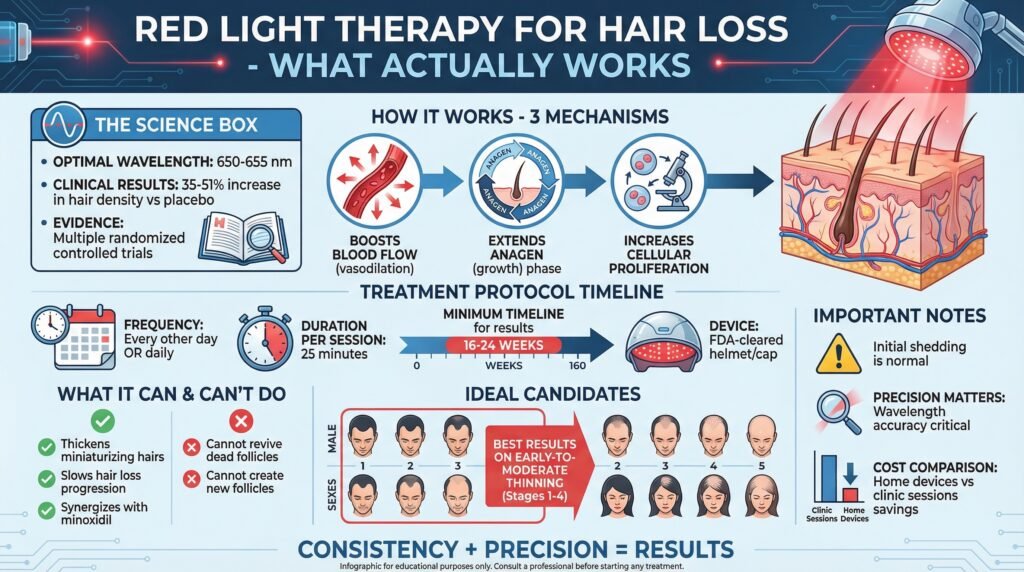
Red light therapy (RLT) at precise wavelengths (especially 650-655 nm) is backed by multiple randomized controlled trials showing 35-51% increases in hair density and counts versus placebo for androgenetic alopecia. It works via photobiomodulation: boosting blood flow (vasodilation), extending the anagen (growth) phase of hair follicles, and increasing cellular proliferation.
Best results occur with consistent use (every other day or daily 25-minute sessions for at least 16-24 weeks) using FDA-cleared helmet or cap devices on early-to-moderate active thinning. It cannot revive long-dead follicles or create new ones, but it thickens existing miniaturizing hairs, slows loss, and synergizes with minoxidil. Initial shedding is normal; consistency and wavelength precision are critical. Home devices offer major long-term cost savings over clinic sessions.
🧾 Table of Contents
· Introduction: Skepticism vs. evidence; overview of impressive trial results and basic mechanism.
· The Biology That Makes This Work Hair growth cycle (anagen, catagen, telogen) in pattern hair loss; how 650 nm red light extends anagen phase, increases Ki67 proliferation marker, and improves nutrient delivery via vasodilation. Limitations (won’t revive inactive follicles).
· What the Clinical Trials Actually Show Detailed results from RCTs (e.g., 37%, 51%, 35% hair count increases; up to 63.67% terminal hair gains); objective measurements; synergy with minoxidil; improvements continuing to 24 weeks.
· The Critical Detail Everyone Misses: Wavelength Precision Effective range (630-670 nm, optimal 650-655 nm); why generic “red light” devices often fail; importance of FDA-cleared devices with proven specs.
- Red Light Therapy Cost Savings Calculator (home device vs. professional sessions).
· Power Density Importance of correct energy delivery (joules/cm²) for efficacy and safety.
· Treatment Protocols That Work Recommended schedule (25 min every other day or daily); minimum 16 weeks; helmet/cap advantages for compliance; tips for building consistency.
· The Side Effects Nobody Talks About Properly. Initial shedding (weeks 2-4, positive sign); scalp warmth/redness; temporary headaches; eye safety (use goggles).
· What Success Actually Looks Like: Realistic expectations (fuller appearance in moderate thinning, maintenance in early stages); tracking progress with photos; focus on terminal hair increases.
· Key Takeaways: Summary of evidence, requirements for success, and practical advice.
Introduction
I need to start by saying something that might surprise you: I was skeptical about red light therapy for hair loss until I actually looked at the data. When someone first mentioned shining red lights on their scalp to regrow hair, it sounded like wellness theater, something that makes you feel like you’re doing something without actually doing anything.
But the evidence changed my mind.
We’re talking about randomized controlled trials showing 35-51% increases in hair growth compared to placebo. That’s not trivial.
That’s actually pretty remarkable for a non-pharmaceutical intervention.
What really got my attention was understanding the mechanism. Red light therapy uses photobiomodulation, where light at specific wavelengths triggers measurable biological responses in your cells.
The 650-675 nm wavelengths used for hair regrowth cause vasodilation in your scalp, increasing blood flow to follicles.
They extend the anagen phase of your hair cycle. They increase cellular proliferation markers.
This is measurable stuff.
The catch, and there’s always a catch, is that results depend entirely on consistency and realistic expectations. You can’t shine a light on your head twice and expect new regrowth.
You can’t revive follicles that died years ago.
But if you’ve got active pattern hair loss in earlier to moderate stages, and you’re willing to commit to 25-minute sessions every other day for at least 16 weeks, the evidence suggests you’ll probably see improvement.
Let me walk you through what actually works, what doesn’t, and how to think about this treatment option intelligently.
The Biology That Makes This Work
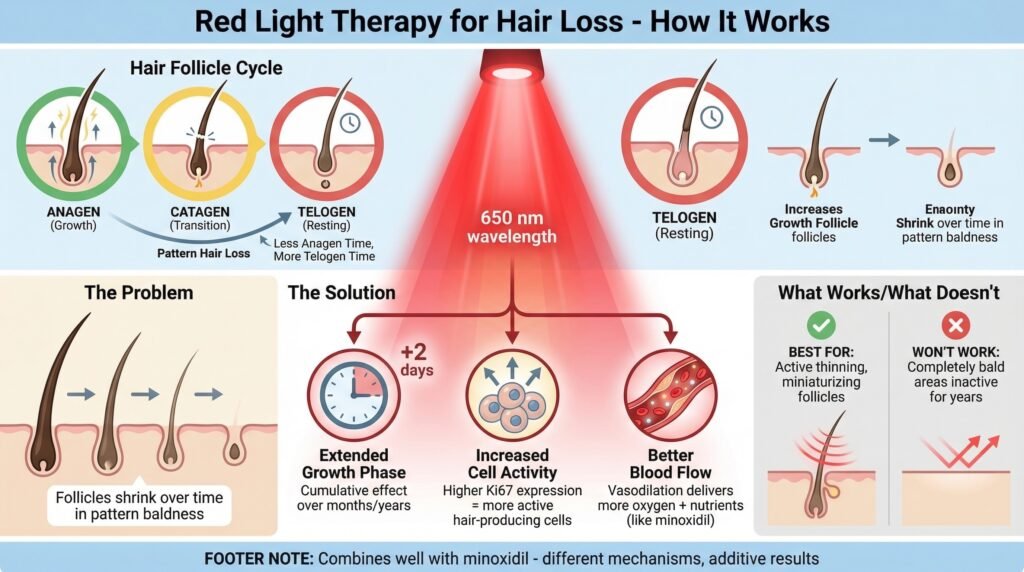
Your hair follicles go through cycles: anagen (growth), catagen (transition), and telogen (resting). In pattern hair loss, whether androgenetic alopecia in men or female pattern baldness, follicles spend less time in the growth phase and more time resting.
They also miniaturize over time, producing thinner, shorter hairs until eventually they stop producing visible hair altogether.
Red light at 650 nm wavelength does something really interesting to these follicles. Research using cultured human hair follicles showed that exposure to this specific wavelength kept follicles in the anagen phase for two days longer than untreated controls.
Two days might not sound like much, but when you’re talking about hair cycles that last months to years, extending the growth phase even slightly creates added effects over time.
The light also increases the proportion of cells actively dividing within the follicle. Researchers measure this using Ki67 expression, a marker for cellular proliferation.
Treated follicles showed significantly higher Ki67 expression, meaning more cells were actively doing the work of producing hair.
This represents a genuine increase in cellular activity, not just a cosmetic change.
The vasodilation effect mirrors how topical minoxidil works. When blood vessels in your scalp dilate, more oxygen and nutrients reach your follicles.
This isn’t speculative; it’s observable through various imaging techniques and blood flow measurements.
The interesting part is that you’re getting a minoxidil-like effect through a completely different delivery mechanism, which is why combining both treatments produces better results than either alone.
What red light can’t do is create new follicles where none exist or resurrect follicles that have been completely inactive for years. If you’ve been bald on your crown for a decade, those follicles are likely past the point of recovery.
But if you’ve got active thinning, where follicles are miniaturizing but still producing some hair, that’s where this therapy works best.
What the Clinical Trials Actually Show
Let’s get specific about the evidence, because generic claims about “studies show it works” don’t mean much.
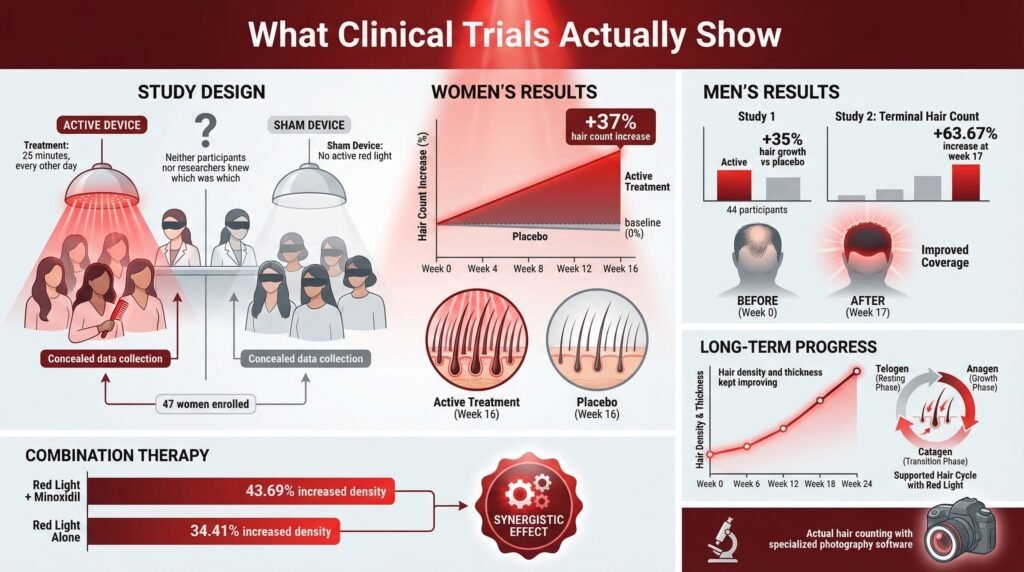
A multicenter randomized controlled trial enrolled 47 women with early-stage female pattern baldness. Half used an active red light device, half used an identical-looking sham device.
Neither the participants nor the researchers measuring results knew who had which device.
After 16 weeks of every-other-day 25-minute sessions, the active treatment group showed a 37% increase in hair counts compared to placebo.
Another trial of 44 women produced even stronger results: 51% increased hair growth versus placebo. These weren’t subjective assessments.
Researchers were literally counting hairs in standardized scalp areas and comparing before-and-after measurements using specialized photography and hair count software.
For men, a trial of 44 participants showed 35% increased hair growth compared to placebo. A different study tracking terminal hair counts (the thick, pigmented hairs you actually want) found a 63.67% increase at week 17.
These numbers represent real changes in hair density that you could see with your own eyes.
The 24-week studies are particularly interesting because they show continued improvement over time. Hair density and thickness kept improving through week 24, suggesting that longer treatment periods might produce even better outcomes.
This matches what we understand about hair biology, since hair cycles take months to finish and you need multiple cycles to see most benefit.
The combination therapy data really caught my attention. When researchers combined red light therapy with topical minoxidil, 43.69% of participants showed increased hair density compared to 34.41% with red light alone.
That’s a meaningful difference.
The treatments appear to work synergistically, not just additively, because they’re addressing different aspects of follicle health simultaneously.
The Critical Detail Everyone Misses: Wavelength Precision
Not all red lights are equal. Not even close.
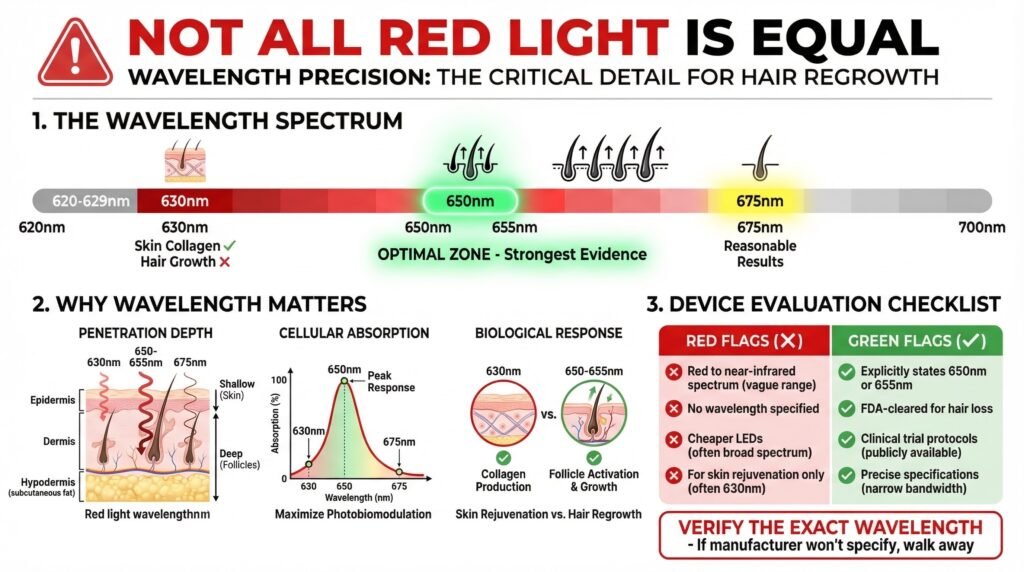
The research consistently points to wavelengths between 630nm and 670nm, with 650-655 nm as the optimal wavelength. Some studies tested 675 nm with reasonable results, but the strongest evidence clusters around 650 nm.
This matters because many consumer devices on the market use different wavelengths entirely or don’t specify wavelength at all.
You can’t just buy a red LED panel marketed for skin rejuvenation and expect hair regrowth results. Different wavelengths penetrate to different depths and trigger different cellular responses.
A 630 nm light might do wonderful things for your skin collagen, but nothing for your hair follicles. Of course, this will vary from individual to individual in terms of how responsive one naturally is to therapy. Some may see results on the lower end of 630 nm, and some less responsive, may need a higher wavelength of 655 nm. Titrate as needed.
The penetration depth, cellular absorption characteristics, and biological responses all vary based on precise wavelength.
The FDA-cleared devices specifically for hair loss use the researched wavelengths. This is one case where FDA clearance actually means something useful, not because the FDA verified efficacy (they focus on safety), but because manufacturers had to demonstrate they’re using the protocols that showed results in clinical trials.
When you’re evaluating devices, verify the exact wavelength. If a manufacturer won’t specify or gives you a broad range like “red to near-infrared spectrum,” that’s a red flag.
You want a device that explicitly states 650 nm or 655 nm wavelength.
Some manufacturers try to obscure this information, which usually means they’re using cheaper LEDs that don’t match the research specifications.
Helmet and cap devices provide the most comprehensive coverage. If you’ve got diffuse thinning across your entire scalp, you want broad coverage. Three brands that provide full transparency of FDA-clearance and the efficacious wavelengths we just covered are:
>>CurrentBody Skin LED Hair Regrowth Device>>Available on Amazon>>Click Here
>>Capillus Pro Mobile Laser Therapy Cap for Hair Regrowth>>Available on Amazon>>Click Here
Of course, there is an initial price shock when researching these devices. These devices range anywhere from $800 to upwards of $1600.
Every individual has to weigh what the therapy is worth to them. Professionally administered, targeted red light therapy sessions within a clinical environment run anywhere from $75 – $150 per session.
And as mentioned, consistency is critical to seeing any meaningful results. Hence, 2 to 3 sessions per week at a minimum can add up. These devices pay for themselves within a month or so when you take this cost-comparison into account. After that, the device is yours for life, and so are continuous sessions within the comfort of your own home.
See the cost-savings calculator below to crunch the real-time numbers and see how the savings add up. Bookmark this page and come back to the calculator anytime you are comparing red light services in your area.
Red Light Therapy Cost Savings Calculator
Consistency is critical to seeing meaningful results. Professional red light therapy sessions can range from $75-$150 per session, and with 2-3 sessions per week minimum, costs add up quickly. These devices range from $800-$1,600 but typically pay for themselves within a month or so. After that, the device is yours for life, and so are continuous sessions within the comfort of your own home. Use the calculator below to crunch the real-time numbers and see how the savings add up.
⚡ After your device pays for itself, you’ll save $800 every single month!
🌟 Top-Rated Red Light Therapy Devices for Hair Growth
Power density
Power density matters too, though this gets technical. The effective studies used devices delivering specific energy densities to the scalp, typically measured in joules per square centimeter.
Too little power and you're not getting a therapeutic effect.
Too much power doesn't improve results and increases side effect risk. FDA-cleared devices have already sorted this out.
Treatment Protocols That Work
The clinical trials used specific protocols, and deviating from them probably explains why some people report disappointing results.
Every-other-day treatment for 25 minutes per session produced the documented results. Some studies used daily treatment with similar success.
What didn't work in the research was sporadic use, treating once or twice a week or skipping days randomly.
Consistency matters because you're trying to influence biological cycles that operate on their own timeline.
The 16-week minimum is real. Hair cycles don't run on your schedule.
The follicles need time to finish their current phase, enter the extended growth phase, and produce visible hair.
Expecting results at week 6 or 8 sets you up for disappointment and premature abandonment of treatment. I've seen people quit at week 10, right before they would have started seeing real improvement.
The practical challenge is consistency over months. This is where helmet-type or cap-type devices have an advantage over comb devices.
With a helmet or cap, you can set a timer, put the device on, and do other things.
With a comb device, you're actively running it over your scalp for 25 minutes, which gets tedious fast.
I've found that tying treatment to an existing routine works best. If you watch a particular show every evening, that's your treatment window.
If you have a morning coffee ritual, add the device to that routine.
Waiting until you "have time" means it won't happen consistently. You need to build this into your day the same way you build in brushing your teeth.
The Side Effects Nobody Talks About Properly
Initial shedding freaks people out, but it's actually a good sign. When you start red light therapy, you might notice increased hair fall in the first 2-4 weeks.
This isn't damage, it's your hair cycling.
The treatment is pushing follicles from the resting phase into the active growth phase, and the old hairs shed to make room.
This is exactly what happens with minoxidil, too. It's called "shedding" and it's actually an indicator that the treatment is working.
If you panic and stop treatment when this happens, you've wasted your initial weeks of effort right when the therapy was starting to take effect.
Push through this phase. The shedding typically stops by week 4-6, and new growth starts becoming visible around week 8-12.
The scalp warmth and redness some people experience is normal vasodilation. Your blood vessels are dilating, which is part of the therapeutic mechanism.
It should subside within minutes after treatment.
If it continues for hours or becomes painful, that's worth investigating, but mild warmth is expected and actually confirms the device is working properly.
Some people report headaches, particularly in the first week or two. This might relate to changes in blood flow patterns or just the novelty of having a device on your head.
It typically resolves with continued use.
If headaches continue or worsen, that's obviously a reason to stop and ask a healthcare provider.
The eye protection warnings are real. Don't skip the goggles thinking you'll be careful.
Red light at these wavelengths can damage retinal tissue.
Every quality device includes eye protection. Use it every single time, no exceptions.
What Success Actually Looks Like
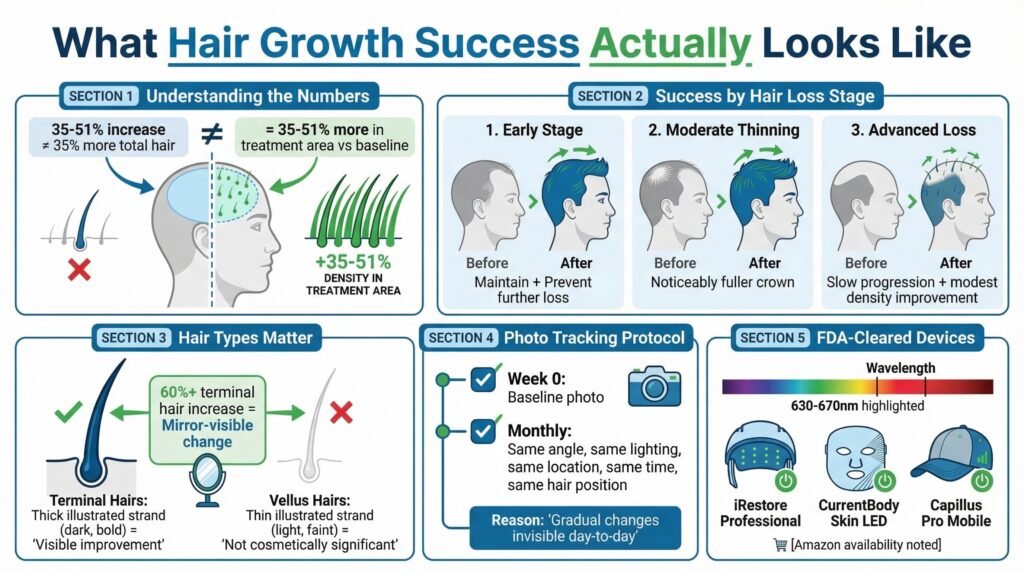
A 35-51% increase in hair growth doesn't mean you're getting 35-51% more total hair on your head. It means the treatment area shows that percentage increase compared to baseline.
For someone with moderate thinning, this might mean their crown looks noticeably fuller.
For someone with more advanced hair loss, it might mean slowing progression and achieving modest improvement in density. For someone in the very early stages, it might mean maintaining their current hair and preventing further loss.
The terminal hair count increases are meaningful. Terminal hairs are the thick, pigmented hairs you actually see.
An increase in terminal hair counts means you're getting real, visible improvement, not just vellus hairs (the fine, nearly invisible hairs that don't contribute to cosmetic appearance).
When studies report terminal hair increases of 60% or more, that represents a change you can see in the mirror.
Photos are essential for tracking progress because changes happen gradually. Your perception adjusts day by day, making it hard to notice improvement.
Baseline photos at week 0, then monthly photos under consistent lighting from consistent angles, give you real comparison points.
Use the same location, same time of day, same lighting setup. Pull your hair the same way.
These details matter for accurate comparison. Choose from the trusted and FDA-cleared devices below that deliver wavelengths between 630nm and 670nm. See the links to three FDA-cleared and efficacious devices that provide the recommended wavelengths.
>>CurrentBody Skin LED Hair Regrowth Device>>Available on Amazon>>Click Here
>>Capillus Pro Mobile Laser Therapy Cap for Hair Regrowth>>Available on Amazon>>Click Here
Key Takeaways
Red light therapy for hair loss has been validated by multiple randomized controlled trials showing 35-51% improvements over placebo when using 650-655 nm wavelength devices for 16-24 weeks with consistent every-other-day or daily use.
The mechanism is biological and measurable: vasodilation increases blood flow to follicles, cellular proliferation increases, and the anagen growth phase extends. This happens through photobiomodulation, where specific wavelengths trigger cellular responses.
Results need commitment. Every other day, 25-minute sessions for at least 16 weeks, without fail.
Sporadic use produces sporadic results.
Stopping treatment means results stop; this is maintenance therapy, not a cure.
Wavelength precision is non-negotiable. Verify your device uses 650-655 nm.
Generic red light panels won't work.
FDA-cleared devices designed specifically for hair loss are your safest bet.
Initial shedding is expected and actually shows the therapy is working. Don't panic and quit at week 2 when you see increased hair fall.
Push through to week 8 and beyond.
Realistic expectations based on your current hair loss stage determine satisfaction with results. Early to moderate pattern hair loss responds best.
Severe, long-standing baldness won't see dramatic regrowth, but might achieve modest improvement and slowed progression.
Track progress with monthly photos, not daily mirror checks. Changes are gradual enough that you won't notice them day-to-day, but photos reveal meaningful improvement over months.
People Also Asked
Does red light therapy regrow hair?
Red light therapy can stimulate hair regrowth in people with androgenetic alopecia (pattern hair loss). Clinical trials show 35-51% increases in hair growth when using 650 nm wavelength devices for 16-24 weeks.
The treatment extends the growth phase of hair follicles and increases cellular activity, but works best on follicles that are still active and producing some hair.
How long does red light therapy take to work for hair loss?
You need at least 16 weeks of consistent treatment to see results from red light therapy for hair loss. Most clinical trials show initial improvements around week 12-16, with continued improvement through week 24.
Treatment involves 25-minute sessions every other day, and you may experience initial shedding in weeks 2-4 before seeing new growth.
What wavelength of red light is best for hair growth?
The optimal wavelength for hair growth is 650-655 nm. Clinical research consistently shows this wavelength effectively stimulates hair follicles, extends the growth phase, and increases hair density.
Some studies tested 675 nm with reasonable results, but the strongest evidence supports 650 nm specifically.
Can you use red light therapy with minoxidil?
You can combine red light therapy with minoxidil for better results. Studies show that 43.69% of participants using both treatments achieved increased hair density compared to 34.41% using red light alone.
The treatments work through different mechanisms; minoxidil dilates blood vessels chemically, while red light does so through photobiomodulation, creating complementary effects.
Does red light therapy work for female hair loss?
Red light therapy works effectively for female pattern baldness. Clinical trials with women showed 37-51% increases in hair counts compared to placebo after 16 weeks of treatment.
The therapy works similarly for both men and women because it targets the biological processes of hair follicles regardless of gender.
Will hair fall out if you stop red light therapy?
Hair improvements from red light therapy need ongoing maintenance. When you stop treatment, follicles gradually return to their previous patterns.
This happens because red light therapy maintains follicle health rather than permanently curing pattern hair loss.
Most people maintain results by continuing treatment long-term at the same frequency.
This article includes affiliate links. If you click through and make a purchase, I may receive a small commission. This helps support the site and allows me to keep creating helpful content at no extra cost to you.