Best Mobile & Budget-Friendly Red Light Therapy Device
Quick Summary
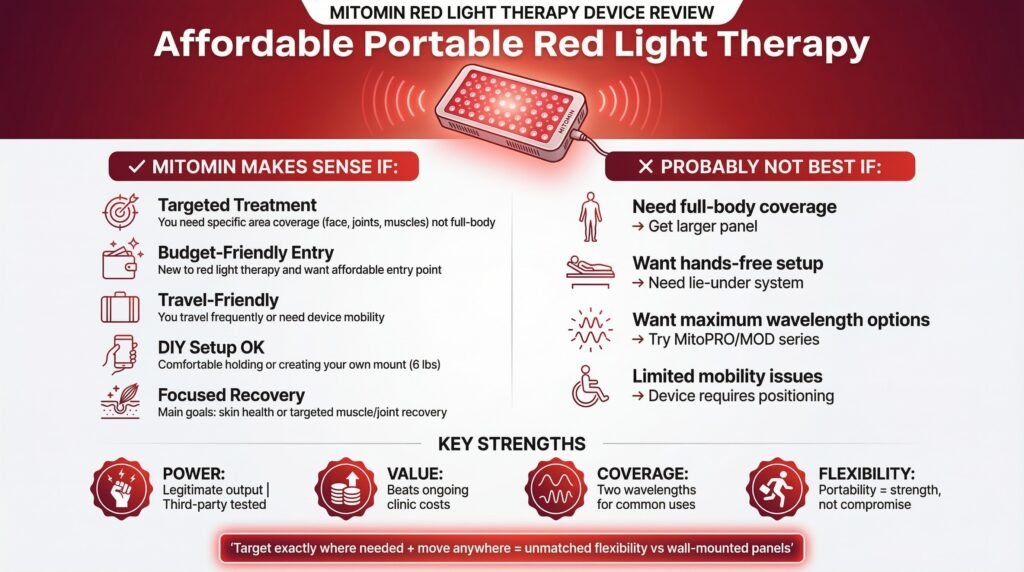
The MitoMIN is a portable, affordable (~$249) handheld red light therapy device from trusted brand Mito Red Light, ideal for targeted treatments like skin rejuvenation (660nm red light) or deeper muscle/joint recovery (850nm near-infrared).
It delivers strong, third-party verified power output (14,503–21,720 joules in 10 minutes), is HSA/FSA eligible, and offers massive long-term savings vs. clinic sessions ($75–150 each).
Pros include portability, simplicity, and effectiveness for beginners or travelers. Cons: requires manual holding (original model lacks a kickstand; 2.0 has one), only two wavelengths, not expandable or suited for full-body use. Overall, solid value for specific needs, but not for hands-free or advanced users.
Check current MitoMIN pricing>>>CLICK HERE.
Table of Contents
1. Introduction – Overview of red light therapy options and positioning of the MitoMIN.
2. MitoMIN – What You’re Actually Getting – Product specs, design, power, and features.
3. The Wavelength Thing Everyone Gets Confused About – Explanation of 660nm vs. 850nm benefits.
4. Who Actually Uses This Thing
– Face and Skin Therapy
– Post-Workout Recovery
– Travel and Convenience
– Budget Entry Point
5. The Honest Downsides – Limitations like manual operation and lack of expandability.
6. How It Stacks Up Against Similar Options – Comparison to MitoPRO 300 and professional sessions.
7. What the Testing Actually Shows – Third-party irradiance results and user benefits.
8. The Day-to-Day Reality – Ease of use, portability, and warranty details.
9. The Real MitoMIN Review Verdict – Who it’s best (and not) for, with pros/cons summary.
Introduction
So, you’ve been looking into red light therapy.
Maybe you keep seeing those glowing red panels all over Instagram, or your physical therapist mentioned it, or you’re just tired of paying $100+ per session at some fancy wellness clinic.
Here’s the thing about at-home red light devices… There are like a thousand options out there now. And most of them are either garbage Amazon knockoffs with fake reviews, or they’re legit professional-grade panels that cost more than a used car.
The MitoMIN sits somewhere in the middle. It’s made by Mito Red Light (one of the more trusted brands in this space), costs around $300-ish, and it’s designed for targeted treatment as opposed to full-body sessions.
Also, if getting access to red light therapy to support your long-term health and wellbeing is a priority, then you’re in luck…Mito Red has partnered with Truemed to make it easy to buy your favorite Mito Red products with pre-tax HSA / FSA dollars.
That last part matters a lot, TBH.
MitoMIN – What You’re Actually Getting
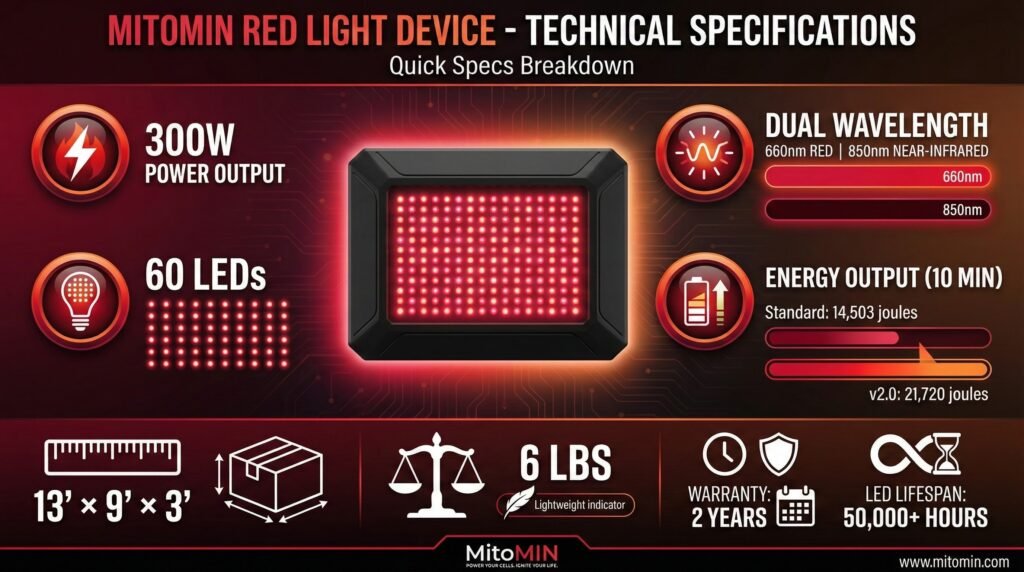
The MitoMIN is basically a handheld red light panel. It’s 13 inches long, 9 inches wide, about 3 inches thick, and weighs 6 pounds.
Not exactly pocket-sized, but you can easily carry it around your house or pack it in a suitcase if you travel a lot.
It’s got 60 LED lights that pump out 300 watts total. The two wavelengths it uses are 660 nanometers (that’s the red light you can actually see) and 850 nanometers (near-infrared, which you can’t see but it penetrates deeper into your tissue).
In a 10-minute session, the original MitoMIN delivers about 14,503 joules of energy. The newer MitoMIN 2.0 cranks that up to 21,720 joules in the same time frame.
For context… that’s a decent amount of energy. Not as much as standing in front of a massive full-body panel, but plenty for treating your face, a sore shoulder, or a bum knee.
The device has cooling fans built in (they’re pretty quiet tbh), a 2-year warranty, and the LEDs are supposedly good for 50,000+ hours of use. So like… years and years of daily sessions before you’d need to worry about them dying.
The Wavelength Thing Everyone Gets Confused About
Okay, so this is where people start getting overwhelmed with information…
Red light therapy works at specific wavelengths. Different wavelengths do different things because they penetrate to different depths in your skin and tissue.
The 660nm red light stays pretty close to the surface. That makes it good for skin stuff like wrinkles, acne, discoloration, wound healing, that kind of thing.
If you’re mainly focused on your face or surface-level skin issues, this is the wavelength you want.
The 850nm near-infrared light goes deeper. We’re talking into your muscles, joints, even down to the mitochondria in your cells (that’s where the whole “Mito” brand name comes from bth).
This wavelength is what people use for muscle recovery after workouts, joint pain, inflammation, stuff like that.
The MitoMIN gives you both with a simple switch. You pick which wavelength you want based on what you’re treating that day.
Some of the fancier Mito panels (like the Mito PRO series) have four wavelengths instead of two. That’s nice if you want most options, but for most people dealing with specific issues, two wavelengths get the job done.
Who Actually Uses This Thing
Face and Skin Therapy
A lot of people buy this specifically for facial treatments. You can prop it up on your bathroom counter or nightstand, flip it to 660nm, and do a 10-minute session while you’re getting ready for bed or scrolling on your phone.
People use it for anti-aging (fine lines, wrinkles, skin texture), acne management, and general skin health. The fact that it’s portable means you can position it right where you need it instead of trying to angle yourself under a wall-mounted panel.
Post-Workout Recovery
Fitness people use these for sore muscles and joints. Like… you just crushed leg day and your quads are screaming?
Hold the MitoMIN over them for 10-15 minutes using the 850nm setting.
Or if you’ve got chronic knee pain, bum shoulder, whatever. The portability actually matters here because you can target the exact spot that hurts instead of exposing your whole body.
Travel and Convenience
At 6 pounds, this fits in a gym bag or carry-on suitcase pretty easily. If you travel a lot for work or you’re bouncing between houses, you can bring this with you without needing to pack a massive panel.
Budget Entry Point
Here’s the other big use case… if you’re new to red light therapy and not sure if it’s going to work for you, starting with something like the MitoMIN makes more sense than dropping $1000+ on a full-body setup.
You can test the waters, see if you actually stick with it, and if it helps your specific issues… then maybe upgrade later to something bigger.
In terms of pricing, clearly the Mito MIN at $249 (other promotions may exist), along with the HAS/FSA-eligible savings, by far surpasses professional clinical sessions that average around $100 per session.
See the cost-savings calculator below to crunch the real numbers and see the savings stack up.
Mito MIN Red Light Therapy
Discover how much money you can save by investing in the Mito MIN Red Light Therapy device instead of paying for expensive professional sessions. Calculate your personalized savings based on your usage pattern.
The Honest Downsides
Look, no device is perfect. The MitoMIN has some limitations you should know about before buying.
You have to hold it or mount it yourself. This isn’t a set-it-and-forget-it situation. You’re either holding the panel in your hand for 10 minutes (which gets tiring), or you need to rig up some kind of stand situation.
The newer MitoMIN 2.0 comes with a kickstand built in, which helps, but the original version doesn’t include that.
If you have limited mobility or you just want a completely passive experience where you lie down and zone out… this probably isn’t the best choice.
Only two wavelengths. As I mentioned earlier, some panels offer four different wavelengths. The MitoPRO 300 (which is basically the same size and power output as the MitoMIN) has four wavelengths and modular connectivity.
That extra flexibility might matter if you really get into red light therapy and want to experiment with different protocols.
You can’t expand it. Some Mito panels can connect to create larger treatment areas. The MitoMIN can’t do that.
You buy one unit, that’s what you get.
If you later decide you want full-body coverage, you’d need to buy a completely different panel.
The modular MOD series solves that problem, but costs more upfront.
It’s still $300-ish. Which is way cheaper than professional clinic sessions (those run like $75-150 per session), and way cheaper than the big panels (which can hit $1500+)… but it’s not pocket change either.
If the whole red light therapy thing ends up being a fad for you, that’s money you could’ve spent elsewhere.
How It Stacks Up Against Similar Options
The main competitor people compare this to is the MitoPRO 300 from the same brand.
Both have 60 LEDs. Both put out 300 watts.
Both are similar sizes and weights.
The differences are:
MitoPRO 300 pros: Four wavelengths instead of two, modular design so you can connect many panels, slightly more versatile overall.
MitoPRO 300 cons: Costs more (usually $100-200 more, depending on sales), weighs a bit more, and may be overkill if you’re just treating your face.
MitoMIN pros: Cheaper, super portable, good power output for the price, simple two-wavelength setup that covers most use cases.
MitoMIN cons: Only two wavelengths, can’t expand it, no kickstand on the original version.
For most people doing targeted treatment, the MitoMIN delivers solid value. You’re getting legit power output (backed by independent testing) in a portable package for a reasonable price.
If you’re someone who wants the most flexibility and thinks you might want to expand later, the MitoPRO 300 makes more sense despite costing more.
Check out Mito’s catalog to compare pricing by clicking the button below.
What The Testing Actually Shows
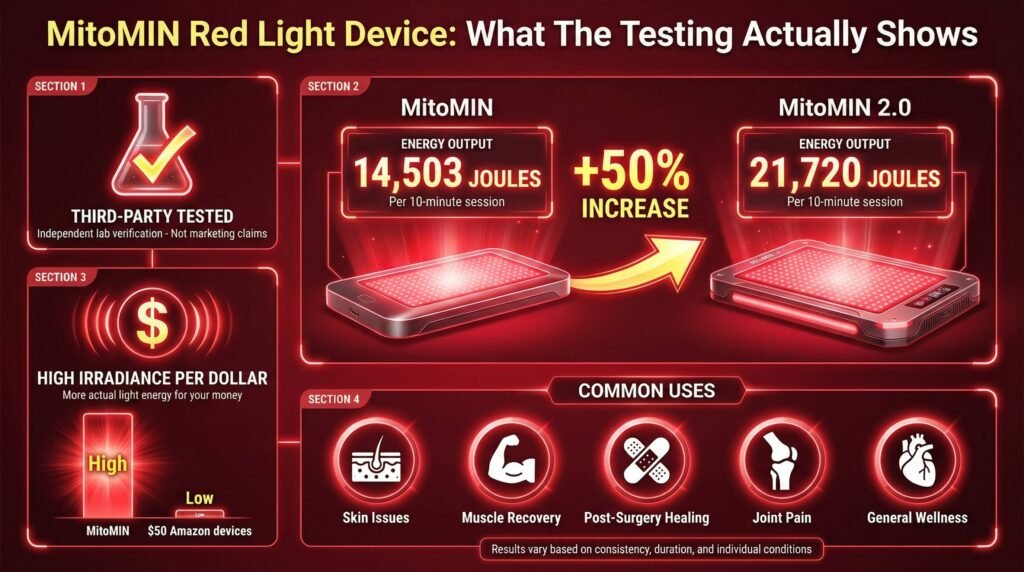
One thing I appreciate about Mito Red Light as a brand… they actually do independent third-party testing on their devices and publish the results.
The MitoMIN has been tested and confirmed to deliver 14,503 joules in a 10-minute session. The MitoMIN 2.0 bumps that up to 21,720 joules.
That’s not just marketing fluff. Those are actual lab measurements.
The device also ranks well for “irradiance per dollar,” which is basically a measure of how much actual light energy you get relative to what you paid. That metric matters because there are plenty of cheap red light devices out there that barely put out any actual power (looking at you, $50 Amazon specials).
People are using the MitoMIN report, using it for all kinds of stuff. Skin issues, muscle recovery, post-surgery healing, joint pain, and general wellness routines.
Results obviously vary person to person based on consistency, how long you use it, your specific condition, and all that.
But the device itself appears to deliver legitimate energy output that can potentially support the benefits that red light therapy research suggests.
The Day-to-Day Reality
Here’s the thing about any at-home therapy device… You actually have to use it consistently for it to matter.
The good news with the MitoMIN is that using it is stupid simple. Plug it in, flip the wavelength switch to whichever one you want, set your timer (or just use your phone), and hold it where you need it.
There’s no complicated programming or apps or Bluetooth pairing or any of that nonsense.
The portability actually helps with consistency tbh. You can keep it next to your couch and use it while watching TV.
Or prop it on your bathroom counter and use it as part of your nighttime routine.
Or bring it to your home office and use it during a break between Zoom calls.
The cooling fans do their job without being super loud (they’re quieter than a regular desk fan), so you can have a conversation or listen to a podcast while using it.
The 2-year warranty gives you some peace of mind, and the 50,000+ hour LED lifespan means you’re looking at years of use before the lights start degrading noticeably.
Again, the HSA/FSA eligibility really helps to bring down the price and further sweetens the Mito MIN’s appeal.
The Real Mito MIN Review Verdict
Alright, so here’s the bottom line after looking at all this stuff…
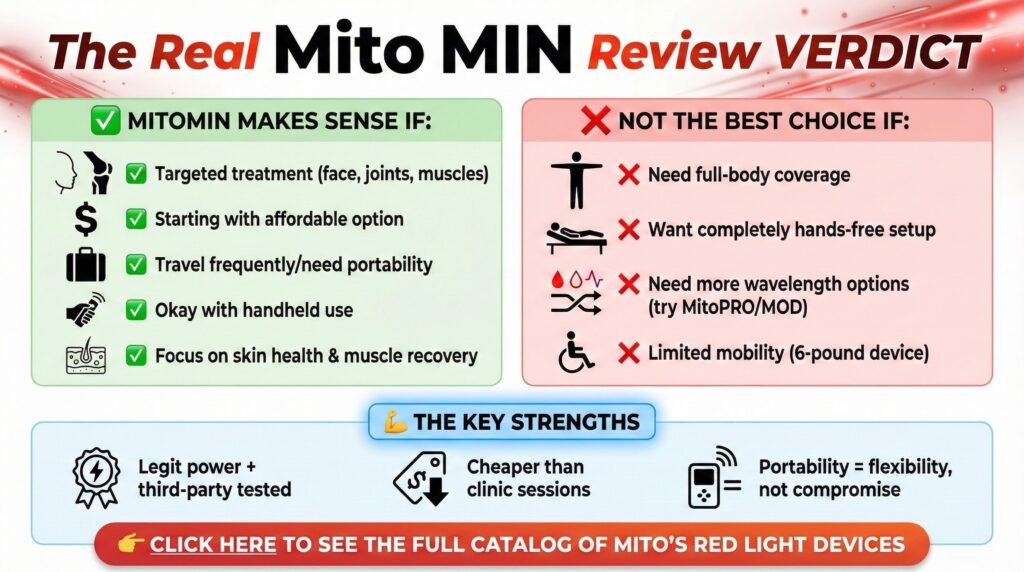
The MitoMIN makes sense if:
- You want to treat specific areas (face, joints, muscles) as opposed to doing full-body sessions
- You’re new to red light therapy and want to start with something affordable before committing to a bigger system
- You travel a lot or want the flexibility to move the device around
- You’re okay with holding it or setting up your own mounting solution
- Your main focus is skin health or targeted muscle/joint recovery
The MitoMIN probably isn’t the best choice if:
- You want full-body red light therapy coverage (get a bigger panel for that)
- You need a completely hands-free setup that you can just lie under
- You want most wavelength options and future expandability (look at the MitoPRO or MOD series)
- You have very limited mobility and can’t hold or position a 6-pound device
The device delivers legit power output, comes from a reputable brand that does third-party testing, costs way less than ongoing clinic sessions, and handles most common red light therapy use cases with its two wavelengths.
The portability is genuinely a strength, not a compromise. Being able to target exactly where you need treatment (and move the device around your house or take it traveling) adds flexibility that wall-mounted panels can’t match.
Grab the MitoMIN 2.0>>HERE (the newer version with the kickstand is worth the small price difference imo).
For someone looking at this MitoMIN review and trying to decide if it’s worth buying… the answer depends on your specific situation and what you’re actually trying to treat.
If you’re dealing with facial skin issues, chronic joint pain in specific spots, post-workout soreness, or you just want to experiment with red light therapy without spending a fortune… this delivers solid value.
It’s not the fanciest option out there, and it’s not designed to be. It’s designed to give you legitimate red light therapy in a portable, affordable package that doesn’t need a PhD to figure out.
The fact that independent testing backs up the energy output claims, that it comes with a real warranty from a known brand, and that real people use these things daily and report positive experiences… that all adds up to a device that does what it claims to do.
Just understand what you’re getting (targeted treatment, not full-body) and what the tradeoffs are (portability and price vs most features and expandability), and you’ll probably be happy with it.
Check our full list of red light therapy device reviews if you want to compare the whole product line before deciding.
FAQ’s
What wavelengths does the MitoMIN use, and what are they for?
It uses 660nm (visible red light) for superficial skin benefits like anti-aging, acne, wrinkles, and wound healing, and 850nm (near-infrared) for deeper penetration into muscles, joints, and cells to reduce inflammation, aid recovery, and relieve pain.
How portable is the MitoMIN?
It’s highly portable at 6 pounds with dimensions of 13″ x 9″ x 3″, fitting easily in a gym bag or suitcase, great for travel, home use, or multi-location lifestyles.
Does it require manual holding, or does it have a stand?
The original model requires manual holding or propping up (can be tiring); the upgraded MitoMIN 2.0 includes a built-in kickstand for hands-free positioning.
How much does the MitoMIN cost compared to professional sessions?
Around $249 (with promotions varying), plus HSA/FSA eligibility. It breaks even after just 3–4 clinic sessions ($75–150 each) and can save thousands long-term (e.g., $7,551 over 6 months).
What is the power output, and is it verified?
Original: 14,503 joules in 10 minutes; MitoMIN 2.0: 21,720 joules. Yes, independently third-party tested for strong irradiance per dollar.
Is the MitoMIN suitable for full-body treatment?
No, it’s designed for targeted spot treatments only, not full-body coverage (better suited to larger panels for that).
What warranty and lifespan does it offer?
2-year warranty, with LEDs rated for 50,000+ hours of use and quiet cooling fans for durability.
Can it be expanded or connected to other panels?
No, it’s not modular or expandable, unlike higher-end models like the MitoPRO series.
How does the MitoMIN 2.0 differ from the original?
The 2.0 has higher energy output (21,720 vs. 14,503 joules/10 min) and includes a kickstand; otherwise, specs are similar.
Is red light therapy with the MitoMIN effective?
User reports and research support benefits for skin health, muscle recovery, pain relief, and wellness, though results vary by consistency and individual condition. The device’s tested power aligns with effective doses in studies.
This article includes affiliate links. If you click through and make a purchase, I may receive a small commission. This helps support the site and allows me to keep creating helpful content at no extra cost to you.