Quick Summary
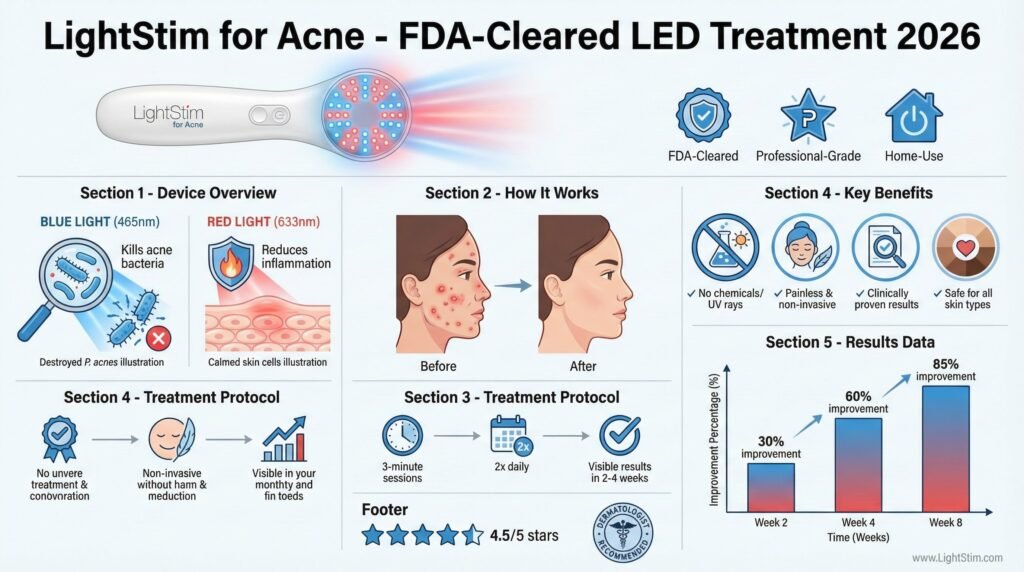
The LightStim for Acne is an FDA-cleared handheld LED device that combines blue light (415nm) to kill acne-causing bacteria and red light (660nm) to reduce inflammation and promote healing.
It’s best suited for mild to moderate inflammatory acne, offering a gentle, non-irritating at-home alternative to harsh topicals. Results typically appear after 4–6+ weeks of consistent daily (or near-daily) 9–15 minute use, but it’s not ideal for severe cystic acne, blackheads/whiteheads, or scarring.
Upfront cost is $170–250, but it’s cheaper long-term than professional treatments, with realistic expectations and commitment, it’s a solid option for sensitive skin types seeking chemical-free maintenance.
Table of Summary
· Introduction
· How the LightStim Device Actually Works
· What the Clinical Studies Actually Show
· My Take on Actually Using This Thing
· Comparing At-Home vs Professional Light Therapy
· Timeline for Seeing Actual Results
· Who This Device Works Best For
· Limitations You Should Know About
· Does It Actually Work Better Than Other Options?
· The Real Cost Breakdown
· Safety Details You Should Actually Know
· What Other Users Actually Report
· Using It as Part of a Complete Routine
· Final Thoughts on Whether It’s Worth It
Introduction
So, I’ve been using LED light therapy for acne for a while now, and I wanted to share what I’ve learned about the LightStim device specifically.
This thing keeps popping up everywhere, and after doing a ton of research (and spending way too much time comparing specs), I figured it was time to break down whether it’s actually worth the hype.
The LightStim for Acne is an FDA-cleared handheld device that uses blue and red LED lights to treat breakouts. Blue light kills the bacteria that cause acne, while red light helps with inflammation and healing.
You hold it against your skin for about 3 minutes per area, and you’re supposed to see results after a few weeks of consistent use.
Here’s the thing, though… It’s not cheap. We’re talking a few hundred bucks for a handheld device.
But when you compare that to professional light therapy sessions (which can run $100-200 per session), it starts to make more sense if you’re planning to use it regularly.
As many red and blue light therapy practitioners will attest, consistent and lasting results require consistent use.
Use the cost-savings calculator below to crunch the numbers and see the real savings of the Lightstim device versus multiple professional clinic sessions per week.
LED Therapy Cost Savings Calculator
Compare the costs of professional LED therapy treatments versus at-home LightStim devices. Calculate your potential savings and see how quickly an at-home device pays for itself.
| Factor | LightStim At-Home | Professional LED Therapy |
|---|---|---|
| Cost per Session | ~$0.50 (electricity only after initial purchase) | $100-200 per session |
| Initial Investment | $170-250 (depending on promotions) | $0 upfront |
| Power Density | Lower (gentler, slower results) | Higher (faster, more intense) |
| Convenience | Use anytime at home | Schedule appointments, travel time |
| Treatment Area | Small handheld (3-5 square inches) | Full face panels (larger coverage) |
| Best For | Mild to moderate acne, maintenance, budget-conscious | Severe acne, faster results, professional supervision |
How the LightStim Device Actually Works
The device combines two wavelengths: 415nm blue light and 660nm red light. The blue light targets Cutibacterium acnes (the bacteria responsible for inflammatory acne), while the red light penetrates deeper to reduce inflammation and speed up healing.
Red light therapy, more specifically, yields several benefits for the face.
You don’t need any gels or creams with it. Just clean skin, press the device against your face, and hold it there.
It has this auto-shutoff timer that turns off after 3 minutes, so you know when to move to the next spot.
Takes about 9-15 minutes total if you’re treating your whole face.
The light isn’t harsh or uncomfortable. No heat, no tingling.
Honestly, it feels like nothing is happening, which freaked me out at first because I kept wondering if it was even working.
What the Clinical Studies Actually Show
LightStim has FDA clearance for treating mild to moderate acne, which means it went through actual testing. The company claims their studies showed improvement in inflammatory acne lesions, but (and this is important) the results take time.
Most studies on LED light therapy for acne show that you need consistent use for at least 4-6 weeks before seeing noticeable improvement. Some people see results sooner, but that seems to be the average timeline based on what I’ve read.
The blue light specifically has been shown in multiple studies to reduce acne-causing bacteria. Red light helps with the healing process and can reduce the appearance of post-inflammatory marks (those annoying red spots that stick around after a pimple heals).
Here’s the realistic expectation: this works best for mild to moderate inflammatory acne (the red, painful bumps). It’s not going to do much for blackheads or whiteheads (non-inflammatory acne), and it’s probably not strong enough for severe cystic acne on its own.
My Take on Actually Using This Thing
The biggest challenge is consistency. You need to use it every day (or at least 5-6 times per week) to see results.
Miss a week, and you’ll probably notice your progress stalls.
The handheld design makes it pretty easy to use while watching TV or whatever. I’ve seen people use it during their morning routine, right after washing their face.
The 3-minute timer per area is actually helpful because it keeps you from rushing through it.
One thing that surprised me is how it doesn’t dry out your skin like benzoyl peroxide or other harsh treatments. That’s a huge plus if you’ve already got irritated skin from other acne products.
The device itself feels solid. It’s not some cheap plastic thing that’ll break in a month.
LightStim has a 3-year warranty, which gives you some peace of mind, given the price point.
If you want to check current pricing and availability, you can see it >>>HERE. – Prices seem to fluctuate depending on sales and promotions.
Comparing At-Home vs Professional Light Therapy
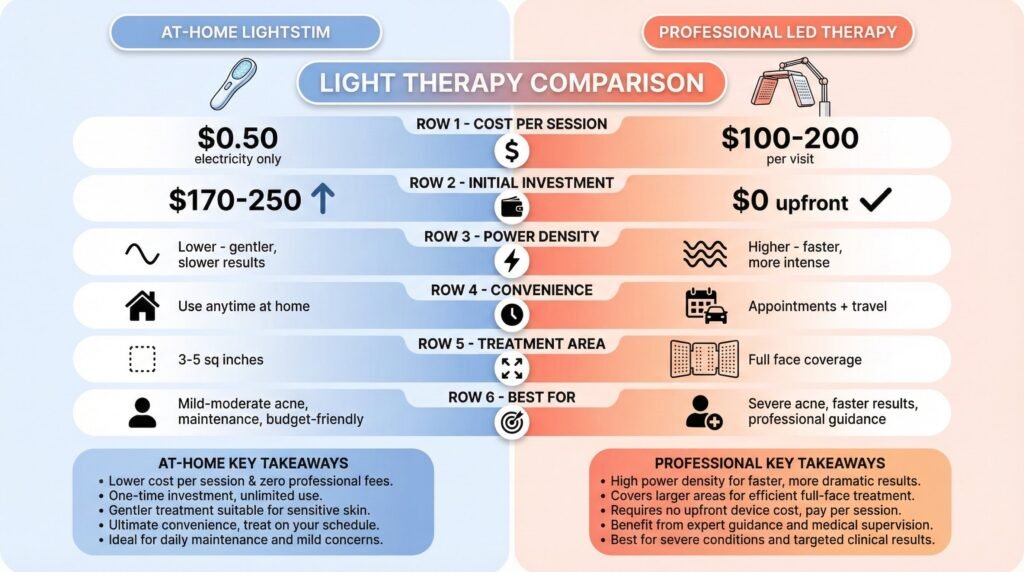
Professional LED treatments use more powerful panels with higher irradiance (power density), so they can deliver more light energy in less time. A typical professional session might give you 30-60 joules per square centimeter in 15-20 minutes.
The LightStim handheld device delivers lower power density, which means you’re getting gentler treatment over time. That’s not necessarily bad; it just means you need to be more patient and consistent.
Here’s the math that made me consider the at-home option: let’s say professional treatments cost $150 per session, and you do it twice a week for 8 weeks. That’s $2,400.
The LightStim costs around $170-250 (depending on promotions), and you can use it indefinitely.
Even if it only lasts you a year before you need to replace it (which is unlikely), you’re still coming out way ahead financially.
The tradeoff is convenience vs. power. Professional treatments are stronger, and you have someone making sure you’re getting the right exposure.
At-home devices put the responsibility on you to use them correctly and consistently.
Timeline for Seeing Actual Results
This is where expectations need to be realistic. Most people report seeing some improvement around week 3-4, with more significant results by week 8-12.
The first thing you’ll probably notice is that new breakouts heal faster and are less inflamed. Existing acne might take longer to clear up completely.
Some users report that their skin looks calmer and less red within the first couple of weeks, even before the acne itself clears up. That’s the red light doing its anti-inflammatory thing.
If you’re not seeing any improvement after 8 weeks of consistent daily use, then this might not be the right solution for your particular skin situation. At that point, it’s worth talking to a dermatologist about what’s actually causing your breakouts.
Who This Device Works Best For
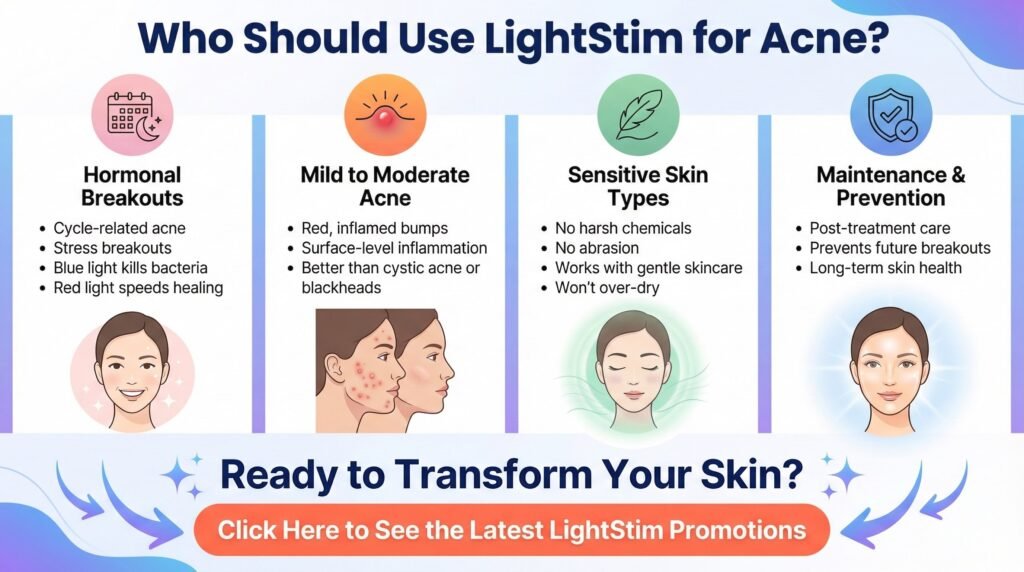
The LightStim for acne review data suggests it works best for specific situations:
Hormonal breakouts: If you get regular breakouts around your cycle or from stress, this can be really helpful for managing those recurring spots. The blue light kills bacteria before they get out of control, and the red light helps existing bumps heal faster.
Mild to moderate inflammatory acne: Those red, inflamed bumps respond better than cystic acne or blackheads. If most of your acne is surface-level inflammation, you’re more likely to see good results.
Sensitive skin types: Because there are no harsh chemicals or abrasion, this works well if your skin freaks out from traditional acne treatments. You can use it alongside gentle skincare without worrying about over-drying or irritation.
Maintenance after clearing acne: Once you’ve gotten your skin under control with prescription treatments or other methods, the LightStim can help keep breakouts from coming back. Think of it as preventative maintenance.
Limitations You Should Know About
It doesn’t replace prescription treatments for severe acne. If you’ve got deep cystic acne or scarring, you probably need something stronger (retinoids, antibiotics, or isotretinoin prescribed by a dermatologist).
The handheld size means treating larger areas takes time. If you’ve got acne on your back or chest, you’re looking at a pretty long treatment session.
They make other LightStim devices for body use, but those cost more.
You can’t share the device easily because the treatment head touches your skin. Some people buy protective sheets to put over it, but that might reduce the light penetration.
The LEDs will eventually lose intensity over time (probably after thousands of hours of use), but there’s no way to replace just the bulbs. When it dies, you’re buying a whole new device.
That said, most people report their devices lasting years without issues.
Does It Actually Work Better Than Other Options?
Compared to benzoyl peroxide, BP kills bacteria faster but can be really harsh and drying. LightStim is gentler but takes longer to work.
Some people use both together (LED therapy in the morning, BP at night).
Compared to salicylic acid: Salicylic acid is better for blackheads and whiteheads because it exfoliates inside pores. LightStim is better for inflammatory acne.
Again, you can use both.
Compared to other LED devices, LightStim is one of the more expensive handheld options, but it’s FDA-cleared and has a solid warranty. Cheaper devices might not have the right wavelengths or enough power to actually work.
More expensive devices exist (like professional-grade panels), but they’re overkill for most people’s needs.
The Real Cost Breakdown
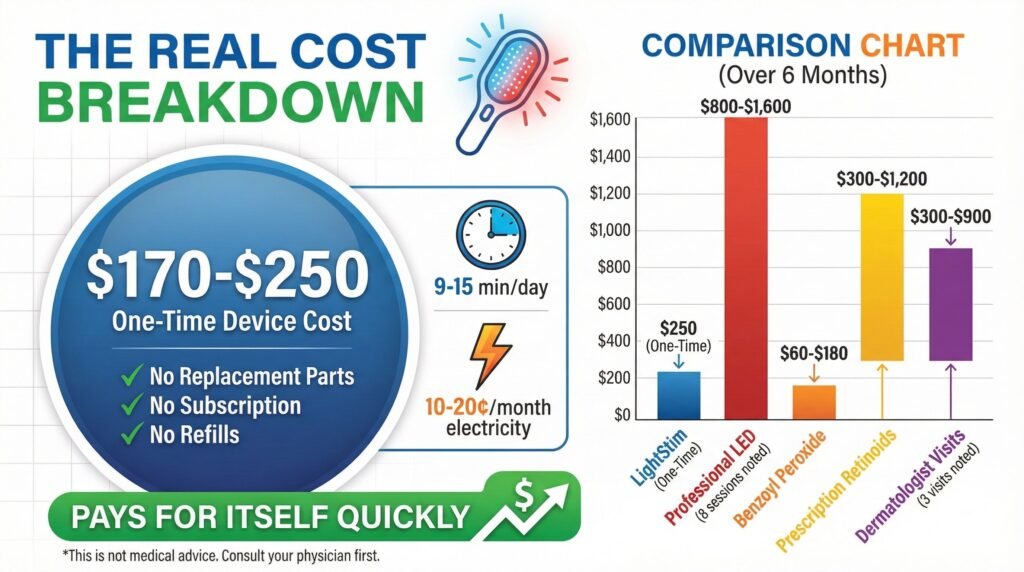
Let’s talk actual numbers. The device itself runs about $170-250, depending on where you buy it and if there’s a sale running.
You’ll use it for 9-15 minutes per day. At average electricity rates, that’s maybe 10-20 cents per month in power costs (basically nothing).
No replacement parts needed. No subscription. No refills.
Just the upfront cost and you’re done.
Compare that to:
- Professional LED sessions: $100-200 each, typically need 8-16 sessions
- Benzoyl peroxide products: $10-30 per month, ongoing
- Prescription retinoids: $50-200 per month, depending on insurance
- Dermatologist visits: $100-300 per visit
The LightStim pays for itself pretty quickly if you are already spending money on acne treatments or considering professional light therapy.
This review is not to serve as medical advice; please consult your physician first.
If you’re comparing different acne treatments and want to see where LightStim fits in your routine, this is where I’d start looking..
Safety Details You Should Actually Know
LED light therapy is considered really safe. The lights don’t contain UV rays (so no sun damage risk), and they don’t generate heat that could burn your skin.
There’s no downtime or recovery period. You can use it and immediately put on makeup or go about your day.
Some medications make your skin photosensitive (more reactive to light), which may cause mild and temporary side effects such as hyperpigmentation. If you’re on antibiotics, retinoids, or other prescription meds, just double-check with your doctor that LED therapy is safe to add.
Don’t use it directly over active cold sores or open wounds. Let those heal first.
Pregnant or nursing women should check with their doctor before using it, though LED therapy is generally considered low-risk.
What Other Users Actually Report
The reviews are mixed but lean positive for people with the right expectations.
People who are happy with it usually mention: seeing less inflammation, faster healing of breakouts, gentler than chemical treatments, good for sensitive skin, and worth the investment after a few months of use.
People who are disappointed usually mention: took longer than expected to see results, didn’t work for severe acne, too time-consuming, or expensive for what it does.
The common thread in negative reviews seems to be unrealistic expectations (wanting overnight results or expecting it to cure severe cystic acne without other treatments).
Using It as Part of a Complete Routine
The LightStim works best when it’s part of a broader skincare approach, not a magic bullet on its own.
A typical routine might look like:
- Morning: Gentle cleanser, LightStim treatment, serum moisturizer, sunscreen
- Evening: Cleanser, any prescription treatments, moisturizer
You can add other acne treatments, but give your skin some time between different treatments. For example, use the LightStim in the morning and apply benzoyl peroxide or retinoids at night.
Don’t skip the sunscreen. Even though LED light doesn’t cause sun damage, treating your acne means your skin needs protection while it heals.
Keep your skin barrier healthy with a good moisturizer. The whole point of LED therapy is that it’s gentle, so don’t undermine that by drying out your skin with harsh products.
Final Thoughts on Whether It’s Worth It
The LightStim for acne device works well for what it’s designed to do: treat mild to moderate inflammatory acne with a gentle, non-invasive method that you can use at home. It won’t replace dermatologist care for severe acne, and it needs consistent use for several weeks before you see results.
The cost makes sense if you were already considering professional light therapy sessions or spending a lot on acne products that aren’t working. It’s less appealing if you’re looking for a quick fix or if your acne is really severe.
The fact that it’s FDA-cleared gives it more credibility than random LED devices on Amazon. The 3-year warranty is solid.
And the gentle nature of the treatment makes it a good option for people with sensitive skin who can’t tolerate harsh chemicals.
My honest take is this: if you’ve got recurring breakouts that aren’t severe but are annoying to deal with, and you’re willing to commit to daily use for at least two months, then this is worth trying. The upfront cost feels steep, but it pays off over time compared to ongoing professional treatments.
You can check the current price and read more user reviews right here – I’d recommend looking at verified purchase reviews to get a realistic sense of what to expect.
Just go in with realistic expectations. This won’t magically clear severe acne overnight, but it can genuinely help manage mild to moderate breakouts over time without the harsh side effects of chemical treatments.
That’s a pretty solid value if it fits your specific situation.
Click the button below to see the product’s current prices on Amazon.
FAQ’s
What does the LightStim for Acne device do? It uses blue light to target and kill Cutibacterium acnes bacteria and red light to calm inflammation and support skin healing. It is a non-invasive, chemical-free approach for acne.
Is LightStim FDA-cleared? Yes, it’s FDA-cleared specifically for treating mild to moderate acne.
How long do treatments take? Hold the device against each area for 3 minutes (auto-timer shuts off). A full face usually takes 9–15 minutes.
How often should I use it? Every day or at least 5–6 times per week on clean skin for best results. Consistency is key. Skipping a week can stall progress.
When will I see results? Most people need a minimum of 4–6 weeks of consistent use; some improvement in inflammation and faster healing may appear sooner, but full benefits take patience.
Is it painful or uncomfortable? No, the treatment feels like nothing is happening (no heat, tingling, or drying sensation like benzoyl peroxide).
Is it better than professional LED treatments? Professional treatments are stronger/faster (higher power, full-face coverage) but expensive ($100–200/session). LightStim is gentler, more convenient, and far cheaper long-term for mild cases.
Will it last forever? LEDs gradually lose intensity after thousands of hours (several years of use), but the device has a solid build and a 3-year warranty.
This article includes affiliate links. If you click through and make a purchase, I may receive a small commission. This helps support the site and allows me to keep creating helpful content at no extra cost to you.