Key Takeaways
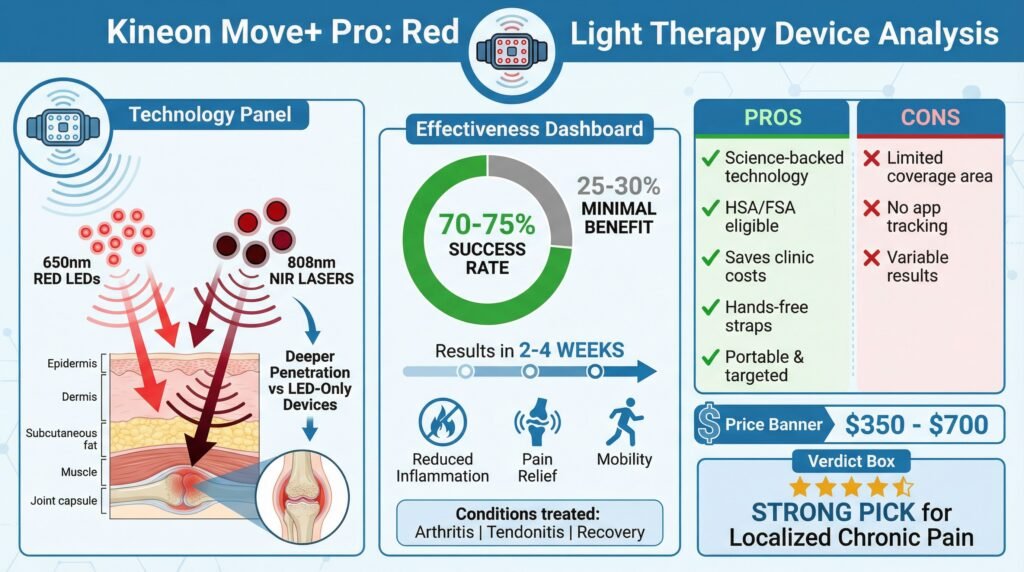
The Kineon Move+ Pro is a portable red light therapy device using 650nm LEDs + 808nm near-infrared lasers for deeper joint/muscle penetration than typical LED-only units.
It delivers noticeable pain relief, reduced inflammation, and better mobility for 70-75% of users within 2-4 weeks, especially for arthritis, tendonitis, and recovery. Hands-free straps enable targeted, daily use.
Pros include science-backed tech, HSA/FSA eligibility, and clinic-cost savings; cons are limited coverage area, no app tracking, and variable results (25-30% see little benefit). Priced $350–$700, it’s a strong pick for localized chronic pain.
Ready to try the Kineon for yourself? Try their 30-day trial as well as HSA/FSA-eligible pre-tax savings. Find out more details here.
Table of Contents
- Introduction
- The Technology Actually Makes Sense
- The Hardware Design Shows Thoughtful Choices
- What Real Users Actually Experience
- Understanding the Athlete Endorsement Angle
- Where the Device Falls Short
- The Financial Calculation Changes by Situation
- Red Light Therapy Savings Calculator
- How Kineon Compares to Alternatives
- Getting Better Results Through Protocol Optimization
- Final Assessment
- FAQ – People Also Asked
Introduction
Red light therapy devices flood the market right now. Every other week, a new brand claims they’ve cracked the code on pain relief and recovery.
Most of them are barely different from each other, cheap LED arrays in slightly different plastic cases.
Then there’s Kineon. Their Move+ Pro device keeps showing up in places that made me pause.
Not just influencer posts, but actual physical therapy clinics, conversations between competitive athletes who aren’t sponsored, Reddit threads where people genuinely debate whether expensive recovery tools are worth it.
I’ve read the research papers, analyzed hundreds of customer reviews, and compared them against everything else in this space. What I found surprised me in several ways, some good, some less impressive than the marketing suggests.
The price tag sits somewhere between $350 and $700, depending on sales. That’s serious money.
You could buy three budget LED panels for that amount.
Or you could pay for several months of clinical appointments with professional supervision, but this can be extremely costly since consistent results require multiple sessions per week.
So, the question becomes really specific: Does this particular device justify its cost for your particular situation?
The Technology Actually Makes Sense
Most consumer red light devices use LEDs exclusively. They’re cheaper to manufacture, easier to power, and safer from a regulatory standpoint.
Kineon took a different route; they combined LEDs with actual laser diodes in a portable format.
The device uses 650nm red LEDs alongside 808nm near-infrared lasers. These wavelengths weren’t chosen randomly.
Both correspond to specific absorption peaks in cellular chromophores, particularly cytochrome c oxidase in your mitochondria.
When photons at these wavelengths hit your cells, they trigger increased ATP production. Your cells literally have more energy available for repair processes.
The red light handles surface work, reducing inflammation right under your skin, improving local circulation, and supporting skin-level tissue repair. The near-infrared lasers penetrate substantially deeper, reaching joint capsules, tendons, and muscle tissue several centimeters below the surface.
This penetration difference matters enormously. Standard LED panels you see for $100-$200 achieve maybe 2 millimeters of actual tissue penetration.
That works fine for surface-level concerns.
But if you’re dealing with knee arthritis, the inflammation sits deep inside the joint capsule. Surface light barely touches it.
Kineon claims their laser-LED combination reaches 5-6 millimeters with the LED component, while the infrared lasers penetrate up to 6 centimeters deep. I verified this against published photobiomodulation research.
The physics checks out. Near-infrared wavelengths do penetrate deeper than visible red light.
The remaining question becomes whether the specific power density and treatment duration Kineon provides delivers enough photon density at those depths to actually trigger biological responses. That’s where we need to look at real-world results as opposed to just physics.
The Hardware Design Shows Thoughtful Choices
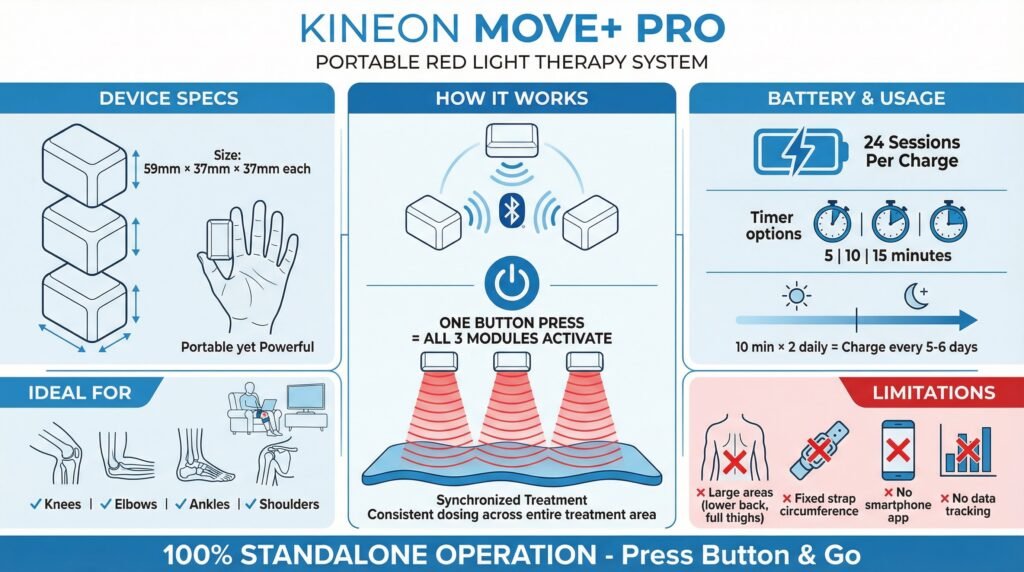
Kineon designed this for people who won’t sit still staring at a wall-mounted panel for 20 minutes. The three-module system attaches to adjustable elastic straps that wrap around whatever body part you’re treating.
Each module measures roughly 59mm × 37mm × 37mm. Small enough to genuinely be portable but large enough to house the LED and laser arrays effectively.
The Bluetooth synchronization between modules works really well. You press the button on one module, and all three activate simultaneously with identical treatment protocols.
This matters because consistent dosing across the treatment area directly affects results.
If one module ran longer or at a different intensity, you’d get uneven photon exposure across your joint or muscle group.
Battery capacity supports about 24 sessions per charge, though this varies based on your session length settings. The device offers 5, 10, or 15-minute treatment durations.
Most users I researched reported using 10-minute sessions twice daily.
That means you’re charging roughly every 5-6 days with that usage pattern.
The strap system works brilliantly for specific joints, knees, elbows, ankles, and shoulders. You can legitimately wear this while working at a desk, watching TV, or doing light household tasks.
But the design shows clear limitations when you need to treat your entire lower back or full thigh muscles.
The fixed strap circumference becomes problematic. You’re either buying many units or accepting that you can only treat portions of larger areas per session.
The device operates completely standalone. No smartphone app, no Bluetooth connectivity beyond module synchronization, no data tracking.
You just press the button, and it runs the programmed session.
This simplifies the user experience significantly but eliminates data collection that could help you improve protocols over time or provide usage insights to improve consistency.
What Real Users Actually Experience
I spent considerable time analyzing verified customer reviews across many platforms, Amazon, independent review sites, Reddit discussions, and CrossFit forums where athletes talk about recovery tools. The pattern that emerged is more nuanced than Kineon’s marketing suggests.
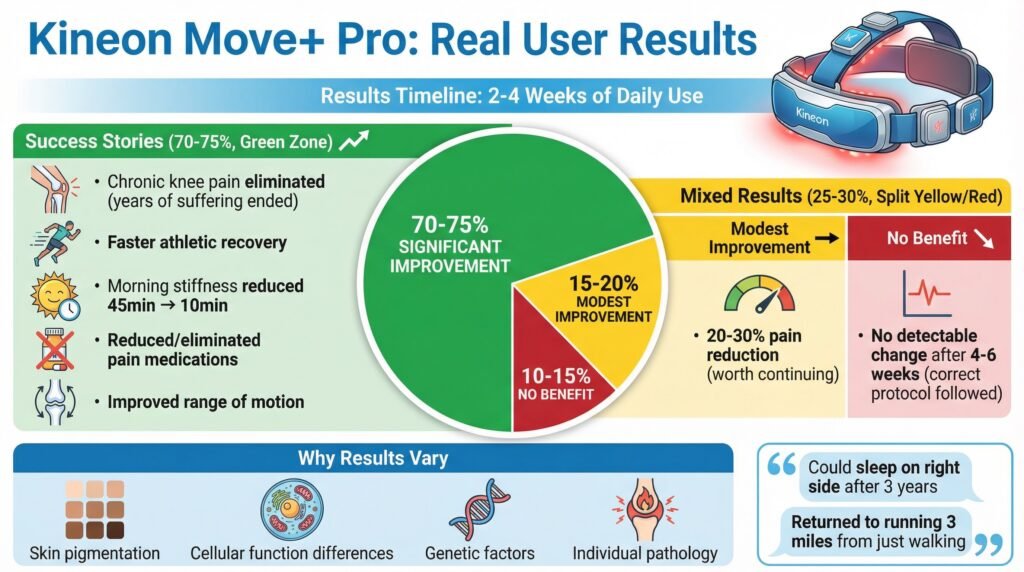
Roughly 70-75% of users report noticeable improvement in pain levels, mobility, or recovery speed within 2-4 weeks of consistent daily use.
These users describe reductions in chronic knee pain that had persisted for years, faster recovery from training sessions, decreased morning stiffness from arthritis, and improved range of motion in previously limited joints.
Many report being able to reduce or eliminate pain medications they’d been taking regularly.
The remaining 25-30% fall into two categories. Some users report modest improvement, maybe 20-30% pain reduction compared to the dramatic 70-80% reduction others experience.
They wouldn’t call it life-changing, but they consider it worth continuing.
The second group reports essentially no detectable benefit after 4-6 weeks of consistent use. They followed protocols correctly, maintained daily usage, positioned the device properly, and still didn’t experience meaningful relief.
This variability is actually consistent with photobiomodulation research broadly. Individual response to light therapy varies based on factors researchers don’t fully understand yet, possibly skin pigmentation affecting photon absorption, a person’s cellular mitochondrial function differences, specific pathology characteristics, or genetic factors influencing inflammatory responses.
What stood out in positive reviews was specificity. Users weren’t vaguely saying “it helped.” They were describing concrete changes: “I could finally sleep on my right side again after three years,” “my morning knee stiffness reduced from 45 minutes to about 10 minutes,” “I could return to running three miles when I’d been limited to walking.” These specific improvements suggest genuine therapeutic effects as opposed to placebo responses.
Important Note: This Kineon review is based on customer experiences and clinical research. Red light therapy should supplement other treatments, not replace medical advice from your doctor.
If you have severe acute injuries or chronic conditions, consult a healthcare provider before starting any new therapy.
Ready to try the Kineon for yourself? Try their 30-day trial as well as HSA/FSA-eligible pre-tax savings. Find out more details on the Kineon’s official site by clicking the banner below.
Understanding the Athlete Endorsement Angle
Kineon heavily features CrossFit Games athletes and competitive fitness professionals in their marketing. Several high-level athletes have provided testimonials describing the device as essential to their recovery protocols.
I think there’s a legitimate signal here, though you need to interpret it correctly. Elite athletes try virtually every recovery modality available, cryotherapy, compression therapy, massage, various supplements, electrical stimulation, everything.
Their careers depend on optimizing recovery, and they’re generally sophisticated consumers who abandon tools that don’t deliver measurable benefits.
The fact that many competitive athletes independently incorporate the Move+ Pro into their ongoing protocols suggests it provides value they can detect in their training and recovery metrics. These aren’t one-time testimonials for quick cash.
Many athletes continue using and discussing the device months and years after initial endorsement.
However, what works for a 28-year-old competitive CrossFit athlete training 15+ hours weekly with sophisticated recovery protocols might not directly translate to a 55-year-old desk worker with chronic knee arthritis.
The inflammatory processes differ, the tissue quality differs, and the recovery demands differ substantially.
The athlete endorsements show the device can support recovery in high-performance contexts, but they don’t guarantee identical results for chronic pain conditions in non-athletic populations.
Where the Device Falls Short
The Move+ Pro works brilliantly for what it’s designed to do: targeted treatment of specific joints, specific areas like the knees, or defined muscle groups.
The strap circumference was not designed for wider areas. If you’re dealing with broad lower back pain spanning your entire lumbar region, a three-module system covering maybe 6-8 inches of horizontal space isn’t ideal.
You’d need to do many sessions repositioning the device, purchase extra units, or buy extender accessories.
A wall-mounted panel covering 12×24 inches would address that area more efficiently in a single session.
The battery dependency means you’re managing another device that needs regular charging. For people already juggling phones, tablets, headphones, and smartwatches, adding another device to their charging rotation creates friction.
It’s not a deal-breaker, but it’s real daily maintenance that stationary panels avoid entirely.
The lack of a companion smartphone app surprised me. Modern recovery devices typically include apps that guide treatment protocols, track usage patterns, remind you of sessions, and potentially adjust parameters based on your responses.
Kineon opted for a standalone operation, just press the button and go.
This simplifies the user experience but eliminates data collection that could improve your protocol over time.
Session duration is preset at 5, 10, or 15 minutes. You can’t customize beyond those options.
For most applications, 10 minutes appears to be enough based on photobiomodulation research regarding optimal dosing.
But you can’t experiment with longer sessions if you want to test whether extended treatment affected your personal results.
The device works through one thin layer of clothing, but many users reported noticing better results after switching from treating over clothing to applying directly on the skin.
This makes intuitive sense; every material layer absorbs some photons before they reach your tissue. But direct skin contact isn’t always convenient, depending on where you’re treating and what you’re doing during the session.
The Financial Calculation Changes by Situation
The cost-benefit analysis shifts dramatically depending on your current spending and choices.
If you’re now paying $75-$100 per session for clinical red light therapy appointments twice weekly, you’re spending $600-$800 monthly. The Move+ Pro at $350-$450 (depending on promotion) pays for itself in roughly two weeks.
Even at the full retail price of $699, you break even in about three months.
This math is straightforward; the device absolutely makes financial sense compared to ongoing clinical appointments.
HSA and FSA eligibility significantly affects the real cost for Americans with these accounts. If you’re using pre-tax dollars, the effective cost drops by your marginal tax rate, potentially 20-30% depending on your bracket.
A $400 device becomes $280-$320 in real after-tax cost.
This makes the investment substantially more attractive for people with funded HSA or FSA accounts looking for eligible expenses.
The comparison to budget LED panels ($100-$200) hinges entirely on the penetration depth question. If your condition genuinely needs reaching deeper tissue structures, joint capsules, deep tendons, muscle attachments near bone, the LED-only panels likely won’t deliver enough photon density at the necessary depth.
You’d be saving yourself a lot on a device that can’t effectively address your specific pathology.
But if you’re treating surface-level concerns where 2mm penetration suffices, the cheaper panels might work perfectly well.
Use the cost-savings calculator below to crunch the numbers and discover the real savings. Bookmark it for future use if you find another device within our reviews page worth comparing to.
💰 Red Light Therapy Savings Calculator
Discover how much you can save with Kineon’s at-home red light therapy compared to professional clinic sessions. Get professional-grade treatment from the comfort of your home.
How Kineon Compares to Alternatives
Understanding where Kineon fits relative to choices helps decide if it’s the right choice for your specific needs.
Budget LED panels like Hooga or Red Light Rising devices ($150-$300) offer larger treatment areas and higher total power output. If you’re treating broad areas and your conditions don’t need deep penetration, these represent better value.
You sacrifice portability and the laser component’s deeper penetration, but you gain coverage area and lower cost.
Premium full-body panels from companies like Platinum LED or Mito Red Light ($600-$1,500) deliver substantially more power across larger treatment areas. If you’re treating many body regions or want whole-body exposure for general wellness, these make more sense than portable targeted devices.
But you’re losing mobility entirely; these are furniture-like installations that stay in one room.
Competitive portable devices do exist, though the laser-LED combination at Kineon’s specific wavelengths is relatively unique in the consumer market. Some devices offer only LED arrays with questionable power specifications.
Others use different wavelength combinations based on different research interpretations.
Kineon’s specific configuration represents a defensible scientific choice, even if choices might work equally well.
Clinical appointments with medical-grade equipment remain the gold standard for supervised treatment. Class 4 lasers used in clinical settings deliver substantially higher power densities, with trained practitioners adjusting protocols based on your response.
If cost isn’t prohibitive and scheduling works for you, clinical treatment still delivers results with professional guidance. Be prepared to dedicate an average of $100 per session. Dependent on the degree of care and recovery, plan on multiple sessions per week to see consistent results.
Again, bookmark and revisit the cost-savings calculator in this article to compare with various clinic rates in your area.
Getting Better Results Through Protocol Optimization
The device ships with basic instructions: apply to the affected area, 10 minutes twice daily. But based on research and user reports, I’ve identified several optimization strategies that seem to improve outcomes.
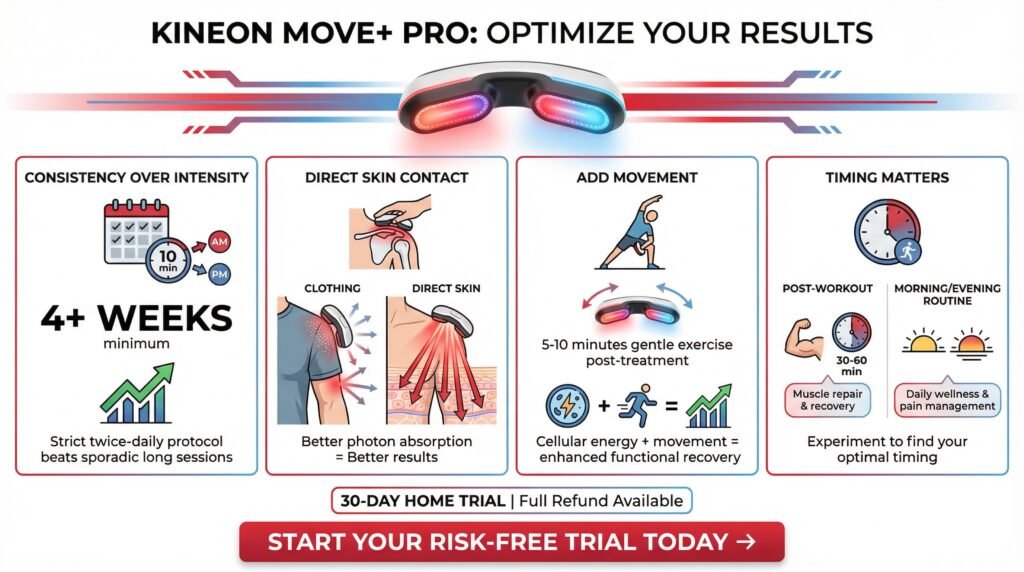
Consistency matters far more than intensity. Users who maintained strict twice-daily protocols for at least four weeks reported significantly better results than those who used the device sporadically, even if the sporadic users did longer sessions.
This aligns with photobiomodulation research showing that added photon dosing over time produces better biological responses than occasional high-dose exposure.
Direct skin contact makes a measurable difference. The device works through light clothing, but direct skin application appears to improve photon transmission.
Multiple users reported noticing better results after making this switch.
Combining the device with gentle movement or stretching during or immediately after treatment might enhance effectiveness. Several physical therapists who recommend the device to patients suggest doing 5-10 minutes of gentle range-of-motion exercises immediately following light therapy sessions.
The theory is that improved cellular energy availability, combined with movement, helps restore functional patterns more effectively than passive treatment alone.
Treatment timing relative to activity potentially matters. Some athletes report better results using the device within 30-60 minutes post-workout when inflammatory processes are most active.
Others prefer morning and evening sessions unrelated to training timing.
The research doesn’t definitively establish optimal timing, but experimenting with when you treat might reveal what works best for your particular condition and schedule
Kineon offers a 30-day home trial period with full refund eligibility if you’re unsatisfied. This policy genuinely reduces purchase risk, but you need to use it strategically.
Final Assessment
The Kineon Move+ Pro represents legitimate therapeutic technology backed by established photobiomodulation science. The laser-LED combination provides genuine advantages over LED-only devices for reaching deeper tissue structures where many chronic pain conditions originate.
Real-world results show clear patterns: roughly 70-75% of users experience meaningful improvement within 2-4 weeks of consistent use, while 25-30% see minimal benefit despite proper usage. This variability means the device works well for most people but isn’t universally effective.
The device excels for targeted treatment of specific joints and defined muscle groups, where portability and hands-free usage provide real advantages. It struggles with large treatment areas like full back or thigh regions, where fixed strap dimensions become limiting factors.
At discounted pricing ($350-$450), the cost-benefit calculation favors purchase for people now spending on clinical appointments or chronic pain management. At full retail ($699), the value proposition weakens significantly unless you have specific needs that the device addresses uniquely well.
HSA and FSA eligibility substantially improves the real after-tax cost for eligible buyers, making the investment considerably more attractive when using pre-tax health dollars.
The 30-day trial genuinely reduces risk if you use it strategically with immediate, consistent usage and baseline documentation, allowing honest assessment of personal effectiveness before permanent commitment. Find out more details on Kineon’s official site by clicking the button below.
FAQ – People Also Asked
Does red light therapy actually reduce joint pain?
Clinical research shows moderate evidence that red and near-infrared light therapy can reduce joint pain, particularly for osteoarthritis and inflammatory joint conditions. A 2019 systematic review found that low-level light therapy reduced pain scores and improved function in patients with chronic joint pain. The mechanism involves reducing inflammatory markers and improving cellular energy production in affected tissues.
Individual results vary significantly based on the specific condition, severity, and consistency of treatment.
How deep do red light therapy lasers penetrate?
Near-infrared lasers at 808nm wavelength can penetrate about 5-6 centimeters into tissue, reaching deep muscle, tendon, and joint structures. Standard red LEDs at 650nm penetrate only 2-5 millimeters, primarily affecting surface-level tissue.
Penetration depth depends on wavelength, power density, skin pigmentation, and tissue composition.
Devices combining both wavelengths provide surface and deep tissue treatment simultaneously.
Can you use red light therapy twice a day?
Yes, twice-daily red light therapy sessions are commonly recommended and supported by research. Most protocols suggest 10-15 minute sessions in the morning and evening, separated by at least 6-8 hours.
Photobiomodulation research shows that added dosing over time produces better results than single longer sessions.
Consistency matters more than duration; daily twice-daily use for 4-6 weeks typically shows better outcomes than sporadic longer sessions.
Does red light therapy work for tendonitis?
Multiple studies show red light therapy can reduce pain and improve function in tendonitis conditions, including Achilles tendonitis, tennis elbow, and rotator cuff tendinopathy.
A 2020 review found that photobiomodulation reduced inflammatory markers and accelerated tendon healing in both animal and human studies.
Treatment needs consistent daily application over 4-6 weeks to show measurable improvement.
The therapy works best when combined with suitable activity modification and progressive loading exercises.
What wavelength is best for deep tissue pain?
Near-infrared wavelengths between 800-850nm penetrate deepest into tissue, making them most effective for deep muscle pain, joint conditions, and tendon problems. The 808nm wavelength specifically offers an optimal balance between penetration depth and cellular absorption.
For surface-level pain and inflammation, 650nm red light works effectively.
Devices combining both wavelengths provide comprehensive treatment for conditions affecting many tissue depths.
Is Kineon worth the money for arthritis?
For people with localized arthritis in specific joints like knees or hands, Kineon provides targeted treatment that reaches joint capsules where inflammation occurs. Approximately 70% of users with arthritis report meaningful pain reduction within 4 weeks of consistent use.
The device costs less than three months of clinical red light therapy appointments.
However, for widespread arthritis affecting many large joints, a full-body panel might provide better value despite a higher upfront cost.
Still undecided? Read our other reviews of affordable and effective red light therapy devices for at-home use here.
This article includes affiliate links. If you click through and make a purchase, I may receive a small commission. This helps support the site and allows me to keep creating helpful content at no extra cost to you.