Quick Summary
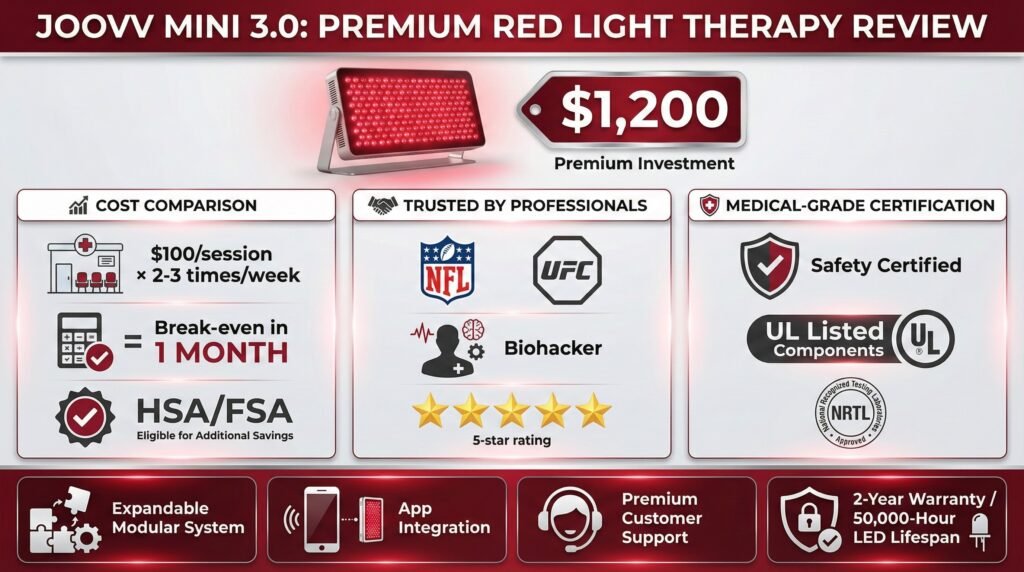
The Joovv Mini 3.0 is a premium, medical-grade targeted red light therapy panel (660 nm red + 850 nm near-infrared, 53 mW/cm² irradiance) priced at $1,200. It excels in safety certifications (third-party tested by Intertek), modular expandability, a useful Bluetooth app with modes/timers/pulsing, and solid build quality for targeted use (e.g., face, joints).
The quality speaks for itself, and it pays for itself quickly compared to professional sessions ($75–125 each), multiple times a week.
Table of Contents
- Introduction
- Key Specifications and Features
- Performance and Effectiveness
- Pros
- Cons
- Pricing and Value Comparison
- Comparisons to Alternatives
- User Experience and Additional Notes
- Final Thoughts
Introduction
The Joovv Mini 3.0 sits at the more expensive, premium end of the red light therapy market. But here’s the thing about red light therapy devices… the market is absolutely flooded with cheap panels that claim amazing results.
Even though Joovv’s Mini 3.0 sits at $1,200 (depending on promotions). Joovv enjoys high praise from many biohackers and athletes, ranging from the NFL to the UFC.
Also, when you compare the cost of Joovv’s at-home red light devices to professional clinical sessions 2 to 3 times per week at an average of $100 per session, you hit breakeven within a month of consistent use.
Also, Joovv’s products are HSAS/FSA eligible, which provides additional savings.
What You’re Actually Getting – Joovv Mini 3.0 Device Specs
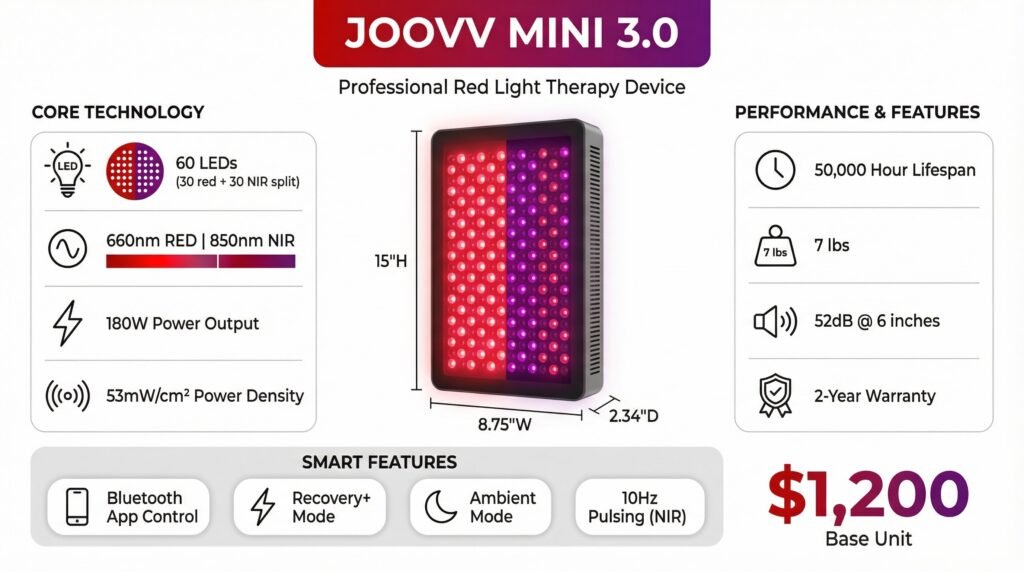
The Mini 3.0 is a compact tabletop panel. It measures 15 inches tall, 8.75 inches wide, and about 2.34 inches deep.
It weighs 7 pounds, so it’s not exactly lightweight, but you can move it around without much trouble.
Inside the panel, you’ve got 60 LEDs total. Half of those (30 LEDs) produce red light, and the other half produce near-infrared light.
The wavelengths are 660 nanometers for the red and 850 nanometers for the near-infrared.
Total power output is 180 watts. The LEDs are rated for 50,000 hours of use, which translates to years of daily sessions. You get a 2-year warranty with it.
The device connects to your phone via Bluetooth, and there’s an app for iOS and Android that lets you control everything. You can pick which wavelengths to use (just red, just near-infrared, or both together), set timers, and switch between different modes.
Medical-Grade Certification
One of the main selling points for Joovv is their focus on safety certification. Every component inside the Mini 3.0 has either UL listings or safety markings from National Recognized Testing Laboratories.
The whole device went through third-party testing by Intertek.
This matters more than you might think. A lot of budget red light panels skip this step entirely.
They might work fine, but nobody’s verified that they meet specific safety standards.
Joovv is basically betting that people care about certified safety. That’s part of what you’re paying for with the higher price.
Coverage Area and Treatment Zones
The Mini 3.0 is designed for targeted treatment, not full-body sessions. The coverage area is about 9 inches by 15 inches.
That works well for your face, a knee, your lower back, or other specific spots.
But if you want to treat your entire body, you’ll need to move it around or buy many units.
The 660nm red light penetrates about 1-2 millimeters into your skin. That’s useful for collagen production, wound healing, and surface-level skin stuff like wrinkles or acne.
The 850nm near-infrared goes deeper, around 5-10 millimeters. That’s where you get benefits for muscle recovery, joint pain, and deeper tissue work.
So basically, you’ve got one wavelength for skin health and another for musculoskeletal stuff. That covers most of what people want from red light therapy.
The Modular System (and Why It Matters)
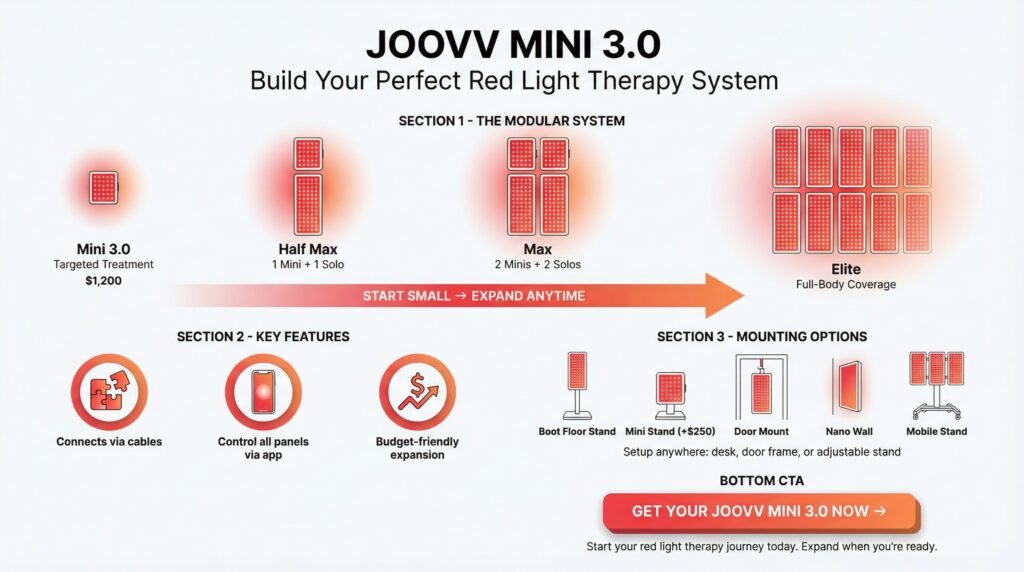
Here’s where the Joovv Mini 3.0 review gets interesting. The device is part of a modular system.
You can start with just one Mini 3.0 and expand later if you want.
They offer different configurations:
- Mini 3.0: Single unit for targeted treatment
- Half Max: 1 Mini + 1 Solo (the Solo is taller)
- Max: 2 Minis + 2 Solos
- Elite: 6 Solo panels (full-body coverage)
The panels connect via physical cables on the back, and you can control all of them through the app. So, if you’re not sure whether you want to commit to a huge system right away, you can start small and build up.
That’s actually pretty smart, because dropping $1,200 is a lot easier to justify than spending several thousand on a full setup when you’re not even sure if you’ll stick with it.
Mounting Options
Joovv offers five different mounting setups: Boot Floor Stand, Mini Stand, Door Mount System, Nano Wall System, and Mobile Stand. The Mini Stand adds another $250 to your total cost, btw.
The variety here is nice because you can set it up however it works for your space. Maybe you want it on your desk for face treatments, or mounted on a door frame, or on an adjustable stand.
They’ve got you covered.
App Control and Smart Features
The Bluetooth connectivity and app control are where modern red light panels separate themselves from older models. Through the app, you can:
- Choose wavelength settings (red only, NIR only, or both)
- Set session timers
- Track your treatment history
- Set reminders so you don’t skip sessions
- Toggle between Recovery+ and Ambient modes
Recovery+ mode is your standard high-intensity treatment. This is what you use when you want the full therapeutic effect.
Ambient mode is dimmed down to provide soft red light that won’t mess with your circadian rhythm. Some people use this in the morning or evening as a gentle wake-up or wind-down light.
The app also lets you enable a 10Hz pulsing function, but only for the near-infrared wavelength. Some research suggests pulsed light might have different effects than continuous light, but the jury’s still out on whether that makes a meaningful difference for most people.
The app needs you to create an account, which some people find annoying. But once you’re set up, it works smoothly from what I’ve seen in user feedback.
Performance vs. Competitors
When you compare the Joovv Mini 3.0 review specs to other brands, some interesting patterns emerge.
Power density sits at 53mW/cm², which is pretty good. That’s enough to deliver therapeutic doses without needing extremely long session times.
Wavelength options are limited to just 660nm and 850nm. Some newer competitors offer 5+ wavelengths, including 810nm, 830nm, and 630nm.
Those extra wavelengths target specific benefits, but whether you actually need them is debatable.
The two wavelengths Joovv uses are the most researched and proven.
EMF levels are higher on the Joovv compared to some competitors. The electric field reading in particular is elevated. If you’re concerned about electromagnetic exposure, this is something to know about.
Magnetic fields are fine, but the electric field may be an issue for those sensitive types
Noise level measures 52 decibels at six inches away. For comparison, the BioMAX hits 48dB, and the Mito Red comes in at 49dB.
Under 50dB is generally considered quiet for these devices. So, 2 decibels above this is not extreme.
There’s also a weird quirk where the device makes a faint digital static noise even when it’s plugged in but turned off. It doesn’t affect functionality.
If you’re leaning toward the certified safety and modular expandability, you can check out the Joovv Mini 3.0 directly on their site to see current pricing and bundle options.
Real Talk About the Price
$1,200 may seem steep. You need to be clear about what you’re actually paying for:
- Medical-grade component certification
- Third-party safety testing by Intertek
- The expandable modular system
- Bluetooth and app integration
- Brand reputation and customer support
- 2-year warranty and 50,000-hour LED lifespan
Budget competitors at $400-600 deliver red and near-infrared light at the right wavelengths. They work.
But they typically skip the safety certifications, have cheaper components, and don’t offer modular expansion.
The real question becomes whether those extras matter enough to you to justify the extra $600-800.
If you’re buying once and never plan to expand, a budget panel makes more sense financially. If you value certified safety standards and might want to scale up later, the Joovv Premium starts to make sense.
Just be honest with yourself about whether you’ll actually use it consistently. An expensive panel that sits in your closet is worse than a cheaper panel you actually use.
As many red light therapy practitioners will attest, consistent use equals consistent results. Hence, this higher-quality, premium red light product makes up for the cost within a month when compared to expensive professional settings at $75 – 125 per session, multiple times per week.
Use the cost-savings calculator below to crunch the real numbers and see how Joovv stands up.
Red Light Therapy Savings Calculator
Discover how much you’ll save with the Joovv Mini 3.0 compared to expensive professional sessions. Most users break even within the first month!
Who This Device Makes Sense For
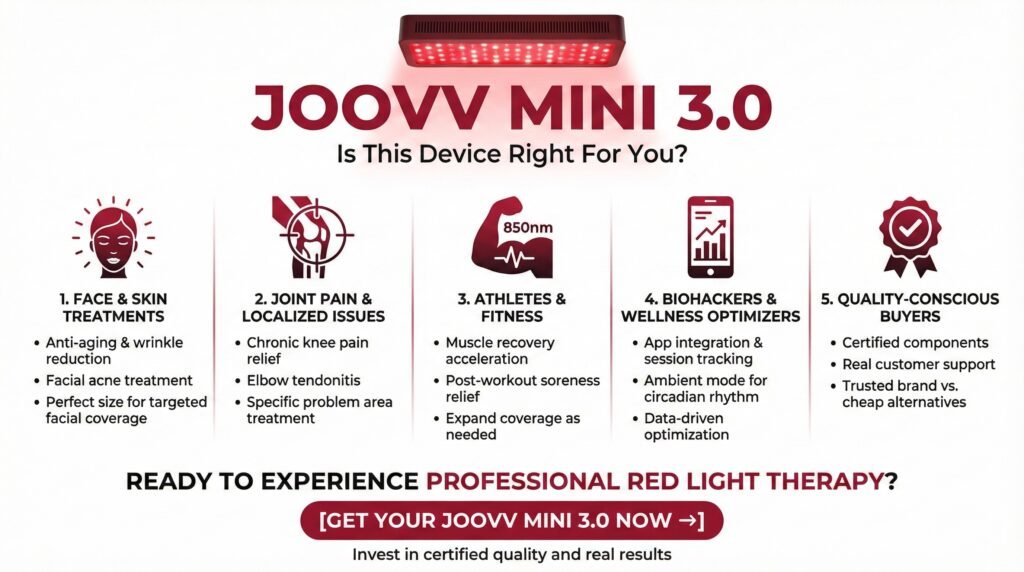
Face and skin treatments: If your main goal is anti-aging, wrinkle reduction, or treating facial acne, the Mini 3.0 size works perfectly. You don’t need a full-body panel to treat your face, so the smaller coverage area isn’t a limitation here.
Joint pain and localized issues: People dealing with chronic knee pain, elbow tendonitis, or other specific problem areas can target those spots without paying for a massive panel.
Athletes and fitness people: The 850nm near-infrared helps with muscle recovery and soreness. Start with the Mini for targeted post-workout treatment, then expand if you want.
Biohackers and wellness optimizers: If you’re into tracking data and optimizing everything, the app integration and session tracking will appeal to you. Plus, the Ambient mode for circadian rhythm support fits into the whole optimization mindset.
People skeptical of cheap devices: If you’ve had bad experiences with poorly made electronics or just don’t trust random Amazon brands, paying more for certified components and real customer support might be worth it for peace of mind.
Who Should Skip This
Full-body treatment seekers: The Mini 3.0 coverage area is too small for effective whole-body sessions. You’d spend forever moving it around.
If that’s your goal, look at the Solo 3.0 or a multi-panel kit instead.
Budget-focused buyers: If $1,200 feels like way too much (which is totally reasonable), there are functional red light panels at $400-600 that deliver therapeutic wavelengths. You give up some features and certifications, but they work.
EMF-sensitive individuals: The higher electric field readings on the Joovv compared to competitors mean this isn’t the best choice if you’re trying to minimize electromagnetic exposure.
Practical Usage Considerations
Session times typically run 10-20 minutes, depending on what you’re treating and how close you position the panel. The device has a 10-second gradual power-up to avoid sudden bright light shocking your eyes.
You can use it while you’re doing other stuff… watching TV, reading, scrolling your phone, whatever. That’s actually one of the nice things about having an at-home device.
You don’t need to block out time to drive to a clinic and pay $50-100 per session.
Treatment distance matters. The closer you are, the higher the power density you receive.
Most people position it 6-12 inches away.
The app helps you track optimal distances and times.
Consistency is what decides whether you see results. Using it 3-5 times per week will get you way further than using it once in a while when you remember.
That’s where the app reminders actually become useful.
The Competition
Just so you have context, here are some choices in different price ranges:
Budget option: Hooga – Lower price and EMF.
Mid-range: Mito Red Light and Red Light Rising in the $600-900 range. Better than budget, not as premium as Joovv.
Premium competitors: PlatinumLED BioMax series with more wavelengths but no modular system. Similar price point to Joovv.
DIY route: Some people build their own panels. Cheaper, but you’re responsible for safety and getting the specs right.
Joovv positions itself as the premium medical-grade option. Whether that positioning is worth it depends entirely on how much you value certifications and brand reputation.
You can compare the full Joovv lineup if you’re considering different sizes or configurations before deciding.
Long-Term Durability
The 50,000-hour LED lifespan means you can use this thing for about 13 years if you do daily 10-minute sessions. That’s solid.
The 2-year warranty covers defects and malfunctions. After that, you’re on your own.
Some competitors offer 3-year warranties, so Joovv isn’t leading the pack there.
Build quality seems good based on user reports. The device feels solid, not cheap or flimsy.
No widespread reports of units failing after a year or having issues with the LEDs dying early.
The app needs occasional updates, which could potentially become an issue years down the line if Joovv stops supporting older models. That’s a concern with any smart device, tbh.
Final Thoughts on This Joovv Mini 3.0 Review
The device does what it’s supposed to do. It delivers red and near-infrared light at therapeutic wavelengths with decent power density.
The medical-grade certifications and third-party safety testing are legitimate differentiators from budget brands.
The modular expansion system is genuinely useful if you think you might scale up later. That flexibility has real value.
For someone starting with red light therapy who values certified safety and might expand their setup over time, the Mini 3.0 makes sense. The price hurts upfront, but the quality and expandability justify it if those priorities align with your needs.
For someone who just wants to try red light therapy without dropping over a thousand dollars, or someone specifically looking for low EMF or multi-wavelength options, you’ll find better matches elsewhere.
You’re not buying just a light panel with Joovv. You’re buying certifications, customer support, a modular system, and brand reputation.
Whether those extras are worth $600-800 more than budget options depends entirely on your situation and priorities.
The Mini 3.0 is a solid entry into home red light therapy if the price fits your budget and the targeted treatment size matches your needs. Just make sure you’ll actually use it consistently, because that’s what decides whether any red light device is worth the investment.
Still not sure? Read our full list of reviews of other affordable and effective red light therapy products here.
FAQ’s
Is the Joovv Mini 3.0 worth the $1,200 price? It depends on your priorities. Yes, if you value medical-grade certifications, third-party safety testing, modular expandability (easy upgrades to larger setups), strong app features, and brand reputation/support. No, if you’re budget-conscious, want lower EMF, quieter operation, more wavelengths, or full-body coverage from a single unit. Cheaper functional alternatives ($400–600) exist.
What are the main benefits of the Joovv Mini 3.0? It delivers therapeutic red (660 nm for skin/collagen) and near-infrared (850 nm for deeper muscle/joint recovery) light. Users report improvements in skin health, anti-aging, acne, wound healing, muscle recovery, and joint pain with consistent use (10–20 min sessions, 3–5×/week at 6–12 inches).
What is the coverage area and best use case? Small targeted area (about 9 × 15 inches), making it ideal for face, specific joints, lower back, or localized issues, not full-body (requires repositioning or buying multiple panels for larger coverage).
How does the app work? Bluetooth-connected (iOS/Android) with an account required. Features include selecting wavelengths (red only, NIR only, or both), timers, treatment history tracking, reminders, Recovery+ mode (high-intensity), Ambient mode (dim, circadian-friendly), and 10 Hz pulsing for NIR.
What about EMF and noise levels? EMF: Magnetic fields are normal, but electric fields are higher than those of many competitors (may concern sensitive users). Noise: 52 dB (fan is noticeably louder and less pleasant than competitors like BioMAX at 48 dB or Mito Red at 49 dB); faint digital static when plugged in but off.
How long until it pays for itself vs. professional red light therapy? Roughly 30 days/1 month with consistent use. Professional sessions often cost $75–125 each (2–3/week = $600–1,500/month); the device provides unlimited home sessions after the upfront cost.
Is it expandable? Yes, part of Joovv’s modular system. Start with one Mini 3.0 and add panels (e.g., Solos) for configurations like Half Max, Max, or Elite full-body setups, all controlled together via the app.
What wavelengths does it use, and are they effective? Only 660 nm (red, surface-level benefits) and 850 nm (near-infrared, deeper penetration). These are well-researched and proven, but some competitors offer 4–5+ wavelengths (e.g., 810 nm, 830 nm) for potentially broader effects.
Any warranty or safety details? 2-year warranty; LEDs rated for 50,000 hours (~13 years of daily 10-min use). UL-listed components and third-party Intertek testing for medical-grade safety (a key differentiator from many budget brands).
Who is this best for? People new to red light therapy who want a premium, certified, targeted device with future expansion potential; biohackers; athletes; those treating specific areas (face/joints); users who value app features and brand support over cost or lowest EMF. Less ideal for full-body needs, ultra-budget buyers, or those highly sensitive to noise/EMF. Consistency matters most. Any device is “worth it” only if used regularly.
This article includes affiliate links. If you click through and make a purchase, I may receive a small commission. This helps support the site and allows me to keep creating helpful content at no extra cost to you.