📌 Quick Summary
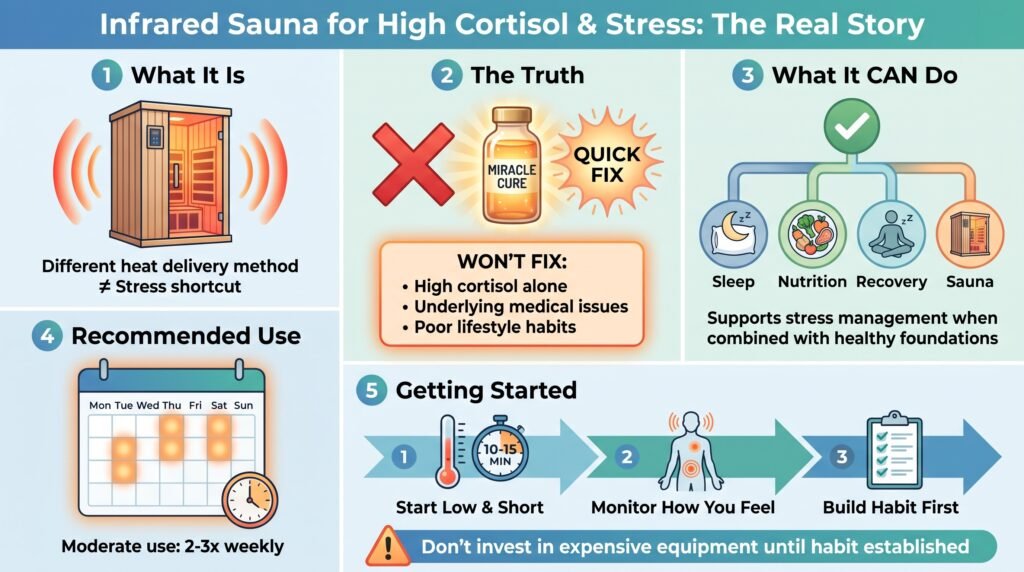
Infrared saunas are a different way to deliver heat, not a shortcut around the body’s stress response. They can support stress management and sleep when used moderately (2-3 times a week) alongside good sleep, nutrition, and recovery, but they won’t fix high cortisol or an underlying medical problem.
Start low and short, pay attention to how you feel, and don’t buy an expensive unit until you’ve built the habit.
🧾 Table of Contents
- Quick Summary
- Infrared Versus Traditional Sauna for Stress
- When Sauna Actually Helps with Stress
- Practical Considerations for Buying or Accessing a Sauna
- What Sauna Can’t Do
- Final Summary
- Frequently Asked Questions
Infrared Versus Traditional Sauna for Stress
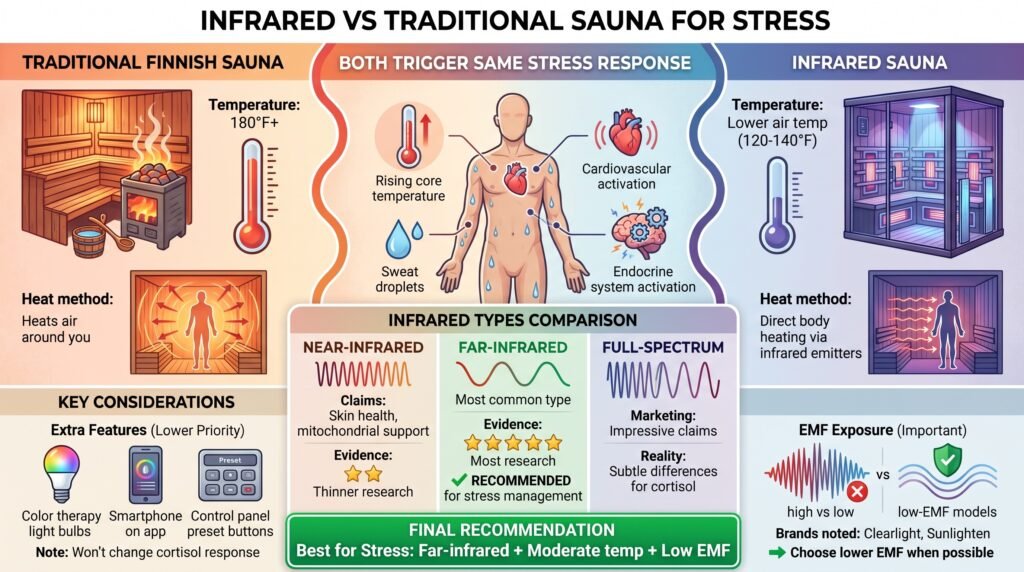
Infrared saunas heat your body more directly using infrared emitters, and they generally operate at lower air temperatures than traditional Finnish saunas. For someone who finds 180-degree Finnish heat intolerable, far-infrared might feel more manageable.
But lower air temperature doesn’t mean zero physiological stress. You’re still raising core temperature, still sweating, still activating your cardiovascular and endocrine systems.
Infrared isn’t a magic bypass around the stress response. It’s just a different delivery method for heat, and your body still has to respond to the temperature challenge.
Far-infrared is the most common type in consumer saunas and has the most research behind it. Near-infrared sits closer to visible light and is often marketed for extra benefits like skin health or mitochondrial support, but the evidence is thinner.
Full-spectrum saunas combine near, mid, and far-infrared wavelengths, which sounds impressive but doesn’t necessarily translate to better cortisol outcomes. The marketing makes it sound impressive, but the physiological differences might be subtle.
If your main goal is relaxation and stress management, a straightforward far-infrared sauna at a moderate temperature is probably the most practical choice. The extra features (chromotherapy, app controls, preset programs) might be nice, but they’re not going to fundamentally change your cortisol response.
One thing to watch for is EMF exposure. Some infrared saunas emit higher electromagnetic fields than others, and while the health significance of low-level EMF is still debated, lower is generally better if you have the option.
Brands like Clearlight and Sunlighten market low-EMF designs, and third-party testing can verify those claims if you want to take a closer look before making a purchase.
When Sauna Actually Helps with Stress
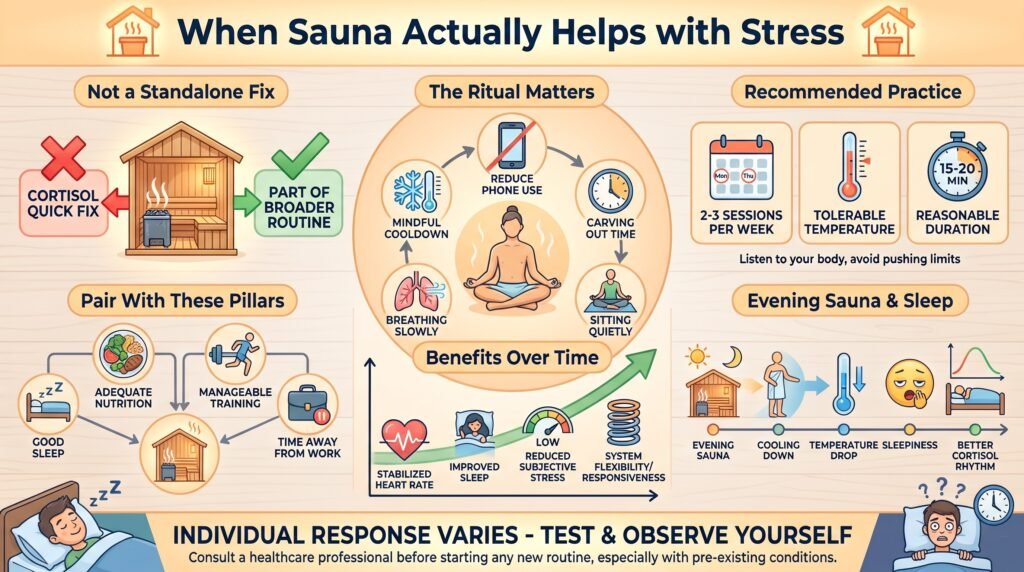
I think sauna is most useful when it becomes part of a broader stress-management routine, not as a standalone cortisol fix. The ritual around the session (carving out time, reducing phone use, sitting quietly, breathing slowly, cooling down mindfully) might contribute as much to the benefit as the infrared wavelength or the wood type.
If you use sauna two or three times a week, at a tolerable temperature, for a reasonable duration, and you pair it with good sleep, adequate nutrition, manageable training volume, and time away from work stress, you might notice that you feel more resilient over time. Your resting heart rate might stabilize, your sleep might improve, and your subjective stress might decrease.
That doesn’t mean your cortisol lab result will suddenly be perfect. It means your stress system might be functioning better: raising cortisol when it needs to, lowering it when it doesn’t, and recovering more efficiently after challenges.
The system develops flexibility and responsiveness as opposed to just blunting all stress responses.
Some people also report that sauna helps them fall asleep more easily, especially if they use it in the evening and finish early enough to cool down before bed. The drop in core temperature after you leave the sauna can promote sleepiness, and better sleep is one of the most reliable ways to support healthy cortisol rhythm.
But again, this isn’t universal. Some people feel too stimulated or too hot after an evening sauna and sleep worse.
You have to test it and pay attention to your own response.
What works for someone else might not work for you.
Practical Considerations for Buying or Accessing a Sauna
If you’re thinking about buying a home sauna, the financial math matters. Commercial infrared sessions often cost around 40 to 60 dollars each.
If you go twice a week, that’s roughly 320 to 480 dollars per month. A decent home far-infrared cabin might cost 3,000 to 6,000 dollars, plus delivery, installation, and electricity.
At two sessions per week, a 4,000-dollar sauna pays for itself in about ten to twelve months compared to commercial pricing. But that assumes you actually use it consistently.
If it sits in your garage gathering dust, the commercial sessions would have been cheaper. Buying equipment you don’t use is just wasting money.
Space is another consideration. Even a one-person infrared cabin takes up meaningful floor space.
You also need a suitable electrical outlet, ventilation, and enough clearance to open the door.
If you’re renting or living in a small apartment, a portable sauna tent might be more realistic, though the experience won’t be the same as a wooden cabin. Portable units work fine for heat exposure, but they feel different.
Warranty matters more than most people realize. A lifetime warranty on the heaters and electrical components (like Clearlight offers) can be really valuable if something breaks five years in. A short warranty on a cheaper unit might mean you’re replacing parts or buying a whole new sauna sooner than you’d like.
If you’ve never established a sauna habit, I’d honestly suggest trying commercial sessions, borrowing access from a gym, or starting with a lower-cost portable unit before dropping several thousand dollars on a premium cabin. Consistency beats features, and the best sauna is the one you’ll actually use.
What Sauna Can’t Do
Sauna won’t fix an underlying endocrine disorder. If you have Cushing’s syndrome, an adrenal tumor, or another medical cause of genuinely elevated cortisol, heat exposure isn’t a treatment.
You need proper diagnosis and medical care from an endocrinologist. Sauna is a wellness tool, not a medical intervention.
Sauna also won’t compensate for terrible sleep, chronic overtraining, a high-stress job, poor nutrition, or unresolved psychological stress. It can be a helpful part of a stress-management plan, but it’s not a substitute for addressing the root causes.
If your life is genuinely chaotic, adding sauna won’t magically fix everything else.
Sweating doesn’t detoxify you in any meaningful hormonal sense. Sweat is primarily water and electrolytes, with trace amounts of other compounds.
Sweating is a cooling mechanism, not a cortisol-removal system. If a marketing page tells you that sweating is flushing cortisol out of your body, that’s not accurate.
And finally, more heat isn’t automatically better. Extreme temperatures, very long sessions, and daily use don’t guarantee better results.
In fact, they might just add unnecessary stress and delay recovery. Moderate, consistent exposure is almost always more useful than occasional heroic sessions where you push yourself to the limit.
Final Summary
Infrared vs. traditional. Infrared saunas heat the body more directly and run at lower air temperatures, which may feel more tolerable. They still raise core temperature and engage the cardiovascular and endocrine systems.
Far-infrared has the most research behind it. Near-infrared and full-spectrum claims are less proven, and extras like chromotherapy or app controls won’t meaningfully change your cortisol response. If EMF concerns you, look for low-EMF models (such as Clearlight or Sunlighten) and consider third-party testing.
When it helps. Sauna works best as one piece of a broader routine, not a standalone cortisol fix. The ritual itself (quiet time, less phone use, slow breathing) may contribute as much as the heat. Used 2-3 times a week at a comfortable temperature, it may improve resilience, resting heart rate, sleep, and perceived stress. The goal is a more flexible stress system, not a “perfect” cortisol lab result. An evening session can aid sleep through the post-sauna drop in core temperature, but some people feel overstimulated, so test your own response.
Buying considerations.
- Commercial sessions run about $40-60 each, roughly $320-480 a month at twice weekly.
- A home far-infrared cabin costs about $3,000-6,000 plus installation and electricity, paying for itself in around 10-12 months if used consistently.
- Consider space, electrical needs, and ventilation. Portable tents suit small spaces or renters but feel different from a cabin.
- Warranty matters (lifetime heater and electrical coverage is valuable).
- If you haven’t built a habit yet, try commercial sessions, gym access, or a cheap portable unit first. Consistency beats features.
What sauna can’t do.
- It doesn’t treat endocrine disorders like Cushing’s syndrome or adrenal tumors, which need an endocrinologist.
- It can’t offset poor sleep, overtraining, poor nutrition, or a high-stress life.
- Sweating doesn’t flush out cortisol or detoxify you in any hormonal sense.
- More heat isn’t better, and extreme or very long sessions may add stress and slow recovery.
FAQ highlights.
- Starting point: 120-130°F for infrared (about 150°F for traditional), 10-15 minutes, then increase gradually.
- Cortisol rhythm: Regular use may indirectly support it, but poorly timed sessions (such as late evening if you feel wired) could disrupt sleep.
- High cortisol: If it’s medically confirmed, work with a healthcare provider first. Sauna is an added stressor, so start conservatively if you try it.
Cold plunge: It’s another stressor that temporarily raises cortisol, so build a sauna habit first and avoid stacking stressors when you’re already stressed.
Frequently Asked Questions
Is infrared or traditional sauna better for cortisol?
Both types of sauna can affect cortisol levels through heat stress. Infrared saunas operate at lower air temperatures, which some people find more comfortable, but they still raise core body temperature and activate stress responses.
The best type is the one you’ll actually use consistently.
Does sauna affect cortisol rhythm?
Regular sauna use might help improve overall stress system function, which could indirectly support healthy cortisol rhythm. However, using sauna at the wrong time (like late evening if it makes you feel wired) could potentially disrupt sleep and cortisol patterns.
Test different timing to see what works for your body.
Can I use sauna if my cortisol is high?
If you have genuinely elevated cortisol confirmed by proper medical testing, you need to work with a healthcare provider to identify the cause. Sauna adds an extra stressor, so it might not be appropriate if your stress system is already overwhelmed. Start conservatively if you do try it, and watch your response carefully.
Should I combine sauna with cold plunge for cortisol?
Cold exposure is its own stressor that raises cortisol temporarily. If your main goal is relaxation and stress management, adding cold plunge right after sauna might be counterproductive.
Establish a solid sauna habit first before adding cold exposure, and don’t stack stressors if you’re already dealing with high stress levels.
This article includes affiliate links. If you click through and make a purchase, I may receive a small commission. This helps support the site and allows me to keep creating helpful content at no extra cost to you.