Key Takeaways
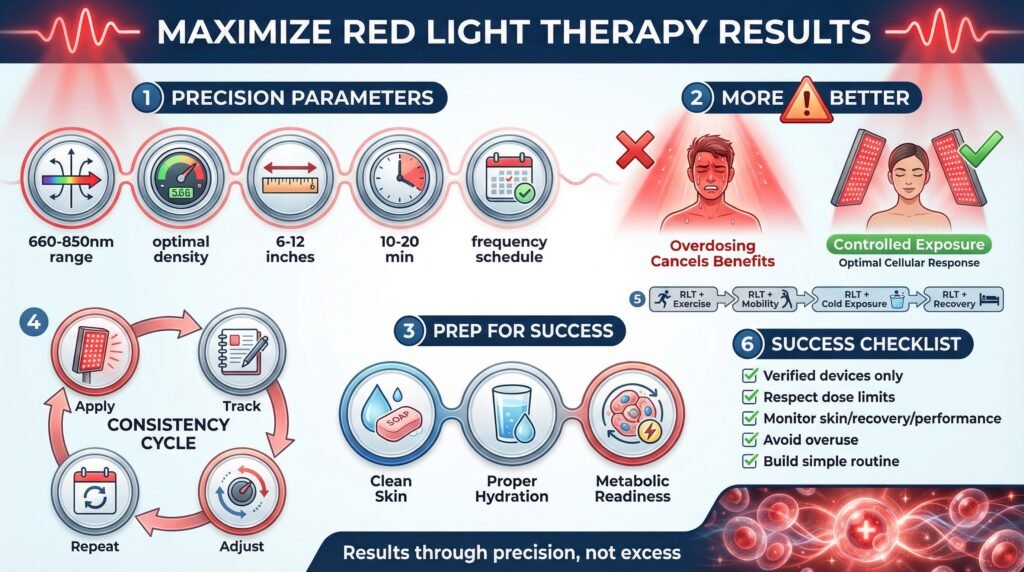
Red light therapy works only when applied with precision. Results depend on hitting the right wavelengths, power density, distance, timing, and recovery frequency, while your cells are metabolically ready to respond. More exposure isn’t better; overdosing cancels benefits. Clean skin, proper hydration, and smart session periodization dramatically improve outcomes.
Table of Contents
Introduction: Why Red Light Therapy Fails for Most People
Understanding Cellular Response Windows: The Biphasic Dose Response Explained
Wavelength Penetration and Tissue Targeting
Distance, Power Density, and Dose Accuracy
Session Length, Frequency, and Periodization
Skin Preparation and Absorption Optimization
Hydration, Nutrition, and Metabolic Readiness
Final Summary
Introduction
If cellular energy production is the foundation of recovery, performance, and aging well, and it absolutely is, why do so many people treat RLT like a magic tanning bed they can just stand in front of randomly?
Red light therapy delivers results through precision, not wishful thinking. The photons hitting your skin need to interact with specific chromophores in your cells at the right power density while your mitochondria are in the proper metabolic state to respond.
You can also completely saturate your cells’ capacity to benefit, which means more exposure actually makes things worse.
This explains why two people can buy the same expensive device and get completely different outcomes. One person follows precise protocols and sees dramatic improvements in recovery time and skin quality within weeks.
The other stands too far away, uses it through moisturizer, does daily 45-minute sessions, thinks more equals better, and ends up with nothing but frustration and an expensive closet ornament.
Understanding Cellular Response Windows
Your mitochondria have a really specific capacity for light absorption at any given time. When red and near-infrared photons hit cytochrome c oxidase in the electron transport chain, they displace nitric oxide that has been competitively inhibiting oxygen binding.
This displacement allows the enzyme to function more efficiently, ramping up ATP production dramatically.
What most people miss is that this benefit exists within a therapeutic window. Too little light exposure means you don’t reach the activation threshold needed to trigger meaningful cellular responses.
Too much actually starts inhibiting the very enzymes you’re trying to stimulate.
Training volume in the gym works the same way. There’s an optimal dose that stimulates adaptation without exceeding recovery capacity.
Go beyond that, and you’re not getting extra gains; you’re actively sabotaging your progress.
The biphasic dose response in photobiomodulation follows identical principles, except that the feedback isn’t delayed soreness or fatigue. It’s simply the absence of expected benefits, which makes it harder to recognize you’re overdoing it.
The research on this is crystal clear. Studies using excessive irradiation times or frequencies show diminished outcomes compared to moderate protocols.
In some cases, excessive exposure produces results statistically indistinguishable from control groups receiving no treatment at all. You’re literally spending time and energy to achieve nothing.
The Wavelength Penetration Strategy
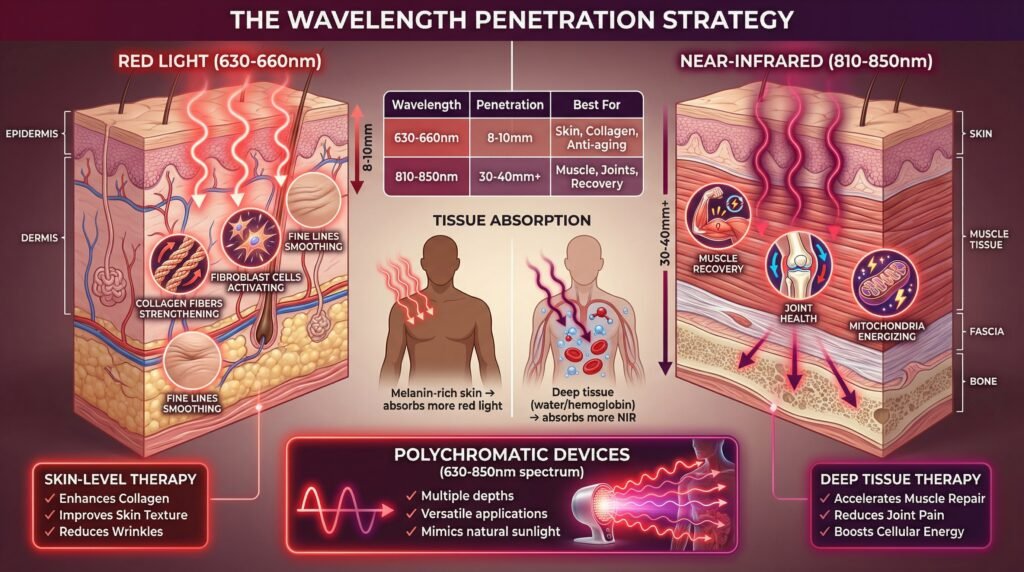
Not all red light is created equal, and this is where device selection becomes absolutely crucial. Red wavelengths around 630-660nm penetrate roughly 8-10mm into tissue.
They’re phenomenal for skin-level interventions, stimulating fibroblasts, increasing collagen density, reducing fine lines, and modulating inflammatory responses in the dermis.
Near-infrared wavelengths at 810-850nm penetrate significantly deeper, reaching 30-40mm or more depending on tissue composition. This deeper penetration targets muscle tissue, fascia, and even bone, making NIR ideal for recovery applications, joint health, and systemic mitochondrial support.
Different tissues respond to different wavelengths in fascinating ways. Melanin in your skin absorbs red light more efficiently than NIR, which means darker skin tones may need slightly adjusted protocols when targeting superficial concerns.
Meanwhile, water and hemoglobin in deeper tissues absorb NIR more readily, making it the superior choice for post-workout muscle treatment.
I’ve found that devices combining both wavelength ranges offer the most practical versatility. You’re not locked into single-purpose applications, and you can target many tissue depths simultaneously.
Polychromatic devices using the full 630-850nm spectrum allow your body to absorb the wavelengths it needs most at any given depth, which is honestly closer to how natural sunlight works anyway.
Distance and Power Density Calculations
Distance dramatically affects your actual dose, and this is where things get technical, but really important to understand. Power density follows the inverse square law.
Double your distance, and you quarter the irradiance reaching your tissue.
If your device delivers 100mW/cm² at 6 inches, moving to 12 inches drops that to roughly 25mW/cm². Most therapeutic protocols need irradiance levels between 10-50mW/cm² at the tissue level, depending on the application.
Go too far, and you’re wasting time. Get too close without adjusting duration, and you risk overshooting the optimal dose.
I measure this practically by finding the distance where I feel gentle warmth without any burning sensation. That’s typically the sweet spot where enough photon density is reaching tissue without creating problematic thermal effects that could trigger heat shock proteins or inflammatory responses.
The device specifications matter enormously here. A panel with 300 LEDs might sound impressive, but if the total power output is low or the LEDs are spaced inefficiently, you’re not getting meaningful therapeutic density.
Look for devices specifying their irradiance at different distances, and actually measure your treatment position to confirm you’re in the effective range.
Session Timing and Recovery Periodization
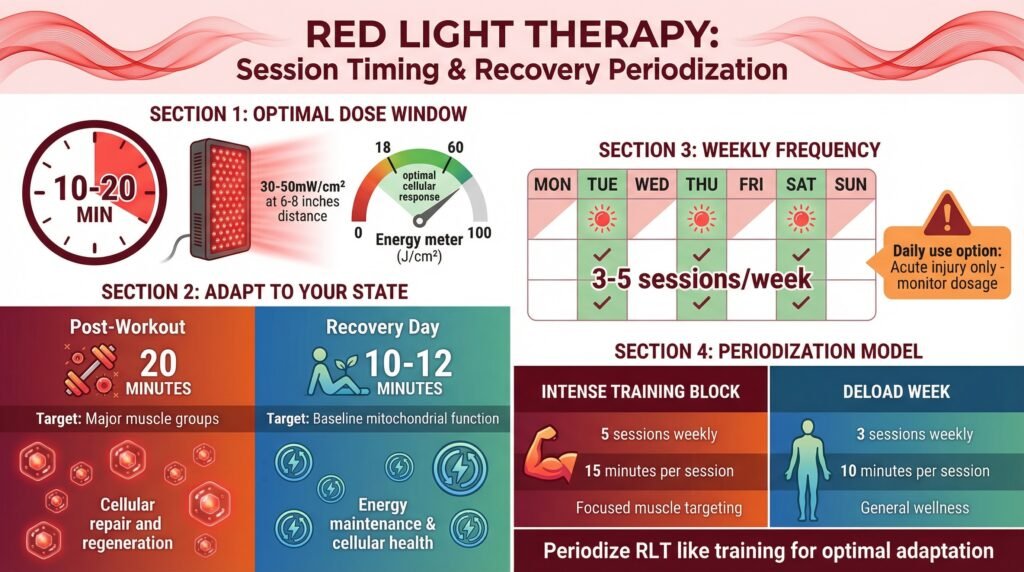
The 10-20-minute recommendation you see everywhere comes from calculating optimal dose delivery within therapeutic windows. For a typical quality device delivering 30-50mW/cm² at 6-8 inches, this duration provides roughly 18-60 J/cm² of energy, which falls squarely in the range shown to maximize cellular responses without triggering inhibition.
Timing should adapt based on your current state. Post-workout, when inflammation is elevated and cellular damage needs addressing, I use the full 20 minutes on major muscle groups.
On recovery days when I’m just supporting baseline mitochondrial function, 10-12 minutes is plenty.
Think of frequency the same way you’d think about training frequency. Three to five sessions weekly provide enough stimulus for adaptation while allowing adequate recovery between exposures.
Daily use can work for acute injury recovery or specific protocols, but it needs careful dose management to avoid the biphasic response.
I’ve noticed the best results come from periodizing RLT just like training. During intense training blocks, I increase frequency to 5 sessions weekly with 15-minute durations focused on worked muscle groups.
During deload weeks, I drop to 3 sessions at 10 minutes, targeting more general wellness and maintenance.
Skin Preparation and Absorption Optimization
This seems almost too simple to mention, but I’ve watched countless people use RLT through makeup, moisturizer, or even clothing, wondering why they’re not seeing results. Photons don’t magically pass through cosmetics or fabric.
They get scattered, absorbed, or reflected before ever reaching your skin.
Clean, completely bare skin is non-negotiable. Even thin residues from cleansers or toners can reduce photon transmission by 10-30%.
I wash target areas with plain water and pat them dry before every session.
No products whatsoever until after treatment.
The state of your skin barrier also affects response. Compromised barriers with elevated trans-epidermal water loss may respond differently from healthy, well-hydrated skin. I’ve found that maintaining good baseline skin health through proper hydration, adequate essential fatty acid intake, and barrier support actually enhances RLT outcomes, probably because healthy cells are more metabolically responsive.
Immediately after sessions, your skin is primed for absorption. This is actually the ideal time to apply serums or actives if you’re using RLT for skin health.
The increased blood flow and cellular activation enhance penetration and potentially magnify the benefits of quality topical ingredients.
Hydration and Metabolic Support
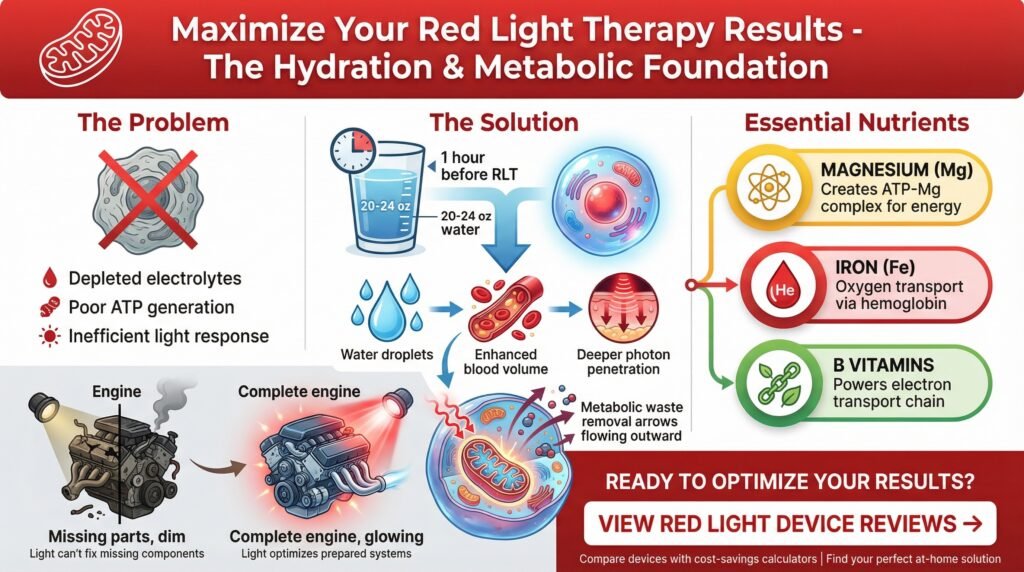
Your cells’ ability to respond to photobiomodulation depends heavily on their baseline metabolic state. Chronically dehydrated cells with depleted electrolyte gradients can’t generate ATP efficiently regardless of light exposure.
The mitochondria need adequate hydration, oxygen, and substrate availability to convert the photonic stimulus into actual energy currency.
I drink at least 20-24 ounces of water within an hour before RLT sessions, especially when targeting muscle recovery. The increased blood volume supports better photon delivery to deeper tissues and facilitates the removal of metabolic waste products that accumulate during the recovery process.
Mineral status matters too. Magnesium is directly involved in ATP synthesis.
Your cells actually use the ATP-Mg complex, not ATP alone.
Iron is crucial for hemoglobin function, which affects how much oxygen is available for the mitochondria to use once cytochrome c oxidase is optimized. Adequate B vitamins support the enzymatic reactions throughout the electron transport chain.
I don’t obsess over perfect supplementation, but I make sure my baseline nutrition supports mitochondrial function. Otherwise, you’re trying to improve an engine that’s missing essential components.
The light can’t create energy from nothing. It can only enhance the efficiency of processes that need proper substrates.
In part 2 of this series on red light therapy best practices, we will discuss response monitoring, protocol adjustment, combining RLT with other interventions, and more. Subscribe to our blog for further updates
If you are ready to consider red light therapy devices, click here to get started today by visiting our review page for a complete list of affordable and effective red light therapy devices for at-home use.
We have provided cost-savings calculators for each product so you can compare each device to the average cost of professional red light sessions as well.
If you are looking for an affordable entry point, read our review of the Mito Pro line of red light devices. Click here to start reading or click below to be taken to Mito’s official site.
Final Summary
Red light therapy is not a passive wellness trend; it’s a biologically precise intervention. When wavelengths, distance, duration, and frequency align with your cells’ recovery capacity, RLT can meaningfully improve skin health, muscle recovery, and mitochondrial efficiency. When misused, it does nothing or actively blunts results.
The most consistent outcomes come from respecting therapeutic dose windows, matching wavelengths to tissue depth, maintaining clean bare skin, and supporting cellular metabolism through hydration and nutrition. Treat RLT like training: dose it intentionally, allow recovery, and adjust protocols to your current physiological state. Precision, not excess, is what delivers real results.
In part 2 of this series, we will discuss response monitoring, protocol adjustment, combining RLT with other interventions, and more.
People Also Asked
How long should you use red light therapy per session?
Most effective protocols use 10-20 minutes per session at a proper distance. This provides 18-60 J/cm² of energy for a device delivering 30-50mW/cm² at 6-8 inches, which falls in the therapeutic range without triggering inhibition.
Does red light therapy work for muscle recovery?
Research shows red light therapy significantly reduces delayed onset muscle soreness and speeds recovery when used 3-6 hours post-workout. Near-infrared wavelengths at 810-850nm penetrate deep enough to reach muscle tissue effectively.
Can you use red light therapy every day?
Daily use can work for acute injury recovery, but risks overshooting the optimal dose because of the biphasic response. Three to five sessions weekly provide better results for most people by allowing adequate recovery between exposures.
What distance should you be from red light therapy device?
Most devices work best at 6-8 inches, where irradiance is high enough to be therapeutic but not so intense that it causes thermal damage. Check your specific device specifications since power density follows the inverse square law.
Does red light therapy help with wrinkles and skin aging?
Red wavelengths at 630-660nm stimulate fibroblasts and increase collagen density when used consistently. Visible improvements in fine lines and skin texture typically appear after 4-6 weeks of regular treatment at 4-5 sessions weekly.
Should you wear goggles during red light therapy?
Protective goggles rated for red and NIR wavelengths are recommended during facial treatments or when panels face your eyes directly. Near-infrared at 810-850nm doesn’t trigger protective reflexes, making eye protection especially important.
Can you use red light therapy through clothes?
No. Photons get scattered, absorbed, or reflected by fabric before reaching your skin. Clean, completely bare skin is required for effective treatment since even thin residues from products can reduce photon transmission by 10-30%.
Click the button below to get started today by visiting our review page for a complete list of affordable and effective red light therapy devices for at-home use.
We have provided cost-savings calculators for each product so you can compare each device to the average cost of professional red light sessions as well. For an affordable entry point, see our reviews of Mito red light products by clicking here.
This article includes affiliate links. If you click through and make a purchase, I may receive a small commission. This helps support the site and allows me to keep creating helpful content at no extra cost to you.