Quick Summary
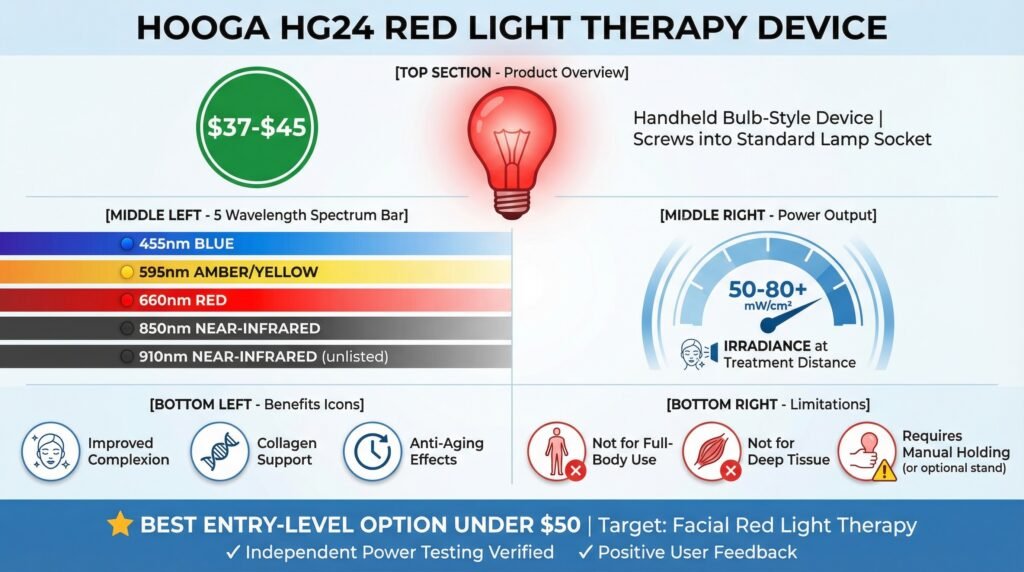
The Hooga HG24 is a budget-friendly ($37–$45), handheld/ bulb-style red light therapy device that screws into a standard lamp socket. It features five wavelengths (455nm blue, 595nm amber/yellow, 660nm red, 850nm + an unlisted 910nm near-infrared), delivers solid irradiance (50–80+ mW/cm² at treatment distances), and provides legitimate facial skin benefits like improved complexion, collagen support, and anti-aging effects.
While it requires manual holding (or an optional stand) and isn’t suited for full-body or deep tissue use, it’s praised as one of the best entry-level options under $50 for targeted facial red light therapy, backed by independent power testing and positive user feedback.
Check out the HG24 here if it sounds like a fit for what you need, especially if you’re mainly focused on facial skin.
Table of Contents
- Introduction – Overview of the HG24 as an affordable yet effective red light option.
- What You’re Actually Getting – Product description, design (handheld bulb with 12 LEDs, cord, switch), and basic specs.
- The Five Wavelengths Nobody Talks About – Breakdown of the four advertised wavelengths plus a fifth discovered via testing (blue for acne, amber for wrinkles, red for collagen, NIR for deeper benefits).
- Power Output: The Numbers That Matter – Irradiance measurements (50–55 mW/cm² average at 6 inches, up to 126 mW/cm² closer), total 2.5W, and why it matters for effectiveness.
- Using It in Real Life – Practical experience, session times (5–15 minutes), how to hold/use it, and optional stand.
- Who This Makes Sense For (And Who Should Pass) – Ideal for budget users focused on facial skin, travel/portability; not for deep tissue, joints, or hands-free full-body needs.
- The Price Thing Everyone Wonders About – Explanation of the ultra-low cost ($37–$45) due to simple design and brand strategy.
- Trade-Offs You Need to Know – Cons like manual holding, no timer, vision blockage during use, elevated EMF if too close, short cord, and US plug limitations.
- Real Customer Feedback Patterns – Common reports of skin improvements and energy boosts over weeks, plus complaints about effort and lack of time.
- Comparing to Other Options – How it stacks up vs. expensive panels (e.g., BioMAX 300); suggests buying multiples for a still-cheaper setup.
- Practical Usage Tips – Start slow (5 min), distance (3–6 inches), frequency (3–5x/week), cleaning, progress tracking.
- The Bottom Line – Strong recommendation for facial-focused, budget-conscious users wanting to try red light therapy without big investment.
Introduction
Red light therapy used to mean expensive clinic visits or dropping serious cash on those massive wall panels. Then the Hooga HG24 showed up at $40 (depending on promotions), and people lost their minds a bit.
I get it. When you’ve been researching red light devices and seeing $300+ price tags everywhere, something this cheap feels suspicious.
Like… what’s the catch?
Turns out there’s no catch exactly, but there are trade-offs worth knowing about before you buy. That’s what this HG24 review is here to explain.
What You’re Actually Getting
The HG24 is basically 12 LEDs in a handheld unit that screws into a regular lamp socket. You plug it into any wall outlet, flip the switch, and hold it near your face (or wherever you’re treating).
That’s it. No fancy control panel, no timer, no beeping noises.
It weighs about 1.5 pounds. You can hold it comfortably for 10-15 minutes without your arm getting tired (though some people grab the optional $20 stand and just position their face in front of it instead).
The simplicity is either perfect or annoying, depending on what you want. If you like minimal gear that just works, this is great.
If you want preset programs and automatic timers and all that… well, you’re not getting it here.
The Five Wavelengths Nobody Talks About
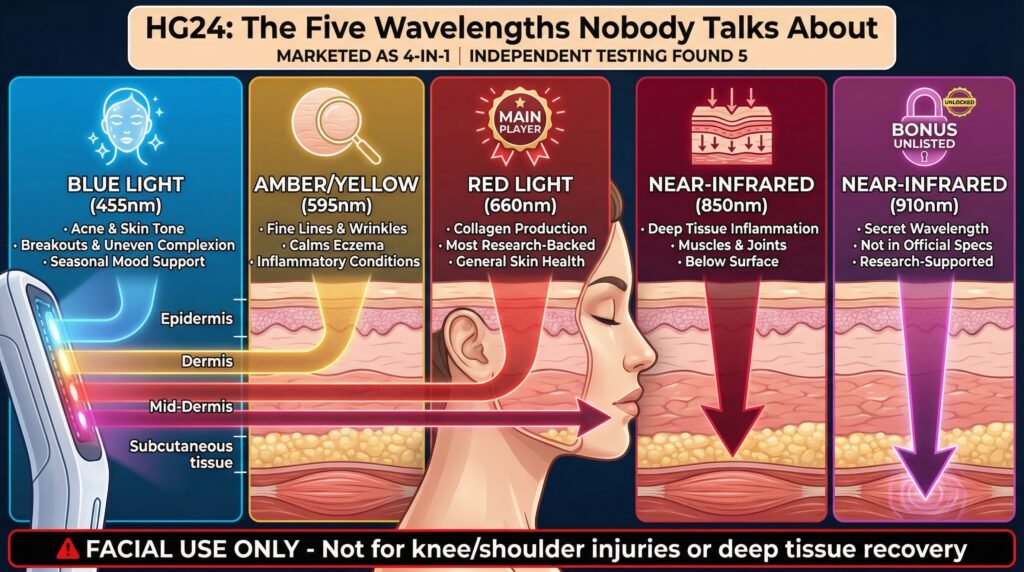
Hooga says the HG24 has four wavelengths. Hence, the official title: HG24 4-in-1.
But we will reveal five. Independent testing found five.
Here’s what’s actually coming out of this thing:
Blue light (455nm) helps with acne and skin tone. If you deal with breakouts or uneven complexion, this wavelength is doing work.
Bonus: it might help with seasonal mood stuff, too.
Amber/yellow light (595nm) targets fine lines and wrinkles. Research also shows it can calm down inflammatory skin conditions like eczema.
Red light (660nm) is the main player in most red light therapy. It penetrates surface tissue and has the most research backing for collagen production and general skin health.
Near-infrared (850nm) goes deeper than red light to reach muscles, joints, and deeper tissue layers. This is what addresses inflammation below the skin surface.
Near-infrared (910nm) showed up in testing but isn’t listed anywhere in the official specs. It’s like a secret bonus wavelength (and research suggests it’s useful, so… cool).
The device was specifically designed for facial and skin applications. That multi-wavelength combo makes sense for anti-aging and complexion work.
If you’re planning to use this on your knee injury or sore shoulder, you’re using the wrong tool. This isn’t a deep tissue recovery device.
Power Output: The Numbers That Matter
You can have perfect wavelengths, but if the device barely emits light, you’re wasting time.
Independent testing measured the HG24 at about 50-55mW/cm² average output at 6 inches distance. Total wattage is 2.5W.
Another source listed it at 80mW/cm² at 6 inches, and 126mW/cm² when you hold it at 3 inches.
For context: that’s solid for a handheld device. It’s not going to match a 300-watt panel, but the power density is adequate for facial use.
The recommended treatment time is 5-15 minutes per area. Since this is handheld, you’ll move it around to cover your whole face.
Most people need 15-20 minutes total to treat their entire face and neck when moving the device to different sections.
One thing worth mentioning: EMF emissions are a bit elevated when you hold it super close to your face because the device isn’t grounded. Holding it a few inches away instead of pressing it against your skin makes sense.
Not a deal breaker, just something to know.
Using It in Real Life
The handheld format creates some practical considerations.
You can’t treat your entire face in one shot like you could with a panel. You’ll hold it on your right cheek, then left cheek, then forehead, then neck.
To be thorough, you’re looking at many passes and about 15-20 minutes of active treatment time.
Your vision gets blocked while you’re using it. You can’t check your phone, read, or see what you’re doing.
You’re basically holding a light bulb in front of your face.
The $20 stand changes the experience completely. You can set it on a table and position your face in front of it instead of holding it.
For a $40 device, spending an extra $20 to remove that friction point is worth considering.
There’s no built-in timer, so you’ll use your phone’s timer app. It’s not complicated, but it’s an extra step every session.
Who This Makes Sense For (And Who Should Pass)
The HG24 isn’t for everyone, and being honest about that saves you from buying something that won’t work for your situation.
This makes sense if:
You’re focused on facial skin health, anti-aging, or complexion improvements. The wavelength combo was designed for this exact use case.
You travel often and want something compact. At 1.5 pounds, it fits in a suitcase without taking up much space.
You’re on a tight budget and want to try red light therapy without a huge investment. The $37-45 price point is genuinely affordable compared to other choices.
You want to test red light therapy before committing to a larger purchase. This is a low-risk way to see if it works for your skin.
This doesn’t make sense if:
You need deep muscle recovery or joint pain relief. Get a dedicated red and near-infrared panel designed for those purposes instead.
You want a full-body treatment. A handheld device needs too many passes to be practical for large areas.
You need a set-and-forget system. This needs active involvement; you’re holding or positioning the device and timing your own sessions.
Check out the HG24 here if it sounds like a fit for what you need, especially if you’re mainly focused on anti-aging and skin health.
The Price Thing Everyone Wonders About
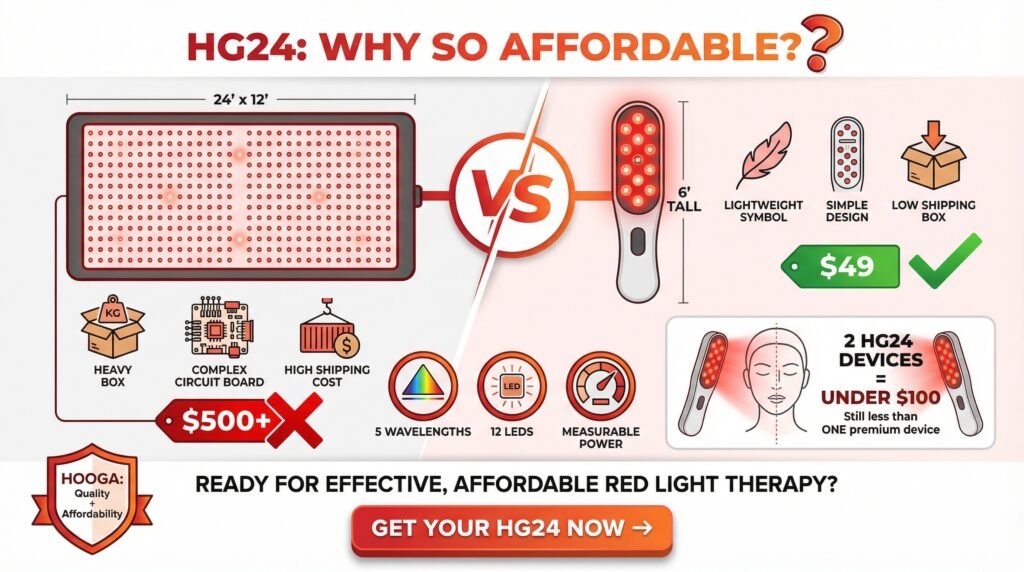
How is a device with five wavelengths and measurable power output so cheap?
The answer is pretty straightforward: it’s handheld instead of a panel. Panels need way more LEDs, bigger housing, control electronics, and more labor to gather.
A handheld with 12 LEDs costs dramatically less to manufacture and ship.
Hooga’s whole brand is built around offering good value in the red light therapy space. They’ve always positioned themselves as the affordable option without completely compromising quality.
The HG24 is an extreme version of that strategy, prioritizing price and accessibility over features and power.
You could buy two HG24 devices for under $100 and use one on each side of your face simultaneously. You’d still spend less than a single higher-end device.
That’s genuinely remarkable if you’re willing to work with the handheld format.
Trade-Offs You Need to Know
Buying a $45 device means accepting limitations that a $300 device wouldn’t have.
If you’re outside the US, the device ships with a US plug. You’ll need an adapter.
Still cheaper than alternatives, but it’s annoying.
The cord could be longer. If your outlets aren’t positioned where you want to use the device, you might need an extension cord.
Full face coverage takes many passes. You won’t get comprehensive treatment in a single five-minute session.
Plan for 15-20 minutes if you want to cover everything.
The warranty is three years, which is solid. Despite the low price, Hooga stands behind the product.
Real Customer Feedback Patterns
People using this device are reporting skin improvements and better energy levels. The results aren’t instant; they depend on consistent use over weeks, but the pattern of positive feedback is consistent.
Most complaints focus on the handheld format, requiring more effort than a panel. That’s the trade-off you’re making when you pay $45 instead of $300.
Some people mention the lack of a timer as annoying. Others say they don’t care because they just set their phone timer anyway.
The stand comes up a lot in reviews as a worthwhile addition. It removes the main friction point (holding the device for 15+ minutes).
Comparing to Other Options
The BioMAX 300 is another option in the red light therapy space. It’s more expensive but offers a larger treatment area and different wavelength combinations.
That comparison only makes sense if you’re willing to spend significantly more. The HG24 and BioMAX 300 aren’t really competing for the same buyer.
Full-sized panels in general offer more power, a larger coverage area, hands-free operation, and often better EMF shielding. They also cost 5-10x more.
For facial-focused treatment on a budget, nothing else offers five wavelengths with verified power output at this price point. Visit Hooga’s official site by clicking the button below and get started with this affordable and portable red light device.
Practical Usage Tips
Start with 5-minute sessions and work up to 10-15 minutes as your skin adjusts. More isn’t always better; consistency matters more than session length.
Hold the device 3-6 inches from your skin. Closer gives you higher power density and higher EMF exposure. Find the balance that works for you.
Treat one section at a time. Right cheek, left cheek, forehead, chin, neck.
Moving methodically confirms you don’t miss spots.
Use it 3-5 times per week for best results. Daily use is fine too, but you’ll see benefits with just a few sessions weekly.
Clean the device regularly with a soft cloth. Dust and oils can accumulate on the LED surface and reduce effectiveness.
Track your results somehow, photos, notes, whatever works. Skin changes happen gradually, and it’s easy to miss progress without a reference point.
The Bottom Line
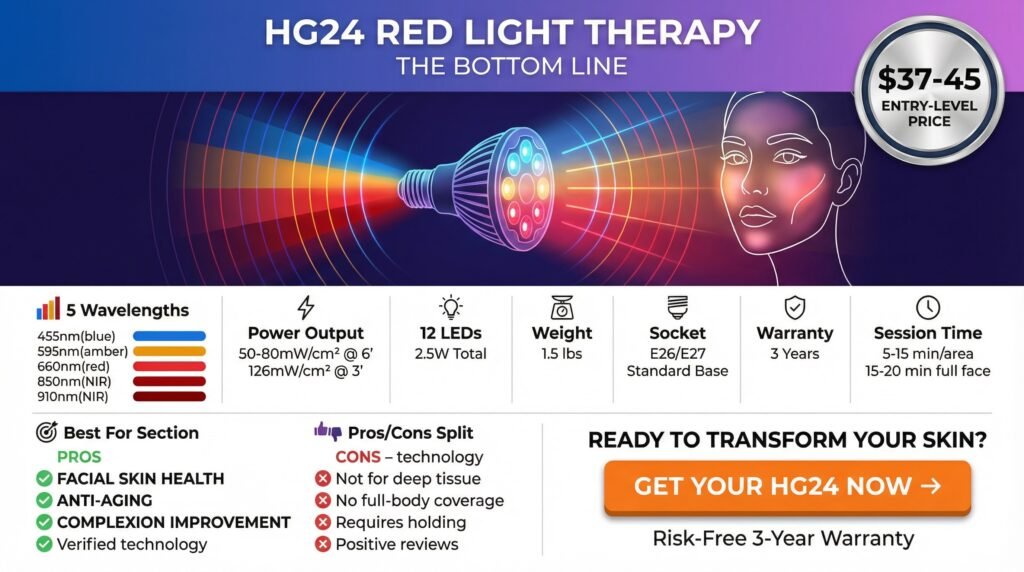
This HG24 review consistently points to one conclusion: you’re getting legitimate red light therapy technology at an entry-level price point.
The trade-offs are clear, and none of them are deal breakers for the intended use case (facial skin health and anti-aging).
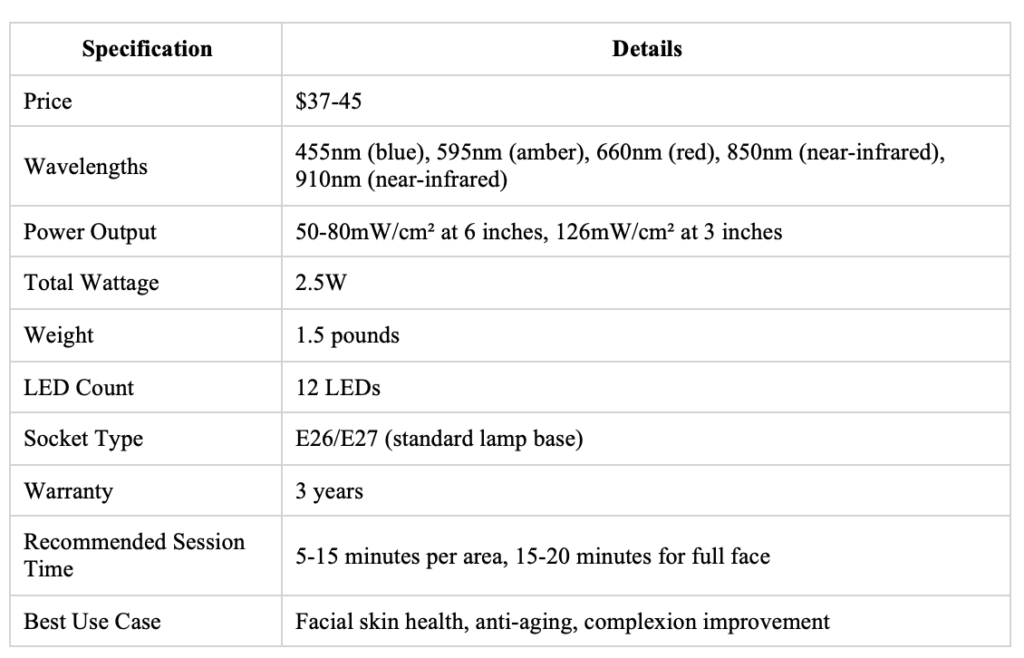
For anyone focused on facial red light therapy who wants to test the technology without a massive investment, the HG24 is worth checking out. Five wavelengths with verified power output for under $50 doesn’t exist anywhere else.
If you need deep tissue work, full-body coverage, or completely hands-free operation, look at full-sized panels instead. The HG24 won’t meet those needs.
But for what it’s designed to do, targeted facial treatment at an accessible price point, it delivers. The wavelengths check out, the power density is adequate, the warranty is solid, and customer feedback is consistently positive.
The device removes the main barriers to trying red light therapy: cost and complexity. You get legitimate technology without the huge upfront investment or learning curve.
Whether that fits your specific situation depends on what you need, but for facial-focused users on a budget, this HG24 review suggests it’s a solid option worth considering. Click the button below to grab the HG24 if you want to test red light therapy without the huge upfront investment.
Frequently Asked Questions
What is the Hooga HG24? A compact, plug-in red light therapy bulb/device with 12 LEDs, designed for targeted use (especially facial skin health and anti-aging). It screws into a regular lamp socket and comes with a power cord/switch.
How much does it cost? Typically $37–$45 (often around $40), depending on promotions, making it one of the cheapest legitimate options available.
What wavelengths does it use? Advertised: 455nm (blue), 595nm (amber/yellow), 660nm (red), 850nm (near-infrared). Independent testing confirmed an additional 910nm near-infrared.
Is it powerful enough to work? Yes, independent tests show 50–55 mW/cm² (average) at 6 inches, up to 80–126 mW/cm² closer, which is adequate for facial/skin benefits (collagen, tone, acne support).
How do you use it? Plug it in, turn it on, hold 3–6 inches from the skin, treat one area at a time (e.g., cheeks, forehead), for 5–15 minutes per session. Use 3–5 times per week. An optional $20 stand allows hands-free positioning.
What are the main benefits? Targeted facial improvements: better skin tone, reduced fine lines, collagen production, acne help (via blue light), and some users report higher energy. Results typically appear with consistent use over weeks.
What are the downsides? Handheld design requires effort (multiple passes for full face, ~15–20 min total); blocks vision during use; no built-in timer; short cord; higher EMF if held too close (keep distance); not ideal for large areas, deep tissue, or joints.
Who should buy it? Budget-conscious people wanting to try red light therapy for face/skin, travelers needing portability, or anyone testing the tech without spending hundreds.
Who should skip it? Those needing hands-free, full-body coverage, deep tissue/muscle/joint recovery, or premium features (timer, low EMF, large panels).
How does it compare to expensive devices? It has less coverage/power than $300+ panels but delivers comparable wavelengths and verified output for facial use at a fraction of the cost (e.g., two HG24s < $100 vs. one high-end panel).
Is it safe and reliable? Yes, from reputable brand Hooga; 3-year warranty; positive customer patterns; just follow distance guidelines to minimize EMF concerns.
This article includes affiliate links. If you click through and make a purchase, I may receive a small commission. This helps support the site and allows me to keep creating helpful content at no extra cost to you.