Quick Summary
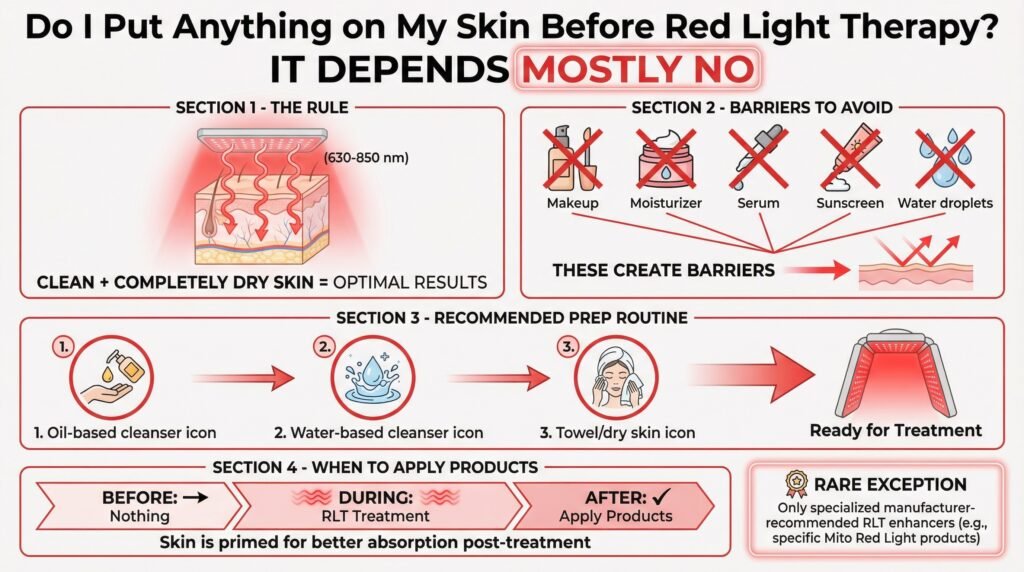
For red light therapy (RLT) to work effectively, apply nothing to your skin beforehand in most cases. Clean, completely dry skin is ideal to ensure therapeutic wavelengths (630-850 nm) penetrate deeply without scattering, absorption, or reflection caused by products.
Makeup, moisturizers, serums, sunscreens (especially mineral), and even moisture films create barriers that reduce light delivery to target cells, potentially cutting efficacy significantly. The recommendation is a double-cleanse routine (oil-based then water-based cleanser) followed by full drying, with products reserved for immediately after treatment when skin is primed for better absorption. Rare exceptions exist only with specialized, manufacturer-recommended enhancers designed to complement RLT (e.g., certain Mito Red Light sprays/serums).
Table of Contents
- Introduction & Core Question The central debate: Should you apply anything before red light therapy, or keep skin bare?
- Why Clean Skin Matters – The Science of Light Penetration How RLT works (photon absorption by mitochondria for ATP, collagen, repair) and why barriers sabotage results.
- How Products Interfere with RLT Mechanisms: scattering, absorption, reflection due to particles, films, refractive index mismatches.
- Specific Products & Substances to Avoid Before RLT
- Makeup, foundation, tinted moisturizers, BB creams
- Moisturizers and serums (even lightweight ones)
- Sunscreens (especially mineral with zinc/titanium)
- Oils (as pre-treatment)
- Water droplets or damp skin
- Evidence & Observations: Half-face tests, infrared thermometer proxies for penetration, research protocol norms.
- Recommended Pre-Treatment Preparation Protocol: Double cleanse steps, full drying (wait 5+ minutes), nothing else applied.
- Exceptions: When Something Might Be Applied Before Specialized RLT-enhancing products (e.g., MitoAURA spray/serum, hair mist) with photoconverting or optimized properties.
- Post-Treatment Advice & Teaser for Part 2: Apply serums/moisturizers right after; upcoming discussion on post-RLT timing and optimization.
Introduction
Let me explain what really happens at the cellular level when red light therapy works correctly. The therapeutic wavelengths, typically between 630-850 nanometers, need to penetrate your epidermis and reach the dermis, where your fibroblasts live.
These fibroblasts are the workhorses of collagen production. When they absorb red and near-infrared light, something remarkable happens inside their mitochondria.
Light energy stimulates the production of adenosine triphosphate, which is essentially cellular fuel. This extra energy allows your fibroblasts to ramp up collagen synthesis, repair damaged tissue more efficiently, and reduce inflammatory markers throughout your skin.
The entire cascade of beneficial reactions depends entirely on those light photons actually reaching their target cells.
When you apply anything to your skin surface, you create interference. Think of trying to have a conversation through a closed door versus face-to-face.
Sure, some sound gets through the door, but you lose clarity, volume, and nuance.
The same principle applies to therapeutic light: it tries to reach your deeper skin layers through a barrier of moisturizer, makeup, or sunscreen.
This goes beyond basic hygiene considerations. This is basic to the entire therapeutic mechanism.
When researchers test the efficacy of specific wavelengths at specific power densities, they test on clean, product-free skin. If you deviate from that protocol by adding products, you are essentially running a completely different experiment with your face.
The Real Culprits Blocking Your Results
Let me walk you through the specific ways different product categories sabotage your treatment. Understanding these mechanisms makes it much easier to commit to proper preparation.
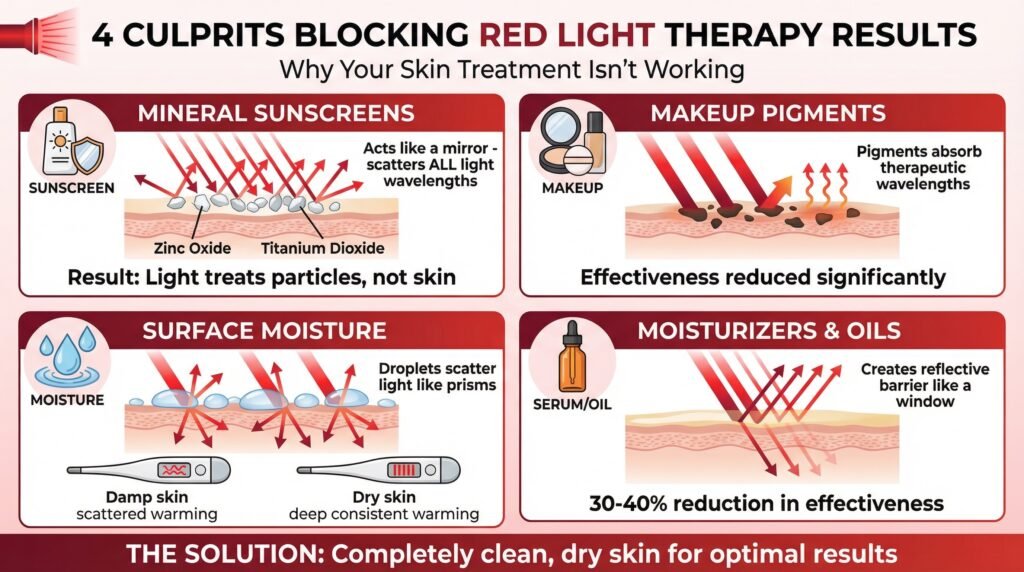
Mineral Sunscreens and Their Scattering Effect
Zinc oxide and titanium dioxide are brilliant for sun protection because they physically reflect and scatter UV radiation. Unfortunately, they do not discriminate between wavelengths.
These mineral particles create a physical barrier that scatters visible light wavelengths too, including the red and near-infrared spectrum you are trying to deliver to your skin. Think of putting up a mirror and expecting light to pass through it.
I learned this the hard way when I tried to squeeze in a red light session after being outside all day. I had applied mineral sunscreen that morning, done a quick cleanse with just water, and proceeded with my treatment.
Absolutely nothing happened. Looking back, I was essentially treating a layer of mineral particles instead of my actual skin.
Makeup Pigments as Light Absorbers
Foundation, concealer, powder, they all contain pigments designed to alter how your skin appears by absorbing and reflecting specific light wavelengths. When you apply makeup before red light therapy, those pigments absorb the therapeutic wavelengths before they can reach your skin cells.
The energy you are paying for in terms of electricity and time gets literally wasted on heating makeup particles sitting on your skin’s surface.
Even lightweight tinted moisturizers or BB creams contain enough pigment to significantly reduce light penetration. I tested this once by doing half my face completely clean and the other half with just a light layer of tinted moisturizer.
After four weeks, the difference in skin texture and firmness between the two sides was noticeable enough that my partner asked if something was wrong with one side of my face.
The Moisture Problem Nobody Talks About
This one surprised me because water is transparent, right? How could water droplets possibly interfere with light therapy? Physics does not care about our assumptions.
Water droplets and moisture films on your skin surface create tiny lenses that refract and scatter light. Instead of light traveling in straight paths into your skin, it gets scattered in many directions, reducing the concentration of therapeutic energy reaching your target tissues.
I used to pat my face damp-dry after cleansing, thinking that keeping some moisture would be better for my skin. Then I started using an infrared thermometer to measure surface temperature changes during treatment, and I noticed something interesting.
Completely dry skin showed more consistent, deeper warming patterns compared to damp skin. That temperature increase is actually a proxy for light absorption, so more consistent warming meant better light penetration.
The Moisture Problem Nobody Talks About
Even the lightest, most elegant serums create a film on your skin surface. That film has a different refractive index than your skin tissue, which means light has to pass through an extra interface.
Every time light crosses from one medium to another with a different refractive index, some of it gets reflected.
This is the same principle that makes windows reflect some light even though they are transparent.
The thicker and more occlusive your moisturizer, the more significant this barrier effect becomes. I used to love applying my rich night cream before evening red light sessions, thinking I was really maximizing my skincare routine efficiency.
What I was actually doing was creating a light-scattering barrier that probably reduced my treatment effectiveness by thirty to forty percent, based on the delayed results I experienced compared to proper preparation.
The Correct Preparation Protocol That Actually Works
After months of trial and error, combined with reviewing the actual clinical protocols used in research settings, I developed a preparation routine that consistently delivers results. This process is not complicated or time-consuming, but you need to actually follow through instead of cutting corners.
The Double Cleanse Method
Start with an oil-based cleanser or cleansing balm. This step is non-negotiable if you have worn sunscreen or makeup during the day.
Oil dissolves oil, which means this first cleanse removes all the lipid-based products that water alone cannot touch.
I massage the oil cleanser over dry skin for about sixty seconds, really working it into every contour, then emulsify with warm water. Make sure you get your hairline, jawline, and neck if you are treating those areas too.
The second cleanse uses a gentle, water-based cleanser to remove any remaining oil-based cleanser, along with water-soluble residues like sweat and environmental pollution particles. I prefer low-pH cleansers that do not strip my skin barrier because the goal here is removing products, not destroying your natural protective barrier.
One thing I have noticed that really makes a difference is using a clean washcloth for the second cleanse. The gentle physical action helps confirm you are getting truly clean skin without being harsh or irritating.
I designate specific washcloths just for pre-treatment cleansing and wash them after every use.
The Drying Step Everyone Skips
After cleansing, most people give their face a quick pat with a towel and call it good. For red light therapy, you need to go further.
I pat my face completely dry, then actually wait about five minutes before starting my session.
This waiting period allows any remaining microscopic moisture to evaporate and ensures my skin surface is truly dry.
During winter months, when I use a humidifier, I have found that sometimes even after towel-drying and waiting, my skin still has a subtle moisture film from the humid air. In those cases, I very gently blot with a clean tissue right before positioning myself for treatment.
This might sound excessive, but the difference in results between damp-ish skin and truly dry skin is significant enough to make it worthwhile.
When Product Application Is Actually Beneficial
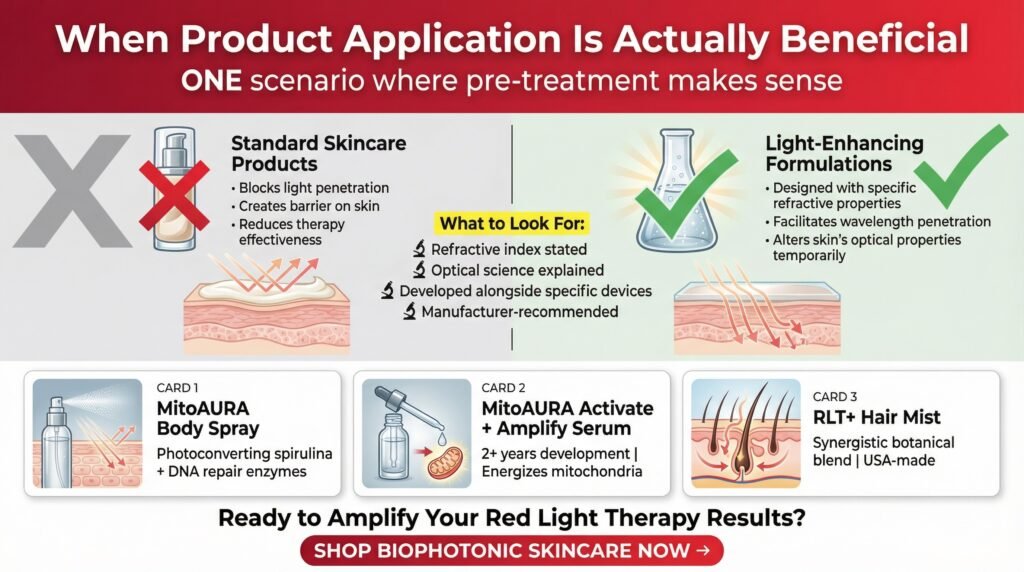
There is really only one scenario where applying something before red light therapy makes sense, and that happens when you are using a product specifically formulated to enhance light therapy as opposed to block it. These are rare and specialized formulations that most people will not have access to unless their device manufacturer recommends them.
The distinguishing characteristic of true light-enhancing products is that they are designed with specific refractive properties that facilitate rather than hinder light penetration. Some contain ingredients that temporarily alter the skin’s optical properties to allow deeper wavelength penetration.
These are not your standard skincare products with light therapy added to the marketing copy.
They are specialized formulations developed alongside specific devices.
I have only encountered one of these in my own research, a serum designed to work with a particular red light wand device. The product information explicitly stated its refractive index and explained the optical science behind why it enhanced, as opposed to blocked, treatment.
That level of technical detail is what you should look for if considering any pre-treatment product.
For everyone else using standard red light panels or masks without manufacturer-recommended enhancing serums, the answer stays the same: nothing goes on your skin before treatment.
Mito Red Light has formulated a small line of BioPhotonic Skincare products for both skin and hair care and health to work with the therapeutic effects of red light therapy.
- MitoAURA: Red Light Therapy Enhancing Body Spray – BioPhotonic Skincare is the pioneering light-enhancing spray crafted to actively partner with red light therapy, not merely coexist with it. Harnessing photoconverting spirulina and light-activated DNA repair enzymes, this innovative mist helps your skin capture more light, accelerate recovery, and deliver a deeper, more radiant glow. Before, during, and after every session.
- MitoAURA™ Activate + Amplify Serum – BioPhotonic Skincare™ Developed over two years at the crossroads of photobiology and mitochondrial research, MitoAURA™ Activate + Amplify Serum stands as the world’s first serum precision-engineered to amplify red light therapy. This groundbreaking formula energizes mitochondria, maximizes light absorption and utilization, and elevates every RLT session into a profoundly rejuvenating experience.
- RLT+® Hair Mist | Red Light Therapy Adjunct for Hair Created by hair loss researcher Brian Simonis, the RLT+ Hair Mist features a synergistic botanical blend expertly formulated to boost the effects of red light therapy on the scalp and revitalize hair follicles. Proudly made in the USA.
Click here to access Mito Red Light’s BioPhotonic Skincare products as well as affordable and effective red light therapy devices for at-home use.
In part 2 of this red light skincare series, we will discuss the post-treatment window of opportunity, treatment timing, and more. Subscribe and follow our blog so you are always updated on the latest information on red light therapy, anti-aging, and skincare.
People Also Asked
Can I wear moisturizer during red light therapy?
You should not wear moisturizer during red light therapy because it creates a barrier on your skin surface that scatters and reflects the therapeutic wavelengths before they can penetrate to your target cells. Apply your moisturizer immediately after your session instead, when your cells are primed to absorb it more effectively.
How do I prepare my face for red light therapy?
Use an oil-based cleanser first to remove sunscreen and makeup, followed by a water-based cleanser to remove any remaining residue. Pat your face completely dry with a clean towel, then wait about five minutes to confirm all moisture has evaporated before starting your treatment.
Does red light therapy work through makeup?
Red light therapy does not work effectively through makeup because makeup pigments absorb and block the therapeutic wavelengths before they can reach your skin cells. The energy gets wasted heating up the makeup particles instead of penetrating to your deeper skin layers, where collagen production happens.
Can I use serum before red light therapy?
You should not use serum before red light therapy because even lightweight serums create a film with a different refractive index than your skin, causing light to scatter and reflect as opposed to penetrate effectively. Save your serums for immediately after treatment when your cells are metabolically active.
Real Issues to Know About
I came across a documented design problem with the MitoPRO 300X hinge mechanism. Someone reported the hinge being poorly designed, and customer support didn’t help address it.
The standard MitoPRO models use mounting brackets instead of hinges, so they don’t have this particular failure point. If you’re specifically looking at the 300X, I’d verify the current hinge design before buying.
Another limitation, standard MitoPRO panels don’t have pulsing modes. Some research suggests pulsed light therapy offers benefits for certain conditions, though the evidence is mixed. If you specifically want pulsing capability, you’ll need to look at other brands or the newer X series.
The MitoPRO panels also don’t include the 810nm wavelength. Recent research highlights 810nm as particularly effective for neurological and cognitive issues.
The 830nm provides similar deep tissue penetration, but that gap matters if you’re focused specifically on brain health applications.
For most people treating skin conditions, muscle recovery, or joint pain, the four wavelengths MitoPRO offers cover the important bases.
The missing 810nm and pulsing modes only matter for specific use cases.
This article includes affiliate links. If you click through and make a purchase, I may receive a small commission. This helps support the site and allows me to keep creating helpful content at no extra cost to you.