Quick Summary
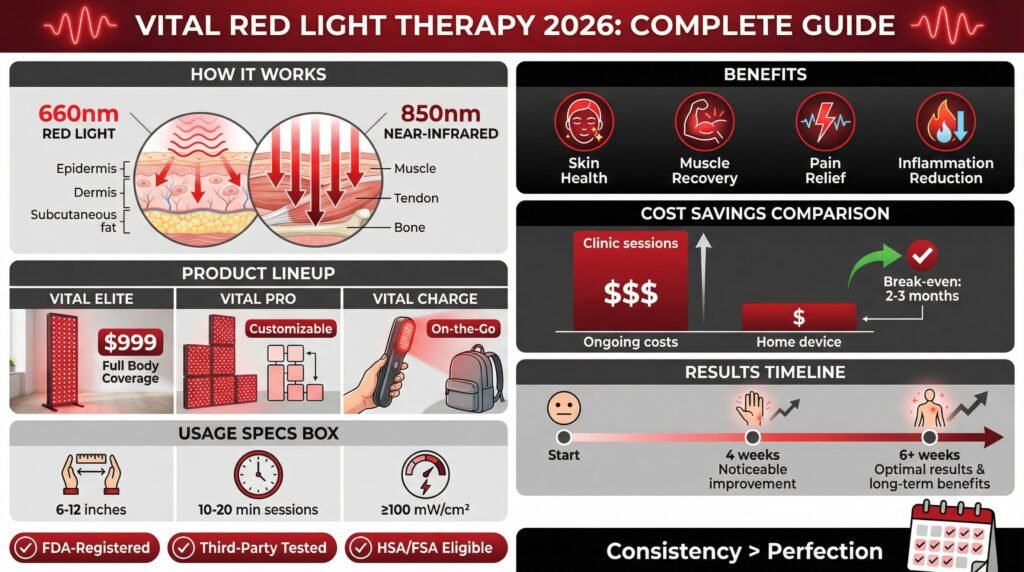
Vital Red Light offers FDA-registered, third-party tested red light therapy devices for home use, delivering 660nm red and 850nm near-infrared light to support skin health, muscle recovery, pain relief, and inflammation reduction.
The guide reviews their product lineup (full-body Vital Elite panels ~$999, modular Vital Pro, portable Vital Charge devices, and accessories), highlighting transparent specs, HSA/FSA eligibility, and major long-term savings versus clinic sessions (often breaking even in months with 2-3 uses per week).
Devices provide solid irradiance (≥100 mW/cm²), require consistent 10-20 minute sessions at 6-12 inches, and show gradual results in 4-6+ weeks with minimal risks. Vitals’ devices are great for those committed to seeking convenient, effective at-home therapy, emphasizing starting simple, tracking progress, and prioritizing consistency over chasing the “perfect” device.
Table of Contents
- Introduction to Vital Red Light Background on the brand, red light therapy basics, wavelengths (660nm red for surface/skin benefits, 850nm NIR for deeper tissue/muscle/joint effects), and why Vital stands out with transparency and testing.
- Product Categories Overview
- Full-Body Panels (Vital Elite – large panels for whole-torso/face/legs coverage)
- Modular/Mid-Size Panels (Vital Pro – flexible, expandable for targeted areas)
- Desktop and Portable Devices (Vital Charge – handheld, masks, wands, tabletop units for spot treatment/travel)
- Accessories and Add-Ons
- How to Choose the Right Product Matching devices to goals (skin vs. pain/recovery), budget, space, and treatment area.
- Setup and Getting Started Mounting, ideal distances (6-12 inches), session times (10-20 min), dosing basics (irradiance × time for 3-60 J/cm²), and building a routine (2-3×/week).
- Advanced Tips and Tricks: Optimizing routines, combining with other therapies (e.g., exercise, sauna), tracking progress.
- Troubleshooting Common Issues: Underdosing/inconsistency causing slow/no results, device problems, avoiding overexposure/irritation.
- Conclusion and Next Steps: Final verdict on value, encouragement to start, and emphasis on patience for results.
Introduction to Vital Red Light
Vital Red Light makes FDA-registered red light therapy panels and devices for home use. They focus on medical-grade LEDs that emit specific wavelengths (usually 660nm red and 850nm near-infrared) that can penetrate your skin at different depths.
The company came out of the frustration most of us feel when researching this stuff. You’ve got dozens of brands claiming their panels are the best, wildly different price points, and zero way to verify if the power output specs are even accurate.
Vital Red Light positions itself as the transparent option with third-party testing and actual customer service.
Their product line covers everything from smaller targeted panels to full-body setups. The panels use LEDs that mix red (visible) and near-infrared (invisible to our eyes) wavelengths.
Red light at 660nm works great for surface-level stuff like skin health and wound healing.
Near-infrared at 850nm penetrates deeper to reach muscles, joints, and tissues.
People use these devices for a bunch of different reasons. Some want to reduce wrinkles and improve skin tone.
Others are trying to speed up muscle recovery after workouts.
And plenty of guys deal with chronic pain or inflammation and want something that doesn’t involve pills or invasive procedures.
Product Categories Overview
Vital Red Light breaks down their lineup into a few main categories based on size and intended use. Understanding which category fits your needs saves you from buying too little (and not getting results) or too much (and wasting money).
Full-Body Panels – Vital Elite
These are the big boys. Full-body panels typically measure 36 inches or larger and let you treat large areas at once.
To stand in front of it and expose your entire torso, face, and legs, this is what you need.
Full-body setups work well for people serious about making red light therapy part of their daily routine. You can treat many areas in one session instead of moving a smaller device around.
The tradeoff is cost and space. The Vital Elite panels are $999 (depending on promotions)
Also, given the expense of professional clinic sessions at an average cost of $100 per session, these panels hit breakeven relatively quickly. And as any red light therapy practitioner will attest, consistent use equals consistent results. Usually, 2 to 3 times per week.
Use the cost-savings calculator below to see the real cost savings. Bookmark this page for future use when comparing red light therapy services in your local area.
Also, Vital’s catalog of products is HSA/FSA eligible, so you can use pre-tax dollars for extra savings.
Red Light Therapy Cost Savings Calculator
Vital Elite panels are $999 (depending on promotions). Given the expense of professional clinic sessions at an average cost of $100 per session, these panels hit breakeven relatively quickly. And as any red light therapy practitioner will attest, consistent use equals consistent results — usually 2 to 3 times per week.
Use the cost-savings calculator below to see the real cost savings. Bookmark this page for future use when comparing red light therapy services in your local area.
| Time Period | Clinic Total Cost | Panel Total Cost | Your Savings |
|---|
💡 Extra Savings: Vital’s catalog of products are HSA/FSA eligible, so you can use pre-tax dollars for additional savings on your Vital Elite panel!
Modular/Mid-Size Panels – Vital Pro
These panels are the sweet spot for most people who want targeted treatment on specific areas like the face, back, or joints without committing to a full-body system.
Modular panels give you flexibility. You can buy one to start, see how you like it, then add more later if you want fuller coverage.
They’re easier to move around your house, too. >>See the most recent promotions for the Vital Pro here<<
Desktop and Portable Devices – Vital Charge
Smaller devices are designed for faces, joints, or spot treatment. These include face masks, handheld wands, and tabletop panels.
The coverage area is limited, but they’re affordable entry points and convenient for travel.
If you mainly care about facial skin benefits or targeting one specific problem area (like a bum knee), a desktop device might be all you need. Just know that treatment times will be longer if you’re trying to cover larger areas by moving it around.
Accessories and Add-Ons
Door hangers, stands, light blockers, protective eyewear, the stuff that makes using your panel more convenient. These aren’t necessary, but they do make a difference in comfort and consistency. Access the Vital Charge on their official site by clicking the button below and take your red light therapy on the road.
How to Choose the Right Product
Picking the right panel comes down to matching your goals, budget, and available space. Here’s how to narrow it down without getting overwhelmed by specs.
Start with Your Primary Goal
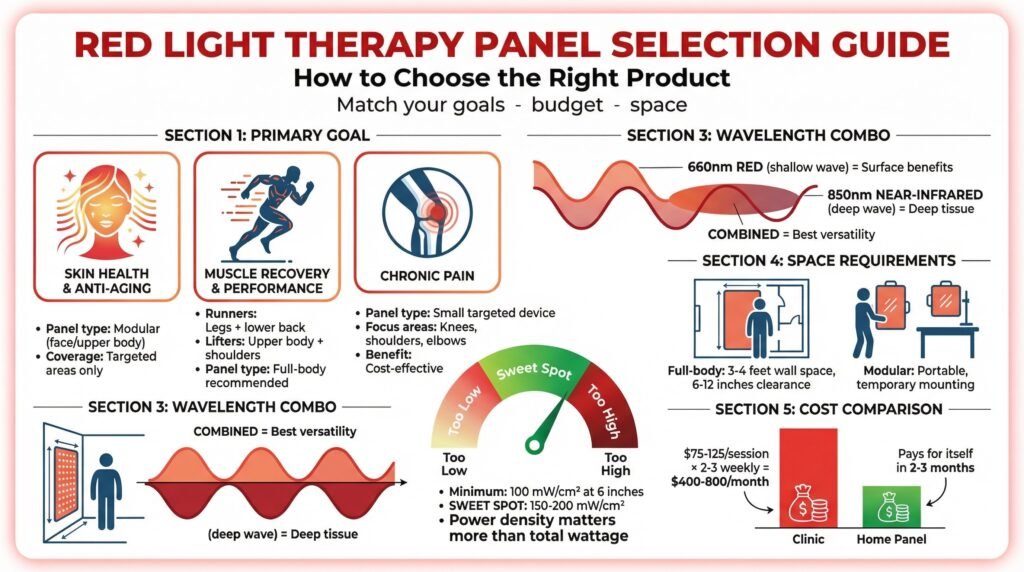
What’s the main thing you’re trying to fix? If skin health and anti-aging are your focus, a modular panel that covers your face and upper body works great.
You don’t need full-body coverage to see improvements in skin tone and wrinkles.
For muscle recovery and athletic performance, you want enough coverage to treat the muscles you actually use. Runners might prioritize leg and lower back coverage.
Lifters might want the upper body and shoulders.
Full-body panels give you the most flexibility here.
If you’re dealing with chronic pain in specific joints (knees, shoulders, elbows), a smaller targeted device might be enough. You can position it right where you need it and save some money.
Power Density Matters More Than Wattage
This is where people get confused. Total wattage sounds impressive in ads, but what actually matters is the irradiance or power density measured at the surface where you’ll stand.
Good panels deliver at least 100 mW/cm² at 6 inches from the surface. Higher is better up to a point (around 150-200 mW/cm² is the sweet spot for home devices).
Too low and you won’t get an adequate dose.
Too high and… well, you probably won’t find dangerously powerful home devices, but you might pay extra for power you don’t need.
Vital Red Light publishes third-party test results showing actual power output at different distances. This transparency helps because some brands just make up numbers.
Wavelength Combination
Most quality panels mix 660nm (red) and 850nm (near-infrared). This combo gives you surface and deep tissue benefits in one device.
Some panels let you toggle between wavelengths or run them together.
Unless you have a very specific reason to use only one wavelength, the combination panels are the way to go. You get more versatility without buying many devices.
Treatment Area and Space
Measure the space where you’ll actually use this thing. Full-body panels need about 3-4 feet of wall space or a sturdy stand.
They also need clearance in front so you can stand 6-12 inches away comfortably.
If you live in a small apartment or don’t have a dedicated wellness space, modular panels might make more sense. You can hang them temporarily or move them between rooms.
Budget Reality Check
At-home red light therapy saves money compared to clinic sessions, but the upfront cost still matters. A single clinic session might run $50-100.
If you go twice a week, that’s $400-800 per month.
A quality panel pays for itself in 2-3 months of regular use.
That said, don’t cheap out so much that you buy a low-power device that doesn’t work or end up spending $75 – 125 per session, 2 to 3 times a week in a clinical environment.
Check out Vital Red Light’s current lineup to see where different models fall in terms of price and power. Click the button below to visit Vital’s official site.
Setup and Getting Started
You’ve got your panel. Now what?
Setting it up right makes the difference between consistent use and letting it collect dust in a closet.
Physical Installation
Most panels come with hanging hardware to mount on a door or wall. Door mounting is popular because you don’t have to drill holes, and you can take it down when not in use.
Wall mounting is more permanent, but it frees up your door.
If you go the stand route, make sure it’s stable. These panels aren’t super heavy, but you don’t want them tipping over.
Position the panel at the right height for what you’re treating. For the face and upper body, mount it at chest/face level.
For full-body treatment, center it around your midsection so coverage extends up and down.
Your First Session
Start conservative. Even though red light therapy is pretty safe, some people get slight headaches or feel weary if they overdo it on day one.
Begin with 5-10 minutes at 12 inches away for the first few sessions.
Stand or sit comfortably at the recommended distance. You should feel gentle warmth on your skin, but nothing uncomfortable.
If you don’t feel anything, that’s normal too; near-infrared is invisible and doesn’t always produce a heat sensation.
You can use red light therapy naked or in minimal clothing. Unlike UV light, red and near-infrared light don’t pose a cancer risk.
The more skin exposed, the more area you’re treating.
Building a Routine
Consistency beats intensity with red light therapy. Daily sessions of 10-20 minutes work better than occasional long sessions.
The effects are added; you’re not going to see dramatic changes after one use.
Most people do their sessions in the morning or evening. Morning sessions might help with energy and circadian rhythm.
Evening sessions are relaxing and fit easily into a bedtime routine.
Pick whatever time you’ll actually stick with.
Track your sessions somehow. Set a phone reminder, use a habit tracking app, or just mark it on a calendar.
The first month is when you’re building the habit, so don’t skip days if you can help it.
Grab a Vital Red Light panel and start your routine (they usually have bundle deals that save you some cash).
Advanced Tips and Tricks
Once you’ve got the basics down and have been using your panel regularly for a few weeks, these tips can help you improve results.
Distance and Duration Adjustments
The standard recommendation is 6-12 inches from the panel for 10-20 minutes. But you can adjust based on your goals.
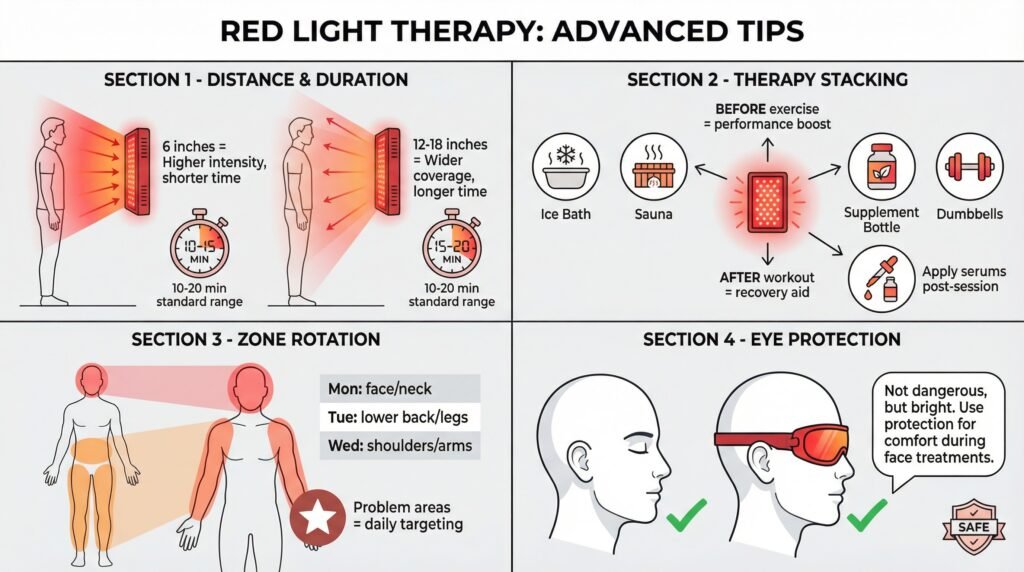
Closer distance (6 inches) delivers higher power density for shorter sessions.
Further distance (12-18 inches) covers more area but needs longer sessions to get the same dose.
Calculate your dose using this formula: irradiance (mW/cm²) × time (seconds) = dose (J/cm²). Most research shows benefits in the range of 3-60 J/cm².
Your panel’s spec sheet should tell you the irradiance at different distances.
Layering With Other Therapies
Red light therapy stacks well with other wellness practices. People mix it with ice baths, sauna sessions, and specific supplements.
There’s some evidence that using red light before exercise might enhance performance, while post-workout sessions help recovery.
For skin benefits, many people apply serums or skincare products right after red light sessions. The theory is that red light increases blood flow and might help with absorption.
No solid research proves this, but it doesn’t hurt.
Zone Targeting
You don’t have to treat your whole body every session. Rotate between zones if you have limited time.
Monday could be face and neck, Tuesday lower back and legs, Wednesday shoulders and arms, etc.
Target problem areas more often. If you’ve got a nagging shoulder injury, hit that spot daily while rotating other areas every other day.
Eye Protection Debate
This one comes up a lot. Red and near-infrared light at the power levels in home devices isn’t going to blind you.
Looking directly at the LEDs is uncomfortable (they’re bright), but brief exposure isn’t dangerous like lasers.
That said, if bright light bothers you or you’re treating your face with eyes open, wearing red light therapy goggles or just closing your eyes makes the session more comfortable. Some people skip eye protection when treating other body parts and just avoid staring at the panel.
Troubleshooting Common Issues
Even with straightforward technology like red light panels, you might run into problems. Here’s how to fix the most common ones.
Not Seeing Results
If you’ve been using your panel consistently for 4-6 weeks and haven’t noticed any improvements, check these things:
Are you actually getting an adequate dose? Recalculate your irradiance and session time.
You might need to move closer or extend your sessions.
Underdosing is the most common reason people think red light “doesn’t work.”
Are you consistent? Skipping many days per week reduces the cumulative effect.
Red light therapy works through repeated exposure, not occasional use.
Are your expectations realistic? Red light therapy produces gradual improvements, not overnight transformations.
Skin changes take 4-8 weeks.
Pain reduction might happen faster, but it varies by person. Take photos beforehand so you can actually see subtle changes over time.
Panel Not Turning On
Check the obvious stuff first: is it plugged in, is the outlet working, is the power switch actually on? These panels use standard electrical plugs and wall outlets, so basic troubleshooting applies.
If half the LEDs light up but others don’t, you might have a connection issue or defective LEDs. Contact customer support with photos and your order info.
Most reputable brands have warranties covering defective units.
Skin Irritation or Redness
This is a rare side effect, but it can happen. Mild redness that fades within 30 minutes is normal, especially when you’re starting out.
Your skin is getting increased blood flow.
Redness that lasts for hours or comes with itching might mean you’re overdoing it. Cut your session time in half and gradually build back up.
Make sure you’re at least 6 inches away from the panel.
If you’re using skincare products before your session, try doing red light first on clean skin. Some products might react poorly to heat or light exposure.
Inconsistent Results
Some days you feel great after a session, other days nothing. This is normal.
Your body’s response varies based on sleep, stress, diet, and a bunch of other factors.
Keep using it consistently anyway. The research on red light therapy looks at results over weeks and months, not day-to-day fluctuations.
Think of it like exercise, some workouts feel amazing, and others are a slog, but they all contribute to long-term fitness.
Conclusion and Next Steps
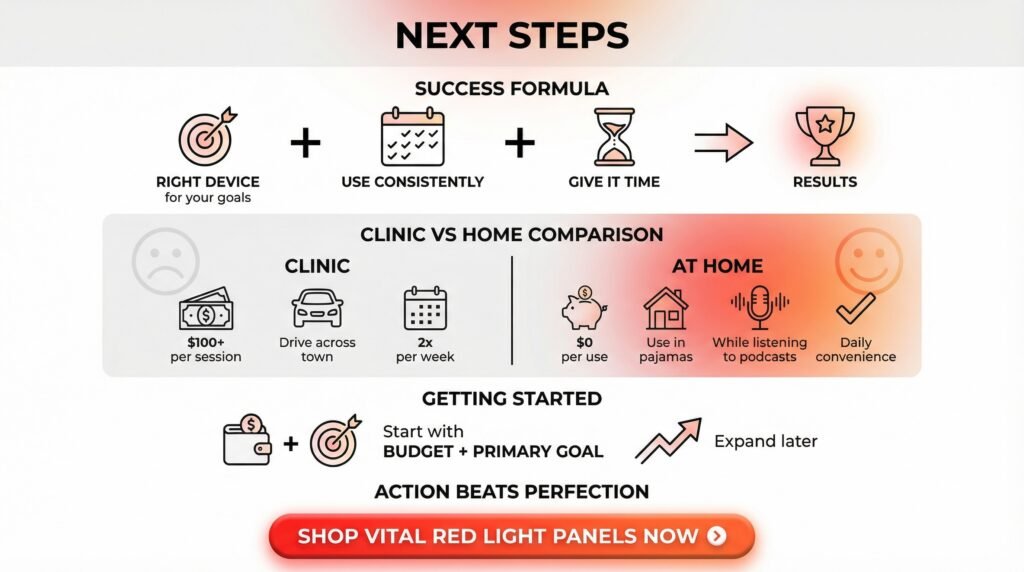
This Vital Red Light guide covered the main things you need to know to choose and use Vital Red Light products effectively. Red light therapy at home works when you pick the right device for your goals, use it consistently, and give it enough time to produce results.
The biggest advantage of at-home panels is that you’re not spending $100+ per clinic session or driving across town twice a week. You can use your panel daily in your pajamas while listening to a podcast.
The convenience factor makes it easier to stick with it long enough to actually see benefits.
If you’re still on the fence about which panel to get, start with what fits your budget and primary goal. You can always add more panels later or upgrade to a larger system.
The important thing is to actually start using red light therapy instead of spending months researching the “perfect” device.
Check out Vital Red Light’s current models and deals here and pick one that matches your needs.
For people new to red light therapy, expect a learning curve of a few weeks while you figure out your ideal distance, timing, and routine. Don’t get discouraged if you don’t see massive changes in week one.
Most people report noticeable improvements around the 4-6 week mark with daily use.
Track your progress somehow, photos for skin changes, notes about pain levels or energy, whatever metrics matter for your specific goals. Subjective feelings are fine, but having some objective measure helps you stick with it during the period where changes are subtle.
Red light therapy fits into the category of wellness practices that need patience but deliver real benefits when used correctly. Similar to strength training or meditation, you’ve got to show up consistently and give it time.
The good news is that sessions are short, the devices last for years, and the risk of side effects is minimal.
Start with the basics from this guide, use your panel regularly, and adjust based on what you notice in your own body. That’s how you get the most value out of your investment in red light therapy.
Read more about Vital’s Red Light products here.
Access our full list of reviews of other red light products for at-home use
FAQs
What wavelengths do Vital Red Light devices use, and what do they do? 660nm (red) targets surface-level benefits like skin rejuvenation, collagen boost, and wound healing; 850nm (near-infrared) penetrates deeper for muscle recovery, joint pain relief, and inflammation reduction.
Are Vital Red Light products worth it compared to clinic visits? Yes, for regular users. A $999 full-body panel can break even quickly (e.g., equivalent to $9-10 per session vs. $100+ clinic fees), with HSA/FSA eligibility and lifelong home convenience.
How long until I see results? Most people notice improvements in 4-6 weeks with consistent use (2-3 sessions/week); skin benefits may take 4-8 weeks, while pain/recovery can vary.
What if I don’t see results? Common causes include underdosing (too short/distant sessions), inconsistency, or unrealistic expectations (no overnight changes). Adjust distance/time, track usage, and give it at least 6 weeks.
Which product should beginners start with? Depends on goals. Portable Vital Charge for targeted/affordable entry, Vital Pro for mid-size flexibility, or Vital Elite for comprehensive full-body treatment if budget/space allows. Start simple and consistent rather than over-researching.
Are there any risks or side effects? Minimal. Generally safe with no major side effects; rare mild irritation from overuse. Use protective eyewear when needed and follow guidelines.
This article includes affiliate links. If you click through and make a purchase, I may receive a small commission. This helps support the site and allows me to keep creating helpful content at no extra cost to you.