Quick Summary
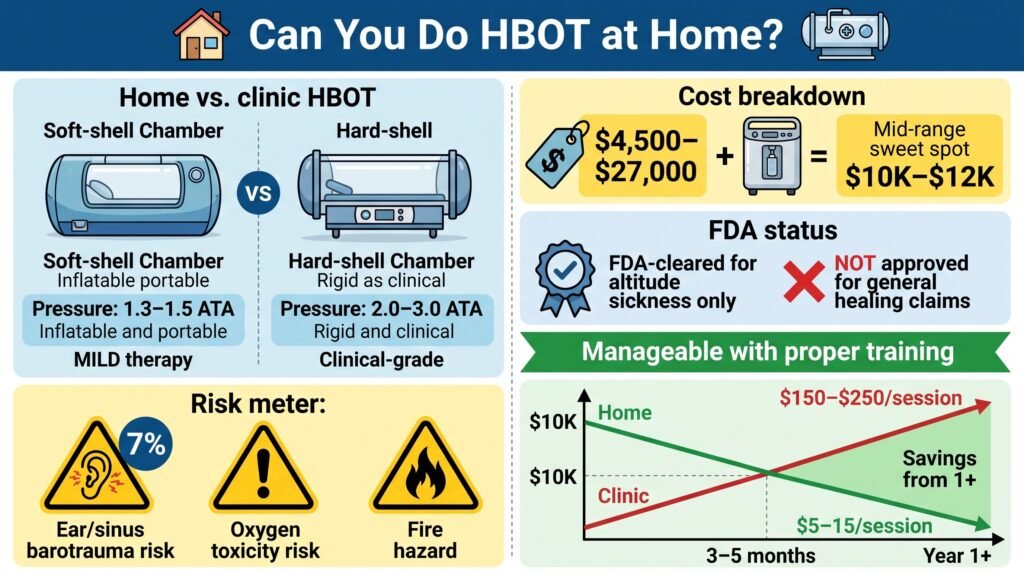
Home hyperbaric oxygen therapy usually means “mild” HBOT at 1.3–1.5 ATA in soft-shell chambers, much gentler than the 2.0–3.0 ATA hard-shell chambers used in clinics, so results differ too. Soft-shell setups run $4,500–$27,000 plus an oxygen concentrator, with only a few FDA-cleared for altitude sickness (not general healing claims). Main risks are ear/sinus barotrauma (~7% of sessions), oxygen toxicity, and fire — all manageable with proper technique and precautions. Financially, a mid-range home chamber ($10K–$12K) typically breaks even against $150–250/session clinic visits within 3–5 months of regular use, dropping to $5–15/session after year one.
Table of Contents
- Quick Summary
- What Home HBOT Actually Means
- The HBOT Equipment Landscape
- Safety Considerations That Actually Matter
- Clinic vs Home Pricing and Value Assessment
- Cost-Savings Calculator
- People Also Asked
What Home HBOT Actually Means
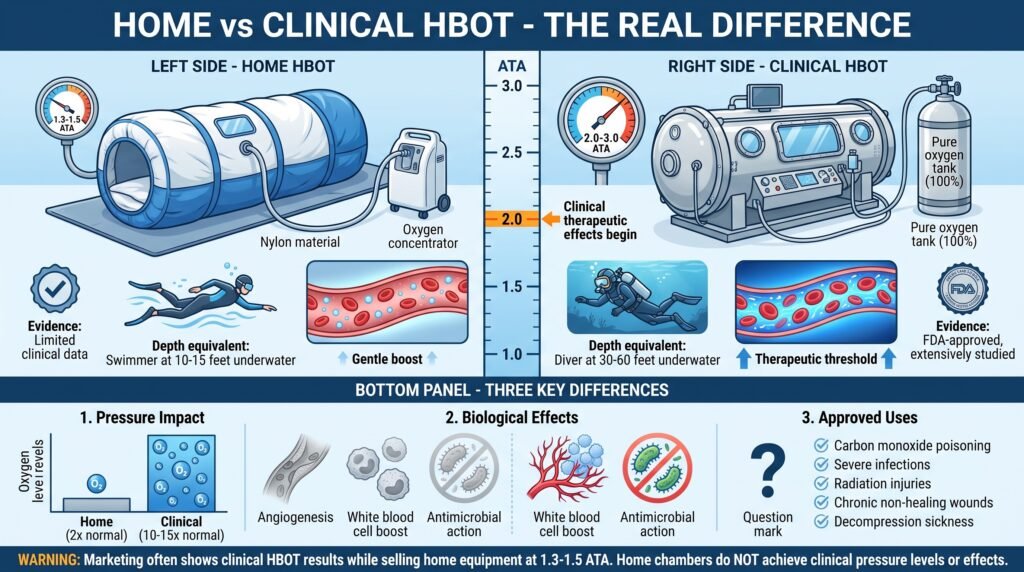
When you see “hyperbaric oxygen therapy” advertised for home use, you’re almost always looking at what’s called mild hyperbaric therapy. These systems typically use soft-shell chambers- think of a large, pressurized fabric tube- that operate at around 1.3 to 1.5 atmospheres absolute (ATA).
To put that in perspective, that’s roughly the equivalent of diving 10 to 15 feet underwater in terms of pressure increase.
Clinical hyperbaric facilities, by contrast, use hard-shell chambers that can reach 2.0 to 3.0 ATA or even higher for specific medical conditions. That difference in pressure isn’t just a technical detail.
It fundamentally changes what the therapy can accomplish physiologically.
At higher pressures, oxygen dissolves directly into your blood plasma in quantities that can reach damaged tissues in ways normal breathing cannot. This is why hospital-grade HBOT can treat carbon monoxide poisoning, severe infections, and radiation injuries.
The oxygen delivery at those pressures creates measurable therapeutic effects that have been studied extensively and approved by regulatory bodies.
At 1.3 ATA with an oxygen concentrator, the typical home setup, you’re working with much gentler pressure and oxygen delivery. This isn’t necessarily bad, but it means the biological effects are different and, frankly, less well-established for most of the conditions home chambers are marketed to address.
The pressure differential really matters here. When you’re at 2.5 or 3.0 ATA breathing pure oxygen, you’re achieving oxygen partial pressures that can be ten to fifteen times higher than normal.
That level of oxygenation drives mechanisms like angiogenesis (new blood vessel formation), enhanced white blood cell function, and significant antimicrobial effects.
At 1.3 ATA with supplemental oxygen from a concentrator, you’re getting a modest boost in dissolved oxygen, but you’re not reaching the therapeutic thresholds required for many of the dramatic healing effects seen in clinical studies.
This distinction gets glossed over in marketing materials that show the same before-and-after healing photos from clinical HBOT studies while selling you equipment that operates at less than half the pressure. You need to understand what you’re actually buying.
The HBOT Equipment Landscape
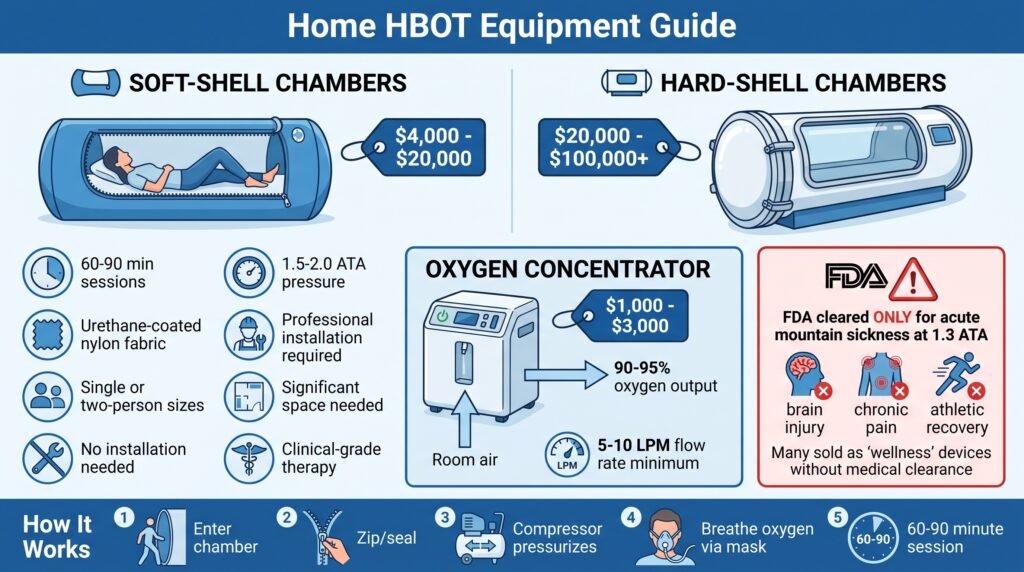
Soft-shell portable chambers dominate the home market because they’re relatively affordable and don’t need major installation work. Prices for these units typically range from about $4,000 to $20,000, depending on size, brand, and features.
You’ll also need an oxygen concentrator, which adds another $1,000 to $3,000 to your setup cost.
These chambers zip up around you, then pressurize using an electric compressor. You lie inside, usually with an oxygen mask or nasal cannula connected to the concentrator, breathing oxygen-enriched air while the chamber maintains its mild pressure.
Sessions typically last 60 to 90 minutes.
The chambers come in different sizes. Single-person chambers are basically large tubes where you lie down flat.
Some models are wider or taller, giving you more room to move around or sit up.
Larger models can fit two people, though that substantially increases the price. The fabric is typically urethane-coated nylon or similar material, designed to handle repeated pressurization cycles without developing leaks.
Hard-shell personal chambers exist for home use as well, but they’re a different animal entirely. These can cost anywhere from $20,000 to well over $100,000, need significant space, and often need professional installation with proper ventilation and electrical setup.
Most people exploring home HBOT never seriously consider these because of the cost and complexity.
But if you do have the resources and space, hard-shell home chambers can reach higher pressures than soft-shell models, typically up to 1.5 or occasionally 2.0 ATA, getting you closer to clinical-grade therapy.
What’s really important to understand about the soft-shell chambers is their regulatory status. In the United States, only a handful of portable soft-chamber models hold FDA 510(k) clearance, and those are cleared specifically for treating acute mountain sickness at 1.3 ATA.
Not for brain injury, not for chronic pain, not for athletic recovery.
Just altitude sickness.
Many other chambers on the market are sold under European CE marks or without any medical device clearance at all. They’re marketed for “wellness” purposes, which allows manufacturers to sidestep medical device regulations while still making suggestive claims about benefits.
This regulatory gray zone is something you need to be acutely aware of.
Just because you can buy something online doesn’t mean it’s been vetted for safety or efficacy for the use you have in mind.
The oxygen concentrators deserve attention too. These devices pull in room air, strip out the nitrogen, and output oxygen-enriched air, typically around 90-95% oxygen purity.
Medical-grade concentrators are more reliable and consistent than cheaper models.
Flow rate matters; you want a concentrator that can deliver at least 5 liters per minute, preferably 10 LPM, to confirm adequate oxygen supply during your session. Cheaper concentrators sometimes can’t maintain consistent output over long sessions or lose efficiency over time.
Hyperbaric Pro: Recovery You Can Trust
Looking for a hyperbaric oxygen chamber that’s built to last? Hyperbaric Pro has you covered with triple-layer walls, sturdy viewing windows, and a design that’s genuinely easy to use on your own — no assistance needed.
Whether you need a clinic-grade chamber or a portable option for home, every model comes fully loaded: air conditioning, a dehumidifier, an ionizer, and a three-year warranty. Made in Germany with phthalate-free materials, these chambers are built for the long haul.
Athletes and professionals trust Hyperbaric Pro for good reason — quality performance at a range of price points, so healing and daily wellness stay within reach.
Ready to recover better? Explore the Hyperbaric Pro lineup today. Click the button below to find the right fit for your needs.
Safety Considerations That Actually Matter
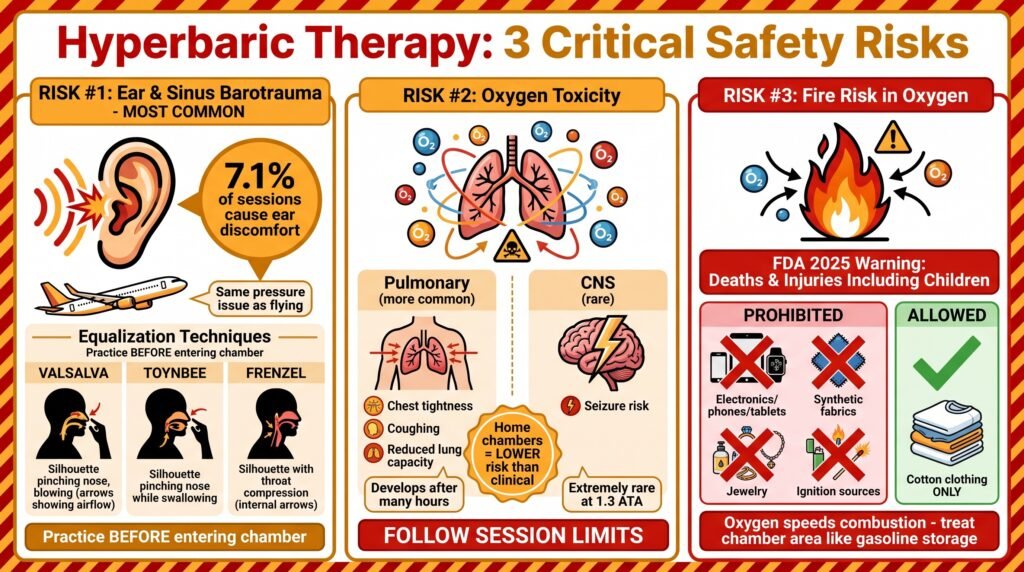
The most common complication with hyperbaric therapy, whether at home or in a clinic, is ear and sinus barotrauma. As pressure increases, air in your middle ear needs to equalize, just like when you’re on an airplane.
If you can’t equalize properly, maybe because of congestion, a cold, or just personal anatomy, you can experience significant pain and, in rare cases, damage to your eardrum.
I’ve talked to dozens of people who use home chambers, and almost everyone reports at least occasional ear discomfort. Learning proper equalization techniques before you start is essential.
The Valsalva maneuver (gently blowing against closed nostrils) works for some people.
Others do better with the Toynbee maneuver (swallowing while pinching the nose) or the Frenzel maneuver (using throat muscles to compress air). Practicing these techniques dry, before you’re actually in a pressurizing chamber, makes a huge difference.
In a 2023 study by Monge and colleagues examining mild hyperbaric therapy, about 7.1% of sessions resulted in some form of adverse event, and essentially all of them were subjective ear discomfort. No documented eardrum ruptures occurred, which suggests that with proper instruction and screening, serious complications are uncommon.
But that 7.1% rate also means that if you’re doing regular sessions, you’ll probably experience uncomfortable pressure episodes at some point.
The second major concern is oxygen toxicity. Breathing high concentrations of oxygen for extended periods can irritate your lungs and, at extreme levels, affect your central nervous system.
In practice, mild home chambers at 1.3 ATA with oxygen concentrators are much less likely to cause oxygen toxicity than clinical systems using 100% oxygen at higher pressures.
But it’s not zero risk, especially if you extend sessions beyond recommended durations or use the chamber many times per day without proper breaks.
Pulmonary oxygen toxicity presents as chest tightness, coughing, and reduced lung capacity. It typically develops after many hours of continuous high-oxygen exposure.
CNS oxygen toxicity is more dramatic; seizures can occur, but this is exceedingly rare at the low pressures used in home chambers.
Still, following recommended session lengths and frequencies isn’t optional. These limits exist for good reasons.
The third risk, and the one that regulators are increasingly vocal about, is fire. Oxygen dramatically speeds up combustion.
In an oxygen-enriched environment, things that would smolder can burst into flames.
Materials that are normally safe become dangerous. The FDA issued a safety communication in 2025 specifically highlighting fires, injuries, and deaths associated with hyperbaric chambers, including incidents involving children.
Fire prevention in a home chamber means no electronics inside, no synthetic fabrics that can generate static, no petroleum-based lotions or lip balm, and absolutely no ignition sources anywhere near the chamber. Treat the chamber area with the same caution you’d use when storing gasoline.
Cotton clothing only.
Remove all jewelry that could create sparks. No phones, tablets, or any battery-powered devices inside with you.
These rules might seem excessive until you understand how fast things can go wrong in an oxygen-rich environment.
Clinic vs Home Pricing and Value Assessment
Clinical hyperbaric sessions commonly cost $150-250 per session at facilities using hard-shell chambers and 2.0 ATA protocols. Premium clinics or hospital settings can charge even more.
Some cities see broader ranges of $80-350 per session depending on the facility and chamber type.
Home soft-shell chambers usually cost:
- Entry soft-shell: about $4,500-$8,000
- Mid-range soft-shell: roughly $9,000-$14,000
- Premium soft-shell: $16,000-$27,000
- Hard-shell personal chambers: $25,000-$50,000+
Several independent guides estimate that a mid-range home chamber around $10,000-$12,000 breaks even against clinic sessions after about 40-60 visits at $200-250 each. At three sessions per week, that break-even point lands around 3-5 months.
For heavy users, the home cost per session drops dramatically after the first year. One analysis I read placed the first-year all-in cost at about $38 per session for a $12,000 chamber.
In later years, when ongoing costs are mostly electricity and maintenance, it falls to $5-15 per session.
The math is straightforward once you know the actual price:
- Estimate your likely sessions per month
- Multiply by 12 to get yearly sessions
- Compare clinic cost per session against home amortized cost
If you hit 50-150 sessions in a year or two, home units usually pay for themselves within 6-18 months compared to ongoing clinic visits.
When you’re ready to calculate your personal break-even point, confirm current Hyperbaric Pro pricing through this link and plug the numbers into a simple spreadsheet. Treat this like a serious investment, not an impulse buy.
Bookmark this page and come back to it whenever you are calculating the cost of professional sessions in your area vs. unlimited home use.
Hyperbaric Oxygen Chamber Cost Calculator
Compare the long-term costs of clinical hyperbaric sessions versus investing in an at-home chamber. See your break-even point and potential savings.
Clinical Sessions
Home Chamber
Break-Even Point
58 sessions (4.8 months)
Why Choose an At-Home Chamber?
Convenience: No travel time, scheduling hassles, or waiting rooms. Use your chamber whenever you want.
Cost Savings: Most users break even within 3-5 months with regular use (3 sessions/week).
Long-Term Value: After the first year, your effective cost per session drops dramatically – often to just $38-50 per session.
Privacy & Comfort: Enjoy treatments in the comfort of your own home with complete privacy.
Learn more about who should not use home HBOT, further research and evidence, setup considerations, and more here.
People Also Asked
Can mild hyperbaric chambers help with concussions?
The evidence for mild hyperbaric therapy treating concussions and traumatic brain injury is controversial. Some small studies have suggested benefits, but larger controlled trials have been less convincing.
Clinical HBOT at higher pressures has more research support for certain types of brain injury, but even there the evidence is mixed. If you're considering this for concussion recovery, know that you're in experimental territory.
What pressure should a home hyperbaric chamber be?
Most home soft-shell chambers operate at 1.3 to 1.5 ATA. This is significantly lower than clinical chambers that reach 2.0 to 3.0 ATA.
The lower pressure in home units makes them safer for unsupervised use and limits the therapeutic effects compared to clinical treatment.
How often should you use a hyperbaric chamber at home?
Common protocols suggest three to five sessions per week, with each session lasting 60 to 90 minutes. However, optimal frequency depends on what you're trying to accomplish and how your body responds.
Some people use chambers daily during intensive protocols, while others maintain with just one or two sessions weekly.
Do you need a prescription for a home hyperbaric chamber?
In the United States, you don't need a prescription to purchase a mild hyperbaric chamber for home use. However, this doesn't mean medical supervision isn't valuable.
Getting proper screening and guidance from a doctor familiar with hyperbaric medicine is strongly recommended even though it's not legally required.
Can hyperbaric oxygen therapy help with inflammation?
Clinical hyperbaric oxygen therapy at higher pressures has demonstrated anti-inflammatory effects in certain conditions. For mild hyperbaric therapy at 1.3 ATA, the evidence for significant anti-inflammatory benefits is less established.
Some small studies suggest modest effects, but more research is needed to decide clinical significance.
This article includes affiliate links. If you click through and make a purchase, I may receive a small commission. This helps support the site and allows me to keep creating helpful content at no extra cost to you.