Quick Summary
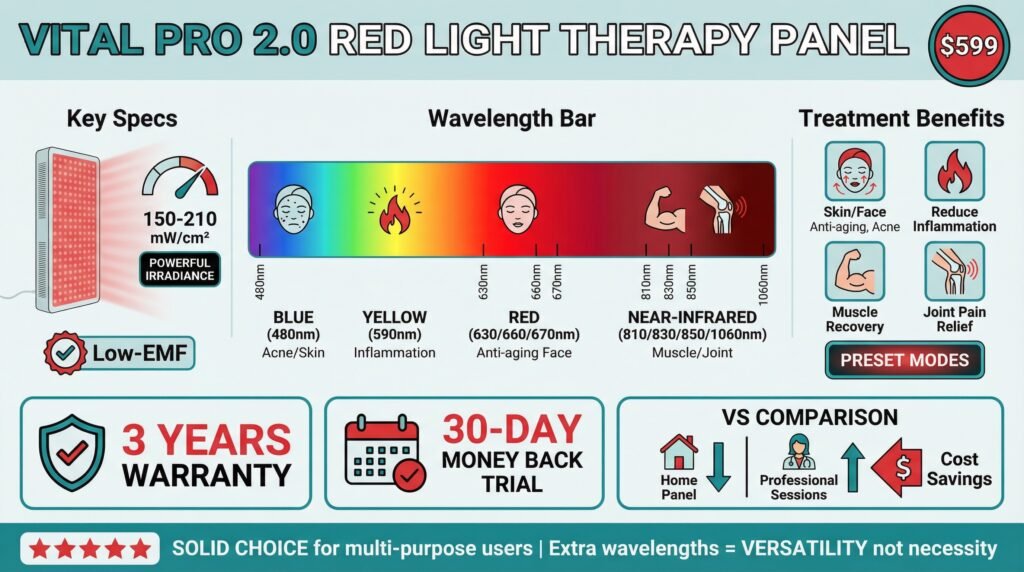
The Vital Pro 2.0 is a $599 targeted red light therapy panel from Vital Red Light featuring nine wavelengths (blue 480nm, yellow 590nm, red 630/660/670nm, near-infrared 810/830/850/1060nm) for versatile at-home use. It covers skin health (anti-aging, acne, inflammation), muscle recovery, joint pain, and more via preset modes.
The review finds it solid and worth considering for committed users needing multi-purpose treatment, though extra wavelengths add versatility rather than being strictly necessary for basic red/NIR benefits. It’s half-body sized, powerful (150-210 mW/cm² irradiance), low-EMF, with a 3-year warranty and 30-day trial, offering good long-term value vs. professional sessions.
Click here to see the current price and warranty terms on the manufacturer’s site.
Table of Contents
- Introduction to the Vital Pro 2.0
- Key Specifications and Features
- The Nine Wavelengths Explained
- Do Nine Wavelengths Actually Matter?
- Pros and Cons
- Who It’s Best For and Comparisons
- Price, Value, and Final Verdict
- FAQ
Introduction
The Vital Pro 2.0 sits in an interesting spot in the red light therapy market. It’s priced at $599, includes nine different wavelengths (which is way more than most panels), and targets half your body at once.
The device appeals to people in different situations. Some are dealing with facial wrinkles and aging skin. Others want faster muscle recovery after workouts.
Guys are managing chronic skin conditions like acne or psoriasis.
And then there’s the biohacker crowd tracking every health metric they can measure.
What makes this device stand out is the multi-wavelength approach. Most red light panels you’ll find online stick to just two wavelengths (usually 660nm and 850nm).
The Vital Pro 2.0 throws in blue light, yellow light, and seven other specific wavelengths.
Whether that’s actually useful or just marketing depends on what you’re trying to fix.
What You Actually Get for $599
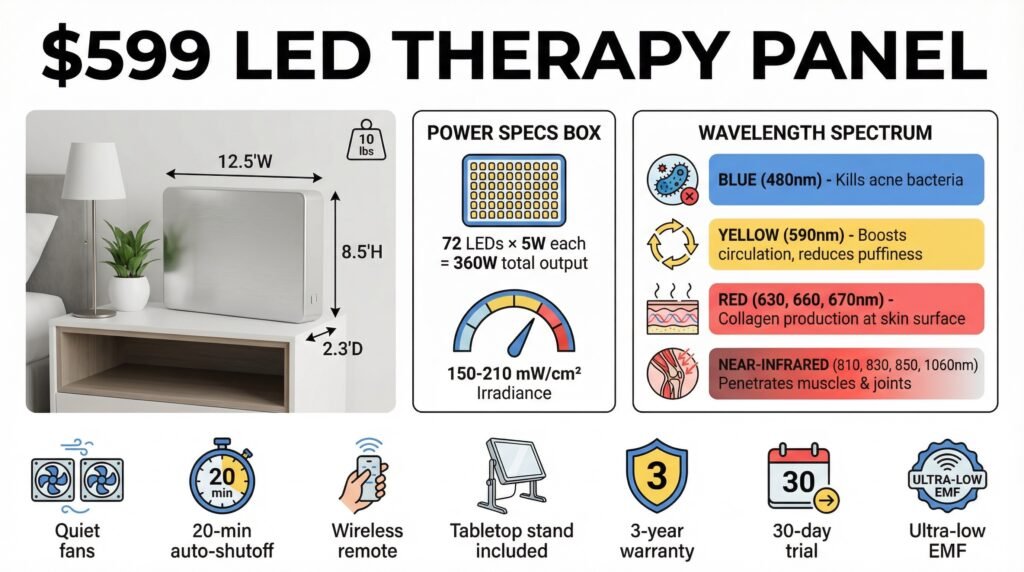
The panel measures 12.5″ x 8.5″ x 2.3″ and weighs about 10 pounds. It sits on your nightstand or a shelf, not something you mount on the wall (though you could if you wanted to).
Inside are 72 LEDs rated at 5 watts each. The total power output hits 360W, and the irradiance measures between 150-210mW/cm² depending on how far you stand from it.
Here’s the wavelength breakdown:
- Blue: 480nm
- Yellow: 590nm
- Red: 630nm, 660nm, 670nm
- Near-infrared: 810nm, 830nm, 850nm, 1060nm
The red wavelengths (especially 660nm) target your skin surface and help with collagen production. The near-infrared wavelengths (especially 850nm) penetrate deeper into muscles and joints.
Blue light kills acne bacteria.
Yellow light boosts circulation and reduces puffiness.
The device includes two cooling fans that run pretty quietly, a 20-minute auto-shutoff timer, and a remote so you don’t have to get up mid-session to adjust settings. It comes with a basic tabletop stand, a 3-year warranty, and a 30-day trial period.
EMF emissions are ultra-low, which matters if you’re concerned about electromagnetic exposure during treatment.
The Preset System and How It Works
Instead of manually selecting wavelengths, the Vital Pro 2.0 uses preset modes. You pick your goal, and the device automatically activates the right combination of wavelengths.
The presets include:
- Skin health
- Muscle recovery
- Joint pain
- Fat loss
- Sleep
- Universal wellness
For example, the skin preset combines red wavelengths (630, 660nm) with blue light to kill acne bacteria and yellow light to reduce puffiness. The muscle recovery preset uses red and all the near-infrared wavelengths to penetrate deep tissue.
This removes the confusion about which wavelengths to use. You don’t need to research penetration depths or understand the science behind each frequency.
Just pick what you want to improve and start the session.
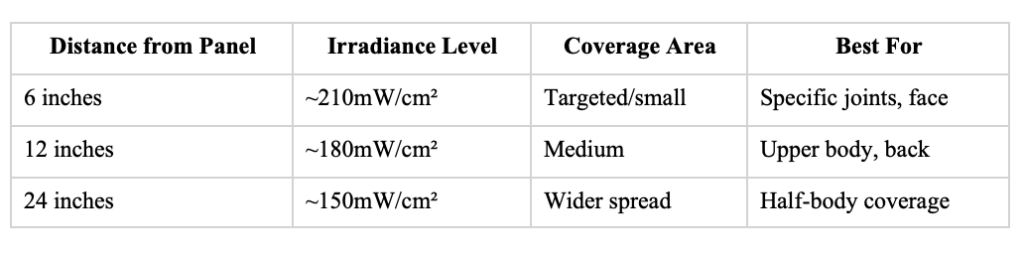
Each session runs for 20 minutes. You position yourself 16-24 inches away from the panel.
Closer gives you higher intensity but covers less area.
Farther away covers more area but reduces intensity.
Who Gets the Most Out of This Device
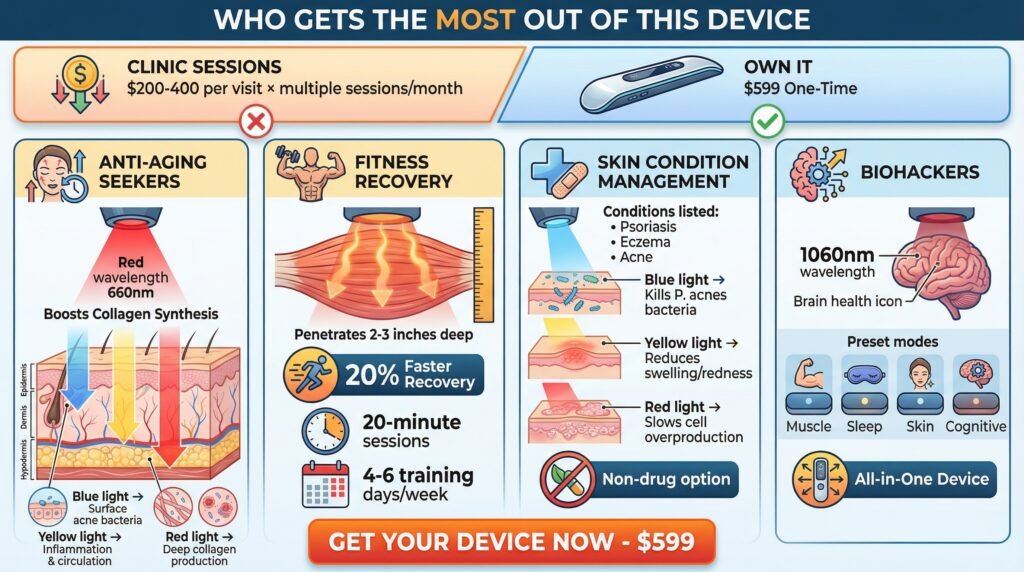
People dealing with aging skin and wrinkles benefit from the red wavelengths that stimulate collagen production. The skin ages partly because collagen breaks down faster than your body produces it.
Red light therapy at 660nm has solid research showing it boosts collagen synthesis.
Instead of paying $200-400 per session at a clinic (and needing many sessions per month), you own the device outright for $599. If you use it daily for even three months, the math makes sense.
The skin preset combines many wavelengths to address different layers of skin damage at once. Blue light handles surface-level acne bacteria.
Yellow light reduces inflammation and improves circulation.
Red light penetrates deeper to trigger collagen production.
Fitness people focused on recovery use the muscle recovery preset that includes all the near-infrared wavelengths. These penetrate 2-3 inches deep into tissue, reaching muscles and supporting cellular energy production (ATP).
Red light therapy reduces inflammation markers and speeds up the healing process after intense training. For someone training 4-6 days per week, cutting recovery time by even 20% makes a noticeable difference in how you feel during the next workout.
The 20-minute session fits into a post-workout routine without adding much time. You can sit in front of the panel while stretching or checking your phone.
People managing chronic skin conditions like psoriasis, eczema, or persistent acne can use the blue and yellow wavelengths alongside the red. Psoriasis involves overactive skin cell production. Red light therapy can slow that down and reduce inflammation.
Acne responds to blue light because it kills Propionibacterium acnes bacteria on the skin surface. Yellow light reduces swelling and redness.
This doesn’t replace medical treatment for severe cases, but it offers a non-drug option for mild to moderate conditions. The cost of repeated dermatology visits adds up quickly, especially if insurance doesn’t cover light therapy treatments.
The biohacker crowd interested in optimizing everything will appreciate the 1060nm wavelength, which is less common in consumer devices. Some research suggests it supports cognitive function and brain health, though the evidence is less robust than for skin and muscle benefits.
The preset system lets you switch between different goals. Maybe you use the muscle recovery preset after workouts, the sleep preset in the evening, and the skin preset in the morning.
The device handles many optimization goals without needing separate equipment.
Cost Breakdown Over Time
At $599 upfront, the per-session cost depends on how long you use it. Let’s assume daily use over three years (the warranty period).
That’s 1,095 sessions, which works out to roughly 55 cents per treatment.
Professional red light therapy sessions cost anywhere from $150-400 depending on location and clinic. Even at the low end ($150), three sessions cost more than buying the device outright.
If you need ongoing treatment for chronic conditions or long-term anti-aging goals, the at-home device makes financial sense.
The LEDs are rated for 50,000 to 100,000 hours of use. Even at daily 20-minute sessions, that’s decades of lifespan. The device will likely outlast your need for it.
To further sweeten the deal, Vital Red Light has partnered with Flex to allow you to take advantage of pre-tax dollars by using your Health Savings Account (HSA) or Flexible Spending Account (FSA). This alone can result in net savings of 30-40%, depending on your tax bracket.
See the cost-savings calculator below to crunch the real numbers. Bookmark this page to return when you are comparing the Vital Charge to red light therapy services in your local area.
Red Light Therapy Cost Savings Calculator
See how much you’ll save with an at-home device versus professional sessions
Device Longevity & Value
- LEDs rated for 50,000 to 100,000 hours of use
- Even at daily 20-minute sessions, that’s decades of lifespan
- 3-year warranty period included
- Device will likely outlast your need for it
- Perfect for chronic conditions or long-term anti-aging goals
How This Compares to Other Options
Most red light devices fall into a few categories:
Basic two-wavelength panels (usually 660nm and 850nm) cost less (typically $300-500 for a similar size) but don’t include blue or yellow light. If you specifically need acne treatment or circulation benefits, you’d need a separate device.
Handheld devices offer portability and lower prices ($100-300) but need manual treatment of different body areas and deliver lower irradiance. You end up spending more time treating the same area to get equivalent results.
Full-body panels provide finish coverage but cost significantly more ($1,500-3,000) and need dedicated floor space. These make sense if you want to treat your entire body daily, but they’re overkill if you’re mainly focused on facial skin or targeted muscle recovery.
The Vital Pro 2.0 sits between basic panels and full-body systems. It costs more than basic two-wavelength panels but offers more versatility.
It costs less than full-body systems but provides less coverage.
Whether that middle position works for you depends on your primary use case.
The Honest Assessment
This Vital Pro 2.0 review would be incomplete without addressing what the device does well and where it has limitations.
What it does well: The nine-wavelength system covers most common use cases without needing many devices. The preset modes eliminate confusion about settings.
The build quality seems solid based on user feedback.
The 3-year warranty and 30-day trial reduce purchase risk. The cooling fans keep it from overheating.
The price sits in a reasonable range for what you’re getting.
Where it’s limited: Half-body coverage means many sessions for full-body treatment. It requires consistent use to see results (not a device limitation, just the reality of how red light therapy works).
It takes up space and isn’t portable.
Results take weeks to become noticeable, not days.
The device works best for people who have already decided they want red light therapy and are comparing specific panels. If you’re still skeptical about whether red light therapy does anything, you should research the underlying science first before buying any device.
Setting Up and Using the Device
The panel comes mostly assembled. You attach the stand, plug it in, and start using it. Setup takes maybe 5 minutes.
You position yourself at the right distance based on what you’re treating. The remote lets you choose your preset mode.
The device runs for 20 minutes and automatically shuts off.
During treatment, you can read, check your phone, or just sit there. Some people meditate. Some catch up on emails.
The point is that the 20 minutes don’t have to be wasted time. You can wear minimal clothing to expose the skin you’re treating. The light needs direct skin contact to work properly.
Heavy clothing blocks the wavelengths.
Eye protection isn’t strictly required for red and near-infrared wavelengths at these power levels, but some people prefer closing their eyes during facial treatment to avoid the bright light. The blue light is the brightest and most likely to be uncomfortable if you’re staring directly at it.
After the session, you continue your day. There’s no downtime, no recovery needed, no side effects for most people.
You just did a 20-minute treatment, and you’re done.
Who This Doesn’t Make Sense For
If you want full-body coverage and can afford it, the Elite 2.0 or similar full-body panel makes more sense.
If you’re on a tight budget and only care about two wavelengths (660nm and 850nm), basic panels cost less.
If you need portability for travel, a handheld device works better, even though it takes longer to treat the same area.
If you haven’t researched red light therapy at all and are buying on impulse, you should probably learn more about how it works first.
If you’re looking for dramatic overnight results, red light therapy doesn’t deliver that. Results compound over weeks and months of consistent use.
Making the Decision
The Vital Pro 2.0 review consensus from actual users points to a device that delivers reliable results when used consistently. The multi-wavelength approach covers more use cases than basic panels.
The price seems fair for what you’re getting compared to professional sessions or other at-home devices with similar specs.
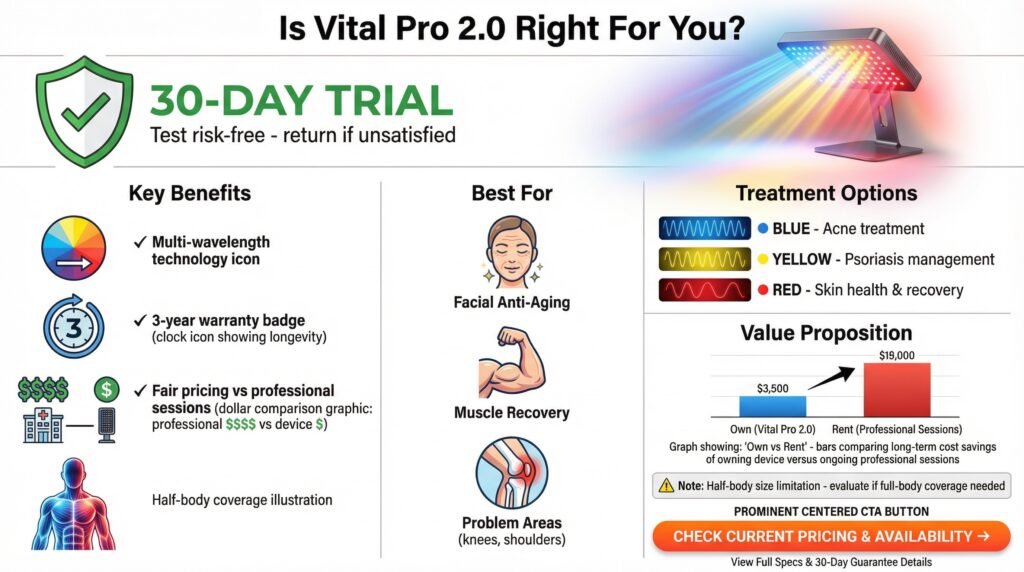
The 30-day trial period removes most of the purchase risk. You can test whether the device fits into your routine and whether you notice benefits for your specific goals.
If it doesn’t work out, you return it.
The warranty covers three years, which is solid for a device at this price point. Most issues show up in the first year, so a three-year warranty suggests the manufacturer expects the device to last.
For people serious about skin health, muscle recovery, or managing chronic skin conditions, the math strongly favors owning your own device versus paying for ongoing professional sessions.
The device works best for people targeting facial anti-aging, upper-body muscle recovery, or specific problem areas like the knees or shoulders. The half-body size handles these use cases without issues.
For people managing acne or psoriasis, the blue and yellow wavelengths add treatment options that basic red light panels don’t offer. You get many approaches to skin health in one device instead of buying separate blue light and red light equipment.
The combination of preset modes, many wavelengths, solid build quality, and reasonable pricing puts this vital pro 2.0 review in the “worth considering” category if you’ve already decided you want at-home red light therapy. The half-body limitation is the main factor that determines whether this specific model fits your needs or whether you should look at full-body options instead.
Click the button below to check current pricing and availability. You can see the full specs and guarantee details.
Frequently Asked Questions
What is the Vital Pro 2.0? A mid-sized (12.5″ × 8.5″) red light therapy panel with 72 LEDs, delivering nine therapeutic wavelengths for skin rejuvenation, acne treatment, muscle recovery, pain relief, and general wellness.
What are the nine wavelengths and their benefits?
- Blue (480nm): Targets acne bacteria.
- Yellow (590nm): Improves circulation, reduces swelling/puffiness.
- Red (630nm, 660nm, 670nm): Boosts collagen, reduces surface inflammation (strongest evidence at 660nm).
- Near-infrared (810nm, 830nm, 850nm): Deep penetration for muscle/joint recovery and ATP production.
- 1060nm: Potential brain/cognitive and metabolism support (less established evidence).
Does having nine wavelengths make it significantly better? It provides more versatility than standard two-wavelength (660nm + 850nm) panels, covering acne, circulation, and broader goals via presets. However, for basic skin or recovery needs, fewer wavelengths are often sufficient; extra ones can be useful but are partly marketing for multi-condition users.
How much does it cost, and is it worth it? $599 upfront; ~55 cents per 20-minute session over 3 years with daily use. HSA/FSA-eligible (30-40% savings). Much cheaper long-term than clinic sessions ($150–400 each).
What are the main pros and cons? Pros: Versatile presets, solid build, quiet fans, low EMF, good warranty/trial, covers many use cases in one device. Cons: Half-body size (needs repositioning for full body), results require weeks of consistency, not highly portable,and blue light can feel bright.
Who should buy the Vital Pro 2.0? People targeting the face/upper body for anti-aging, acne/psoriasis, muscle recovery, or biohacking with multiple goals. Ideal for those committed to regular at-home use who want more than basic red/NIR panels. Skip if you need full-body coverage or instant results.
This article includes affiliate links. If you click through and make a purchase, I may receive a small commission. This helps support the site and allows me to keep creating helpful content at no extra cost to you.