Quick Summary
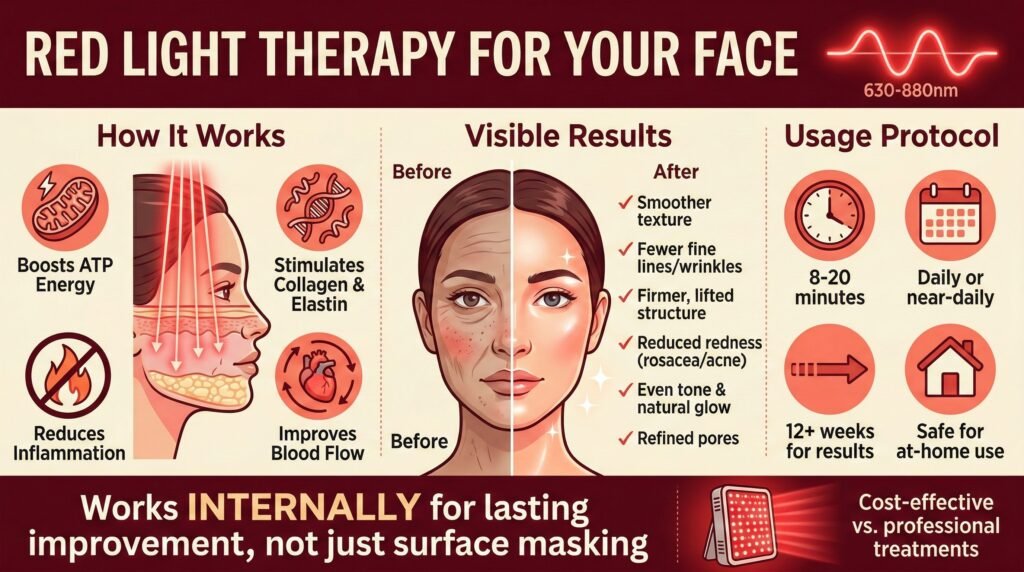
Red light therapy (using 630-880 nm wavelengths) supercharges facial skin cells by boosting mitochondrial ATP production, stimulating collagen/elastin synthesis, reducing inflammation, and improving circulation. This leads to smoother texture, fewer fine lines/wrinkles, firmer structure, reduced redness (helpful for rosacea/acne), better tone/glow, and refined pores over time.
It’s safe for consistent at-home use (8-20 minutes daily or near-daily for 12+ weeks), works internally for lasting improvements rather than surface masking, and offers good value compared to professional treatments (e.g., via recommended devices like Quasar MD Plus).
Table of Contents
- Introduction to Red Light Therapy for the Face: Overview of why facial skin responds particularly well due to its thin, vascular nature and the cellular-level transformations.
- The Cellular Foundation of Facial Transformation: Explanation of how red/near-infrared light boosts ATP, enhances cellular energy/repair, and drives visible skin improvements.
- Collagen Architecture and Facial Structure: How it stimulates organized collagen/elastin production for firmer skin, reduced sagging, softened folds, and better jawline definition.
- Inflammation Management and Facial Redness Mechanisms for calming chronic inflammation, lowering cytokines, and helping with rosacea, post-acne marks, and barrier function.
- Circulation Enhancement and Nutrient Delivery: Nitric oxide release, improved blood flow/oxygenation, waste clearance, reduced puffiness, and the resulting healthy glow.
- Texture Refinement and Pore Appearance Smoothing micro-irregularities, better cell turnover, firmer pores, and regulated sebum for minimized appearance.
- Strategic Treatment Protocols for Facial Application Recommended usage guidelines: session length (8-20 min), frequency (5-7×/week), distance, prep, consistency, timelines (texture in 2-4 weeks, structure in 12-16 weeks), and safety notes.
- People Also Asked (FAQs on Effectiveness and Safety) Addresses common questions about side effects (minimal/temporary), comparisons to other treatments, device choices, and long-term benefits.
Introduction
I remember the first time I stood in front of a red light therapy panel, feeling slightly ridiculous as this warm, crimson glow washed over my face. I couldn’t help but wonder if this was actually doing anything beyond making me look like I was standing in front of a sci-fi spaceship control panel.
What red light therapy does for your face is actually pretty remarkable, grounded in solid science that goes way beyond wellness hype.
Your face responds incredibly well to red light therapy because facial skin is thinner and more vascular than skin on other parts of your body. This means the specific wavelengths penetrate more effectively and reach the cellular structures where the real changes happen.
When you expose your facial skin to concentrated red and near-infrared light, you’re essentially supercharging your cells’ ability to produce energy, repair damage, and function at peak levels.
The visible results, smoother texture, reduced fine lines, improved tone, and that subtle glow people associate with healthy skin, are really just the outward manifestation of what’s happening at the cellular level.
What makes facial red light therapy particularly interesting is that it addresses many skin concerns simultaneously through a single biological mechanism. Unlike topical products that sit on the surface or target one specific issue, red light works from within your skin’s structure, triggering cascading useful effects that improve overall skin health rather than just masking problems temporarily.
The Cellular Foundation of Facial Transformation
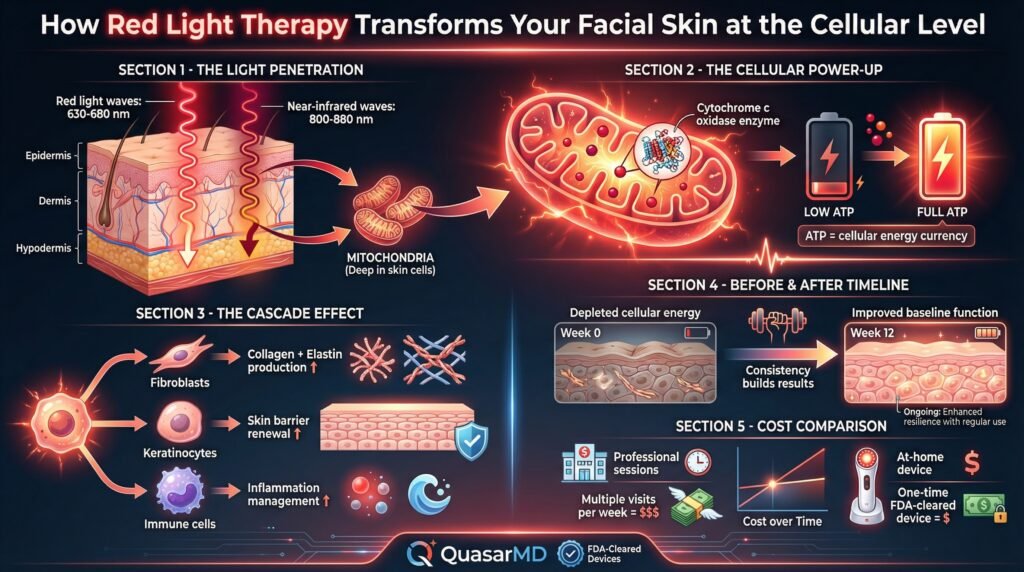
What red light therapy does for your face starts deep within your skin cells, specifically in the mitochondria. These tiny powerhouses are responsible for generating cellular energy.
When red light at wavelengths between 630-680 nanometers and near-infrared light at 800-880 nanometers penetrates your facial skin, it gets absorbed by chromophores within the mitochondria, particularly an enzyme called cytochrome c oxidase.
This absorption triggers a really fascinating cascade effect. Your mitochondria ramp up production of adenosine triphosphate, which is essentially the energy currency your cells use to perform every function.
With more ATP available, your facial skin cells can operate at peak efficiency. They’re better equipped to repair damage, produce structural proteins, manage inflammation, and maintain optimal function.
Think of it like upgrading the power supply to a computer. Suddenly, everything runs faster and more efficiently.
Your fibroblasts, the cells responsible for producing collagen and elastin, become significantly more active.
Your keratinocytes, which form the protective outer layer of your skin, turn over more effectively.
Your immune cells in the dermal layer can better manage inflammation and respond to potential threats. Everything just works better when your cells have adequate energy.
The facial skin specifically benefits from this because it’s constantly exposed to environmental stressors: UV radiation, pollution, temperature fluctuations, and mechanical stress from facial expressions. This ongoing assault reduces cellular energy reserves over time, which is partly why facial skin shows aging signs earlier than skin on protected areas of your body.
Red light therapy essentially helps replenish those depleted reserves, giving your facial skin the resources it needs to maintain itself properly.
What’s particularly compelling is that this effect doesn’t disappear the moment you stop treatment. Regular red light therapy actually helps improve your skin’s baseline cellular function.
Your facial skin becomes genuinely healthier and more resilient over time, not just temporarily improved. On the flipside, consistent weekly treatment helps build on this foundation. The purpose is not just to stay at this healthy baseline, but to maintain constant improvement. Hence, regular treatments are necessary, just like going to the gym weekly. Compare reliable at-home red light therapy devices versus a professional therapy session to get the best cost savings with the calculator below.
Should you decide to take advantage of the cost savings of using your own red light therapy device versus numerous professional sessions per week, it is important to make sure that your device has been shown to FDA scrutiny.
QuasarMD is a U.S. beauty-tech brand creating FDA-cleared red light therapy devices for skin and wellness. Discover Quasar’s extensive range of cost-effective and effective red light therapy products>>CLICK HERE.
Also, use the cost-savings calculator below that crunches the numbers so you can find out the true savings.
Quasar MD Plus vs Professional Clinic Sessions
Calculate how much you’ll save by investing in your own device instead of paying for recurring clinic treatments
💡 What’s included in your Quasar MD Plus costs:
✓ One-time device purchase: Your selected price option
✓ Activating Serum: $50 per bottle (lasts 2-3 months with daily use)
✓ Unlimited treatments at home, on your schedule
✓ 90-day risk-free trial with full money-back guarantee
Collagen Architecture and Facial Structure
One of the most significant things red light therapy does for your face is stimulate substantial increases in collagen production. But we’re not talking about random collagen production.
This is organized, structured collagen that actually improves facial architecture.
This distinction matters tremendously because disorganized collagen deposition can actually contribute to scarring and texture irregularities.
When fibroblasts are activated by red light therapy, they don’t just randomly pump out collagen. The increased ATP availability allows them to produce Types I and III collagen in proper ratios and arrange these proteins in organized networks that provide structural support while maintaining skin flexibility.
Type I collagen is the strong, rope-like protein that gives your skin its firmness and resistance to sagging.
Type III collagen is slightly more flexible and helps with skin elasticity and the ability to return to its original shape after stretching.
In your face, specifically, this improved collagen architecture translates to several visible improvements. Fine lines and wrinkles become less pronounced because the dermis has better structural support, essentially “filling in” from beneath rather than being plumped artificially from the surface.
The nasolabial folds, those lines that run from your nose to the corners of your mouth, often soften because the midface has better structural integrity.
The jawline can appear more defined because the skin has improved tensile strength and resists the downward pull of gravity more effectively.
I’ve noticed that people often expect immediate dramatic changes, as you’d see from an injectable filler, and then feel disappointed when red light therapy doesn’t work that way. But what’s actually happening is more valuable.
You’re rebuilding your skin’s foundational structure rather than just temporarily propping it up.
The difference is between renovating a house’s framework versus just hanging new curtains.
One takes longer but creates lasting, authentic improvement.
The timeline for collagen remodeling typically follows a predictable pattern. During the first two to four weeks of consistent red light therapy, you’re primarily seeing improvements in skin texture and tone as cellular function improves.
Between weeks four and eight, you start to notice subtle yet real changes in fine lines as new collagen begins to mature and organize.
The more substantial structural improvements in deeper wrinkles, skin laxity, and facial contours typically become obvious after twelve weeks or more of consistent use, as the added collagen remodeling reaches critical mass.
As is well known, seeing improvements in body composition is an inside as well as outside process. Hence, using collagen boosters may assist as an adjunct to red light therapy in accelerating results. Click here to try Golden Collagen’s 2-minute quiz to find the right collagen formula match for your specific needs.
Inflammation Management and Facial Redness
What red light therapy does for your face in terms of inflammation control is really quite sophisticated. Chronic low-grade inflammation is increasingly recognized as a major driver of accelerated facial aging, contributing to everything from persistent redness and sensitivity to breakdown of existing collagen and impaired wound healing.
Red light therapy exerts anti-inflammatory effects through many pathways. It reduces the production of pro-inflammatory cytokines, those chemical messengers that perpetuate inflammatory responses.
It modulates mast cell activity, which means less histamine release and reduced reactive flushing.
It improves microcirculation, which helps clear inflammatory mediators from tissue more efficiently. And it enhances antioxidant enzyme activity, which helps neutralize the reactive oxygen species that drive inflammatory cascades.
For facial skin specifically, this inflammation reduction manifests in some really practical, visible ways. If you experience persistent facial redness, whether from rosacea, sensitivity, or just reactive skin, red light therapy can help calm that baseline inflammation that keeps your face looking flushed.
The redness doesn’t just temporarily disappear; the underlying inflammatory processes actually decrease, so your skin maintains a calmer appearance even when you’re not actively using the device.
Post-inflammatory hyperpigmentation, those dark marks that linger after acne or other facial injuries, often improves with consistent red light therapy because the inflammation that drives prolonged melanin production is reduced.
The skin can finish its healing process more efficiently without the ongoing inflammatory signals that keep pigment cells in overdrive.
Active acne also responds to red light therapy, though the mechanism is slightly different than for bacterial control, which is where blue light excels. Red light reduces the inflammation surrounding acne lesions, which means less pronounced swelling, faster resolution, and reduced likelihood of scarring.
It also helps regulate sebaceous gland activity to some degree, which can contribute to fewer breakouts over time.
The improvement in skin barrier function that comes from reduced inflammation is honestly one of the most valuable but underappreciated aspects of what red light therapy does for your face.
When your skin barrier is compromised by chronic inflammation, you experience increased transepidermal water loss, heightened sensitivity to products and environmental factors, and impaired ability to protect against pathogens and irritants.
As red light therapy helps restore barrier integrity, your facial skin becomes more resilient, less reactive, and better able to maintain optimal hydration levels.
Hyperpigmentation is one of a few temporary side effects to be aware of, so make sure you are utilizing best practices.
Circulation Enhancement and Nutrient Delivery
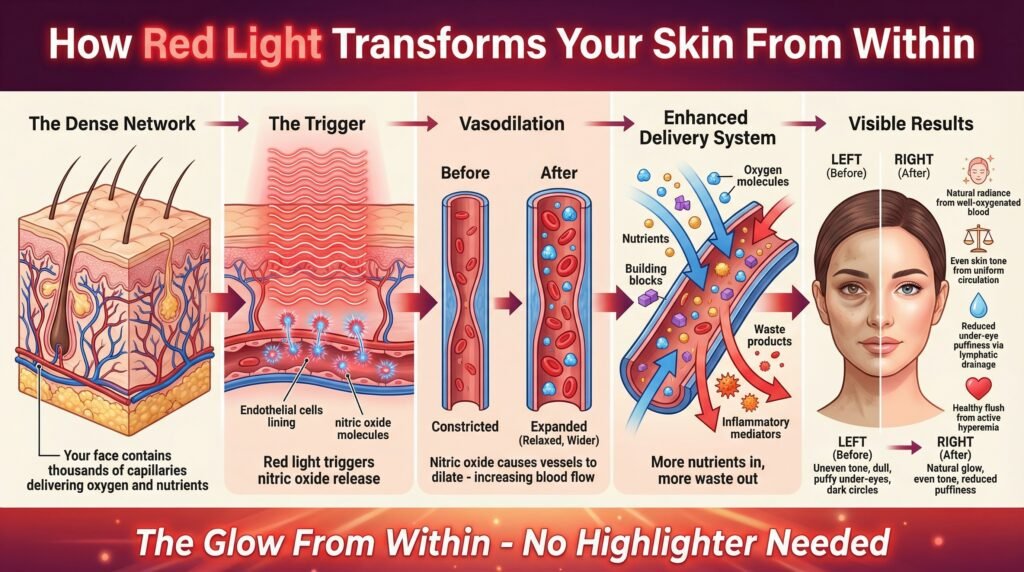
What red light therapy actually does to the body is somewhat complex. Your facial skin has an incredibly dense network of capillaries, those tiny blood vessels that deliver oxygen and nutrients while removing metabolic waste products. What red light therapy does for your face in terms of circulation improvement creates a foundation for all other useful effects to be amplified.
Red and near-infrared light triggers the release of nitric oxide from endothelial cells lining your blood vessels. Nitric oxide is a potent vasodilator, meaning it causes blood vessels to relax and expand, increasing blood flow.
This enhanced circulation means your facial skin cells receive more oxygen, more nutrients, and more of the building blocks they need for repair and maintenance.
Simultaneously, metabolic waste products and inflammatory mediators are cleared more efficiently.
The visible result of improved facial circulation is that healthy glow people spend fortunes trying to achieve with highlighters and illuminating products. But this glow comes from within. It’s the result of well-oxygenated blood flowing through your facial capillaries, bringing a natural radiance to your complexion.
Your skin tone becomes more even because circulation is more uniform across your face, rather than being sluggish in some areas and adequate in others.
Improved circulation also means better lymphatic drainage, which is particularly relevant for the under-eye area. That puffy, congested appearance many people struggle with is often partly because of sluggish lymphatic flow that allows fluid and metabolic waste to accumulate in the delicate tissue beneath your eyes.
Red light therapy helps stimulate lymphatic movement, reducing puffiness and that tired, aged appearance that comes with under-eye bags and dark circles.
The temperature increase from red light therapy, while minimal, also contributes to improved circulation. Your facial blood vessels naturally dilate slightly in response to warmth, further enhancing nutrient delivery and waste removal.
This is why your face often appears slightly flushed immediately after a red light session. That’s active hyperemia, the temporary increase in blood flow that supports healing and regeneration.
Texture Refinement and Pore Appearance
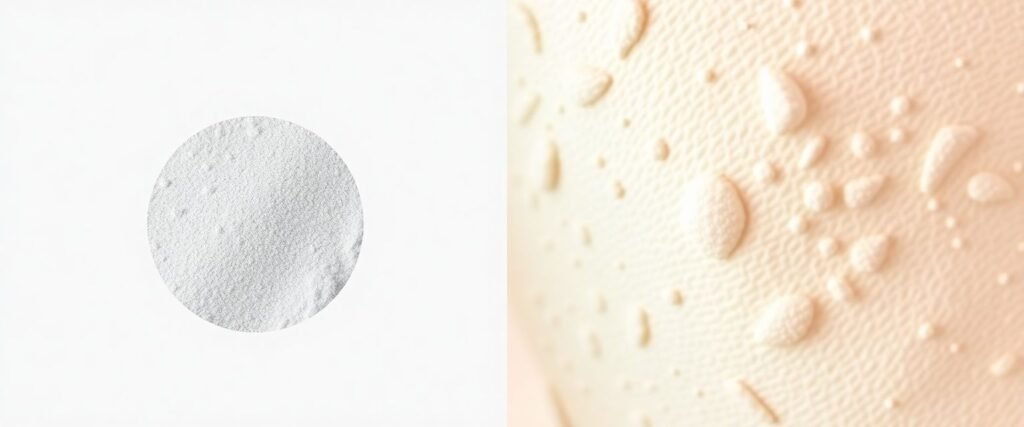
One of the more immediately noticeable things red light therapy does for your face is improve overall skin texture, making it feel smoother and more refined. This texture improvement happens through several converging mechanisms that work together to create that silky, even surface everyone wants.
The increase in collagen and elastin production doesn’t just affect deeper wrinkles. It also fills in and smooths micro-irregularities in your skin’s surface.
Those subtle bumps, uneven patches, and rough areas gradually reduce as the dermal layer becomes more robust and uniformly structured. The improved skin cell turnover that comes from enhanced cellular energy means dead skin cells are shed more efficiently and replaced with healthy new cells, preventing the buildup of rough, dull surface layers.
Pore appearance is another area where red light therapy creates noticeable improvement, though you need to understand what’s actually happening. Red light therapy doesn’t physically shrink your pores.
Pore size is largely determined by genetics and the amount of oil your skin produces.
However, it does improve the appearance of pores through several mechanisms.
When collagen production increases around pore openings, the skin becomes firmer and more taut, which makes pores appear smaller even though their actual diameter hasn’t changed. It’s similar to how a balloon’s surface looks different when it’s fully inflated versus when it’s partially deflated. The openings in the material appear smaller when there’s adequate internal pressure and structure.
Improved oil regulation also contributes to better-looking pores. When sebaceous glands function optimally rather than being in overdrive because of inflammation or hormonal imbalances, they produce adequate but not excessive sebum.
This means less oil accumulation in pores, which reduces the enlarged, clogged appearance.
Regular red light therapy helps maintain this balanced sebum production by supporting overall skin health and reducing the inflammatory signals that can trigger excessive oil production.
The added effect of better texture and smaller-appearing pores is that your facial skin reflects light more evenly. Instead of light being scattered by rough texture and enlarged pore openings, it bounces off your skin more uniformly, creating that luminous, refined appearance associated with youthful, healthy skin.
Finding a reliable red light therapy facial device that pays for itself when compared to 2-3 professional therapy sessions only makes sense. Considering that consistent results depend on consistent long-term use. See our review of the Quasar MD Plus for a more in-depth analysis, or get started now by clicking the button below to see Quasar’s latest promotions.
Strategic Treatment Protocols for Facial Application
How you actually use red light therapy on your face significantly impacts what results you achieve. There’s real science to optimizing treatment parameters, and getting this right makes the difference between mediocre results and really transformative improvements.
Distance from the light source matters tremendously for facial treatments. The inverse square law means that light intensity decreases exponentially as you move farther from the source.
Most quality facial red light devices are designed to be used at a specific distance, typically between six and twelve inches from your face.
At this range, you’re receiving adequate light intensity to trigger the biological responses you want without being so close that you risk any thermal damage or uneven coverage.
Treatment duration for facial red light therapy typically falls between eight and twenty minutes per session, depending on the device’s power output. More isn’t necessarily better here.
Once you’ve delivered adequate photonic energy to your facial tissues, additional exposure doesn’t create proportionally greater benefits.
In fact, excessive exposure could theoretically overstimulate certain cellular processes or cause temporary sensitivity.
Consistency is absolutely where most people either succeed or fail with facial red light therapy. What red light therapy does for your face is cumulative.
Each session builds on previous ones, gradually improving cellular function and triggering progressive tissue remodeling.
Using your device sporadically, like once a week or whenever you remember, produces minimal results because you never achieve the consistent cellular signaling needed for substantial change.
The ideal protocol for most people is daily treatment, at least five days per week, for a least twelve weeks to see substantial changes in collagen structure, wrinkles, and skin laxity. For maintenance of results or addressing less significant concerns, three to four sessions per week may be enough once you’ve achieved your desired improvements.
Timing your red light therapy sessions can enhance results, though this is more of an optimization factor than a make-or-break issue. Morning sessions can energize your skin cells for the day ahead and create a nice glow before you apply makeup or go about your day.
Evening sessions may support the skin’s natural nighttime repair processes, when cellular regeneration naturally peaks.
Honestly, the best time for red light therapy is whenever you’ll actually do it consistently. Adherence trumps perfect timing.
Also, finding a reliable, safe, and affordable red light therapy device that delivers the therapeutic effects of professional red light sessions without breaking the bank is also key. Read our full list of reviews here.
Facial preparation before red light therapy is straightforward but important. You want your skin clean and free of products that might interfere with light penetration.
Heavy makeup, sunscreen, or thick serums create a barrier that reduces how much light actually reaches your skin cells.
A freshly cleansed face allows most light absorption. Some people prefer to apply certain serums immediately after red light therapy when cellular activity is elevated, theoretically enhancing product absorption, though research on this specific practice is limited.
Combining red light therapy with other facial treatments can amplify results. Microcurrent devices work synergistically with red light.
The microcurrent provides additional cellular stimulation while the red light supports the energetic and regenerative processes needed to sustain those improvements.
Facial massage or gua sha before red light therapy can prime circulation and lymphatic flow, potentially enhancing the effectiveness of the light treatment.
Retinoids, used on alternate evenings from red light therapy, provide complementary anti-aging benefits through different mechanisms.
Key Takeaways
What red light therapy does for your face operates through fundamental cellular mechanisms: enhanced mitochondrial function, increased ATP production, stimulated collagen synthesis, reduced inflammation, and improved circulation. These biological processes create genuine improvements in skin health and function rather than temporary cosmetic effects.
The visible results- reduced wrinkles, improved texture, enhanced skin tone, diminished inflammation, and overall facial rejuvenation- emerge progressively over weeks and months as cellular improvements accumulate and tissue remodeling occurs. Consistency matters far more than treatment intensity, with daily sessions producing substantially better results than sporadic use.
Quality device selection based on proper wavelength specification, adequate power output, and suitable coverage confirms you’re actually receiving therapeutic light doses rather than just pleasant-feeling warmth. Integration with comprehensive skincare practices and evidence-based treatments amplifies results beyond what any single intervention achieves alone.
The investment in red light therapy for facial use pays dividends not just in improved appearance but in genuinely healthier, more resilient skin with enhanced ability to repair damage, resist environmental stress, and maintain optimal function as you age. Try the Quasar MD Plus today to get started with the benefits of red light therapy. Click the button below to visit their official site.
People Also Asked
Does red light therapy actually work for wrinkles?
Yes, red light therapy has been shown in many clinical studies to reduce the appearance of wrinkles and fine lines. The mechanism works by stimulating collagen production in the dermal layer of skin and improving cellular energy production.
Most people see noticeable improvements in fine lines after 8-12 weeks of consistent use, with deeper wrinkles showing improvement after 12-16 weeks.
The key is regular, consistent use rather than sporadic treatments.
How long does it take to see results from red light therapy on the face?
You can expect to see initial improvements in skin texture and radiance within 2-4 weeks of daily use. More significant changes, like a reduction in fine lines, typically become visible around 6-8 weeks.
Substantial improvements in deeper wrinkles, skin laxity, and overall facial structure usually take 12-16 weeks of consistent treatment.
The progressive timeline reflects the time required for actual collagen remodeling and cellular regeneration to occur.
Can I use red light therapy on my face every day?
Yes, daily red light therapy on your face is safe and actually produces better results than less frequent use. Most protocols recommend 10-20 minutes per day, 5-7 days per week.
The added effect of daily sessions is what drives meaningful improvements in skin health.
Your cells don’t become desensitized to the treatment, and there’s no evidence that daily use causes any negative effects when proper treatment parameters are followed.
What wavelength of red light is best for the face?
The most effective wavelengths for facial skin are red light between 630-680 nanometers and near-infrared light between 800-880 nanometers. Red light in the 660nm range is excellent for surface-level improvements like texture and tone.
The Quasar MD Plus provides therapy within this range.
Near-infrared light around 850nm penetrates deeper and is particularly effective for collagen stimulation and structural improvements.
Many quality facial devices mix both wavelengths for comprehensive benefits.
Does red light therapy help with acne scars?
Red light therapy can improve the appearance of acne scars, particularly rolling scars and shallow boxcar scars, by stimulating collagen production that helps fill in depressed areas. It also reduces the post-inflammatory hyperpigmentation that often accompanies acne scarring.
However, deep ice-pick scars typically require more aggressive interventions.
For acne scars, you’ll want to commit to at least 16-20 weeks of consistent treatment to see meaningful improvement.
Can red light therapy tighten face skin?
Red light therapy can improve mild to moderate skin laxity by increasing collagen and elastin production in the dermal layer. This gives skin better structural support and improved tensile strength.
While it won’t produce the dramatic tightening of surgical procedures, many people see noticeable improvement in jawline definition and reduction in jowling after several months of consistent use.
The tightening effect develops gradually as new collagen matures and organizes.
Is red light therapy safe for the under-eyes?
Yes, red light therapy is safe for the under-eye area and can be particularly useful for this delicate skin. It helps reduce puffiness by improving lymphatic drainage, diminishes dark circles by improving circulation, and reduces fine lines through collagen stimulation. Keep your eyes closed during treatment or use protective eyewear.
The thin skin under the eyes actually responds very well to red light therapy because the wavelengths penetrate easily.
Does red light therapy help with rosacea?
Red light therapy can significantly help with rosacea by reducing the chronic inflammation that drives this condition. Many people with rosacea see decreased baseline redness, fewer flare-ups, and improved skin barrier function with regular red light therapy use.
Start with shorter sessions of 5-8 minutes to allow your sensitive skin to adapt, then gradually increase duration as your skin’s inflammation decreases and tolerance improves.
Find a reliable, safe, and affordable red light therapy device that delivers the therapeutic effects of professional red light sessions without breaking the bank. Click here to read our full list of reviews.
This article includes affiliate links. If you click through and make a purchase, I may receive a small commission. This helps support the site and allows me to keep creating helpful content at no extra cost to you.