Quick Takeaways
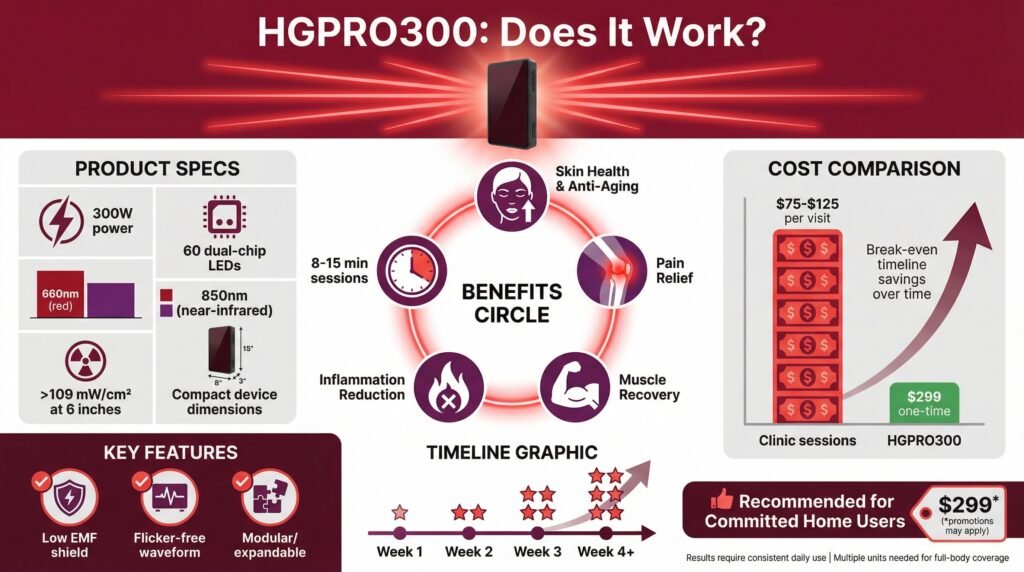
The Hooga HGPRO300 is a compact, mid-range red light therapy panel (300W nominal, 60 dual-chip LEDs at 660nm red + 850nm near-infrared) delivering high irradiance (>109 mW/cm² at 6 inches) for skin health, anti-aging, pain relief, muscle recovery, and inflammation reduction.
It’s praised for strong performance, low EMF/flicker-free design, modular expandability, and cost savings versus clinic sessions (breaks even quickly vs. $75–125 per visit).
The review (based on specs, user feedback, and science) concludes it’s effective with consistent daily use (8–15 min sessions), though results take weeks, and full-body coverage requires multiple units. Recommended for committed home users at ~$299 (with discounts).
You can check current pricing and availability here to see if it fits your budget. Use the code: HOOGATIME for 10% off here.
Table of Contents
- Introduction: Why Consider Home Red Light Therapy and the HGPRO300
- Product Overview and Key Specifications
- Size, power, LEDs, wavelengths, irradiance, and EMF/safety features
- Features and Usability
- Dual-wavelength modes, modular design, stand, and HSA/FSA eligibility
- How Red Light Therapy Works (Scientific Basis)
- 660nm for skin vs. 850nm for deeper tissues
- Testing and Real-World Results
- User-reported benefits, timelines (skin in 4–12 weeks, pain/recovery faster), importance of consistency
- Pros and Cons
- Cost Comparison: HGPRO300 vs. Clinic Sessions
- Verdict and Recommendation
- Where to Buy, Discounts, and Affiliate Disclosure
Introduction
So, I’ve been researching red light therapy panels for a while now, and the HGPRO300 keeps popping up. It sits in this weird middle ground between the cheap Amazon panels that probably don’t do anything and the $5,000+ professional units that most people can’t justify buying.
The specs looked promising on paper, so I spent way too much time digging through the actual numbers, reading what people are saying about it, and comparing it to other options. Here’s what I found out.
What the HGPRO300 Actually Is (and Isn’t)
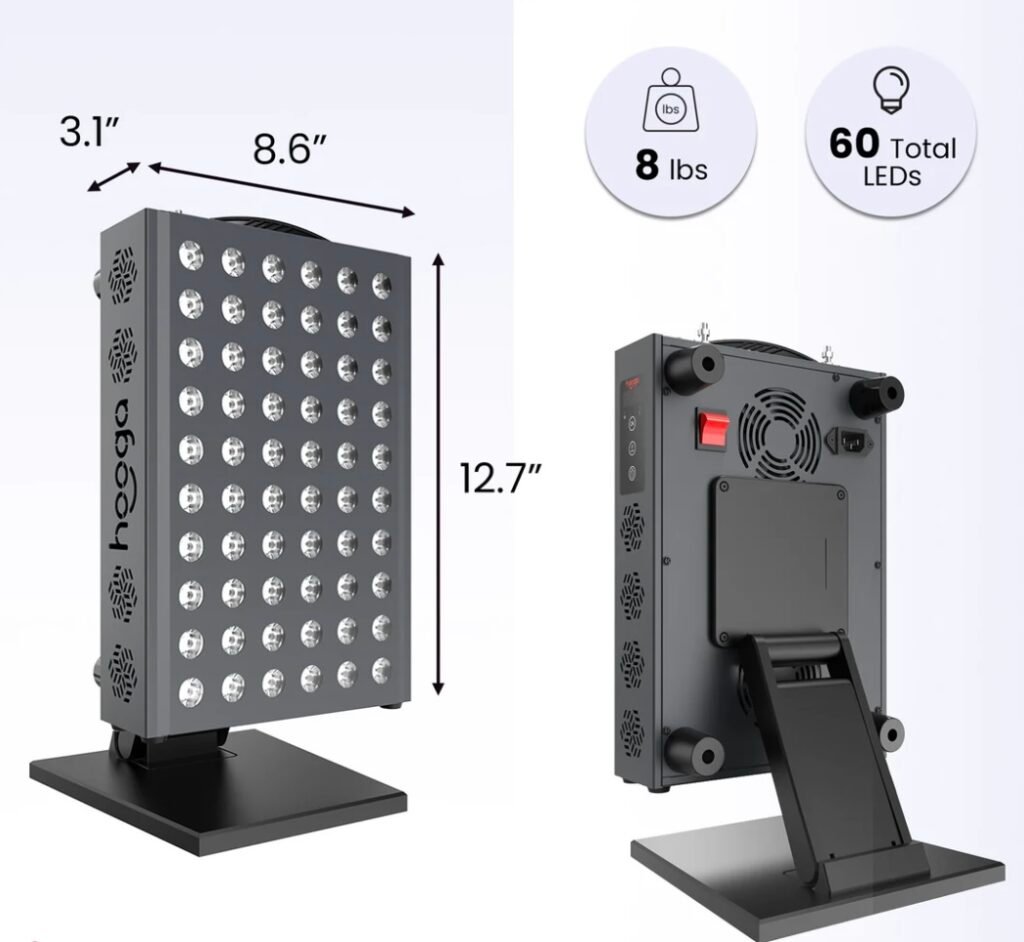
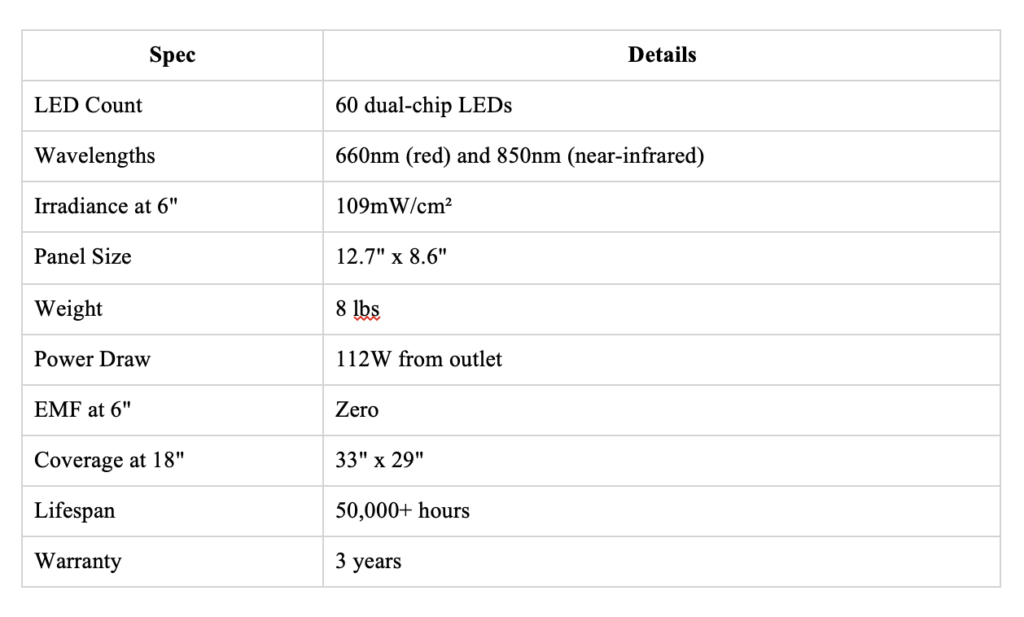
The HGPRO300 is a mid-sized red light therapy panel with 60 dual-chip LEDs. It puts out two wavelengths: 660nm (red light you can see) and 850nm (near-infrared that’s invisible). You can switch between them or run both at the same time.
The panel is about 12.7 inches by 8.6 inches and weighs around 8 pounds. Not huge, but not tiny either.
You can move it around pretty easily, but it feels solid, not like some flimsy thing that’ll break if you look at it wrong.
It comes with a tabletop stand built in and has cooling fans inside (you can hear them running, but they’re not loud or anything). Hooga markets this as an affordable alternative to going to clinics for red light therapy sessions.
The thing about clinics is that they charge anywhere from $75-125 per session, and you’d typically go a few times a week. The math adds up fast.
That’s the main selling point here: getting clinical-level treatment at home without the ongoing costs.
The Power Output Situation
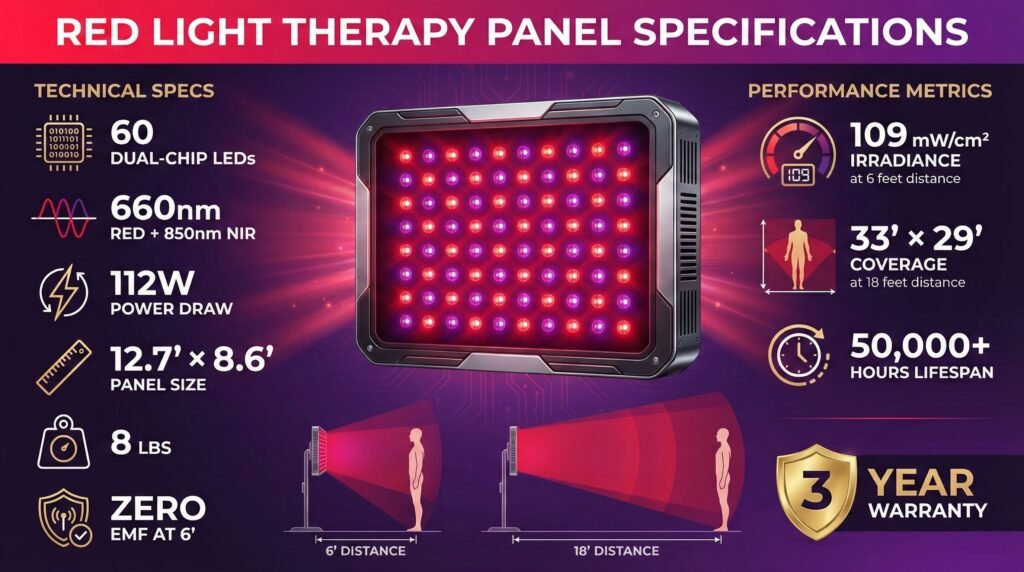
This is where a lot of panels fall short, so it’s worth paying attention to. The HGPRO300 puts out over 109mW/cm² at 6 inches away from the panel.
That’s the irradiance measurement, which basically tells you how strongly the light is hitting your skin.
For comparison, a lot of cheaper panels put out like 30-50mW/cm² at the same distance. The difference matters because weak light doesn’t penetrate deep enough to do much.
The panel uses 300W of LED power but only pulls 112W from your wall outlet. It’s efficient, won’t mess with your electric bill too much.
Here’s how the light dose works: you multiply the irradiance by how long you use it. At 6 inches, you’re getting about 5 joules per minute of treatment.
If you step back to 12 or 18 inches, you cover more area but need to use it longer to get the same dose.
Most protocols recommend somewhere between 5-30 joules, depending on what you’re treating.
Red Light vs Near-Infrared (and Why It Matters)
The 660nm red light penetrates about 5-10mm below your skin surface. This depth is good for skin-related stuff, collagen production, reducing fine lines, improving skin texture, that kind of thing.
If you’re mainly interested in anti-aging or dealing with acne/skin conditions, the red light is what you want.
The 850nm near-infrared goes way deeper, like 50-75mm. This hits muscle tissue, joints, and tendons. People use this for muscle recovery after workouts, joint pain, tendonitis, and inflammation deeper in the body.
The HGPRO300 lets you toggle between them or use both together. Pretty straightforward, red for surface stuff, near-infrared for deeper tissue, both if you want the full spectrum.
See Hooga’s latest deals. Click the button below to get 12% off the HGPRO300.
EMF and Safety Concerns
People worry about EMF exposure with electrical devices, and it’s a legit concern if you’re using something daily right next to your body.
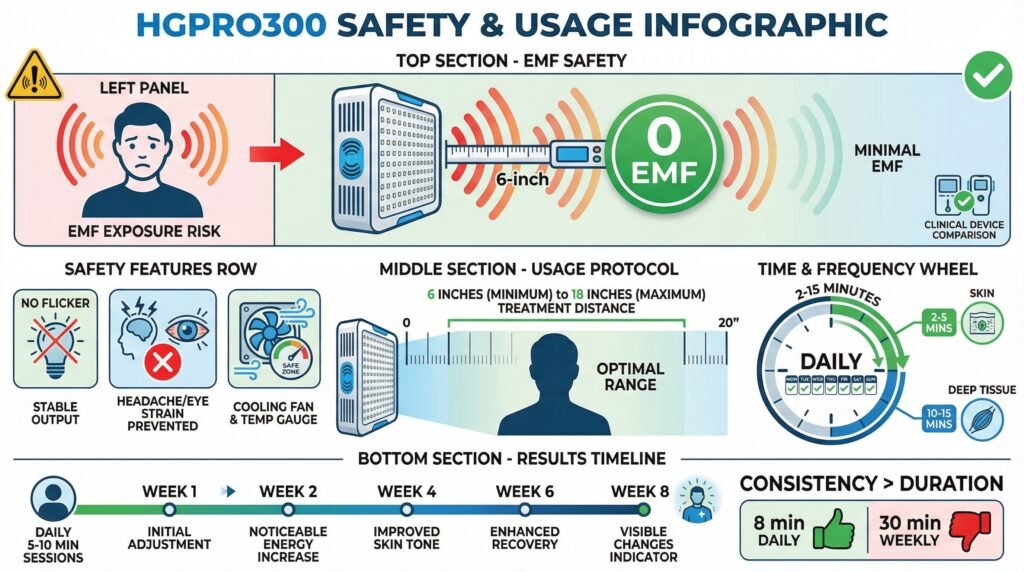
The HGPRO300 has zero EMF emission at 6 inches (the recommended treatment distance). Beyond 6 inches, it stays minimal. This puts it in line with what you’d get from clinical devices.
The LEDs are flicker-free, which prevents the strobe effect that causes headaches and eye strain with cheaper panels. The cooling fans keep it from getting too hot during longer sessions. No major safety red flags here.
How Long and How Often You’d Actually Use It
The standard protocol for the HGPRO300 is pretty simple:
Distance: 6 to 18 inches from your skin
Time: 2-15 minutes per session (depends on distance and what you’re treating)
Frequency: Daily
Skin treatments need less time. Deep tissue treatments need more.
Most people do 5-10 minutes daily and see changes within 4-8 weeks. That matches what clinical protocols recommend, so it’s not like they’re making up random numbers.
The consistency matters more than the exact timing tbh. Doing it daily for 8 minutes is better than doing 30 minutes once a week.
Coverage Area and Modular Setup Options
At 18 inches away, the panel covers about 33″ x 29″. That’s enough for your whole face and neck, or a section of your back, but not full-body coverage.
To treat your whole body at once, you’d need many panels. Hooga designed this as a modular system; you can connect panels on mobile stands to create a larger setup.
For targeted treatment (face, specific muscle groups, joints), the single panel works fine. For full-body sessions, you either step further back (which reduces the irradiance) or buy extra panels.
Who This Panel Makes Sense For
People dealing with aging skin and wrinkles: The 660nm red light triggers collagen production and improves skin elasticity. If you’re seeing fine lines, age spots, or general skin texture issues, this wavelength addresses those problems.
Results typically show up within 6-12 weeks with consistent daily use.
Athletes and fitness people: The 850nm near-infrared penetrates muscle tissue and reduces inflammation. Runners, lifters, and people doing intense training, they use this to recover faster between sessions and reduce muscle soreness (DOMS).
The effects show up faster than skin benefits, usually within 1-2 weeks.
Anyone with chronic skin conditions: Acne, psoriasis, eczema responds to the anti-inflammatory effects of red light. It’s not a cure, but people report fewer flare-ups and faster healing when they use it consistently.
Biohackers and optimization types: If you’re already tracking sleep, HRV, performance metrics, and trying to improve everything, red light therapy fits into that approach. The science behind it is solid, thousands of studies on mitochondrial energy production (ATP) improving under red and near-infrared light.
The HGPRO300 review data from actual users lines up with these use cases. People report improvements in skin appearance, recovery time, and general well-being when they stick with it.
Real-World Timeline Expectations
Red light therapy works, but you need realistic timelines and consistency.
For anti-aging, skin, and facial treatments, expect 4-12 weeks before you see obvious changes.
The first thing people usually notice is improved skin texture and hydration. Fine lines start reducing after that. Deeper wrinkles take longer.
For pain and recovery, effects happen faster. Athletes often see reduced soreness and faster recovery within 1-2 weeks of daily use.
Knee, joint pain, and chronic muscle issues improve on a similar timeline.
For sleep, mood, and energy, the benefits are subtler. Studies show these effects occur, but they’re harder to pin down individually.
You might notice better sleep quality, but it’s not like waking up transformed overnight.
The key is actually using it. The device sitting in your closet does nothing. Pick a time (morning routine, post-workout, before bed) and stick with it for at least a month before deciding if it’s working.
Warranty and How Long It Lasts
The HGPRO300 comes with a 3-year warranty and has a lifespan of over 50,000 hours. If you use it for 15 minutes daily, that’s roughly 22 years before LED degradation becomes significant.
It’s built to last. Not a disposable thing you’ll replace in a year. Get started with the button below.
HGPRO300 Compared to Professional Sessions and Cheaper Options
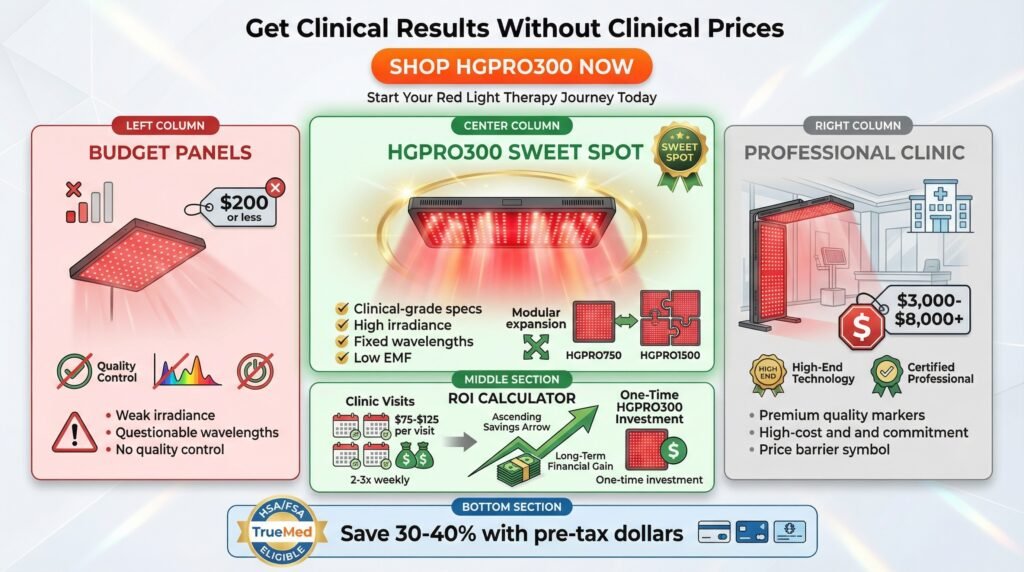
Professional panels (the ones clinics use) cost $3,000-8,000+. They have higher power output and larger coverage areas, but the HGPRO300 delivers clinical-grade specs (high irradiance, fixed wavelengths, low EMF) at a fraction of that price.
Cheaper panels (under $200) usually have weak irradiance, questionable wavelengths, and no real quality control. You get what you pay for.
The HGPRO300 sits in the middle. It costs more than budget options but way less than professional equipment.
The modular design is smart too. If you start with one HGPRO300 and later decide you want more coverage, you can add panels like the HGPRO750 or HGPRO1500.
Your initial purchase isn’t a dead end.
For people who can’t drop $5,000+ on a professional panel but want something that actually delivers results, this price point makes sense.
The HGPRO300 cost justifies itself pretty quickly when you compare it to ongoing clinic sessions at $75 – $125 per visit, 2-3times a week if you want lasting results.
Also, Hooga has teamed up with TrueMed to make HSA and FSA payments available. Eligible customers can use pre-tax dollars to purchase Hooga products, potentially reducing their out-of-pocket cost by roughly 30–40%.
Use the cost-savings calculator below to see the real cost savings. Bookmark this page for future use when comparing red light therapy services in your local area.
HGPRO300 Cost Savings Calculator
See how much you’ll save with the HGPRO300 compared to ongoing clinic sessions. Professional results at home, without the professional price tag.
HSA/FSA Eligible: Through TrueMed, you can use pre-tax dollars to purchase your HGPRO300, potentially reducing your out-of-pocket cost by 30-40%. That’s real money back in your pocket.
What People Actually Say About It
Looking at user feedback across different platforms, the patterns are consistent. People mention visible improvements in skin appearance, reduced pain and inflammation, and better recovery after workouts.
The complaints that do show up are usually about wanting more extensive coverage (which makes sense for a panel this size) or wishing it came with more mounting options.
Nobody’s claiming it’s a secret device, but the feedback suggests it works as advertised when you use it consistently. That’s about as good as it gets for honest reviews.
You can check current pricing and availability here to see if it fits your budget. Click the button below to visit Hooga’s official site to get started.
Who Shouldn’t Buy This
If you want instant results, red light therapy isn’t your tool. It works through cellular changes that take weeks to become obvious.
Impatient people who do not use the red light regularly will quit before seeing benefits.
If you need full-body coverage right away, buying many panels upfront gets expensive. Starting with one panel makes sense, but understand its limitations.
If you’re expecting it to fix deep wrinkles, significant joint damage, or other serious issues without any other interventions, you’ll be disappointed. Red light therapy works best alongside good habits (sleep, nutrition, proper training).
If you have photosensitivity issues or take medications that increase light sensitivity, you should talk to a doctor before using any light therapy device.
Final Take on the Hooga PRO300
The HGPRO300 review data and specs show a device that delivers what it promises. Clinical-grade wavelengths, high irradiance, low EMF, solid warranty.
The user feedback confirms results appear with consistent use.
For anyone serious about non-invasive anti-aging, recovery optimization, or managing chronic skin issues, this panel represents a legitimate option. The specs are real, the price is reasonable compared to professional choices, and the warranty backs it up.
It’s not magic. It needs consistency and realistic expectations.
But if you’re willing to commit to 10-15 minutes daily for a few weeks, the HGPRO300 review consensus suggests you’ll see results.
The panel does what it’s supposed to do. Whether that’s worth it depends on your goals and commitment level.
If you’re serious about red light therapy and want something that actually works, this is probably where you should be looking. \
You can check current pricing and availability by tapping the button below.
Frequently Asked Questions
What wavelengths does the HGPRO300 use, and what do they target?
660nm (visible red light) for surface-level benefits like collagen production, skin texture, acne, and anti-aging (penetrates ~5–10mm). 850nm (near-infrared) for deeper penetration (~50–75mm), targeting muscle recovery, joint pain, inflammation, and wound healing. You can use one or both simultaneously.
How strong/effective is the panel?
It delivers over 109 mW/cm² irradiance at 6 inches (clinical-grade for many uses) and ~5 joules per minute. Users report noticeable improvements in skin, reduced pain, faster recovery, better sleep/energy with daily 8–15 minute sessions, though effects build over weeks rather than instantly.
Is it safe (EMF, flicker, eye concerns)?
Yes, zero measurable EMF at 6 inches (minimal farther away), flicker-free LEDs to avoid headaches/eye strain, and quiet cooling fans. Use protective goggles if sensitive, but not required for normal use.
How much does the HGPRO300 cost, and is it worth it compared to clinics?
Around $299 (often with 10% off codes like HOOGATIME). It pays for itself in weeks versus $75–125 per clinic session; it saves thousands annually with home use. HSA/FSA eligible via TrueMed for potential tax savings.
Who is this panel best for, and are there downsides?
Ideal for targeted face/body treatment, anti-aging, recovery, or chronic issues if you’re consistent. Downsides: limited single-panel coverage for the full body (modular add-ons help), no instant miracles, and requires daily commitment. Not ideal for severe conditions without medical advice or impatient users.
Where can I buy it, and is the review sponsored?
Primarily via Hooga’s official site (affiliate links in the article may earn the site a commission at no extra cost to you). The review analyzes specs and user data independently but includes an affiliate disclosure.
This article includes affiliate links. If you click through and make a purchase, I may receive a small commission. This helps support the site and allows me to keep creating helpful content at no extra cost to you.