Key Takeaways
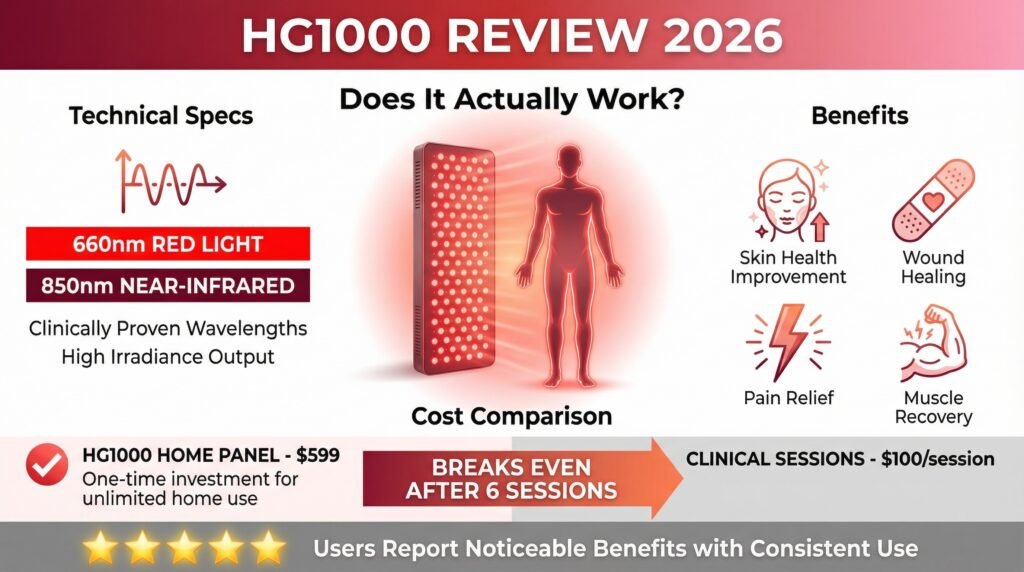
The HG1000 is a reasonably priced, full-body red and near-infrared therapy panel designed for home use, emitting clinically proven wavelengths (660 nm red + 850 nm near-infrared) with high irradiance for potential benefits like skin health improvement, wound healing, pain relief, and muscle recovery. Users report noticeable benefits when used consistently. The price, depending on promotions, is $599, and breaks even when compared to professional clinical sessions averaging $100 per session.
Click here to see HG1000’s availability, current prices, and discounts on their official site.
📋 Table of Contents
- Introduction
- What Is the HG1000?
- How Are People Using It
- Key Features & Specs
- Real-World Performance Reports
- Set Up and Daily Use
- Comparing It to Alternatives
- Who is the Panel For
- The Practical Downsides
- How Red Light Therapy Works
- Long-Term Ownership Considerations
- Making the Decision
- Final Thoughts
- FAQ
Introduction
I’ve been looking into at-home red light therapy panels for a while now, and the HG1000 keeps coming up in different forums and wellness communities. The price point sits in that middle zone where it’s not cheap enough to impulse buy, but not so expensive that it feels completely out of reach.
That’s probably why so many people are trying to figure out if it’s actually worth the investment.
Red light therapy isn’t exactly new. Professional athletes have been using it for years, dermatologists offer clinical sessions, and there’s actual research backing up the benefits for skin health and muscle recovery.
But those clinical sessions get expensive fast.
We’re talking $50-100 per session, and you need multiple sessions per week to see results. That’s where at-home panels like the HG1000 come in.
What the HG1000 Actually Is
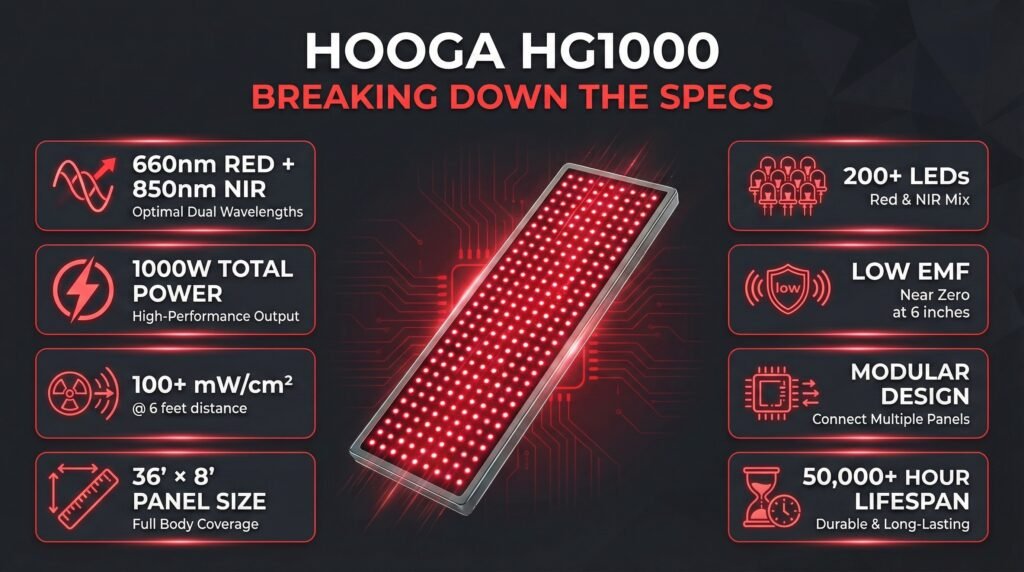
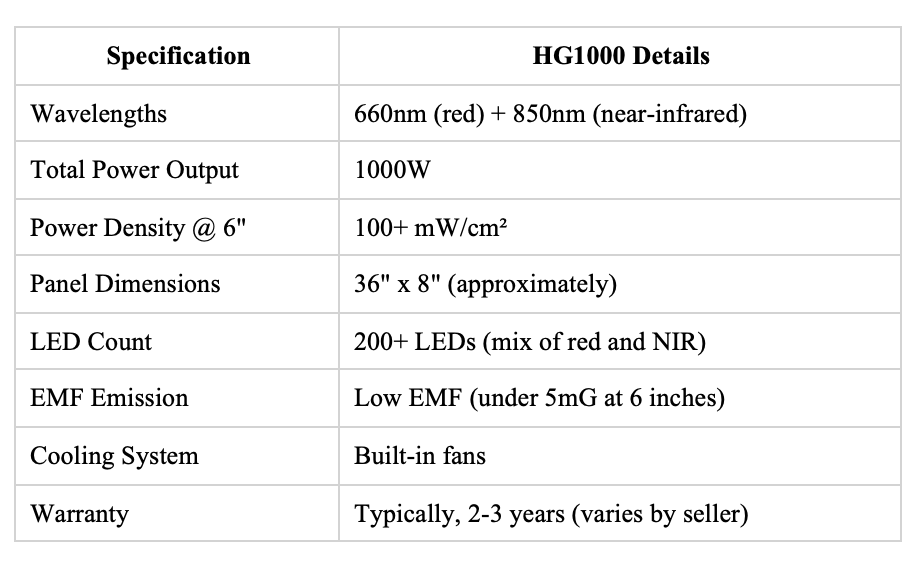
The HG1000 is a full-body red light therapy panel that uses both 660nm (red) and 850nm (near-infrared) wavelengths. Those specific wavelengths matter because they penetrate your skin at different depths.
The 660nm targets surface-level stuff like wrinkles, acne scars, and overall skin tone.
The 850nm goes deeper and reaches your muscles, joints, and even bone tissue.
The panel measures about 36 x 8 inches, so it’s tall enough to cover a good portion of your body when you’re standing in front of it. It puts out around 1000 watts of power, which is where the name comes from.
The power density at 6 inches is reportedly around 100+ mW/cm², which is solid for an at-home device.
Here’s what you’re getting in the box: the panel itself, a power cord, hanging hardware for wall mounting, and an adjustable stand if you don’t want to mount it. The panel has a built-in timer and cooling fans to prevent overheating during longer sessions.
How People Are Actually Using It
Hooga is known for their well-built, budget-friendly line of red light therapy products that deliver results without the sticker shocks when compared to other expensive lines.
From what I’ve seen in user communities and product forums, people use the HG1000 for a bunch of different things. Some guys stand in front of it for 10-15 minutes in the morning as part of their routine.
Others use it after workouts for muscle recovery.
There’s a decent group using it specifically for skin issues like psoriasis, rosacea, or stubborn acne.
The typical session length is 10-20 minutes at a distance of 6-12 inches from the panel. Closer means more intensity but shorter sessions.
Further away means you can go longer, but the effects are less concentrated.
One thing that comes up a lot is consistency. This isn’t a one-and-done situation.
The people reporting actual visible results are the ones using it 4-6 times per week for at least a month or two. That makes sense given how cellular regeneration actually works. Again, as any red light therapy practitioner will attest, consistent use equals consistent results.
Given this fact, the expense of professional clinic sessions at an average cost of $100 per session, the HG1000 hits breakeven relatively quickly.
Hooga’s line of products is HSA/FSA eligible, so you can use pre-tax dollars for extra savings.
Use the cost-savings calculator below to see the real cost savings. Bookmark this page for future use when comparing red light therapy services in your local area.
Hooga HG1000 Cost Savings Calculator
See how much you’ll save vs. professional clinic sessions
About the Hooga HG1000
Hooga is known for their well-built, budget-friendly line of red light therapy products that deliver results without the sticker shock when compared to other expensive lines.
From what I’ve seen in user communities and product forums, people use the HG1000 for a bunch of different things. Some guys stand in front of it for 10-15 minutes in the morning as part of their routine. Others use it after workouts for muscle recovery. There’s a decent group using it specifically for skin issues like psoriasis, rosacea, or stubborn acne.
The typical session length is 10-20 minutes at a distance of 6-12 inches from the panel. Closer means more intensity but shorter sessions. Further away means you can go longer, but the effects are less concentrated.
Consistency is key: This isn’t a one-and-done situation. The people reporting actual visible results are the ones using it 4-6 times per week for at least a month or two. That makes sense given how cellular regeneration actually works. Consistent use equals consistent results.
Bonus: Hooga’s line of products are HSA/FSA eligible, so you can use pre-tax dollars for extra savings.
💰 HSA/FSA Eligible
Use pre-tax dollars to purchase your HG1000, increasing your effective savings even more.
🏠 Unlimited Home Access
No appointments, no travel time, no scheduling conflicts. Use it whenever you want, as often as you want.
👨👩👧👦 Family Friendly
Everyone in your household can benefit. Multiply your value even further when multiple people use it.
📈 Long-Term Investment
The HG1000 is built to last years. Your savings compound the longer you own it.
Breaking Down the Specs
Let me get into the technical details because this is where a lot of the confusion happens with red light therapy devices.
Why Wavelengths Matter
The 660nm and 850nm combo is basically the standard for quality red light panels. Some cheaper devices only offer one wavelength or use wavelengths outside the therapeutic range.
The research supports these specific numbers.
660nm red light helps with collagen production, reduces inflammation at the skin surface, and speeds up wound healing. This is the wavelength you want for anti-aging and skin concerns.
850nm near-infrared light penetrates 2-3 inches deep into your tissue. This reaches your muscles, tendons, and joints.
It's why athletes use it for recovery and why people with joint and knee pain report feeling better after consistent use.
Power Density Explained
Power density (also called irradiance) measures how much energy is hitting your skin per square centimeter. Higher power density means shorter sessions to get the same dose of light.
The HG1000's power density of 100+ mW/cm² at 6 inches is in the effective range. Clinical studies typically use 50-200 mW/cm², so this fits right in there.
Some panels claim crazy high numbers like 200+ mW/cm², but you have to watch out because those measurements might be taken at unrealistic distances like 1-2 inches, where you wouldn't actually use the device.
At 6 inches, you're getting enough intensity for a 10-15 minute session to be useful. At 12 inches, you'd probably want to go 15-20 minutes to get the same light dose.
How Red Light Therapy Works - Real-World Performance Reports
I've been tracking discussions about the HG1000 across multiple platforms, and there are some consistent patterns in what people report.
Skin Improvements
People using it for skin issues report seeing changes after about 3-4 weeks of consistent use. The most common improvements mentioned are smoother texture, reduced redness, and better overall skin tone.
Some people with acne say their breakouts became less severe and healed faster.
The anti-aging crowd talks about reduced fine lines around the eyes and improved skin firmness. But that takes longer to show up, usually 6-8 weeks minimum.
Collagen production is a slow process.
Muscle Recovery
The fitness people seem to notice effects faster. Several users mention reduced soreness after heavy training sessions and feeling ready to train again sooner.
This aligns with research showing that near-infrared light reduces oxidative stress in muscle tissue and speeds up cellular repair.
Some people use it pre-workout for a performance boost. There's actually research supporting this, showing that red light therapy before exercise can improve endurance and reduce fatigue.
Joint Pain and Inflammation
People with chronic joint pain (knees, shoulders, lower back) report mixed results. Some say it's made a noticeable difference in their pain levels and mobility.
Others say they didn't notice much.
This probably depends on the underlying cause of the pain and how deep the affected tissue is.
Sleep and Energy
This one surprised me, but a bunch of people mentioned better sleep quality and more energy during the day. The theory is that near-infrared light exposure helps with mitochondrial function, which affects your cellular energy production.
Morning sessions seem to help with energy, while evening sessions seem to help with sleep.
Ready to experience the benefits of the HG1000? Tap the button below to visit Hooga's official site and take advantage of current deals.
Set Up and Daily Use
Setting up the panel is pretty straightforward. You can mount it on the wall using the included hardware, or use the stand if you want something portable.
Wall mounting makes sense if you have a dedicated spot for it and want to save floor space.
The stand is better if you want to move it around or angle it differently.
The panel gets warm during use, which is normal. The cooling fans run the whole time, and they're not silent but not super loud either.
About the noise level of a desktop computer fan.
Some people say they barely notice it; others find it slightly annoying.
You'll want to use it with your eyes closed or wear protective eyewear. The light is bright.
Not dangerously bright, but staring directly at it isn't comfortable.
Most people just close their eyes during sessions.
Distance matters. At 6 inches, a 15-minute session is plenty.
At 12 inches, you can go 20 minutes.
Going closer than 6 inches isn't really necessary and can be uncomfortable because of the heat generated by the panel.
Timing seems to be personal preference. Some people swear by morning sessions to wake up their system.
Others do it at night and say it helps them wind down.
For muscle recovery, doing it after your workout makes the most sense.
Comparing It to Alternatives
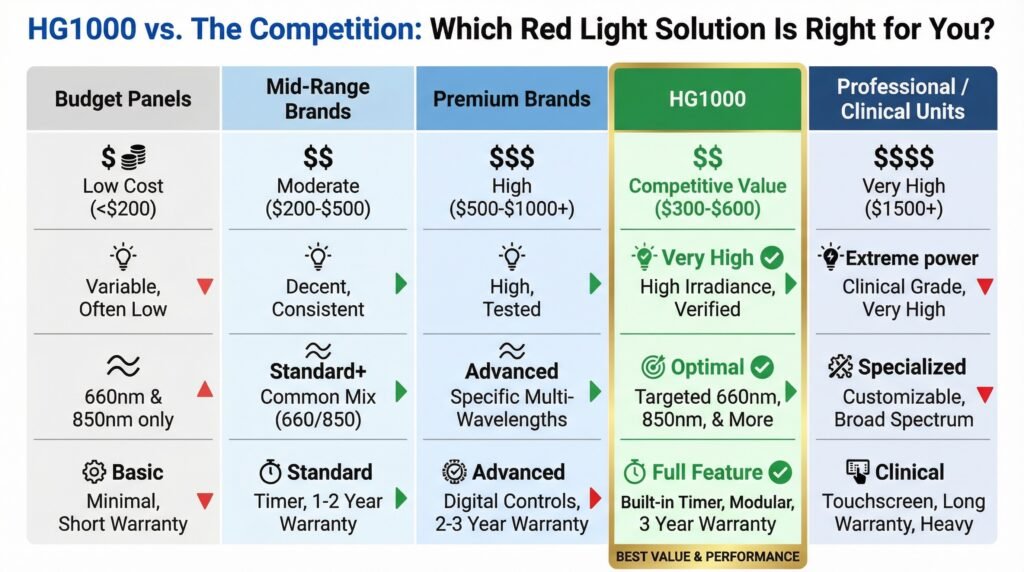
The home red light therapy market has a ton of options at different price points. The HG1000 sits in the middle tier.
Cheaper panels (under $200) usually have lower power output, fewer LEDs, or questionable wavelength accuracy. You get what you pay for with those.
They might work, but sessions take longer, and results are less consistent.
Higher-end panels ($800+) offer larger treatment areas, more power, or fancier features like pulsing modes and Bluetooth controls. Whether those extras are worth the price depends on your budget and how serious you are about red light therapy.
Professional clinical sessions give you more power and usually larger treatment areas, but the cost adds up fast. If you're paying $75 per session and going 3 times a week, you're spending $900 a month.
The HG1000 pays for itself in a couple of months compared to that.
Handheld red light devices are cheaper and more portable, but they only treat small areas at a time. Fine for targeting a specific injury or wrinkle zone, but not practical for full-body use.
Who This Panel Makes Sense For
The HG1000 fits a specific type of user. You need to be willing to commit to regular sessions.
If you're going to use it twice and forget about it, save your money.
It makes sense if you're now paying for professional red light therapy sessions and want to bring that home. The convenience factor alone is worth it when you don't have to drive somewhere and schedule appointments.
People dealing with chronic skin issues who've tried everything else often find red light therapy helpful. It's non-invasive, has minimal side effects, and there's actual research supporting its use for inflammatory skin conditions.
Athletes and fitness people who train hard and need faster recovery will probably get value out of it. Being able to do a 15-minute session right after working out fits easily into most routines.
The biohacker crowd likes having control over their protocol and being able to experiment with timing, distance, and session length. The HG1000 gives you that flexibility.
It's less ideal if you're extremely skeptical about red light therapy in general or if you need results immediately. This requires patience and consistency.
If you want to check current pricing and availability, tap the banner below to visit Hooga's official site to get started.
The Practical Downsides
The HG1000 isn't perfect. The panel size is decent for targeted treatment but not huge.
You can't treat your entire body at once unless you do multiple positions.
Front, back, and sides if you want full coverage.
The cooling fans are necessary, but they do make noise. Not a dealbreaker but worth mentioning if you're sensitive to background noise.
It takes up space. Even the stand version has a footprint, and wall-mounted, it's permanently taking up wall space.
You need a spot where you can comfortably stand in front of it with some clearance.
The upfront cost is significant. Even though it pays for itself compared to clinical sessions, spending several hundred dollars on a wellness device requires some financial wiggle room.
Results take time. You won't see dramatic changes after one week.
The people getting good results are putting in weeks or months of consistent use.
If you're ready to try it, check the latest deals on the HG1000 by clicking the button below to get 12% off.
How Red Light Therapy Works
Red light therapy works and has legit scientific backing. This isn't pseudoscience or wishful thinking.
There are hundreds of peer-reviewed studies on photobiomodulation (the technical term for red light therapy).
Studies show that red and near-infrared light at the right wavelengths and doses increase ATP production in your cells. ATP is cellular energy.
More ATP means better cellular function across the board.
For skin, research shows increased collagen production, reduced inflammation, and faster wound healing. Studies on muscle recovery show reduced muscle damage markers, less delayed onset muscle soreness, and improved performance when used before exercise.
Joint pain and arthritis studies show reduced pain and inflammation, though results vary depending on the condition. Thyroid function, testosterone levels, and brain health are newer areas of research with promising early results but less definitive proof.
The effective dose range is generally 3-60 joules per square centimeter per session. The HG1000's power density means you're getting around 36-90 joules per session, depending on distance and time, which puts it in the therapeutic range.
Long-Term Ownership Considerations
Red light panels are built to last. LEDs have a long lifespan, typically 50,000+ hours.
At 15 minutes per day, that's decades of use before the LEDs degrade noticeably.
Most HG1000 units come with a warranty covering defects and failures. Check what's included because warranty terms vary by seller.
Maintenance is minimal. Dust the panel occasionally and make sure the cooling vents don't get blocked. That's about it.
Energy cost is low. Running a 1000W panel for 15 minutes per day is around 7.5 kWh per month.
At average electricity rates, that's less than a dollar per month.
The panel holds its value pretty well if you decide to sell it later. Used red light panels sell for a decent percentage of their original price, especially if they're in good condition.
Making the Decision
The HG1000 review data I've gathered suggests this panel delivers what it promises for people who use it consistently. The wavelengths are right, the power density is in the therapeutic range, and user reports align with what the research says should happen.
The cost makes sense if you're replacing professional sessions or if you're committed to red light therapy as a long-term health practice. It doesn't make sense if you're casually curious or if consistency isn't your strong suit.
The size works for targeted treatment and individual use. If you want full-body coverage in less time, you'd need a larger panel or multiple panels.
For most people's needs, this size handles it fine.
Build quality seems solid based on what people report. No widespread complaints about units failing or LEDs dying prematurely.
The biggest question is whether you'll actually use it. Red light therapy works, but only if you do it regularly.
If you can commit to 10-15 minutes several times per week, the HG1000 gives you a legitimate way to get those benefits at home.
Hooga has teamed up with TrueMed to make HSA and FSA payments available. Eligible customers can use pre-tax dollars to purchase Hooga products, potentially saving 30–40% compared to paying out of pocket.
You can see full specifications and current pricing for the HG1000 on Hooga's official site by clicking the button below.
Final Thoughts
The HG1000 sits in that practical middle ground. It's not the cheapest option, and it's not the most expensive.
It offers legit specs without unnecessary features that drive up the cost.
For someone dealing with skin issues, muscle recovery needs, or joint pain who's willing to put in consistent sessions, it's a solid investment. The convenience of home treatment and the cost savings compared to clinical sessions make it worthwhile.
The research backing red light therapy is real. The technology works.
The question is whether this specific panel delivers it effectively, and based on specs and user reports, it does.
If you've been considering at-home red light therapy, the HG1000 offers a reasonable entry point without compromising on the important factors like wavelength accuracy and power density. Just go in knowing it requires commitment, not just financially, but time-wise too.
The people getting results are the ones treating it like brushing their teeth, just part of the routine, several times a week, without overthinking it. That's probably the best way to approach it.
Read more reviews of other affordable and effective red light therapy devices for at-home use here.
📌 FAQ
What wavelengths does the HG1000 use?
Red (660 nm) + Near-Infrared (850 nm), which are commonly studied for therapeutic light effects.
How long should I use it per day?
Typical sessions range from a few minutes up to ~10-15 min, depending on distance and goals.
Does red light therapy really work?
There’s evidence for benefits like skin health and muscle recovery, but it’s not guaranteed for every user or condition.
Can it replace professional treatments?
No. Home devices supplement wellness routines but don’t replace clinical medical care.
Is the HG1000 safe?
Generally, yes, when used as directed, but you should wear eye protection and avoid overexposure.
This article includes affiliate links. If you click through and make a purchase, I may receive a small commission. This helps support the site and allows me to keep creating helpful content at no extra cost to you.