Quick Takeaway
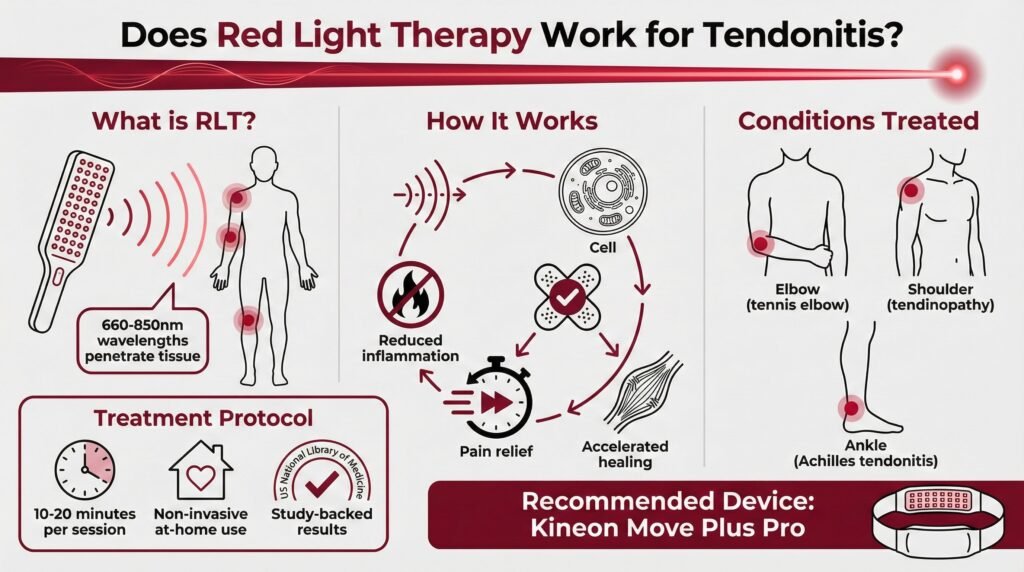
Red light therapy (photobiomodulation) can help with tendonitis as part of a consistent rehab plan.
Research suggests it may:
- Reduce pain and inflammation
- Increase blood flow to poorly vascularized tendons
- Stimulate collagen production and tissue repair
- Accelerate recovery, especially when combined with exercise
It’s most effective when used:
- Daily over several weeks (2–8+)
- With the right wavelengths (typically 660nm–850nm)
- Alongside eccentric rehab exercises
Bottom line:
👉 Red light therapy can speed up healing and improve symptoms, but results depend on consistency, correct usage, and whether your condition is acute or chronic.
Discover if red light therapy for tendonitis works. Backed by studies on PubMed, RLT (660-850nm wavelengths) reduces inflammation, eases tennis elbow, Achilles tendonitis, and tendinopathy pain, and speeds tendon repair.
Table of Contents
- Quick Takeaway
- Introduction
- The Science Behind Light and Tissue Repair
- What the Research Actually Shows
- Critical Parameters That Determine Success or Failure
- Integrating Red Light Therapy with Rehabilitation
- Common Mistakes and Misconceptions
- Adapting Treatment to Different Tendon Locations
- The Realistic Value Proposition
- Red Light Therapy Savings Calculator
- Key Takeaways
- FAQs About Red Light Therapy for Tendonitis
Introduction
Red light therapy for tendonitis has moved from something you’d only find in professional sports clinics to a treatment people are trying at home with their own devices.
I’ve been watching this shift happen over the past several years, and the results are genuinely interesting, though not quite as straightforward as the marketing materials would have you believe.
Tendonitis affects millions of people every year. That deep, persistent ache in your Achilles tendon, rotator cuff, elbow, or knee can really mess with your daily life.
Whether you’re an athlete dealing with chronic overuse or someone who just pushed too hard during a weekend project, the pain has a way of sticking around longer than you’d like.
Traditional treatments help to some degree. Rest, ice, compression, elevation, and anti-inflammatory medications are the standard recommendations.
They work, but they don’t always speed up healing as much as we’d hope.
Many people find themselves stuck in a frustrating cycle where the pain improves slightly, they return to activity, and then the whole thing flares up again.
Also called photobiomodulation, red light therapy works by using specific wavelengths of light that penetrate your skin and supposedly trigger cellular repair processes. The theory sounds reasonable enough.
The real question is whether the actual clinical evidence supports using it for tendon injuries, and if so, how to apply it correctly to get meaningful results.
The Science Behind Light and Tissue Repair
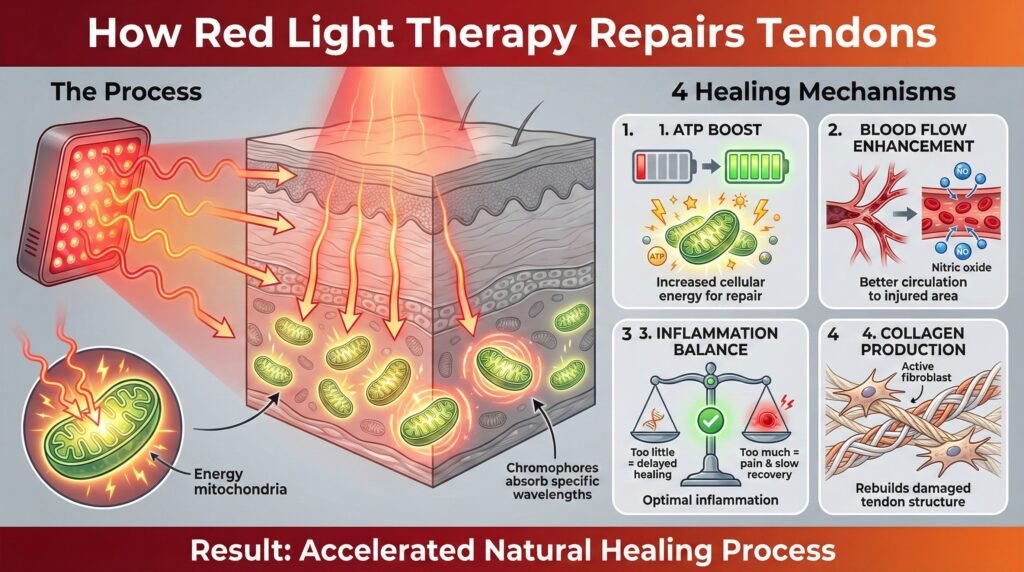
The mechanism that makes red light therapy potentially effective for tendonitis is actually pretty well understood at the cellular level. Your cells contain mitochondria, which function as tiny power plants generating ATP.
ATP is the energy currency your body uses for everything, including tissue repair.
When you shine specific wavelengths of red or near-infrared light onto injured tissue, those photons penetrate through your skin and get absorbed by chromophores in the mitochondria. This absorption triggers a cascade of cellular responses that could theoretically support healing.
First, the light exposure ramps up ATP production. Your cells suddenly have more energy available to devote to repair processes.
Second, it causes the release of nitric oxide, which dilates blood vessels and increases circulation to the injured area.
Better blood flow means more oxygen and nutrients reaching the damaged tendon.
Third, and this is really important, the light appears to modulate inflammation as opposed to simply suppress it.
That distinction matters quite a bit because inflammation gets a bad reputation, but you actually need some inflammation during the initial stages of tendon healing.
Zero inflammation would delay repair.
Excessive inflammation impairs recovery and causes ongoing pain. Red light therapy seems to help regulate inflammation to optimal levels, which is honestly more sophisticated than what most anti-inflammatory medications accomplish.
The fourth mechanism involves collagen production. Tendons are tough, fibrous cords made primarily of collagen.
When you injure a tendon, your body needs to produce new collagen to rebuild the damaged structure.
Red light therapy has been shown to stimulate fibroblasts, the cells responsible for producing collagen, potentially accelerating this reconstruction process.
What the Research Actually Shows
I’m going to be straight with you about the evidence quality because you need realistic expectations. The research on red light therapy for tendonitis shows promise, but the studies aren’t as robust as we’d ideally want.
Most research trials are relatively small, and the quality of evidence ranges from very low to moderate according to systematic reviews.
That said, some findings are really quite compelling. A 15-month study involving 65 university athletes treated 395 injuries with 830 nm near-infrared LED phototherapy.
Among these were 30 cases of Achilles tendonitis.
The results showed that athletes returned to play in an average of 9.6 days with red light therapy compared to 19.23 days with conventional treatment alone. That’s roughly a 50% reduction in recovery time, which is substantial if you’re trying to get back to competition or even just normal daily activities.
Participants in that study achieved up to 6 points of pain reduction on a visual analog scale within just 2 to 6 treatment sessions. The safety profile was excellent, with no adverse events reported across 1,669 treatment sessions.
About 78.5% of participants reported being very satisfied or satisfied with the treatment.
However, I need to point out the limitations. This study didn’t have a control group receiving sham treatment, which means we can’t completely rule out placebo effects or the natural healing that would have occurred anyway.
The pain assessments were subjective as opposed to using objective measures.
And the data weren’t specifically isolated for tendonitis cases versus other soft tissue injuries.
A 2021 systematic review and meta-analysis examined photobiomodulation across 17 studies and found very-low-to-moderate quality evidence supporting its use for tendinopathy. When combined with exercise, red light therapy showed similar effectiveness at reducing pain compared to other interventions like ultrasound and shock wave therapy.
The review uncovered that more robust randomized controlled trials with standardized protocols are needed before we can make definitive claims.
Research specifically on Achilles tendonitis presents a mixed picture. One randomized controlled trial compared actual red light therapy to a placebo device that looked identical but delivered incorrect wavelengths.
Both groups improved with rehabilitation exercise alone, which makes sense because exercise is the foundation of tendon recovery.
The group receiving real red light therapy experienced slightly less pain during early stages, but the difference wasn’t statistically significant, and functional outcomes at 3 to 4 months were similar between groups.
Critical Parameters That Determine Success or Failure
This is where most people go wrong when trying red light therapy at home. Effectiveness depends heavily on getting the dosing parameters fixed.
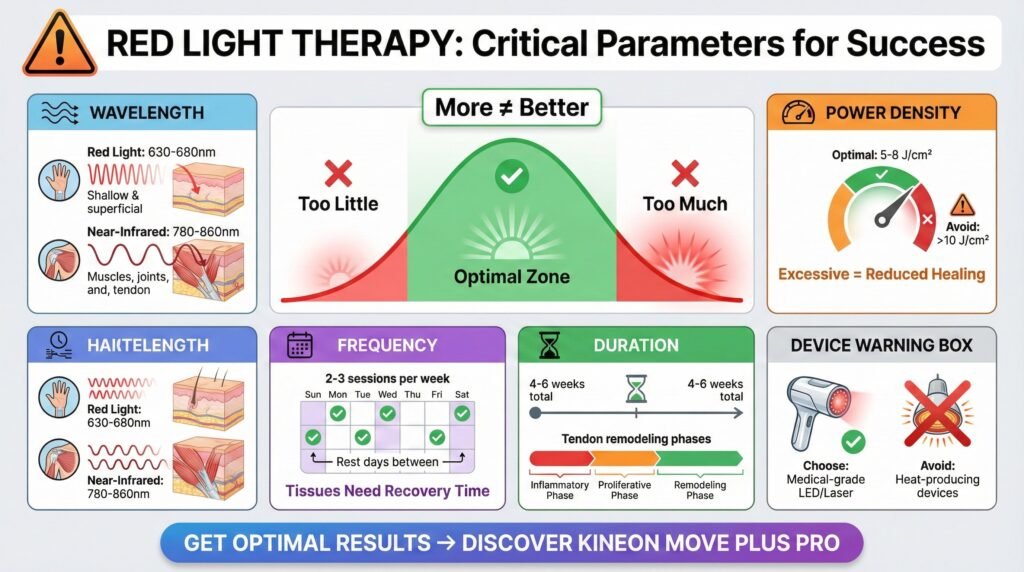
There’s actually something called a biphasic dose response, which means that too little light won’t produce therapeutic effects, but too much light can actually inhibit healing as opposed to promoting it.
The wavelength you use matters tremendously. Red light in the 630 to 680 nm range works well for tendons close to the surface, like those in your hand or wrist.
Near-infrared light in the 780 to 860 nm range penetrates deeper and is necessary for structures like the Achilles tendon or rotator cuff.
If you use the wrong wavelength, the light simply won’t reach your target tissue effectively.
Power density is another crucial variable. Most research protocols use between 5 and 8 joules per square centimeter per session.
Going beyond 10 joules per square centimeter may actually reduce effectiveness because of that biphasic response.
This is counterintuitive because people naturally think more treatment equals better results, but that’s not how photobiomodulation works.
Treatment frequency should be around 2 to 3 sessions per week, and importantly, not on consecutive days. Your tissues need recovery time between treatments to respond to the cellular changes initiated by the light exposure.
The total treatment duration should span 4 to 6 weeks, which aligns with the natural timeline of tendon healing and remodeling.
The type of device matters as well. You want LED panels or medical-grade lasers that produce non-thermal red or near-infrared light.
Some devices marketed as “infrared therapy” actually produce heat as opposed to therapeutic light wavelengths.
Those may feel good temporarily because heat increases circulation, but they don’t provide the same photobiomodulation effects.
Integrating Red Light Therapy with Rehabilitation
Here’s what I consider the most important takeaway from all the research. Red light therapy works best as a complementary treatment combined with proper rehabilitation, not as a standalone solution.
Tendons need mechanical loading through progressive strengthening exercises to remodel properly and regain their load-bearing capacity.
The primary value of red light therapy appears to be reducing pain enough that you can engage more effectively in physical therapy exercises. If your tendonitis hurts so much that you can’t perform the strengthening work your tendon needs, red light therapy might provide just enough pain relief to enable better rehabilitation adherence.
During the acute inflammatory phase, which lasts roughly 1 to 7 days after injury, you’d focus on relative rest and pain management. This is when red light therapy can be particularly useful for reducing pain and modulating that initial inflammatory response.
You might do 2 to 3 sessions during this first week.
As you transition into the proliferative phase, which spans from about day 4 through week 6, your body is actively producing new collagen and rebuilding tissue. This is when you’d continue red light therapy sessions 2 to 3 times weekly while gradually introducing gentle, controlled loading exercises.
The red light may support increased collagen production during this critical rebuilding window.
During the remodeling phase, which can last from week 6 through month 12 or even longer, you’re progressively strengthening the tendon and improving its organization and tensile strength. Red light therapy becomes less critical during this phase, though some people continue using it for pain management as they increase exercise intensity.
Common Mistakes and Misconceptions
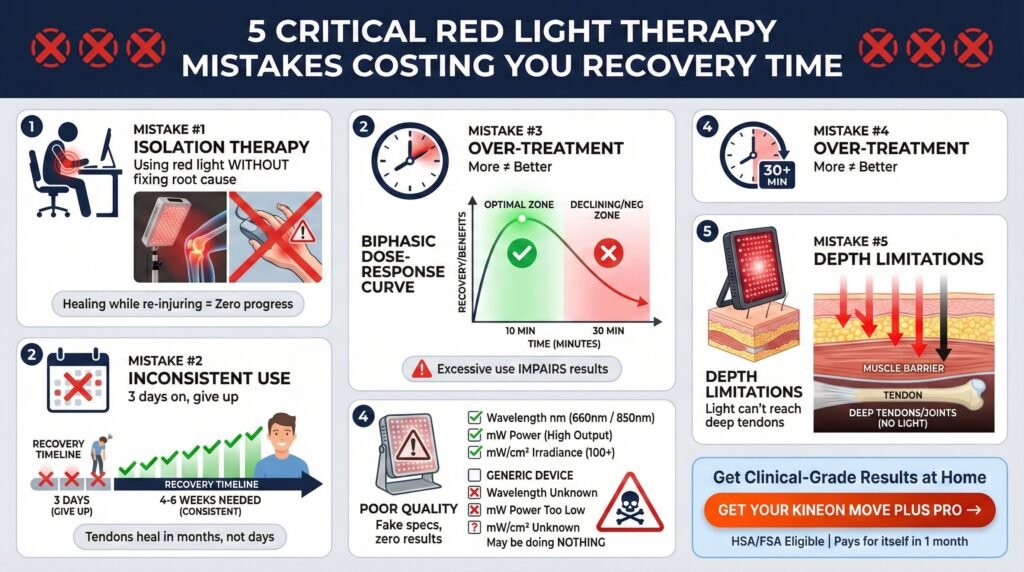
I’ve seen people make several recurring errors when trying red light therapy for tendonitis. The first is using it in isolation without addressing the underlying biomechanical issues or activity modifications that caused the tendonitis in the first place.
If you have tennis elbow from repetitive strain at work and you use red light therapy but don’t change your technique or take breaks, you’re essentially trying to heal while continuing to re-injure yourself.
Another common mistake is inconsistent application. People might use it intensively for a few days, see no dramatic improvement, and give up.
Tendon healing operates on a timeline of weeks to months, not days.
The research shows the benefits of protocols spanning 4 to 6 weeks with consistent frequency.
Over-treatment is surprisingly common. People figure if 10 minutes is good, then 30 minutes must be better.
Because of that biphasic dose response, excessive treatment can actually impair your results.
Stick to the recommended parameters as opposed to freelancing.
Device quality varies enormously in the consumer market. Many inexpensive devices don’t actually deliver the wavelengths or power densities they claim.
Without proper calibration and verification, you might be using a device that’s essentially doing nothing.
Legitimate red light devices should provide specifications including precise wavelength measurements, power output in milliwatts, and irradiance at the skin surface measured in milliwatts per square centimeter.
Some people also expect red light therapy to work for very deep tendons that are simply beyond the penetration capacity of the light. Near-infrared light can penetrate tissue fairly well, but there are limits.
If your tendon is very deep or surrounded by thick muscle tissue, the light may not reach it effectively.
Adapting Treatment to Different Tendon Locations
The approach needs customization based on which tendon you’re treating. For Achilles tendonitis, you want near-infrared wavelengths around 830 nm because the Achilles tendon, while superficial in some areas, still needs good penetration.
Position the device so it directly contacts or sits very close to the back of your heel and lower calf.
Treatment time might be 10 to 15 minutes per session.
For lateral epicondylitis or tennis elbow, the common extensor tendon at the elbow is relatively accessible. Near-infrared wavelengths work well here, too.
You’d position the device on the outside of your elbow where you feel the pain. This location responds particularly well when you mix red light therapy with eccentric strengthening exercises, where you slowly lower resistance as opposed to lifting it.
Rotator cuff tendinopathy presents more challenges because the tendons are deeper and covered by muscle. You definitely need near-infrared wavelengths, and you might need a more powerful device to achieve adequate tissue penetration.
Treatment sessions might need to be slightly longer, though still respecting the most dose guidelines.
For patellar tendinopathy or jumper’s knee, the patellar tendon sits relatively superficial, just below your kneecap. Near-infrared wavelengths around 810 to 830 nm work well.
This condition particularly benefits from combining red light therapy with eccentric squatting exercises that specifically load the patellar tendon.
Of course, having a red light device that can provide targeted treatment is key. The Kineon Move+ Pro is one such red light device. This at-home device pays for itself within a month when compared to expensive clinical sessions multiple times per week.
Click the link below to get the Kineon Move+ Pro and take advantage of the Promo Code listed below plus HSA- and FSA-eligible savings.
The Realistic Value Proposition
After reviewing all the evidence, I’d characterize red light therapy for tendonitis as occupying a “likely useful but not definitively proven” position. The biological mechanisms are legitimate and well-documented. Some clinical outcomes are genuinely impressive, particularly the 50% reduction in return-to-play time for athletes.
The safety profile is excellent, with essentially no reported serious adverse events.
However, the evidence quality stays moderate at best. Studies are often small, protocols vary significantly between research groups, and many lack proper blinded control groups.
We’re not yet at the point where major medical organizations are including red light therapy in their standard treatment guidelines for tendonitis.
For someone dealing with tendonitis, I think red light therapy represents a reasonable adjunctive option, particularly if pain is the limiting factor preventing you from engaging in rehabilitation exercises. Set realistic expectations around incremental pain reduction that supports more effective physical therapy as opposed to expecting dramatic, standalone healing.
The cost consideration is worth addressing. At-home devices range from $100 to $500 or more, depending on specifications and build quality.
If you need 10 to 15 sessions over 4 to 6 weeks, that’s a significant investment.
The Kineon MOVE Plus Pro offers targeted red light therapy at a reasonable price. When compared to clinical treatments, which might cost $75 to $150 per session, 2 to 3 times a week, the MOVE Plus hits break-even fairly quickly.
Compare this to the cost of prolonged disability, missed work, or inability to join in activities you enjoy, and it might be worthwhile.
Use and bookmark the cost savings calculator below to crunch the real numbers and see the savings for yourself.
💰 Red Light Therapy Savings Calculator
Discover how much you can save with Kineon’s at-home red light therapy compared to professional clinic sessions. Get professional-grade treatment from the comfort of your home.
Key Takeaways
Red light therapy for tendonitis shows modest promise for reducing pain during early-stage recovery when pain limits rehabilitation efforts. The biological mechanisms are legitimate, involving mitochondrial stimulation, improved circulation, inflammatory modulation, and collagen production support.
Evidence quality stays moderate, with most studies showing benefit when red light therapy is combined with exercise rehabilitation.
Treatment parameters matter enormously. Wavelengths should be 630 to 860 nm, depending on tendon depth; power density should stay between 5 and 8 joules per square centimeter, and frequency should be 2 to 3 sessions weekly over 4 to 6 weeks.
The safety profile is excellent, with essentially no serious adverse events reported in clinical trials.
Set realistic expectations around incremental pain reduction, enabling better physical therapy as opposed to expecting dramatic standalone healing.
Read our full list of reviews of affordable and effective red light therapy devices here.
Frequently Asked Questions
Does red light therapy actually help tendonitis?
The evidence suggests red light therapy can help reduce pain and potentially speed recovery when combined with proper rehabilitation exercises. Studies show mixed results, with some demonstrating significant benefits like 50% faster return-to-play times, while others show minimal difference compared to a placebo.
The therapy works best as a complementary treatment alongside physical therapy as opposed to as a standalone solution.
What wavelength is best for treating Achilles tendonitis?
Near-infrared wavelengths around 830 nm work best for Achilles tendonitis because they penetrate deeply enough to reach the tendon tissue. Red light wavelengths in the 630 to 680 nm range don’t penetrate as deeply and are better suited for more superficial tendons.
The Achilles tendon needs deeper penetration to achieve therapeutic effects.
How often should you use red light therapy for tendonitis?
Most research protocols recommend 2 to 3 sessions per week over a period of 4 to 6 weeks. You shouldn’t do sessions on consecutive days because your tissues need recovery time between treatments to respond to the cellular changes.
More frequent treatment doesn’t necessarily produce better results and may actually impair healing due to the biphasic dose response.
Can you overdo red light therapy on tendons?
Yes, you can definitely overdo red light therapy. The biphasic dose response means that too much light can actually inhibit healing as opposed to promoting it.
Most research suggests staying between 5 and 8 joules per square centimeter per session, and going beyond 10 joules may reduce effectiveness.
Longer treatment times don’t necessarily produce better outcomes.
How long does it take to see results from red light therapy for tendonitis?
Most people who respond to red light therapy notice some pain reduction within 2 to 6 treatment sessions, which typically spans 1 to 3 weeks. However, the healing takes much longer, usually 4 to 6 weeks at least, and often several months for full recovery.
Red light therapy may speed this process, but it doesn’t eliminate the natural healing timeline.
Does insurance cover red light therapy for tendonitis?
Most insurance plans don’t cover red light therapy for tendonitis because it’s still considered an emerging treatment without definitive evidence from large-scale clinical trials. Some sports medicine clinics may include it as part of a covered physical therapy program, but standalone red light therapy sessions are typically paid out-of-pocket.
What’s the difference between red light and infrared therapy for tendons?
Red light (630 to 680 nm) penetrates skin superficially and works well for shallow tendons. Near-infrared light (780 to 860 nm) penetrates much deeper and is necessary for deeper structures like the Achilles tendon or rotator cuff.
Some devices marketed as “infrared therapy” produce heat as opposed to therapeutic light wavelengths, which don’t provide the same photobiomodulation effects.
Can red light therapy help chronic tendonitis?
Red light therapy may help chronic tendonitis, though the evidence is less clear than for acute injuries. Chronic tendinopathy involves more complex tissue changes and often needs longer treatment protocols.
The therapy appears most useful for reducing pain enough to engage in the progressive strengthening exercises that are essential for treating chronic tendon conditions.
Get started today by clicking the button below and starting to take advantage of the relief of at-home red light treatments.
This article includes affiliate links. If you click through and make a purchase, I may receive a small commission. This helps support the site and allows me to keep creating helpful content at no extra cost to you.