Quick Summary
Red light therapy (RLT) helps relieve knee pain through non-invasive mechanisms: specific wavelengths (red ~660 nm for surface + near-infrared 808–850 nm for deep penetration) boost mitochondrial ATP production for cellular repair, reduce inflammation (lower cytokines, increase nitric oxide/blood flow), and modulate pain signals (endorphin release, nerve effects). It’s effective for osteoarthritis, acute injuries, post-surgery recovery, and overuse issues, with studies showing ~50% pain reduction and benefits lasting 4–6 months after treatment.
Recommended protocol: Use a quality device with both red and NIR wavelengths, apply directly to clean bare skin over the knee (close contact or within 1 inch) for 10–20 minutes per session, at least 3–7 times weekly.
Consistency is crucial. Expect subtle early changes (less stiffness in days), noticeable improvements in 2–4 weeks, and peak benefits around 4–6 weeks. Avoid pitfalls like irregular use, wrong devices, or poor positioning.
Combine with exercise and other therapies for best results; it’s safe for daily use with minimal side effects. The article promotes wearable options like Kineon for convenient at-home joint treatment.
Table of Contents
- Understanding How Light Actually Heals Your Knee
- Mechanisms of action (wavelength penetration, mitochondrial ATP boost, inflammation reduction via cytokines/nitric oxide, nerve modulation, and endorphin release)
- Setting Up Your Treatment Protocol
- Device selection (combined red 660 nm + near-infrared 808-850 nm; wearable/joint-specific preferred)
- Positioning and setup (direct skin contact, clean bare skin, close proximity)
- Schedule and dosing (10-20 minutes per session, daily or at least 3x/week; consistency emphasized)
- What Actually Happens During Treatment
- Session experience (minimal sensation, internal cellular changes)
- Timeline of results (days 3–4: less stiffness; week 2: better motion/swelling; weeks 4–6: structural improvements, ~50% pain reduction in studies, lasting effects)
- Avoiding Common Implementation Mistakes
- Expecting instant results (allow 4–6+ weeks)
- Inconsistency, poor device choice, incorrect distance/positioning
- Over-reliance without combining with exercise/other care
- Adapting Treatment for Different Situations
- Acute injuries, chronic osteoarthritis, post-surgical recovery, overuse injuries
- Considerations for age, severity, and maintenance
- (Includes promotional section on Kineon MOVE+ Pro device, cost savings calculator, and affiliate links)
- Building Advanced Understanding
- Combining with exercises, temperature therapies, progress tracking, long-term maintenance protocols
- Key Takeaways for Long-Term Success
- Multi-pathway benefits, importance of proper wavelengths/consistency, integration into comprehensive care
- Frequently Asked Questions
- Covers safety of daily use, expected timelines, efficacy for arthritis/meniscus issues, best wavelengths, device distance, post-surgery application, insurance, etc.
Introduction
You’ve probably noticed everyone from elite athletes to your neighbor raving about red light therapy. It might seem like just another wellness trend destined to fade.
The reality is quite different.
What makes this particular treatment stick around while other fads disappear? The answer comes from something most knee pain sufferers desperately want: real relief without pills, injections, or surgery.
Walk into any physical therapy clinic these days, and you’ll increasingly spot those glowing red panels positioned near treatment tables. Professional athletes strap portable devices to their knees during recovery.
Your coworker mentions using one while watching television at night.
This happens because red light therapy addresses knee pain through mechanisms your body already understands. It amplifies what your cells naturally try to do when healing damaged tissue.
In this article, we will cover all the mechanisms that involve using red light therapy for knee pain relief.
Understanding How Light Actually Heals Your Knee
The concept sounds almost too simple to work. You shine red light on your knee, and the pain decreases.
But knowing how red light therapy actually works and what happens beneath your skin involves sophisticated cellular processes that researchers have studied for decades.
When specific wavelengths of light between 620 and 750 nanometers penetrate your skin, they don’t just warm the surface. These photons travel through layers of tissue, reaching the synovial fluid, cartilage, and surrounding structures inside your knee joint.
Once there, they interact with your mitochondria. Those tiny power plants inside every cell produce ATP, which serves as cellular currency.
Your cells spend it on everything from building new proteins to repairing damaged tissue to regulating inflammation.
Red light therapy essentially gives your cells a bigger budget to work with. When mitochondria absorb these specific light wavelengths, they produce more ATP without requiring extra oxygen or nutrients.
This energy boost translates directly into accelerated healing. Your body was already trying to repair that damaged cartilage or inflamed tendon.
It just lacked sufficient resources to do it effectively.
But energy production represents only part of the equation. The light wavelengths also change how your nerve cells behave.
Sodium ion channels in nerve membranes become less permeable, raising the threshold required for pain signals to fire. Simultaneously, your body releases more endorphins and endogenous opioids.
These natural pain relievers work without the side effects of pharmaceutical versions.
This dual mechanism explains why some people experience immediate pain reduction during their very first session, even before any structural healing occurs.
The inflammation response deserves special attention because chronic knee inflammation creates a vicious cycle. Your immune system detects damage and floods the area with inflammatory cytokines.
These chemicals cause swelling, which restricts movement, which causes more irritation, which triggers more inflammation.
Red light therapy works by interrupting this cycle by actively reducing inflammatory markers while simultaneously increasing blood flow to clear away cellular debris and deliver fresh nutrients.
The wavelengths trigger nitric oxide release from your blood vessels, causing them to dilate and allow more oxygen-rich blood to reach the damaged areas.
Your body knows how to heal itself. Red light therapy simply removes the roadblocks preventing that healing from happening efficiently.
Setting Up Your Treatment Protocol
Getting started requires more thought than simply buying a device and turning it on. The wavelength selection matters considerably.
The red light handles surface-level inflammation in skin and connective tissue, while near-infrared penetrates deeper to reach internal joint structures.
I’ve found that wearable devices specifically designed for knee application outperform general-purpose panels for most people. A large panel works fine if you’re committed to sitting still for 15 minutes daily, but a wrap-style device that straps directly around your knee lets you move around during treatment.
This convenience factor dramatically improves compliance. The best treatment protocol becomes the one you’ll actually follow consistently.
Position the device directly over your kneecap, centered on the joint. If you’re treating both knees, finish one before moving to the other, as opposed to trying to split time between them.
Your skin should be clean and free from lotions or thick clothing. A thin layer of fabric, like compression shorts, won’t significantly reduce penetration, but jeans or thick sweatpants will block too much light from reaching your tissues.
The treatment schedule follows a simple pattern. Ten to twenty minutes per session, either daily or at least three times weekly.
Daily use produces faster results, but three times weekly still delivers meaningful improvement if that matches your schedule better.
Consistency matters far more than session length. Four 10-minute sessions weekly will outperform one 40-minute weekend session.
Start with lower power settings if your device offers adjustment options. Most people tolerate the treatment with zero discomfort, experiencing only gentle warmth, but beginning conservatively prevents any surprises.
After three or four sessions, you can increase intensity if desired.
The distance between your skin and the light source makes a huge difference. Light disperses according to the inverse square law, meaning small distance changes create large intensity differences.
Keep the device as close to your skin as the manufacturer recommends, typically touching or within one inch.
What Actually Happens During Treatment
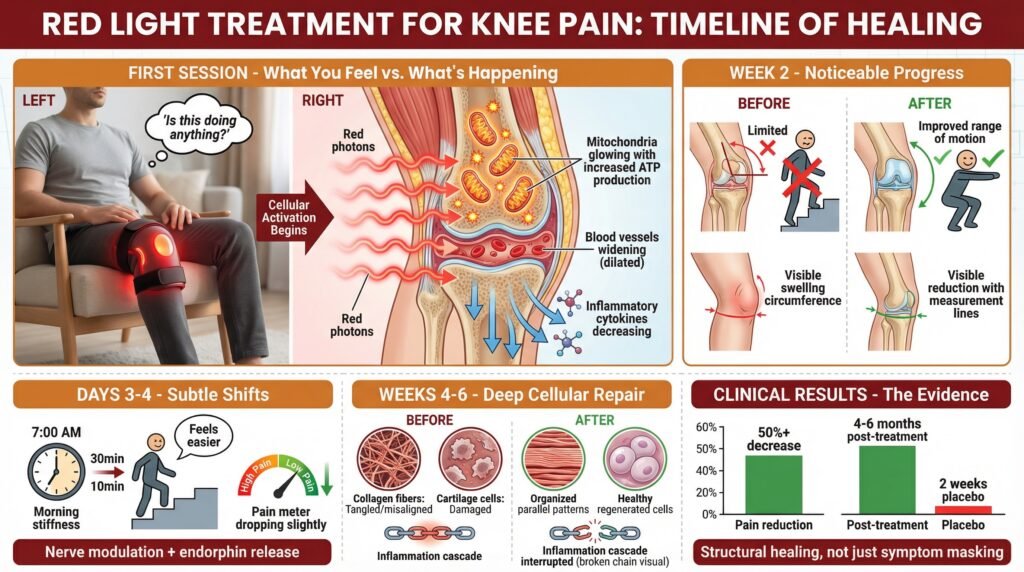
The first few sessions might feel anticlimactic. You position the device, turn it on, and sit there watching red light glow against your knee.
Some people feel warmth. Others feel nothing at all.
This doesn’t mean the treatment fails to work.
Inside your knee, photons are penetrating several centimeters deep, reaching tissues that topical creams and ice packs can’t touch. Your mitochondria start ramping up ATP production within minutes.
Blood vessels dilate, increasing circulation.
Inflammatory cytokines begin decreasing in concentration. None of this produces dramatic sensations, but the biological processes unfold nonetheless.
Around day three or four of consistent treatment, many people notice subtle changes. The morning stiffness lasts 10 minutes instead of 30.
Climbing stairs feels slightly easier.
The constant background ache reduces just enough to be noticeable.
These early improvements often come from nerve signal modulation and endorphin release as opposed to structural healing, which takes longer to develop.
Week two typically brings more obvious progress. Range of motion improves measurably.
You can bend your knee further without discomfort.
Activities you’d been avoiding, like squatting down or kneeling, become possible again. The swelling around your knee visibly decreases when you compare photos from before treatment started.
By weeks four through six, the cellular repair processes have had time to accumulate meaningful results. Collagen fibers that were shortened and misaligned begin reorganizing into proper patterns.
Damaged cartilage cells have been replaced with healthier versions.
The inflammatory cascade has been genuinely interrupted as opposed to just temporarily suppressed.
Clinical trials show this progression clearly. Participants with degenerative knee osteoarthritis experienced over 50% pain reduction after consistent treatment, with improvements continuing to build over time.
The benefits lasted four to six months after treatment ended, compared to just two weeks for placebo groups.
This extended benefit period suggests actual structural healing as opposed to temporary symptom masking. Your knee becomes objectively healthier, not just temporarily less painful.
Avoiding Common Implementation Mistakes
The biggest mistake people make stops them from getting results. They try red light therapy for a week or two, don’t see a dramatic transformation, and conclude it doesn’t work.
This completely misunderstands how cellular healing happens. Your body doesn’t replace damaged tissue overnight.
It needs consistent energy input over weeks to rebuild structures that took months or years to degrade.
Give any new treatment protocol at least four to six weeks before evaluating its effectiveness. Track your baseline pain levels, range of motion, and functional abilities before starting, then reassess at the one-month mark.
You’ll often discover improvements you hadn’t consciously noticed because they happened gradually.
Another common error involves inconsistent application. Using the device daily for a week, then forgetting about it for two weeks, then doing another few scattered sessions produces minimal results.
Your cells respond to regular, predictable stimulation.
Sporadic treatment prevents the added benefits of building properly.
Device selection causes problems for many first-time users. Those inexpensive LED face masks designed for skin rejuvenation won’t penetrate deeply enough for joint treatment.
You need a device specifically mentioning joint or muscle treatment in its specifications, with confirmed near-infrared wavelengths for deep tissue penetration.
The extra investment in a proper device pays off through actual results instead of wasted time with inadequate equipment.
Positioning errors reduce effectiveness substantially. Holding the device six inches away from your knee instead of directly against it cuts light intensity dramatically.
The photons spread out and lose power quickly over distance.
Some people expect red light therapy to completely replace other treatments. While it works remarkably well, it functions best as part of a comprehensive approach.
Continue your physical therapy exercises.
Take prescribed medications if needed. Use ice or heat as suitable. Red light therapy speeds up and enhances these interventions as opposed to replacing them entirely.
Treatment timing can make a real difference, too. Many people experience worse knee pain in the morning because of overnight inflammatory buildup.
Treating your knee first thing in the morning addresses inflammation at its peak, potentially providing better relief throughout the day compared to evening treatments. Take advantage of the Kineon MOVE+ Pro’s HSA/FSA savings plus 10% off with the coupon code by clicking the button below.
Adapting Treatment for Different Situations
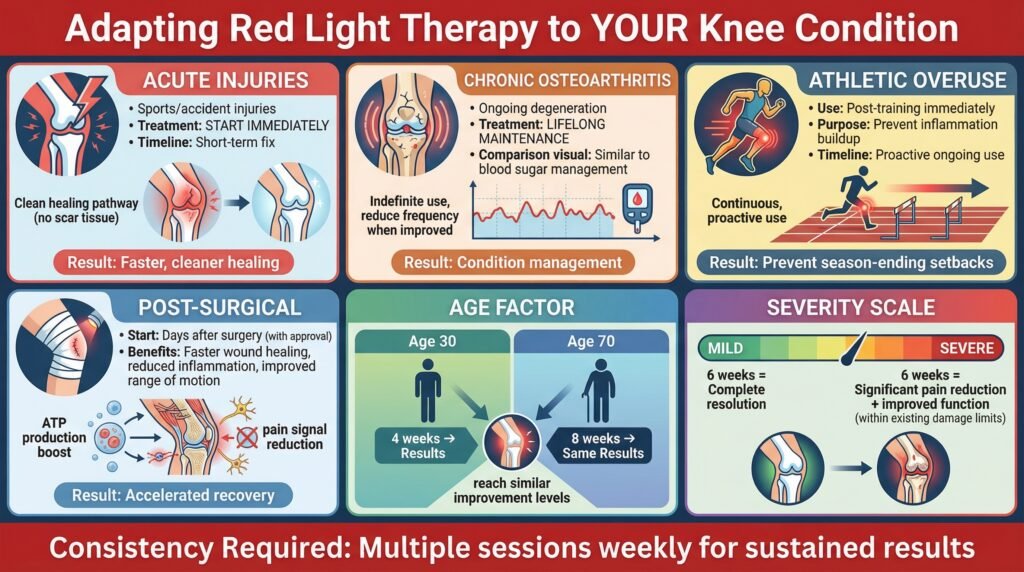
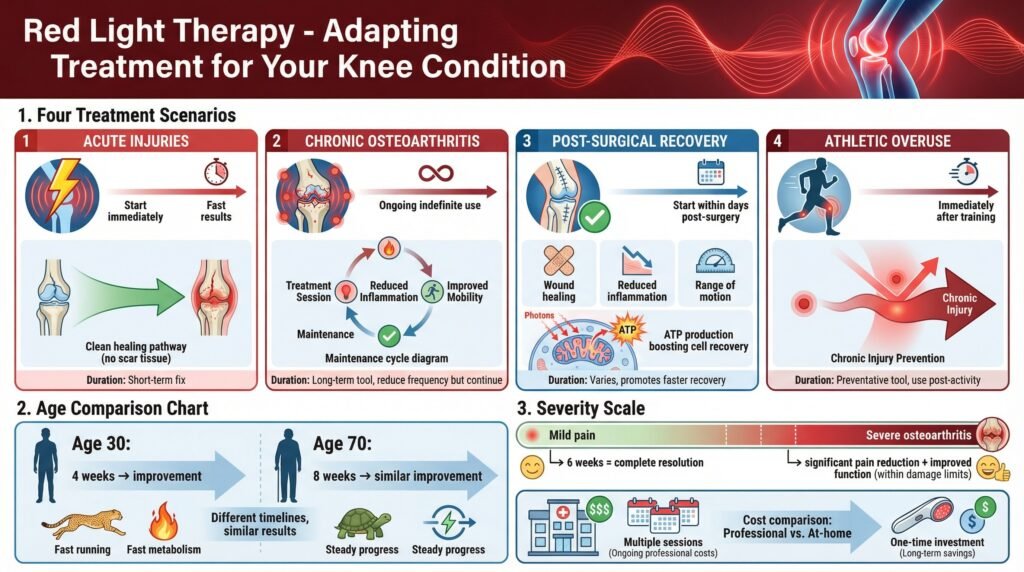
Your specific knee condition influences how you should approach red light therapy. Acute injuries from sports or accidents benefit from immediate treatment starting right after the injury occurs.
This early intervention helps control the initial inflammatory response and speeds up the healing timeline from the very beginning.
The cells haven’t yet formed scar tissue or chronic inflammation patterns, so the healing happens cleaner and faster.
Chronic osteoarthritis requires a different mindset. You’re not healing a recent injury but rather managing ongoing degeneration and inflammation.
This means red light therapy becomes a long-term maintenance tool as opposed to a short-term fix.
Many people with osteoarthritis use their device indefinitely, perhaps reducing frequency once symptoms improve, but never stopping completely. The treatment manages the condition similarly to how diabetics manage blood sugar levels.
Post-surgical recovery represents an ideal application for red light therapy. The treatment speeds up wound healing, reduces surgical site inflammation, and helps restore range of motion faster.
Start as soon as your surgeon approves, often within days of the procedure.
The increased ATP production helps your body handle the metabolic demands of healing surgical trauma while simultaneously reducing the pain signals that make recovery uncomfortable.
Athletes dealing with overuse injuries or training-related knee pain can combine treatment into their existing recovery protocols. Using the device immediately after training sessions helps control exercise-induced inflammation before it builds into chronic problems.
This proactive approach prevents small issues from becoming major setbacks that derail entire seasons.
Age matters more than you might expect. Older adults often see slower but sustained improvements, while younger people sometimes experience faster initial results.
This likely reflects overall cellular health and metabolic efficiency as opposed to any limitation of the therapy itself.
Both age groups benefit significantly, just on slightly different timelines. Someone in their 70s might need eight weeks to see what a 30-year-old sees in four weeks, but the result reaches similar levels of improvement.
The severity of your condition also affects the treatment approach. Mild knee pain from occasional inflammation might resolve completely with six weeks of treatment.
Severe osteoarthritis with bone-on-bone contact won’t magically regenerate lost cartilage, but it can significantly reduce pain and improve function within the limitations of the existing damage.
As you well know, professional red light treatments can end up being costly. Especially when considering the fact that to experience consistent results, it typically requires multiple sessions per week.
Obtaining an affordable and effective at-home option can help alleviate this common ‘cost-shock ’ issue. See the cost-saving calculator below to crunch the real numbers and see how the savings stack up.
💰 Red Light Therapy Savings Calculator
Discover how much you can save with Kineon’s at-home red light therapy compared to professional clinic sessions. Get professional-grade treatment from the comfort of your home.
Building Advanced Understanding
Once you understand the basic mechanisms, you can improve results through more sophisticated approaches. Combining red light therapy with specific exercises creates synergistic benefits.
Use the device for 15 minutes, then immediately perform gentle range-of-motion exercises while your tissues have increased blood flow and reduced pain sensitivity. This combination addresses both the biological healing and functional restoration simultaneously.
Your nervous system learns new movement patterns more easily when pain signals are temporarily reduced, helping you break out of protective movement restrictions.
Temperature considerations add another layer of optimization. Some practitioners alternate between cold therapy and red light therapy, using ice to control acute inflammation, then following with red light to speed up healing.
Others prefer heat before light therapy to increase initial blood flow.
Experiment with both approaches to find what works best for your specific situation. Your body might respond differently from someone else’s.
Tracking detailed metrics changes red light therapy from a passive treatment into an active learning process. Record specific functional measures:
- How many stairs can you climb comfortably?
- How long can you stand without discomfort?
- What distance can you walk before symptoms increase?
These goal measurements reveal progress that subjective pain ratings might miss. You might rate your pain the same number on a scale, but if you can now walk three miles instead of one mile before reaching that pain level, you’ve made a real improvement.
The maintenance phase requires its own strategy. Once you’ve achieved significant pain reduction and functional improvement, you face a decision.
Continue daily treatments indefinitely, or reduce frequency to see if benefits persist.
Most research suggests that some ongoing treatment maintains results better than stopping completely. Many people successfully transition to every-other-day or even three times weekly maintenance schedules after achieving initial improvements.
Think of it like exercise. You don’t stop working out completely once you reach your fitness goals.
You maintain what you’ve built through continued effort, just perhaps at a reduced intensity.
Click the links to Kineon’s Move Plus or Flexbeam’s portable red light devices to start your knee pain recovery journey today.
Key Takeaways for Long-Term Success
Red light therapy reduces knee pain through many simultaneous mechanisms. It increases cellular energy production, reduces inflammatory markers, improves blood flow, and modulates nerve pain signals.
This multi-pathway approach explains why it works for various knee conditions, from acute injuries to chronic arthritis.
Consistency decides success far more than session length or device cost. Ten minutes daily outperforms sporadic, longer sessions every time.
Build the treatment into existing daily habits to confirm you actually follow through.
Proper wavelength selection matters critically. Devices combining red light around 660 nanometers with near-infrared around 808 to 850 nanometers penetrate deeply enough to reach internal joint structures where healing needs to occur.
Results follow a predictable timeline. Immediate pain relief from nerve modulation and endorphin release happens in the first few sessions.
Noticeable functional improvements appear around weeks two to three.
Significant structural healing becomes obvious by weeks four to six. Don’t judge effectiveness before giving the treatment adequate time to work.
Red light therapy works best as part of a comprehensive approach as opposed to a standalone solution. Combine it with appropriate exercises, medical treatments, and lifestyle modifications for optimal outcomes.
The treatment provides benefits that require ongoing maintenance. Results typically last four to six months after stopping treatment, but continuing some level of regular use maintains improvements indefinitely for most people with chronic conditions.
Frequently Asked Questions
Can you use red light therapy every day for knee pain?
Yes, daily use is safe and often produces faster results than less frequent treatment. Most protocols recommend 10 to 20 minutes per session, once or twice daily.
The wavelengths used in red light therapy don’t damage tissue or create heat damage like UV light does, making daily treatment both safe and effective for chronic knee conditions.
How long does it take for red light therapy to work on the knees?
Most people notice subtle improvements within the first week, with more obvious pain reduction and functional gains appearing around weeks two to three. Significant structural healing typically becomes obvious by weeks four to six.
Chronic conditions like osteoarthritis may require eight to twelve weeks of consistent treatment before reaching most improvement.
Does red light therapy really help arthritis in the knee?
Clinical studies show red light therapy reduces pain and improves function in knee osteoarthritis patients by over 50% compared to placebo treatments. The therapy reduces inflammatory markers, increases cartilage cell metabolism, and improves joint lubrication through enhanced synovial fluid production.
While it won’t regenerate severely degraded cartilage, it meaningfully improves pain levels and mobility.
What is the best wavelength for knee pain?
The most effective devices mix red light at 660 nanometers with near-infrared light at 808 to 850 nanometers. Red light treats surface inflammation in skin and superficial tissues, while near-infrared penetrates deeper to reach internal joint structures, cartilage, and synovial membranes where most knee pain originates.
Can I use red light therapy after knee replacement surgery?
Yes, but only after your surgeon approves its use, typically within the first week or two after surgery. Red light therapy speeds up surgical wound healing, reduces post-operative inflammation, and helps restore range of motion faster during physical therapy.
Many orthopedic surgeons now recommend it as part of comprehensive post-surgical recovery protocols.
How close should the red light be to your knee?
Position the device directly against your skin or within one inch for maximum effectiveness. Light intensity decreases rapidly with distance according to the inverse square law.
A device positioned six inches away delivers only about 10% of the intensity compared to one touching your skin, significantly reducing therapeutic effects.
Does insurance cover red light therapy for knee pain?
Most insurance plans currently don’t cover at-home red light therapy devices. However, treatments performed in a physical therapy clinic or medical office may receive coverage under certain conditions.
Some HSA and FSA accounts allow purchases of red light therapy devices as qualified medical expenses.
Check with your specific plan administrator.
Can red light therapy help with a torn meniscus?
Red light therapy can reduce pain and inflammation associated with meniscus tears and may speed up the healing of minor tears. However, it cannot repair significant tears that require surgical intervention.
Many orthopedic surgeons recommend it as a conservative treatment option before considering surgery for partial tears, and as a recovery aid after meniscus repair surgery.
This article includes affiliate links. If you click through and make a purchase, I may receive a small commission. This helps support the site and allows me to keep creating helpful content at no extra cost to you.