Key Takeaways
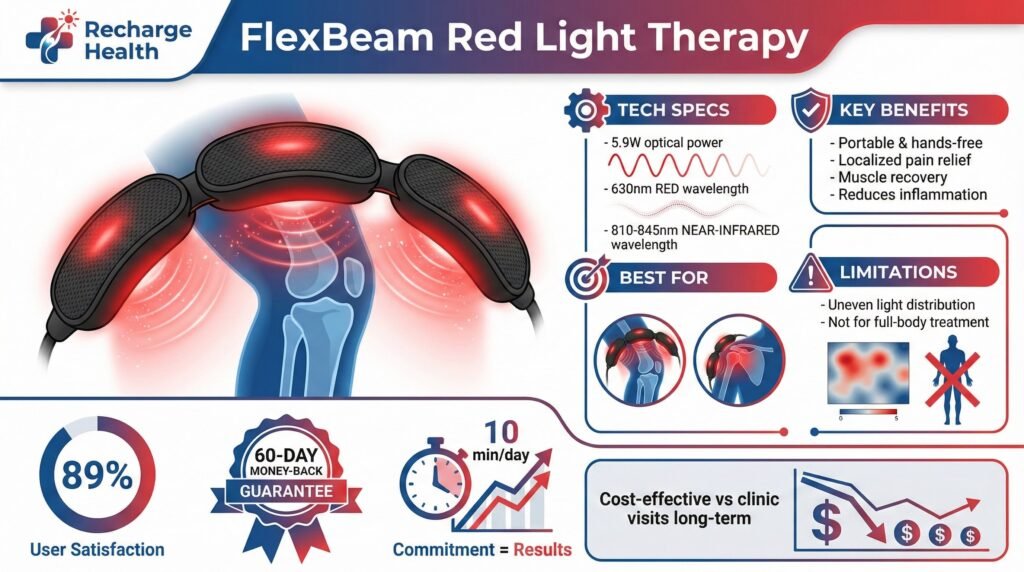
The FlexBeam is a portable, wearable red light therapy device (priced at ~$599) from Recharge Health, featuring three flexible pods that wrap around targeted body areas like joints, muscles, or limbs. It delivers a solid 5.9W of optical power using proven wavelengths (630nm red + 810-845nm near-infrared), with strong portability, hands-free design, and good build quality.
It’s best for consistent users seeking localized pain relief, recovery, or inflammation reduction, but it has uneven light distribution and isn’t ideal for full-body treatment.
Overall, it’s a worthwhile investment if used regularly (beats clinic costs long-term), backed by high user satisfaction (~89%) and a 60-day guarantee, but only a “game changer” for those who commit to daily/near-daily 10-minute sessions.
Check current FlexBeam pricing and availability >>>CLICK HERE (Get an extra 5-10% off now.)
Table of Contents
· Introduction
· About Recharge Health and How FlexBeam Works
· Power Output: How FlexBeam Compares to Other Devices
· The Build Quality and Design Details
· Real User Results and Survey Data
· How to Set It Up and Use It Effectively
· Advanced Tips for Getting the Most Out of FlexBeam
· The Cost Reality Check
· Common Issues and How to Fix Them
· Who Actually Benefits Most from FlexBeam
· How FlexBeam Stacks Up Against Alternatives
· Warranty, Safety, and Reliability
· Final Thoughts on Whether FlexBeam Is Worth It
Introduction
So, I’ve been looking into portable red light therapy devices for a while now, and FlexBeam keeps coming up in conversations. People either love it or think there are better options out there, but nobody really explains what you’re actually getting for the price.
I wanted to dig into this properly because clinic visits add up fast (like $75-125 per session), and most at-home panels are either underpowered or take up half your room.
FlexBeam is supposed to be different… It’s wearable, you can move around with it, and the company claims it has way more power than other portable devices.
The thing that caught my attention is that it’s actually designed in Norway by a company called Recharge Health (they started in 2018). They built the whole device around making red light therapy something you can actually use consistently without blocking out 20 minutes to sit in front of a panel or drive to appointments.
But does it work? Is it worth the cost compared to other options?
In this Flexbeam review, that’s what I wanted to figure out.
About Recharge Health and How FlexBeam Works
Recharge Health isn’t one of those random companies pumping out cheap wellness gadgets. They focused specifically on creating a wearable red light therapy device that delivers clinical-level results at home.
The basic science behind red light therapy is pretty straightforward. Red and near-infrared light wavelengths penetrate your skin and get absorbed by mitochondria (the energy factories in your cells).
This process helps your cells produce more ATP, which is basically cellular fuel.
More ATP means better cellular repair, less inflammation, and faster recovery from workouts or injuries.
FlexBeam uses two specific wavelengths: 630nm (red light) and 810-845nm (near-infrared). These aren’t random numbers… they’re the scientifically validated wavelengths that actually do something useful in your body.
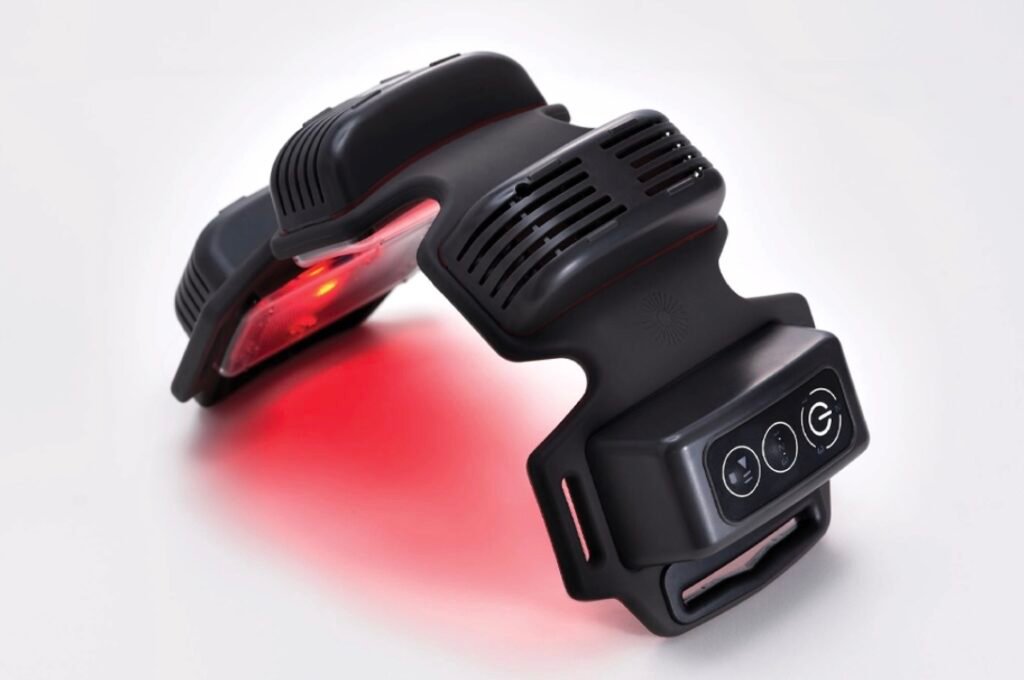
The device itself has three flexible pods that wrap around different body parts. Each pod contains LEDs configured to deliver both red and near-infrared light at the same time.
The flexible design is what sets it apart from rigid panels. You can strap it to your knee, shoulder, back, wherever you need it, and keep moving around.
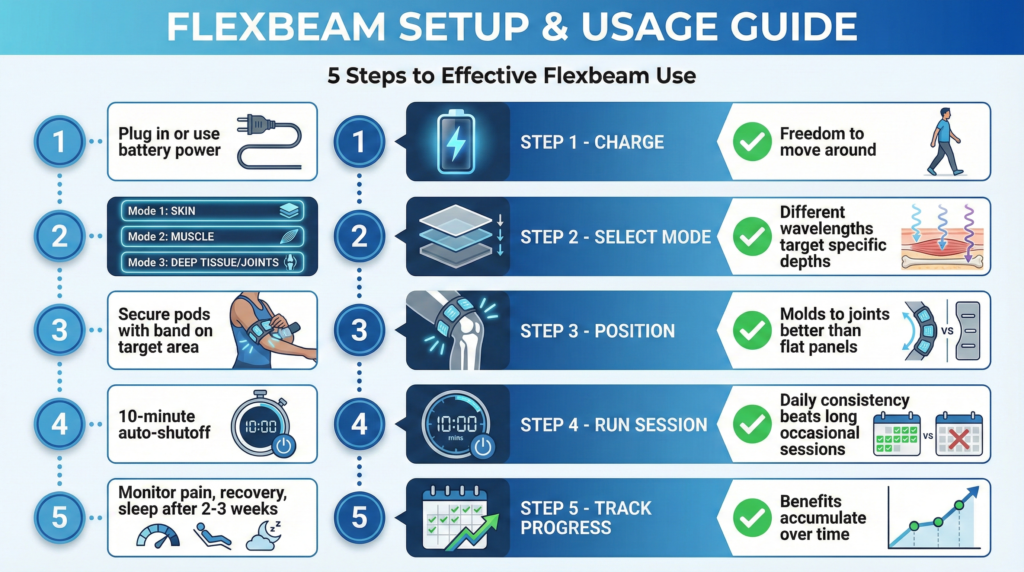
It runs on battery power (or plugged in if you want), has three preset modes for different treatment depths, and auto-shuts off after 10 minutes. Pretty simple setup.
Power Output: How FlexBeam Compares to Other Devices
The company claims FlexBeam delivers 3x more power than other portable red light devices, and 8x more near-infrared power specifically. The actual specs list it at 5.9W total optical power.
That’s not massive compared to big stationary panels or professional clinic equipment, but it’s solid for something you can wear while working or exercising. Independent testing confirmed the device peaks around 635nm for red light and 807-808nm for near-infrared, which lines up pretty closely with what the company says.
Here’s the thing, though… the device only has nine LEDs total (two near-infrared and one red per pod). That’s not a lot.
It creates concentrated spots with some gaps in between, so the light distribution isn’t perfectly even.
For targeted treatment on a specific joint or muscle, that’s fine. For broad coverage across your whole back or legs, you’ll feel the limitations.
The trade-off is portability. You can use FlexBeam anywhere, while traveling, during a phone call, or after a workout.
That consistency usually beats having a more powerful device that sits unused because it’s inconvenient.
The Build Quality and Design Details
The three pods connect and come with adjustable Velcro bands for different body parts (arms, legs, torso, joints). It includes a carrying case, which is useful if you travel a lot.
The device feels solid without being heavy. People who’ve used it for months report it holds up well with regular use.
There are active cooling fans built in to prevent overheating when you’re wearing it against your skin, which is a nice touch.
Operation is dead simple: pick one of three preset modes based on what you’re treating, strap it on, and let it run for 10 minutes. The modes are designed for surface skin work (more red light), medium-depth muscle treatment (mixed wavelengths), and deep tissue/joint work (high near-infrared).
It comes with safety goggles too, which you should actually use since you’re dealing with active light sources close to your eyes sometimes.
The 10-minute session limit might feel short if you’re used to longer treatments, but tbh most people don’t have the patience for 30-minute sessions anyway. Shorter sessions that you actually do consistently beat longer sessions you skip.
This portable at-home red light device gives you portable flexibility and beats costly professional therapy sessions. Click the button below to get started.
Real User Results and Survey Data
Red light therapy can yield several benefits, but what does this device actually deliver?
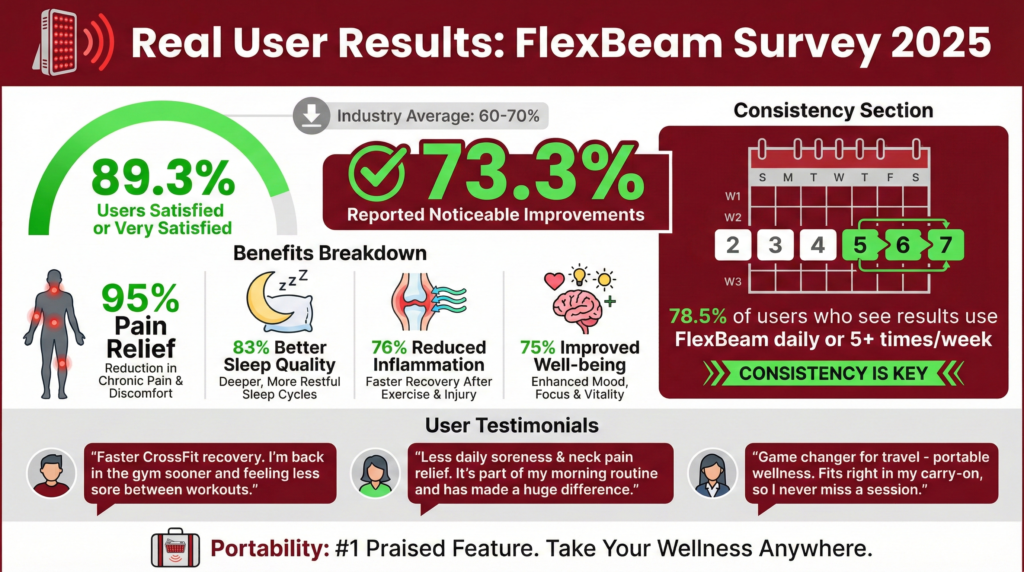
Recharge Health ran a customer survey in 2025, and the results showed 89.3% of users were satisfied or very satisfied. That’s pretty high for wellness devices (a lot of them hover around 60-70% satisfaction).
More specifically, 73.3% of users reported noticeable improvements in their condition. That’s the number that matters… not just “I like the product” but “it actually helped with my problem.”
The breakdown of what people reported:
- 95% use it primarily for pain relief
- 83% report better sleep quality after evening sessions
- 76% report reduced inflammation
- 75% report improved mental well-being
The catch is that 78.5% of users who see results use FlexBeam daily or at least five times per week. This isn’t a “use it once in a while and feel amazing” device.
It requires consistency to build up benefits over time.
Real testimonials mention things like recovering faster after CrossFit workouts, less daily soreness, relief from neck injuries, and being able to maintain their routine while traveling.
One person mentioned their spouse used it for Sjögren’s syndrome support (though that’s not a cure, just supportive wellness).
Portability comes up a lot in positive reviews. People describe it as a “game changer,” specifically because they can travel with it and not miss sessions.
Check current FlexBeam pricing and availability. Get an extra 5-10% off by clicking the button below.
How to Set It Up and Use It Effectively
The actual setup takes maybe two minutes. Charge it, pick your mode, strap it on, done.
For best results, consistency matters way more than intensity. People who use it daily or at least five times per week report the most noticeable improvements.
Many people build it into existing routines… after workouts, during work-from-home calls, or before bed.
The flexible design actually performs really well for joints. If you have knee or elbow problems, it wraps around the joint instead of sitting flat as a panel would.
That targeted application sends most light exactly where you need it.
For broader areas like your back or shoulders, you can position many pods or do sequential sessions on different spots.
One practical tip: if you’re using it for recovery after workouts, consistency beats timing. Whether you use it immediately after training or later in the evening, regular use matters more than the exact timing.
Advanced Tips for Getting the Most Out of FlexBeam
If you’re serious about optimizing results, a few things are worth knowing.
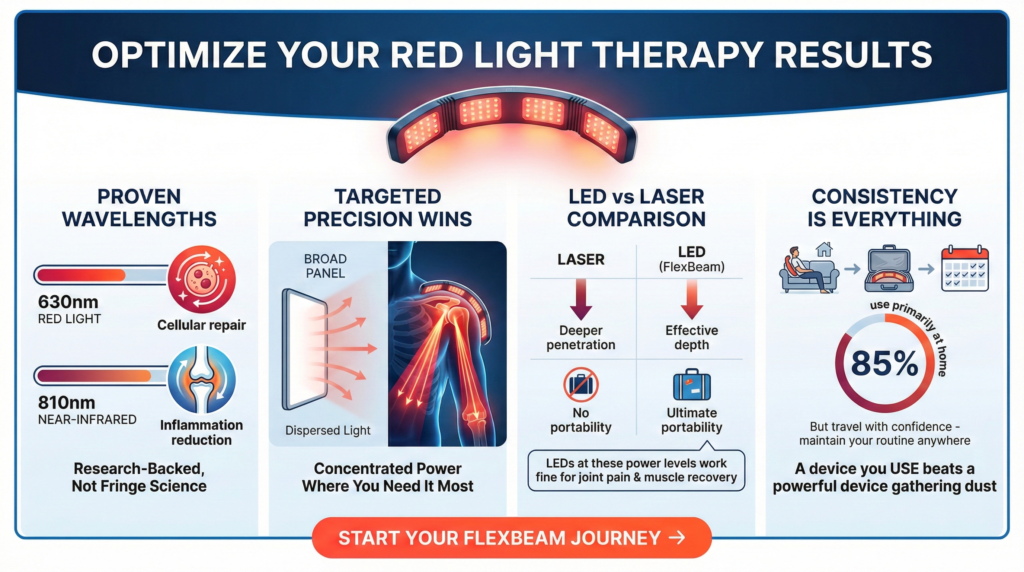
Wavelength effectiveness: The 630nm red light and 810nm near-infrared output both have solid research supporting their use for cellular repair and inflammation reduction. These are proven wavelengths, not fringe science.
Targeted application advantage: If your pain is localized (one specific shoulder, knee, elbow), FlexBeam’s targeted approach can actually outperform broad-coverage panels because you’re concentrating all the light output exactly where it’s needed.
Comparison to laser-LED hybrids: Some reviewers comparing FlexBeam to laser-LED combination devices note that lasers can penetrate deeper than LEDs alone. If most depth penetration is your main goal and you don’t care about portability, that’s worth researching.
But for most people dealing with joint pain or muscle recovery, LEDs at these power levels and wavelengths work fine.
Travel and consistency benefit: The biggest real-world advantage comes down to this… a device you actually use beats a more powerful device gathering dust at home. If you travel often or have a chaotic schedule, the portability factor becomes the deciding factor.
Over 85% of FlexBeam users report using it primarily at home, but the ability to take it with you when traveling keeps your routine consistent.
The Cost Reality Check
The real question for any FlexBeam review comes down to value… does the price align with what you get?
FlexBeam costs more than basic consumer panels but way less than professional clinic sessions (which run $75-125+ each). If you use it consistently, the device pays for itself in roughly 10-15 clinic visits.
At a price tag of $599 (depending on promotions), over a few years of home use, the economics look pretty favorable.
The survey data backs this up… 89.3% satisfaction plus 73.3% reporting noticeable improvements suggests most people feel they got their money’s worth. Real users describe it as a “game changer” or mention they’re “still using it and feeling the benefits” after extended periods.
But this only works if you actually use it. A device collecting dust isn’t a bargain at any price, and this thing costs enough that you want to make sure you’ll commit to daily or near-daily use.
If you’re the type who buys wellness devices and uses them for a week before forgetting about them, save your money.
If you’re consistent with routines and looking for something that fits into your lifestyle easily, the portability and ease of use make it more likely you’ll stick with it.
Use the cost savings calculator below to crunch the real numbers a see how the savings add up.
FlexBeam Cost Savings Calculator
FlexBeam costs more than basic consumer panels but way less than professional clinic sessions (which run $75-125 each). If you use it consistently, the device pays for itself in roughly 10-15 clinic visits. Calculate your potential savings below.
Ready to Start Saving?
At a price tag of $599 (depending on promotions), over a few years of home use, the economics look pretty favorable. Real users describe it as a “game changer” or mention they’re “still using it and feeling the benefits” after extended periods.
Get Your FlexBeam NowJoin thousands of satisfied users experiencing real results
Common Issues and How to Fix Them
Most problems people run into are pretty minor.
Device not turning on: Check the battery charge first (seems obvious, but happens a lot). If it's charged and still not working, try the reset button or contact support.
Uneven light coverage: This isn't really fixable since it's a design limitation from the LED count, but you can work around it by doing many sessions on different spots or repositioning the pods slightly between sessions.
Bands not staying secure: The velcro bands can loosen over time with heavy use. You can tighten them more aggressively or contact support for replacements if they're worn out.
Not seeing results: The most common issue here is inconsistent use. If you're only using it a couple of times per week, you probably won't see much.
Bump it up to daily use for at least 2-3 weeks before deciding it's not working.
Battery life decreasing: Normal over time, but if it's dropping fast within the first year or two, that's covered under warranty.
The company offers a 60-day money-back guarantee, so if you run into issues early on and can't resolve them, you can return it. The 5-year warranty covers manufacturing defects and hardware problems.
Who Actually Benefits Most from FlexBeam
FlexBeam makes the most sense for specific situations.
Frequent travelers or mobile professionals get the most value from the portability. If you're not home for extended periods, being able to maintain your red light therapy routine regardless of location is huge.
People with localized pain (specific joint issues, targeted muscle soreness, one injury area) benefit from the precision application. The wrap-around design works better for joints than flat panels.
Beginners exploring red light therapy appreciate the straightforward operation. Three preset modes remove the guesswork if you don't want to research optimal wavelength ratios and treatment times.
Athletes need recovery between workouts, like the hands-free operation. You can use it while foam rolling, stretching, or doing other recovery work.
FlexBeam probably isn't your best option if you want full-body coverage, need the absolute most power output, or are on a tight budget. Large panel systems or clinic visits serve those needs better.
Start benefiting from FlexBeam with an extra 10% off sets. Click the button below to go to FlexBeam's Official Site.
How FlexBeam Stacks Up Against Alternatives
There are a few other options worth considering, depending on your specific needs.
Large stationary panels deliver more total power and broader coverage, but they take up space and need you to sit still for 15-20 minutes. If you're treating your whole body or large areas regularly, panels make more sense.
If you want targeted treatment and portability, FlexBeam wins.
Professional clinic sessions provide the highest power output and expert guidance, but they cost $50-100+ per session and need regular appointments. For severe or chronic conditions, professional treatment might be necessary.
For general recovery, pain management, and wellness maintenance, home devices work fine.
Other portable devices (various brands) often have lower power output than FlexBeam. The company's claim of 3x more power than competitors seems to hold up based on independent testing.
Cheaper portable options exist, but they typically deliver less power and may not have the same build quality.
Laser-LED hybrid devices penetrate deeper than LED-only devices. They're more expensive and usually less portable.
If deep tissue penetration is your primary goal, worth researching.
For most use cases (muscle recovery, joint pain, skin health), the LED-only FlexBeam works well enough.
Warranty, Safety, and Reliability
FlexBeam carries a 60-day money-back guarantee and a 5-year warranty. That's solid protection for a device in this price range.
The device is FDA-cleared as a Class II exempt medical device, which provides basic assurance that it meets safety standards. Red light therapy at these wavelengths and power levels is generally safe for home use... it doesn't burn tissue, doesn't damage skin, and has no known serious side effects for most people.
You should still use the safety goggles included with the device to protect your eyes, especially if you're treating areas near your face.
Long-term reliability seems good based on user reports. People who've owned their units for over a year report they're still working well, though battery performance will naturally decline over several years (like any rechargeable device).
The company is based in Norway and has been around since 2018, so they're not a fly-by-night operation. Customer support seems responsive based on user feedback, though I haven't tested it myself.
Final Thoughts on Whether FlexBeam Is Worth It
After digging into the specs, user data, and comparisons, here's what I think.
FlexBeam is a solid, well-engineered device that delivers on its main promise: portable, targeted red light therapy with respectable power output.
The technology is legitimate, the wavelengths are scientifically backed, and the user satisfaction rates reflect genuine positive experiences.
The device isn't magic, won't replace professional medical care for serious conditions, and requires consistent use to work. It's also not the cheapest entry into red light therapy, and it doesn't match professional clinic power levels.
What it does offer is practical, consistent access to red light therapy without clinic visits, expensive equipment, or blocking out chunks of your day. For many people, that's exactly what they need.
The portability factor sets it apart from panels. If you travel often, have a mobile lifestyle, or just want something you can use while doing other things, that flexibility makes it more likely you'll actually use it consistently.
And consistency drives results with red light therapy.
The localized treatment design works really well for joints and specific problem areas. If you're dealing with knee pain, shoulder issues, or targeted muscle soreness, the wrap-around pods perform better than flat panels.
The price feels fair given the specs and build quality, especially when you compare it to the cost of ongoing clinic visits. But it only represents good value if you use it regularly.
Click the button below to try FlexBeam risk-free with their 60-day guarantee to see if it works for your specific situation.
For anyone doing a proper FlexBeam review comparison against other options, the decision comes down to your specific needs. If you want full-body coverage or the most power output, look at large panels or clinic visits. If you want targeted, portable treatment that fits into your daily routine, FlexBeam delivers what it promises.
The 89.3% satisfaction rate and 73.3% reporting noticeable improvements suggest most people who buy it feel it was worth the investment. That's about as good as you can hope for with wellness devices.
Just make sure you're realistic about what red light therapy can and can't do, and commit to using it consistently if you decide to get one. A device that sits unused is money wasted, regardless of how good the specs are.
FAQ
What is the FlexBeam, and what does it do?
FlexBeam is a battery-powered, portable red light therapy device with three flexible LED pods that wrap around body parts. It uses red (630nm) and near-infrared (810-845nm) light to support cellular repair, reduce inflammation, relieve pain, and aid recovery. Ideal for targeted areas like joints, muscles, or injuries.
How much does the FlexBeam cost, and what's included?
It costs around $599 (may vary with promotions). The package includes: three connected flexible pods, adjustable Velcro straps, a carrying case, safety goggles, and a charger.
Is the FlexBeam powerful enough to be effective?
Yes, it delivers 5.9W total optical power (independent tests confirm), with claims of 3× more power than most portable competitors and strong near-infrared output. It's concentrated for targeted use but has some gaps in coverage due to only 9 LEDs total.
How long are treatment sessions, and how often should I use them?
Sessions are 10 minutes (auto shut-off), with three preset modes for different depths (skin, muscle, deep tissue/joint). For best results, use daily or at least 5× per week; consistency is critical; irregular use yields little to no benefit.
Who is the FlexBeam best for?
It's ideal for athletes, frequent travelers, people with localized pain/joint issues, or anyone wanting convenient, hands-free therapy at home/on the go. It's less suitable for full-body treatment, tight budgets, or inconsistent users.
What do real users say about the results?
User surveys show ~89% satisfaction, with 73% reporting noticeable improvements (e.g., 95% pain relief, 83% better sleep) when used consistently.
How does it compare to clinic sessions or other devices?
It pays for itself after roughly 10–15 clinic visits ($75–125 each). Compared to large stationary panels, it's far more portable but offers less broad coverage. It outperforms most other portables in power and build quality.
What warranty and safety features does it have?
It comes with a 60-day money-back guarantee, a 5-year warranty for defects, and is FDA-cleared (Class II exempt). Safety goggles are included, and active cooling fans prevent overheating.
Is the FlexBeam worth the money?
Yes, if you value portability, plan to use it regularly for targeted therapy, and want to avoid clinic costs long-term. It's a solid, well-engineered device, but skip it if you need full-body coverage or won't commit to frequent sessions.
This article includes affiliate links. If you click through and make a purchase, I may receive a small commission. This helps support the site and allows me to keep creating helpful content at no extra cost to you.