Quick Summary
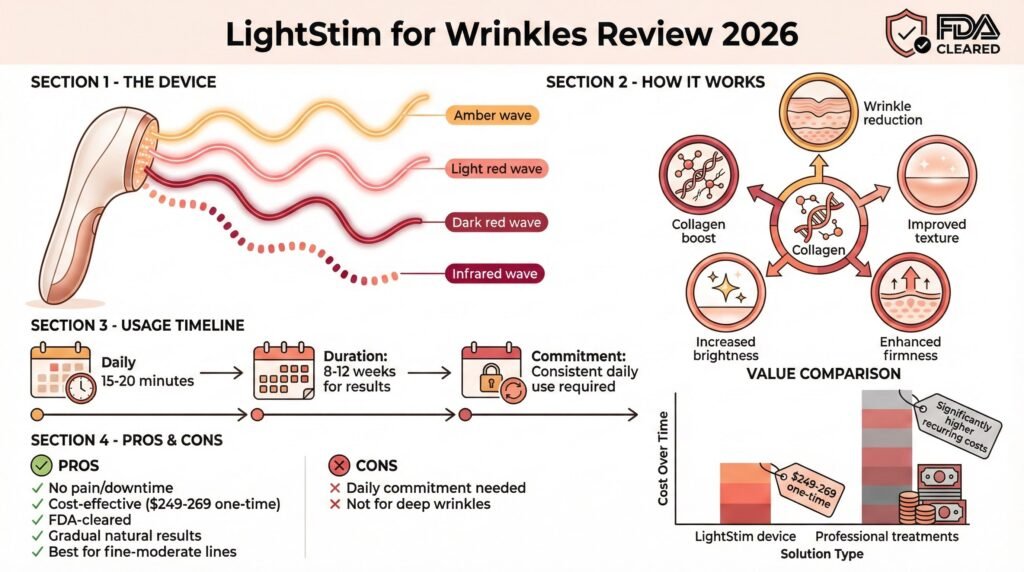
The LightStim for Wrinkles is a handheld, FDA-cleared red light therapy device that uses four wavelengths (amber, light red, dark red, and infrared) to stimulate collagen production, reduce fine lines, improve skin texture, firmness, and brightness.
It delivers gradual, natural results with consistent use (15-20 min/day for 8-12 weeks), no pain/downtime, and is cost-effective compared to professional treatments (~$249-269 one-time cost). Best for fine-to-moderate lines and patient users, but requires daily commitment and won’t dramatically fix deep wrinkles.
If you’re curious about the device, here’s where you can check it out and see if they’re running any current promotions>>>CLICK HERE
Table of Contents
- Introduction
- What Made Me Look into Lightstim
- How This LED Thing Actually Works
- The Science Behind LED Light Therapy for Skin
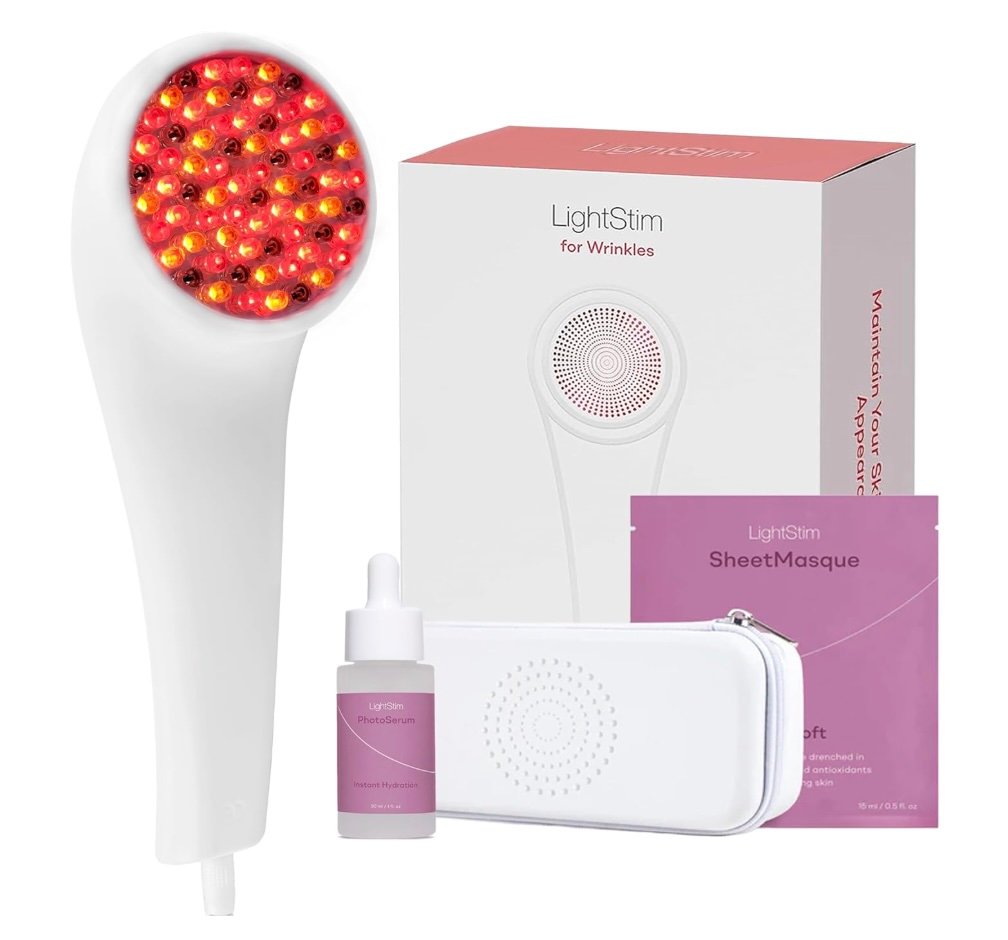
- What You Get with the LightStim for Wrinkles
- Using the Lightstim Device and Specs
- What People Are Actually Experiencing?
- How It Compares to Other Options
- vs. Professional LED Treatments
- vs. Other At-Home LED Devices
- vs. Other Anti-Aging Treatments
- What I Think About the Cost
- The Realistic Downsides
- Who This Device Makes Sense For
- My Overall Take
- Other Things Worth Mentioning
- Final Verdict
Introduction
LightStim for Wrinkles is an FDA-cleared LED light therapy device designed to reduce fine lines and wrinkles using multi-wavelength technology.
It combines amber, light red, dark red, and infrared wavelengths to stimulate collagen production without heat, chemicals, or downtime.
The results take time (usually 8-12 weeks), but the clinical backing and user reviews suggest this thing actually delivers.
What Made Me Look into Lightstim
So, I’ve been researching at-home red light therapy devices for a while now. The professional treatments cost like $100-200 per session, and you need many sessions… it adds up fast.
I kept seeing LightStim pop up everywhere. Dermatologists mention it, estheticians recommend it, and tbh the reviews seemed almost too good to be true.
But here’s what caught my attention: it’s actually FDA-cleared for wrinkles.
Not just “approved” for general use like most devices, but specifically cleared for treating wrinkles.
That’s a pretty big deal because the FDA doesn’t hand those out like candy.
The device costs around $249-$269, depending on where you get it, which seems like a lot upfront. But when you break it down… if you were doing professional LED treatments (which run $100-150 per session), you’d spend that in like 2-3 visits.
And those treatments use the same basic technology.
How This LED Thing Actually Works
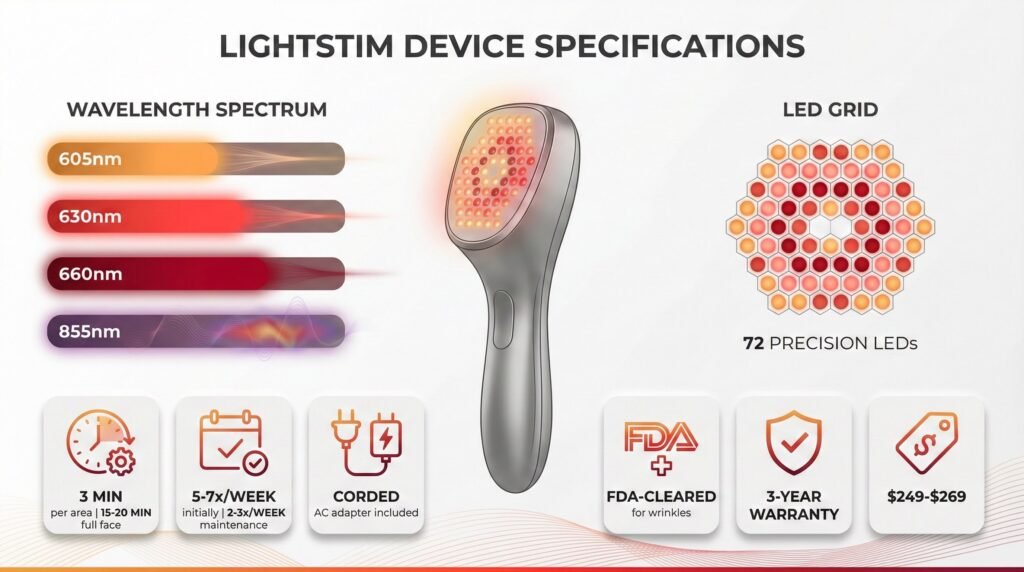
LightStim uses something called multi-wavelength light therapy. The device emits amber (605nm), light red (630nm), dark red (660nm), and infrared (855nm) wavelengths all at once.
Here’s the simplified version of what this device and red light therapy can do for your face:
These specific light wavelengths penetrate your skin at different depths. The light energy gets absorbed by your cells, which then triggers increased ATP production (that’s basically cellular energy).
More ATP means your fibroblasts can produce more collagen and elastin.
Collagen is what keeps your skin firm and smooth. As we age, collagen production drops by about 1% per year after age 30.
That’s why wrinkles show up.
The infrared wavelengths go deeper and help with circulation and inflammation. The red and amber wavelengths work on the upper layers where fine lines form.
What sets LightStim apart is that it uses many wavelengths simultaneously instead of just one or two. Most cheaper devices only use one wavelength (usually 660nm red light).
LightStim combines four different wavelengths that work together.
The light is also extremely gentle. There’s no heat, no UV rays, no pain. You literally just hold it against your face and let it do its thing.
The Science Behind LED Light Therapy for Skin
Look, I’m not going to pretend this is some magical solution, but the research on LED light therapy for skin is actually pretty solid.
There is a wide array of treatments that you can use red light therapy for. Multiple clinical studies have shown that red and near-infrared light therapy can:
- Increase collagen density in the skin
- Improve skin texture and tone
- Reduce fine lines and wrinkles
- Improve skin firmness
- Reduce inflammation
One study published in the Journal of Cosmetic and Laser Therapy found that participants using LED therapy showed measurable improvements in skin complexion and feeling after 12 weeks of treatment.
Another study in Photomedicine and Laser Surgery showed that LED light therapy increased collagen production and improved wrinkles in 90% of subjects.
The key thing is consistency. This isn’t like Botox, where you see results the next day.
LED therapy works by gradually stimulating your skin’s natural healing and regeneration processes.
That takes time… usually 8-12 weeks of regular use.
What You Get with the LightStim for Wrinkles
The device itself is pretty straightforward. It’s a handheld wand about the size of a TV remote, maybe a bit wider.
In the box:
- The LightStim device
- AC power adapter
- User manual
- Storage/travel bag
The treatment head has 72-person LED lights arranged in rows. When you turn it on, all four wavelengths light up at once (the light looks kind of amber/red when they’re all combined).
There’s a 3-minute auto-shutoff timer built in. You treat each area of your face for 3 minutes, then the device turns off automatically. Then you move to the next area and turn it back on.
The whole face takes about 15-20 minutes total if you’re being thorough.
One thing I really appreciate… the device is corded. I know that sounds old-school, but cordless LED devices lose power as the battery drains, which means inconsistent treatment strength. With a corded device, you get the same power output every single time.
You can grab the LightStim for Wrinkles here if you want to check current pricing and availability. They sometimes run sales around holidays.
Using the LightStim Device and Specs
This is where things get interesting…
The overwhelming majority of users report seeing results, but not immediately. Most people start noticing changes around weeks 6-8.
The results show up gradually… You don’t wake up one day with perfect skin. It’s more like you look in the mirror one morning and think, “Huh, my forehead lines look softer.”
Common feedback:
- Skin texture improves before wrinkles do (usually within 3-4 weeks)
- Skin looks brighter and more even
- Fine lines around the eyes respond really well
- Deeper wrinkles improve but don’t disappear completely
- Skin feels firmer overall
- Some people notice their skincare products absorb better
The people who get the best results are the ones who actually stick with it. The ones who give up after 2-3 weeks because they don’t see dramatic changes… yeah, they’re disappointed. But that’s not how LED therapy works.
A few people mention using it for other things too (though it’s only FDA-cleared for wrinkles). Some use it on their neck, chest, hands… basically anywhere they have sun damage or aging skin.
One thing that comes up a lot: people wish the treatment head were bigger. With 72 LEDs, the coverage area is decent but not huge.
That’s why the full face takes 15-20 minutes.
Some of the larger panel-style LED devices cover more area at once, but those cost way more ($500-$1500+).
What People Are Actually Experiencing?
This is where things get interesting…
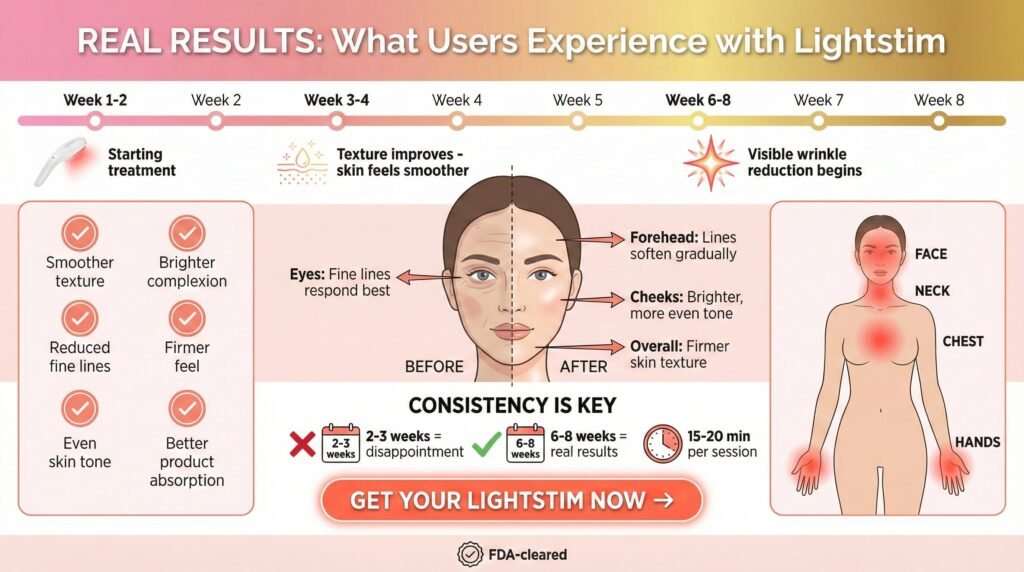
The overwhelming majority of users report seeing results, but not immediately. Most people start noticing changes around week 6-8.
The results show up gradually… You don’t wake up one day with perfect skin. It’s more like you look in the mirror one morning and think, “huh, my forehead lines look softer.”
Common feedback:
- Skin texture improves before wrinkles do (usually within 3-4 weeks)
- Skin looks brighter and more even
- Fine lines around the eyes respond really well
- Deeper wrinkles improve but don’t disappear completely
- Skin feels firmer overall
- Some people notice their skincare products absorb better
The people who get the best results are the ones who actually stick with it. The ones who give up after 2-3 weeks because they don’t see dramatic changes… yeah, they’re disappointed. But that’s not how LED therapy works.
A few people mention using it for other things too (though it’s only FDA-cleared for wrinkles). Some use it on their neck, chest, hands… basically anywhere they have sun damage or aging skin.
One thing that comes up a lot: people wish the treatment head were bigger. With 72 LEDs, the coverage area is decent but not huge.
That’s why the full face takes 15-20 minutes.
Some of the larger panel-style LED devices cover more area at once, but those cost way more ($500-$1500+).
How It Compares to Other Options
vs. Professional LED Treatments
Professional treatments use higher-powered LED panels that cover your whole face at once. Treatment sessions are usually 20-30 minutes.
The technology is similar, just stronger and faster.
Cost comparison: Professional sessions run $100-200 each, and you need 8-12 sessions initially. That’s $800-$2400.
Plus maintenance sessions every month.
LightStim costs $249-269 once, and you own it. Even if you factor in the extra time it takes to treat at home, the cost savings are pretty obvious.
Again, as many red and blue light therapy practitioners will attest, consistent and lasting results require consistent use.
Use the cost-savings calculator below to crunch the numbers and see the real savings of the LightStim device versus multiple professional clinic sessions per week.
LightStim vs Professional LED Treatment Cost Calculator
Professional LED treatments use higher-powered panels with 20-30 minute sessions. They’re effective, but expensive at $100-200 per session with 8-12 initial sessions required, plus ongoing monthly maintenance. LightStim costs $249-269 once, and you own it forever. Use the calculator below to see your real savings.
vs. Other At-Home LED Devices
There are a ton of at-home LED devices now. Here’s how LightStim stacks up:
Cheaper devices ($50-150): Usually only have one or two wavelengths. Lower LED count.
Not FDA-cleared. Some are decent, many are junk.
You get what you pay for.
LightStim ($249-269): Four wavelengths working together. 72 LEDs.
FDA-cleared for wrinkles specifically.
Made in the USA. 3-year warranty.
This is sort of the sweet spot for quality and price.
High-end panels ($500-1500+): Larger treatment areas, more LEDs, often adjustable settings. Good if you want to treat your whole body or have money to burn.
Probably overkill if you just want to work on facial wrinkles.
vs. Other Anti-Aging Treatments
Compared to Botox, fillers, retinoids, chemical peels… LED therapy is about as gentle and safe as it gets. There’s basically no downtime, no side effects (unless you have a seizure disorder or are on photosensitizing medications).
Botox paralyzes muscles. Fillers add volume.
Retinoids increase cell turnover (and can irritate skin).
LED therapy just stimulates your skin’s natural collagen production.
You can use LED therapy alongside other treatments. A lot of people do retinoids at night and LED therapy in the morning, for example.
What I Think About the Cost
$249-269 is not cheap for a skincare device. Let’s be real about that.
But here’s my take after researching this thing extensively: the cost makes sense when you look at alternatives.
If you were going to do professional LED treatments (which use the same technology), you’d spend that in 2-3 sessions. And you need at least 8-12 sessions to see results.
If you’re already spending money on high-end serums and creams ($50-100+ per bottle), those costs add up too. And honestly… topical products can only do so much because they work from the outside in. LED therapy works from the inside out by actually triggering biological processes in your skin cells.
The device is well-made. It’s not some flimsy plastic thing that’ll break in 6 months.
It has a 3-year warranty.
People report using the same device for 5+ years without issues.
If you break it down monthly, $269 divided by 36 months (the warranty period) is like $7.47 per month. That’s less than a single fancy coffee per month for a device that you’ll probably use way longer than 3 years.
For people dealing with aging skin who want to avoid injections or more invasive procedures, this is one of the better investments out there imo.
If you’re curious about the device, click the button below to check out any current promotions.
The Realistic Downsides
Nothing is perfect, so let’s talk about the actual downsides…
The time commitment is real. 15-20 minutes per day, 5-7 days per week for at least 8-12 weeks. Then 2-3 times per week forever for maintenance.
Some people just can’t stick with that routine.
Results take patience. If you’re looking for fast, dramatic changes, this isn’t it. You need to commit to at least 8 weeks before judging whether it’s working.
The treatment head could be bigger. This is probably the most common complaint. A larger treatment area would cut down the time per session.
It only does one thing. Unlike some devices that claim to do LED + microcurrent + whatever else, LightStim just does LED therapy. Some people see this as a pro (it does one thing really well), others want a multi-function device.
Deep wrinkles won’t disappear. LED therapy can improve deep wrinkles, but it won’t eliminate them. It works best on fine to moderate lines.
If you have really deep-set wrinkles, you might need to mix this with other treatments.
You’re tied to an outlet. The corded design means you need to be near a power source. You can’t use it in bed unless you have an outlet nearby.
(Though again, corded means consistent power output, which is actually a good thing.)
Who This Device Makes Sense For
This Lightstim for wrinkles review wouldn’t be finished without talking about who should actually consider buying this thing…
You’re a good candidate if:
You’re starting to see fine lines and wrinkles, but aren’t ready for Botox or fillers yet. This works really well for early to moderate aging.
You want a preventative approach. If you’re in your 30s-40s and want to slow down collagen loss before major wrinkles form, LED therapy is smart.
You’re willing to commit to a consistent routine. If you can set aside 15-20 minutes most days, you’ll get results.
You prefer non-invasive treatments. No needles, no downtime, no risk of looking “overdone” or frozen.
You’ve already spent money on professional LED treatments and want a home option. The technology is similar; you just do it yourself.
You like the idea of actually stimulating collagen production instead of just masking aging with makeup or temporary fixes.
This probably isn’t for you if:
You want instant results. LED therapy needs patience and consistency.
You have very deep wrinkles and expect them to disappear completely. You might need more aggressive treatments.
You won’t use it regularly. If it’s going to sit in a drawer, save your money.
You’re on a really tight budget. There are cheaper options, though they’re not as well-made or FDA-cleared.
My Overall Take
After spending a bunch of time researching LED therapy and this specific device, I get why dermatologists and estheticians recommend it so often.
The science backs it up. The FDA clearance is legit.
The user reviews are consistently positive.
The device is well-made and should last for years.
The main thing is managing expectations. This isn’t going to make you look 20 years younger.
It’s not going to erase every wrinkle. But it can genuinely improve skin texture, reduce fine lines, and help your skin produce more collagen over time.
For people who want to take care of their skin without going the injection route, LightStim is one of the better investments you can make. It’s cheaper than ongoing professional treatments, safer than most choices, and actually works if you stick with it.
The 15-20 minutes per day is either going to be a deal breaker or totally manageable, depending on your lifestyle.
If you’re serious about addressing wrinkles and aging skin, and you’re willing to commit to the routine, you can check out LightStim here. Just go into it knowing that results take 8-12 weeks and consistency is everything.
The device has a 3-year warranty, so there’s some protection if anything goes wrong. If you want to see the latest promotions available on Amazon, see the button below to get started.
Other Things Worth Mentioning
A few random but useful things that came up during research…
You can use it on other body parts. Even though it’s marketed for facial wrinkles, the light therapy works the same anywhere. People use it on their neck, chest, hands, etc.
It works with your existing skincare routine. You don’t have to give up your retinoids or serums or whatever else you’re using. Just use LED therapy on clean skin, then apply your products after.
There’s no UV radiation. The wavelengths used are completely safe. No risk of sun damage or skin cancer from the light.
Most people don’t experience any side effects. Occasionally, someone might get mild redness that goes away quickly, but that’s rare. This is one of the gentlest anti-aging treatments available.
The LEDs don’t burn out quickly. Some people worry about the lights dying after a year or two. The LEDs in these devices are designed to last 50,000+ hours.
Even if you used it for 30 minutes every single day, that would take like 25+ years to burn out.
You can share the device (just clean it between users). Some couples or roommates split the cost, and both use it.
For what it’s worth, LightStim makes other devices too, one for acne, one for pain relief, etc. But the one for wrinkles is by far their most popular model.
If you’re ready to try it, see the button below to grab one and see current pricing.
Final Verdict
So that’s my thorough breakdown of the LightStim for Wrinkles device. It’s one of those products that actually lives up to the hype, as long as you understand what it is (a gradual collagen-boosting tool) and what it isn’t (a secret overnight fix).
The combination of FDA clearance, solid science, good build quality, and reasonable price (compared to choices) makes it one of the better at-home anti-aging devices you can buy right now. Just be patient with it and stick with the routine… that’s where the results happen.
FAQ
Hold the wand against clean skin for 3 minutes per area (it auto-shuts off), covering the full face in 15-20 minutes. Use 5-7 days/week initially, then 2-3 times/week for maintenance.
What wavelengths does LightStim for Wrinkles use, and what do they do?
It combines amber (605nm), light red (630nm), dark red (660nm), and infrared (855nm) to target different skin depths, boosting collagen/elastin, improving texture/tone, enhancing circulation, and reducing inflammation.
How long until I see results?
Most users report improvements in skin brightness and texture within 3-4 weeks, with noticeable softening of fine lines around 6-8 weeks. Full benefits (firmer skin, reduced fine lines) typically appear after 8-12 weeks of consistent use.
How do I use the device?
Hold the wand against clean skin for 3 minutes per area (it auto-shuts off), covering the full face in 15-20 minutes. Use 5-7 days/week initially, then 2-3 times/week for maintenance.
Is it safe? Are there side effects?
Yes, FDA-cleared, no UV, no heat, painless. Rare mild temporary redness may occur. Avoid if you have a seizure disorder or take photosensitizing medications.
How much does the LightStim cost, and is it worth it?
Around $249-269 as a one-time purchase. Reviewers consider it cost-effective compared to professional LED sessions ($800-2400+ for a course), especially since LEDs last 50,000+ hours with a 3-year warranty.
How does it compare to masks or other at-home devices?
It’s more powerful and multi-wavelength than most cheap devices, with FDA clearance and solid build quality. However, it’s handheld (requires manual use) vs. hands-free masks. Some users prefer masks for convenience despite potentially lower power.
Who is this device best for?
People seeking gradual, non-invasive anti-aging for fine-to-moderate lines who are consistent and patient. It’s great as an add-on to skincare routines and works on the face, neck, chest, hands, etc. Not ideal for those wanting instant or dramatic results or who dislike holding a device.
This article includes affiliate links. If you click through and make a purchase, I may receive a small commission. This helps support the site and allows me to keep creating helpful content at no extra cost to you.