Quick Summary
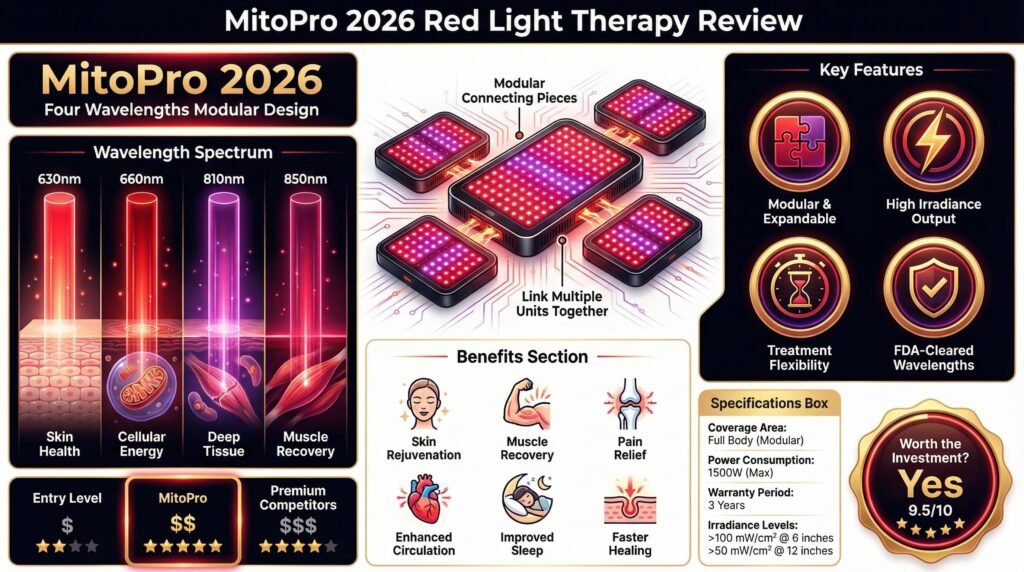
The MitoPRO series from Mito Red Light is a mid-range red light therapy panel lineup featuring four wavelengths (630nm, 660nm, 830nm, 850nm) for both skin and deep tissue benefits, modular design for expandability, high irradiance (>130mW/cm² at 6 inches), low EMF, and competitive pricing ($369–$1,169 depending on model).
It’s a strong value for at-home clinical-grade therapy, especially with FSA/HSA eligibility and a 60-day guarantee, but narrower panels may require repositioning, and it lacks pulsing or 810nm. Overall, it is worth the price for consistent users seeking wavelength variety over budget two-wavelength options.
Table of Contents
- Introduction to MitoPRO
- Why Four Wavelengths Actually Matter
- Breaking Down the MitoPRO Models
- MitoPRO 300
- MitoPRO 1000
- MitoPRO 1500
- MitoPRO X Series
- How MitoPRO Compares to Other Mito Products
- Real Issues to Know About
- What the Specs Actually Mean in Practice
- How to Actually Use the MitoPRO
- Warranty and Purchase Details
- Who Gets the Most Benefit from MitoPRO
- My Overall Take on This MitoPRO Review
Introduction to MitoPRO
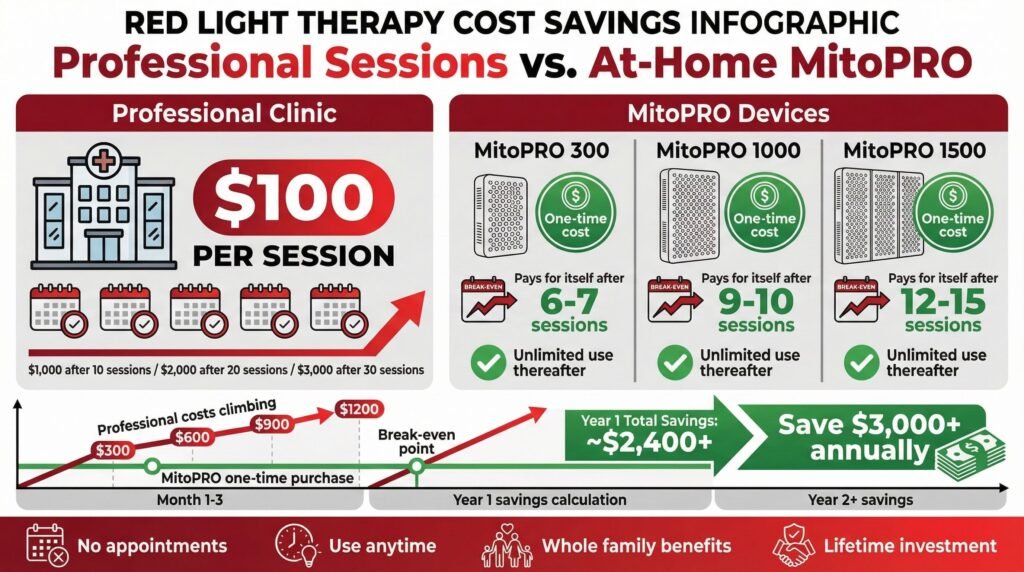
Clinical red light therapy sessions run about $100-200 per visit. After just 10-15 sessions, you’ve already spent enough to buy your own decent panel. That’s the math that got me looking at at-home devices in the first place.
In terms of price, MitoPRO is the middle ground between cheap Amazon panels and the super-premium brands that cost as much as a used car.
Also, to help with additional cost savings, Mito red light products are FSA/HSA-eligible. This allows you to use pre-tax money if you have those accounts.
They claim professional-grade output with four wavelengths instead of the usual two.
Let me walk you through what actually matters here.
Why Four Wavelengths Actually Matter
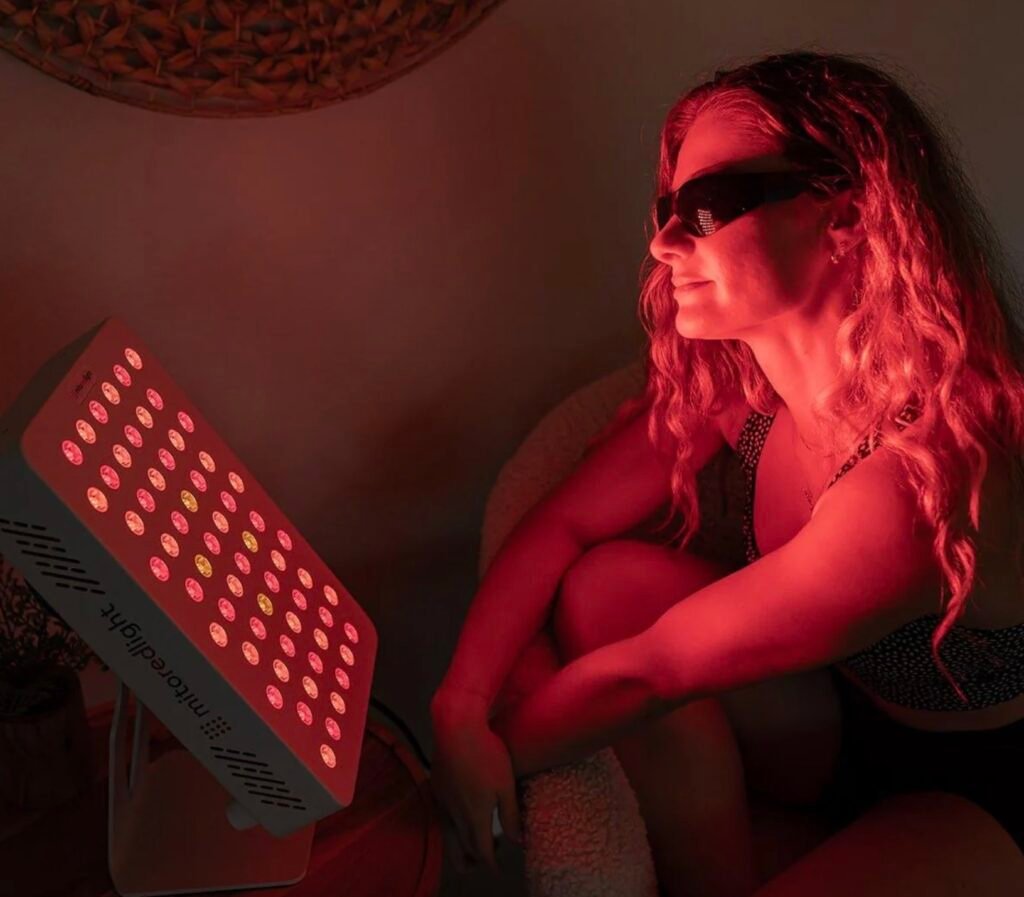
Most budget panels give you two wavelengths, 660nm and 850nm. MitoPRO panels include four: 630nm, 660nm, 830nm, and 850nm. Each one is distributed evenly at 25%.
The different wavelengths target different tissue depths. The 630nm and 660nm wavelengths work on surface skin stuff, collagen production, wound healing, and anti-inflammatory response.
The 830nm and 850nm wavelengths go deeper for muscle tissue, joint pain, and bone health.
If you’re only treating surface skin conditions, two wavelengths probably work fine. But if you want something that handles both skin health and deeper tissue recovery, the four-wavelength setup makes sense.
Some companies offer 5+ wavelengths, but from what I’ve seen in the research, four hits the sweet spot. More wavelengths don’t necessarily mean better results, just higher prices.
Breaking Down the MitoPRO Models
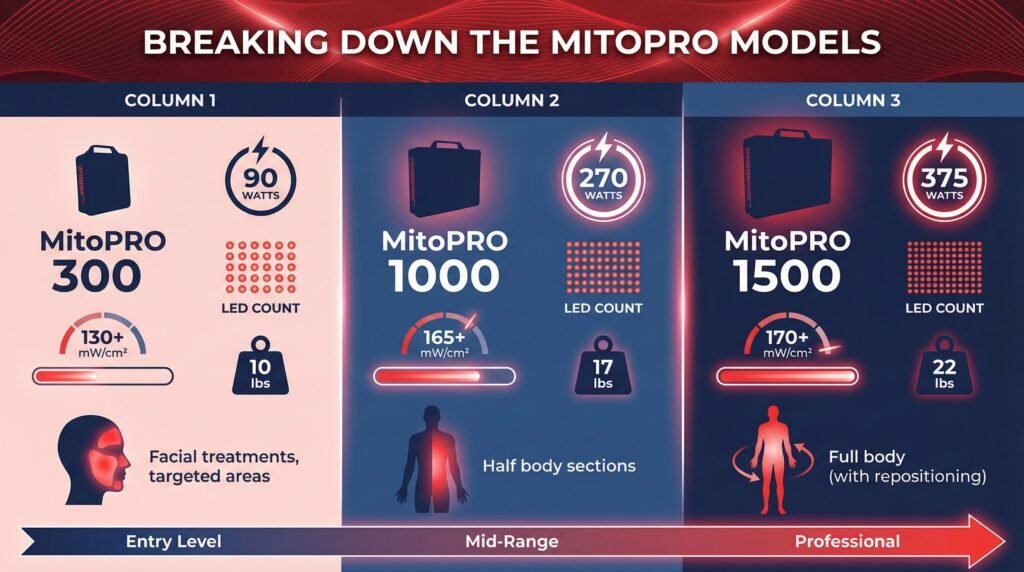
The MitoPRO line includes several sizes. I’ll go through each one because the differences actually matter depending on what you’re trying to treat.
MitoPRO 300
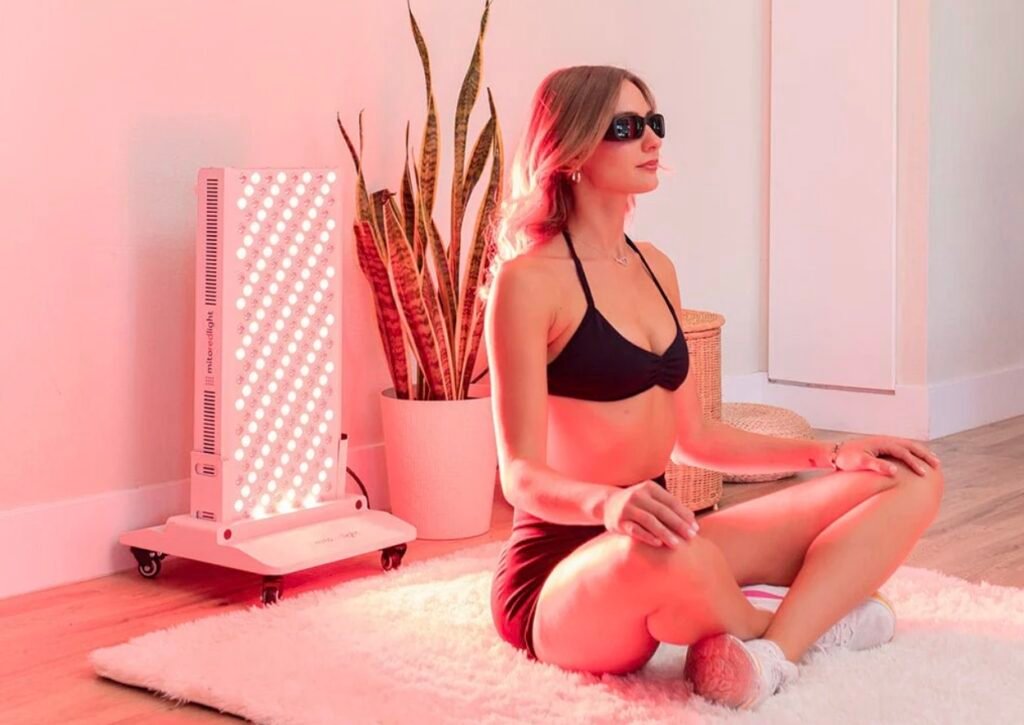
With a cost of $369 (depending on promotions), this is the smallest panel at 11 inches by 11 inches. It weighs seven pounds, so you can move it around pretty easily.
It puts out 300 watts with irradiance over 130mW/cm² at six inches.
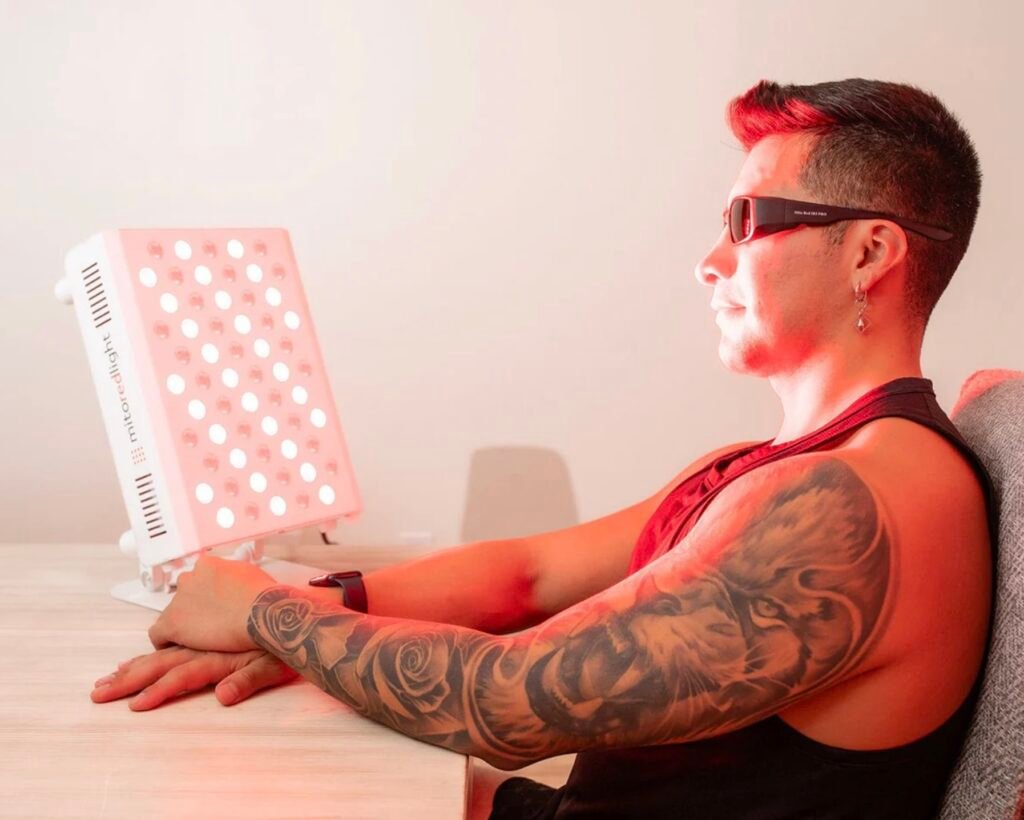
The compact size makes it practical for targeted treatment. You can set it on your desk while you work, or position it for facial treatments or specific joints.
The modular design means you can connect it to other Mito devices later without starting over.
You get a digital control panel with a timer, a stand, eye protection goggles, and all four wavelengths. The automatic 20-minute shutoff is nice for hands-free sessions.
The obvious limitation is the coverage area. You can’t treat your whole back or full body in one session with this size.
You’ll need to reposition it many times or get a bigger panel.
For someone starting or focusing on facial anti-aging, this size works. For full-body recovery after workouts, not so much.
The modular expansion option means you’re not locked into this size forever.
MitoPRO 1000
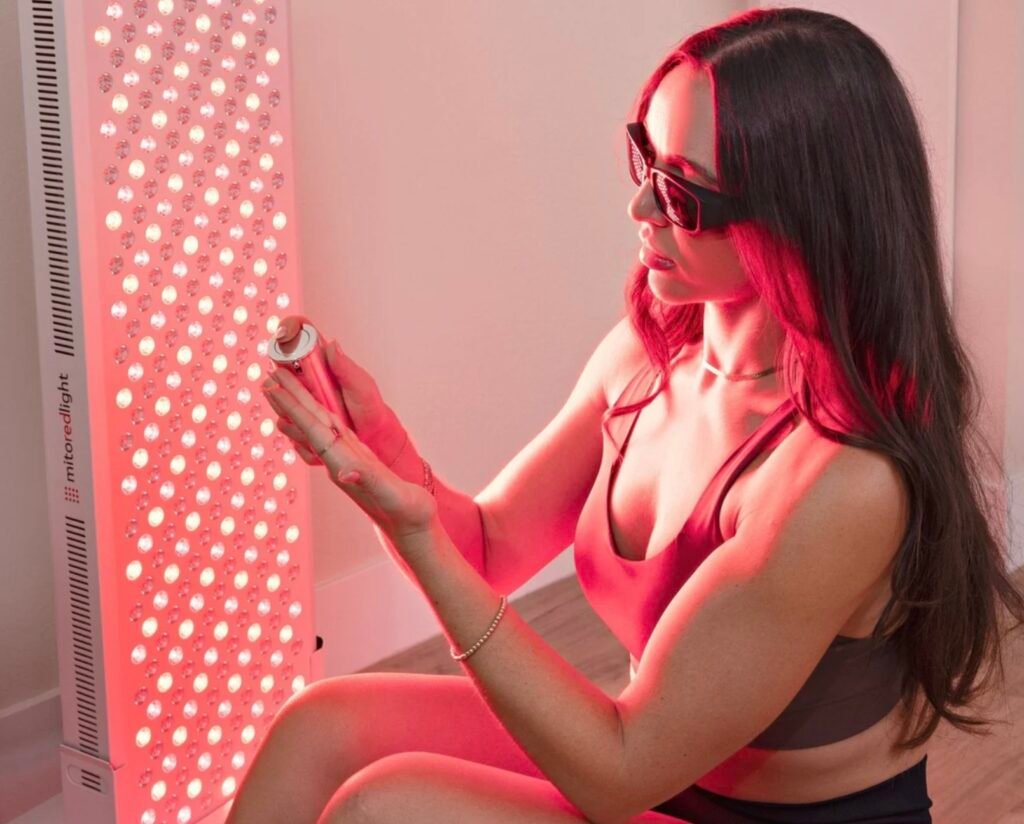
For $869 (depending on promotions), the mid-sized option has 200 LEDs putting out 1000 watts. Irradiance still exceeds 165mW/cm² at six inches.
Set up takes maybe five minutes, plug it in, set the timer, and start treatment.
The standout feature here is still that modular capability. You can attach a MitoPRO 1500 later if you want more coverage.
That flexibility matters if you’re not sure yet how much you’ll use red light therapy long-term.
The specs include 1000 watts across 150 LEDs, all four wavelengths, EMF output below 0.1 microtesla (which is extremely low), and a 60-degree beam angle. That narrower beam angle actually concentrates the light intensity, so you don’t have to position yourself super close to get therapeutic levels.
Cost per watt on the 1000 is competitive with other brands in this power range. Not the cheapest, not the most expensive.
This size probably makes the most sense for people who want to treat larger areas than just their face, but don’t need full body coverage in a single session.
MitoPRO 1500
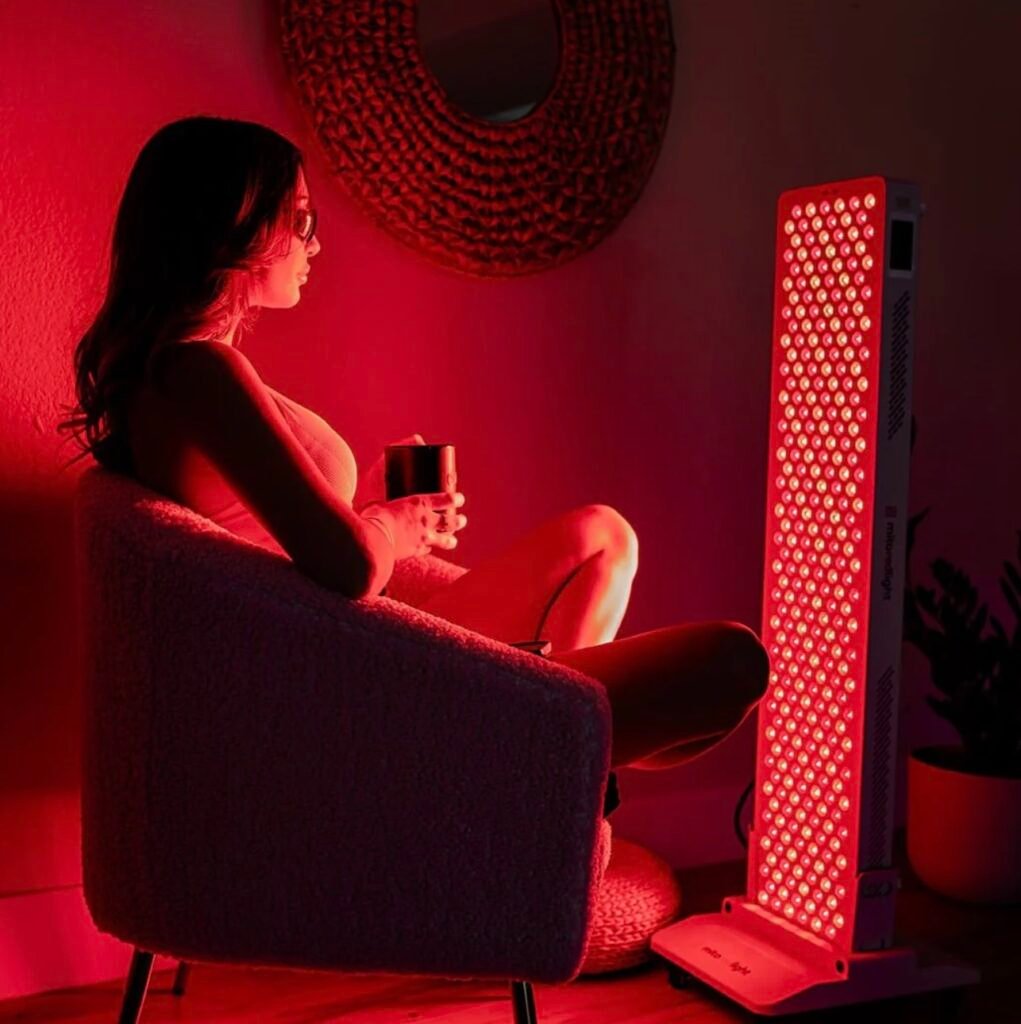
Costing $1,169 (depending on promotions), the big panel delivers 1500 watts through 300 LEDs spread across the four wavelengths. Independent testing showed no hotspots, which means consistent light distribution across the whole treatment area.
EMF levels measured below 0.1 microtesla. The panel comes with a pulley system and mounting hardware.
At 25 pounds, though, it’s not something you’ll casually move between rooms.
Third-party testing showed some interesting numbers. One reviewer measured 76.5mW/cm² average irradiance with an 87mW/cm² peak.
The total power output measured 136 watts.
Those numbers don’t match the claimed specs exactly, but that’s pretty normal across the industry because of how measurements get taken.
What matters is whether the measured output reaches therapeutic thresholds. Clinical studies typically use 50-100mW/cm² for effective treatment.
The 76.5mW/cm² average hits that range.
One practical issue is that the panel is narrower than some competing full-body options. You might need to reposition during sessions or use many panels for true full-body coverage at once.
Mito sells mounting hardware for multi-panel setups to deal with this.
MitoPRO X Series
The newest generation added touchscreen controls, brightness adjustment, alarm function, and app connectivity. The core therapeutic specs stay the same as the standard PRO series, but you get more convenience features.
If you want programmed treatment protocols or remote control through your phone, the X series delivers that. For me personally, I don’t think the extra cost is worth it for those features, but your mileage may vary.
Click the button below to test red light therapy without a huge investment. The MitoPRO300 gives you the full wavelength range in a portable package.
How MitoPRO Compares to Other Mito Products
Mito makes other product lines besides the PRO series. The MitoMEGA offers 36-inch coverage for full-body treatment and costs about $8.03 per watt.
The tradeoff is that you only get two wavelengths, 660nm and 850nm.
For people who prioritize large treatment areas over wavelength variety, the MEGA makes more sense financially than the PRO 1500. Independent testing confirmed no hotspots, and it includes a pulley system.
The MitoMOD series splits the difference with modular design and high output per dollar, but again limits wavelengths to just two. The MOD 300 produces 135mW/cm² at six inches despite only 300 watts of power.
Both MitoPRO and MitoMOD use 60-degree beam angles instead of the 90-degree angles common in competing devices. The narrower angle concentrates light intensity, which means you can stand a bit further away and still get therapeutic levels.
With 90-degree angles, you typically need to position yourself really close.
Real Issues to Know About
I came across a documented design problem with the MitoPRO 300X hinge mechanism. Someone reported the hinge being poorly designed, and customer support didn’t help address it.
The standard MitoPRO models use mounting brackets instead of hinges, so they don’t have this particular failure point. If you’re specifically looking at the 300X, I’d verify the current hinge design before buying.
Another limitation: standard MitoPRO panels don’t have pulsing modes. Some research suggests pulsed light therapy offers benefits for certain conditions, though the evidence is mixed. If you specifically want pulsing capability, you’ll need to look at other brands or the newer X series.
The MitoPRO panels also don’t include the 810nm wavelength. Recent research highlights 810nm as particularly effective for neurological and cognitive issues.
The 830nm provides similar deep tissue penetration, but that gap matters if you’re focused specifically on brain health applications.
For most people treating skin conditions, muscle recovery, or joint pain, the four wavelengths MitoPRO offers cover the important bases.
The missing 810nm and pulsing modes only matter for specific use cases.
What the Specs Actually Mean in Practice
Let me break down the technical stuff into plain language.
Irradiance measures the light energy reaching your skin surface. It’s expressed as milliwatts per square centimeter (mW/cm²).
Clinical studies typically use 50-100mW/cm² for effective treatment.
The MitoPRO series exceeds this threshold at a six-inch distance. That means you can do shorter session times and still get therapeutic doses.
Joule delivery matters more than raw wattage, honestly. The MitoPRO 750 delivers over 130mW/cm² at six inches.
During a 10-20-minute session, that translates to significant joule accumulation in your tissues.
LED lifespan exceeds 50,000 hours across MitoPRO models. At 20 minutes daily, that’s over 400 years of use.
Basically, the LEDs will outlast every other component in the device and probably outlast you and me both.
EMF output below 0.1 microtesla qualifies as extremely low. Household appliances typically emit 0.5-5 microtesla.
The low EMF becomes relevant if you’re planning extended daily sessions or positioning panels near sensitive areas.
How to Actually Use the MitoPRO
Position yourself about six inches from the panel for optimal irradiance delivery. Treatment duration runs 10-20 minutes per target area, depending on what you’re treating.
Red-only mode (630nm and 660nm) focuses on skin surface conditions, wrinkles, acne, and wound healing. Near-infrared-only mode (830nm and 850nm) penetrates deeper for muscle recovery, joint pain, and inflammation.
Combined mode delivers all four wavelengths at once for comprehensive treatment.
The 20-minute automatic shutoff prevents overexposure and lets you do other stuff during treatment. Session frequency typically ranges from daily to three times weekly, depending on your goals and how your body responds.
A conservative starting protocol would be 10-minute sessions three times weekly. Assess your response before increasing frequency or duration.
This helps you find optimal dosing without risking overexposure.
Some people are treated daily; some do every other day. It depends on what you’re trying to accomplish and how your skin or body reacts.
Warranty and Purchase Details
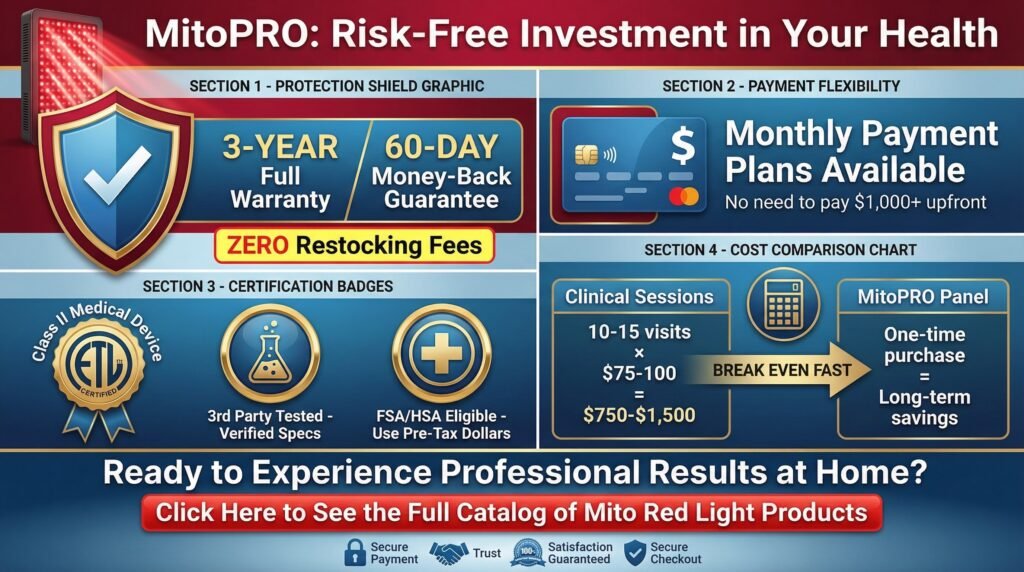
MitoPRO devices include a three-year full warranty and 60-day money-back guarantee. The return period has no restocking fees, which reduces purchase risk if you’re uncertain about a long-term commitment to red light therapy.
Mito offers monthly payment plans across most models. That makes higher-wattage panels accessible without dropping a grand all at once.
The ETL certification as Class II medical devices provides regulatory validation of safety standards. Third-party lab testing confirms power output and spectral distribution, which addresses concerns about manufacturers inflating their specs.
The panels qualify as FSA/HSA-eligible medical devices, so you can pay with pre-tax money if you have those accounts.
After 10-15 professional clinical sessions at an average of $75 -100 per session, you’ve spent enough to buy a MitoPRO panel. The math makes sense for long-term use.
Use the cost savings calculator below to compare the cost of a MitoPRO series device to the cost of professional sessions in your area. Bookmark this page a use it whenever you are researching.
MitoPRO Cost Savings Calculator
Discover how much you’ll save by owning your own red light therapy device compared to professional clinical sessions
Click the button below to get started with Mito Red Light. The 60-day return window gives you enough time to test consistently and see if red light therapy works for you before you’re locked in.
Who Gets the Most Benefit from MitoPRO
If you’re dealing with visible aging signs and want to target collagen production, the 630nm and 660nm wavelengths specifically address skin health. Daily facial treatments take 10-15 minutes with the MitoPRO 300, which is manageable for long-term consistency.
For fitness recovery, the 830nm and 850nm wavelengths penetrate deep enough to reach muscle tissue. Post-workout treatments might reduce recovery time and inflammation.
Results vary individually from what I’ve seen in user reports.
People with chronic skin conditions like psoriasis, acne, or eczema might benefit from the four-wavelength coverage hitting both surface and deeper skin layers simultaneously.
That said, you should probably talk to your doctor about this stuff if you have chronic conditions.
For biohacking and wellness optimization, the modular design lets you experiment with protocols and gradually expand your system. The digital controls and timer functions help you track treatment variables consistently.
My Overall Take on This MitoPRO Review
The MitoPRO series delivers legitimate therapeutic irradiance at competitive prices. The four-wavelength configuration provides broader coverage than budget two-wavelength panels without the premium pricing of 5+ wavelength systems.
Strengths include the modular expandability, measured irradiance exceeding clinical thresholds, low EMF output, solid warranty coverage, and FSA/HSA eligibility.
The cost per watt and irradiance measurements make MitoPRO competitive with established brands.
Limitations include narrower panel width requiring repositioning or many units for full-body coverage, no pulsing modes in standard models, missing 810nm wavelength, and some reported quality issues in specific models like the 300X hinge mechanism.
Click here if you’re just starting with red light therapy. The MitoPRO 300 provides an accessible entry point with full wavelength coverage and expansion capability down the road.
For immediate full-body coverage needs, the PRO 1500 or MitoMEGA choices make more sense despite the higher upfront cost.
The thing about red light therapy is that it takes patience and consistency. You won’t see dramatic changes after one or two sessions.
Most research suggests you need several weeks of regular use before noticing significant changes.
Track specific metrics instead of relying on subjective impressions. If you’re treating skin texture, take photos in consistent lighting every week.
If you’re working on pain levels, keep a simple log.
If you’re focusing on recovery time, track your actual performance metrics.
The MitoPRO provides the necessary specifications for clinical-grade results. Whether you actually get those results depends on proper technique, appropriate session duration, and realistic expectations about the timeline.
I think that’s about everything worth knowing about these panels. The specifications check out, the price point makes sense compared to alternatives, and the modular design gives you flexibility as your needs change.
Just don’t expect miracles overnight, and use that 60-day return period to actually test it properly before you fully commit.
Click the button below to take advantage of the 60-day return window. This gives you enough time to test consistently and see if red light therapy works for you before you’re locked in.
FAQ’s
What are the key features of the MitoPRO series?
It includes four evenly distributed wavelengths (630nm and 660nm for skin; 830nm and 850nm for deeper tissues), a modular design to connect multiple panels, high irradiance (typically >130–165mW/cm² at 6 inches), low EMF (<0.1 microtesla), digital controls with a timer, and a 60-degree beam angle for focused intensity.
How much do the MitoPRO models cost?
Prices vary with promotions: MitoPRO 300 (~$369), MitoPRO 1000 (~$869), MitoPRO 1500 (~$1,169). The X series adds premium features like touchscreen and app control at a higher cost.
Is the four-wavelength design worth it over two-wavelength panels?
Yes, for broader applications (skin + deep recovery), as research shows four as the “sweet spot.” Two wavelengths (660nm/850nm) suffice for many, but four provide more versatility without high cost.
What are the main pros and cons?
Pros: Therapeutic irradiance, modular expandability, low EMF, strong warranty (3 years), 60-day money-back, FSA/HSA-eligible, cost savings vs. clinic sessions. Cons: Narrower coverage (may need repositioning or multiple panels for full body), no standard pulsing, missing 810nm wavelength, some reported quality issues (e.g., hinges on 300X).
How does MitoPRO compare to other Mito Red Light products?
Better wavelength variety than MitoMEGA (full-body but two wavelengths) or MitoMOD (modular but two wavelengths). MitoPRO balances features and price for users wanting multi-depth benefits.
How should I use the MitoPRO for the best results?
Position 6 inches away, 10–20 minutes per session/area, 3–7 days/week. Use red-only for skin, NIR-only for deep tissue, or combined. Start conservatively and track progress.
Is it safe and effective?
Yes, ETL-certified, third-party tested, low EMF, and irradiance meets clinical thresholds (50–100mW/cm²). Effectiveness requires consistency over weeks; benefits include skin improvement, recovery, and inflammation reduction.
Is the modular design useful?
Highly. Start small (e.g., 300) and connect larger panels later for bigger setups without replacing everything.
Does it have advanced features like pulsing or app control?
Standard models lack pulsing; the X series adds touchscreen, brightness adjustment, protocols, alarm, and app connectivity.
Is it worth the price?
Yes, for most, per the reviewer: Breaks even after ~12 clinic sessions, offers professional-grade specs at mid-range cost, with strong support and eligibility perks. Best for committed users valuing four wavelengths and modularity.
This article includes affiliate links. If you click through and make a purchase, I may receive a small commission. This helps support the site and allows me to keep creating helpful content at no extra cost to you.