Quick Summary
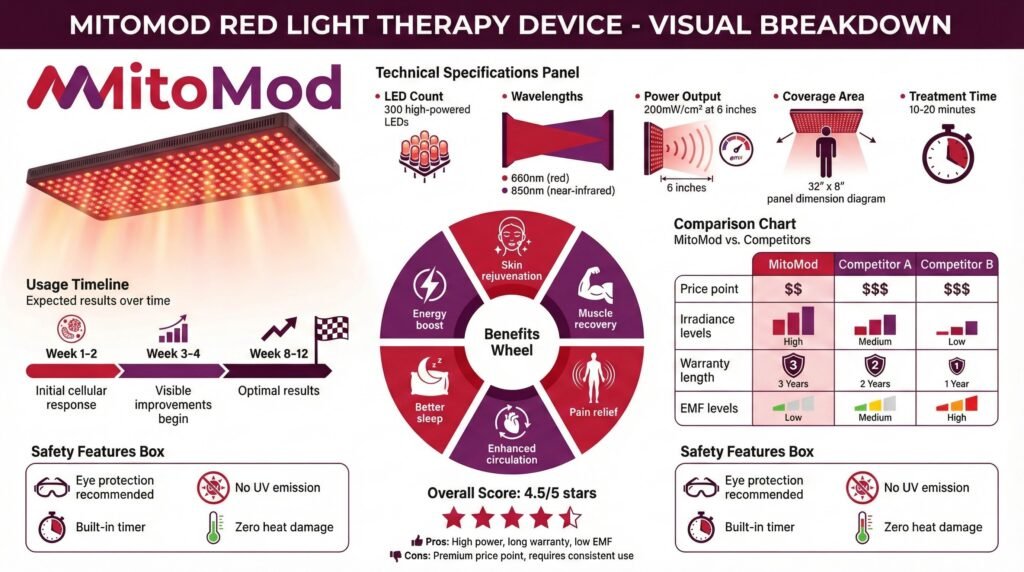
The MitoMOD series from Mito Red Light is a mid-range, modular red light therapy panel lineup (models: 300 and 600) using 660nm (skin health) and 850nm (deep tissue recovery) wavelengths.
It offers strong irradiance (135mW/cm² at 6 inches), expandability by connecting panels, significant cost savings over clinic sessions (pays for itself in 10-15 uses), low EMF, a 60-day trial, and a 2-year warranty.
It’s ideal for most users seeking effective at-home therapy without premium extras like additional wavelengths or smart features. Overall verdict: A practical, scalable choice for skin rejuvenation, muscle recovery, and general wellness.
Table of Contents
1. Introduction to MitoMOD
2. Why Consider Red Light Therapy Panels
3. What MitoMOD Is and Its Place in Mito Red Light’s Range
4. MitoMOD 300: Smaller Panel Details
5. MitoMOD 600: Larger Coverage Option
6. Understanding the Two Wavelengths (660nm and 850nm)
7. Comparison to Professional Clinic Sessions
8. Cost Savings Calculator
9. Evidence-Based Benefits
10. Real Limitations
11. Safety Specifications and EMF Levels
12. Who Should Buy MitoMOD
13. Who Should Avoid MitoMOD
14. Practical Usage Guide
15. The Modular Design Advantage
16. Pricing and Payment Options
17. Overall Review Verdict
Why I Started Looking into Red Light Therapy Panels
So, here’s the thing about professional red light therapy sessions… they’re expensive. Like $100-200 per session, expensive.
I started calculating what it would cost to do this regularly (thinking about muscle recovery and skin stuff) and realized pretty quickly that buying an at-home device would pay for itself after maybe 10-15 sessions. The problem was figuring out which panel to actually trust.
There’s so much confusing information out there about wavelengths and irradiance and power density. Half the brands don’t even list their specs properly, and the other half are making claims that sound too good to be true.
That’s when I started digging into the Mito Red Light brand and specifically their MitoMOD lineup.
In this MitoMOD review, we will explore how this specific model sits in this interesting middle ground between budget red light panels and premium setups, offering solid specs with a modular design that lets you expand without throwing away your first purchase.
To sweeten the ‘cost-savings pot’, Mito is the first red light therapy brand to partner with TrueMed and open the gates for tax-free HSA and FSA funds to be used towards red light devices.
What MitoMOD Actually Is (And How It Fits into Mito’s Product Range)
Mito Red Light makes several different panel series at different price points. The MitoMOD is basically their modular option that gives you two wavelengths instead of four.
Before you think “only two wavelengths = bad,” let me explain what that actually means.
The MitoMOD uses 660nm and 850nm wavelengths. The 660nm is red light that works on your skin and surface-level stuff (think wrinkles, acne, psoriasis).
The 850nm is near-infrared, which penetrates deeper into your muscles and joints for recovery.
Mito’s fancier MitoPRO series adds 630nm and 830nm to the mix. Those extra wavelengths do provide extra benefits… but the research I found suggests that two wavelengths cover most of what people actually need.
The four-wavelength systems are considered optimal for most efficacy, but you’re not missing critical functionality with just the two main ones.
The real selling point for MitoMOD (at least from what I can tell) is that modular design. You can buy one panel now and connect more later without compatibility issues.
MitoMOD 300: The Smaller Panel Option
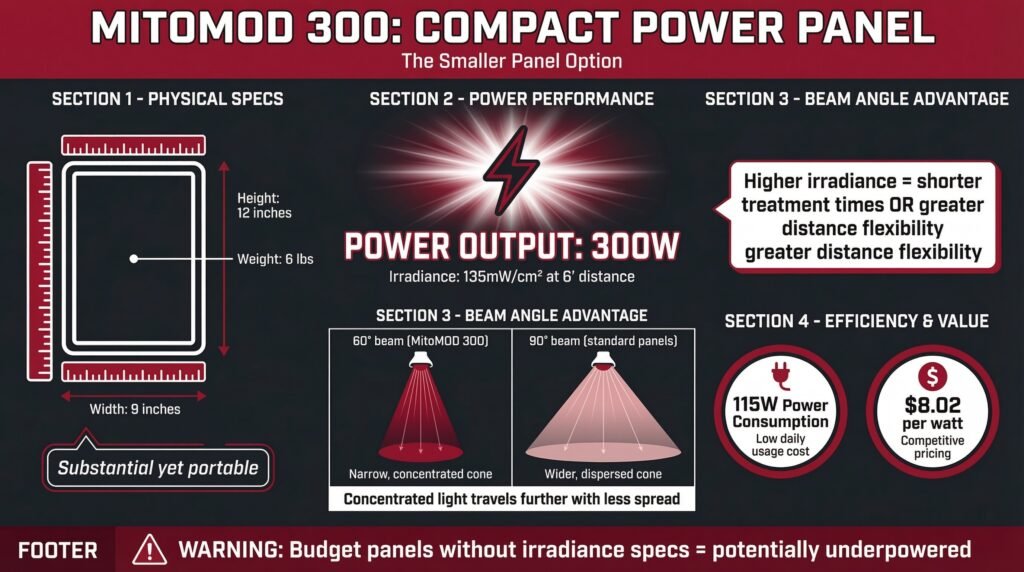
The MitoMOD 300 is 12 inches tall, 9 inches wide, and weighs 6 pounds. It’s not huge, but it’s substantial enough that you know it’s a real device.
Power output is 300 watts with an irradiance of 135mW/cm² at 6 inches away. That irradiance number matters because it tells you how much light energy actually reaches your skin. Higher numbers mean shorter treatment times, or you can stand further away and still get results.
One thing I noticed about the MitoMOD 300 is the 60-degree beam angle (compared to standard 90-degree panels).
This actually works in your favor because the light stays concentrated over a longer distance instead of spreading out too wide too fast.
Power consumption is only 115 watts, so you’re not going to see your electric bill spike even if you use this daily.
The price works out to around $8.02 per watt, which is honestly pretty competitive when you compare it to other brands. Some budget panels are cheaper per watt, but they don’t list their irradiance specs (which makes me suspicious they’re underpowered).
If you want to check out the MitoMOD 300 specs, Mito’s full line of products, and current pricing, click the button below to visit Mito Red Light’s official site.
MitoMOD 600: Double the Coverage
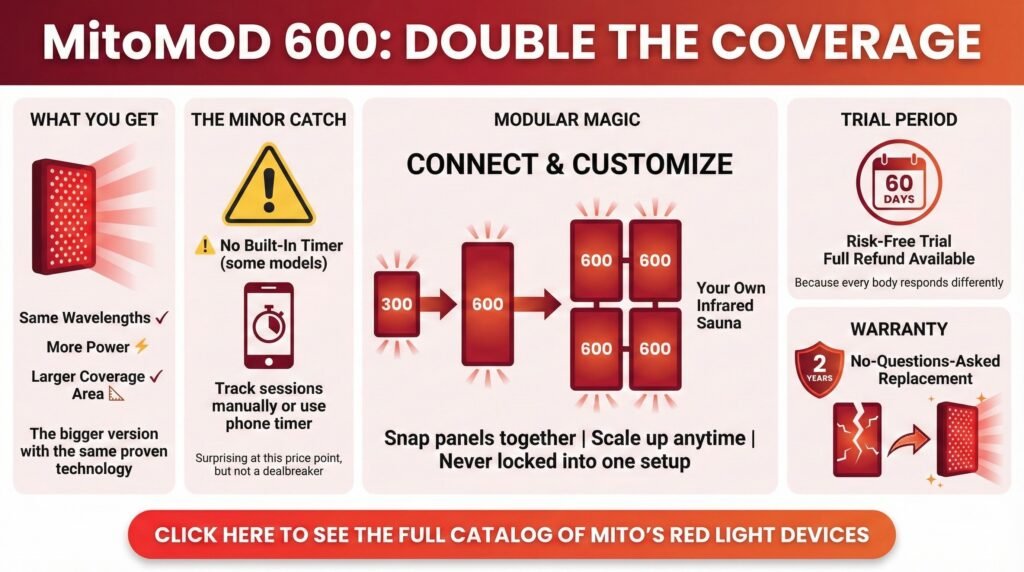
The MitoMOD 600 is basically the bigger version. Same wavelengths, same concept, just more power and coverage area.
One annoying thing about the 600 models… it doesn’t have a built-in timer on some versions. You’ll need to track your session time manually or use your phone timer.
Not a real deal breaker, but kind of surprising for a device at this price point.
The big advantage (and this applies to the whole MitoMOD series) is that you can connect many panels. Like, you could buy a 300 and a 600 and snap them together to build a larger treatment area.
Or you could get many 600s and basically create your own infrared sauna setup.
That modular flexibility changes what this purchase actually means. You’re not locked into one configuration forever.
Mito offers a 60-day free trial on these panels, which removes a lot of the risk. If red light therapy doesn’t do anything for you after two months, you can return it.
That’s pretty important because everyone’s body responds differently to this stuff.
The warranty is 2 years with no-questions-asked replacement. So, if anything goes wrong with the panel, they’ll just send you a new one.
The Two Wavelengths Thing (And Whether It Actually Matters)
This is probably the biggest question people have when comparing MitoMOD to other panels.
The 660nm red light wavelength is what you want for skin health. It helps with collagen production, reduces inflammation on the surface level, and there’s decent research backing its use for acne and psoriasis.
If you’re in that 45-65 age range, looking at anti-aging treatments, this wavelength is your main focus.
The 850nm near-infrared wavelength goes deeper. We’re talking muscle tissue, joints, and tendons.
This is what fitness people care about for recovery. It penetrates through the skin into the tissue underneath.
Now, budget 2-wavelength panels miss out on some therapeutic benefits compared to 4-wavelength systems (which research suggests hit the optimal efficacy sweet spot).
But the MitoMOD’s two wavelengths still cover what most people actually need the device for.
If you specifically want to experiment with different wavelength combinations or you’re a biohacker type who wants the most flexibility, you’d probably want the MitoPRO series instead. But for straightforward “I want muscle recovery and skin benefits,” the MitoMOD wavelengths are solid.
How the MitoMOD Compares to Professional Clinic Sessions
Let me break down the cost comparison because this is what makes at-home panels attractive in the first place.
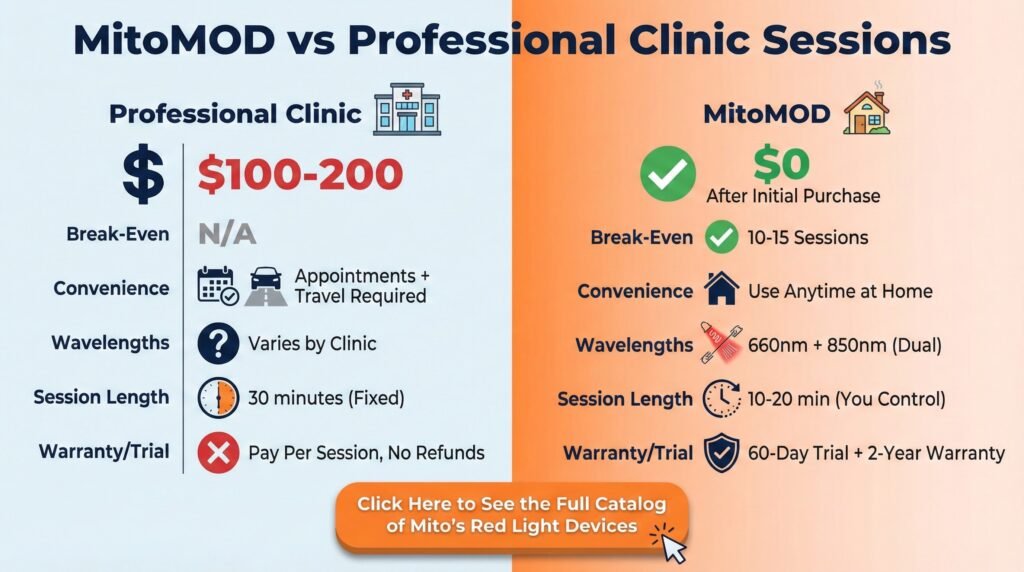
Professional red light therapy sessions run $100-200 for 30 minutes. Let’s say you’re paying $150 on average.
If you buy a MitoMOD 300, you break even after about 10 sessions (give or take, depending on the exact model pricing).
That means if you use it consistently for recovery or skin treatment, you’ve paid for the device in a few months. After that, every session is essentially free (minus the minimal electricity cost).
Again, the ability to take advantage of tax-free HSA and FSA funds to be used towards red light devices is another cost-saving advantage you receive with the Mito brand.
The convenience factor is huge, too. Clinic sessions need appointments, travel, and waiting rooms.
With an at-home panel, you just turn it on whenever you want.
Morning routine, post-workout, before bed… whatever fits your schedule.
Use the cost-savings calculator below to see the real cost-savings for yourself.
MitoMOD Cost Savings Calculator
See how much you can save by choosing at-home red light therapy over professional clinic sessions
*Savings calculated based on your inputs. Professional clinic costs vary by location and provider. Electricity costs are minimal (typically $0.10-0.20 per session). Individual results may vary.
What This Panel Actually Does (Based on Research)
I want to be clear here… I’m not making claims about secret cures or anything like that. But there’s legitimate research on red light therapy for specific uses.
For muscle recovery (the 850nm wavelength), studies show it can help reduce soreness and inflammation after workouts. Fitness people use it post-training to speed up recovery time.
The deeper penetration reaches the muscle tissue, where micro-tears and inflammation happen.
For skin stuff (the 660nm wavelength), there’s research on collagen production, wrinkle reduction, and inflammatory skin conditions. People dealing with psoriasis or acne have reported improvements, though results vary person to person.
Some people use red light therapy for sleep quality (the near-infrared wavelength apparently affects melatonin production). There’s also research on joint pain, though that’s more of a long-term consistency thing.
The key is managing expectations. You’re not going to use this once and wake up with perfect skin or zero muscle soreness.
The research suggests that consistent use over weeks and months shows gradual improvements. This further underlines the at-home approach to owning an effective red light therapy device versus the expensive professional sessions.
Real Limitations You Should Know About
The MitoMOD series doesn’t have app connectivity or smart controls. You turn it on, set a timer (manually on some models), and that’s it.
If you’re into tracking data and optimizing protocols through an app, this might feel limited.
The lack of 630nm and 830nm wavelengths means you don’t get the full spectrum that the MitoPRO offers. For most people, this probably doesn’t matter, but if you’re specifically trying to target protocols that benefit from those extra wavelengths, you’d need to upgrade.
The larger MitoMOD panels need specific mounting setups. The 600 model is pretty big, so you need wall space or a stand that can handle the size and weight.
Moving it around isn’t terrible, but it’s not something you’re casually carrying from room to room.
Some versions don’t have automatic shutoff timers, which means you need to manually track your session time. This is more of an inconvenience than a serious problem, but it’s worth mentioning.
Safety Specs and EMF Concerns
One thing that came up in my research is EMF (electromagnetic field) exposure from these panels. Mito’s devices emit less than 0.1 microtesla on their premium models, which is extremely low.
For context, that’s way below what you’d get from a cell phone or laptop.
The irradiance level (135mW/cm² at 6 inches for the MitoMOD 300) is strong enough to be therapeutic without being dangerous. Red light doesn’t cause the UV damage that tanning beds or sun exposure does.
The safety profile is pretty well-established at this point. LED lifespan is rated at 50,000+ hours. If you use the panel for 20 minutes daily, that works out to something like 40+ years of operation.
You’re basically never going to burn out the LEDs during normal use.
Who Should Actually Consider MitoMOD
If you’re someone who’s been going to red light therapy clinics and paying $100-200 per session, the math makes sense to get an at-home panel. The MitoMOD gives you clinic-level power at a price point that pays for itself relatively fast.
For fitness people in that 25-45 range who train regularly and want faster recovery… the 850nm wavelength is what you care about. Muscle soreness, joint support, and inflammation reduction.
The modular design means you can start with one panel and expand coverage later if you want a full-body treatment.
If you’re in the 45-65 range, looking at skin aging and wrinkle reduction, the 660nm wavelength handles that. Collagen production, surface-level skin improvements.
You can use it on your face, neck, wherever you want targeted treatment.
People dealing with chronic skin conditions (psoriasis, acne) might benefit from consistent red light therapy at home instead of relying on clinic sessions. The 60-day trial gives you time to test whether it actually helps your specific situation.
Biohackers and wellness optimizer types… the MitoMOD is solid if you want to experiment with red light therapy without dropping premium money. The modular aspect lets you build out a larger system over time if you decide this is a long-term thing.
You can see MitoMOD options and payment plans here on their site by clicking the button below.
Who Should Actually Consider MitoMOD
If you’re someone who’s been going to red light therapy clinics and paying $100-200 per session, the math makes sense to get an at-home panel. The MitoMOD gives you clinic-level power at a price point that pays for itself relatively fast.
For fitness people in that 25-45 range who train regularly and want faster recovery… the 850nm wavelength is what you care about. Muscle soreness, joint support, and inflammation reduction.
The modular design means you can start with one panel and expand coverage later if you want a full-body treatment.
If you’re in the 45-65 range, looking at skin aging and wrinkle reduction, the 660nm wavelength handles that. Collagen production, surface-level skin improvements.
You can use it on your face, neck, wherever you want targeted treatment.
People dealing with chronic skin conditions (psoriasis, acne) might benefit from consistent red light therapy at home instead of relying on clinic sessions. The 60-day trial gives you time to test whether it actually helps your specific situation.
Biohackers and wellness optimizer types… the MitoMOD is solid if you want to experiment with red light therapy without dropping premium money. The modular aspect lets you build out a larger system over time if you decide this is a long-term thing.
You can see MitoMOD options and payment plans here on their official site>>CLICK HERE.
What You Probably Shouldn’t Use MitoMOD For
If you need immediate full-body coverage and you’re certain about it, a dedicated full-body panel might be more practical than buying many MitoMOD units.
If you specifically want to experiment with different wavelength ratios or you need all four wavelengths for specific protocols, the MitoPRO or MitoADAPT series would make more sense.
If your budget is extremely tight and you’re only looking for occasional supplementary use, there are cheaper entry-level panels. The MitoMOD sits in the mid-range, so you’re paying for better build quality and specs than the budget tier.
If you want smart features like app control, data tracking, or automated protocols, the MitoMOD doesn’t offer that. It’s a straightforward device without much tech integration.
How This Actually Works in Practice
The setup is pretty straightforward from what I can tell. Unbox it, plug it in, position it at the right distance from your body, and turn it on.
Sessions typically run 10-20 minutes, depending on how far you are from the panel.
Closer distance means shorter sessions (because the irradiance is higher). Further away means longer sessions but more convenience (you can do other stuff while the panel runs).
The 60-degree beam angle on MitoMOD panels means the light stays concentrated better at a distance compared to wider beam angles. You can sit a bit further back and still get therapeutic levels of light.
Most people report noticing changes in sleep quality or muscle recovery within the first few weeks of consistent use. Skin improvements tend to take longer (collagen production is a gradual process).
But there’s definitely person-to-person variation in how quickly results show up.
How This Actually Works in Practice
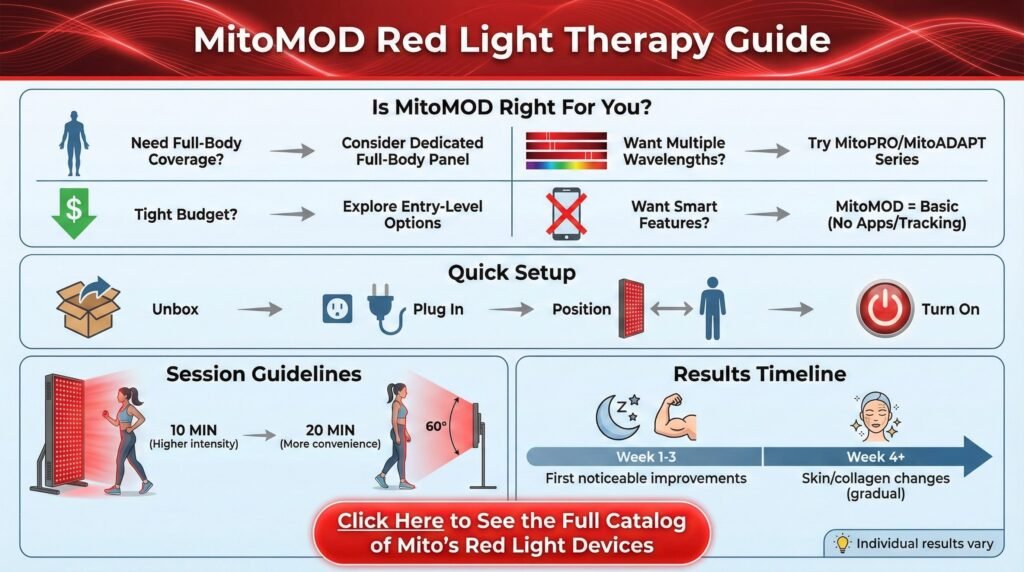
The setup is pretty straightforward from what I can tell. Unbox it, plug it in, position it at the right distance from your body, and turn it on.
Sessions typically run 10-20 minutes, depending on how far you are from the panel.
Closer distance means shorter sessions (because the irradiance is higher). Further away means longer sessions but more convenience (you can do other stuff while the panel runs).
The 60-degree beam angle on MitoMOD panels means the light stays concentrated better at a distance compared to wider beam angles. You can sit a bit further back and still get therapeutic levels of light.
Most people report noticing changes in sleep quality or muscle recovery within the first few weeks of consistent use. Skin improvements tend to take longer (collagen production is a gradual process).
But there’s definitely person-to-person variation in how quickly results show up.
The Modular Aspect (Which Is Actually a Big Deal)
The ability to connect many MitoMOD panels changes the value proposition. You can start with a single MitoMOD 300, see how you like red light therapy, and then add a 600 or another 300 later.
The panels snap together, so you’re building a larger treatment area without compatibility issues. Compare this to buying a single fixed-size panel… if you later decide you want more coverage, you have to buy a completely new device.
Some people start with one panel for targeted treatment (face, specific muscle groups) and eventually build out a full-body setup by adding more panels. The modular design makes that upgrade path possible without throwing away your initial investment.
Mito designed the panels to work together as a system. You could theoretically build your own infrared sauna setup by connecting enough panels.
That level of flexibility is pretty rare in the red light therapy market.
Pricing and Payment Options
Mito offers payment plans on select models, which removes the barrier of a high upfront cost. Instead of dropping $500-1000+ all at once, you can spread it out monthly.
The cost per watt ($8.02 for MitoMOD) is a useful comparison metric when looking at different brands. Some cheaper panels look attractive until you realize they’re underpowered and you’d need longer sessions to get the same results.
Refer back to the cost-savings calculator to crunch the actual numbers, and the savings speak for themselves. The HSA/FSA pre-tax savings help as well.
The 60-day trial means you’re not gambling your money. Use it for two months, and if you don’t see benefits or don’t like it, return it.
That’s a pretty generous trial period compared to most electronics.
The 2-year warranty provides peace of mind. If the panel stops working or has issues, Mito replaces it without hassle.
That warranty length suggests they’re confident in the build quality.
Click here to check current MitoMOD pricing and payment options here.
My Overall Take on MitoMOD
After going through all the specs and comparing them to other panels on the market, the MitoMOD series makes sense for people who want solid performance without paying premium prices.
The two-wavelength approach covers the main use cases (muscle recovery and skin health) without the complexity or cost of four-wavelength systems. You’re not missing critical functionality unless you have very specific wavelength protocol needs.
The modular design is probably the strongest selling point. You’re not locked into one configuration, which gives you flexibility as your needs change or as you get more serious about red light therapy.
The price point positions MitoMOD between budget devices (which often have questionable specs) and premium panels (which add features many people won’t use). For most people, this middle ground is probably the right fit.
The 60-day trial removes the risk of buying something that doesn’t work for you. The 2-year warranty removes the risk of device failure.
Those two factors together make this a pretty safe purchase decision.
If you’re someone who’s been considering red light therapy but didn’t want to commit to clinic sessions or premium panels, the MitoMOD lineup is worth looking into. It’s powerful enough to deliver real benefits, flexible enough to expand later, and priced reasonably for what you’re getting.
This MitoMOD review basically comes down to this… solid specs, modular flexibility, mid-range pricing, and enough trial/warranty coverage to make it a low-risk purchase.
For muscle recovery, skin health, or general wellness optimization, this panel delivers what most people actually need from red light therapy without overcomplicating it.
FAQ
What is the MitoMOD series?
MitoMOD is a modular red light therapy panel from Mito Red Light, available in 300 (smaller, targeted) and 600 (more extensive coverage) models. It uses two key wavelengths: 660nm for skin benefits and 850nm for deeper muscle/joint recovery.
What wavelengths does it use, and do I need more?
It features 660nm (red light for collagen, acne, wrinkles, psoriasis) and 850nm (near-infrared for inflammation, soreness, joints). Two wavelengths cover most research-backed needs; four-wavelength options (like the MitoPRO series) are better for advanced users but not essential for everyone.
How does it compare to clinic sessions?
At-home use is far cheaper; clinics cost $100-200 per session, while MitoMOD pays for itself after 10-15 sessions. It offers convenience, unlimited use, and similar therapeutic doses.
What are the MitoMOD key specs?
Irradiance: 135mW/cm² at 6 inches
Beam angle: 60 degrees (focused light)
Power: 300W (MOD 300), higher for 600
Low EMF (<0.1 microtesla)
LED lifespan: 50,000+ hours
Is it modular? Why does that matter? Yes, panels connect seamlessly. Start small and expand to half- or full-body setups without wasting your initial purchase, unlike most fixed-size panels.
Is it modular? Why does that matter?
Yes, panels connect seamlessly. Start small and expand to half- or full-body setups without wasting your initial purchase, unlike most fixed-size panels.
What benefits can I expect?
Research supports reduced muscle soreness, improved recovery, better skin (collagen boost), help with acne/psoriasis, potential joint pain relief, and sleep improvements. Results build over weeks/months with consistent 10-20 minute sessions.
Are there limitations?
No app/smart controls, manual timing on some models, only two wavelengths, requires space/mounting for larger setups. Not ideal for full-spectrum protocols or ultra-budget buyers.
Is it safe?
Yes, very low EMF, no UV light, therapeutic (not harmful) irradiance levels. Suitable for daily use.
Who is it best for?
People switching from expensive clinics, fitness enthusiasts (recovery), anti-aging focused users, those with skin conditions, or biohackers wanting expandable systems.
What’s the warranty and trial?
60-day money-back trial and 2-year no-questions warranty. Eligible for tax-free HSA/FSA payments via TrueMed partnership.
How much does it cost?
Mid-range pricing (~$8 per watt); payment plans available. Exact prices vary. Check the official Mito Red Light site for current details.
This article includes affiliate links. If you click through and make a purchase, I may receive a small commission. This helps support the site and allows me to keep creating helpful content at no extra cost to you.