📌 Quick Summary
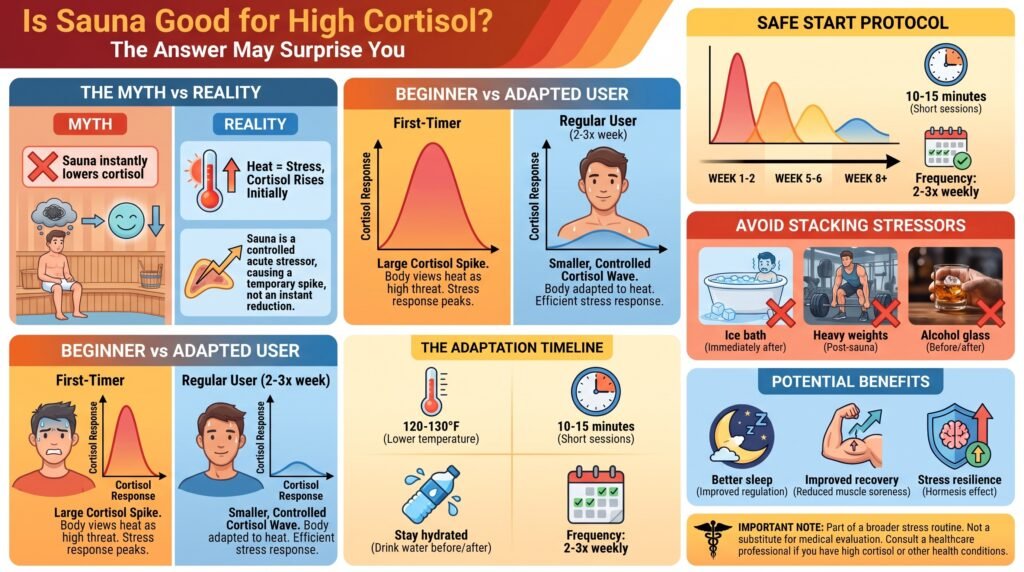
Sauna doesn’t instantly lower cortisol. Heat is a real stressor, so cortisol often rises during and right after a session, especially for beginners. With regular use (2-3 times a week), the body adapts, and the response shrinks, which may improve stress resilience, sleep, and recovery.
Research is mixed, though, and there’s no guaranteed cortisol-lowering protocol. Start moderate (about 120-130°F infrared, 10-15 minutes), stay hydrated, avoid stacking other stressors like cold plunges, hard workouts, or alcohol, and judge success by how you recover the next day.
Sauna works best as part of a broader stress routine and isn’t a substitute for medical evaluation if your cortisol is truly abnormal.
🧾 Table of Contents
- Quick Summary
- Introduction
- What Actually Happens to Cortisol During a Sauna Session
- The Difference Between Acute Response and Long-Term Adaptation
- Why Some People Feel Worse After Sauna
- Key Takeaways
- Frequently Asked Questions
Introduction
I understand why this question keeps popping up everywhere. You’re completely exhausted but somehow still wired, your sleep is a disaster, and someone on Instagram swore that sweating in a wooden box fixed their cortisol problem overnight.
The promise sounds simple and natural. After scrolling through enough glowing testimonials, it starts to feel like the answer you’ve been searching for.
But here’s what really complicates the sauna-cortisol conversation: heat can actually raise your cortisol levels initially. This happens not because the sauna failed you, or because you bought the wrong brand, but because heat genuinely stresses your body.
Your cardiovascular system works harder, your thermoregulation kicks into overdrive, and your hypothalamic-pituitary-adrenal axis (the system coordinating your stress hormones) responds accordingly.
Walking into a sauna expecting your cortisol to plummet the moment you start sweating sets you up for confusion. You might feel wired afterward, or your sleep tracking app might show your heart rate stayed elevated all night.
That doesn’t mean sauna is bad for you.
The relationship between heat exposure and cortisol is just way more nuanced than most marketing copy suggests.
I’ve watched people genuinely benefit from regular sauna use. I’ve also watched people add it to an already overtrained, under-slept, overworked lifestyle and wonder why they feel worse.
The difference usually comes down to understanding what heat stress actually does, how your body adapts over time, and whether your particular situation can handle another stressor, even a supposedly therapeutic one. Let’s unpack what the research actually shows, what happens in your body during and after a sauna session, and how to figure out whether adding heat exposure makes sense for your specific cortisol situation.
What Actually Happens to Cortisol During a Sauna Session
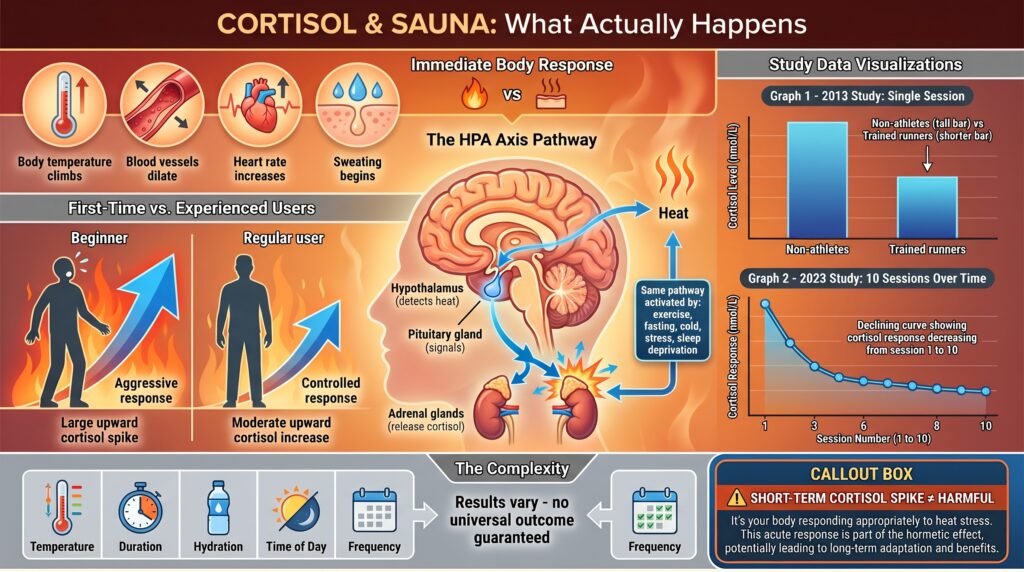
When you sit in a sauna, your body temperature starts climbing. Blood vessels dilate to move heat toward your skin, your heart rate increases to maintain circulation, and you start sweating to cool down.
All of this coordination comes from your autonomic nervous system and your endocrine system working together.
The hypothalamic-pituitary-adrenal axis gets activated because heat is a legitimate physiological challenge. Your hypothalamus senses the temperature change, signals your pituitary gland, which then tells your adrenal glands to release cortisol and other stress hormones.
This is the same system that responds to exercise, fasting, cold exposure, psychological stress, and lack of sleep. Heat stress activates it just like any other significant challenge to your body’s balance.
A 2013 study compared trained runners with non-athletes and found that both groups experienced significant cortisol increases after a single Finnish sauna session. The non-athletes had a larger response, which researchers connected to lower heat adaptation.
If you’re new to sauna, your body treats it as a bigger stressor than it will once you’re more experienced. Your system hasn’t learned the patterns yet. It doesn’t know how long the heat will last, how high the temperature will go, or when relief will come.
So it responds more aggressively.
Another study in 2023 tracked participants through ten sauna sessions and found that cortisol still rose after each one, but the magnitude of the increase got smaller over time. That’s adaptation in action.
Your body learns to handle the heat more efficiently, so it doesn’t need to mount as aggressive a hormonal response. The stress is still there, but your system gets better at managing it without panicking.
But here’s where it gets really complicated: not all studies show cortisol going up. Some report reductions, some show no meaningful change, and others show mixed results depending on temperature, session length, hydration status, time of day, and whether participants were regular sauna users.
The variables matter tremendously, and that makes it really difficult to give a universal answer about whether sauna will lower your cortisol. Anyone promising you a guaranteed outcome is oversimplifying the science.
What we can say with more confidence is that the immediate hormonal response doesn’t tell the whole story. A short-term cortisol spike doesn’t automatically mean the session was harmful.
It might just mean your body is doing exactly what it’s supposed to do when faced with a heat challenge. The real question is what happens over weeks and months of regular use.
The Difference Between Acute Response and Long-Term Adaptation
This distinction gets lost in most online discussions. When people talk about sauna lowering cortisol, they’re usually imagining a direct, immediate effect, like taking a supplement that drops a number on a lab test within hours.
But that’s not how stress adaptation works in your body.
Your body doesn’t want cortisol to be flatlined all the time. You need cortisol to wake up in the morning, to mobilize energy when you exercise, to maintain blood pressure, and to coordinate your immune response.
A healthy stress system should be able to raise cortisol when appropriate and then return to baseline afterward. The system needs flexibility, not rigidity.
So the better question isn’t necessarily whether sauna lowers cortisol in the moment. The better questions are: Does regular sauna use help your stress system become more resilient?
Does it improve your ability to recover from stressors?
Does it make you feel calmer, sleep better, and handle daily stress more effectively?
Some research suggests that repeated heat exposure can improve parasympathetic nervous system activity. That’s the rest-and-digest side of your autonomic nervous system, the part that helps you relax after a stressor passes.
If sauna helps shift you toward more parasympathetic tone over time, that could indirectly support better cortisol regulation, even if your cortisol doesn’t drop during the session itself. You’re training your body to recover faster and more completely.
One study involving young men who completed repeated sauna and cooling cycles showed cortisol dropping from 13.61 to 9.67 µg/ml during the treatment protocol. That’s encouraging, but it’s one study with a specific protocol.
It doesn’t mean every sauna session will produce that result, and it doesn’t mean infrared sauna at a different temperature with a different duration will do the same thing. The conditions matter.
The key insight here is that adaptation takes time. If you try sauna once, feel exhausted, and decide it doesn’t work for you, you might be bailing before your body has had a chance to learn how to handle the heat more efficiently.
Why Some People Feel Worse After Sauna
I’ve talked to quite a few people who were really excited to try sauna for stress relief and ended up feeling completely drained afterward. Their sleep got worse, their resting heart rate stayed elevated, and they felt foggy the next day.
Usually, one of several things is happening.
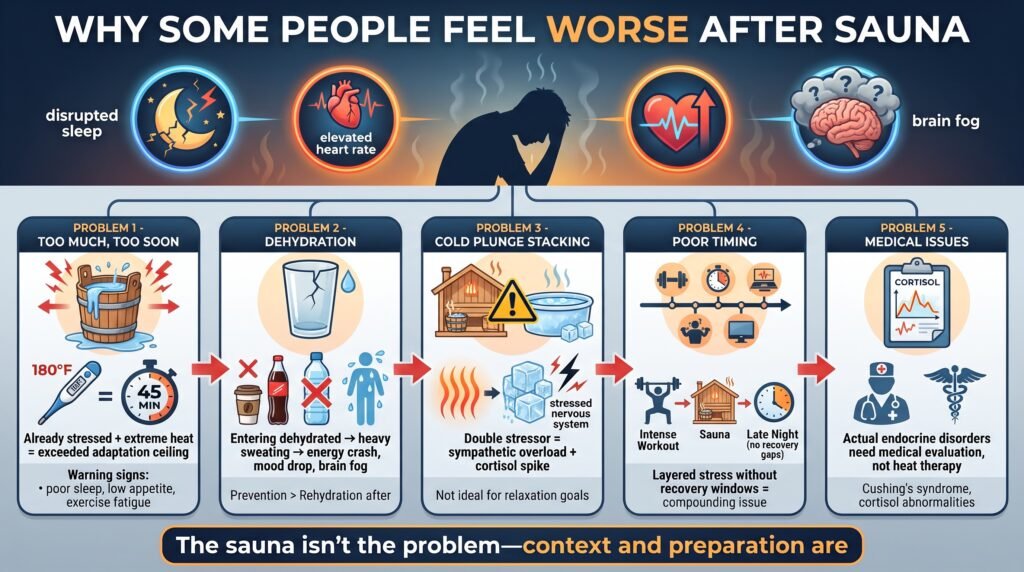
First, they might have started too hot or stayed in too long. If you’re already dealing with poor sleep, low appetite, exercise fatigue, or other signs that your stress bucket is overflowing, adding a 45-minute session in a 180-degree sauna might just be too much.
Your body doesn’t have the capacity to recover from that extra stressor. You’ve exceeded your current adaptation ceiling.
Second, dehydration is a real issue. If you walk into a sauna already under-hydrated (maybe you had coffee all morning, skipped water, and didn’t eat much), sweating heavily can push you into a deficit that affects energy, mood, blood pressure, and cognitive function.
Rehydrating afterward helps, but prevention is better. Your body can’t perform optimally when it’s already behind on fluids.
Third, some people add cold plunging immediately after the sauna because they’ve seen influencers do it. Cold exposure is its own stressor.
It activates the sympathetic nervous system, raises cortisol temporarily, and needs cardiovascular adaptation. For someone whose main goal is relaxation, stacking heat and cold back-to-back might be counterproductive.
You’re essentially hitting your stress system twice in rapid succession without giving it time to stabilize.
Fourth, timing matters a lot. If you do a hard workout, then immediately sit in a sauna, then stay up late because you feel wired, you’re layering stressors without giving your body time to recover between them.
The sauna isn’t the problem in isolation. Adding it on top of everything else creates the issue.
And fifth, some people are dealing with an actual medical cortisol abnormality, like Cushing’s syndrome or another endocrine disorder, and sauna isn’t going to fix that. If your cortisol is genuinely out of range on many validated tests, you need medical evaluation, not just heat exposure.
How to Start Sauna Without Adding Excessive Stress
If you’ve never used a sauna regularly, or if you’ve tried it and felt terrible, I’d suggest a much more conservative approach than what most marketing suggests.
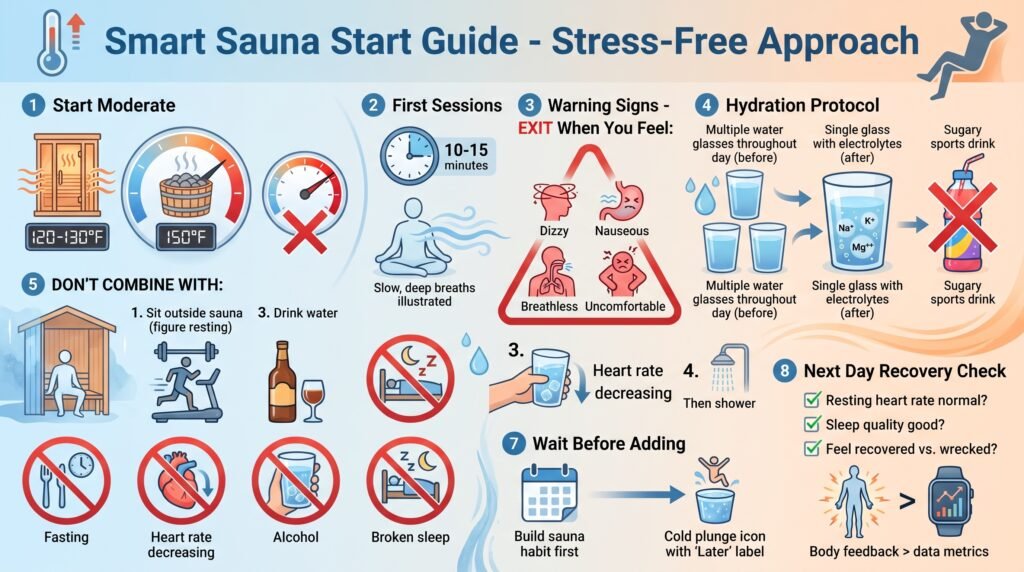
Start with a moderate temperature. For infrared, that might be around 120 to 130 degrees Fahrenheit.
For a traditional Finnish sauna, maybe start at 150 degrees instead of maxing it out.
You’re not trying to prove anything. You’re trying to figure out whether your body can tolerate the heat without feeling wrecked afterward.
Keep your first few sessions short. Ten to fifteen minutes is plenty to start.
Sit down instead of standing, and focus on breathing slowly and deeply.
If you start feeling lightheaded, nauseated, unusually breathless, or just weirdly uncomfortable, get out. There’s no benefit to pushing through dizziness or distress.
That’s your body telling you it’s had enough.
Hydrate before you go in. Drink water throughout the day leading up to your session, not just a glass right before. If you sweat heavily, consider adding electrolytes afterward.
Not a sugary sports drink, but something with sodium, potassium, and magnesium to replace what you lost.
Don’t combine your first sauna sessions with fasting, intense workouts, alcohol, or poor sleep. You’re trying to isolate the variable here.
If you do a fasted HIIT workout, sit in a sauna, drink wine, and sleep four hours, you won’t know which part made you feel bad. Keep the other variables stable while you test sauna.
Cool down gradually after your session. Sit outside the sauna for a few minutes, let your heart rate come down, and drink water before you jump in the shower.
To try cold exposure, wait until you’ve built a solid sauna habit first. Don’t stack stressors before you understand how each one affects you individually.
Track how you feel the next day. That’s really the best indicator of whether the session was appropriate for your current capacity.
Does your resting heart rate return to normal? Do you sleep well that night?
Do you wake up feeling recovered, or do you feel like you got hit by a truck?
Your subjective recovery is more useful than any single cortisol measurement. Your body will tell you whether it can handle the load.
Learn more about infrared versus traditional sauna for stress, when sauna actually helps with stress, what sauna can’t, and more here.
Key Takeaways
Sauna can temporarily raise cortisol because heat is a genuine stressor, especially for beginners or at high temperatures. Your body responds to heat by activating the same stress systems that respond to exercise, fasting, and psychological pressure.
Repeated exposure may lead to adaptation, with smaller cortisol responses over time and potential improvements in stress resilience. Your body learns to handle heat more efficiently, but this takes weeks or months of consistent practice.
The evidence is mixed and doesn’t establish a universal cortisol-lowering protocol. Individual response varies widely based on temperature, duration, hydration, timing, and your current stress load.
Starting with moderate infrared heat, short sessions, good hydration, and careful attention to next-day recovery is the most sensible approach for someone dealing with stress-related symptoms. Conservative progression beats aggressive protocols.
Sauna works best as part of a broader stress-management routine, not as a standalone hormonal fix, and it should never replace medical evaluation for confirmed cortisol abnormalities.
Frequently Asked Questions
Does sauna lower cortisol immediately?
Sauna can actually raise cortisol temporarily during and immediately after a session because heat is a physiological stressor. The cortisol response typically decreases over time as your body adapts to regular heat exposure, but the immediate effect is often an increase as opposed to a decrease.
How often should I use sauna for stress management?
Two to three sessions per week seems to be a reasonable frequency for most people looking to manage stress. Daily use might add too much stress if you’re already dealing with poor sleep or overtraining.
Start conservatively and increase frequency only if you’re recovering well between sessions.
What temperature should I start with for stress relief?
Start with 120 to 130 degrees Fahrenheit for infrared saunas, or around 150 degrees for traditional saunas. Keep your first sessions short (10 to 15 minutes) and pay attention to how you feel the next day.
You can gradually increase temperature and duration as your body adapts.
Can sauna help with adrenal fatigue?
Adrenal fatigue isn’t a recognized medical diagnosis. If you’re experiencing symptoms like chronic exhaustion, poor sleep, and difficulty handling stress, you should get proper medical evaluation as opposed to assuming sauna will fix it.
Sauna might help with stress resilience, but it won’t cure an underlying medical condition.
This article includes affiliate links. If you click through and make a purchase, I may receive a small commission. This helps support the site and allows me to keep creating helpful content at no extra cost to you.