Quick Summary
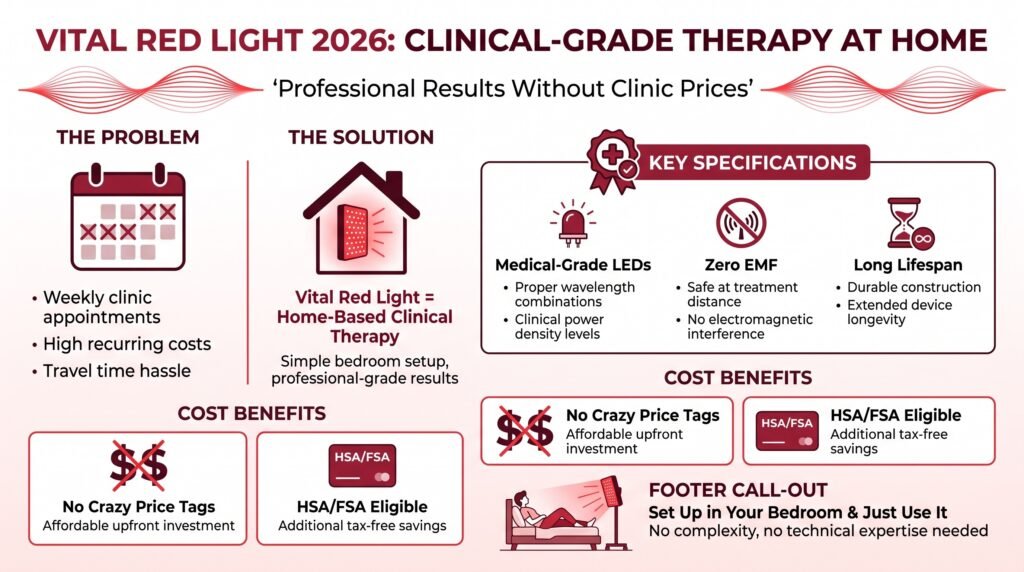
Vital Red Light builds panels and devices designed to bring clinical-grade red light therapy into your home without the crazy price tags or hassle of booking appointments every week.
The company focuses on professional-level specs (like proper wavelength combinations and actual power density numbers) while keeping things simple enough that you can set up a panel in your bedroom and just… use it.
Devices feature medical-grade LEDs, zero EMF at treatment distance, and long lifespan. Also, Vital’s devices are HSA/FSA eligible, which provides additional cost savings.
Check out the current Vital Red Light lineup>>CLICK HERE. and look for specs that hit at least 100 mW/cm² at 6 inches, with both 660nm and 850nm wavelengths if possible.
Table of Contents
1. Quick Summary
A brief overview of Vital Red Light devices and their benefits for at-home clinical-grade therapy.
2. Introduction to Vital Red Light
Background on red light therapy, its science, wavelengths (660nm and 850nm), and how Vital Red Light makes it accessible at home.
3. Product Categories Overview
– Full-Body Panels (e.g., Vital Charge and Vital Pro)
– Targeted Devices (e.g., Vital Flex and handheld units)
– Wavelength Combinations
Includes discussion on treatment areas and cost savings calculator.
4. How to Choose the Right Product
Key factors:
– Treatment Area
– Power Density (Irradiance)
– EMF Emissions
– Cooling and Build Quality
– Warranty
5. Setup and Getting Started
Guidance on mounting, distance, treatment duration, skin preparation, and tracking progress.
6. Advanced Tips and Tricks
Combining with other treatments, pulsed vs. continuous mode, multiple sessions per day, temperature considerations, and emphasizing consistency.
Introduction to Vital Red Light
Red light therapy used to be one of those things you could only get at fancy med spas or dermatologist offices, and honestly, the costs added up fast. We’re talking $75-150 per session, and you need many sessions per week to see anything happen.
Vital Red Light entered the market with a different approach. They make panels and devices that hit the same wavelengths (660nm red and 850nm near-infrared) that clinical devices use, but you can keep them at home and use them as much as you want.
The science behind red light therapy is pretty straightforward. Specific wavelengths of light penetrate your skin and get absorbed by mitochondria in your cells. This triggers a boost in ATP production (basically cellular energy), which then kick-starts various healing and regeneration processes.
The 660nm wavelength works on surface-level stuff like skin and shallow tissue, while 850nm penetrates deeper for muscles, joints, and inflammation.
The FDA classifies these devices as low-risk wellness products, and they’ve been studied for decades. That said, results vary between people, and the therapy works better for some conditions than others (more on that later).
What makes this vital red light guide different from the hundred other articles out there is that we’re going to cut through the marketing fluff and focus on what actually matters when you’re trying to decide if these panels are worth the investment.
Product Categories Overview
Vital Red Light offers several different types of devices, and picking the right one depends mostly on what you’re trying to treat and how much space you have.
Full-Body Panels
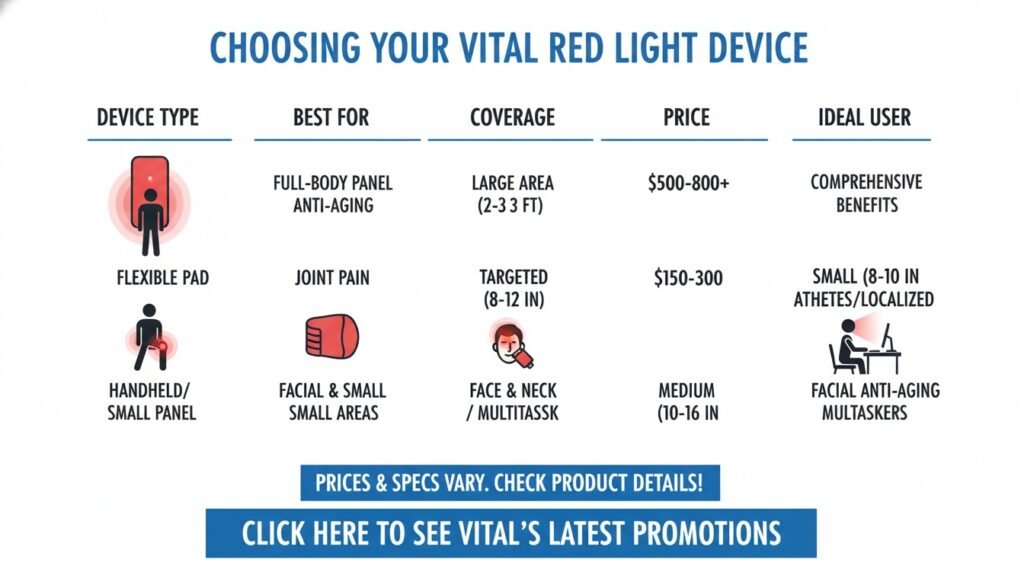
These are the big ones, the panels that mount on a door or wall and cover a large treatment area. The Vital Charge (their mid-sized panel) and Vital Pro (the larger version) fall into this category.
Full-body panels make sense if you want to treat many areas at once or if you’re dealing with something systemic like overall skin quality, widespread inflammation, or muscle recovery after full-body workouts.
You can stand in front of one for 10-20 minutes and hit your face, torso, arms, and legs all at once.
The tradeoff is size and cost. These panels are not small (we’re talking 24-36 inches tall), and they start around $500-800 depending on the model and any sales they’re running.
Targeted Devices
Vital Red Light also makes smaller, focused devices like the Vital Flex (a flexible pad you can wrap around joints or lay on specific areas) and handheld units.
These work well for spot treatment. If you have a janky knee that acts up, or you’re dealing with a specific patch of psoriasis on your elbow, or you want to focus exclusively on facial skin, a targeted device lets you get closer to the problem area and concentrate the light where it matters.
Smaller devices are also way easier to travel with and generally cost less (usually $200-400).
Wavelength Combinations
Most of their panels use a combination of 660nm (red) and 850nm (near-infrared). Some devices let you toggle between wavelengths or use them together.
The 660nm red light is visible (it glows red when you turn it on) and works primarily on skin, collagen production, and surface-level healing. The 850nm near-infrared is invisible to your eyes but penetrates deeper for joint pain, muscle recovery, and internal inflammation.
If you’re mainly worried about wrinkles, acne scars, or skin texture, you want strong 660nm output. If you’re chasing muscle recovery, joint pain relief, or deeper tissue healing, 850nm matters more.
For most people, having both wavelengths in one panel makes the most sense.
As many red light practitioners agree, consistent sessions yield consistent results. This is where Vital Red Light’s at-home therapy products provide the real advantage.
Use the calculator below to crunch the real numbers and discover the cost savings of Vital’s devices compared to multiple professional sessions per week.
Red Light Therapy Savings Calculator
Professional red light therapy sessions typically cost $100 – $150 each. With a Vital Red Light device priced at $899, you can enjoy unlimited sessions at home and save thousands of dollars.
💡 Smart Investment: Most users break even within the first month. After that, every session is completely free, giving you unlimited access to red light therapy from the comfort of your home.
How to Choose the Right Product
Here’s where people get stuck, because there are a lot of technical specs thrown around, and it’s hard to know what actually matters.
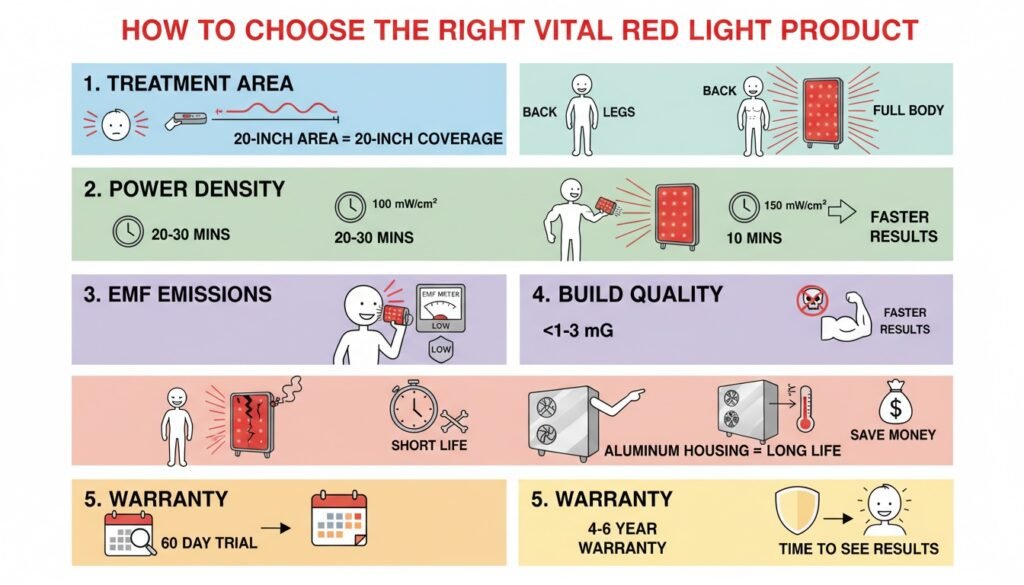
Treatment Area
Start with what you’re trying to treat. If it’s your face, a small panel or targeted device works fine.
If it’s your entire back, legs after leg day, or you want full-body anti-aging benefits, you need a larger panel.
Vital Red Light lists the treatment area for each device (usually measured at 6 inches from the panel). A device with a 20-inch treatment area means you can effectively treat about 20 inches of your body at once when standing at the recommended distance.
Commit to using it consistently for at least 8 weeks. That’s two months of 10-minute sessions, 3-5 times per week.
Power Density (Irradiance)
This is the metric that separates real devices from overpriced toys. Power density (measured in mW/cm²) tells you how much light energy actually reaches your skin.
For effective therapy, you want at least 100 mW/cm² at 6 inches away. Vital Red Light panels typically deliver 100-150 mW/cm² at that distance, which puts them in the clinical range.
Higher power density means shorter treatment times. A panel with 150 mW/cm² gets you the same results in 10 minutes that a weaker panel might take 20-30 minutes to deliver.
Your time is worth something, so this matters.
EMF Emissions
Some people care about electromagnetic field exposure, especially if you’re using the device near your head or for extended periods. Vital Red Light designs their panels with low EMF output (usually under 1-3 mG at 6 inches), which is well below concerning levels.
If EMF bothers you, check the specs before buying. Most of their panels list EMF readings right on the product page.
Cooling and Build Quality
Cheaper panels overheat, and the LEDs degrade faster. Vital Red Light uses aluminum housing with built-in cooling systems to keep the LEDs at stable temperatures.
This matters for longevity. LEDs that run hot die faster, and nobody wants to replace a $600 panel after 18 months because half the bulbs burned out.
Warranty
Vital Red Light offers a 60-day trial period and a 3-year warranty on most panels. That’s pretty standard for this category.
The trial period gives you time to actually test the device and see if you notice anything, which is useful since results can take 4-6 weeks to show up.
If you’re on the fence about whether red light therapy works for you, check out their current panel options via the button below. Look for models with the trial period, so you’re not locked in immediately.
Setup and Getting Started
Setting up a Vital Red Light panel is honestly simpler than most people expect, but there are a few things that make the difference between getting results and just standing in front of a glowing red panel for no reason.
Mounting and Placement
Most full-size panels come with a door mount system (basically hooks that hang over the top of a door) and sometimes a stand option. You can also wall-mount them if you have a dedicated space.
Put the panel somewhere you’ll actually use it. If it’s buried in a closet or in the cold garage, you won’t use it consistently, and consistency is the main thing that determines results.
A lot of people put panels in their bedroom or bathroom where they’re already spending time getting ready in the morning or winding down at night.
Distance from the Panel
The standard recommendation is 6-12 inches away from the panel. Closer means more intensity but a smaller treatment area.
Farther away covers more area but with lower power density.
For face and skin work, 6 inches works well. For full-body coverage or if you find the intensity uncomfortable at first, start at 12 inches and move closer as you get used to it.
Treatment Duration
Start with 10 minutes per session. Most of the research on red light therapy uses protocols ranging from 10 to 20 minutes per area, done 3-5 times per week.
More is not always better. Overexposure can actually reduce effectiveness (there’s something called biphasic dose response, where too much light has diminishing or even negative returns).
Stick to the recommended times, especially when you’re starting.
Skin Preparation
Use the panel on bare, clean skin. Lotions, makeup, and even thick moisturizers can block light penetration. Some people use red light therapy right after a shower when their skin is clean and pores are open.
You can wear eye protection if the brightness bothers you, but for most people it’s not necessary. Just don’t stare directly into the LEDs (same as you wouldn’t stare at any bright light source).
Tracking Your Progress
Take photos before you start, especially if you’re using this for skin conditions or anti-aging. It’s hard to notice gradual changes when you see yourself every day.
Photos give you a baseline to compare against after 30, 60, and 90 days.
For pain or recovery goals, keep a simple log of symptoms. Rate your pain or stiffness on a 1-10 scale before you start and then weekly as you go.
This helps you figure out if it’s actually working or if you’re just experiencing a placebo.
Most people start noticing surface-level changes (skin texture, minor pain reduction) around the 4-6 week mark with consistent use. Deeper benefits like significant collagen improvement or major inflammation reduction take 8-12 weeks.
Advanced Tips and Tricks
Once you’ve been using your panel for a few weeks and you’ve got the basics down, some tweaks can help you get more out of it.
Combining with Other Treatments
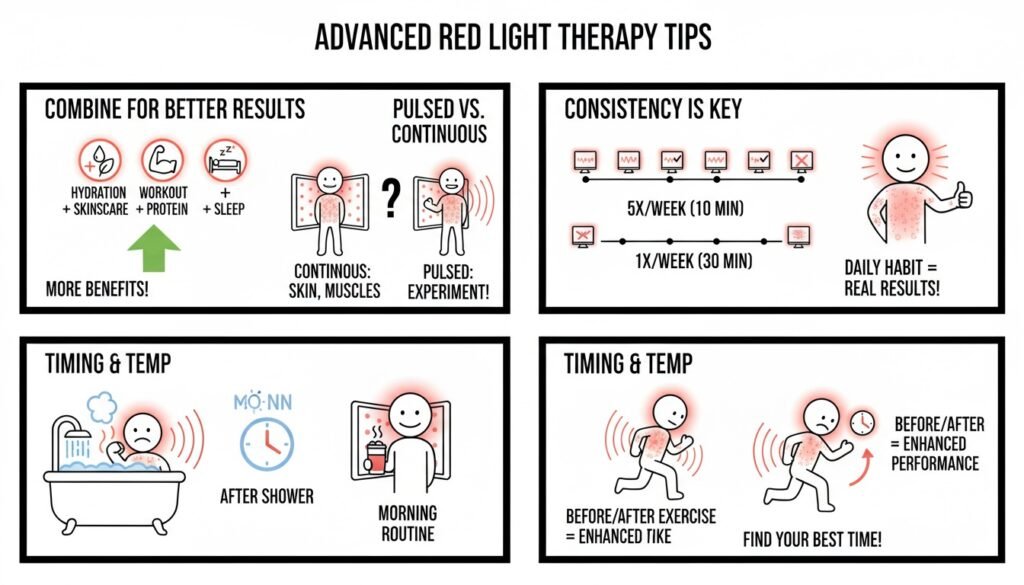
Red light therapy seems to work better when combined with other healthy habits. People using it for skin benefits often pair it with good skincare routines, hydration, and collagen-supporting supplements found here.
For muscle recovery, using it after workouts along with proper protein intake and sleep gives better results than just doing red light alone.
Some research suggests red light therapy right before or after exercise can enhance performance and speed up recovery. The timing might matter, though the studies are still working that out.
Pulsed vs. Continuous Mode
Some Vital Red Light panels offer both pulsed and continuous light modes. Continuous mode keeps the LEDs on steady for the whole session.
Pulsed mode flickers the light at specific frequencies (usually 10 Hz or 40 Hz).
There’s some evidence that pulsed frequencies might work better for certain neurological and cognitive benefits, while continuous works fine for skin and musculoskeletal stuff. Honestly, the research is still pretty mixed on this, so if your panel has the option, you can experiment and see if you notice any difference.
Using Multiple Times Per Day
For acute issues (like a fresh injury or sudden inflammation flare-up), some people use red light 2-3 times per day in shorter sessions (5-10 minutes each). For maintenance and general wellness, once per day or even 3-4 times per week is usually enough.
Temperature Considerations
Your body temperature affects how well tissues absorb light. Some people do red light therapy right after a warm shower or bath when circulation is already increased. Others prefer doing it first thing in the morning on an empty stomach.
There’s no definitive answer here, but it’s something you can play with if you’re not seeing results after a few weeks of consistent use.
Consistency Over Intensity
Using the panel for 10 minutes five times a week will get you better results than doing 30 minutes once a week. Your cells respond better to regular, repeated exposure than to sporadic, intense sessions.
If you’re struggling with consistency, tie it to an existing habit. Do your red light session right after you brush your teeth, or while you’re listening to a podcast, or during the first 10 minutes of your coffee in the morning.
For anyone serious about getting results, grab a panel designed for consistent home use as opposed to trying to DIY something or relying on wimpy handheld devices that take forever to treat a single area. Click the button to get started.
Troubleshooting Common Issues
Even with good equipment and a solid routine, you might run into some issues or questions.
Not Seeing Results After a Few Weeks
First, check your expectations. Red light therapy is gradual.
If you’re looking for dramatic overnight changes, that’s not how this works.
Most visible improvements take 4-8 weeks at least.
Second, confirm you’re using proper distance, duration, and frequency. Ten minutes at 6-12 inches, 3-5 times per week, is the baseline.
If you’re doing less than that, ramp up consistency before deciding it doesn’t work.
Third, consider your specific goal. Red light therapy has strong evidence for certain things (skin texture, wound healing, muscle recovery, joint pain) and weaker evidence for others.
If you’re trying to treat something outside the main research areas, your results might be limited.
Skin Irritation or Redness
Some people get mild redness or warmth during treatment. That’s normal and usually fades within 30 minutes. Hyperpigmentation is a common and temporary side effect of red light therapy, especially when first starting.
If you’re getting persistent irritation, blistering, or worsening of skin conditions, you might be overexposing.
Dial back the time or increase the distance. Start with shorter sessions (5-7 minutes) if you have sensitive skin, and work your way up as your skin adapts.
Panel Not Turning On or Flickering
Check the obvious stuff first: is it plugged in properly, is the outlet working, are there any loose connections? If the panel flickers or only half the LEDs turn on, contact the manufacturer.
That’s usually a defect covered under warranty, not something you can fix yourself.
Eye Sensitivity
The brightness can be uncomfortable for some people, especially if you’re treating your face. You can close your eyes (the light still penetrates your eyelids, which is fine for skin benefits), or use red light-compatible eye protection.
There’s no evidence that red light at these wavelengths damages eyes the way UV light does, but the brightness itself can feel intense if you’re staring directly at it.
Managing Treatment Time
Ten to twenty minutes doesn’t sound like much, but it can feel tedious when you’re just standing there. Most people use the time to listen to music, podcasts, or audiobooks.
Some do light stretching or meditation.
Find something that makes the time pass more easily so you’ll actually stick with it.
Conflicting Information Online
Yeah, there’s a lot of conflicting advice about red light therapy floating around. Some people claim it cures everything from baldness to depression, while others say it’s just nonsense.
The truth is somewhere in the middle. Red light therapy has legitimate research backing it for specific uses (mostly skin, wound healing, pain management, and inflammation).
It’s not a secret cure, but it’s also not snake oil.
Stick to established protocols, manage your expectations, and give it a proper trial (at least 6-8 weeks) before deciding if it works for you.
Conclusion and Next Steps
Red light therapy with devices like those from Vital Red Light gives you access to clinical-grade treatment without the ongoing costs and scheduling hassles of professional sessions. The science behind it is solid for certain applications, though results vary between people.
If you fit into the category of someone dealing with aging skin, nagging joint pain, slow muscle recovery, or stubborn skin conditions, and you’ve already tried other approaches without much success, red light therapy is a reasonable next step.
Start here:
Pick a device that matches your primary goal. For full-body benefits or treating large areas, go with a full-size panel like the Vital Charge or Vital Pro.
For targeted treatment or if you’re testing the waters before committing to a large panel, start with a smaller device or flexible pad.
Again, look for specs that hit at least 100 mW/cm² at 6 inches, with both 660nm and 850nm wavelengths if possible.
Commit to using it consistently for at least 8 weeks. That’s two months of 10-minute sessions, 3-5 times per week.
Take before photos, track symptoms or pain levels, and actually give it enough time to work.
Set up your space so the panel is easy to access and use. The biggest reason people don’t see results is that they stop using the device after a few weeks because it’s inconvenient or they forget about it.
What to expect:
In the first 2-3 weeks, you might not notice much. Some people report better sleep or slightly less pain, but major changes are rare this early.
Around weeks 4-6, surface-level improvements start showing up: skin texture gets a better, minor aches improve, and recovery from workouts might speed up slightly.
By weeks 8-12, if it’s going to work for you, you should see more noticeable results: clearer skin, reduced fine lines, better joint mobility, faster healing from minor injuries.
Not everyone responds the same way. Some people see dramatic changes, others see modest improvements, and some see nothing.
That’s true for most therapeutic interventions.
The trial period most companies offer (including Vital Red Light’s 60-day window) exists specifically so you can test it risk-free and return it if it doesn’t do anything for you.
Red light therapy isn’t going to replace proper sleep, good nutrition, exercise, or medical treatment when you need it. But as a supplementary tool for skin health, recovery, and pain management, it has enough research and real-world results backing it to be worth trying, especially if you’ve already exhausted other options.
If you’re ready to test it yourself, start with a panel that fits your space and budget.>>CLICK HERE. Give it the full 8 weeks, use it consistently, and track your results properly. That’s the only way you’ll know if this particular vital red light guide actually helps you or if you’re better off spending your money elsewhere.
FAQ’s
Here are answers to frequently asked questions about Vital Red Light therapy devices, based on the article’s content and common inquiries from the brand’s official resources.
Is red light therapy with Vital Red Light devices safe?
Yes, these devices are designed with medical-grade LEDs, zero or low EMF emissions at treatment distance, and are classified as low-risk wellness products by the FDA. They have no known negative side effects when used as directed, though minor tiredness or temporary skin redness can occur rarely.
What wavelengths do Vital Red Light devices use, and why do they matter?
Most devices combine 660nm (visible red light for skin-level benefits like collagen production and surface healing) and 850nm (near-infrared for deeper penetration into muscles, joints, and inflammation reduction). Having both provides versatile benefits for most users.
How do I choose between a full-body panel and a targeted device?
Choose full-body panels (e.g., Vital Charge or Pro) for treating large areas like the torso, back, or full-body recovery. Opt for targeted devices (e.g., flexible pads or handhelds) for spot treatment of specific issues like joints, facial skin, or travel-friendly use.
What is the recommended power density for effective results?
Look for at least 100 mW/cm² (milliwatts per square centimeter) at 6 inches distance. Vital Red Light panels typically deliver 100-150 mW/cm², allowing shorter, effective 10-20 minute sessions.
How far should I stand from the panel, and how long per session?
Start at 6-12 inches away: closer for higher intensity on smaller areas, farther for broader coverage. Sessions should be 10-20 minutes, 3-5 times per week. Avoid overexposure, as more is not always better.
When can I expect to see results?
Surface-level changes (e.g., skin texture, minor pain relief) often appear in 4-6 weeks with consistent use. Deeper benefits (e.g., collagen improvement, significant inflammation reduction) may take 8-12 weeks.
Does Vital Red Light offer a trial period or warranty?
Yes, most panels come with a 60-day trial period and a 3-year warranty, allowing time to test results without full commitment.
Can I combine red light therapy with other treatments?
Yes, it pairs well with skincare routines, supplements, exercise, or post-workout recovery for enhanced results. Some devices offer pulsed mode, which may provide additional benefits for certain uses.
How does owning a Vital Red Light device save money compared to professional sessions?
Professional sessions cost $75-150 each. With consistent home use (3-5 times/week), a device often pays for itself in 2-3 months through unlimited sessions.
Is eye protection necessary?
Not usually required, but avoid staring directly at the LEDs. Use protection if the brightness bothers you.
This article includes affiliate links. If you click through and make a purchase, I may receive a small commission. This helps support the site and allows me to keep creating helpful content at no extra cost to you.