Key Takeaways
This article examines whether red light therapy can directly target cancer cells, rather than ease treatment side effects. Preclinical studies show promise; high-dose red LED light has slowed tumor growth and triggered cancer cell death in lab models, but results are highly dependent on wavelength, dose, and cancer type, and aren’t ready for DIY use. Photodynamic therapy (PDT), which pairs light with a photosensitizing drug, is the one FDA-approved way light is used to actively kill cancer cells.
For general supportive use, patients should talk to their oncology team, target non-tumor areas, use red (630–670nm) and near-infrared (780–830nm) devices with transparent irradiance data, and treat PBM as an adjunct — never a replacement — to standard cancer care. Melanoma patients and anyone considering PBM over an active tumor site should exercise extra caution, since research on dose effects and long-term outcomes is still limited.
In part one of this series, we discussed how red light works as an adjunct to cancer care, the questions of safety, supportive evidence, and more.
Table of Contents
Key Takeaways
The Experimental Frontier: When Red Light Targets Cancer Cells Directly
How to Think About Using Red Light Therapy If You Have Cancer
What About the Risks and Controversies
Summary
People Also Asked
The Experimental Frontier: When Red Light Targets Cancer Cells Directly
Now we get to the really interesting and controversial part. Can red light actually kill cancer cells?
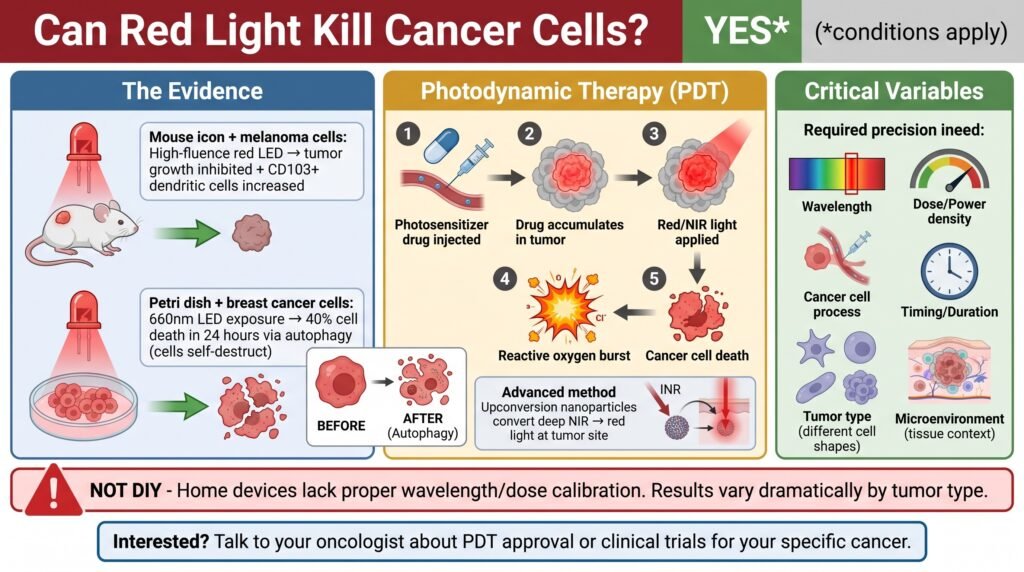
The short answer is yes, under the right conditions, in preclinical models. The longer answer is that those conditions are highly specific, not yet standardized for clinical use outside of PDT, and definitely not something you should try to copy on your own.
A study on melanoma using high-fluence red LED therapy found that repeated exposures significantly inhibited tumor growth in mice and increased markers of anti-tumor immunity, specifically CD103-positive dendritic cells, which are associated with better melanoma outcomes. The key detail is that this wasn’t gentle, low-dose PBM.
It was a carefully calibrated, higher-dose regimen designed to stress cancer cells.
In vitro work with 660-nanometer LED light on breast cancer-derived cells showed about a 40 percent reduction in cell viability after 24 hours of exposure. Electron microscopy revealed signs of autophagy, with cancer cells essentially digesting their own components and dying.
Again, this required specific parameters: wavelength, power density, exposure duration.
Photodynamic therapy takes this concept further by adding a drug that makes cancer cells exquisitely sensitive to light. Once the photosensitizer accumulates in the tumor, red or near-infrared light triggers a burst of reactive oxygen species that overwhelm the cancer cells’ defenses.
Newer approaches use upconversion nanoparticles that can convert deeply penetrating near-infrared light into visible red light right at the tumor site, allowing PDT to work on cancers buried centimeters deep in tissue.
But here’s the critical point. All of these anti-cancer applications depend enormously on wavelength, dose, timing, tumor type, and microenvironment.
The same light that inhibits one cell line might not affect another, or could even stimulate growth under different conditions.
In animal studies, the effects of PBM on tumors have been variable enough that responsible researchers consistently emphasize the need for careful protocol development and caution against generalizing from one setting to another.
This is why you can’t just buy a red light panel, point it at a tumor, and expect it to shrink. The device might not emit the right wavelengths.
The dose might be too low to have an effect or high enough to potentially cause harm.
And crucially, your tumor might not respond the way the one in a published study did.
If you’re intrigued by the tumor-targeting potential of red light, the appropriate path is to ask your oncologist whether any clinical trials are exploring PBM or PDT for your specific cancer type, or whether PDT is an approved option in your case.
This is genuinely cutting-edge medicine in some contexts, but it needs to be done under rigorous medical supervision.
How to Think About Using Red Light Therapy If You Have Cancer
Let’s get practical. You’re not a mouse in a lab, and you’re not going to DIY your cancer treatment.
But you might be wondering whether adding some form of red light therapy to your recovery plan makes sense.
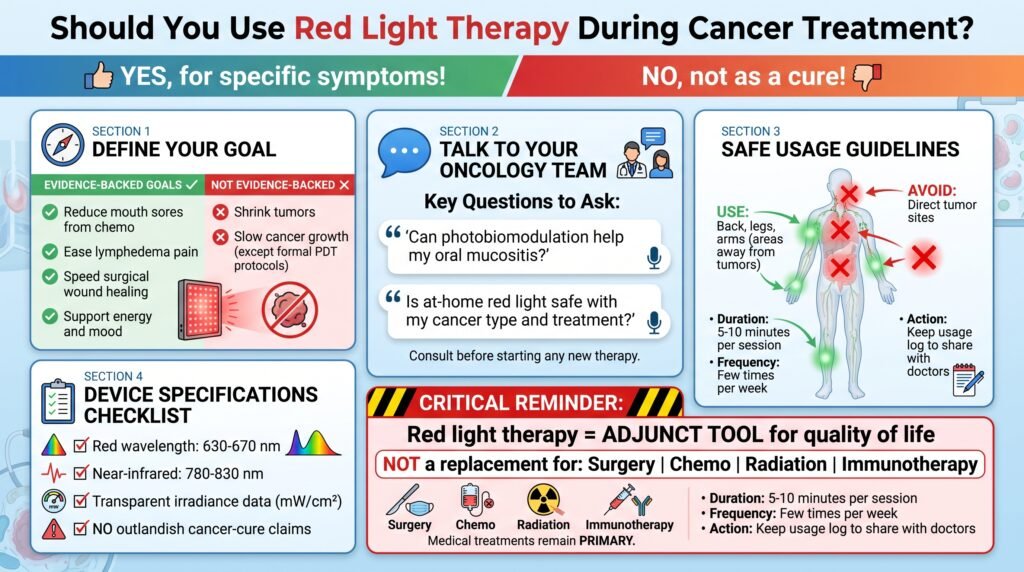
Start by getting crystal clear on your goal. Are you hoping to reduce mouth sores during chemo?
Ease lymphedema pain?
Help surgical wounds heal faster? Support your overall energy and mood while in treatment?
Or are you hoping to slow or shrink your tumor?
The first set of goals has genuine evidence behind it. The last one doesn’t, outside of formal PDT protocols.
Once you’re clear on your goal, have a real conversation with your oncology team. Bring specific questions.
“I’ve read that photobiomodulation can help with oral mucositis. Is that something that might work in my case?” or “I’m interested in using a red light panel at home for general recovery. Are there any reasons that would be unsafe given my cancer type and treatment?” Good oncologists and integrative oncology specialists are increasingly familiar with PBM and can help you work through this decision.
If your team gives you the green light for at-home supportive PBM, focus on general wellness applications rather than tumor sites. Use the device on your back, legs, arms, or other areas away from known malignancies.
Start with short sessions, maybe five to ten minutes at a comfortable distance, a few times per week.
Keep a simple log of when you use it and how you feel, and share that with your medical team at follow-ups.
Pay close attention to device specifications if you go the at-home route. Look for panels that emit wavelengths in the red (630 to 670 nanometers) and near-infrared (780 to 830 nanometers) ranges, as these align with most of the supportive-care research.
Check for transparent irradiance data, measured in milliwatts per square centimeter, so you can calculate reasonable exposure times.
Avoid devices making outlandish cancer-cure claims, as those are red flags for either poor quality or deceptive marketing.
Understand that at-home devices almost certainly won’t match clinical PBM units in terms of calibration, beam geometry, or treatment protocols. That’s okay if your goal is general support, but it’s another reason why you shouldn’t expect home PBM to function as cancer treatment.
And critically, keep PBM in perspective as one small piece of a comprehensive plan. You’re still going to need your surgery, chemo, radiation, immunotherapy, or whatever evidence-based treatments your oncologists recommend.
PBM is an adjunct tool, potentially helpful for quality of life and managing side effects, but not a replacement for proven cancer therapies.
What About the Risks and Controversies
Even though the safety data are generally reassuring, you should understand where the remaining uncertainty and controversy lie.
Some early cell culture experiments did show that PBM could stimulate proliferation of certain cancer cell lines. This has made some clinicians understandably cautious, particularly about using PBM directly over tumor sites.
The reality is that cells in a dish don’t behave the same way as cells in a living body, where the immune system, tumor microenvironment, and systemic factors all play roles.
But the observation reminds us that cellular stimulation is a real biological effect of PBM.
Melanoma remains a special concern. Some experts recommend avoiding PBM over active melanoma lesions, given the unique biology of melanoma cells and mixed preclinical data.
Interestingly, one of the more promising studies showing melanoma growth inhibition used higher-dose red light, which suggests that if PBM has anti-melanoma potential, it’s probably dose-dependent and needs careful control.
Until that’s clarified, caution is warranted.
There’s also the issue of dose variability. In animal studies, researchers have reported both tumor inhibition and neutral effects from PBM, often depending on subtle differences in treatment parameters.
This variability underscores that we don’t yet have a one-size-fits-all protocol, and personal factors matter.
Tumor type, location, stage, and the patient’s overall health likely all play roles.
The lack of long-term, large-scale human trials specifically tracking tumor progression in patients receiving PBM for supportive care is another gap.
The studies we have are reassuring, but most have follow-up periods measured in months to a few years, and they often focus on specific complications rather than survival as a primary endpoint.
More data would strengthen confidence, particularly for patients using at-home devices over extended periods.
None of this means red light therapy is dangerous. It means we’re still learning, and prudent caution, especially around active tumor sites and higher-risk cancers like melanoma, makes sense.
Summary
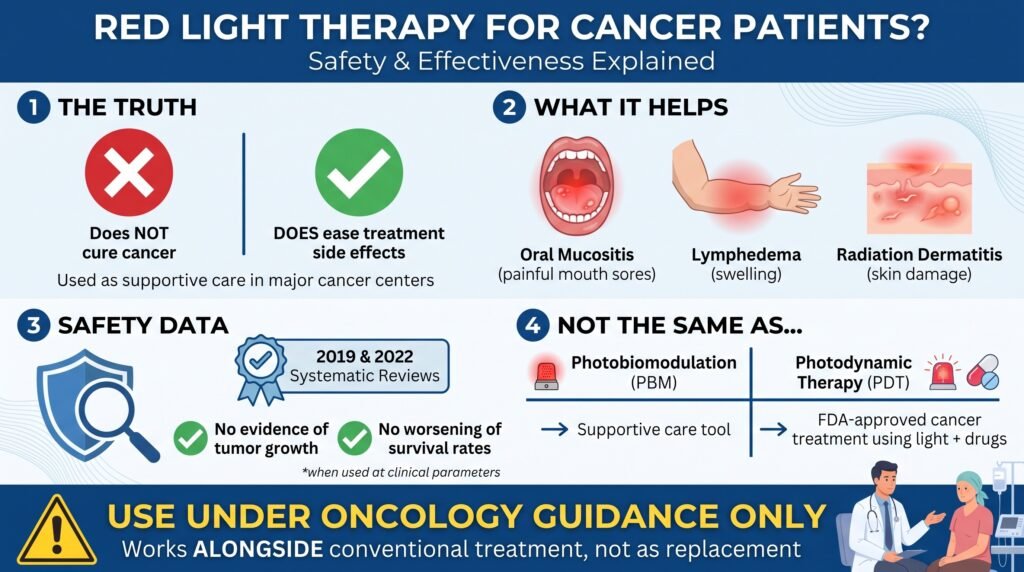
Photobiomodulation using red and near-infrared light has clinical evidence supporting its use for reducing specific cancer treatment side effects, particularly oral mucositis, lymphedema, and radiation dermatitis, without evidence of promoting tumor growth when used within established protocols.
Red light therapy functions as a supportive adjunct to conventional cancer treatment, helping manage side effects and potentially improving quality of life, but it cannot replace surgery, chemotherapy, radiation, or other standard cancer therapies.
The safety and effectiveness of PBM depend heavily on wavelength, dose, timing, and cancer type, making careful parameter selection and professional oversight essential, especially for at-home use and particularly for melanoma patients where extra caution is warranted.
To learn more about what red light therapy actually means in cancer care, safety concerns, supportive evidence, and more here.
If you are ready to consider red light therapy devices, click here to get started today and visit our review page for a complete list of affordable and effective devices for at-home use.
We have provided cost-savings calculators for each product so you can compare each device to the average cost of professional red light sessions as well.
If you are looking for an affordable entry point, read our review of the Mito Pro line of red light devices. Click here to start reading or click below to be taken to Mito’s official site.
Click the button below to start browsing Mito Red Light’s full line of affordable red light panels for at-home use.
People Also Asked
Can I use an at-home red light device during cancer treatment?
You can potentially use an at-home red light device during cancer treatment, but only after discussing it with your oncology team. The key factors are ensuring the device emits appropriate wavelengths (630-670 nm red and 780-830 nm near-infrared), using it on areas away from tumor sites, starting with conservative doses, and monitoring your response.
Your specific cancer type, treatment plan, and overall health status all influence whether at-home PBM is appropriate for you.
What is photodynamic therapy for cancer?
Photodynamic therapy (PDT) is an FDA-approved cancer treatment that combines a photosensitizing drug with specific wavelengths of light to destroy cancer cells. Patients first receive a drug that accumulates preferentially in cancer tissue.
After an appropriate waiting period, doctors apply red or near-infrared light to the tumor site, which activates the drug.
The activated drug produces reactive oxygen species that kill cancer cells while sparing most normal tissue. PDT is approved for certain skin cancers, esophageal cancer, and lung cancer, among others.
How does red light therapy reduce oral mucositis?
Red light therapy reduces oral mucositis through several mechanisms. The light stimulates mitochondrial function in healthy cells, increasing ATP production and giving them more energy for repair processes.
It also reduces pro-inflammatory signaling molecules while promoting anti-inflammatory responses.
Additionally, PBM increases blood flow to affected tissues and stimulates growth factors that support tissue healing. These combined effects help prevent the breakdown of oral tissues during chemotherapy and radiation, and speed healing when damage does occur.
Is photobiomodulation covered by insurance for cancer patients?
Insurance coverage for photobiomodulation varies widely and depends on your specific insurance plan, the indication for treatment, and where you receive care. Some insurance companies cover PBM for well-established uses like oral mucositis prevention in head-and-neck cancer patients, especially when provided in a clinical setting.
Coverage for other applications like lymphedema or peripheral neuropathy is less consistent.
Many patients find they need to pay out-of-pocket for PBM treatments or invest in home devices, which may cost several hundred to several thousand dollars.
Click the button below to get started today by visiting our review page for a complete list of affordable and effective red light therapy devices for at-home use.
We have provided cost-savings calculators for each product so you can compare each device to the average cost of professional red light sessions as well. For an affordable entry point, see our reviews of Mito red light products by clicking here.
This article includes affiliate links. If you click through and make a purchase, I may receive a small commission. This helps support the site and allows me to keep creating helpful content at no extra cost to you.