Key Takeaways
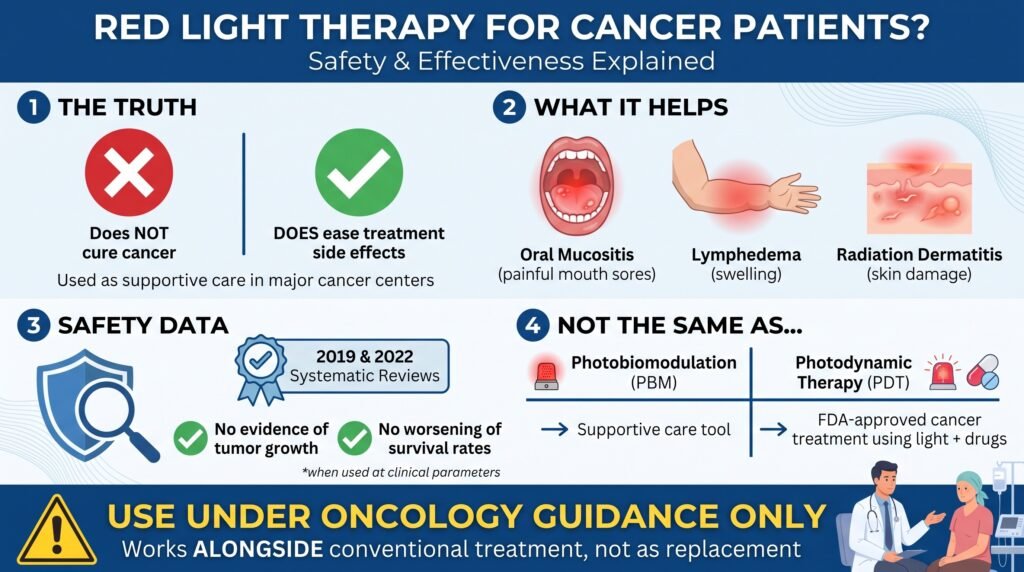
Red light therapy (photobiomodulation) doesn’t cure cancer, but it’s increasingly used in major cancer centers to ease treatment side effects, especially oral mucositis, lymphedema, and radiation dermatitis. Multiple systematic reviews (2019, 2022) found no evidence it fuels tumor growth or worsens survival when used at clinical parameters.
That’s distinct from photodynamic therapy (PDT), an FDA-approved cancer treatment using light plus a photosensitizing drug, and from experimental high-dose direct-tumor applications still in preclinical stages. Bottom line: PBM is a supportive tool that works alongside conventional treatment, not a replacement for it — and should be used under oncology guidance.
Table of Contents
Introduction
Understanding What Red Light Therapy Actually Means in Cancer Care
The Safety Question Everyone Asks
Where the Evidence Really Supports Red Light Therapy
People Also Asked
Introduction
When you’re facing cancer, you spend hours searching for anything that might help without adding more poison to an already brutal treatment plan. Red light therapy keeps showing up in those searches.
Sometimes people frame it as a secret cure.
Other times it gets dismissed as dangerous snake oil.
The truth sits in the complicated middle. Understanding that middle ground could genuinely help you handle cancer care better.
I won’t tell you that shining red light on your body will cure cancer. It won’t.
Anyone promising that is either dangerously misinformed or trying to sell you something.
But I will walk you through what red light therapy, specifically photobiomodulation or PBM, can and cannot do for cancer patients based on what the research actually shows.
This therapy is already being used in major cancer centers worldwide. They don’t use it to treat tumors directly in most cases.
They use it to reduce some of the most horrible side effects of chemotherapy and radiation.
For many patients, that difference in quality of life matters enormously.
The confusion around red light and cancer makes sense. On one hand, clinicians successfully use it to prevent mouth sores in head-and-neck cancer patients.
On the other hand, legitimate concerns exist about whether stimulating cellular activity might somehow feed a tumor.
Both perspectives deserve serious consideration. I’ll give you the tools to think through this decision intelligently, whether you’re considering clinical PBM, exploring at-home options, or trying to understand what your oncologist means when they mention photobiomodulation.
Understanding What Red Light Therapy Actually Means in Cancer Care
The first thing to clear up is that “red light therapy for cancer” refers to several very different applications. Mixing them up causes most of the confusion.
Supportive photobiomodulation is by far the most studied and accepted use. This involves exposing tissue to low-level red or near-infrared light, typically wavelengths around 630 to 670 nanometers for red, and 780 to 830 nanometers for near-infrared, at doses that don’t heat tissue but do trigger cellular responses.
The goal here is to help healthy cells cope better with the stress of cancer treatment. Think of it as giving your normal cells extra energy and repair capacity when chemotherapy or radiation is hammering them.
The second application is photodynamic therapy, or PDT, which genuinely aims to kill cancer cells. In PDT, patients receive a photosensitizing drug that accumulates preferentially in malignant tissue.
Then, when red or near-infrared light is applied, that drug becomes activated and generates reactive oxygen species, particularly singlet oxygen, that destroy cancer cells while leaving most normal tissue alone.
PDT is FDA-approved for certain skin cancers, esophageal cancer, and a few other malignancies. It qualifies as a real cancer treatment, but it’s highly specialized, needs precise medical supervision, and you absolutely cannot copy it with a panel you order online.
The third category, still mostly experimental, involves using higher doses of red or near-infrared light to directly affect tumor cells without a photosensitizing drug.
Some really interesting preclinical work has shown that specific wavelengths and doses can actually inhibit cancer cell growth, trigger autophagy (a kind of cellular self-digestion), and even enhance anti-tumor immune responses in melanoma models.
But this research is early-stage. The parameters matter enormously.
We haven’t translated it into standardized clinical protocols for most cancers yet.
When most people search for “red light therapy for cancer,” they’re usually hoping for something in that third category: a safe, non-toxic way to directly fight their disease. What they’re most likely to actually benefit from, based on current evidence, is the first category.
Supportive care that makes conventional treatment more tolerable and possibly more effective.
The Safety Question Everyone Asks
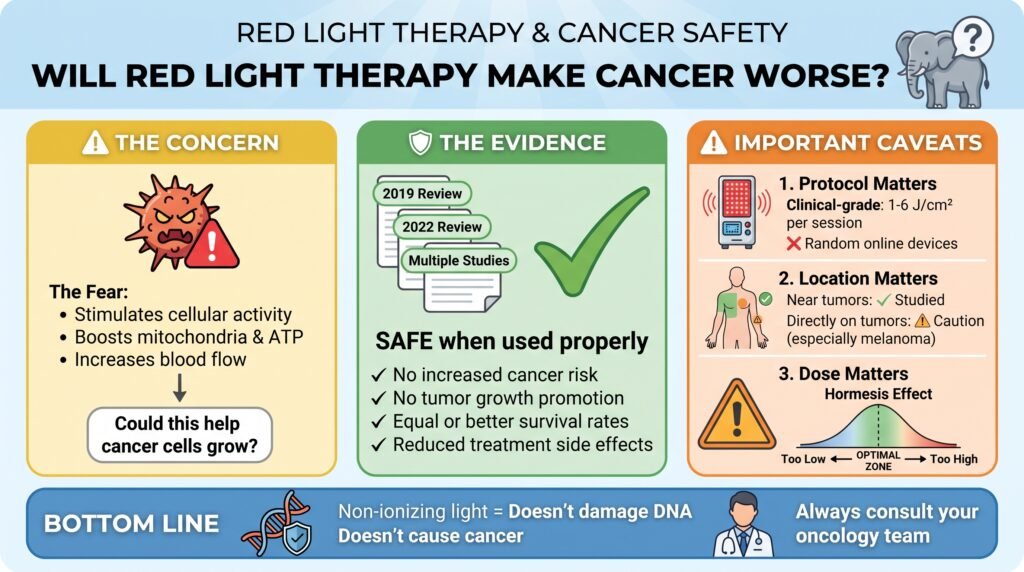
Let me address the elephant in the room. Will red light therapy make cancer worse?
This fear is rooted in basic cancer biology. Cancer cells have dysregulated metabolism and often grow faster than normal cells.
If red light therapy stimulates cellular activity, boosting mitochondrial function, increasing ATP production, and enhancing blood flow, could it also give cancer cells a growth advantage?
The concern makes sense. Researchers have taken it seriously.
Multiple systematic reviews have now examined the oncologic safety of PBM, and the consistent finding is reassuring.
When used within established parameters, photobiomodulation does not appear to increase cancer risk, promote tumor growth, or worsen survival outcomes.
A 2019 systematic review specifically focused on PBM for managing cancer treatment side effects provides evidence that there were no tumor safety issues associated with its use.
A larger 2022 review came to the same conclusion, noting that PBM was safe with respect to tumor growth and clearly useful for reducing treatment complications, especially in head-and-neck cancer patients undergoing chemoradiation.
Another safety-focused review of low-level light therapies found no significant adverse events or evidence of new or recurrent malignancies that could be attributed to PBM.
Perhaps most tellingly, some clinical studies have actually shown equal or slightly better survival in cancer patients who received PBM for side-effect management compared to controls. That doesn’t mean PBM cured their cancer.
They were all receiving standard oncologic treatment.
But it strongly suggests that supportive PBM isn’t helping tumors thrive.
There are important caveats, though. First, these reassuring safety data come from studies using specific wavelengths, doses, and treatment protocols.
We’re talking about clinical-grade devices delivering controlled energy densities, often in the range of one to six joules per square centimeter per session, applied to specific anatomical sites for defined durations.
That’s quite different from buying a random panel online and blasting your entire body with light for an hour every day.
Second, most of the safety data come from studies where PBM was used on tissue near tumors or in patients with a history of cancer, not necessarily directly over active, growing tumor masses. Some experts still recommend caution when it comes to applying PBM directly to known tumor sites, particularly for melanoma, where the data are more mixed.
Third, effects can be dose-dependent in complex ways. In cell culture and animal studies, low to moderate doses of red and near-infrared light often show anti-inflammatory, pro-healing effects, while very low or very high doses might have neutral or even opposite effects.
This phenomenon, called hormesis or biphasic dose response, means there’s likely a therapeutic window for any given application.
More isn’t necessarily better.
The bottom line on safety is this. Red and near-infrared light used in PBM is non-ionizing, meaning it doesn’t damage DNA the way ultraviolet light or X-rays do.
It doesn’t cause cancer.
And when used appropriately for supportive care, it doesn’t appear to speed up existing cancers.
But “used appropriately” is doing a lot of work in that sentence, which is why working with your oncology team matters so much.
Where the Evidence Really Supports Red Light Therapy
If you’re looking for rock-solid evidence that PBM helps cancer patients, the strongest data come from studies on specific, well-defined side effects of cancer treatment.
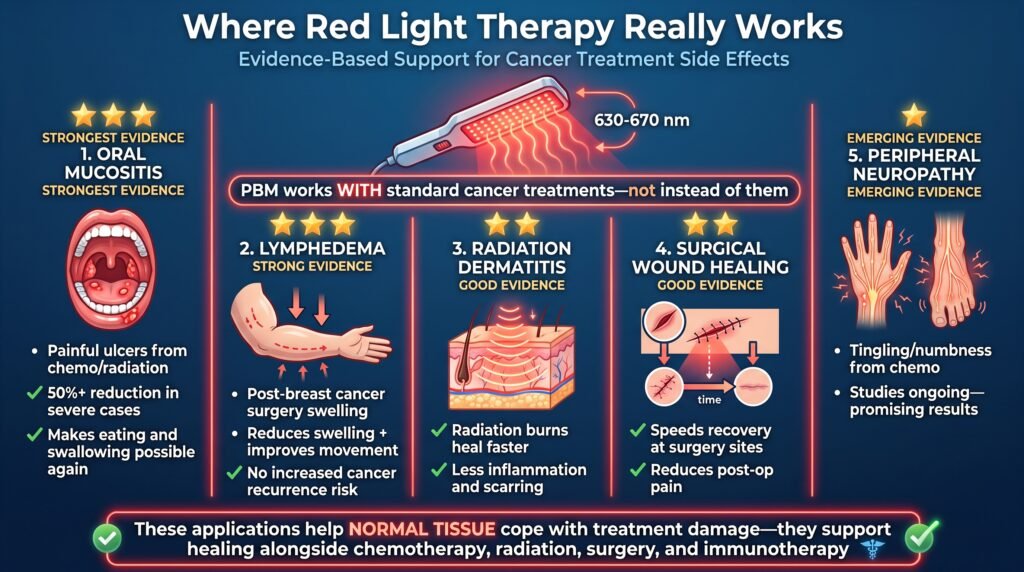
Oral mucositis, painful ulceration of the mouth and throat, is one of the most common and debilitating complications of chemotherapy and radiation, especially in head-and-neck cancer. It can make eating, drinking, and even talking excruciating, often forcing treatment delays or dose reductions.
Multiple randomized controlled trials and systematic reviews have shown that PBM using red light, typically in the 630 to 670 nanometer range, significantly reduces both the incidence and severity of oral mucositis. Some studies show reductions in severe mucositis of 50 percent or more.
That’s a genuinely life-changing difference for patients who otherwise would have spent weeks unable to swallow.
Breast cancer-related lymphedema is another area with good evidence. After breast surgery and radiation, some patients develop chronic swelling in the arm and chest because of impaired lymphatic drainage.
Low-level laser or LED photobiomodulation has been shown to reduce swelling, improve range of motion, and ease discomfort, with multiple studies showing safety in long-term follow-up.
Importantly, these studies haven’t found increased rates of cancer recurrence in patients who received PBM for lymphedema, which was a major concern when this treatment was first explored.
Radiation dermatitis, essentially a radiation burn, responds well to PBM in several studies. The light appears to speed up healing, reduce inflammation, and minimize scarring when applied to irradiated skin. Similarly, PBM has been used around surgical sites to speed wound healing and reduce post-operative pain in cancer patients, again without obvious oncologic harm.
There’s also emerging evidence for PBM in managing chemotherapy-induced peripheral neuropathy, the tingling, numbness, and pain in hands and feet that many chemo patients experience.
The data here are less robust than for mucositis, but several small studies suggest benefit, and researchers are actively investigating it.
What all these applications have in common is that they use PBM as a supportive tool to help normal tissue cope with the collateral damage of cancer treatment. Rather than trying to treat the cancer itself, they work alongside, not instead of, chemotherapy, radiation, surgery, or immunotherapy.
To learn more about using red light therapy to target cancer cells, the possible risks, and more, read this article here.
If you are ready to consider red light therapy devices, click here to get started today and visit our review page for a complete list of affordable and effective devices for at-home use.
We have provided cost-savings calculators for each product so you can compare each device to the average cost of professional red light sessions as well.
If you are looking for an affordable entry point, read our review of the Mito Pro line of red light devices. Click here to start reading or click below to be taken to Mito’s official site.
Click the button below to start browsing Mito Red Light’s full line of affordable red light panels for at-home use.
People Also Asked
Can red light therapy help with chemotherapy side effects?
Yes, red light therapy has strong evidence for reducing specific chemotherapy side effects. Multiple clinical trials show that photobiomodulation significantly reduces oral mucositis, the painful mouth sores that often occur during cancer treatment.
Studies also show it can help with chemotherapy-induced peripheral neuropathy, the tingling and numbness in hands and feet that many patients experience.
The therapy appears to work by helping healthy cells repair damage more efficiently and reducing inflammation in affected tissues.
Is near-infrared light safe for melanoma patients?
Clinical studies on cancer treatment side effects primarily use red light in the 630 to 670 nanometer range and near-infrared light in the 780 to 830 nanometer range. For oral mucositis prevention, most successful protocols use wavelengths around 650 to 660 nanometers.
For lymphedema and wound healing, both red and near-infrared wavelengths have shown benefits.
The specific wavelength matters because different wavelengths penetrate to different depths and trigger slightly different cellular responses.
What wavelength of red light is used for cancer treatment side effects?
Clinical studies on cancer treatment side effects primarily use red light in the 630 to 670 nanometer range and near-infrared light in the 780 to 830 nanometer range. For oral mucositis prevention, most successful protocols use wavelengths around 650 to 660 nanometers.
For lymphedema and wound healing, both red and near-infrared wavelengths have shown benefits.
The specific wavelength matters because different wavelengths penetrate to different depths and trigger slightly different cellular responses.
Does photobiomodulation help with radiation burns?
Yes, photobiomodulation has shown significant benefits for radiation dermatitis, commonly called radiation burns. Multiple studies show that applying red or near-infrared light to irradiated skin can speed up healing, reduce inflammation, minimize pain, and decrease scarring.
Many cancer centers now offer PBM as a standard supportive treatment for patients undergoing radiation therapy, particularly for breast cancer and head-and-neck cancers where skin damage is common.
Click the button below to get started today by visiting our review page for a complete list of affordable and effective red light therapy devices for at-home use.
We have provided cost-savings calculators for each product so you can compare each device to the average cost of professional red light sessions as well. For an affordable entry point, see our reviews of Mito red light products by clicking here.
This article includes affiliate links. If you click through and make a purchase, I may receive a small commission. This helps support the site and allows me to keep creating helpful content at no extra cost to you.