📌 Quick Summary
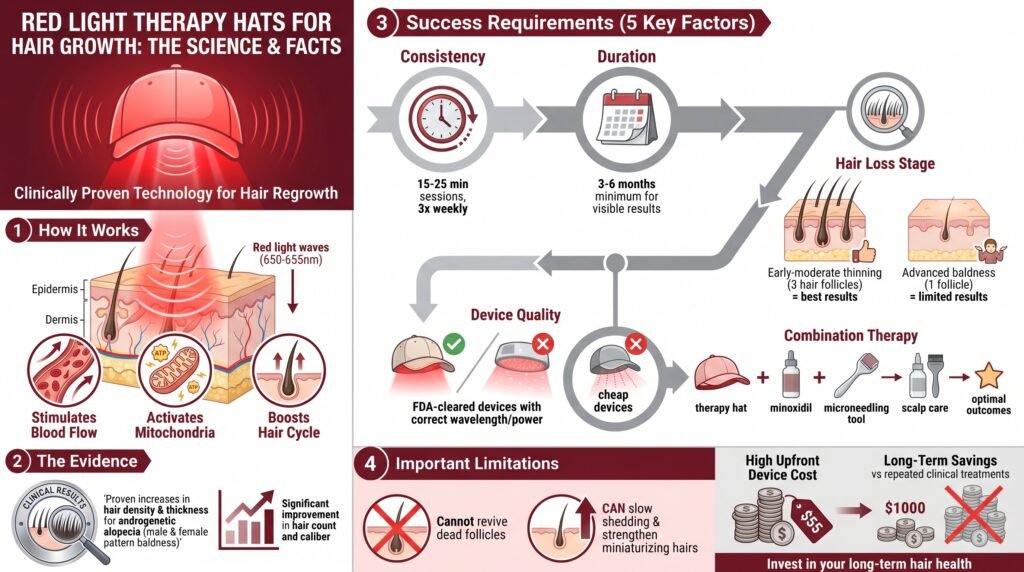
Red light therapy hats for hair growth are not just another internet trend — there is legitimate clinical evidence showing they can help improve hair density, thickness, and follicle activity when used consistently over time. The technology works through low-level light therapy (LLLT), typically using wavelengths around 650–655nm to stimulate blood flow, mitochondrial activity, and the hair growth cycle. Studies referenced in the article report measurable increases in hair counts and density in both men and women with androgenetic alopecia.
However, results depend heavily on several factors:
- Consistency is critical — most protocols require 15–25 minute sessions several times per week for at least 3–6 months before noticeable changes appear.
- Device quality matters — many cheaper hats use incorrect wavelengths or weak power output, which may explain poor consumer experiences.
- Best results occur in early-to-moderate thinning rather than advanced baldness.
- Red light therapy is more effective when combined with treatments like minoxidil, scalp care, or microneedling.
- It won’t revive dead follicles, but it may slow shedding and strengthen miniaturizing hairs.
FDA-cleared helmets and caps generally perform better because they use clinically studied wavelengths and provide more complete scalp coverage. While the upfront cost of quality devices can be high, they may still be cheaper long-term than repeated in-office treatments.
🧾 Table of Contents
- Introduction: Are Red Light Therapy Hats Legit or Just Hype?
- Understanding the Science Behind Light and Hair Follicles
- What the Clinical Evidence Actually Reveals
- Implementing a Red Light Therapy Hat in Your Hair Growth Strategy
- Potential Problems and How to Navigate Them
- Red Light Therapy Cost-Savings Calculator
- Adapting Red Light Therapy to Different Hair Loss Scenarios
- Key Takeaways
- Frequently Asked Questions
Introduction
You’re standing in front of the mirror again, running your fingers through your hair, and you can feel it, that gradual thinning that’s been creeping up on you for the past year or two.
Maybe you’ve noticed more hair in the shower drain, or perhaps your part is getting wider, or the light catches your scalp in photos when it never used to before.
You’ve looked into the usual options: minoxidil that you’d have to apply twice daily forever, finasteride with its potential side effects, or those expensive professional laser treatments that need clinic appointments you honestly don’t have time for.
Then you came across red light therapy hats, devices you can use at home while you’re watching TV or working at your desk.
But here’s the question that keeps nagging you: do these things actually work, or are they just another overpriced gadget preying on people’s insecurities?
Learning whether red light therapy hats deliver real, measurable hair growth results is absolutely critical before you drop several hundred dollars on one of these devices.
Understanding the Science Behind Light and Hair Follicles
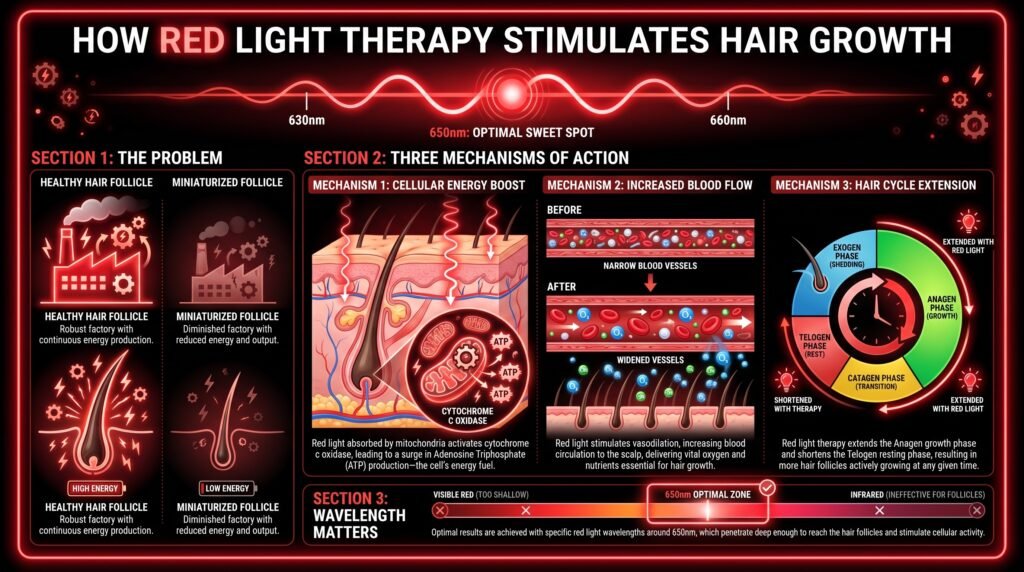
The concept of using light to stimulate biological processes comes from solid cellular biology. Your hair follicles are essentially tiny factories that need enormous amounts of energy to produce hair shafts.
When these follicles start to miniaturize (which is what happens in pattern baldness), they’re not getting enough cellular energy to maintain their production cycles.
Red light in the 630-660 nanometer range penetrates your scalp tissue and gets absorbed by mitochondria inside your follicle cells. These mitochondria contain an enzyme called cytochrome c oxidase that responds to specific light wavelengths by ramping up ATP production.
ATP is basically the energy currency your cells use for everything, including hair production.
The red light also triggers vasodilation in your scalp’s tiny blood vessels, widening them and increasing blood flow. Think of it like opening up traffic lanes on a congested highway; suddenly, more oxygen and nutrients can reach those hungry hair follicles.
This mechanism is actually similar to how minoxidil works, though through different biological pathways.
The third mechanism involves manipulating the hair growth cycle itself. Your hair follicles cycle through growth phases (anagen), transition phases (catagen), and resting phases (telogen).
In pattern baldness, the anagen phase gets progressively shorter while the telogen phase extends, meaning your hairs spend less time growing and more time resting.
Red light therapy appears to extend the anagen phase and delay the transition to telogen, giving each hair more time to grow before it falls out.
What really matters here is the wavelength specificity. Research consistently points to 650 nanometers as the sweet spot for hair growth stimulation.
Go too far into the infrared spectrum, and you lose the follicle-stimulating effects.
Stay in the visible red range at the wrong wavelength, and you won’t get adequate penetration through the scalp tissue.
What the Clinical Evidence Actually Reveals
I’ve gone through a really substantial amount of research on this topic, and honestly, the evidence base is more robust than I initially expected. We’re talking about many randomized controlled trials, systematic reviews, and FDA clearance processes.
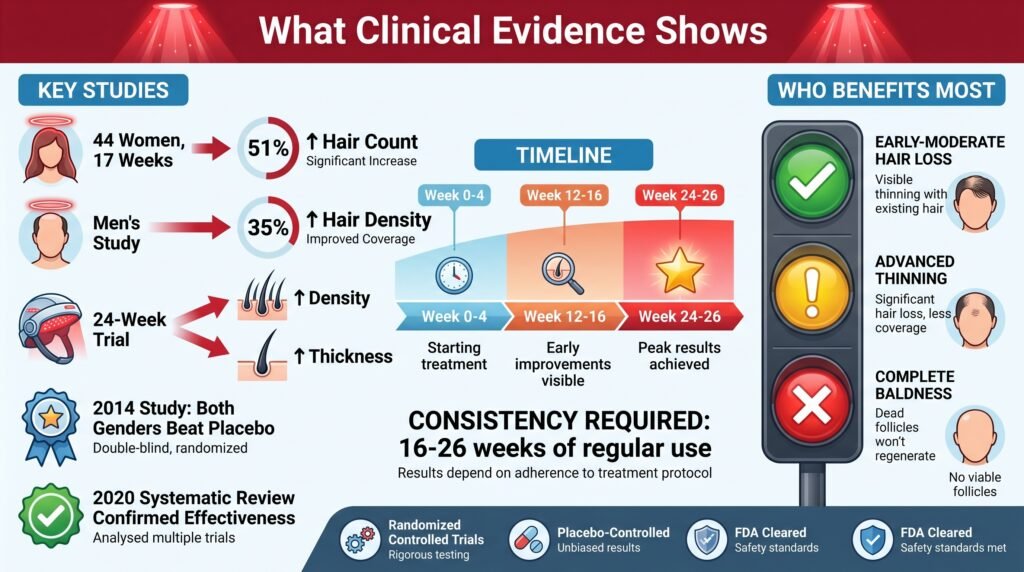
One particularly compelling study tracked 44 women over 17 weeks and found a 51% increase in hair count. That’s a statistically significant change that would be visually obvious.
Another study on men showed a 35% increase in hair density, which again represents meaningful improvement.
A 24-week trial specifically examining red light therapy helmets found significant increases in both hair density and hair thickness compared to control groups. The 2014 study published in Lasers in Surgery and Medicine demonstrated that both men and women experienced measurable improvements versus placebo devices.
What’s important here is the placebo-controlled design; these studies didn’t just measure whether people using the devices saw improvement, but whether they saw MORE improvement than people who thought they were using the devices but actually weren’t.
The 2020 systematic review is particularly valuable because it compiled data across many studies and confirmed that low-level light therapy works for both male and female pattern baldness. Systematic reviews look at the entire body of evidence as opposed to cherry-picking individual studies.
However, and this is really crucial to understand, these results came from studies where participants used the devices consistently for 16 to 26 weeks. We’re not talking about trying it for a month and seeing dramatic results.
The timeline for visible improvement generally falls in the 3 to 6 month range, with most studies showing the most significant improvements around the six-month mark.
The clinical trials also reveal something important about who benefits most. People with early to moderate androgenetic alopecia (pattern baldness) showed the best responses.
If you’re at the stage where you’ve got significant thinning but still have visible hair, you’re in the sweet spot for potential benefit.
If you’re completely bald in certain areas with no miniaturized hairs remaining, the technology won’t regenerate follicles that have essentially died.
Implementing a Red Light Therapy Hat in Your Hair Growth Strategy
Starting with a red light therapy hat isn’t particularly complicated, but some really important protocol considerations can make or break your results. The first decision you’ll face is choosing between daily shorter sessions or less frequent longer sessions.
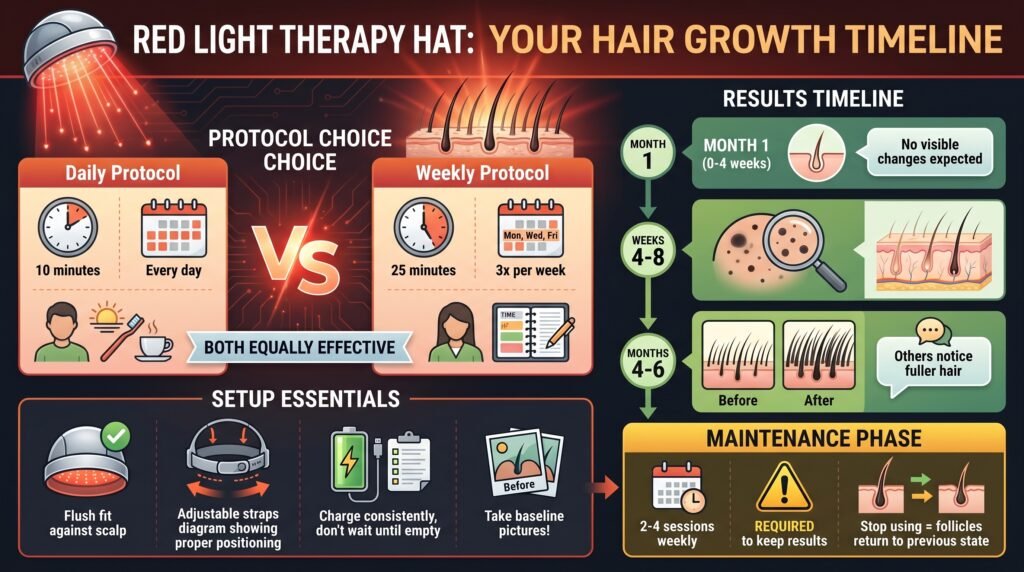
Most clinical studies used protocols of either 10 minutes daily or 25 minutes three times per week. Both approaches showed effectiveness, so this comes down to personal preference and compliance.
If you’re the type of person who can build a 10-minute habit into your morning routine, daily use might work better.
If you prefer dedicating slightly more time less often, the three-times-weekly protocol is equally valid.
When you first get your device, you’ll need to figure out the proper fit and positioning. This matters more than you might think.
If the device isn’t sitting flush against your scalp, you’re getting uneven light distribution, which means some areas of your scalp are getting therapeutic doses while others aren’t.
Most quality devices have adjustable straps and some degree of flexibility to conform to different head shapes.
The battery life on these devices varies considerably. Some need charging after every use, while others last for several sessions.
I’d really recommend charging it on a consistent schedule as opposed to waiting until it dies, because inconsistent power delivery could potentially affect treatment outcomes.
During your first month, don’t expect to see anything dramatic. What you’re looking for around weeks 4 to 8 are subtle changes, like small dark spots on your scalp where new hairs are beginning to emerge from dormant follicles.
These baby hairs are the early indicators that the therapy is working.
They’ll be fine and light-colored initially, then gradually thicken and darken over subsequent months.
The 4 to 6 month mark is when visual changes become obvious enough that you’ll notice them in photos or when comparing to baseline pictures (which you should absolutely take before starting treatment). This is also when other people might start commenting that your hair looks thicker or fuller without necessarily being able to pinpoint why.
After you’ve completed the intensive phase and achieved your desired results, you’ll need to transition to a maintenance protocol. Most people drop down to 2 to 4 sessions weekly.
This isn’t optional; if you want to keep your results, the benefits genuinely stop when you stop using the device.
Your follicles will gradually return to their previous miniaturized state without continued stimulation.
Potential Problems and How to Navigate Them
When starting this specific type of targeted red light therapy, it is necessary to address the common, but temporary, side effects.
Some people experience initial shedding when they start treatment, which understandably freaks them out. This can actually be a positive sign that the therapy is working.
When dormant follicles reactivate, they sometimes shed the existing miniaturized hair before producing a new, healthier hair shaft. If you experience this, it typically happens in the first month or two, and resolves as new growth comes in.
Scalp sensitivity is occasionally reported, though it’s uncommon. If you experience discomfort, warmth, or irritation, you might need to reduce session duration or frequency initially and gradually build up tolerance.
The light itself shouldn’t cause pain; if it does, stop using the device and check with a dermatologist.
The biggest pitfall, problem, issue, problem, issue, problem, issue I see people falling into is purchasing devices that simply don’t have adequate power or the right wavelength specifications. Not all red light therapy devices are created equal, and this is where things get a bit technical, but really important.
There’s a meaningful distinction between low-level laser therapy devices and generic red light LED panels. LLLT devices use coherent laser light that penetrates deeper into tissue and delivers higher energy density to the target area.
The clinical studies establishing efficacy predominantly used laser-based LLLT technology, not just any red light-emitting device.
Consumer-grade red light panels marketed for general wellness often emit non-coherent LED light that scatters more and may not deliver enough power density to stimulate hair follicles effectively. These devices might work wonderfully for skin rejuvenation or pain relief, but they’re not necessarily optimized for hair growth.
When evaluating devices, you need to look for specific wavelength listings (ideally 650-655 nanometers), power density measurements (measured in milliwatts per square centimeter), and ideally FDA clearance specifically for hair loss treatment.
FDA clearance doesn’t guarantee results, but it does show the device met certain safety and efficacy standards for its intended purpose.
Understand that there is a fairly high price tag to many of these items that utilize the effective laser-based LLLT technology and specific wavelengths previously mentioned. Amazon is littered with cheaper models if you take a short amount of time to look for them. What you save in money, you lose time and effectiveness.
Four such devices that fulfill the necessary red light specification criteria for effective hair restoration are below:
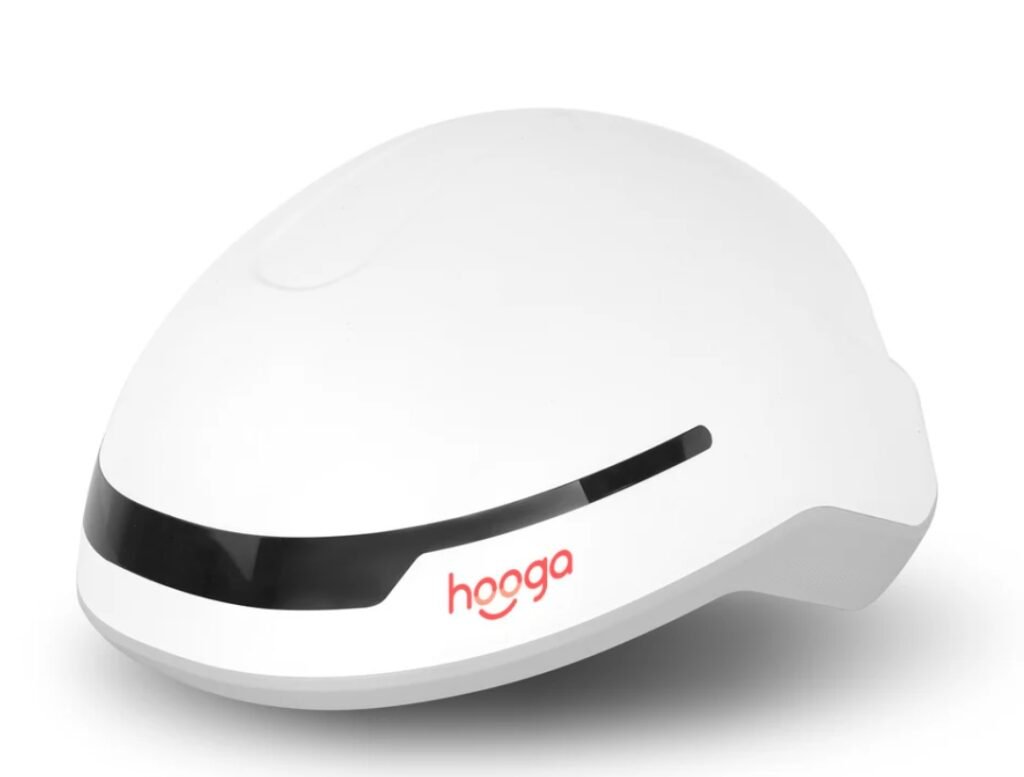
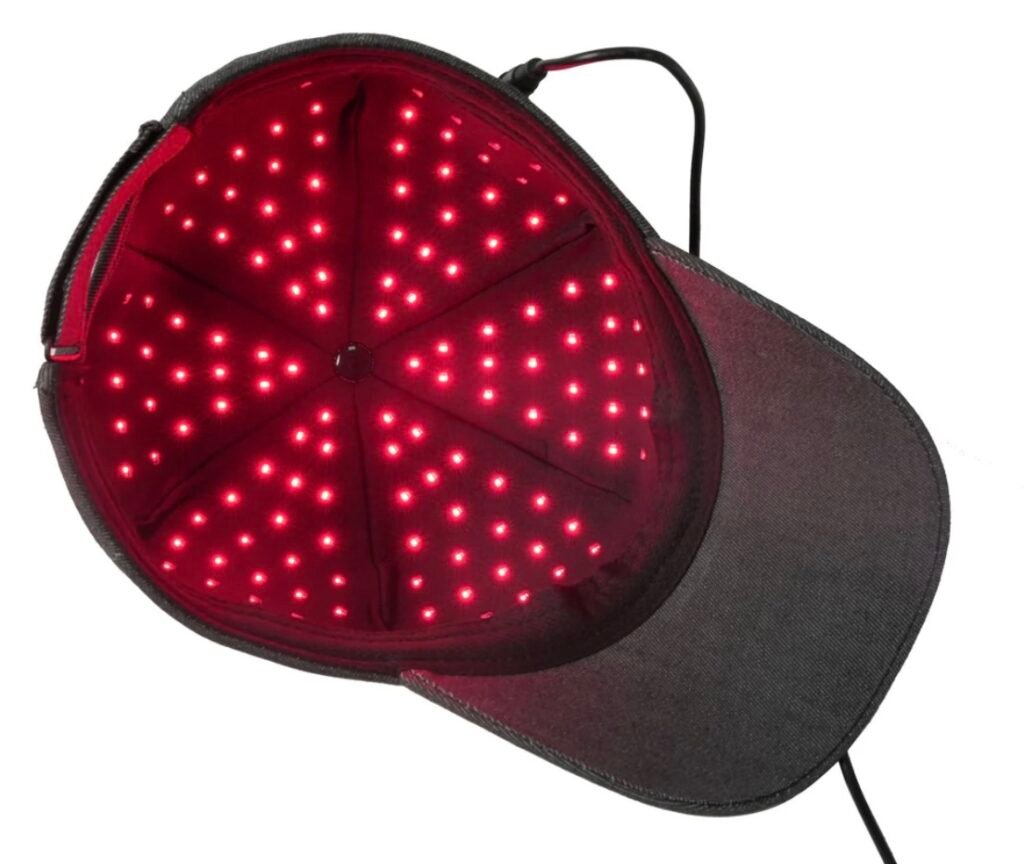
- Hooga Red Light Laser Helmet – HSA/FSA-Eligible – $499
- Featuring 96 laser diodes with a 650±5nm wavelength, this portable helmet delivers safe, low-level laser therapy (LLLT) directly to your scalp.
- >>Click Here to See the Hooga Red Laser Helmet & Receive 12% Off<<
- Hooga Red Light Hat – HSA/FSA-Eligible – $299
- Featuring 150 dual-chip LEDs that emit both red (660nm) and near-infrared (850nm) light, this hat delivers powerful wavelengths directly to your scalp for a convenient at-home experience.
- >>Click Here to get the Mito Red Light Hat & Receive 12% Off<<
Another common problem is inconsistent usage. Life gets busy, you travel, you forget a few sessions, and suddenly you’ve gone from a consistent protocol to sporadic use.
The research really emphasizes consistency as a critical variable.
If you can’t commit to regular sessions for at least six months, you’re probably not going to see the results the studies demonstrated.
Professionally administered, targeted red light therapy sessions within a clinical environment run anywhere from $75 – $150 per session. Since consistency is key to seeing any meaningful results, 2 to 3 sessions per week at a minimum can add up.
The Hooga red light at-home devices range anywhere from $299 to upwards of $499. These devices pay for themselves within a few weeks or so when you take this cost comparison into account. After that, the device is yours for life, and so are continuous sessions within the comfort of your own home.
See the cost-savings calculator below to crunch the real-time numbers and see how the savings add up. Bookmark this page and come back to the calculator anytime you are comparing red light services in your area.
Red Light Therapy Cost Savings Calculator
Professionally administered, targeted red light therapy sessions within a clinical environment run anywhere from $75 – $150 per session. Since consistency is key to seeing any meaningful results, 2 to 3 sessions per week at a minimum can add up.
The Hooga red light at-home devices range anywhere from $299 to $499. These devices pay for themselves within a few weeks when you take this cost-comparison into account. After that, the device is yours for life, and so are continuous sessions within the comfort of your own home.
Use the calculator below to crunch the real-time numbers and see how the savings add up. Bookmark this page and come back anytime you’re comparing red light services in your area.
HSA/FSA-Eligible • $499 • Get 12% Off Get Hooga Red Light Hat
HSA/FSA-Eligible • $299 • Get 12% Off
Adapting Red Light Therapy to Different Hair Loss Scenarios
Pattern baldness is the primary indication where red light therapy has the strongest evidence, but people use these devices for various types of hair loss with varying degrees of success. Understanding how to adapt the approach for different scenarios can help set realistic expectations.
For androgenetic alopecia (genetic pattern baldness), the standard protocols work well. You're following the research-backed approach of consistent sessions over months.
This is the straightforward application.
For telogen effluvium (temporary hair shedding from stress, illness, or nutritional deficiency), red light therapy can potentially speed up recovery, but you really need to address whatever triggered the shedding in the first place.
For alopecia areata (autoimmune hair loss causing patchy baldness), the evidence is much less established. Some people report improvements, but this condition has a different underlying mechanism than pattern baldness, and the photobiomodulation effects may not address the autoimmune component effectively.
If you're dealing with diffuse thinning as opposed to a receding hairline or crown thinning, you'll want to confirm your device provides even coverage across your entire scalp as opposed to concentrated treatment in specific zones. Some devices are designed more for targeted areas, while others provide more comprehensive coverage.
Combining red light therapy with other treatments is where things get really interesting. The research supports using it alongside minoxidil, and some studies suggest the combination produces superior results to either treatment alone.
The mechanisms are complementary; minoxidil promotes vasodilation and appears to extend the anagen phase, while red light therapy enhances cellular energy production and also improves blood flow.
Combining with finasteride is also common, as finasteride blocks DHT (the hormone that miniaturizes follicles) while red light therapy stimulates follicle activity. You're essentially attacking the problem from two different angles.
Some people use red light therapy in conjunction with microneedling or PRP (platelet-rich plasma) injections. The theory is that the light therapy creates a more favorable cellular environment for the growth factors and healing processes that these treatments start.
While there's some emerging research supporting these combinations, the evidence base isn't as robust as for red light therapy alone.
Key Takeaways
Red light therapy hats deliver measurable hair growth results for early to moderate pattern baldness when used consistently for 4 to 6 months, with clinical studies showing 35% to 51% increases in hair density and count.
The therapeutic effect comes from 650-nanometer wavelength light stimulating mitochondrial ATP production, increasing scalp blood flow, and extending the hair growth phase.
Device quality matters enormously; look for laser-based LLLT technology with FDA clearance for hair loss as opposed to generic red light LED panels marketed for general wellness.
Results need ongoing maintenance sessions to sustain, typically 2 to 4 times weekly after the initial intensive phase, because benefits stop when treatment stops.
Red light therapy works best as part of a comprehensive approach combined with proven treatments like minoxidil, and it cannot regenerate completely dead follicles in totally bald areas.
Frequently Asked Questions
Does red light therapy actually regrow hair?
Red light therapy does regrow hair for people with androgenetic alopecia (pattern baldness) when used consistently over 4 to 6 months. Clinical studies show 35% to 51% increases in hair density and count.
The therapy works by stimulating mitochondrial energy production in follicle cells, increasing blood flow to the scalp, and extending the active growth phase of your hair cycle.
You need viable follicles for it to work; completely bald areas with no remaining follicles won't respond.
How long does it take to see results from red light therapy for hair?
Most people start seeing initial signs around 4 to 8 weeks in the form of small new hairs emerging from dormant follicles. Visually noticeable improvements typically appear at the 4 to 6 month mark.
The most significant results in clinical studies occurred around six months of consistent use.
You need to commit to regular sessions (either 10 minutes daily or 25 minutes three times weekly) throughout this entire period.
Can I use red light therapy with minoxidil?
Yes, you can mix red light therapy with minoxidil, and some research suggests the combination produces better results than either treatment alone. The mechanisms are complementary; minoxidil promotes blood vessel dilation and extends the growth phase, while red light enhances cellular energy production and also improves circulation.
Many people use both treatments simultaneously without issues.
What wavelength is best for hair growth?
The optimal wavelength for hair growth is 650 nanometers, which falls in the red light spectrum. Research consistently points to the 650-655 nanometer range as the sweet spot for follicle stimulation.
Going too far into infrared loses effectiveness, and staying in visible red at the wrong wavelength won't penetrate scalp tissue adequately.
Check device specifications to confirm the wavelength before purchasing.
Is LLLT better than LED for hair growth?
Low-level laser therapy (LLLT) devices generally outperform LED panels for hair growth because laser light is coherent, penetrates deeper into tissue, and delivers higher energy density to follicles. Most clinical studies establishing efficacy used laser-based technology.
Consumer LED panels marketed for general wellness may not provide adequate power density or proper wavelength for follicle stimulation.
Do red light therapy hats work for women?
Red light therapy hats work for women with female pattern baldness. The 2014 study in Lasers in Surgery and Medicine specifically included women and found measurable improvements in both hair density and thickness.
One study tracking 44 women over 17 weeks showed a 51% increase in hair count.
The mechanisms of follicle stimulation work the same regardless of gender.
Will I lose my hair if I stop using red light therapy?
Yes, the benefits gradually reverse when you stop treatment. Your follicles will return to their previous miniaturized state without continued stimulation.
This is why maintenance sessions (typically 2 to 4 times weekly) are necessary after completing the initial intensive phase.
Red light therapy needs ongoing commitment to sustain results.
This article includes affiliate links. If you click through and make a purchase, I may receive a small commission. This helps support the site and allows me to keep creating helpful content at no extra cost to you.