📌 Quick Summary
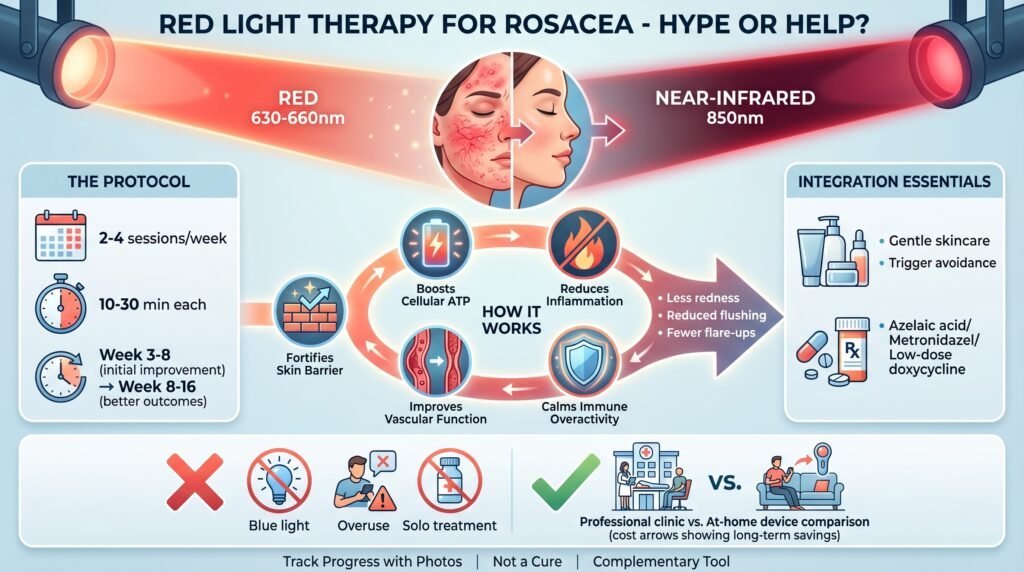
Red light therapy (specifically 630-660nm red + 850nm near-infrared wavelengths) shows real potential for managing rosacea by boosting cellular ATP, reducing inflammation, calming immune overactivity, improving vascular function, and strengthening the skin barrier—leading to less redness, flushing, and flare-ups.
It’s not hype when used correctly, but results require:
- Consistency (2–4 sessions/week, 10–30 min each)
- Patience (initial improvements in 3–8 weeks; better outcomes in 8–16 weeks)
- Proper integration with gentle skincare, trigger avoidance, and existing treatments (e.g., azelaic acid, metronidazole, or low-dose doxycycline)
Key caveats:
- Not a standalone cure or replacement for medications (especially moderate/severe cases)
- Avoid overuse, wrong wavelengths (blue light is unsuitable), or irritating combos
- Professional sessions work faster but are expensive; quality at-home FDA-cleared devices (like Mito Glow or CurrentBody masks) are more cost-effective long-term
Bottom line: Evidence-based red light therapy can be a helpful complementary tool for rosacea when done right, shifting it from “hype” to a practical part of a broader management routine. Track progress with photos and adjust based on your skin’s response.
🧾 Table of Contents
1. Introduction
- What rosacea is and why it’s difficult to treat
- Why red light therapy is trending
2. What Is Red Light Therapy?
- How it works (wavelengths, cellular energy, inflammation reduction)
- Why is it considered “gentle” compared to other treatments
3. Why Red Light Therapy Might Help Rosacea
- Anti-inflammatory effects
- Skin barrier repair
- Impact on redness and blood vessels
4. What the Science Actually Says
- Key clinical findings
- Limitations of current research
- What dermatologists agree (and disagree) on
5. Realistic Results: What You Can Expect
- Timeline (weeks vs months)
- Best vs worst-case outcomes
- Who it works best for (subtypes of rosacea)
6. When It Works (And When It Doesn’t)
- Factors that influence results:
- Device quality
- Wavelength accuracy
- Consistency of use
- Individual skin differences
7. Risks, Downsides, and Misconceptions
- Overuse and irritation
- Potential to worsen rosacea in some cases
- Lack of long-term safety data
- Industry hype vs reality
8. At-Home vs In-Clinic Treatments
- Power differences
- Cost vs convenience tradeoffs
- Which is better for rosacea sufferers
9. How to Use Red Light Therapy Safely for Rosacea
- Ideal frequency and duration
- Best wavelengths
- What to avoid (heat, aggressive devices)
10. Who Should (and Shouldn’t) Use It
- Good candidates
- Situations where caution is needed
11. Final Verdict: Does It Actually Work or Just Hype?
- Balanced conclusion
- When it’s worth trying—and when it’s not
Introduction
I’ll be honest with you, when I first heard about red light therapy for rosacea, I was pretty skeptical. It sounded like one of those too-good-to-be-true wellness trends that promise everything but deliver nothing.
But after taking a close look at the research and seeing real results from people who’ve incorporated it into their skincare routines, my perspective completely shifted.
Living with rosacea is genuinely frustrating. You wake up some mornings not knowing if your face is going to cooperate or if you’ll be dealing with angry, inflamed skin that makes you want to skip social plans.
I’ve watched friends struggle with this condition, trying every cream and medication under the sun, only to find temporary relief at best.
Red light therapy works differently than traditional treatments because it targets the cellular level where inflammation actually starts. We’re talking about specific wavelengths of light that penetrate your skin and get absorbed by your cells’ mitochondria, essentially giving them more fuel to do their job properly.
For skin that’s constantly inflamed and reactive, like rosacea-prone skin, that cellular-level support can make a noticeable difference.
When I started researching this topic seriously, what really caught my attention was how the mechanism actually makes scientific sense. This approach uses light in the same way plants use sunlight for energy, except your skin cells are absorbing it to power their repair and anti-inflammatory processes.
Understanding How Red Light Actually Works for Inflamed Skin
The science behind red light therapy becomes clear once you break it down. Your skin cells contain these tiny powerhouses called mitochondria, which create energy that fuels everything your cells do.
When you have rosacea, your skin exists in a constant state of inflammation, which means your cells are working overtime trying to manage that chronic stress.
Red light in the 630-660 nanometer range penetrates through the surface of your skin and gets absorbed by those mitochondria. This absorption triggers increased production of ATP, which is essentially a cellular fuel.
You can think of it like giving your exhausted skin cells a proper energy boost so they can actually function the way they’re supposed to.
What really happens at this level is fascinating. The increased ATP production doesn’t just give cells more energy.
It also triggers a cascade of useful processes throughout your skin tissue.
Your cells start producing more collagen, which strengthens your skin barrier. They ramp up their repair mechanisms, fixing damage that inflammation has caused. And crucially, the therapy modulates your immune response, reducing the production of those inflammatory molecules that make your face red and angry in the first place.
Near-infrared light at 850 nanometers goes even deeper, reaching the lower layers of your skin where inflammation might be brewing beneath the surface. This is why many effective devices mix both wavelengths.
They’re tackling the problem from many angles simultaneously.
The anti-inflammatory mechanism is particularly important for rosacea sufferers. Your immune system is basically overreacting to various triggers, flooding your facial skin with inflammatory cytokines.
Red light therapy helps calm that overreaction by promoting anti-inflammatory mediators while reducing the pro-inflammatory ones. You’re essentially turning down the volume on an alarm system that’s been stuck on high alert.
The vascular component of rosacea also responds well to red light exposure. Many people with rosacea have dilated blood vessels and increased blood flow to the face, which contributes to that persistent redness.
Red light therapy has been shown to improve vascular function and reduce the reactive dilation that causes flushing episodes.
Choosing the Right Wavelengths and Understanding Device Differences
Not all red lights are created equal, and this is where a lot of people get confused. You might see devices marketed for skin health that use all sorts of different colored lights, but for rosacea specifically, you want to be really particular about wavelengths.
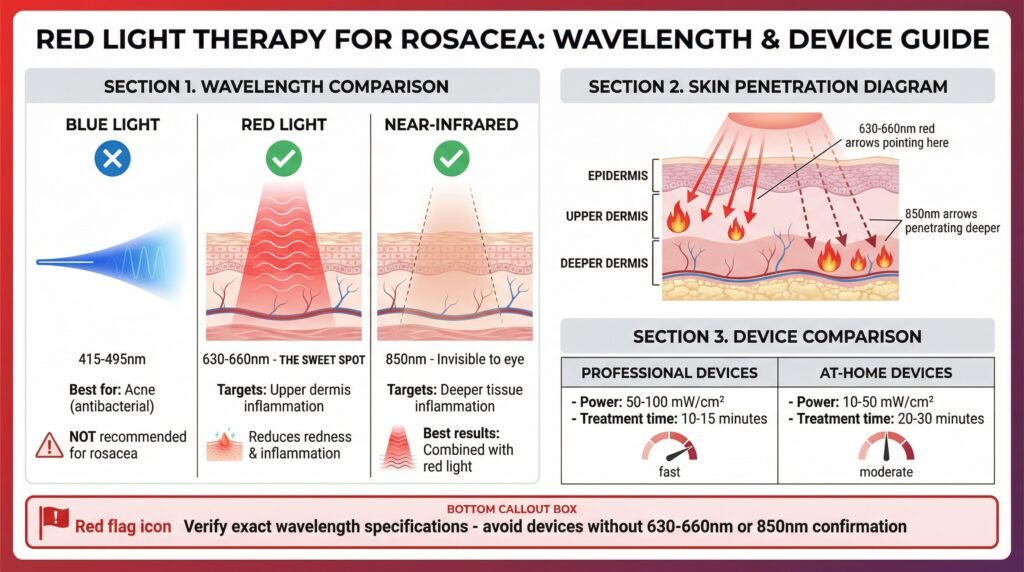
The sweet spot for surface-level rosacea symptoms is the 630-660nm red light range. This wavelength has been studied extensively and consistently shows benefits for reducing inflammation and redness.
It penetrates just deep enough to affect the upper layers of your dermis, where a lot of rosacea inflammation occurs, without going so deep that it wastes energy in tissues that aren’t really the problem.
Near-infrared at 850nm complements this perfectly. While you can’t see this wavelength with your naked eye, it’s working beneath the surface to address inflammation in deeper tissue layers.
Some people find that combining both wavelengths gives them better overall results than using red light alone. The research supports this combination approach, showing that dual-wavelength treatment can address both superficial and deeper inflammatory processes.
Blue light, which you’ll see in many LED therapy devices, is honestly not your best choice for rosacea. Blue light is excellent for acne because it has antibacterial properties, but rosacea isn’t primarily a bacterial condition.
Rosacea is an inflammatory disorder with immune system involvement, which is why red wavelengths make so much more sense for this particular skin issue.
When you’re looking at devices, whether professional or at-home, you want to verify that they actually deliver these specific wavelengths. Some cheaper devices claim to offer red light therapy but don’t specify their exact wavelength output, which is a red flag.
The research supporting rosacea benefits is based on those specific 630-660nm and 850nm ranges, so straying too far from those numbers means you’re essentially experimenting on yourself without the backing of clinical evidence.
Professional devices typically deliver higher intensity light, which means you can achieve results with shorter treatment sessions. A professional treatment might only take 10-15 minutes to deliver the same amount of light energy that an at-home device would need 20-30 minutes to provide.
That intensity difference is why you often see faster initial results with professional treatments. The power output is measured in milliwatts per square centimeter, and professional units often deliver 50-100 mW/cm², while consumer devices typically range from 10-50 mW/cm².
Creating an Effective Treatment Schedule That Actually Works
Consistency is absolutely everything with red light therapy. I can’t stress this enough.
You’re not going to see meaningful results from using a device once when you remember it or doing a treatment here and there when your skin is particularly angry.
The benefits build over time through regular, repeated exposure that allows your cells to gradually shift their behavior. Red light therapy creates cumulative effects that compound with each session.
The research supports 2-4 sessions per week as the optimal frequency for most people. Going beyond that doesn’t necessarily give you better results and might actually irritate sensitive rosacea skin. Your skin needs time between treatments to respond to the cellular changes that the light therapy starts.
Session length depends entirely on your device’s intensity. Professional treatments might only need 10-15 minutes because of their higher power output.
At-home devices typically need 15-30 minutes per session to deliver comparable light energy. Your device should come with specific recommendations based on its technical specifications, and you should actually follow them instead of guessing.
The timeline for seeing results needs patience, which I know is frustrating when you’re dealing with uncomfortable, visible skin issues. During the first couple of weeks, you’re primarily initiating cellular changes that aren’t yet visible on the surface.
Your mitochondria are ramping up ATP production, and anti-inflammatory processes are beginning to shift, but you might not notice much difference in the mirror.
Around weeks three through eight, this is typically when you start seeing noticeable improvements. Your baseline redness might decrease.
Flushing episodes might become less intense or recover more quickly. Your skin might feel calmer overall and less reactive to triggers.
Some people report that makeup goes on more smoothly because the texture of their skin has improved.
Longer-term benefits in the 9-16 week range include improvements in skin texture, a strengthened barrier that’s less prone to irritation, and potentially fewer flare-ups overall. This is when red light therapy really starts proving its value as a maintenance tool as opposed to just symptomatic treatment.
The distance you maintain from the device also matters more than most people realize. Too close, and you might cause heat-related irritation.
Too far, and you’re not getting adequate light penetration.
Most devices work best at 6-12 inches from your face, but check your specific device’s recommendations.
Too far, and you’re not getting adequate light penetration.
Most devices work best at 6-12 inches from your face, but check your specific device’s recommendations. You can choose a device that mainly targets the face directly or a device that provides the additional option to cover your face as well as your body.
See the two affordable and effective options listed below and find the device that best suits your needs.
Integrating Red Light Therapy with Your Existing Rosacea Management
Red light therapy works best when it’s part of a comprehensive approach as opposed to something you’re doing in isolation. I’ve seen people get disappointed because they started red light therapy while continuing to use harsh skincare products or ignoring their dietary triggers, and then wondered why results were limited.
Your skincare routine matters tremendously. Right before a red light session, you want thoroughly cleansed skin with no makeup, oils, or products that could block light penetration.
But after your session, that’s actually an optimal time to apply treatment products because your increased cellular energy and improved circulation mean better absorption and utilization of active ingredients.
Pairing red light with antioxidant-rich serums makes a lot of sense. The therapy increases cellular metabolism, which can temporarily increase oxidative stress as a byproduct.
Antioxidants help neutralize that stress while supporting the anti-inflammatory benefits you’re trying to achieve. Ingredients like niacinamide, vitamin C, and green tea extract can complement red light therapy nicely.
If you’re using prescription medications for rosacea, red light therapy can work alongside them. Topical treatments like azelaic acid, metronidazole, or ivermectin address rosacea through different mechanisms than light therapy, so they’re complementary as opposed to redundant.
Low-dose oral doxycycline, which works primarily as an anti-inflammatory as opposed to an antibiotic at subantimicrobial doses, can synergize well with the anti-inflammatory effects of red light.
Some people mix red light therapy with more intensive procedures like IPL or laser treatments. The advantage here is that red light can help with healing after those more aggressive treatments while providing ongoing anti-inflammatory support between sessions.
If you’re considering this combination approach, spacing is important. You generally want to wait at least a week after IPL or laser before resuming red light therapy to allow initial healing to occur.
Trigger management stays essential regardless of what treatments you’re using. Red light therapy can make your skin more resilient and less reactive, but it’s not going to completely override the inflammatory response triggered by a huge bowl of spicy curry or an intensely hot shower.
You still need to identify and minimize your personal triggers for best results. Common triggers include alcohol, spicy foods, hot beverages, extreme temperatures, stress, and certain skincare ingredients.
Professional Treatment Versus At-Home Devices: Making the Right Choice
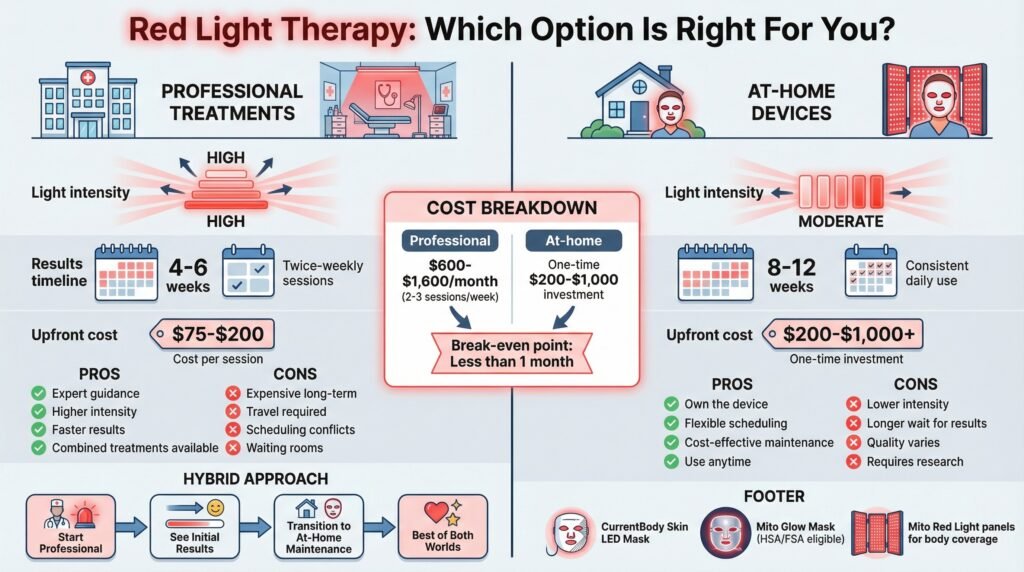
The professional versus at-home debate really comes down to your specific situation, budget, and how quickly you want to see results. Professional treatments offer higher intensity, which translates to faster visible improvements.
When you’re going to a dermatologist’s office or medical spa for red light therapy, you’re typically getting devices that deliver significantly more light energy than consumer products can safely provide.
The advantage of that intensity is efficiency. You might see noticeable improvements within 4-6 weeks of twice-weekly professional sessions, whereas an at-home device might take 8-12 weeks of consistent use to produce comparable results.
For someone dealing with severe rosacea symptoms that are affecting their quality of life, that time difference can be really meaningful.
Professional treatments also come with expert guidance. A trained provider can assess your skin, adjust treatment parameters based on your response, and identify if you’re experiencing any issues that need addressing.
They can also mix red light therapy with other in-office treatments strategically for enhanced benefits.
The downside is obviously cost and convenience. Professional red light sessions can run anywhere from seventy-five to two hundred dollars per treatment, and you need many sessions for initial results plus ongoing maintenance.
The time commitment of traveling to appointments, fitting them into your schedule, and sitting in waiting rooms adds up quickly.
At-home devices need a larger upfront investment, typically ranging from two hundred to over a thousand dollars depending on size and quality, but then you own them. For ongoing maintenance therapy, this becomes much more cost-effective than continued professional treatments.
You can do sessions on your own schedule, whether that’s early morning before work or late evening while watching television.
The trade-off is that at-home devices generate less intense light, so you need longer session times and more patience for results. Device quality varies enormously in the consumer market.
Some products from reputable manufacturers deliver legitimate therapeutic wavelengths at meaningful intensities. Others are essentially glorified mood lighting that won’t do much for your rosacea.
Many people find that starting with professional treatments to get their inflammation under control, then transitioning to at-home devices for maintenance, offers the best of both worlds. You get faster initial improvement from professional intensity, then sustain those results cost-effectively at home.
However, many professional red light therapy providers charge $75 – 125 per session. And consistency leads to consistent results. When you are looking at 2-3 sessions per week, the costs can add up.
When shopping for at-home devices, look for FDA-cleared products that specify exact wavelength output, power density, and treatment area size. Read actual user reviews from people with rosacea, not just general skin care testimonials. Two such devices are the Mito Glow Red Light Mask and the CurrentBody Skin LED Light Therapy Face Mask: Series 2.
When comparing these at-home red light masks to the cost of professional sessions multiple times a week, the CurrentBody and HSA/FSA eligible Mito Glow Mask pay for themselves in less than a month.
In addition to the MitoGlow mask, Mito Red Light provides larger panel options for greater expanded body coverage as well.
See the cost savings calculator below and crunch the real-time savings numbers of at-home red light therapy vs clinical sessions. Bookmark this page and come back whenever you are comparing the cost of red light therapy providers in your area.
Red Light Therapy Cost Savings Calculator
Research demonstrates that consistent red light therapy protocols for 4-7 weeks deliver the best results. Calculate how much you can save by investing in an at-home device compared to ongoing professional sessions.
Recognizing and Avoiding Common Mistakes
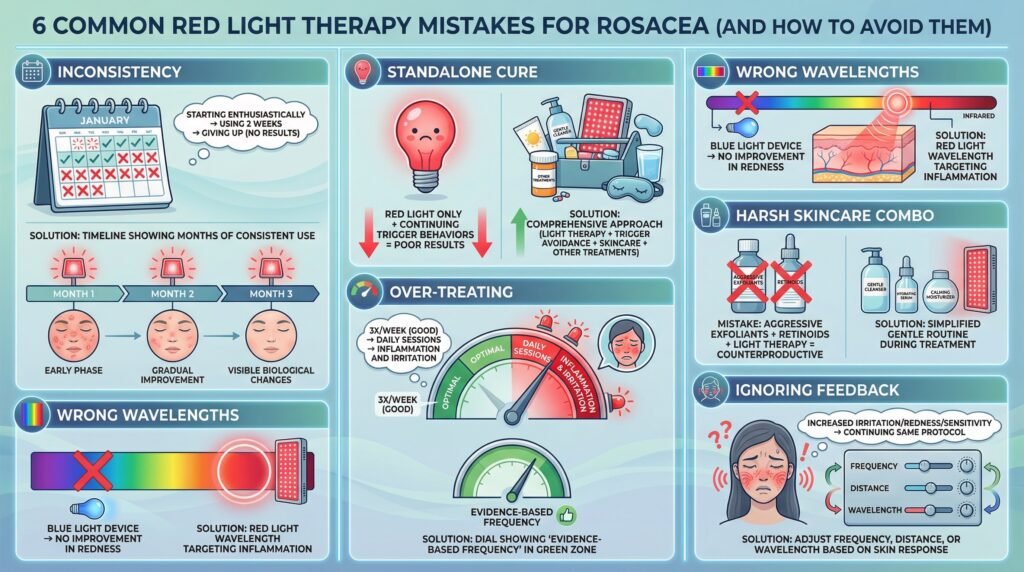
The biggest mistake I see people make is inconsistency. They buy a device or start professional treatments with great enthusiasm, use it regularly for two weeks, don’t see a dramatic transformation, and give up.
Red light therapy produces biological changes that need time and consistency to generate meaningful visible improvements.
Another common problem is treating red light therapy as a standalone cure. People sometimes think they can just do light therapy while continuing all their rosacea-triggering behaviors and still see great results.
Red light therapy works best as part of a comprehensive management strategy that includes trigger avoidance, appropriate skincare, and potentially other treatments.
Over-treating is surprisingly common, too. People figure if three sessions per week is good, then daily sessions must be better. But more isn’t always better with red light therapy.
Excessive exposure can actually irritate sensitive rosacea skin and potentially trigger inflammation as opposed to reducing it. Following evidence-based frequency recommendations is important for getting results without setbacks.
Using the wrong wavelengths because you didn’t research your device properly is frustrating. Someone buys a blue light device marketed for “acne and skin health,” doesn’t realize that blue light isn’t optimal for rosacea’s inflammatory component, and then wonders why their redness isn’t improving.
Wavelength matters tremendously for getting the specific benefits you’re after.
Combining red light therapy with harsh or irritating skincare is counterproductive. If you’re using aggressive exfoliants, high-percentage retinoids, or irritating ingredients right before or after light therapy sessions, you’re working against yourself.
Your skin needs to be calm and intact to respond optimally to light therapy. This means temporarily simplifying your routine while you establish your red light therapy protocol.
Ignoring your skin’s feedback is another issue. If you notice increased irritation, worsening redness, or unusual sensitivity after starting red light therapy, that’s information you need to pay attention to.
It might mean you need to reduce frequency, adjust your distance from the device, or check whether your device is delivering appropriate wavelengths.
Key Takeaways
Red light therapy offers genuine benefits for rosacea management through cellular-level anti-inflammatory effects that reduce redness, calm reactive skin, and strengthen your skin barrier over time.
The specific wavelengths matter tremendously, with 630-660nm red light and 850nm near-infrared providing the most evidence-based benefits for rosacea symptoms.
Consistency beats intensity when it comes to results, with 2-4 weekly sessions producing better long-term outcomes than sporadic intensive treatment.
Professional treatments deliver faster initial results through higher intensity, while at-home devices provide cost-effective maintenance once you’ve achieved improvement.
Red light therapy works best as part of comprehensive rosacea management that includes trigger avoidance, appropriate skincare, and potentially other medical treatments as opposed to as a standalone solution.
Patience is essential, with meaningful improvements typically emerging over 8-12 weeks of consistent treatment as opposed to days or even early weeks.
Different rosacea phenotypes may respond somewhat differently to light therapy, with persistent redness typically showing the most dramatic improvement.
Tracking your progress through photos and symptom journals provides an objective assessment of benefits and helps you improve your treatment protocol over time.
Ready to get started with treating your skin with this groundbreaking technology? Click the links below to find the right red light mask for your specific budget and needs.
Frequently Asked Questions
Can red light therapy make rosacea worse?
Red light therapy can potentially worsen rosacea if you use too high an intensity, treat too often, or use inappropriate wavelengths like blue light. Some people experience temporary increased redness immediately after treatment that subsides within an hour.
If redness continues or worsens over many sessions, you should reduce treatment frequency or ask a dermatologist to ensure you’re using appropriate parameters for your skin sensitivity level.
How long does it take for red light therapy to work on rosacea?
Most people start seeing noticeable improvements in their rosacea symptoms between 3-8 weeks of consistent treatment at 2-4 sessions per week. The first two weeks primarily involve cellular changes that aren’t yet visible.
Professional high-intensity treatments may produce faster results around the 4-6 week mark, while at-home devices typically need 8-12 weeks for comparable improvements.
Longer-term benefits, including improved skin texture and reduced flare-up frequency, often develop over 3-4 months.
What wavelength of red light is best for rosacea?
The most effective wavelengths for rosacea are 630-660nm red light for surface inflammation and redness, and 850nm near-infrared light for deeper tissue inflammation. Many experts recommend devices that mix both wavelengths for comprehensive treatment of rosacea symptoms.
Blue light wavelengths around 415nm are not recommended for rosacea despite being effective for acne, since rosacea is primarily an inflammatory condition as opposed to a bacterial one.
Is near-infrared or red light better for rosacea?
Both near-infrared and red light provide benefits for rosacea through different mechanisms. Red light at 630-660nm works on surface-level inflammation and visible redness in the upper dermis.
Near-infrared at 850nm penetrates deeper to address inflammation in lower skin layers and improve vascular function.
The best approach for most people with rosacea combines both wavelengths as opposed to choosing one over the other, as they work synergistically to reduce symptoms.
Can I use red light therapy every day for rosacea?
Using red light therapy every day for rosacea is generally not recommended and may actually irritate sensitive skin. Research supports 2-4 sessions per week as the optimal frequency for reducing inflammation while allowing skin time to respond to treatment between sessions. More frequent treatment doesn’t necessarily produce better results and can potentially trigger increased redness in reactive rosacea-prone skin. Consistency at the recommended frequency matters more than daily use.
Does red light therapy help broken capillaries from rosacea?
Red light therapy may help reduce the appearance of broken capillaries associated with rosacea by improving vascular function and reducing chronic inflammation that contributes to blood vessel dilation. The anti-inflammatory effects can decrease the reactive flushing that worsens visible vessels over time.
However, for significant telangiectasia, more intensive treatments like IPL or laser therapy are typically more effective, with red light therapy serving as a complementary maintenance treatment.
What is the best home red light therapy device for rosacea?
The best home red light therapy devices for rosacea are FDA-cleared products that deliver both 660nm red light and 850nm near-infrared wavelengths at power densities of at least 20-30 mW/cm². Panel-style devices that treat the entire face simultaneously are more convenient than handheld devices for consistent treatment.
Look for products that specify exact wavelength output and treatment distance recommendations, and check user reviews specifically from people treating rosacea.
Can red light therapy replace rosacea medication?
Red light therapy should not replace prescribed rosacea medications without consulting your dermatologist. For mild rosacea, some people successfully manage symptoms with red light therapy alone combined with trigger avoidance and gentle skincare.
For moderate to severe rosacea, light therapy typically works best alongside topical or oral medications as opposed to as a replacement.
The therapy addresses inflammation through different mechanisms than medications, making them complementary treatments that can work together.
This article includes affiliate links. If you click through and make a purchase, I may receive a small commission. This helps support the site and allows me to keep creating helpful content at no extra cost to you.