📌 Quick Summary
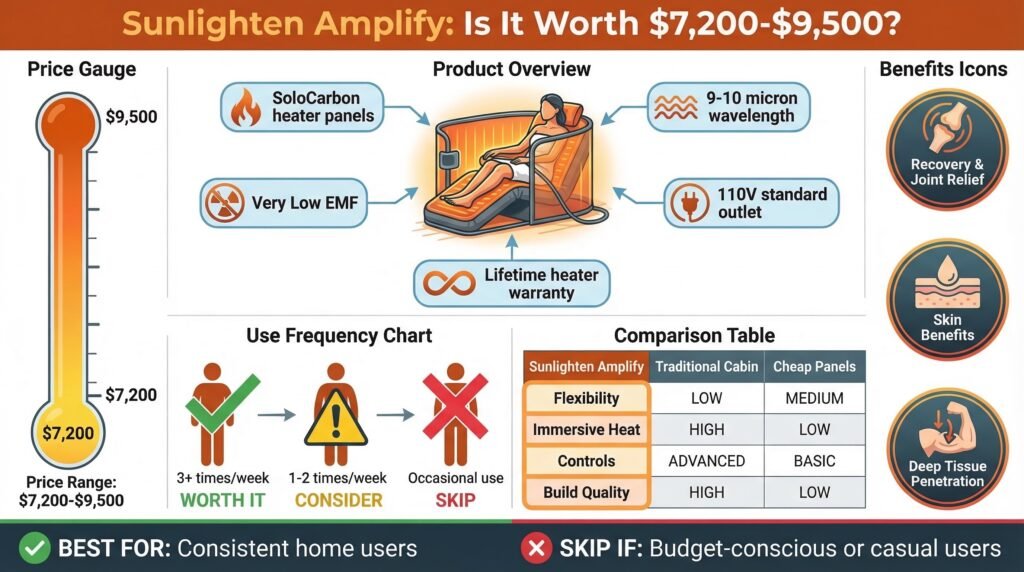
The Sunlighten Amplify is a flexible panel-based far-infrared sauna system using patented SoloCarbon heaters (primarily 9-10 micron wavelength for deep tissue penetration) with very low EMF. It’s not a full enclosure but allows targeted or semi-immersive sessions, runs on standard 110V outlets, and offers solid build quality plus a lifetime heater warranty.
Priced at roughly $7,200–$9,500 depending on the model, it’s considered worth it for frequent users (3+ times/week) focused on recovery, joint relief, or skin benefits who want flexibility over a traditional cabin sauna, but only if you get reliable dealer support. It’s better than cheap generic panels but lacks precise controls and the full immersive heat of enclosed models. Best for consistent home users; casual or budget buyers may prefer alternatives.
🧾 Table of Contents
- Introduction — Overview of the crowded infrared sauna market and the author’s goal to cut through hype.
- Brand Overview and History — Sunlighten’s background since 1999, focusing on infrared and patented SoloCarbon technology.
- Product Range Analysis — Details on Amplify II (two panels) vs. Amplify III (three panels) for different coverage levels.
- Wavelength and Power Density — Explanation of far infrared focus (9-10 microns), estimated power output, and tissue penetration benefits.
- Quality and Performance Testing — Build materials, heat-up time (10-15 min), surface temps (150-170°F), low EMF confirmation, and adjustment via distance/power.
- Customer Service Experience — Dealer variability, warranty (lifetime on heaters, 5 years electrical), and setup/shipping notes.
- Pricing and Value Assessment — Cost breakdown, electricity usage, break-even vs. spa sessions, and long-term savings for regular use.
- Pros and Cons — Balanced list of strengths and weaknesses.
- Final Recommendation — Who it’s best for, caveats, and tips (e.g., verify dealer).
- FAQ
Introduction
I’ve been looking into at-home infrared saunas for a while now, and the Sunlighten Amplify keeps popping up everywhere. The thing is, there’s so much conflicting information out there about these devices that it’s hard to know what’s actually legit and what’s just marketing hype.
After spending way too many hours going through specs, user feedback, and comparing models, I wanted to put together what I found about the Amplify line.
This whole thing started because I got tired of seeing people drop thousands on equipment that doesn’t deliver what it promises. The infrared sauna space is full of companies making wild claims about wavelengths and “clinical-grade” performance without backing it up.
This Sunlighten Amplify review is my attempt to cut through that noise.
Brand Overview and History
Sunlighten has been around since 1999, which honestly matters when you’re talking about buying something this expensive. They’re not some fly-by-night operation that started last year selling rebranded panels from overseas.
The company is based in Kansas, and it has built its reputation specifically around infrared sauna technology.
What sets them apart (at least according to their track record) is that they focus exclusively on infrared saunas. Rather than trying to sell you hot tubs, steam rooms, and a bunch of other wellness equipment. Just infrared saunas.
That kind of specialization usually means the engineering is more refined.
They hold a bunch of patents on their heating technology, particularly the SoloCarbon panels. Whether patents actually translate to better performance is debatable, but it does show they’ve invested in R&D rather than just slapping together generic heaters.
The company sells through dealers and direct, which can be a pro or con depending on how you look at it. More on that later when we talk about customer service.
Ready to view the available models now and receive $200 off now? Click here to get started.
Product Range Analysis
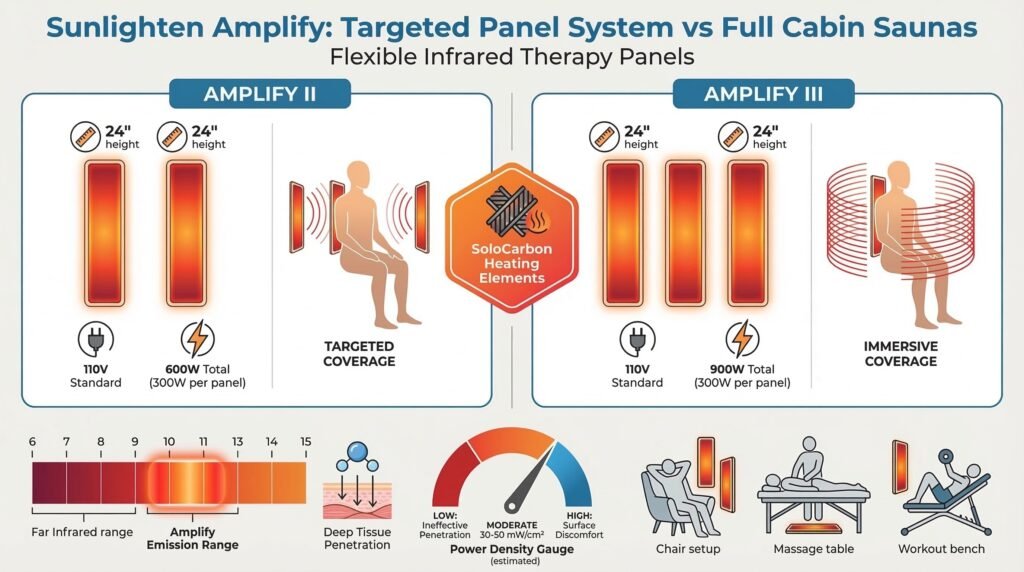
Sunlighten makes several different sauna models, but the Amplify is their targeted panel system rather than a full cabin enclosure. That’s a big distinction if you’re trying to figure out what this thing actually is.
The current lineup includes the Amplify II and the Amplify III. The main difference between them is the number of panels and the coverage area.
Amplify II Specifications
The Amplify II comes with two infrared panels. Each panel measures about 24 inches tall and gives you focused infrared exposure.
This model works well if you want to target specific body areas or if you’re dealing with space constraints.
It runs on standard 110V power, so you don’t need any special electrical work done. Just plug it in like any other appliance.
Each panel pulls around 300 watts, so you’re looking at 600 watts total when running both.
The panels use Sunlighten’s SoloCarbon heating elements, which they claim emit primarily far infrared (around 9-10 microns wavelength). That wavelength range supposedly penetrates deeper into tissue compared to near- or mid-infrared.
Amplify III Specifications
The Amplify III adds a third panel to the setup. Same size panels, same technology, just more coverage.
This configuration lets you create a more immersive setup, like placing panels in front, behind, and to the side.
Power consumption goes up to 900 watts total since you’ve got three panels running. Still on 110V, though, so no electrical upgrades needed for most homes.
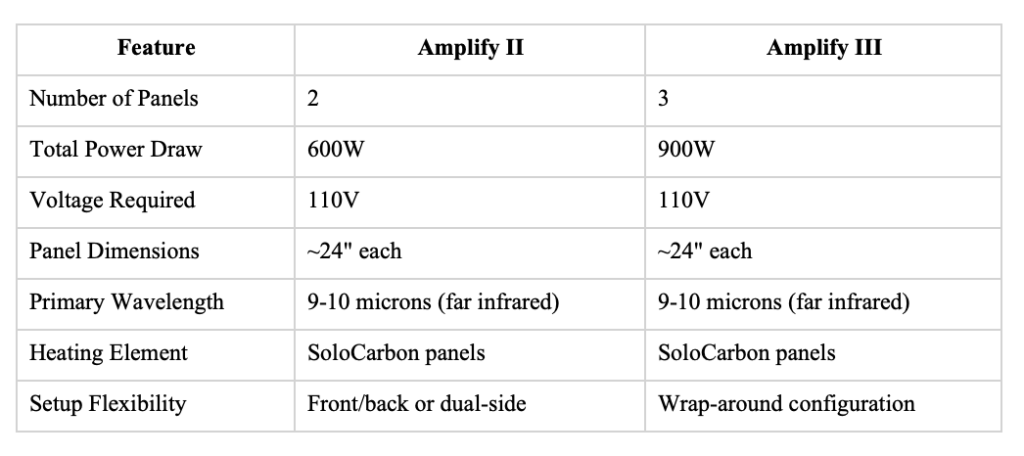
Here’s a quick breakdown of the key specs:

The flexibility is actually pretty nice. You can position these panels however works for your space and what you’re trying to accomplish.
Some people set them up around a chair; others use them on a massage table or workout bench.
If you’re trying to figure out which model fits your situation, the Amplify III obviously gives more coverage, costs more, and takes up more space. The Amplify II works fine if you’re targeting specific areas or rotating positions during sessions.
If you’re interested in purchasing any of Sunlighten’s products, make sure to use the links in this article to get a $200 off today. Redeem your sauna savings by filling out their short contact form.
What About Wavelength and Power Density
This is where things get technical and where a lot of companies try to confuse you with numbers.
Far infrared (which is what the Amplify focuses on) sits in the 6 to 15-micron range. Sunlighten’s panels emit primarily at 9 to 10 microns, which falls right in the middle of that range.
This wavelength gets absorbed by water molecules in tissue, which is why it creates that deep warming sensation.
Power density (measured in mW/cm²) tells you how much infrared energy actually reaches your body. Higher isn’t always better, though, despite what some brands claim.
Too high and you just heat the surface uncomfortably.
Too low and you’re not getting effective tissue penetration.
Sunlighten doesn’t publish exact power density numbers for the Amplify, which is frustrating. Based on the wattage and panel size, you can estimate it’s in a moderate range (probably 30-50 mW/cm² at typical distances), but that’s just educated guessing.
Quality and Performance Testing
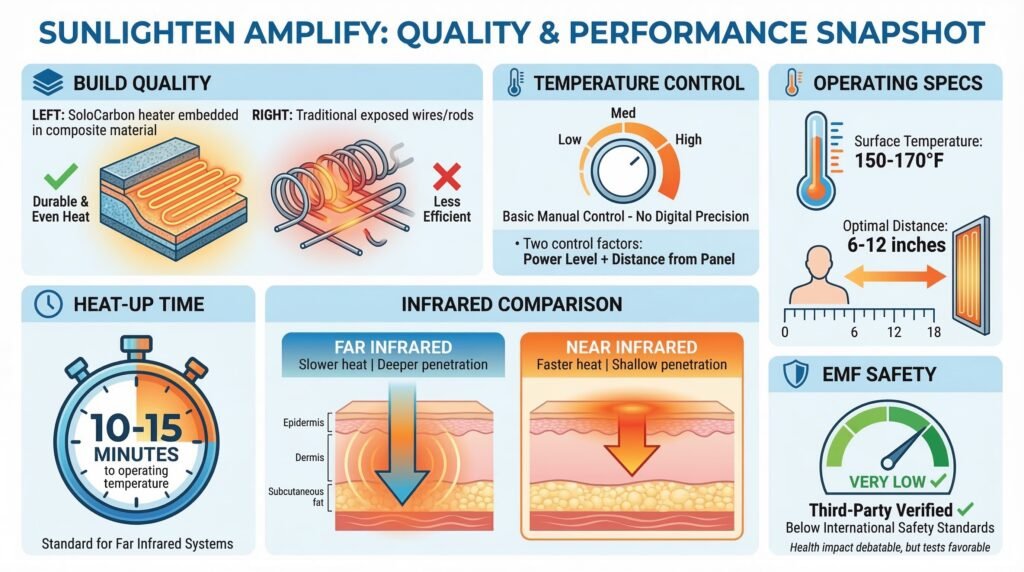
The build quality on these panels seems solid from what people report. The SoloCarbon heaters are embedded in a composite material rather than being exposed wires or rods, which should last longer and emit more evenly.
The panels heat up in about 10-15 minutes to reach operating temperature. That’s pretty standard for far infrared systems.
Near infrared heats faster but doesn’t penetrate as deeply, so there’s always that tradeoff.
Temperature control is basic. Each panel has its own power control, but you’re not getting precise digital temperature settings like you would with a full cabin sauna.
You control heat by adjusting the power level and your distance from the panels.
Some feedback mentions the panels can get surface temps up around 150-170°F, which is hot enough to be effective but not so hot that you can’t be near them comfortably. Typical session distance is 6-12 inches away from the panels.
The EMF (electromagnetic field) levels are worth mentioning since some people are sensitive to them. Sunlighten claims their SoloCarbon technology produces very low EMF, and third-party testing seems to back that up with readings well below international safety standards.
Whether EMF from any infrared sauna is actually a health concern is debatable, but if it matters to you, the Amplify tests well in that category. Redeem your sauna savings by clicking the button below and filling out their short contact form.
Trusted by 200+ wellness experts



Customer Service Experience
Sunlighten uses a dealer network for sales, which means your experience can vary wildly depending on which dealer you work with. Some dealers are responsive and helpful. Others… not so much.
You might get great support, or you might get ghosted after the sale.
The company does offer direct support through their main customer service line, which helps if your dealer isn’t being helpful. Response times seem to range from same-day to several days, depending on how busy they are.
Warranty coverage is lifetime on the heating elements and five years on electrical components. That’s actually pretty good compared to some competitors who only offer 1-3 years.
The lifetime heater warranty suggests they’re confident in the SoloCarbon technology lasting.
Shipping and delivery get complicated because these panels are fairly large and fragile. Most shipments arrive without damage, but there are occasional reports of broken panels that need replacement.
How quickly that gets handled depends again on your dealer relationship.
One frustration people mention is the lack of detailed setup instructions. The panels are simple enough (plug them in and position them), but if you want to build a semi-permanent enclosure or mount them in specific ways, you’re mostly on your own to figure it out.
If you do decide to pick up an Amplify system, make sure you get clear answers about dealer support and what happens if something goes wrong. That conversation before purchase can save a lot of headaches later.
To avoid any complications, go directly to Sunlighten’s official site to receive $200 off and take advantage of additional promotions as well. Click here to get started now.
Pricing and Value Assessment
Let’s talk money, because this is where a lot of people either commit or walk away.
The Amplify II typically runs around $7,500-9,500, depending on dealer pricing and any promotions. The Amplify III is closer to $7,200.
Compared to ongoing spa or clinic infrared sauna sessions at $40-80 per session, the break-even point is somewhere around 30-60 sessions. If you’re planning to use it regularly (3-5 times per week), that’s maybe 3-4 months to break even.
After that, you’re coming out ahead financially.
The real comparison, though, is against other at-home infrared panel systems. There are cheaper options out there in the $500-1,500 range from various brands.
The difference usually comes down to heater quality, EMF levels, and longevity.
Cheaper panels often use carbon fiber or ceramic heaters that don’t emit as evenly or burn out faster.
There are also more expensive “medical-grade” systems that can run $5,000+ for panel setups. Whether those extra thousands get you meaningfully better results is questionable.
A lot of that premium is marketing and certifications rather than actual performance differences.
Operating costs are pretty minimal. At 600-900 watts, you’re looking at maybe $0.10-0.20 per hour of use in electricity, depending on your rates.
Even daily use only adds a few dollars per month to your power bill.
Maintenance is basically zero. Wipe down the panels occasionally, don’t get them wet, and they should last for years without issues.
The value equation really depends on how often you’ll actually use it. If it sits in your closet after the first month, obviously, it’s a terrible investment.
If you use it consistently for recovery, relaxation, or skin health, the cost per session drops to almost nothing over time. Redeem $200 in sauna savings by clicking the button below and filling out their short contact form. Click the button below to get started.
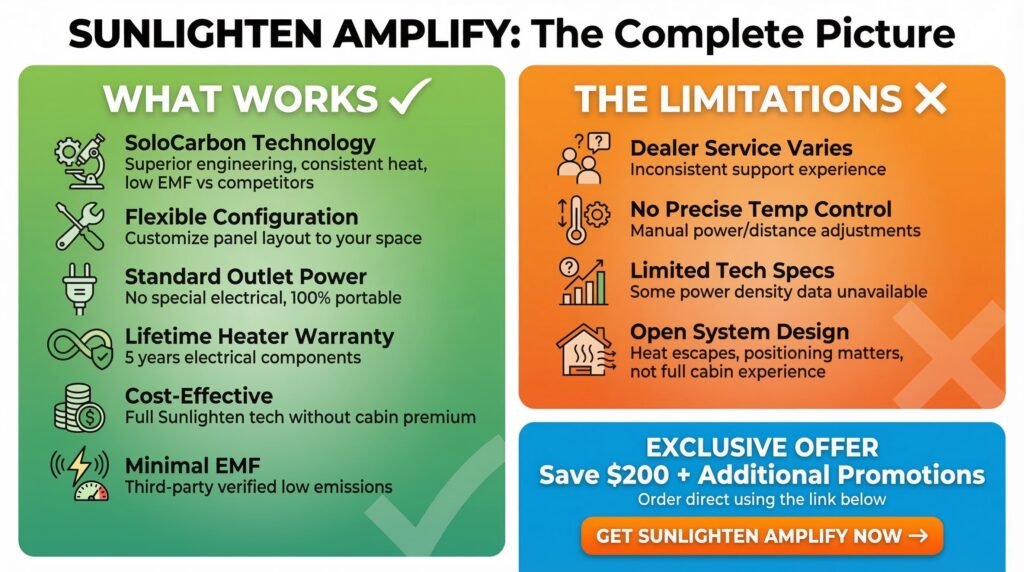
Pros and Cons Summary
Let me break down what works and what doesn’t with the Sunlighten Amplify system, based on everything I’ve gathered for this Sunlighten Amplify review.
What Works Well:
The SoloCarbon heating technology seems legitimately better engineered than generic carbon heaters. More consistent heat emission and lower EMF readings than most competitors at this price point.
Setup flexibility is a huge plus. You can configure the panels however makes sense for your space and needs, rather than being locked into a fixed cabin layout.
No special electrical requirements mean you can use it anywhere with a standard outlet. That portability matters if you move or want to take panels with you somewhere.
The lifetime warranty on heaters shows the company stands behind the core technology. Five years on, electrical components are solid too.
Lower cost than full cabin saunas while still using the same heating technology. You get Sunlighten’s core tech without paying for all the wood and enclosure.
Pretty minimal EMF output for people concerned about that. Third-party testing backs up the company’s claims on this front.
What Doesn’t Work Well:
Dealer-dependent customer service creates inconsistency. Your experience might be great or frustrating, depending on who you buy from. Therefore, go directly to Sunlighten with the links in this article and receive $200 off, plus other available promotions.
There are no precise temperature controls like digital cabin saunas. You’re adjusting power levels and distance rather than setting an exact temp.
Limited information on actual power density and some technical specs.
The panels are effective, but you’re not getting the full enclosure experience of a traditional sauna. Heat escapes, ambient temperature matters, and you need to position yourself carefully.
Not portable in the sense that the panels are large and somewhat fragile. You can move them around your house, but throwing them in your car for travel isn’t really practical. To see a full list of reviews of red light panels, find our reviews here.
The setup instructions could be way better. You’ll figure it out, but some detailed guidance on optimal positioning and configuration would help.
If you’re ready to pull the trigger, wait for a sale period or at least call Sunlighten directly to see if they can offer any kind of discount. Getting even $200 off makes a real difference at this price point. Click Here.
Final Recommendation
After going through all of this, here’s my take on whether the Sunlighten Amplify makes sense.
If you’re looking for regular infrared sauna sessions and the cost of spa visits is adding up, the Amplify can pay for itself pretty quickly. The quality of the SoloCarbon heaters seems legit based on both company specs and user feedback over time.
You’re getting far infrared in the right wavelength range with consistent heat output.
The system works well for targeted therapy. If you’re dealing with sore muscles, joint stiffness, or skin concerns that respond to heat and infrared, the ability to position panels exactly where you need them is actually better than sitting in a fixed cabin.
For general wellness and regular sauna sessions, the Amplify II handles that fine for one person. The Amplify III gives you better coverage if you want a more immersive experience or plan to set up a semi-permanent sauna space.
The price sits in a reasonable middle ground. You’re paying more than bargain-basement panels but less than premium medical systems or full cabins.
For what you get, that seems about right if the heater quality and warranty hold up (and most reports suggest they do).
Where this system doesn’t make sense is if you want a traditional sauna experience with high heat and a full enclosure. The Amplify is specifically an infrared panel setup, not a replacement for a finished sauna cabin. Also, if you’re not going to use it consistently (at least 2-3 times per week), the cost is hard to justify compared to occasional spa visits.
The customer service inconsistency is the biggest concern. Before you buy, have a real conversation with whichever dealer you’re working with.
Ask specific questions about returns, warranty claims, and ongoing support.
If they’re dodgy or unresponsive before the sale, it’ll be worse after.
For people serious about adding infrared therapy to their routine, the Amplify delivers solid performance with good build quality and reasonable (if not cheap) pricing. Just go in with realistic expectations about what panel systems can and can’t do compared to full saunas.
If you want to check current pricing and dealer options, it’s worth reaching out to a couple of different dealers to compare not just price but how they handle customer questions. That dealer relationship matters with Sunlighten products.
This whole Sunlighten Amplify review basically comes down to whether you value flexibility and targeted therapy over the full enclosure experience, and whether you’ll actually use it enough to justify the cost. If both those things line up, the Amplify is a pretty solid option in the at-home infrared sauna space.
If either one doesn’t fit your situation, you might want to look at full cabin saunas or just stick with spa sessions.
The technology works, the quality seems durable, and the value is there if you use it consistently. That’s about as much as you can ask for from any wellness equipment at this price point.
Ready to get started now? Click the button below to go to Sunlighten’s official site and receive $200 off your sauna purchase, plus regular seasonal promotions they run.
Frequently Asked Questions
What is the Sunlighten Amplify?
A modular panel-based infrared sauna (not a full cabin) using SoloCarbon far infrared heaters for targeted or positioned full-body sessions.
How much does the Sunlighten Amplify cost?
Amplify II: $7,500–$9,500; Amplify III: around $7,200 (prices vary by dealer; occasional promotions like $200 off direct).
Is it full spectrum?
No, this model focuses on far infrared (9-10 microns). (Note: Sunlighten has other lines like mPulse or certain Amplify variants marketed as full spectrum in broader brand info, but this review emphasizes the far IR panel design.)
What are the main pros?
Flexible setup, low EMF, consistent heat from patented tech, no electrical upgrades needed, lifetime heater warranty, and lower cost than full cabin saunas.
What are the main cons?
Dealer-dependent service quality, no precise temp controls (adjust via distance/power), heat escapes (not enclosed), limited specs transparency, and fragile/large panels.
Is it worth the price?
Yes, if you use it regularly (e.g., 3–5x/week) for recovery or wellness, the break-even vs. spa visits ($40–80 each) can happen in 30–60 sessions. Less ideal for occasional use or if you want a traditional enclosed sauna experience.
How does it compare to alternatives?
Better quality and longevity than cheap $500–$1,500 panels; more affordable than premium full cabins or “medical-grade” systems, but lacks enclosure immersion. Spa sessions are simpler and short-term, but cost more in the long term.
Still undecided? Read our other sauna reviews below and see how Sunlighten sizes up with the competition.
Clearlight Sanctuary Sauna Review: Worth It or Overhyped? Honest Verdict
Clearlight Sauna Review and Brand Analysis
This article includes affiliate links. If you click through and make a purchase, I may receive a small commission. This helps support the site and allows me to keep creating helpful content at no extra cost to you.