Quick Summary
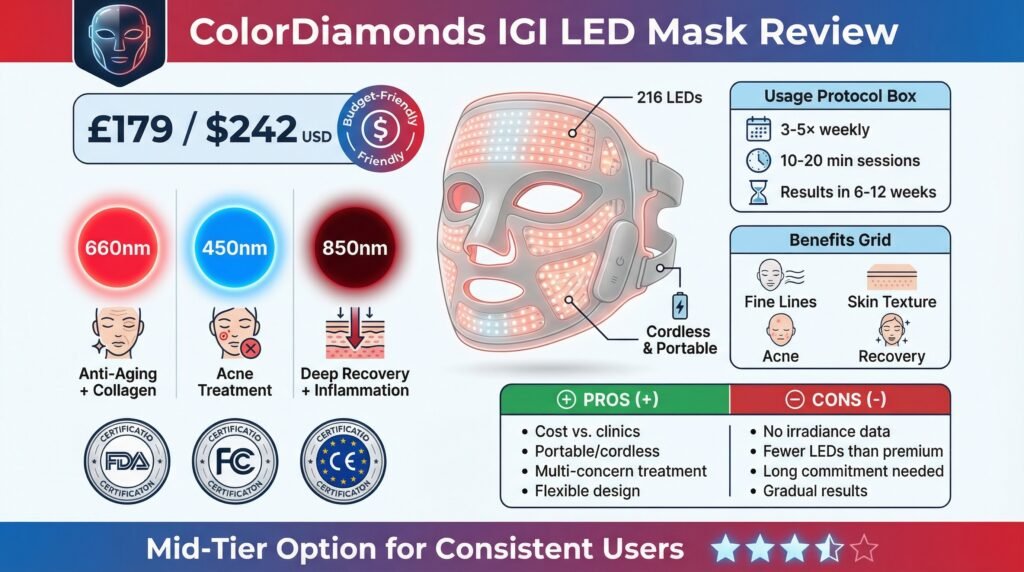
The ColorDiamonds IGI LED Mask is a budget-friendly, portable, cordless at-home LED therapy device priced at £179 (~$242 USD). It features 216 LEDs across three wavelengths (660nm red for anti-aging/collagen, 450nm blue for acne, 850nm near-infrared for deeper recovery/inflammation reduction) in a flexible silicone design.
It’s FDA, FCC, and CE certified, best suited for consistent users (3–5× weekly, 10–20 min sessions) seeking modest improvements in fine lines, texture, acne, and skin recovery over 6–12 weeks. It’s a solid mid-tier option for mixed skin concerns and cost savings vs. clinic treatments, but lacks published irradiance specs, has fewer LEDs than premium rivals, and requires long-term commitment for results. No quick fixes.
Table of Contents
- Introduction — Overview of the mask as a mid-range, portable alternative to expensive clinic sessions or high-end devices.
- Features and Specifications — Design (flexible silicone, 216 LEDs, cordless 2000mAh battery), certifications, and price (£179).
- Light Modes and Claimed Benefits — Details on the three wavelengths and their skin effects.
- How It Works and Usage — Recommended session length/frequency, irradiance considerations, and importance of consistency.
- Performance and Results — Expected timeline (6–12 weeks), observed benefits for aging, acne, and recovery.
- Pros: Versatility, portability, value, even light distribution, safety certifications.
- Cons: No irradiance data, fewer LEDs than competitors, facial-only use, gradual/modest results, requires discipline.
- Verdict — Practical choice for committed users with mixed concerns; not ideal for inconsistent users or those wanting dramatic/fast changes.
Introduction
If you’re considering at-home red light therapy, you’ve probably noticed the prices are all over the place. Professional clinic sessions run £50-150 each time, which adds up fast if you’re going twice a month.
At-home masks range from sketchy £50 devices on Amazon to £500+ medical-grade systems.
The ColorDiamonds IGI LED Mask sits somewhere in the middle at £179.
After looking into the specs and comparing them to what actually makes LED therapy work, here’s what you need to know before buying.
What Actually Makes LED Masks Work (The Boring but Important Part)
Most reviews skip this part, but it matters if you want to know what you’re buying.
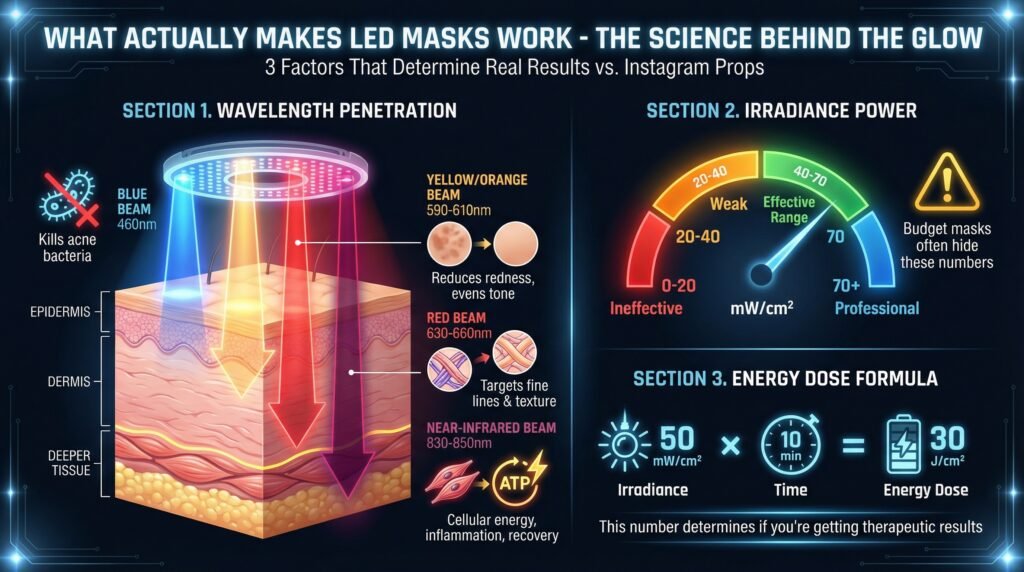
Three things decide whether an LED mask actually does anything or just makes your face glow red for Instagram:
Wavelength (measured in nanometers, or nm) decides how deep the light goes into your skin and what it does once it gets there.
Red light around 630-660nm hits the dermis layer where collagen lives. This is what targets fine lines and skin texture.
Near-infrared at 830-850nm goes deeper. It helps with cellular energy production (ATP), reduces inflammation, and speeds up tissue recovery.
This is the wavelength that fitness people care about for muscle recovery.
Blue light at 460nm stays on the surface to kill acne-causing bacteria.
Yellow and orange wavelengths around 590-610nm help with redness and even out skin tone.
Irradiance is where most cheap masks fall apart. This measures how much light energy actually reaches your skin per square centimeter (mW/cm²).
At-home masks typically deliver 20-70 mW/cm². The effective range for home use is usually 40-70 mW/cm².
Higher irradiance means faster results, but tons of budget masks don’t even publish these numbers (big red flag imo).
Energy dose is what you get when you multiply irradiance by time. A 10-minute session at 50 mW/cm² gives you roughly 30 joules per cm².
This is how you compare whether different devices are actually delivering therapeutic doses or just looking pretty.
The ColorDiamonds IGI Specs Breakdown
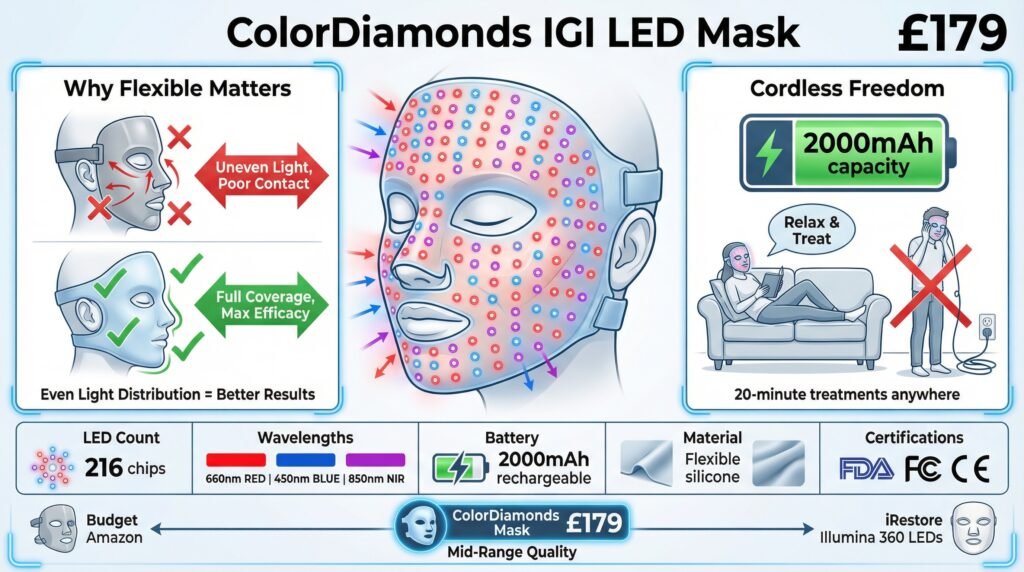
The ColorDiamonds IGI LED Mask runs three main wavelengths: 660nm red light, 450nm blue light, and 850nm near-infrared.
It has 216 LED chips spread across a flexible silicone design that’s supposed to contour to your face. The idea is that better contact means more even light distribution (rigid plastic masks leave gaps around your cheeks and eyes where the light barely reaches).
The 2000mAh rechargeable battery means you’re not plugged into a wall during treatment. This actually matters more than you’d think.
I’ve seen people buy fancy devices and never use them because sitting still next to an outlet for 20 minutes is annoying.
It’s got FDA, FCC, and CE certifications. This means it’s safe and the claims are backed up, but it doesn’t mean it performs like professional clinical equipment.
Important distinction.
At £179, it’s mid-range pricing. You’re paying less than premium brands like iRestore Illumina (which has 360 LEDs and higher specs) but more than budget Amazon options that don’t tell you anything about their actual performance.
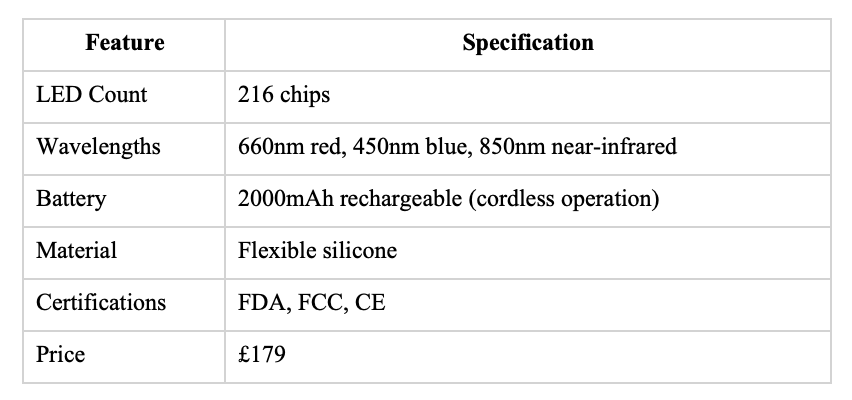
Key Specs at a Glance
What You’re Actually Getting (Real Talk)
The three-wavelength setup means you can switch between red for anti-aging, blue for acne, and infrared for deeper tissue work. You’re not buying three separate devices.
This is solid if you have mixed skin concerns or your skin changes with the seasons (breakouts in summer, dryness in winter, whatever).
But here’s the thing… ColorDiamonds doesn’t publish detailed irradiance specs. You can’t see the exact mW/cm² output, which means you can’t directly compare intensity to clinical devices or other home systems.
This is pretty common with mid-range brands tbh. The companies with really high irradiance publish those numbers because it’s a competitive advantage.
When manufacturers don’t share specs, it usually means the output is moderate as opposed to exceptional.
The 216 LED count sounds decent until you realize competitor devices have anywhere from 240 to 504 LEDs. That said, chip count alone doesn’t predict performance.
Distribution and wavelength accuracy matter more.
The flexible silicone construction probably helps with even distribution, which partially makes up for having fewer LEDs than premium models.
For realistic timelines… most people see visible changes in fine lines, skin texture, and acne within 6-12 weeks of consistent use. That means 3-5 times per week, 10-20 minutes per session.
This isn’t magic overnight transformation stuff. It’s the timeline that matches how LED therapy actually works at a cellular level.
Anyone promising dramatic results in 2-3 weeks is either lying or selling something else.
Who This Mask Actually Makes Sense For
If you’re dealing with aging skin and don’t want invasive procedures, consistent red and infrared light can reduce fine lines and improve elasticity. The results are modest compared to retinoids or professional treatments, but they’re real.
You’re looking at improvement, not time travel. The cordless design means you can use it while doing other stuff (reading, emails, whatever), which helps with actually sticking to it.
For people with chronic acne or breakouts… blue light therapy at 450nm targets the bacteria that cause acne without antibiotics or harsh actives that irritate sensitive skin. If you’re dealing with persistent breakouts or post-acne inflammation, the blue mode could replace some topical treatments.
The red and infrared wavelengths might help with psoriasis or eczema inflammation, but that’s less clinically proven than the acne stuff.
If you’re into fitness and recovery, near-infrared penetrates deep tissue and reduces inflammation. Some athletes use red light therapy on recovery days or after intense training to potentially speed up muscle recovery and reduce soreness.
The 850nm wavelength hits the right depth for muscle tissue, though obviously, a face mask only works for facial muscles and nearby areas. You can’t use it on your shoulders or legs.
If you’re now spending £50-150 per clinic session and going 2-3 times monthly, this mask pays for itself in a few months. The savings compound if you actually use them consistently for a year or longer.
The real question is whether you’ll actually use it. Most home devices end up in a drawer somewhere. Click the button below to check the current ColorDiamonds pricing and see if they’re running any deals right now. (BUTTON)
What This Mask Isn’t Good For
If you need full-body treatment… this is clearly not the option. It’s a face mask.
If you want red light therapy for full-body recovery, muscle growth, or systemic inflammation, you need a panel.
If you need results by next week… LED therapy compounds over weeks and months. There’s no shortcut here.
Whether you are considering expensive professional sessions that average $100 per session or practicing at-home therapy, consistency is key. At a minimum, 2 to 3 times per week. This can be costly when going for the clinical session setting. This is where devices such as the IGI LED mask, at £179 ($242 USD), win.
Use the cost savings calculator below to crunch the real-time numbers and see how much you will save within less than a week compared to professional targeted sessions.
💰 LED Therapy Cost Savings Calculator
Discover how much you can save by investing in the IGI LED Mask instead of expensive professional sessions. Consistency is key for results – calculate your potential savings below!
The Compliance Problem Nobody Talks About
Device effectiveness depends entirely on whether you actually use it.
Some premium competitor studies show that full-face coverage and cordless design encouraged compliance. People actually used the device because it wasn’t annoying.
The ColorDiamonds IGI’s cordless battery and comfortable silicone design support this. But design only matters if the mask doesn’t end up in your bathroom cabinet.
The realistic commitment is 10-20 minutes, 3-5 times weekly. That’s 30-100 minutes per week.
You need to stack it with other activities. Wear it while checking emails, listening to podcasts, or during your morning routine.
If you’re already spending time on skincare, this fits naturally.
If you’re starting from a zero skincare routine… be honest with yourself about whether you’ll maintain it. Nobody’s judging, but buying a £179 device you use twice isn’t a good investment.
What LED Masks Can and Can’t Do (Cutting Through the BS)
Red light therapy produces real biological effects. It stimulates fibroblasts (the cells that make collagen), reduces inflammatory markers, and increases ATP production in your mitochondria.
These aren’t placebo effects. The research is solid.
But they’re also modest effects compared to stronger interventions like retinoids, professional microneedling, or laser treatments.
LED therapy works best as a consistent tool. It doesn’t require downtime, does not irritate, and produces measurable results over months of use.
It combines well with other skincare (retinoids, vitamin C, SPF) without conflict.
But it won’t replace those things. Especially not retinoids, which are still the single most evidence-backed anti-aging ingredient for wrinkles.
For acne, blue light reduces breakouts by killing bacteria and reducing inflammation. But it works best alongside other basics like consistent cleansing, suitable moisturizing, and sometimes topical actives.
LED masks don’t cure acne. They reduce bacterial load and inflammation, which helps manage it.
The ColorDiamonds IGI delivers this realistic performance level. You get genuine biological effects, modest visible results over consistent months of use, and an accessible price point that doesn’t require financing decisions.
The Bottom Line After Six Months
The ColorDiamonds IGI LED Mask isn’t a breakthrough technology. It won’t replace professional treatments or dermatologist-prescribed medications.
But it’s a functional mid-range device that delivers on its core promise. You get consistent, accessible red light therapy with documentation backing its safety and basic effectiveness.
The three-wavelength setup (red, blue, infrared) gives you flexibility for different concerns without buying multiple devices. The cordless battery removes one of the main barriers to actually using it.
The silicone construction helps with even light distribution across your face.
The missing irradiance specs are annoying if you like comparing exact numbers, but the device performs within expected ranges for this price point.
For people committed to 3-5 weekly sessions over several months, it represents reasonable value. You’ll see gradual improvements in skin texture, fine lines, and breakouts if you stay consistent.
For people expecting quick fixes or who know they won’t maintain regular use… save your money. Inconsistent use won’t give you results that justify the cost.
The real test is whether you’ll actually use it. If you can honestly commit to fitting 10-20 minute sessions into your routine several times per week, and if you’re already spending money on clinic sessions or other skincare products, this makes sense.
If you’re hoping a device will magically fix your skin without effort on your part… LED therapy (or any skincare) doesn’t work that way.
At £179, you’re paying for a legitimate mid-tier device with proper certifications, multiple wavelengths, and a design that actually encourages consistent use. It’s not the cheapest option, and it’s not the most powerful, but it sits in that sweet spot where performance meets practicality for most people.
Just go into it with realistic expectations about timelines and commit to actually using the thing consistently. That’s what separates devices that work from expensive drawer decorations. Click the button below to try the IGI LED MASK risk-free for 30 days.
FAQ
What is the ColorDiamonds IGI LED Mask?
A wireless, flexible silicone LED face mask with 216 LEDs delivering red (660nm), blue (450nm), and near-infrared (850nm) light for at-home skin therapy, targeting anti-aging, acne, and inflammation.
How much does it cost?
£179 (approximately $242 USD), positioning it as a mid-range/budget-friendly option compared to premium masks (£500+) or clinic visits (£50–150 per session).
What skin concerns does it help with?
Red light: Fine lines, skin texture, collagen production.
Blue light: Acne (kills bacteria).
Near-infrared: Deeper recovery, reduced inflammation, ATP/energy boost (helpful for overall skin health and even post-exercise facial recovery).
How do you use it?
10–20 minute sessions, 3–5 times per week. It’s cordless for hands-free use (e.g., while reading or working). Visible improvements typically appear after 6–12 weeks of consistent use.
Is it safe?
Yes, it’s FDA, FCC, and CE certified, confirming basic safety and compliance standards for home use.
What are the main advantages?
Portable/cordless design improves routine adherence, flexible fit for even light coverage, multi-wavelength versatility, and significant long-term savings over professional treatments.
What are the drawbacks?
No published irradiance numbers (hard to compare precisely), fewer LEDs than some competitors, results are gradual and modest, limited to the face only, and effectiveness relies heavily on consistent use.
Who is this mask best for?
People with combined concerns (aging + acne + inflammation), budget-conscious users wanting real (but not dramatic) results, or those who value portability and can commit to regular sessions. It’s not ideal for full-body needs, quick fixes, or inconsistent routines.
Does the reviewer give it a rating?
No explicit star rating, but the tone is positive for its category. Described as a “functional mid-tier device” delivering “genuine biological effects” and “reasonable value” for committed users.
Still undecided? Read our other reviews of affordable and effective red light therapy devices for at-home use here.
This article includes affiliate links. If you click through and make a purchase, I may receive a small commission. This helps support the site and allows me to keep creating helpful content at no extra cost to you.