Quick Summary
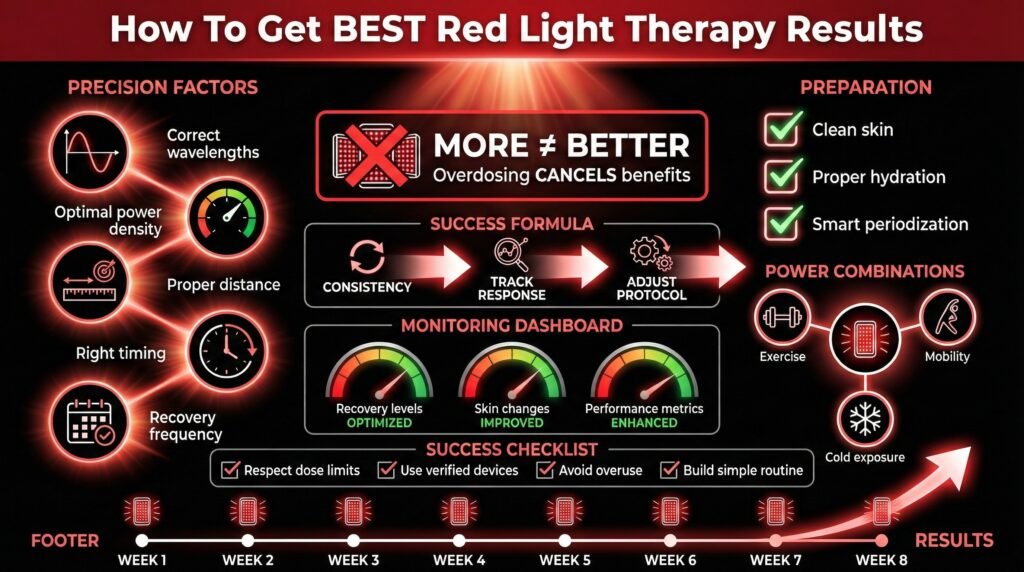
The best red light therapy results come from consistency, tracking response, and adjusting protocols over time. Personal variation matters, so monitoring recovery, skin changes, and performance is essential. Combining RLT with exercise, mobility work, or cold exposure enhances results. Success depends on respecting dose limits, choosing verified devices, avoiding common overuse mistakes, and building a simple, repeatable routine.
In part 1 of this series on red light therapy best practices, we discussed understanding cellular response windows, wavelength penetration, distance, and power density, and more. In part 2, we will discuss response monitoring, protocol adjustment, combining RLT with other interventions, and more.
Table of Contents
Response Monitoring and Protocol Adjustment
Adaptation, Plateaus, and When to Change Your Dose
Combining Red Light Therapy with Other Interventions
Timing RLT with Training, Recovery, and Cold Exposure
Device Selection Beyond Marketing Claims
Common Red Light Therapy Failure Patterns
Practical Implementation Framework
Key Takeaways for Long-Term Results
Response Monitoring and Protocol Adjustment
Something that separates people who get great results from those who get mediocre ones is actually tracking response and adjusting accordingly. RLT needs ongoing attention and modification based on how your body responds.
Your body’s needs change based on training status, stress levels, sleep quality, and dozens of other variables. I keep simple notes on session duration, distance, and subjective recovery markers like soreness levels, sleep quality, and skin appearance.
After 2-3 weeks of consistent use, multiple times per week, the patterns become obvious.
If recovery isn’t improving or skin changes have plateaued, I’ll adjust one variable, usually frequency first, then duration or distance.
Some people respond better to shorter, more frequent sessions. Others need longer exposures less often.
The research provides general guidelines, but personal variation is significant enough that experimentation within safe parameters is really valuable.
I’ve also noticed that adaptation occurs over time. Initial responses can be dramatic: reduced DOMS, better sleep, visible skin improvements, but then things stabilize.
That’s your body reaching a new baseline.
At that point, you can either maintain that level with less frequent sessions or push further by strategically increasing the dose for specific goals.
Combining RLT with Other Interventions
Red light therapy amplifies other recovery modalities in ways that seem genuinely synergistic. The research on combining RLT with exercise is particularly compelling.
Using photobiomodulation before or immediately after training consistently shows enhanced performance metrics and reduced fatigue compared to either intervention alone.
I use RLT about 3-6 hours post-workout during the window when inflammation is elevated, but before natural recovery processes fully kick in. This timing seems to support the useful aspects of inflammation while reducing excessive inflammatory responses that delay recovery.
Pairing RLT with manual therapy or self-myofascial release creates interesting effects. The increased blood flow and cellular metabolism from light exposure seem to enhance tissue pliability and the effectiveness of manual techniques.
I’ll do 5-10 minutes of RLT, then perform targeted mobility work on the same areas, and the combination feels distinctly more effective than either alone.
Cold exposure and RLT might seem contradictory. One increases blood flow, the other restricts it.
But alternating them strategically can be powerful.
I’ll use cold for acute inflammation management, then follow several hours later with RLT to support the repair phase. The contrast seems to amplify both mechanisms.
Device Selection Beyond Marketing Claims
The red light therapy market is absolutely flooded with devices making exaggerated claims based on minimal evidence. Sorting through the noise needs understanding what actually matters versus what’s just marketing.
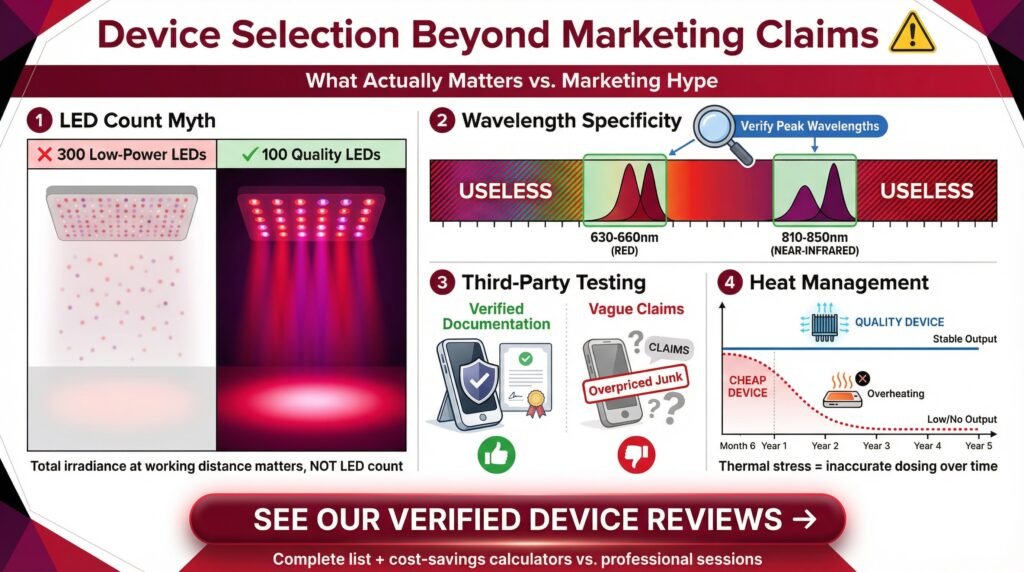
LED count is nearly meaningless without knowing the total power output and beam angle. A device with 100 high-quality LEDs properly spaced and focused can outperform one with 300 low-power LEDs scattered across a panel.
Total irradiance at working distance is what matters, not the number of person lights.
Wavelength specificity is crucial. Some devices claim broad “red light” without specifying actual peak wavelengths.
You need verification that the device emits in the 630-660nm and/or 810-850nm ranges.
Anything outside these therapeutic windows is essentially useless for photobiomodulation.
I prioritize devices that provide third-party testing documentation. Companies willing to send their products for independent wavelength and irradiance verification usually have nothing to hide.
Those making vague claims without specifications are typically selling overpriced junk.
Heat management in the device itself affects longevity and performance. Quality LEDs with proper heat sinking maintain consistent output over years of use.
Cheap devices often show declining performance within months as the LEDs degrade from thermal stress, meaning your carefully calculated doses become increasingly inaccurate over time.
We have a complete list of affordable and effective red light therapy devices for at-home use here. Also, we have provided cost-savings calculators for each product so you can compare each device to the average cost of professional red light sessions.
Common Failure Patterns and Corrections
I’ve seen predictable patterns in why people fail to get results. The most common is simply inconsistency, using the device sporadically when they remember, without establishing a routine.
RLT needs regular exposure to maintain elevated mitochondrial function.
Missing sessions randomly means you’re constantly starting over instead of building progressive improvements.
Another frequent mistake is impatience with timing expectations. People expect immediate, dramatic changes and quit after a week when they don’t see miracles.
Skin remodeling takes weeks because collagen turnover is slow.
Muscle recovery improvements are faster but still need many sessions to establish patterns.
Overdoing it is surprisingly common, especially among the optimization-minded crowd. If some is good, more must be better, right? Wrong.
I’ve talked to many people who bought expensive panels and immediately started doing 40-minute daily sessions on every body part, wondering why they felt worse instead of better. Respect the biphasic response curve.
Poor device selection based on price instead of specifications wastes money. That $89 Amazon panel isn’t delivering therapeutic wavelengths or enough power density, regardless of how many LEDs it claims to have.
You’re better off with one quality device used properly than three cheap devices used constantly without results. Click the button below to see our extensive list of red light therapy devices for at-home use.
Each product review contains a cost-savings calculator that you can bookmark and use to compare to the cost of professional red light sessions from clinics in your area.
Practical Implementation Framework
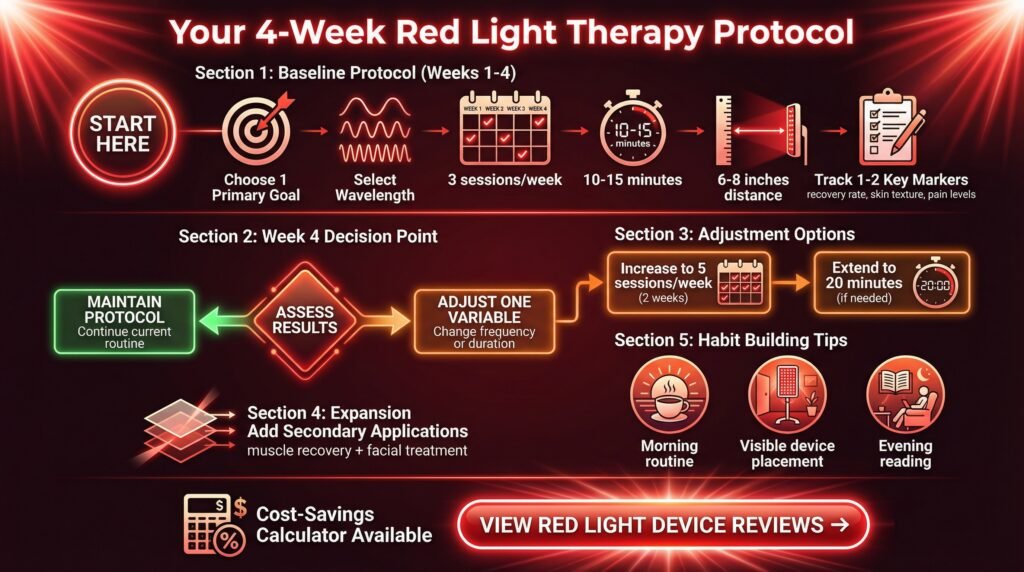
Start with a simple baseline protocol. Choose one primary goal, choose a suitable wavelength emphasis, and commit to 3 sessions weekly for 4 weeks at standard parameters, that’s 10-15 minutes at 6-8 inches.
Track one or two key markers relevant to your goal, whether that’s recovery rate, skin texture, or pain levels, whatever matters most.
After 4 weeks, assess honestly. If you’re seeing positive trends, maintain the protocol.
If results are minimal, adjust one variable.
Usually, I’ll increase frequency first to 5 sessions weekly. If that doesn’t help after 2 more weeks, I’ll extend the duration to 20 minutes.
Once you establish what works for your primary goal, you can layer in secondary applications. Maybe you started with muscle recovery, but want to add a facial treatment.
The extra exposure is fine as long as you’re not exceeding total body exposure to the point of triggering inhibition.
Build the habit around existing routines. I do my sessions right after morning training or in the evening while reading.
The device sits where I’ll see it, not tucked away in a closet where it becomes out-of-sight, out-of-mind. Environmental design matters for consistency.
Click here to see our review page for a complete list of affordable and effective red light therapy devices for at-home use.
Key Takeaways
Red light therapy delivers genuine physiological benefits when you respect the photobiology involved. Appropriate wavelengths, proper dosing within therapeutic windows, and consistent application over time produce measurable improvements in recovery, skin health, and inflammation management.
The biphasic dose response is the critical concept most people ignore to their detriment. More exposure beyond optimal levels doesn’t enhance results and often eliminates benefits, making precision and restraint more important than intensity.
Device selection should prioritize verified specifications over marketing claims, focusing on documented wavelength output, adequate power density at working distance, and clinical validation instead of LED count or price point.
Success needs tracking response and adjusting protocols based on personal variation within safe parameters, because the general guidelines from research provide starting points that need refinement for your specific physiology and goals.
Frequently Asked Questions
How long does it take to see results from red light therapy?
Initial improvements like reduced soreness, better sleep, or decreased inflammation can appear within 1–2 weeks. Skin changes take longer, typically 4–8 weeks, because collagen turnover is slow. Consistency matters more than intensity.
Can I use red light therapy every day?
Daily use can be effective for acute recovery or injury protocols, but it increases the risk of overdosing. For most goals, 3–5 sessions per week produce better results by respecting the biphasic dose-response.
What should I adjust first if I’m not seeing results?
Start by adjusting frequency, not duration. Increase from 3 to 5 weekly sessions before extending exposure time. Change only one variable at a time and reassess after 2–3 weeks.
Is it better to use red light therapy before or after workouts?
Post-workout use generally produces the best recovery benefits, especially 3–6 hours after training when inflammation is elevated. Pre-workout use can support performance, but timing should align with your goals.
Can I combine red light therapy with cold exposure?
Yes, when timed correctly. Use cold exposure first for acute inflammation control, then apply red light therapy several hours later to support tissue repair and mitochondrial recovery.
Why did my results plateau after initial improvements?
This usually indicates adaptation. Your body has reached a new baseline. At that point, you can either reduce frequency to maintain gains or strategically increase dose for specific goals.
Does red light therapy work through clothing or skincare products?
No. Clothing, makeup, and even light skincare products block or scatter photons. Clean, bare skin is essential for effective light absorption.
Are more LEDs or higher wattage always better?
No. What matters is verified irradiance at working distance and correct wavelengths. LED count and advertised wattage are often marketing metrics with little clinical relevance.
How do I know if I’m overdoing red light therapy?
Common signs include stalled progress, worsened recovery, fatigue, or feeling “flat” despite consistent use. These usually indicate exceeding the optimal dose window.
Can I use red light therapy for multiple goals at once?
Yes, as long as total exposure stays within therapeutic limits. Layering treatments is fine once you’ve established what works for your primary goal.
Is red light therapy safe long term?
When used within recommended wavelengths and dose ranges, long-term use is considered safe. Problems arise from excessive duration, frequency, or poorly designed devices.
Do I need supplements for red light therapy to work?
Supplements aren’t required, but hydration and adequate intake of magnesium, iron, and B vitamins support mitochondrial function and can enhance results.
Get started today by visiting our review page here for a complete list of affordable and effective red light therapy devices for at-home use.
We have provided cost-savings calculators for each product so you can compare each device to the average cost of professional red light sessions as well.
If you are ready to consider red light therapy devices, click here to get started today by visiting our review page for a complete list of affordable and effective red light therapy devices for at-home use.
We have provided cost-savings calculators for each product so you can compare each device to the average cost of professional red light sessions as well.
If you are looking for an affordable entry point, read our review of the Mito Pro line of red light devices. Click here to start reading or click below to be taken to Mito’s official site.
This article includes affiliate links. If you click through and make a purchase, I may receive a small commission. This helps support the site and allows me to keep creating helpful content at no extra cost to you.