Quick Summary
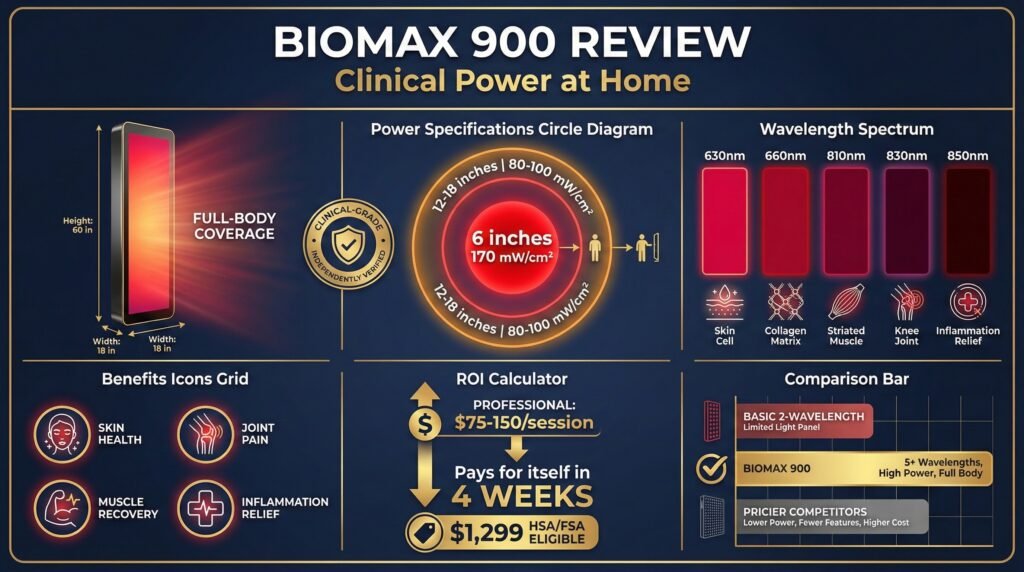
The PlatinumLED BIOMAX 900 is a full-body red light therapy panel delivering clinical-grade power (170 mW/cm² at 6 inches, 80-100 mW/cm² at 12-18 inches) across five wavelengths (630nm, 660nm, 810nm, 830nm, 850nm) for skin health, muscle recovery, joint pain, and inflammation relief.
Independently tested specs match clinical study ranges, enabling short, effective home sessions that pay for themselves quickly (~4 weeks) versus $75-150 professional treatments. Priced at $1,299 (HSA/FSA eligible), it’s recommended for committed users seeking broad-spectrum, verified performance over cheaper or narrower alternatives like basic two-wavelength panels or pricier competitors (e.g., Joovv).
Table of Contents
- Introduction – Overview of clinical-grade at-home red light therapy and why the BIOMAX 900 stands out.
- What You’re Actually Getting with the BIOMAX 900 – Dimensions, specs, coverage, power density, and treatment times.
- The Wavelength (and Why It Matters) – Breakdown of the five wavelengths and their penetration/benefits vs. typical two-wavelength devices.
- Power Density (The Spec That Actually Matters) – Importance of irradiance, independent test results, and comparison to clinical/study standards.
- How the BIOMAX 900 Compares to Professional Clinical Sessions – Cost savings calculator, convenience, and equivalence in dosing.
- What This Panel Makes Sense For – Best use cases (skin/anti-aging, muscle recovery, joint pain, chronic conditions).
- Set Up and Practical Use – Mounting, controls, noise/heat, recommended protocols, and safety tips.
- The Benefits That Are Not Proven…Yet – Evidence strength for various claims and realistic expectations.
- BIOMAX 900 Review: The Actual Verdict – Overall assessment, comparisons, warranty/trial info.
- Final Thoughts – Summary recommendation, emphasis on consistency, and advice for potential buyers.
Introduction
The BIOMAX 900 from PlatinumLED keeps coming up in red light therapy discussions, and after looking at the specs, the third-party testing, and how it stacks up against competitors… yeah, there’s a reason people keep talking about it.
This is one of those panels that actually delivers the power output and wavelength combinations that clinical studies use. Not some watered-down version.
The actual therapeutic dosing that matters.
Let me break down what makes this thing different (and what doesn’t).
What You’re Actually Getting with the BIOMAX 900
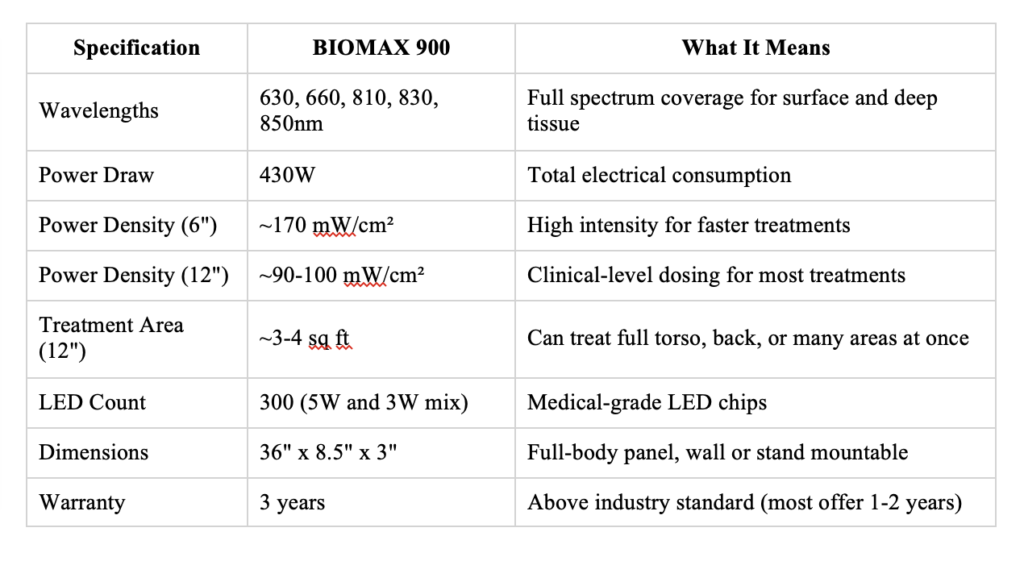
The BIOMAX 900 is a full-body red light therapy panel that combines five specific wavelengths: 630nm, 660nm, 810nm, 830nm, and 850nm. That’s a mix of red and near-infrared light, which penetrates tissue at different depths.
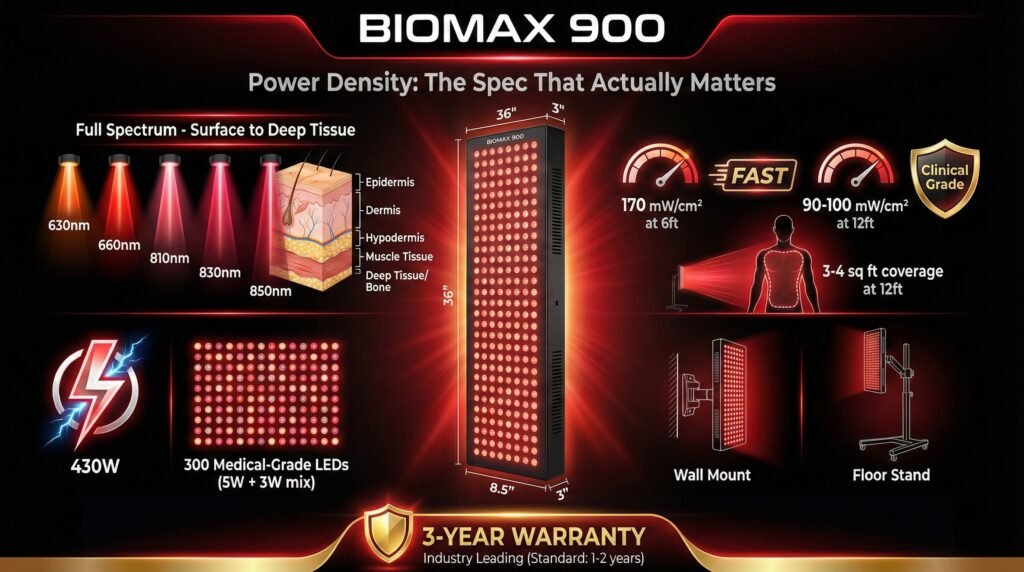
The panel measures 36″ x 8.5″ x 3″, so it covers a decent amount of surface area without taking up half your room. It pulls 430 watts from the wall and weighs about 25 pounds.
Here’s what that actually means for treatment…
The coverage area at 6 inches away is roughly 36″ x 14″. At that distance, you’re getting around 170 mW/cm² of power density based on independent testing.
That’s enough to deliver therapeutic doses (typically 10-20 joules per cm²) in about 1-2 minutes for surface treatments, or 5-10 minutes for deeper tissue work.
Most people use it at 12-18 inches away, which drops the power density to around 80-100 mW/cm² but increases the coverage area to about 3-4 feet. Treatment times go up to 10-15 minutes, but you can treat larger areas at once.
The panel uses a combination of 5W and 3W LEDs (300 total LEDs).
The specific ratio is optimized for the R+|NIR+ spectrum mode, which is basically PlatinumLED’s way of saying “we’re hitting many wavelengths simultaneously.”
The Wavelength (and Why It Matters)
One of the biggest sources of confusion with at-home red light therapy devices is the wavelength situation. Companies throw numbers around without explaining what they actually do.
The BIOMAX 900 uses five wavelengths for specific reasons…
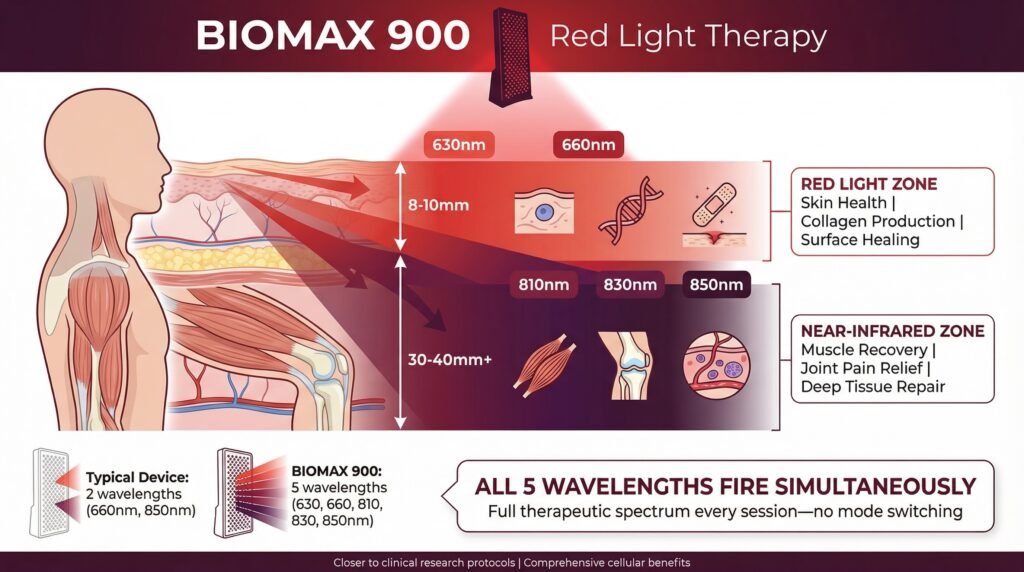
630nm and 660nm (red light) penetrate about 8-10mm into tissue. These wavelengths get absorbed really well by mitochondria in skin cells, which is why they show up in studies on skin health, collagen production, and surface-level healing.
810nm, 830nm, and 850nm (near-infrared) penetrate 30-40mm or more. These reach muscle tissue, joints, and deeper structures.
The research on muscle recovery, joint pain, and deeper tissue repair mostly uses these wavelengths.
Most panels on the market use just two wavelengths (660nm and 850nm). The BIOMAX 900 adds three more to cover more of the therapeutic spectrum.
Does that make a massive difference?
Honestly… probably not for most people. But it does mean you’re getting closer to what clinical studies actually use, and there’s some evidence that different wavelengths have slightly different effects on cellular function.
The bigger deal is that all five wavelengths fire simultaneously. You’re not switching between red and NIR modes.
You’re getting the full spectrum every time.
Power Density (The Spec That Actually Matters)
This is where most at-home panels fall apart. They’ll advertise high wattage or tons of LEDs, but the actual power density at treatment distance is weak.
Power density (measured in mW/cm²) decides how much light energy actually reaches your tissue. It directly affects treatment time and whether you’re getting a therapeutic dose.
Clinical studies on red light therapy typically use power densities between 50-200 mW/cm², with most falling in the 80-120 mW/cm² range. Treatment times in these studies are usually 5-20 minutes, depending on the condition being treated.
Independent testing of the BIOMAX 900 shows around 170 mW/cm² at 6 inches and 90-100 mW/cm² at 12 inches. That puts it right in the clinical range.
For comparison, a lot of cheaper panels claim high irradiance but actually deliver 30-40 mW/cm² at 12 inches. That means treatment times need to be 2-3x longer to get the same dose, assuming the wavelengths are even fixed.
The BIOMAX 900 review data from third-party testers (people using spectrometers and power meters, not company marketing) confirms the specs are legit. That’s honestly rare in this market.
How the BIOMAX 900 Compares to Professional Clinical Sessions
One of the main reasons people look at panels like this is to avoid the cost and hassle of going to clinics for red light therapy.
A typical clinical session costs $75-150 and lasts 10-20 minutes. The equipment used in these clinics usually delivers 80-150 mW/cm² at treatment distance, which is basically what the BIOMAX 900 does at home.
If you’re doing red light therapy 2-3 times per week (which is common for skin concerns, recovery, or chronic conditions), that’s $400-1,800 per month at a clinic. The BIOMAX 900 costs around $1,199, so it pays for itself in about a month of regular use compared to clinical treatments.
The convenience factor is huge, too. Being able to do 10-minute sessions in the morning or evening without driving anywhere makes it way easier to stay consistent.
Consistency is what actually matters with this stuff.
Clinical panels are often larger and might have slightly higher power output in some cases, but the therapeutic effect is based on the dose (power density x time), not just the power. The BIOMAX 900 delivers equivalent doses with just slightly longer treatment times if needed.
Also, the BIOMAXX 900 is HSA/FSA eligible, so you can use pre-tax dollars for extra savings.
Also, given the expense of professional clinic sessions at an average cost of $100 per session, these panels hit breakeven relatively quickly. And as any red light therapy practitioner will attest, consistent use equals consistent results. Usually, 2 to 3 times per week.
Use the cost-savings calculator below to see the real cost savings. Bookmark this page for future use when comparing red light therapy services in your local area.
BIOMAX 900 Cost Savings Calculator
Compare the cost of clinical red light therapy sessions vs. owning your own BIOMAX 900 panel at home
🏥 Clinical Sessions
🏠 BIOMAX 900 at Home
Ready to Start Saving While Getting Better Results?
Own your own clinical-grade red light therapy panel and never pay for another session again. The BIOMAX 900 pays for itself in weeks, not months.
Get Your BIOMAX 900 Now →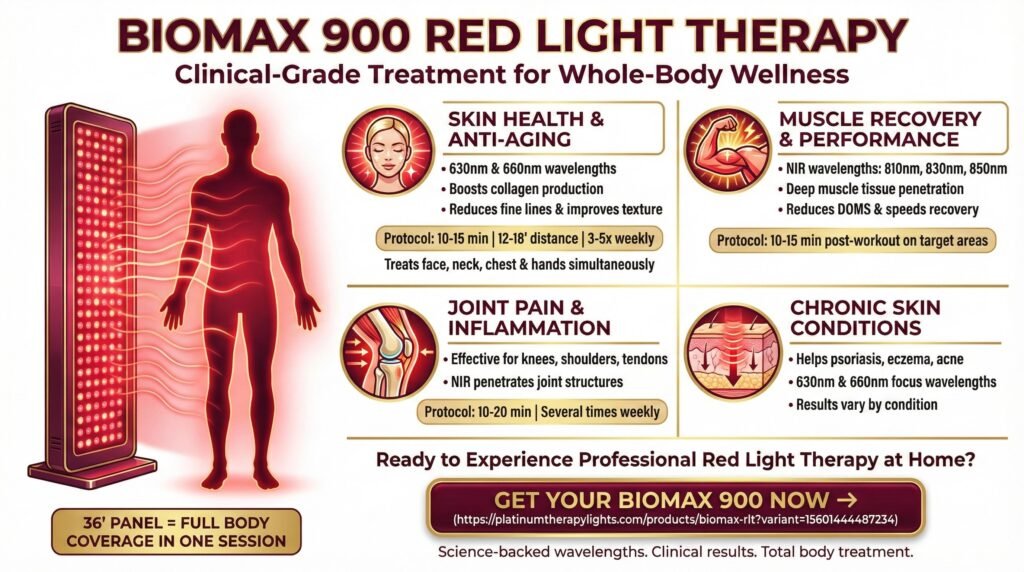
What This Panel Makes Sense For
The BIOMAX 900 works well for a few specific use cases…
Skin health and anti-aging benefits, the 630nm and 660nm wavelengths are what show up in studies on collagen production, fine lines, and skin texture. Typical protocol is 10-15 minutes at 12-18 inches, 3-5 times per week.
The large coverage area means you can treat your face, neck, chest, and hands all at once instead of using a smaller targeted device.
Muscle recovery and performance, the NIR wavelengths (810nm, 830nm, 850nm) penetrate deep enough to reach muscle tissue. Research shows red light therapy before or after workouts can reduce delayed onset muscle soreness (DOMS), speed recovery, and potentially improve performance markers.
Treatment is usually 10-15 minutes on the muscle groups you just worked.
Joint pain and inflammation. There’s decent evidence for red light therapy helping with knee pain, shoulder issues, tendonitis, and other joint problems. The NIR wavelengths penetrate deep enough to reach joint structures.
Most studies use 10-20 minute treatments several times per week.
Chronic skin conditions. Some people use red light therapy for psoriasis, eczema, acne, and other skin issues. Results vary a lot depending on the specific condition and the person’s response.
The red wavelengths (especially 630nm and 660nm) are what most dermatology research focuses on.
If you’re serious about skin health and anti-aging and you’ve already maxed out on topical treatments, sunscreen, retinoids, etc., the evidence for red light therapy on collagen production and skin quality is strong enough to justify trying it. The 630nm and 660nm wavelengths specifically show up in dermatology research.
The panel size (36″ tall) makes it practical for treating your whole back, full torso, legs, or many areas in one session. Smaller panels need you to move them around to different spots, which gets annoying.
If you’re serious about consistent red light therapy and want something that matches clinical specs, you can check out the current pricing and specs here.
Set Up and Practical Use
The panel comes with a door mounting bracket, which is probably the easiest way to use it. Hang it on the back of a bedroom or bathroom door, and you can do treatments while getting ready in the morning or winding down at night.
There’s also a floor stand available separately if you want to use it away from a door. Some people set it up in a home gym or office.
The panel has a built-in timer and two intensity modes (50% and 100%). Most people use 100% to keep treatment times shorter.
The 50% mode is useful if you want longer, lower-intensity sessions or if you’re dealing with very sensitive skin.
The fan noise is noticeable but not annoying. About the same as a laptop fan running.
The panel does get warm during use (that’s normal, the LEDs generate heat), but there’s an automatic thermal shutoff if it gets too hot.
Treatment protocols vary based on what you’re using it for, but a typical approach is 10-15 minutes at 12-18 inches, 3-5 times per week. You can treat many areas in one session by repositioning or doing shorter targeted sessions on specific spots.
The light is bright (obviously), so most people close their eyes during facial treatments or use the included eye protection if they’re treating areas near the face for extended periods.
The Benefits That Are Not Proven…Yet
Red light therapy has solid research backing it for certain things, but the marketing around these devices often oversells the benefits.
The evidence is strongest for skin health (collagen production, fine lines, wound healing), muscle recovery, joint pain, and some forms of inflammation. There are hundreds of peer-reviewed studies on these applications.
The evidence is weaker or mixed for things like fat loss, hair growth, testosterone levels, thyroid function, and a bunch of other stuff that gets mentioned in marketing materials. Some preliminary research exists, but it’s not definitive.
Red light therapy doesn’t replace medical treatment for serious conditions. It’s a complementary tool that might help with recovery, pain management, or skin concerns, but it’s not a cure for anything.
Individual results vary a lot. Some people respond really well, others notice minimal effects.
Genetics, age, overall health, consistency of use, and the specific condition being treated all play a role.
The BIOMAX 900 delivers the wavelengths and power density that research supports, but it can’t make up for weak evidence in certain application areas.
BIOMAX 900 Review: The Actual Verdict
The BIOMAX 900 delivers clinical-level power output and covers the full therapeutic spectrum (630nm-850nm) in a panel that’s practical for home use. The specs hold up to third-party testing, which is more than you can say for a lot of devices in this market.
For people who are already convinced about red light therapy and want something that matches what clinics use, this is one of the better options available. The combination of power density, wavelength coverage, treatment area size, and warranty makes it competitive with higher-priced choices.
For people who are skeptical or just starting to look into red light therapy, the 60-day trial period at least gives you a chance to test it without being locked in. That’s basically two months to run your own experiment and see if it does anything for your specific situation.
The cost makes sense if you were already planning to do regular clinical sessions or if you’re dealing with something chronic that benefits from frequent treatment. It doesn’t make sense as an impulse purchase or if you’re only casually interested.
The main competition is Joovv (similar specs, higher price, strong brand reputation) and various budget panels (lower specs, lower price, hit-or-miss quality). The BIOMAX 900 sits in the middle on price but closer to Joovv on actual performance.
You can check availability and current offers for the BIOMAX 900 on the PlatinumLED website. They run sales periodically that can drop the price by $100-200.
Final Thoughts
The BIOMAX 900 review data, both from PlatinumLED and independent testing, shows it delivers what it claims. The wavelengths are accurate, the power density matches specs, and the build quality holds up over time based on long-term user reports.
It’s not a secret device, and red light therapy isn’t a replacement for actual medical treatment, proper sleep, good nutrition, or any of the other foundational stuff that actually matters for health.
But for the specific things that red light therapy has good evidence for (skin health, muscle recovery, joint pain, certain inflammatory conditions), the BIOMAX 900 gives you a way to do those treatments at home with the same specs that clinical studies use.
The cost is can seem significant upfront, but it pays for itself pretty quickly compared to ongoing clinical sessions. Again, run the numbers on the calculator earlier in this article
The HSA/FSA savings, as well as the 60-day trial period and 3-year warranty, reduce the risk.
If you’re already spending money on clinical red light sessions or if you’re dealing with something chronic that benefits from frequent treatment, this panel makes practical sense.
If you’re just curious but not committed, maybe start with a smaller, cheaper panel to see if you actually use it consistently before dropping over a grand on something this size.
Frequently Asked Questions
What wavelengths does the BIOMAX 900 use? Five: 630nm and 660nm (red, for skin/collagen) + 810nm, 830nm, and 850nm (near-infrared, for deeper tissues like muscles/joints). All fire simultaneously for broad coverage.
How powerful is it? ~170 mW/cm² at 6 inches (close-range, short sessions) and 80-100 mW/cm² at 12-18 inches (full-body, typical use). Independently tested and within clinical study ranges (50-200 mW/cm²).
How much does it cost, and is it worth it? $1,199 (as of 2026 review). It often pays for itself in ~4 weeks compared to clinical sessions ($75-150 each, potentially $1,200+/month). HSA/FSA eligible, 60-day trial, 3-year warranty.
Who is this panel best for? Committed users with needs like anti-aging/skin health, muscle recovery, joint pain, inflammation, or chronic skin issues (e.g., psoriasis/eczema) who want frequent, convenient home treatments matching clinical doses.
Any drawbacks? Upfront cost is high for casual users; fan noise (laptop-like), warmth during use, and eye protection are needed for close/facial sessions. Some benefits (e.g., fat loss, hair growth) lack strong evidence.
How does it compare to competitors? Broader spectrum than most (e.g., typical 660nm/850nm panels); similar specs to premium brands like Joovv but often at a better price point; far superior power/quality to budget options.
Still undecided. See our full list of reviews of affordable and effective red light devices for at-home use here.
This article includes affiliate links. If you click through and make a purchase, I may receive a small commission. This helps support the site and allows me to keep creating helpful content at no extra cost to you.